


2 Samuel 23:31
Bible text: King James Version (1769 Blayney text) · Public domain
Bible text: Berean Standard Bible · Public domain
Bible text: American Standard Version (1901) · Public domain
Bible text: World English Bible, Messianic edition · Public domain
Bible text: Geneva Bible (1599) · Public domain
Bible text: Young's Literal Translation · Public domain
- אֲבִי'a·viAbi-H45N-proper-mNoun Proper Masculine
- עַלְבוֹןal·VonAlbonH45N-proper-mNoun Proper Masculine
- הָעַרְבָתִיha·'ar·va·Tithe ArbathiteH6164Art ¦ N-msNoun Gentilic Singular Masculine AbsoluteהָtheעַרְבָתִיArbathite
- עַזְמָוֶת'az·Ma·vetAzmavethH5820N-proper-mNoun Proper Masculine
- הַבַּרְחֻמִיha·bar·chu·Mithe BarhumiteH1273Art ¦ N-msNoun Gentilic Singular Masculine AbsoluteהַtheבַּרְחֻמִיBarhumite
English is a literal word-by-word gloss of the Hebrew, not the KJV's wording. Why?
This is the original text the KJV's translators worked from — each Hebrew word with its own literal English meaning in this verse, prepared by scholars at Tyndale House, Cambridge. The KJV translates whole sentences, not word by word, so its wording differs: one Hebrew word can become several English words, and the KJV may choose “the LORD” where the gloss reads “Yahweh”. Both are faithful — they answer different questions. For the KJV's own rendering, switch to the KJV text.
Details
See on the biblical-era maps
Study this verse
Continue studying 2 Samuel 23:31 across the web’s major study libraries — every link below opens this exact verse, chapter, or book on the destination site.
Read & Compare
 BibleGatewayThis verse in more than 200 translations and 70 languages.
 Bible.comThe YouVersion reader — hundreds of translations, reading plans, and highlights.
 ESV.orgCrossway's official English Standard Version reader.
 NET BibleThe NET translation with 60,000+ translators' notes on every rendering decision.
 STEP BibleTyndale House's free study tool — original text, vocabulary, and scholarly resources.
 BibliaLogos Bible Software's free web reader.
 USCCBThe New American Bible (Revised Edition) with the U.S. bishops' study notes.
Commentaries
 BibleHub CommentariesDozens of classic commentaries on this verse, gathered on one page.
 StudyLightMore than 100 commentary sets — the largest collection on the web.
 BibleRefPlain-English commentary on what this verse means, verse by verse.
 Enduring WordDavid Guzik's free commentary on this chapter, widely used by Bible teachers.
 Bible Study ToolsVerse commentary alongside Greek and Hebrew study aids.
Original Language & Research
- BibleHub InterlinearThe verse word by word — original language, transliteration, and English.
- BibleHub LexiconEvery word's original-language definition and Strong's entry.
 Blue Letter BibleDeep-study tools — Strong's numbers, concordance, and word studies.
 SefariaThe Hebrew text with Rashi and centuries of Jewish commentary.
Sermons, Hymns & Audio


TrulyRandomVerse is not affiliated with these sites and doesn’t control their content. They’re linked because they’re genuinely useful.
Summary
This concise verse serves as a significant entry within the extensive roster of David's elite warriors, known as his "Mighty Men." It specifically names Abialbon the Arbathite and Azmaveth the Barhumite, two individuals whose inclusion in this prestigious list, even without detailed accounts of their specific exploits, profoundly underscores their valor, unwavering loyalty, and indispensable contributions to the establishment and security of King David's kingdom. Their presence highlights the biblical principle of recognizing faithful service, even when performed in relative obscurity, affirming that every dedicated servant plays a vital role in God's overarching purposes.
Context
ShowHideLiterary Context
2 Samuel 23:31 is situated within the appendix of the book of 2 Samuel, specifically as part of the detailed list of David's "Mighty Men" (found in 2 Samuel 23:8-39). This section immediately follows David's final words (recorded in 2 Samuel 23:1-7) and serves as a powerful testament to the loyal and courageous individuals who helped secure his throne and expand his kingdom. The list is generally structured, beginning with the "Three" (the most distinguished warriors) and then moving to the "Thirty" (a larger, highly esteemed group of commanders). Abialbon and Azmaveth are listed among the "Thirty," indicating their high standing within David's military elite. This roster is not a narrative of specific deeds but a formal record, emphasizing the importance of each individual's contribution to the collective strength of David's reign. A parallel, though slightly varying, account of these warriors can be found in 1 Chronicles 11:10-47.
Historical & Cultural Context
The period of David's reign (c. 1010-970 BC) was a formative era for the Israelite monarchy, marked by significant military campaigns to consolidate power, expand borders, and establish Jerusalem as the capital. The "Mighty Men" were critical to these efforts, serving as the backbone of David's army and embodying the martial prowess and dedication required to forge a unified nation. In Israel, the creation of such "honor rolls" or lists of distinguished warriors was a common practice. These lists served not only as historical records but also as a means of public recognition, preserving the memory and achievements of those who served the king and the nation with exceptional bravery. The geographical identifiers, such as "the Arbathite" and "the Barhumite," were customary ways of distinguishing individuals, akin to surnames, linking them to their ancestral towns or regions. This practice underscores the importance of tribal and regional identity within ancient Israel, even as David forged a unified kingdom.
Key Themes
ShowHideThis verse, as part of the larger list, contributes to several overarching themes within 2 Samuel and the broader biblical narrative. Firstly, it underscores the recognition of faithful service, demonstrating that God, through the inspired record, values and remembers the contributions of all His servants, even those whose specific deeds are not extensively detailed. This resonates with the divine principle that no act of faithfulness goes unnoticed (as seen in Hebrews 6:10). Secondly, it highlights the paramount importance of loyalty and valor in the service of God's anointed king. These men exemplified unwavering commitment to David, who was chosen by God to lead Israel, thereby contributing to the stability and strength of the divinely ordained monarchy. Thirdly, the meticulous listing serves as a historical record, affirming the reality of the events and the individuals involved in the rise of David's kingdom, lending credibility to the biblical account. Finally, it subtly conveys the importance of every member within a larger body or cause. Just as each of David's Mighty Men, from the most famous to the less known, played a vital role in securing the kingdom, so too does every individual contribution matter in the unfolding of God's redemptive plan, a theme powerfully echoed in the New Testament's teaching on the body of Christ.
Exposition and Analysis
ShowHideKey Word Analysis
ShowHideThis name, meaning "father of strength" or "valiant father," is subject to textual variation, with the parallel account in 1 Chronicles 11:32 listing "Abi-el" instead. The Masoretic Text for 2 Samuel 23:31 reads "Abialbon." This name likely reflects a characteristic or hope associated with the individual or his family, emphasizing his strength and perhaps leadership qualities. His inclusion in this elite list, regardless of the textual variant, signifies his exceptional valor and loyalty.
This name literally means "strong one of death" or "strength of death." Such names, while seemingly ominous, were not uncommon in ancient Israel and could signify a person's formidable nature, perhaps their prowess in battle, or a dedication to endure through hardship. It suggests a warrior who was unyielding and powerful, capable of facing even death with strength. Azmaveth is also identified by his place of origin, "the Barhumite," further solidifying his historical identity within the roster of David's loyal warriors.
Verse Breakdown
ShowHide"Abialbon the Arbathite"
This phrase introduces one of David's "Mighty Men," identified by his personal name, Abialbon, and his geographical origin, "the Arbathite." The designation "Arbathite" indicates a connection to Beth-Arabah, a town located in the wilderness of Judah, near the Dead Sea. His inclusion in this elite list, even without a specific narrative of his deeds, signifies his exceptional valor and loyalty, earning him a place among the most distinguished warriors who served King David and helped establish his kingdom.
"Azmaveth the Barhumite"
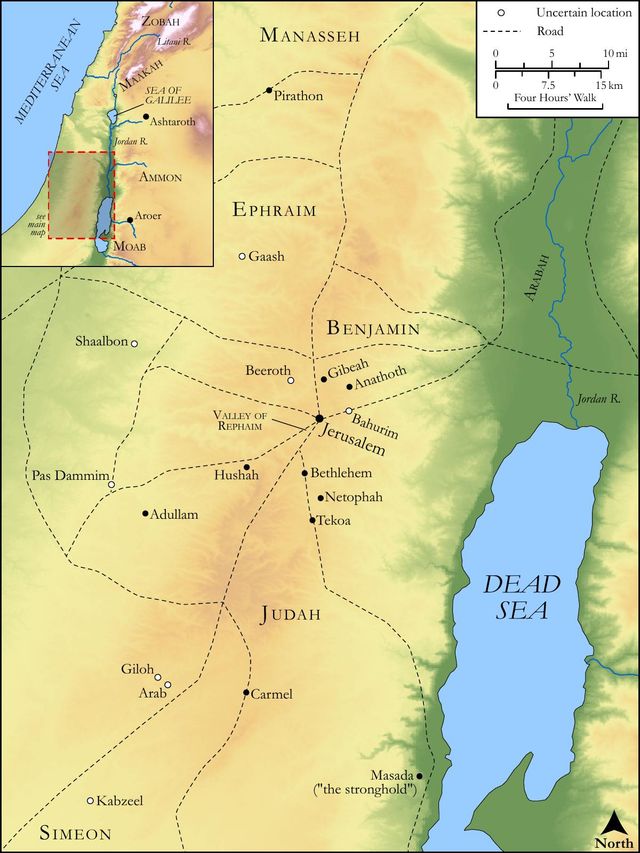
This clause introduces another warrior, Azmaveth, similarly identified by his name and his place of origin, "the Barhumite." This designation links him to Bahurim, a village in Benjamin, east of Jerusalem, notably mentioned as the place where Shimei cursed David during Absalom's rebellion (2 Samuel 16:5). Azmaveth's presence on this honor roll confirms his status as a formidable and faithful warrior, whose contributions, though unrecorded in detail, were vital to David's military success and the security of his kingdom.
Literary Devices
ShowHideThe primary literary device at play in 2 Samuel 23:31, and indeed the entire list of David's Mighty Men, is Cataloging or Listing. This technique involves the systematic enumeration of individuals, serving here as an Honor Roll that formally recognizes the valor and loyalty of David's elite warriors. The use of Toponymy (place names like "Arbathite" and "Barhumite") is also prominent, serving as a crucial form of identification and anchoring these individuals within a specific geographical and historical context. Furthermore, the very act of naming, or Onomastics, is significant; even without detailed narratives of their exploits, the simple inclusion of a name in such a prestigious list confers honor and ensures remembrance. The repetition of the "Name the Place-ite" structure creates a rhythmic pattern that emphasizes the diverse origins of David's unified fighting force, drawing together men from various regions to serve a common king.
Theological and Thematic Connections
ShowHide2 Samuel 23:31, though seemingly a mere list entry, carries profound theological weight by affirming God's meticulous attention to detail and His recognition of faithful service, even when performed in obscurity. It reminds us that every contribution, no matter how seemingly small or unheralded by human standards, is seen and valued by God. The inclusion of these names in the sacred text underscores the divine principle that faithfulness in one's assigned role, whether prominent or behind the scenes, is of immense worth in the building of God's kingdom. This passage encourages believers to serve diligently and with integrity, knowing that their ultimate reward and recognition come from the One who sees all and forgets nothing. It is a powerful testament to the truth that God values character and commitment above outward acclaim.
Reflection and Application
ShowHideThe inclusion of Abialbon and Azmaveth in David's honor roll, despite the absence of specific accounts of their heroic deeds, offers a powerful lesson for believers today. It challenges our often human-centric view of significance, which tends to prioritize visible achievements and public recognition. This verse reminds us that true value in God's economy is often found in consistent faithfulness, unwavering loyalty, and diligent service, regardless of whether it garners widespread acclaim. It encourages us to find contentment and purpose in serving God and His people in whatever capacity we are called, trusting that our labor is seen and treasured by Him. Just as these "Mighty Men" were foundational to David's earthly kingdom, so too are all believers, in their diverse roles, essential to the flourishing of God's eternal kingdom. Our worth is not diminished by obscurity, but rather affirmed by our obedience and dedication to Christ, knowing that our true audience is God Himself.
Questions for Reflection
ShowHideFAQ
ShowHideWhy are these names listed without detailed accounts of their specific deeds?
ShowHideThe listing of names without extensive narratives, as seen in 2 Samuel 23:31, serves several purposes. Firstly, it functions as an "honor roll," formally recognizing individuals who distinguished themselves through valor and loyalty to King David. The very act of being named in such a prestigious list was a high honor, signifying their indispensable contribution to the kingdom. Secondly, it underscores the collective strength and unity of David's forces; while some men had extraordinary, recounted deeds, the entire group of "Mighty Men" was essential. It highlights that not every significant contribution needs a detailed narrative to be valuable or remembered by God. Finally, it provides a historical record, authenticating the existence of these individuals and the foundational support they provided for David's reign. The Bible often uses lists (genealogies, censuses, rosters) to convey historical reality and demonstrate God's meticulous attention to His people and their history, even down to individual names.
Are there discrepancies between this list and the parallel account in 1 Chronicles?
ShowHideYes, there are minor discrepancies between the list of David's Mighty Men in 2 Samuel 23 and its parallel in 1 Chronicles 11. For instance, 2 Samuel 23:31 lists "Abialbon the Arbathite," while 1 Chronicles 11:32 lists "Abi-el the Arbathite." Such variations are common in ancient manuscripts due to factors like scribal transmission, different oral traditions, or even alternative names for the same individual. These minor differences do not undermine the historical accuracy or the theological message of the texts. Both accounts affirm the existence and valor of David's elite warriors, and the core purpose of the lists—to honor these men—remains consistent. Scholars typically examine both accounts to gain a fuller picture, understanding that textual variants are a normal part of ancient literary transmission and do not negate the divine inspiration or historical reliability of the Scriptures.
Christ-Centered Fulfillment
ShowHideWhile 2 Samuel 23:31 directly speaks of men serving an earthly king, it finds profound Christ-centered fulfillment in the New Testament's portrayal of believers serving Christ, the ultimate King and Lord. David's "Mighty Men" were a diverse group, united by their loyalty to him and their shared mission to establish his kingdom. Similarly, the church, as the body of Christ, is comprised of diverse members, each with unique gifts and roles, all called to serve the heavenly King and advance His eternal kingdom. Just as Abialbon and Azmaveth contributed significantly without their specific deeds being detailed, so too does Christ value every faithful act of service, no matter how seemingly small or unheralded by human standards. Jesus Himself taught that true greatness in His kingdom comes through humble service (Mark 9:35). The ultimate recognition comes not from human honor rolls, but from the Lord Himself, who will declare, "Well done, good and faithful servant!" The loyalty and valor of David's men foreshadow the unwavering devotion required of those who follow Christ, who laid down His life for His people (John 15:13). In Christ, every believer, whether a prominent leader or a quiet intercessor, is a vital "mighty one" in the spiritual battle, building up His eternal, unshakable kingdom (Hebrews 12:28).