


2 Samuel 2:28
Bible text: King James Version (1769 Blayney text) · Public domain
Bible text: Berean Standard Bible · Public domain
Bible text: American Standard Version (1901) · Public domain
Bible text: World English Bible, Messianic edition · Public domain
Bible text: Geneva Bible (1599) · Public domain
Bible text: Young's Literal Translation · Public domain
- וַיִּתְקַעvai·yit·Ka'and he gave a blastH8628Conj-w ¦ V-Qal-ConsecImperf-3msVerb Qal Consecutive Imperfect 3rd Singular Masculineוַandיִּתְקַעhe gave a blast
- יוֹאָבyo·'AvJoabH3097N-proper-mNoun Proper Masculine
- בַּשּׁוֹפָרba·sho·Faron the trumpetH7782Prep-b ¦ N-msNoun Singular Masculine Absoluteבַּon theשּׁוֹפָרtrumpet
- וַיַּעַמְדוּvai·ya·'am·Duand they stoodH5975Conj-w ¦ V-Qal-ConsecImperf-3mpVerb Qal Consecutive Imperfect 3rd Plural Masculineוַandיַּעַמְדוּthey stood
- כָּלkolallH3605N-mscNoun Singular Masculine Construct
- הָעָםha·'Amthe peopleH5971Art ¦ N-msNoun Singular Masculine Absoluteהָtheעָםpeople
- וְלֹאve·lo'and notH3808Conj-w ¦ NegParticle Negativeוְandלֹאnot
- יִרְדְּפוּyir·de·Futhey pursuedH7291V-Qal-Imperf-3mpVerb Qal Imperfect 3rd Plural Masculine
- עוֹדodagainH5750Adj-msAdjective Numerical Singular Masculine Absolute
- אַחֲרֵי'a·cha·ReiafterH310Adj-mpcAdjective Numerical Plural Masculine Construct
- יִשְׂרָאֵלYis·ra·'ElIsraelH3478N-properNoun Proper Location
- וְלֹאve·lo'and notH3808Conj-w ¦ NegParticle Negativeוְandלֹאnot
- יָסְפוּya·se·Futhey repeatedH3254V-Qal-Perf-3cpVerb Qal Perfect 3rd Plural common gender
- עוֹדodagainH5750Adj-msAdjective Numerical Singular Masculine Absolute
- לְהִלָּחֵםle·hi·la·Chemto wage warH3898Prep-l ¦ V-Niphal-InfVerb Niphal Infinitive Constructלְtoהִלָּחֵםwage war
English is a literal word-by-word gloss of the Hebrew, not the KJV's wording. Why?
This is the original text the KJV's translators worked from — each Hebrew word with its own literal English meaning in this verse, prepared by scholars at Tyndale House, Cambridge. The KJV translates whole sentences, not word by word, so its wording differs: one Hebrew word can become several English words, and the KJV may choose “the LORD” where the gloss reads “Yahweh”. Both are faithful — they answer different questions. For the KJV's own rendering, switch to the KJV text.
Details
See on the biblical-era maps
Study this verse
Public-domain commentary
Matthew Henry
From his Commentary on the Whole Bible. Henry comments on passages, not single verses — this entry covers 2 Samuel 2:25–32.
Here, I. Abner, being conquered, meanly begs for a cessation of arms. He rallied the remains of his forces on the top of a hill (Sa2 2:25), as if he would have made head again, but becomes a humble supplicant to Joab for a little breathing-time, Sa2 2:26. He that was most forward to fight was the first that had enough of it. He that made a jest of bloodshed (Let the young men arise and play before us, Sa2 2:14) is now shocked at it, when he finds himself on the losing side, and the sword he made so light of drawing threatening to touch himself. Observe how his note is changed. Then it was but playing with the sword; now, Shall the sword devour for ever? It had devoured but one day, yet to him it seemed forever, because it went against him; and very willing he is now that the sun should not go down upon the wrath. Now he can appeal to Joab himself concerning the miserable consequences of a civil war: Knowest thou not that it will be bitterness in the latter end? It will be reflected upon with regret when the account comes to be made up; for, whoever gets in a civil war, the community is sure to lose. Perhaps he refers to the bitterness that there was in the tribes of Israel, in the end of their war with Benjamin, when they wept sorely for the desolations which they themselves had made, Jdg 21:2. Now he begs of Joab to sound a retreat, and pleads that they were brethren, who ought not thus to bite and devour one another. He that in the morning would have Joab bid the people fall upon their brethren now would have him bid them lay down their arms. See here, 1. How easy it is for men to use reason when it makes for them who would not use it if it made against them. If Abner had been the conqueror, we should not have had him complaining of the voraciousness of the sword and the miseries of a civil war, nor pleading that both sides were brethren; but, finding himself beaten, all these reasonings are mustered up and improved for the securing of his retreat and the saving of his scattered troops from being cut off. 2. How the issue of things alters men's minds. The same thing which looked pleasant in the morning at night looked dismal. Those that are forward to enter into contention will perhaps repent it before they have done with it, and therefore had better leave it off before it be meddled with, as Solomon advises. It is true of every sin (O that men would consider it in time!) that it will be bitterness in the latter end. At the last it bites like a serpent those on whom it fawned.
II.Joab, though a conqueror, generously grants it, and sounds a retreat, knowing very well his master's mind and how averse he was to the shedding of blood. He does indeed justly upbraid Abner with his forwardness to engage, and lays the blame upon him that there had been so much bloodshed as there was (Sa2 2:27): "Unless thou hadst spoken," that is, "hadst given orders to fight, hadst bidden the young men arise and play before us, none of us would have struck a stroke, nor drawn a sword against our brethren. Thou complainest that the sword devours, but who first unsheathed it? Who began? Now thou wouldst have the people parted, but remember who set them on to fight. We should have retired in the morning if thou hadst not given the challenge." Those that are forward to make mischief are commonly the first to complain of it. This might have served to excuse Joab if he had pushed on his victory, and made a full end of Abner's forces; but like one that pitied the mistake of his adversaries, and scorned to make an army of Israelites pay dearly for the folly of their commander, he very honourably, by sound of trumpet, put a stop to the pursuit (Sa2 2:28) and suffered Abner to make an orderly retreat. It is good husbandry to be sparing of blood. As the soldiers were here very obsequious to the general's orders, so he, no doubt, observed the instructions of his prince, who sought the welfare of all Israel and therefore not the hurt of any.
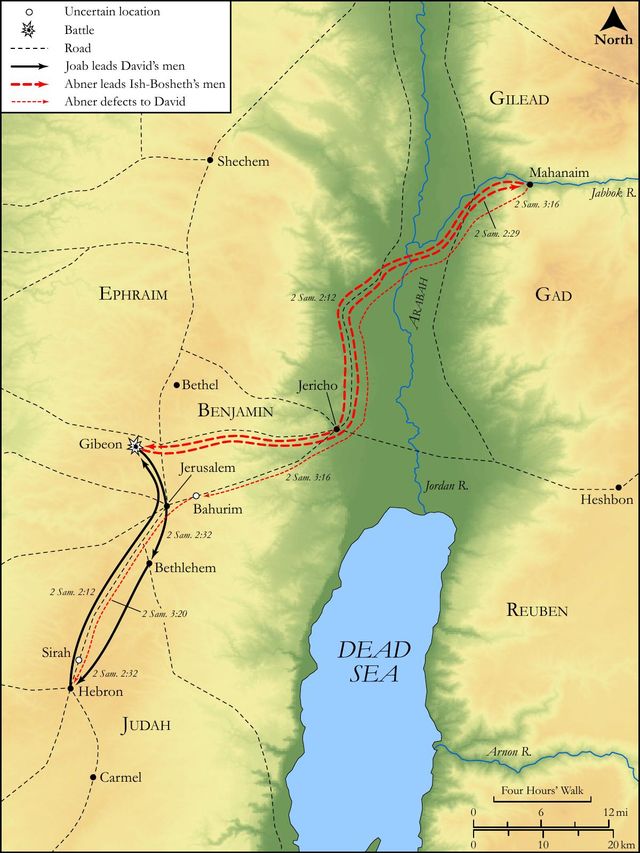
III.The armies being separated, both retired to the places whence they came, and both marched in the night, Abner to Mahanaim, on the other side Jordan (Sa2 2:29), and Joab to Hebron, where David was, Sa2 2:32. The slain on both sides are computed. On David's side only nineteen men were missing, besides Asahel (Sa2 2:30), who was worth more than all; on Abner's side 360, Sa2 2:31. In civil wars formerly great slaughters had been made (as Jdg 12:6; Jdg 20:44), in comparison with which this was nothing. It is to be hoped that they had grown wiser and more moderate. Asahel's funeral is here mentioned; the rest they buried in the field of battle, but he was carried to Bethlehem, and buried in the sepulchre of his father, Sa2 2:32. Thus are distinctions made between the dust of some and that of others; but in the resurrection no other difference will be made but that between godly and ungodly, which will remain for ever.
Continue studying 2 Samuel 2:28 across the web’s major study libraries — every link below opens this exact verse, chapter, or book on the destination site.
Read & Compare
 BibleGatewayThis verse in more than 200 translations and 70 languages.
 Bible.comThe YouVersion reader — hundreds of translations, reading plans, and highlights.
 ESV.orgCrossway's official English Standard Version reader.
 NET BibleThe NET translation with 60,000+ translators' notes on every rendering decision.
 STEP BibleTyndale House's free study tool — original text, vocabulary, and scholarly resources.
 BibliaLogos Bible Software's free web reader.
 USCCBThe New American Bible (Revised Edition) with the U.S. bishops' study notes.
Commentaries
 BibleHub CommentariesDozens of classic commentaries on this verse, gathered on one page.
 StudyLightMore than 100 commentary sets — the largest collection on the web.
 BibleRefPlain-English commentary on what this verse means, verse by verse.
 Enduring WordDavid Guzik's free commentary on this chapter, widely used by Bible teachers.
 Bible Study ToolsVerse commentary alongside Greek and Hebrew study aids.
Original Language & Research
- BibleHub InterlinearThe verse word by word — original language, transliteration, and English.
- BibleHub LexiconEvery word's original-language definition and Strong's entry.
 Blue Letter BibleDeep-study tools — Strong's numbers, concordance, and word studies.
 SefariaThe Hebrew text with Rashi and centuries of Jewish commentary.
Sermons, Hymns & Audio


TrulyRandomVerse is not affiliated with these sites and doesn’t control their content. They’re linked because they’re genuinely useful.
Summary
In 2 Samuel 2:28, the relentless and tragic civil war skirmish between the forces loyal to David, commanded by Joab, and those supporting Ish-bosheth, led by Abner, reaches an abrupt halt. Following a grueling pursuit and the deeply personal tragedy of Asahel's death at Abner's hand, Abner appeals to Joab to cease the fratricidal bloodshed. Joab responds decisively by blowing a trumpet, a universally understood signal that instantly brings the pursuit and fighting to an end, momentarily pausing the devastating internal conflict that threatened to tear apart the nascent kingdom of Israel.
Context
ShowHideLiterary Context
This verse concludes the intense and tragic engagement initiated at the Pool of Gibeon, detailed in 2 Samuel 2:12-17. The conflict escalated dramatically after a deadly "contest" between twelve men from each side. The subsequent battle saw David's men prevail, leading to Abner's retreat. The narrative then focuses on the relentless pursuit of Abner by Asahel, Joab's swift-footed brother, which tragically culminates in Asahel's death at Abner's hand in 2 Samuel 2:23. Driven by vengeance, Joab and Abishai continue the chase until Abner, cornered, appeals to Joab to stop the fratricidal war in 2 Samuel 2:26. Joab's decision to blow the trumpet directly responds to this plea, demonstrating a pragmatic, albeit grief-stricken, recognition of the futility of continued internal strife. The verse sets the stage for the uneasy peace and subsequent political maneuvering that will define the rest of 2 Samuel chapter 2.
Historical & Cultural Context
The period immediately following Saul's death was one of significant political instability and transition in Israel. While David had been anointed king over Judah in Hebron (2 Samuel 2:4), the northern tribes, influenced by Abner, rallied behind Saul's son, Ish-bosheth, establishing a rival kingdom in Mahanaim (2 Samuel 2:8-9). This division led to a protracted civil war, a deeply lamentable situation for a people meant to be unified under God. The concept of "brethren" fighting brethren was particularly abhorrent, violating the spirit of tribal unity and covenantal solidarity. The use of a trumpet (shofar) for signaling in battle was a common military practice in the armies of that day, universally understood as a command to advance, retreat, or cease hostilities. Commanders held significant authority, and their signals were expected to be obeyed instantly, reflecting the discipline of the troops.
Key Themes
ShowHideThis verse powerfully underscores several key themes prevalent in 2 Samuel. Firstly, it highlights the tragic and destructive nature of civil war, particularly among God's chosen people. The bloodshed, the personal vendettas (like Joab's pursuit of Abner), and the senseless loss of life (Asahel's death) vividly portray the devastating cost of division. Secondly, it touches upon the theme of leadership and strategic restraint. Despite the personal grief and military advantage, Joab's decision to halt the pursuit demonstrates a measure of wisdom and a recognition of the broader, long-term implications of annihilating fellow Israelites. This act, while born out of immediate circumstances, foreshadows the complex and often morally ambiguous leadership decisions that Joab and David will face throughout the book. Finally, the verse subtly points to the sovereignty of God even amidst human conflict, as the cessation of hostilities, though initiated by human command, ultimately serves God's purposes in moving the narrative towards David's eventual unified kingship over all Israel, as seen in 2 Samuel 5:1-5.
Exposition and Analysis
ShowHideKey Word Analysis
ShowHideThe Hebrew word שׁוֹפָר (shôwphâr) refers to a cornet or curved horn, often a ram's horn, known for giving a clear, distinct sound. In ancient Israel, the shofar was a versatile instrument used for religious festivals, calling assemblies, sounding alarms, and critically, as a military signal. Its loud, unmistakable blast served as an authoritative command, and in this context, Joab's use of it immediately and undeniably signaled the cessation of intense pursuit and fighting, demonstrating his absolute command and the disciplined obedience of his troops.
The verb עָמַד (ʻâmad) means "to stand, to stand still, to take one's stand." Here, it signifies an immediate and complete cessation of movement and action. It's not merely a pause but a decisive halt to the ongoing pursuit and battle. This word powerfully emphasizes the effectiveness of Joab's command and the instantaneous, disciplined response of his soldiers, who instantly obeyed the signal to cease their aggressive advance.
The verb רָדַף (râdaph) means "to run after, chase, persecute," often with hostile intent. In the immediate narrative, it vividly describes the relentless and vengeful chase by Joab and Abishai after Abner and his men, fueled by the recent, tragic death of Asahel. The phrase "pursued after Israel no more" signifies the complete abandonment of this chase, highlighting the end of active aggression and the conscious decision to spare the retreating enemy, who were, profoundly, fellow Israelites.
Verse Breakdown
ShowHide"So Joab blew a trumpet"
This opening clause immediately establishes Joab's pivotal role as the commanding officer. His action of blowing the trumpet (shofar) is not merely a sound but a decisive, authoritative command that serves as the immediate catalyst for the cessation of hostilities. It signifies a deliberate and strategic choice to halt the bloodshed, demonstrating his supreme authority over David's forces.
"and all the people stood still"
This clause powerfully illustrates the immediate and disciplined obedience of David's army. The effectiveness of Joab's command is underscored by the collective and instantaneous halt of the entire pursuing force. This highlights not only their military training but also their profound respect for their commander's authority, indicating a well-ordered and responsive fighting unit.
"and pursued after Israel no more"
This specifies the primary aggressive action that ceased: the relentless chase of Abner's retreating forces. The deliberate mention of "Israel" instead of simply "Abner's men" or "the enemy" is crucial, underscoring the tragic and lamentable nature of this civil conflict – it was Israelites fighting against fellow Israelites. The cessation of pursuit implies a conscious, strategic decision to avoid further slaughter of their brethren, despite the earlier personal vendetta.
"neither fought they any more"
This concluding clause broadens the scope beyond just the pursuit, indicating a complete and comprehensive end to all combat for that day. It signifies not merely the end of the chase but the overall cessation of all engagement, bringing a temporary, uneasy peace to the battlefield. This emphasizes the finality and totality of Joab's command for this particular engagement, marking a definitive pause in the conflict.
Literary Devices
ShowHideThe verse effectively employs several literary devices to convey its powerful message. Symbolism is central, with the trumpet (shofar) serving as a potent symbol of military authority, decisive command, and the abrupt cessation of conflict. Its piercing blast cuts through the chaos of battle, bringing immediate order and an end to the violence. There is a strong element of Contrast, as the sudden stillness and cessation of pursuit sharply contrast with the preceding relentless chase and brutal bloodshed vividly described in the earlier verses of 2 Samuel chapter 2. This dramatic shift underscores the immediate and profound impact of Joab's command. Furthermore, the use of Parallelism in the phrases "pursued after Israel no more, neither fought they any more" emphasizes the completeness and totality of the cessation. The two clauses reinforce each other, ensuring the reader understands that all forms of aggressive action have definitively ceased. The narrative also employs Conciseness to deliver a powerful punch, with a few short, impactful clauses effectively conveying a pivotal turning point in the battle and the broader civil conflict.
Theological and Thematic Connections
ShowHide2 Samuel 2:28, while depicting a military maneuver, carries profound theological and thematic weight. It highlights the destructive futility of internal strife, especially among God's covenant people. The tragic loss of life, exemplified by Asahel, underscores the high cost of division and vengeance. Joab's decision to halt the pursuit, despite personal grief and military advantage, reflects a pragmatic recognition of the senselessness of kinsmen killing kinsmen. This act, though not explicitly attributed to divine intervention, aligns with the broader biblical emphasis on peace, reconciliation, and the ultimate unity of God's people. It serves as a stark reminder that even in the midst of conflict, there is a call to restraint and a recognition of shared identity, pointing towards the ideal of shalom that God desires for His people.
Reflection and Application
ShowHideThe scene at 2 Samuel 2:28, though set in a bloody civil war, offers timeless lessons for our lives today. It speaks profoundly to the critical importance of discerning when to cease hostilities, whether in the realm of personal relationships, community disagreements, or even our own internal struggles. Joab, despite his raw personal pain and the tactical momentum of victory, chose to blow the trumpet, making a difficult decision that prioritized a fragile peace over continued vengeance or the complete annihilation of his brethren. This narrative calls us to a deep and honest self-assessment regarding the long-term consequences of perpetuating conflict, urging us to prioritize reconciliation, especially when the conflict is with those with whom we share a common bond, identity, or faith. True strength and spiritual maturity often lie not in pressing every advantage or indulging every impulse for retaliation, but in exercising strategic restraint, seeking common ground, and actively pursuing the path of peace. The command to "stand still" can also be understood as a profound spiritual directive: a call to pause, reflect, and seek God's wisdom when we find ourselves caught in destructive patterns, whether external conflicts or internal battles of the soul. It reminds us that sometimes the most courageous and Christ-like act is to lay down our arms and seek the path of healing, unity, and restoration.
Questions for Reflection
ShowHideFAQ
ShowHideWas Joab's decision to stop the pursuit a sign of weakness or wisdom?
ShowHideJoab's decision was profoundly a sign of strategic wisdom and pragmatic leadership, rather than weakness. While certainly influenced by Abner's appeal to cease fratricidal bloodshed and the grim reality of kinsmen killing kinsmen, Joab recognized the long-term futility and detriment of annihilating fellow Israelites. Pressing the immediate military advantage might have secured a more decisive victory in that moment, but it would have further inflamed the civil war, making the eventual and necessary unification of all Israel under David's kingship far more difficult, prolonged, and costly. His action demonstrates a leader capable of making difficult, even unpopular, choices that prioritize the broader, long-term stability and unity of the nation over immediate personal vengeance or fleeting military glory. It also speaks volumes about the discipline of his troops, who immediately obeyed the signal to halt, as vividly described in 2 Samuel 2:28.
Christ-Centered Fulfillment
ShowHideThe cessation of hostilities in 2 Samuel 2:28, commanded by Joab through the decisive sound of a trumpet, finds its ultimate and profound fulfillment in the person and redemptive work of Jesus Christ. Just as Joab's trumpet brought an abrupt end to a physical war among brethren, Christ's advent and atoning sacrifice signal the definitive end of the spiritual warfare that separates humanity from God and from one another. He is the preeminent Peacemaker, the one who "made peace by the blood of his cross" (Colossians 1:20). Through His sacrificial death, Jesus definitively disarmed the spiritual powers and authorities that held humanity captive (Colossians 2:15), thereby ending the pursuit of divine judgment against us and bringing an end to the hostility between God and humanity (Ephesians 2:14-16). He is our very "peace" who has broken down the dividing wall of hostility that separated Jew and Gentile, uniting all believers into one new humanity in Himself (Ephesians 2:14). The trumpet blast in 2 Samuel 2:28, signaling a temporary halt to conflict, powerfully foreshadows the "last trumpet" (1 Corinthians 15:52) that will announce Christ's glorious return, His final victory over sin and death, and the ushering in of an eternal era of perfect peace under His righteous reign, where "He will wipe away every tear from their eyes, and death shall be no more, neither shall there be mourning, nor crying, nor pain anymore, for the former things have passed away" (Revelation 21:4).