


2 Samuel 1:5
Bible text: King James Version (1769 Blayney text) · Public domain
Bible text: Berean Standard Bible · Public domain
Bible text: American Standard Version (1901) · Public domain
Bible text: World English Bible, Messianic edition · Public domain
Bible text: Geneva Bible (1599) · Public domain
Bible text: Young's Literal Translation · Public domain
- וַיֹּאמֶרvai·Yo·merand he saidH559Conj-w ¦ V-Qal-ConsecImperf-3msVerb Qal Consecutive Imperfect 3rd Singular Masculineוַandיֹּאמֶרhe said
- דָּוִדda·VidDavidH1732N-proper-mNoun Proper Masculine
- אֶל'eltoH413PrepPreposition
- הַנַּעַרha·Na·'arthe young manH5288Art ¦ N-msNoun Singular Masculine Absoluteהַtheנַּעַרyoung man
- הַמַּגִּידha·ma·Gidwho had toldH5046Art ¦ V-Hiphil-Prtcpl-msVerb Hiphil Participle Singular Masculine Absoluteהַwhoמַּגִּידhad told
- לוֹloto <the> himPrep-l ¦ 3msSuffix Personal 3rd Singular Masculineלto <the>וֹhim
- אֵיךְ'eikhhow?H349InterrogParticle Interrogative
- יָדַעְתָּya·Da'·tado you knowH3045V-Qal-Perf-2msVerb Qal Perfect 2nd Singular Masculine
- כִּיkithatH3588PrtParticle Conditional
- מֵתmethe has diedH4191V-Qal-Perf-3msVerb Qal Perfect 3rd Singular Masculine
- שָׁאוּלsha·'UlSaulH7586N-proper-mNoun Proper Masculine
- וִיהוֹנָתָןvi·ho·na·Tanand JonathanH3083Conj-w ¦ N-proper-mNoun Proper MasculineוִandיהוֹנָתָןJonathan
- בְּנוֹbe·Nohis sonH1121N-msc ¦ 3msNoun Singular Masculine Constructבְּנsonוֹhis
English is a literal word-by-word gloss of the Hebrew, not the KJV's wording. Why?
This is the original text the KJV's translators worked from — each Hebrew word with its own literal English meaning in this verse, prepared by scholars at Tyndale House, Cambridge. The KJV translates whole sentences, not word by word, so its wording differs: one Hebrew word can become several English words, and the KJV may choose “the LORD” where the gloss reads “Yahweh”. Both are faithful — they answer different questions. For the KJV's own rendering, switch to the KJV text.
Details
See on the biblical-era maps

Study this verse
Public-domain commentary
Matthew Henry
From his Commentary on the Whole Bible. Henry comments on passages, not single verses — this entry covers 2 Samuel 1:1–10. His two-level outline is real structure in the source text, so it is rendered as structure.
Here is, I. David settling again in Ziklag, his own city, after he had rescued his family and friends out of the hands of the Amalekites (Sa2 1:1): He abode in Ziklag. Thence he was now sending presents to his friends (Sa1 30:26), and there he was ready to receive those that came into his interests; not men in distress and debt, as his first followers were, but persons of quality in their country, mighty men, men of war, and captains of thousands (as we find, Ch1 12:1, Ch1 12:8, Ch1 12:20); such came day by day to him, God stirring up their hearts to do so, till he had a great host, like the host of God, as it is said, Ch1 12:22. The secret springs of revolutions are unaccountable, and must be resolved into that Providence which turns all hearts as the rivers of water.
II.Intelligence brought him thither of the death of Saul.
It was strange that he did not leave some spies about the camp, to bring him early notice of the issue of the engagement, a sign that he desired not Saul's woeful day, nor was impatient to come to the throne, but willing to wait till those tidings were brought to him which many a one would have sent more than half-way to meet. He that believes does not make haste, takes good news when it comes and is not uneasy while it is in the coming.
1.The messenger presents himself to David as an express, in the posture of a mourner for the deceased prince and a subject to the succeeding one. He came with his clothes rent, and made obeisance to David (Sa2 1:2), pleasing himself with the fancy that he had the honour to be the first that did him homage as his sovereign, but it proved he was the first that received from him sentence of death as his judge. He told David he came from the camp of Israel, and intimated the bad posture it was in when he said he had escaped out of it, having much ado to get away with his life, Sa2 1:3.
2.He gives him a general account of the issue of the battle. David was very desirous to know how the matter went, as one that had more reason than any to be concerned for the public; and he told him very distinctly that the army of Israel was routed, many slain, and, among the rest, Saul and Jonathan, Sa2 1:4. He named only Saul and Jonathan, because he knew David would be most solicitous to know their fate; for Saul was the man whom he most feared and Jonathan the man whom he most loved.
3.He gives him a more particular account of the death of Saul. It is probable that David had heard, by the report of others, what the issue of the war was, for multitudes resorted to him, it should seem, in consequence; but he was desirous to know the certainty of the report concerning Saul and Jonathan, either because he was not forward to believe it or because he would not proceed upon it to make his own claims till he was fully assured of it. He therefore asks, How knowest thou that Saul and Jonathan are dead? in answer to which the young man tells him a very ready story, putting it past doubt that Saul was dead, for he himself had been not only an eye-witness of his death, but an instrument of it, and therefore David might rely upon his testimony. He says nothing, in his narrative, of the death of Jonathan, knowing how ungrateful that would be to David, but accounts only for Saul, thinking (as David understood it well enough, Sa2 4:10) that he should be welcome for that, and rewarded as one that brought good tidings. The account he gives of this matter is, (1.) Very particular. That he happened to go to the place where Saul was (Sa2 1:6) as a passenger, not as a soldier, and therefore an indifferent person, that he found Saul endeavouring to run himself through with his own spear, none of his attendants being willing to do it for him; and, it seems, he could not do it dexterously for himself: his hand and heart failed him. The miserable man had not courage enough either to live or die; he therefore called this stranger to him (Sa2 1:7), enquired what countryman he was, for, provided he was not a Philistine, he would gladly receive from his hand the coup de grace (as the French call it concerning those that are broken on the wheel) - the merciful stroke, that might dispatch him out of his pain. Understanding that he was an Amalekite (neither one of his subjects nor one of his enemies), he begs this favour from him (Sa2 1:9): Stand upon me, and slay me. He is now sick of his dignity and willing to be trampled upon, sick of his life and willing to be slain. Who then would be inordinately fond of life or honour? The case may he such, even with those that have no hope in their death, that yet they may desire to die, and death flee from them, Rev 9:6. Anguish has come upon me; so we read it, as a complaint of the pain and terror his spirit was seized with. If his conscience now brought to mind the javelin he had cast at David, his pride, malice, and perfidiousness, and especially the murder of the priests, no marvel that anguish came upon him: moles (they say) open their eyes when they are dying. Sense of unpardoned guilt will make death indeed the king of terrors. Those that have baffled their convictions will perhaps, in their dying moments, be overpowered by them. The margin reads it as a complaint of the inconvenience of his clothes; that his coat of mail which he had for defence, or his embroidered coat which he had for ornament, hindered him, that he could not get the spear far enough into his body, or so straitened him, now that his body swelled with anguish, that he could not expire. Let no man's clothes be his pride, for it may so happen that they may be his burden and snare. "Hereupon," saith our young man, "I stood upon him, and slew him" (Sa2 1:10) at which word, perhaps, he observed David look upon him with some show of displeasure, and therefore he excuses himself in the next words: "For I was sure he could not live; his life was whole in him indeed, but he would certainly have fallen into the hands of the Philistines or given himself another thrust." (2.) It is doubtful whether this story be true. If it be, the righteousness of God is to be observed, that Saul, who spared the Amalekites in contempt of the divine command, received his death's wound from an Amalekite. But most interpreters think that it was false, and that, though he might happen to be present, yet he was not assisting in the death of Saul, but told David so in expectation that he would reward him for it, as having done him a piece of good service. Those who would rejoice at the fall of an enemy are apt to measure others by themselves, and to think that they will do so too. But a man after God's own heart is not to be judged of by common men. I am not clear whether this young man's story was true or no: it may consist with the narrative in the chapter before, and be an addition to it, as Peter's account of the death of Judas (Act 1:18) is to the narrative, Mat 27:5. What is there called a sword may here be called a spear, or when he fell upon his sword he leaned on his spear. (3.) However he produced that which was proof sufficient of the death of Saul, the crown that was upon his head and the bracelet that was on his arm. It should seem Saul was so foolishly fond of these as to wear them in the field of battle, which made him a fair mark for the archers, by distinguishing him from those about him; but as pride (we say) feels no cold, so it fears no danger, from that which gratifies it. These fell into the hands of this Amalekite. Saul spared the best of their spoil, and now the best of his came to one of that devoted nation. He brought them to David, as the rightful owner of them now that Saul was dead, not doubting but by his officiousness herein to recommend himself to the best preferments in his court or camp. The tradition of the Jews is that this Amalekite was the son of Doeg (for the Amalekites were descendants from Edom), and that Doeg, who they suppose was Saul's armour-bearer, before he slew himself gave Saul's crown and bracelet (the ensigns of his royalty) to his son, and bade him carry them to David, to curry favour with him. But this is a groundless conceit. Doeg's son, it is likely, was so well known to Saul that he needed not ask him as he did this Amalekite (Sa2 1:8), Who art thou? David had been long waiting for the crown, and now it was brought to him by an Amalekite. See how God can serve his own purposes of kindness to his people, even by designing (ill-designing) men, who aim at nothing but to set up themselves.
Continue studying 2 Samuel 1:5 across the web’s major study libraries — every link below opens this exact verse, chapter, or book on the destination site.
Read & Compare
 BibleGatewayThis verse in more than 200 translations and 70 languages.
 Bible.comThe YouVersion reader — hundreds of translations, reading plans, and highlights.
 ESV.orgCrossway's official English Standard Version reader.
 NET BibleThe NET translation with 60,000+ translators' notes on every rendering decision.
 STEP BibleTyndale House's free study tool — original text, vocabulary, and scholarly resources.
 BibliaLogos Bible Software's free web reader.
 USCCBThe New American Bible (Revised Edition) with the U.S. bishops' study notes.
Commentaries
 BibleHub CommentariesDozens of classic commentaries on this verse, gathered on one page.
 StudyLightMore than 100 commentary sets — the largest collection on the web.
 BibleRefPlain-English commentary on what this verse means, verse by verse.
 Enduring WordDavid Guzik's free commentary on this chapter, widely used by Bible teachers.
 Bible Study ToolsVerse commentary alongside Greek and Hebrew study aids.
Original Language & Research
- BibleHub InterlinearThe verse word by word — original language, transliteration, and English.
- BibleHub LexiconEvery word's original-language definition and Strong's entry.
 Blue Letter BibleDeep-study tools — Strong's numbers, concordance, and word studies.
 SefariaThe Hebrew text with Rashi and centuries of Jewish commentary.
Sermons, Hymns & Audio


TrulyRandomVerse is not affiliated with these sites and doesn’t control their content. They’re linked because they’re genuinely useful.
Summary
Upon receiving the devastating news of King Saul's and Prince Jonathan's deaths at the hand of the Philistines on Mount Gilboa, David's immediate reaction is one of profound disbelief and a demand for verification. This pivotal verse captures his initial shock and the immense gravity of the information, setting the stage for his subsequent lament and the divinely orchestrated transition of leadership in Israel, marking the end of one era and the dawn of David's kingship.
Context
ShowHideLiterary Context
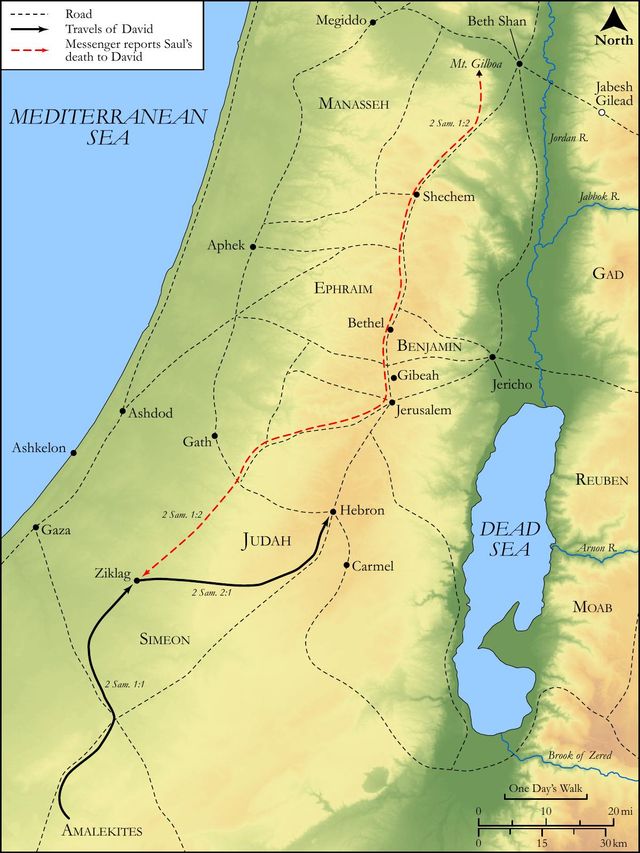
This verse stands at the very threshold of the book of 2 Samuel, serving as the narrative bridge between the tumultuous end of King Saul's reign and the beginning of David's ascent to the throne. It immediately follows the arrival of an Amalekite messenger from the catastrophic battle on Mount Gilboa, bearing the dire news of Israel's defeat and the demise of its king and his heir. The preceding book, 1 Samuel, meticulously details the events leading up to this moment, culminating in the tragic account of Saul's and Jonathan's deaths in 1 Samuel 31. David, who had been residing in Ziklag, a Philistine town, finds himself confronted with the ultimate consequence of the protracted conflict between Israel and its enemies, and the definitive close of the era dominated by Saul's rule. His reaction here is crucial, as it foreshadows his character as king—one who seeks truth and grieves deeply, even for a fallen adversary.
Historical & Cultural Context
The battle on Mount Gilboa was a critical and devastating engagement between the Israelites and the Philistines, a formidable regional power. In the kingdoms of that day, the death of a king in battle was a catastrophic event, often signaling a severe power vacuum, national vulnerability, and a profound crisis of leadership. The messenger, identified as an Amalekite, is particularly significant. The Amalekites were long-standing, bitter enemies of Israel, and God had commanded Israel to utterly destroy them, a command that King Saul notoriously failed to obey fully in 1 Samuel 15. The messenger's presence and his subsequent claims (detailed in later verses) would have been deeply unsettling and suspicious to David. David's precarious position in Ziklag, a Philistine city, further underscores the complex political landscape and his delicate relationship with both Israel and its enemies during Saul's relentless pursuit of him.
Key Themes
ShowHideThis verse introduces and reinforces several crucial themes that will permeate the narrative of 2 Samuel. Firstly, the theme of skepticism and the demand for verification is immediately evident in David's sharp questioning. This highlights the immense weight of the news and the need for absolute certainty regarding such a momentous event, especially given the potential for political manipulation or false reports in that era. Secondly, the theme of profound loss and genuine grief is palpable, not only for Jonathan, David's beloved covenant friend (1 Samuel 18:1), but also, remarkably, for Saul, David's persecutor. This sets the stage for David's heartfelt lament, recorded in 2 Samuel 1:17-27, showcasing David's character and his respect for God's anointed, even in death. Thirdly, the verse subtly but powerfully introduces the overarching theme of divine sovereignty and the transition of leadership. While David had been anointed by Samuel years prior (1 Samuel 16:13), Saul's death marks the divinely ordained moment for David to step into his destined role as king over Israel, a transition fraught with both immense sorrow and profound responsibility.
Exposition and Analysis
ShowHideKey Word Analysis
ShowHideDerived from the same root as dôd, meaning "loving," this name signifies the central figure of the narrative. In this context, David is not yet king, but his immediate and deeply emotional reaction to the news of Saul's and Jonathan's deaths reveals his character as a man capable of profound love and sorrow, even for his persecutor. His identity as the divinely chosen successor, though not explicitly stated here, undergirds the significance of his response to this pivotal moment in Israel's history.
This verb, yâdaʻ, means "to know," encompassing a wide range of understanding from observation to intimate acquaintance. Here, with the interrogative "How," it carries a demanding nuance. David is not merely asking for information but is insisting on the source, evidence, or certainty of the messenger's claim. It expresses deep incredulity, a demand for verification, and the profound emotional impact of news that seems too terrible to be true. It signifies David's need to ascertain the truth with absolute certainty before accepting such a momentous and devastating report.
This word, mûwthîm, is the plural form of "dead," derived from the primitive root mûwth, meaning "to die" or "to kill." Its use here emphasizes the dual tragedy: the death of the reigning king and his son, the heir apparent. This plural form underscores the magnitude of the loss for the nation, signifying not just a single casualty but a double blow to the royal line and the future of Israelite leadership, creating a profound power vacuum and national crisis.
Verse Breakdown
ShowHide"And David said unto the young man that told him"
This clause establishes the immediate and direct confrontation between David and the messenger. David, the one who is about to step into the vacuum of leadership, takes the initiative in questioning the bearer of such momentous news. His direct address signals the gravity of the situation and his personal investment in the veracity of the report, highlighting his role as the one who must discern truth and respond appropriately.
"How knowest thou that Saul and Jonathan his son be dead?"
This is the core of David's inquiry, revealing his shock, skepticism, and perhaps a desperate, lingering hope that the news might be false. The question is loaded with emotional weight, reflecting not only the immense political implications of the deaths but also David's deep personal bond with Jonathan and his complex, yet respectful, relationship with Saul. It functions as a demand for proof, a challenge to the messenger's credibility, and an expression of profound disbelief in the face of an unimaginable national and personal tragedy.
Literary Devices
ShowHideThe verse employs several significant literary devices that amplify its emotional and narrative impact. The most prominent is the Rhetorical Question, "How knowest thou that Saul and Jonathan his son be dead?" While phrased as a direct query, it primarily functions as an exclamation of David's profound shock, disbelief, and desperate need for confirmation, rather than a simple request for facts. It conveys the overwhelming magnitude of the news. There is also a subtle element of Foreshadowing embedded in David's skepticism; his questioning of the messenger's account will later reveal the messenger's own culpability and deceit (as detailed in subsequent verses), leading to his execution. This initial demand for verification hints at the critical importance of discerning truth, a recurring theme in David's kingship. Furthermore, the scene is imbued with Dramatic Irony, as the audience, having just read 1 Samuel 31, already knows the news is true. David's reaction, therefore, underscores the human difficulty in accepting such devastating realities, especially when they involve complex personal relationships and the destiny of a nation.
Theological and Thematic Connections
ShowHideDavid's immediate reaction to the news of Saul and Jonathan's death highlights the profound human experience of grief and the intrinsic need for certainty in the face of overwhelming tragedy. Theologically, it underscores the reality that even divinely ordained transitions of power are often accompanied by deep sorrow and complex emotions, not merely triumphalism. While Saul's reign had been marked by disobedience and relentless persecution of David, his death still represented a significant loss for Israel and, profoundly, for David personally, particularly concerning his beloved friend Jonathan. This moment is a powerful testament to David's character, demonstrating his capacity for genuine lament even for an adversary, and his commitment to truth and justice as he begins to assume the mantle of leadership. It also subtly points to God's sovereign hand in bringing about the end of one era and the beginning of another, orchestrating His purposes even through the chaos of battle, human tragedy, and the intricate web of human relationships. David's response exemplifies a leader who is both emotionally authentic and committed to discerning God's truth.
Reflection and Application
ShowHideDavid's initial reaction to the news of Saul and Jonathan's death offers a timeless lesson in how to process and respond to significant, often devastating, information. In an age saturated with instant and often unverified news, David's "How knowest thou?" serves as a powerful reminder of the importance of critical discernment and the need to seek reliable sources and confirmation before accepting or acting upon critical information. It encourages us to pause, question, and verify, especially when the stakes are high, rather than succumbing to immediate emotional reactions or uncritical acceptance. Furthermore, David's complex grief—mourning both his persecutor and his dearest friend—highlights the multifaceted nature of human relationships and loss. It challenges us to acknowledge and process our own grief, even for relationships that were complicated or difficult, recognizing the profound impact of death on our hearts and communities. This verse calls us to cultivate both intellectual rigor in seeking truth and emotional honesty in confronting sorrow, demonstrating a mature and godly response to life's most challenging moments.
Questions for Reflection
ShowHideFAQ
ShowHideWhy was David so skeptical of the messenger's report?
ShowHideDavid's skepticism stemmed from several profound factors. Firstly, the news was incredibly momentous: the death of the anointed king of Israel and his beloved son, Jonathan. Such a report required absolute certainty and was difficult to believe without irrefutable proof. Secondly, David had a deep personal connection to Jonathan, making the news emotionally devastating and almost impossible to accept. Thirdly, despite Saul's relentless pursuit and attempts on his life, David consistently refused to harm Saul, seeing him as God's anointed (1 Samuel 24:6). The idea of Saul's death, especially at the hands of an Amalekite (as the messenger later claims), would have been shocking and potentially suspicious given David's profound respect for the office of king and his understanding of divine anointing. David's question was a demand for proof and the basis of the messenger's knowledge, not just a casual inquiry for information.
Who was the Amalekite messenger, and why is his identity significant?
ShowHideThe messenger was a young Amalekite, a member of an ancient and persistent enemy nation of Israel. His identity is highly significant because the Amalekites were under a perpetual curse from God, and Israel was commanded to wage war against them (Exodus 17:16). King Saul himself had been rejected by God for failing to utterly destroy the Amalekites, specifically sparing their king Agag and the best of their livestock (1 Samuel 15:9). The messenger's claim to have delivered the final, fatal blow to Saul (as detailed in 2 Samuel 1:9-10) would have been particularly abhorrent to David. Not only was it an act against God's anointed king, but it came from an enemy nation that God had condemned. This audacious and false claim ultimately leads to the Amalekite's swift execution by David (2 Samuel 1:15-16), demonstrating David's commitment to justice and his reverence for God's anointed.
Christ-Centered Fulfillment
ShowHideDavid's immediate and profound reaction to the news of Saul's death, particularly his demand for verification, foreshadows the ultimate truth that would come through another "messenger"—the Gospel itself. Just as David sought concrete proof of a king's demise and the transition of power, so too does humanity grapple with the profound news of the death and resurrection of the King of Kings, Jesus Christ. The death of Saul, Israel's first king, though tragic, paved the way for David, the "man after God's own heart" and a significant type of Christ, to ascend to the throne. This transition, though marked by human grief and initial skepticism, was part of God's sovereign plan to establish a righteous king in Israel. In Christ, we see the ultimate fulfillment of this pattern: His death on the cross, a truly devastating and unbelievable event for His followers, was not the end but the divinely ordained means for the establishment of His eternal kingdom. The "how knowest thou" of David finds its ultimate answer in the irrefutable evidence of Christ's resurrection, attested by numerous witnesses (1 Corinthians 15:3-8). Through Christ's sacrificial death and glorious resurrection, the true and eternal King takes His rightful throne, bringing about a new covenant and an everlasting reign of righteousness and peace, far surpassing the earthly reign of any human king, as powerfully prophesied in passages like Isaiah 9:6-7 and Daniel 7:13-14.