


2 Kings 9:2
Bible text: King James Version (1769 Blayney text) · Public domain
Bible text: King James Version with Strong's numbers · Public domain
Bible text: Berean Standard Bible · Public domain
Bible text: American Standard Version (1901) · Public domain
Bible text: World English Bible, Messianic edition · Public domain
Bible text: Geneva Bible (1599) · Public domain
Bible text: Young's Literal Translation · Public domain
- וּבָאתָu·Va·taand you will goH935Conj-w ¦ V-Qal-ConsecPerf-2msVerb Qal Consecutive Perfect 2nd Singular Masculineוּandבָאתָyou will go
- שָׁמָּהSha·mahthere towardsH8033Adv ¦ SfxAdverbשָׁמָּthereהtowards
- וּרְאֵהu·re·'e·ho·Shaand look forH7200Conj-w ¦ V-Qal-Imp-2msVerb Qal Imperative 2nd Singular Masculineוּandרְאֵהlook for
- שָׁםShamthereH8033AdvAdverb
- יֵהוּאye·Hu'JehuH3058N-proper-mNoun Proper Masculine
- בֶןven[the] son ofH1121N-mscNoun Singular Masculine Construct
- יְהוֹשָׁפָטye·ho·sha·FatJehoshaphatH3092N-proper-mNoun Proper Masculine
- בֶּןben[the] son ofH1121N-mscNoun Singular Masculine Construct
- נִמְשִׁיnim·ShiNimshiH5250N-proper-mNoun Proper Masculine
- וּבָאתָu·Va·taand you will goH935Conj-w ¦ V-Qal-ConsecPerf-2msVerb Qal Consecutive Perfect 2nd Singular Masculineוּandבָאתָyou will go
- וַהֲקֵמֹתוֹva·ha·ke·mo·Toand you will make rise himH6965Conj-w ¦ V-Hiphil-ConsecPerf-2ms ¦ 3msVerb Hiphil Consecutive Perfect 2nd Singular Masculineוַandהֲקֵמֹתyou will make riseוֹhim
- מִתּוֹךmi·Tokhfrom amongH8432Prep-m ¦ N-mscNoun Singular Masculine Constructמִfromתּוֹךamong
- אֶחָיו'e·Chavhis brothersH251N-mpc ¦ 3msNoun Plural Masculine Constructאֶחָיbrothersוhis
- וְהֵבֵיאתָve·he·vei·Taand you will bringH935Conj-w ¦ V-Hiphil-ConsecPerf-2msVerb Hiphil Consecutive Perfect 2nd Singular Masculineוְandהֵבֵיאתָyou will bring
- אֹתוֹ'o·To<obj.> himH853DirObjM ¦ 3msParticle Object Indicatorאֹת<obj.>וֹhim
- חֶדֶרChe·dera roomH2315N-msNoun Singular Masculine Absolute
- בְּחָדֶרbe·Cha·derin a roomH2315Prep-b ¦ N-msNoun Singular Masculine Absoluteבְּinחָדֶרa room
English is a literal word-by-word gloss of the Hebrew, not the KJV's wording. Why?
This is the original text the KJV's translators worked from — each Hebrew word with its own literal English meaning in this verse, prepared by scholars at Tyndale House, Cambridge. The KJV translates whole sentences, not word by word, so its wording differs: one Hebrew word can become several English words, and the KJV may choose “the LORD” where the gloss reads “Yahweh”. Both are faithful — they answer different questions. For the KJV's own rendering, switch to the KJV text.
Details
See on the biblical-era maps
Study this verse
Public-domain commentary
Matthew Henry
From his Commentary on the Whole Bible. Henry comments on passages, not single verses — this entry covers 2 Kings 9:1–10. His four-level outline is real structure in the source text, so it is rendered as structure.
We have here the anointing of Jehu to be king, who was, at this time, a commander (probably commander-in-chief) of the forces employed at Ramoth-Gilead, Kg2 9:14. There he was fighting for the king his master, but received orders from a higher king to fight against him. It does not appear that Jehu aimed at the government, or that he ever thought of it, but the commission given him was a perfect surprise to him. Some think that he had been anointed before by Elijah, whom God ordered to do it, but privately, and with an intimation that he must not act till further orders, as Samuel anointed David long before he was to come to the throne: but that it not at all probable, for then we must suppose Elijah had anointed Hazael too. No, when God bade him do these things he bade him anoint Elisha to be prophet in his room, to do them when he was gone, as God should direct him. Here is,
I.The commission sent.
1.Elisha did not go himself to anoint Jehu, because he was old and unfit for such a journey and so well known that he could not do it privately, could not go and come without observation; therefore he sends one of the sons of the prophets to do it, Kg2 9:1. They not only reverences him as their father (Kg2 2:15), but observed and obeyed him as their father. This service of anointing Jehu,
(1.)Had danger in it (Sa1 16:2), and therefore it was not fit that Elisha should expose himself, but one of the sons of the prophets, whose life was of less value, and who could do it with less danger.
(2.)It required labour and was therefore fitter for a young man in his full strength. Let youth work and age direct.
(3.)Yet it was an honourable piece of service, to anoint a king, and he that did it might hope to be preferred for it afterwards, and therefore, for the encouragement of the young prophets, Elisha employed one of them: he would not engross all the honours to himself, nor grudge the young prophets a share in them.
2.When he sent him,
(1.)He put the oil into his hand with which he must anoint Jehu: Take this box of oil Solomon was anointed with oil out of the tabernacle, Kg1 1:39. That could not now be had, but oil from a prophet's hand was equivalent to oil out of God's house. Probably it was not the constant practice to anoint kings, but upon the disturbance of the succession, as in the case of Solomon, or the interruption of it, as in the case of Joash (Kg1 11:12), or the translation of the government to a new family, as here and in the case of David; yet it might be used generally, though the scripture does not mention it.
(2.)He put the words into his mouth which he must say (Kg2 9:3) - I have anointed thee king, and, no doubt, told him all the rest that he said, Kg2 9:7-10. Those whom God sends on his errands shall not go without full instructions.
(3.)He also ordered him,
[1.]To do it privately, to single out Jehu from the rest of the captains and anoint him in an inner chamber (Kg2 9:2), that Jehu's confidence in his commission might be tried, when he had no witness to attest it. His being suddenly animated for the service would be proof sufficient of his being anointed to it. There needed no other proof. The thing signified was the best evidence of the sign.
[2.]To do it expeditiously. When he went about it he must gird up his loins; when he had done it he must flee and not tarry for a fee, or a treat, or to see what Jehu would do. It becomes the sons of the prophets to be quick and lively at their work, to go about it and go through it as men that hate sauntering and trifling. They should be as angels that fly swiftly.
II.The commission delivered.
The young prophet did his business with despatch, was at Ramoth-Gilead presently, Kg2 9:4. There he found the general officers sitting together, either at dinner or in a council of war, Kg2 9:5. With the assurance that became a messenger from God, notwithstanding the meanness of his appearance, he called Jehu out from the rest, not waiting his leisure, or begging his pardon for disturbing him, but as one having authority: I have an errand to thee, O captain. Perhaps Jehu had some intimation of his business; and therefore, that he might not seem too forward to catch at the honour, he asked, To which of all us? that it might not be said afterwards he got it by speaking first, but they might all be satisfied he was indeed the person designed. When the prophet had him alone he anointed him, Kg2 9:6. The anointing of the Spirit is a hidden thing, that new name which none knows but those that have it. Herewith,
1.He invests him with the royal dignity: Thus saith the Lord God of Israel, whose messenger I am, in his name I have anointed thee king over the people of the Lord. He gives him an incontestable title, but reminds him that he was made king,
(1.)By the God of Israel; from him he must see his power derived (for by him kings reign), for he must use it, and to him he must be accountable. Magistrates are the ministers of God, and must therefore act in dependence upon him and with an entire devotedness to him and to his glory.
(2.)Over the Israel of God. Though the people of Israel were wretchedly corrupted, and had forfeited all the honour of relationship to God, yet they are here called the people of the Lord, for he had a right to them and had not yet given them a bill of divorce. Jehu must look upon the people he was made king of as the people of the Lord, not as his vassals, but God's freemen, his sons, his first-born, not to be abused or tyrannized over, God's people, and therefore to be ruled for him, and according to his laws.
2.He instructs him in his present service, which was to destroy all the house of Ahab (Kg2 9:7), not that he might clear his own way to the throne, and secure to himself the possession of it, but that he might execute the judgments of God upon that guilty and obnoxious family. He calls Ahab his master, that the relation might be no objection. "He was thy master, and to lift up thy hand against his son and successor would be not only base ingratitude, but treason, rebellion, and all that is bad, if thou hadst not an immediate command from God to do it. But thou art under higher obligations to thy Master in heaven than to thy master Ahab. He has determined that the whole house of Ahab shall perish, and by thy hand; fear not: has not he commanded thee? Fear not sin; his command will justify thee and bear thee out: fear not danger; his command will secure and prosper thee." That he might intelligently, and in a right manner, do this great execution on the house of Ahab, he tells him,
(1.)What was their crime, what the ground of the controversy, and wherefore God had quarrel with them, that he might have an eye to that which God had an eye to, and that was the blood of God's servants, the prophets and others, faithful worshippers, which they had shed, and which must now be required at the hand of Jezebel. That they were idolaters was bad enough, and merited all that was brought upon them; yet that is not mentioned here, but the controversy God has with them is for their being persecutors, not so much their throwing down God's altars as their slaying his prophets with the sword. Nothing fills the measure of the iniquity of any prince or people as this does nor brings a surer or a sorer ruin. This was the sin that brought on Jerusalem its first destruction (Ch2 36:16) and its final one, Mat 23:37, Mat 23:38. Jezebel's whoredoms and witchcrafts were not so provoking as her persecuting the prophets, killing some and driving the rest into corners and caves, Kg1 18:4.
(2.)What was their doom. They were sentenced to utter destruction; not to be corrected, but to be cut off and rooted out. This Jehu must know, that his eye might not spare for pity, favour, or affection. All that belonged to Ahab must be slain, Kg2 9:8. A pattern is given him of the destruction intended, in the destruction of the families of Jeroboam and Baasha (Kg2 9:9), and he is particularly directed to throw Jezebel to the dogs, Kg2 9:10. The whole stock of royal blood was little enough, and too little, to atone for the blood of the prophets, the saints and martyrs, which, in God's account, is of great price.
The prophet, having done this errand, made the best of his way home again, and left Jehu alone to consider what he had to do and beg direction from God.
Historical interpretation
Historical reception
1 surviving comment on this verse from the historical church.
“Then the prophet Elisha called a member of the company of prophets and said to him, ‘Gird up your loins; take this flask of oil in your hand, and go to Ramoth-gilead.’ ” Here the Scripture reports the just sentence that befalls the house of Ahab. Immediately it speaks about the choice of the judge and executor of the judgment. And this was Jehu, the son of Nimshi, who, on the word of the Lord, anointed one of the prophets for the royalty. And this was the disciple of Elisha who was sent by his master to the city of Ramoth-gilead, which was under the siege of the Israelites. He entered their camp and went to the tent where the commanders of the army gathered and standing before them, he naively said, “I have a message for you, commander.” Jehu said in reply, “For which one of us?” The servant realized that he was the one indicated by Elisha. In fact, he did not know his name, but even though the son of the prophet did not know him nor had ever seen him, he saw the importance of this situation, and his mind was troubled, so that he said, “For you, commander.” He showed that through the revelation of God he had realized that he was the one chosen by God. And immediately he took him into an inner chamber, according to the order of his master. And two things were also hidden: Jehu understood that that affair had to remain secret and that the news [of the anointing] should not be divulged at that time among the people. Therefore he anointed him and ordered him to take revenge against the house of Ahab. Then the prophet fled at once from the camp, and shortly later the entire assembly was in an admirable unanimity before king Jehu against Israel.So he went out with a group of select men. But he met Joram, king of Israel, in the course of his journey, and little later Ahaziah, king of Judah. He was able to defeat them after the first attack and killed them both. Jehu said to Bidkar, “ ‘Lift him out, and throw him on the plot of ground belonging to Naboth the Jezreelite,’ because last night I saw the blood of Naboth and the blood of his children.” He is thinking here about what had been said to him at night, or maybe he believes that this vengeance and the fact that he would kill Joram had been predicted to him at night through a vision. Jehu had also indicated to Bidkar another reason for killing Joram in his place and for ordering him to throw him on the plot of Naboth, saying, “When you and I rode side by side behind his father Ahab how the Lord uttered this oracle against him: ‘For the blood of Naboth and for the blood of his children that I saw yesterday, says the Lord, I swear I will repay you on this very plot of ground,’ ” that is, outside the walls of Jezreel where the goods of Naboth were. After this action accomplished outside the gates of Jezreel, he entered the city to complete what he had successfully begun.
Continue studying 2 Kings 9:2 across the web’s major study libraries — every link below opens this exact verse, chapter, or book on the destination site.
Read & Compare
 BibleGatewayThis verse in more than 200 translations and 70 languages.
 Bible.comThe YouVersion reader — hundreds of translations, reading plans, and highlights.
 ESV.orgCrossway's official English Standard Version reader.
 NET BibleThe NET translation with 60,000+ translators' notes on every rendering decision.
 STEP BibleTyndale House's free study tool — original text, vocabulary, and scholarly resources.
 BibliaLogos Bible Software's free web reader.
 USCCBThe New American Bible (Revised Edition) with the U.S. bishops' study notes.
Commentaries
 BibleHub CommentariesDozens of classic commentaries on this verse, gathered on one page.
 StudyLightMore than 100 commentary sets — the largest collection on the web.
 BibleRefPlain-English commentary on what this verse means, verse by verse.
 Enduring WordDavid Guzik's free commentary on this chapter, widely used by Bible teachers.
 Bible Study ToolsVerse commentary alongside Greek and Hebrew study aids.
Original Language & Research
- BibleHub InterlinearThe verse word by word — original language, transliteration, and English.
- BibleHub LexiconEvery word's original-language definition and Strong's entry.
 Blue Letter BibleDeep-study tools — Strong's numbers, concordance, and word studies.
 SefariaThe Hebrew text with Rashi and centuries of Jewish commentary.
Sermons, Hymns & Audio


TrulyRandomVerse is not affiliated with these sites and doesn’t control their content. They’re linked because they’re genuinely useful.
Summary
Second Kings 9:2 meticulously records the urgent and highly specific instructions delivered by the prophet Elisha to one of the "sons of the prophets." This divine directive concerns the anointing of Jehu, a prominent military commander, as the divinely appointed king of Israel. This pivotal command initiates a dramatic and divinely orchestrated coup, setting in motion God's long-prophesied judgment against the deeply entrenched idolatry and wickedness of the house of Ahab and Jezebel, thereby marking a decisive and violent turning point in the history of the northern kingdom.
Context
ShowHideLiterary Context
This verse serves as the immediate opening command in a profoundly dramatic and consequential narrative spanning 2 Kings 9-10. It directly follows Elisha's summoning of an unnamed "son of the prophets" and his urgent, clandestine instructions for a mission to Ramoth-Gilead. The primary purpose of this mission is the anointing of Jehu as king, a direct fulfillment of a prophetic word given to Elijah years earlier by God Himself, as detailed in 1 Kings 19:15-17. The subsequent verses in 2 Kings 9 vividly describe the young prophet's swift obedience, Jehu's anointing, and his immediate, violent execution of God's judgment upon the Omride dynasty. This precise instruction in 2 Kings 9:2 thus acts as the narrative's catalyst, setting the stage for the swift and decisive action that follows and powerfully demonstrating God's direct and potent intervention in the political landscape of Israel through His chosen prophets.
Historical & Cultural Context
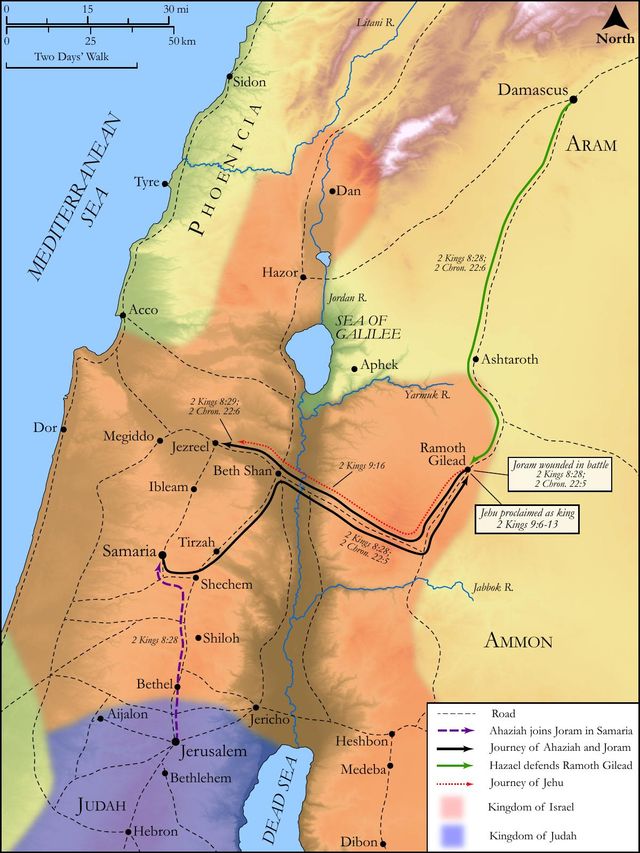
The historical backdrop for this verse is Ramoth-Gilead, a strategically vital Israelite fortress located on the eastern frontier, which was currently under siege by the Arameans. King Joram of Israel, a direct descendant of the notorious Ahab, had been wounded in battle and returned to Jezreel to recover, leaving his military commanders, including Jehu, at the front lines. The Omride dynasty, established by Omri and continued by Ahab and Joram, was infamous for its aggressive promotion of syncretistic Baal worship, largely instigated by Queen Jezebel. This pervasive idolatry had provoked severe prophetic condemnation from both Elijah and Elisha. The anointing of kings, a sacred ritual typically performed by prophets (as seen with Samuel anointing Saul and David), signified divine selection and empowerment. The explicit instruction to take Jehu to an "inner chamber" highlights the extreme political sensitivity and inherent danger of the act; anointing a new king while the current monarch was alive and in power constituted an act of treason, punishable by death. Therefore, absolute secrecy was paramount to ensure the success of this divinely mandated coup and the safety of all involved.
Key Themes
ShowHide2 Kings 9:2 contributes significantly to several overarching themes within the book of Kings. Firstly, it powerfully underscores Divine Sovereignty over human affairs, particularly over the rise and fall of kings and dynasties. God, not human will or political maneuvering, ultimately determines who sits on the throne and for what purpose (compare Daniel 2:21). Secondly, it highlights the Authority and Indispensable Role of the Prophets as direct agents of God's will, even in the most politically charged and dangerous situations. Elisha, acting as God's representative, issues a command that will fundamentally reshape the nation's leadership and destiny. Thirdly, the verse serves as a potent Foreshadowing of Divine Judgment against idolatry and deep-seated wickedness. Jehu's anointing is explicitly for the purpose of executing God's long-delayed judgment upon the house of Ahab, a theme that dominates the subsequent, violent narrative in 2 Kings 9 and 2 Kings 10. Finally, the emphasis on secrecy and urgency speaks to the Confidentiality and Timeliness of God's Plan, indicating that certain divine actions unfold according to a precise, pre-ordained schedule, often hidden from public view until the appointed, strategic moment.
Exposition and Analysis
ShowHideKey Word Analysis
ShowHideThe name "Jehu" is a theophoric name, meaning "Jehovah is He" or "Yahweh is He." This name carries profound significance, especially given Jehu's divinely appointed role as the instrument of Yahweh's judgment against the Baal-worshipping Omride dynasty. His very name serves as a declaration of the supremacy and active involvement of the God of Israel in the unfolding events, emphasizing that the impending purge is not merely a political coup but a direct, sovereign act of God.
The Hebrew verb "qûwm" fundamentally means "to rise," "to stand up," or "to arise." In this context, it carries the crucial nuance of separating Jehu from his military peers, signifying a distinct elevation and a unique divine calling. It implies more than just a physical movement; it is a symbolic act of setting him apart for a singular, divinely appointed task. This commanded separation underscores both the confidential nature of the anointing and the special, authoritative status being conferred upon him by God.
The term "cheder" refers to a private, secluded room, often a bedroom or a deep, innermost part of a house. Its specific use here underscores the absolute necessity of secrecy and confidentiality for the anointing. This private setting ensures that the sacred act is witnessed only by the young prophet and Jehu, preventing premature discovery by King Joram's loyalists and allowing the divine mandate to be delivered without immediate political interference, danger, or the potential for a failed coup.
Verse Breakdown
ShowHide"And when thou comest thither, look out there Jehu the son of Jehoshaphat the son of Nimshi"
This opening clause precisely establishes the immediate destination of the young prophet (Ramoth-Gilead) and the specific individual who is the target of the mission. The three-part lineage ("son of Jehoshaphat the son of Nimshi") is an unusual level of detail for identifying a person, as typically only the father's name is given. This extended genealogy likely serves to precisely identify Jehu among other military commanders, or it could be a subtle nod to his distinct identity or perhaps a well-known family, ensuring the prophet finds the correct individual for such a critical task. It highlights the meticulous precision of God's instructions.
"and go in, and make him arise up from among his brethren"
This instruction emphasizes the need for the young prophet to physically enter Jehu's space and discreetly separate him from his fellow officers or companions. "His brethren" most likely refers to his military comrades or peers, indicating that Jehu was engaged in his regular duties. The command to "make him arise up" implies a direct, authoritative, yet private summons, underscoring the urgency and the absolute necessity for a confidential conversation away from prying eyes and ears, setting him apart for a unique encounter.
"and carry him to an inner chamber;"
The final directive specifies the exact location for the anointing: a private, secluded room. This detail is paramount for security and confidentiality. The act of anointing a new king while the current king is still alive is an act of treason, making absolute secrecy an existential requirement. The "inner chamber" provides the necessary privacy for the sacred, yet politically explosive, act of conferring divine authority upon Jehu, allowing the divine message to be delivered without immediate public scrutiny or danger.
Literary Devices
ShowHideThe verse masterfully employs several significant literary devices that amplify its meaning and impact. Divine Command is the primary driving force, with Elisha's precise instructions serving as the direct manifestation of God's sovereign will, propelling the entire narrative forward. The detailed nature of the command, from identifying Jehu by his extended lineage to the specific location of the anointing, highlights the Precision and deliberate nature of God's meticulously planned intervention. The mention of the "inner chamber" functions as potent Symbolism, representing not only the absolute necessity of secrecy and protection but also the sacred, set-apart nature of the divine appointment, distinct from public political machinations. Furthermore, the entire instruction acts as powerful Foreshadowing, hinting at the dramatic, swift, and violent events that are about to unfold as Jehu, divinely appointed, will execute God's long-delayed judgment. The unnamed "son of the prophets" also serves as a literary device, emphasizing the Obedience required of God's faithful servants, as he carries out a momentous and dangerous task without personal recognition or glory.
Theological and Thematic Connections
ShowHideThis verse powerfully illustrates God's active and sovereign involvement in the affairs of nations and the lives of individuals. It demonstrates unequivocally that political power is ultimately derived from and subject to divine authority, with God raising up and pulling down leaders according to His righteous purposes and perfect timing. The anointing of Jehu, though a human act performed by a prophet, is explicitly a divine commission, highlighting the prophetic office as a crucial conduit for God's will in the world. This moment is a profound testament to God's long-term memory regarding His promises and judgments, fulfilling a decree made years prior to Elijah concerning the wicked house of Ahab. It serves as a powerful reminder that God's justice, though sometimes delayed, is never denied, and He will use chosen instruments, even unlikely ones, to bring His plans to fruition and uphold His holy character.
Reflection and Application
ShowHideThe detailed and urgent instructions given to the young prophet in 2 Kings 9:2 offer profound and enduring insights for contemporary believers. It underscores that God often calls individuals to significant tasks in unexpected places and through seemingly ordinary means. Jehu was "among his brethren," engaged in his daily military duties, when a divine summons dramatically interrupted his routine. This narrative powerfully reminds us to cultivate attentiveness to God's voice and leading, recognizing that His call may come through unconventional channels or require us to step away from our familiar surroundings and associations for a specific, divinely ordained purpose. The emphasis on the "inner chamber" highlights the critical importance of private preparation, spiritual solitude, and confidential communication with God before embarking on public or consequential assignments. Indeed, many of God's most significant works begin in quiet, unseen moments of divine encounter and instruction. Our faithful obedience to these private promptings is absolutely crucial for the successful execution of God's larger purposes, trusting that His appointments are always for a greater, divine end, even if the full scope is not immediately clear to us.
Questions for Reflection
ShowHideFAQ
ShowHideWhy was Jehu chosen, and what was the significance of his anointing?
ShowHideJehu was chosen by direct divine decree, a commission originally given to Elijah by God Himself (see 1 Kings 19:15-17). His anointing was not a mere political maneuver but a sacred act to install him as God's chosen instrument of judgment against the wicked house of Ahab and Jezebel, who had led Israel into deep idolatry and committed heinous acts, such as the murder of Naboth (detailed in 1 Kings 21). The profound significance of Jehu's anointing lies in the direct fulfillment of divine prophecy and the powerful demonstration of God's unwavering commitment to justice and His covenant with Israel, even if it required a violent purge to restore righteousness.
Why was the anointing done in secret and in an "inner chamber"?
ShowHideThe secrecy surrounding Jehu's anointing was absolutely paramount for several critical reasons. Firstly, anointing a new king while the reigning monarch (Joram, Ahab's son) was still alive constituted an act of treason, punishable by death. Secrecy thus protected both the young prophet and Jehu from immediate reprisal and allowed the divine plan to unfold without premature opposition. Secondly, it emphasized that this was a divine appointment, not a public election or a popular uprising. The "inner chamber" (Hebrew cheder) signified a private, secluded space, underscoring the confidential and sacred nature of the act, ensuring the message was delivered solely to Jehu without interference or premature leaks that could jeopardize the mission's success. It allowed the divine authority to be conferred without the immediate chaos and danger of political opposition.
Christ-Centered Fulfillment
ShowHideWhile Jehu's anointing was for a specific purpose of judgment and the establishment of a temporary earthly kingdom, it profoundly foreshadows the ultimate Anointed One, Jesus Christ. Just as Jehu was chosen by divine decree and set apart from his peers in an "inner chamber," so too was Jesus divinely appointed and set apart for His unique mission. His anointing, however, was not with oil in a secret room, but with the Holy Spirit, publicly declared at His baptism (e.g., Matthew 3:16-17 and Acts 10:38). Jehu was commissioned to execute judgment on a wicked dynasty, bringing an end to their reign of idolatry. Christ, the true Messiah (Anointed One), came to execute a far greater judgment—on sin and death itself—and to establish an eternal kingdom that will never be overthrown (e.g., Daniel 7:13-14 and Revelation 19:11-16). Furthermore, the call to Jehu to "arise up from among his brethren" and be set apart for a divine purpose finds its ultimate echo in Christ's call to His disciples to "come out from among them and be separate" (e.g., 2 Corinthians 6:17), being set apart for His service and a kingdom that is not of this world (e.g., John 18:36).