


2 Kings 8:7
Bible text: King James Version (1769 Blayney text) · Public domain
Bible text: Berean Standard Bible · Public domain
Bible text: American Standard Version (1901) · Public domain
Bible text: World English Bible, Messianic edition · Public domain
Bible text: Geneva Bible (1599) · Public domain
Bible text: Young's Literal Translation · Public domain
- וַיָּבֹאvai·ya·Vo'and he wentH935Conj-w ¦ V-Qal-ConsecImperf-3msVerb Qal Consecutive Imperfect 3rd Singular Masculineוַandיָּבֹאhe went
- אֱלִישָׁע'e·li·Sha'ElishaH477N-proper-mNoun Proper Masculine
- דַּמֶּשֶׂקda·Me·sekDamascusH1834N-properNoun Proper Location
- וּבֶןu·venand BenH1130Conj-w ¦ N-proper-mNoun Proper MasculineוּandבֶןBen
- הֲדַדha·DadHadadH1130N-proper-mNoun Proper Masculine
- מֶלֶךְMe·lekh[the] king ofH4428N-mscNoun Singular Masculine Construct
- אֲרָם'a·RamAramH758N-properNoun Proper Location
- חֹלֶהcho·Leh[was] sickH2470V-Qal-Prtcpl-msVerb Qal Participle Singular Masculine Absolute
- וַיֻּגַּדvai·yu·gadand it was toldH5046Conj-w ¦ V-Hophal-ConsecImperf-3msVerb Hophal Consecutive Imperfect 3rd Singular Masculineוַandיֻּגַּדit was told
- לוֹloto himPrep-l ¦ 3msSuffix Personal 3rd Singular Masculineלtoוֹhim
- לֵאמֹרle·Mor<to> sayingH559Prep-l ¦ V-Qal-InfVerb Qal Infinitive Constructלֵ<to>אמֹרsaying
- בָּאba'he has comeH935V-Qal-Perf-3msVerb Qal Perfect 3rd Singular Masculine
- אִישׁ'ish[the] man ofH376N-mscNoun Singular Masculine Construct
- הָאֱלֹהִיםha·'E·lo·Him<the> GodH430Art ¦ N-mpNoun Plural Masculine Absoluteהָ<the>אֱלֹהִיםGod
- עַד'adtoH5704PrepPreposition
- הֵנָּהHe·nahhereH2008AdvAdverb
English is a literal word-by-word gloss of the Hebrew, not the KJV's wording. Why?
This is the original text the KJV's translators worked from — each Hebrew word with its own literal English meaning in this verse, prepared by scholars at Tyndale House, Cambridge. The KJV translates whole sentences, not word by word, so its wording differs: one Hebrew word can become several English words, and the KJV may choose “the LORD” where the gloss reads “Yahweh”. Both are faithful — they answer different questions. For the KJV's own rendering, switch to the KJV text.
Details
See on the biblical-era maps
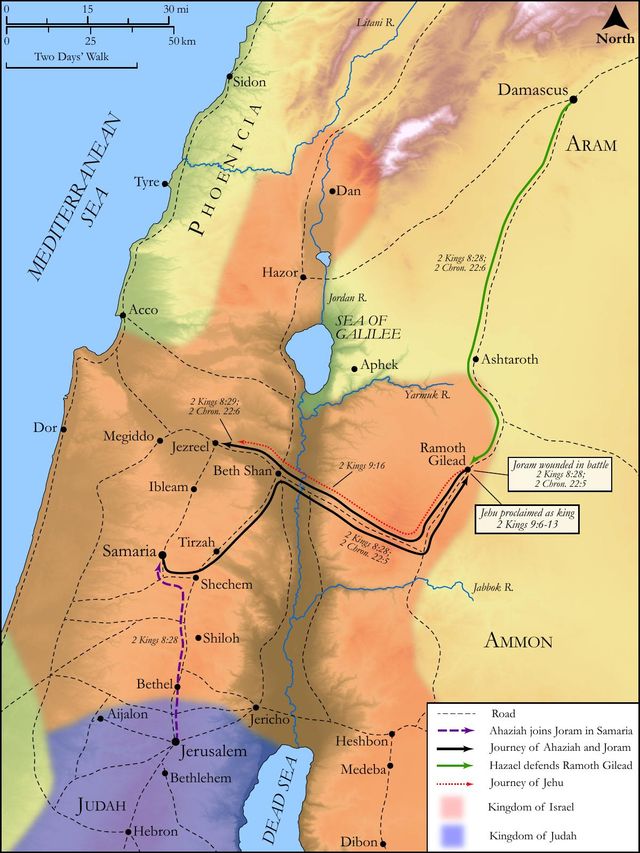
Study this verse
Public-domain commentary
Matthew Henry
From his Commentary on the Whole Bible. Henry comments on passages, not single verses — this entry covers 2 Kings 8:7–15. His four-level outline is real structure in the source text, so it is rendered as structure.
Here, I. We may enquire what brought Elisha to Damascus, the chief city of Syria. Was he sent to any but the lost sheep of the house of Israel? It seems he was. Perhaps he went to pay a visit to Naaman his convert, and to confirm him in his choice of the true religion, which was the more needful now because, it should seem, he was not out of his place (for Hazael is supposed to be captain of that host); either he resigned it or was turned out of it, because he would not bow, or not bow heartily, in the house of Rimmon. Some think he went to Damascus upon account of the famine, or rather he went thither in obedience to the orders God gave Elijah, Kg1 19:15, "Go to Damascus to anoint Hazael, thou, or thy successor."
II.We may observe that Ben-hadad, a great king, rich and mighty, lay sick.
No honour, wealth, or power, will secure men from the common diseases and disasters of human life; palaces and thrones lie as open to the arrests of sickness and death as the meanest cottage.
III.We may wonder that the king of Syria, in his sickness, should make Elisha his oracle.
1.Notice was soon brought him that the man of God (for by that title he was well known in Syria since he cured Naaman) had come to Damascus, Kg2 8:7. "Never in better time," says Ben-hadad. "Go, and enquire of the Lord by him." In his health he bowed in the house of Rimmon, but now that he is sick he distrusts his idol, and sends to enquire of the God of Israel. Affliction brings those to God who in their prosperity had made light of him; sometimes sickness opens men's eyes and rectifies their mistakes. This is the more observable,
(1.)Because it was not long since a king of Israel had, in his sickness, sent to enquire of the god of Ekron (Kg2 1:2), as if there had been no God in Israel. Note, God sometimes fetches to himself that honour from strangers which is denied him and alienated from him by his own professing people.
(2.)Because it was not long since this Ben-hadad had sent a great force to treat Elisha as an enemy (Kg2 6:14), yet now he courts him as a prophet. Note, Among other instances of the change of men's minds by sickness and affliction, this is one, that it often gives them other thoughts of God's ministers, and teaches them to value the counsels and prayers of those whom they had hated and despised.
2.To put an honour upon the prophet,
(1.)He sends to him, and does not send for him, as if, with the centurion, he thought himself not worthy that the man of God should come under his roof.
(2.)He sends to him by Hazael, his prime-minister of state, and not by a common messenger. It is no disparagement to the greatest of men to attend the prophets of the Lord. Hazael must go and meet him at a place where he had appointed a meeting with his friends.
(3.)He sends him a noble present, of every good thing of Damascus, as much as loaded forty camels (Kg2 8:9), testifying hereby his affection to the prophet, bidding him welcome to Damascus, and providing for his sustenance while he sojourned there. It is probable that Elisha accepted it (why should he not?), though he refused Naaman's.
(4.)He orders Hazael to call him his son Ben-hadad, conforming to the language of Israel, who called the prophets fathers.
(5.)He puts an honour upon him as one acquainted with the secrets of heaven, when he enquires of him, Shall I recover? It is natural to us to desire to know things to come in time, while things to come in eternity are little thought of or enquired after.
IV.What passed between Hazael and Elisha is especially remarkable.
1.Elisha answered his enquiry concerning the king, that he might recover, the disease was not mortal, but that he should die another way (Kg2 8:10), not a natural but a violent death. There are many ways out of the world, and sometimes, while men think to avoid one, they fall by another.
2.He looked Hazael in the face with an unusual concern, till he made Hazael blush and himself weep, Kg2 8:11. The man of God could outface the man of war. It was not in Hazael's countenance that Elisha read what he would do, but God did, at this time, reveal it to him, and it fetched tears from his eyes. The more foresight men have the more grief they are liable to.
3.When Hazael asked him why he wept he told him what a great deal of mischief he foresaw he would do to the Israel of God (Kg2 8:12), what desolations he would make of their strong-holds, and barbarous destruction of their men, women, and children. The sins of Israel provoked God to give them up into the hands of their cruel enemies, yet Elisha wept to think that ever Israelites should be thus abused; for, though he foretold, he did not desire the woeful day. See what havock war makes, what havock sin makes, and how the nature of man is changed by the fall, and stripped even of humanity itself.
4.Hazael was greatly surprised at this prediction (Kg2 8:13): What, says he, Is thy servant a dog, that he should do this great thing? This great thing he looks upon to be,
(1.)An act of great power, not to be done but by a crowned head. "It must be some mighty potentate that can think to prevail thus against Israel, and therefore not I." Many are raised to that dominion which they never thought of and it often proves to their own hurt, Ecc 8:9.
(2.)An act of great barbarity, which could not be done but by one lost to all honour and virtue: "Therefore," says he, "it is what I shall never find in my heart to be guilty of: Is thy servant a dog, to rend, and tear, and devour? Unless I were a dog, I could not do it." See here,
[1.]What a bad opinion he had of the sin; he looked upon it to be great wickedness, fitter for a brute, for a beast of prey, to do than a man. Note, It is possible for a wicked man, under the convictions and restraints of natural conscience, to express great abhorrence of a sin, and yet afterwards to be well reconciled to it.
[2.]What a good opinion he had of himself, how much better than he deserved; he thought it impossible he should do such barbarous things as the prophet foresaw. Note, We are apt to think ourselves sufficiently armed against those sins which yet we are afterwards overcome by, as Peter, Mat 26:35.
5.In answer to this Elisha only told him he should be king over Syria; then he would have power to do it, and then he would find in his heart to do it. Honours change men's tempers and manners, and seldom for the better: "Thou knowest not what thou wilt do when thou comest to be king, but I tell thee this thou wilt do." Those that are little and low in the world cannot imagine how strong the temptations of power and prosperity are, and, if ever they arrive at them, they will find how deceitful their hearts were and how much worse than they suspected.
V.What mischief Hazael did to his master hereupon.
If he took any occasion to do it from what Elisha had said the fault was in him, not in the word.
1.He basely cheated his master, and belied the prophet (Kg2 8:14): He told me thou shouldst certainly recover. This was abominably false; he told him he should die (Kg2 8:10), but he unfairly and unfaithfully concealed that, either because he was loth to put the king out of humour with bad news or because hereby he might the more effectually carry on that bloody design which he conceived when he was told he should be his successor. The devil ruins men by telling them they shall certainly recover and do well, so rocking them asleep in security, than which nothing is more fatal. This was an injury to the king, who lost the benefit of this warning to prepare for death, and an injury to Elisha, who would be counted a false prophet.
2.He barbarously murdered his master, and so made good the prophet's word, Kg2 8:15. He dipped a thick cloth in cold water, and spread it upon his face, under pretence of cooling and refreshing him, but so that it stopped his breath, and stifled him presently, he being weak (and not able to help himself) or perhaps asleep: such a bubble is the life of the greatest of men, and so much exposed are princes to violence. Hazael, who was Ben-hadad's confidant, was his murderer, and some think, was not suspected, nor did the truth ever come out but by the pen of this inspired historian. We found this haughty monarch (1 Kings 20) the terror of the mighty in the land of the living, but he goes down slain to the pit with his iniquity upon his bones, Eze 32:27.
Historical interpretation
Historical reception
2 surviving comments on this verse. Each one is dated, so this reads as a timeline rather than a list.
“Elisha went to Damascus while King Ben-hadad was ill.” His illness had derived from his unhappiness. For he had been deeply afflicted by the fact that, in the war of Samaria, his armies had been defeated and that, at the same time, his people had been chased from the city when he had hoped that his victory would occur immediately. His entire army had fled and sunk into shame and dishonor, and he was troubled in his mind because of this. In addition, the anguish of his thoughts was due to something that was not responsible for his fall: he had been deceived in believing that a countless and powerful army would march against him, whereas it was later shown that there was no army at all to oppress him.Therefore the king, when he heard of the coming of Elisha, sent Hazael, one of his noble men, to meet him. He ordered him to persuade the prophet to take care of his healing, and since he thought that this request must be accompanied with gifts and offerings, according to secular customs, he sent him, through his ambassador, all sorts of goods from Damascus and forty camels. But certainly the prophets refused, just as Elisha had refused and had not accepted the offerings of Naaman, the Aramean.
“Go, say to him, ‘You shall certainly recover;’ but the Lord has shown me that he shall certainly die.” These were the words of Elisha to the king, who asked him, “Will I live after this illness?” But it seems that they do not agree with the truth of the events, and not even with each other. However, after the words reported above in the story of the prophet Micah, it is evident that they do not cancel each other out or contradict each other. In fact, both prophets answer in the same manner, and the words of their reply pursue the same aim in the fact that they announce to their interlocutor good and death at the same time. But in the reply of Micah a particular aspect must be considered, that is, the fact that Ahab could not escape from death, because he so ardently and savagely wanted to go to the war, which was the real cause of his fall.But the case of Ben-hadad is quite different: it would have been easy for him to get rid of his illness, because it was not serious or fatal. He would have recovered from his illness, as Elisha had said to him and as Ben-Hadad had asked him by saying, “Will I live after my illness?” However, he died in a natural course but by a hostile means: he was misled by Hazael, his ambassador, the one who spread the bed cover on his master, killed him and reigned in his place, as Elisha had predicted.
Continue studying 2 Kings 8:7 across the web’s major study libraries — every link below opens this exact verse, chapter, or book on the destination site.
Read & Compare
 BibleGatewayThis verse in more than 200 translations and 70 languages.
 Bible.comThe YouVersion reader — hundreds of translations, reading plans, and highlights.
 ESV.orgCrossway's official English Standard Version reader.
 NET BibleThe NET translation with 60,000+ translators' notes on every rendering decision.
 STEP BibleTyndale House's free study tool — original text, vocabulary, and scholarly resources.
 BibliaLogos Bible Software's free web reader.
 USCCBThe New American Bible (Revised Edition) with the U.S. bishops' study notes.
Commentaries
 BibleHub CommentariesDozens of classic commentaries on this verse, gathered on one page.
 StudyLightMore than 100 commentary sets — the largest collection on the web.
 BibleRefPlain-English commentary on what this verse means, verse by verse.
 Enduring WordDavid Guzik's free commentary on this chapter, widely used by Bible teachers.
 Bible Study ToolsVerse commentary alongside Greek and Hebrew study aids.
Original Language & Research
- BibleHub InterlinearThe verse word by word — original language, transliteration, and English.
- BibleHub LexiconEvery word's original-language definition and Strong's entry.
 Blue Letter BibleDeep-study tools — Strong's numbers, concordance, and word studies.
 SefariaThe Hebrew text with Rashi and centuries of Jewish commentary.
Sermons, Hymns & Audio


TrulyRandomVerse is not affiliated with these sites and doesn’t control their content. They’re linked because they’re genuinely useful.
Summary
Second Kings 8:7 initiates a significant phase in Elisha's prophetic ministry, detailing his journey to Damascus, the formidable capital of Aram (Syria). This verse immediately establishes the profound respect Elisha, identified as "the man of God," commanded even among foreign powers. It masterfully sets the stage for a dramatic shift in regional politics, as the gravely ill King Benhadad of Syria seeks counsel from the Israelite prophet, thereby underscoring God's sovereign hand in the affairs of nations beyond Israel's borders and foreshadowing the pivotal events soon to unfold concerning the Syrian throne.
Context
ShowHideLiterary Context
This verse marks a distinct and intentional pivot in the narrative arc of Elisha's prophetic ministry. Prior to this, Elisha's activities were primarily focused within Israel, involving a series of miracles such as the restoration of the Shunammite woman's son and the return of her property, as detailed in 2 Kings 8:1-6. Elisha's unexpected journey to Damascus, the heart of Israel's long-standing adversary, fundamentally shifts the narrative's focus from internal Israelite concerns to the broader geopolitical landscape. This move directly sets the stage for the fulfillment of a divine mandate given much earlier to Elijah, Elisha's predecessor, concerning the anointing of Hazael as king of Aram and Jehu as king of Israel (1 Kings 19:15-17). Although Elijah received the command, it is Elisha who orchestrates its execution, highlighting the continuity of prophetic authority and God's expansive reach beyond the covenant nation. This journey underscores Elisha's expanded sphere of influence, demonstrating God's active involvement and concern for the destinies of nations beyond Israel.
Historical & Cultural Context
During this period, Aram (Syria), with its capital Damascus, was a dominant regional power, frequently clashing with Israel. King Benhadad II was a formidable monarch, renowned for his military campaigns against Israel, particularly during the reigns of Ahab and Jehoram. Damascus itself was not merely a political capital but a crucial trade hub and a strategic military stronghold, making Elisha's presence there highly significant. The fact that an Israelite prophet, representing the God of Israel, could travel to Damascus and gain an audience with the ailing Syrian king speaks volumes about Elisha's widespread reputation and the acknowledged power of the God he served. Among the nations, it was a common practice for kings, even those from rival nations, to consult prophets, diviners, or oracles when faced with severe illness, impending war, or major decisions, as Ahaziah sent messengers to enquire of Baalzebub the god of Ekron whether he should recover of his disease. This was driven by a belief that such individuals possessed unique access to divine knowledge and power, transcending national or religious boundaries, and underscores a universal human tendency to seek supernatural intervention in times of crisis.
Key Themes
ShowHideThis verse introduces and reinforces several profound themes that resonate throughout the book of 2 Kings and the broader biblical narrative. Firstly, it powerfully illustrates Prophetic Authority Beyond Borders, demonstrating that God's chosen servants and their divine authority are not confined to the geographical or political boundaries of Israel. Elisha's presence in Damascus and Benhadad's immediate recognition of him as "the man of God" underscore that divine influence transcends national allegiances, a theme also vividly portrayed in the healing of Naaman the Syrian. Secondly, it highlights Divine Sovereignty Over Nations, implicitly pointing to God's overarching control, even over foreign kings and their destinies. The powerful king of Syria is brought low by illness and compelled to seek insight from the prophet of Israel's God, foreshadowing the dramatic and divinely orchestrated events concerning the Syrian throne that will unfold in 2 Kings 8:13-15. Finally, it touches upon the universal theme of Seeking Spiritual Counsel, as Benhadad's action reflects a deeply human tendency to seek divine intervention and guidance when confronted with severe challenges like sickness, acknowledging a spiritual power beyond his own pagan deities.
Exposition and Analysis
ShowHideKey Word Analysis
ShowHideThe capital city of Aram (Syria), a powerful kingdom frequently hostile to Israel. Its mention here signifies a pivotal shift in Elisha's ministry from internal Israelite affairs to international diplomacy and divine intervention in the affairs of foreign nations. As a major political and economic center, Elisha's presence in Damascus underscores the far-reaching influence of God's prophetic word and His active involvement in the destinies of all nations.
From a primitive root meaning "to be rubbed or worn," and figuratively "to be weak, sick, afflicted." This word describes King Benhadad's physical condition, which is not merely a personal affliction but a strategic vulnerability that God uses to advance His purposes. The king's sickness creates an opening for Elisha's prophetic intervention and highlights the fragility and mortality of even the most powerful human rulers, emphasizing God's ultimate control over life and death.
This honorific title, derived from H376 ('îysh, "man") and H430 ('ĕlôhîym, "God"), is consistently applied to prophets like Elisha (and Elijah before him) throughout the Old Testament. It is more than a respectful designation; it signifies someone divinely appointed, empowered, and who speaks directly on behalf of the Almighty. This title underscores their direct commission from God, imbuing their words and actions with divine weight and authority. The fact that a pagan king like Benhadad recognizes Elisha by this title speaks volumes about Elisha's widespread reputation and the acknowledged power of the God he served, even in a foreign land.
Verse Breakdown
ShowHide"And Elisha came to Damascus;"
This opening clause immediately establishes the setting and the protagonist's intentional movement. Elisha's journey to Damascus is profoundly significant, as it places him directly within the heart of Israel's long-standing adversary. This is not a casual visit but a divinely orchestrated move, setting the stage for major political and prophetic developments that will affect both Israel and Aram. It highlights God's ability to operate even in hostile territories.
"and Benhadad the king of Syria was sick;"
This introduces the immediate catalyst for the dramatic events that follow. The king's illness is not merely a personal affliction but a strategic vulnerability that God uses to advance His purposes. It creates an unexpected opening for Elisha's prophetic intervention and powerfully illustrates the fragility of even the most powerful human rulers in the face of sickness and mortality, underscoring God's ultimate sovereignty.
"and it was told him, saying, "
This indicates that news of Elisha's arrival quickly reached the king. The speed and certainty with which this information reached the royal court underscore Elisha's renown and the immediate interest his presence generated, even among foreign potentates. It also sets up the king's subsequent inquiry, demonstrating his reliance on external, possibly supernatural, counsel, a common practice among the kings of that day.
"The man of God is come hither."
This final clause reveals the specific content of the crucial message delivered to Benhadad. The use of the title "the man of God" is pivotal, as it immediately identifies Elisha not just as a foreign visitor, but as a figure of immense spiritual authority and power. This recognition by the king's servants, and implicitly by the king himself, demonstrates the widespread acknowledgment of Elisha's divine connection and the power of the God of Israel, even in a pagan land.
Literary Devices
ShowHideThe verse employs several potent literary devices to convey its meaning and set the narrative tone for the unfolding drama. Foreshadowing is prominently featured, as the king's severe sickness and Elisha's strategic arrival subtly but powerfully hint at the dramatic and violent shift in the Syrian monarchy that will soon occur. The presence of the "man of God" in the capital of a rival nation signals impending divine intervention. Irony is deeply embedded in the situation: a powerful, pagan king, a consistent adversary of Israel, finds himself utterly dependent on an Israelite prophet for divine insight regarding his health and future. This situation starkly subverts typical power dynamics, highlighting God's ability to use unexpected means and agents. Furthermore, Elisha's deliberate presence in Damascus, a foreign and often hostile capital, serves as profound Symbolism for the universal reach of God's sovereignty and prophetic word, demonstrating unequivocally that His power and authority are not confined by geographical, national, or political boundaries. The concise, declarative statements throughout the verse create a sense of directness and impending significance, drawing the reader into the unfolding divine plan.
Theological and Thematic Connections
ShowHideThis verse powerfully illustrates the boundless reach of God's sovereignty, extending far beyond the covenant nation of Israel to encompass even pagan kings and their kingdoms. It underscores that God is not merely the God of Israel, but the Lord of all nations, actively involved in their political and personal destinies. Benhadad's sickness and his immediate seeking of Elisha's counsel highlight a universal human vulnerability and the innate desire for divine insight in times of crisis, regardless of one's religious or national background. Elisha's journey to Damascus, a hostile capital, further emphasizes that God uses His servants in unexpected places to accomplish His overarching purposes, often in ways that challenge human expectations and political realities, demonstrating His ultimate control over all earthly affairs.
Reflection and Application
ShowHideThe arrival of Elisha in Damascus, and the immediate recognition of him as "the man of God" by a foreign king, offers profound insights for contemporary believers. It reminds us that God's influence and the reach of His kingdom are not limited by our perceived boundaries—whether geographical, cultural, or political. Just as Elisha's reputation for divine power and integrity preceded him, so too should the reputation of Christ's followers, through their character, integrity, and the manifest power of the Holy Spirit within them, extend beyond their immediate circles. This narrative encourages us to be prepared for God to use us in unexpected and perhaps uncomfortable places, demonstrating His truth and power to those who may not yet know Him. It also highlights the universal human need for spiritual truth and guidance, especially in times of vulnerability and uncertainty. Our lives, lived in faithful obedience and marked by genuine love, can become a beacon that draws others, even those from vastly different backgrounds, to seek the ultimate source of healing and wisdom, just as Benhadad sought the prophet of the God of Israel.
Questions for Reflection
ShowHideFAQ
ShowHideWhy did Elisha travel to Damascus, the capital of a rival nation?
ShowHideElisha's journey to Damascus was not a casual visit but a divinely orchestrated mission, fulfilling a prophetic directive given earlier to Elijah. In 1 Kings 19:15, God commanded Elijah to anoint Hazael as king over Aram. While Elijah did not directly perform this anointing, the task fell to his successor, Elisha, to execute this divine plan. Elisha's presence in Damascus was therefore crucial for the unfolding of God's sovereign plan for both Israel and Aram, demonstrating that God's prophetic word and authority extend even to foreign nations and their leadership. It underscores God's active involvement in the geopolitical landscape, using His prophets to shape the destinies of kingdoms according to His will.
Christ-Centered Fulfillment
ShowHideThe narrative of Elisha in Damascus, a foreign capital, profoundly foreshadows the universal reach of God's redemptive plan, ultimately and perfectly fulfilled in Jesus Christ. Elisha, as "the man of God," embodies divine authority extending beyond Israel's borders, serving as a precursor to the boundless compassion and ultimate authority of Christ. Just as Benhadad, a powerful pagan king, sought healing and divine insight from Elisha, so too does all humanity, universally afflicted by the sickness of sin and the certainty of mortality, seek ultimate healing and truth. Jesus, the true Lamb of God who takes away the sin of the world, came not just for Israel but for the "whole world" (1 John 2:2). His earthly ministry transcended geographical and ethnic boundaries, as vividly seen in His compassionate interactions with the Syrophoenician woman and the Roman centurion. Jesus is the ultimate Prophet, Priest, and King, whose authority is not confined to a nation or a temple but extends over all creation (Matthew 28:18). His coming to earth, a "foreign land" for the Son of God, was precisely to confront the pervasive sickness of sin and bring healing, reconciliation, and eternal life to all who believe, fulfilling the universal scope of God's sovereign plan that Elisha's journey to Damascus merely hinted at.