


2 Kings 8:6
Bible text: King James Version (1769 Blayney text) · Public domain
Bible text: King James Version with Strong's numbers · Public domain
Bible text: Berean Standard Bible · Public domain
Bible text: American Standard Version (1901) · Public domain
Bible text: World English Bible, Messianic edition · Public domain
Bible text: Geneva Bible (1599) · Public domain
Bible text: Young's Literal Translation · Public domain
- וַיִּשְׁאַלvai·yish·'Aland he askedH7592Conj-w ¦ V-Qal-ConsecImperf-3msVerb Qal Consecutive Imperfect 3rd Singular Masculineוַandיִּשְׁאַלhe asked
- הַמֶּלֶךְha·Me·lekhthe kingH4428Art ¦ N-msNoun Singular Masculine Absoluteהַtheמֶּלֶךְking
- לָאִשָּׁהla·'i·Shah<to> the womanH802Prep-l ¦ N-fsNoun Singular Feminine Absoluteלָ<to> theאִשָּׁהwoman
- וַתְּסַפֶּרva·te·sa·perand she recountedH5608Conj-w ¦ V-Piel-ConsecImperf-3fsVerb Piel Consecutive Imperfect 3rd Singular Feminineוַandתְּסַפֶּרshe recounted
- לוֹloto himPrep-l ¦ 3msSuffix Personal 3rd Singular Masculineלtoוֹhim
- וַיִּתֶּןvai·yi·tenand he assignedH5414Conj-w ¦ V-Qal-ConsecImperf-3msVerb Qal Consecutive Imperfect 3rd Singular Masculineוַandיִּתֶּןhe assigned
- לָהּlahto herPrep-l ¦ 3fsSuffix Personal 3rd Singular Feminineלָtoהּher
- הַמֶּלֶךְha·me·leKhthe kingH4428Art ¦ N-msNoun Singular Masculine Absoluteהַtheמֶּלֶךְking
- סָרִיסsa·Risa court-officialH5631N-msNoun Singular Masculine Absolute
- אֶחָד'e·ChadoneH259N-fsNoun Singular Feminine Absolute
- לֵאמֹרle·Mor<to> sayingH559Prep-l ¦ V-Qal-InfVerb Qal Infinitive Constructלֵ<to>אמֹרsaying
- הָשֵׁיבha·SheivrestoreH7725V-Hiphil-Imp-2msVerb Hiphil Imperative 2nd Singular Masculine
- אֶת'et<obj.>H853DirObjMParticle Object Indicator
- כָּלkolallH3605N-msNoun Singular Masculine Absolute
- אֲשֶׁר'a·SherthatH834RelParticle Relative
- לָהּlah[belonged] to herPrep-l ¦ 3fsSuffix Personal 3rd Singular Feminineלָ[belonged] toהּher
- וְאֵתve·'Etand <obj.>H853Conj-w ¦ DirObjMParticle Object Indicatorוְandאֵת<obj.>
- כָּלkolallH3605N-mscNoun Singular Masculine Construct
- תְּבוּאֹתte·vu·'Ot[the] produce<s> ofH8393N-fpcNoun Plural Feminine Construct
- הַשָּׂדֶהha·sa·Dehthe fieldH7704Art ¦ N-msNoun Singular Masculine Absoluteהַtheשָּׂדֶהfield
- מִיּוֹםmi·Yomfrom [the] dayH3117Prep-m ¦ N-msNoun Singular Masculine Absoluteמִfromיּוֹם[the] day
- עָזְבָה'a·ze·Vah[when] she leftH5800V-Qal-Perf-3fsVerb Qal Perfect 3rd Singular Feminine
- אֶת'et<obj.>H853DirObjMParticle Object Indicator
- הָאָרֶץha·'A·retzthe landH776Art ¦ N-fsNoun Singular Feminine Absoluteהָtheאָרֶץland
- וְעַדve·'adand untilH5704Conj-w ¦ PrepPrepositionוְandעַדuntil
- עָתָּה'A·tahnowH6258AdvAdverb
English is a literal word-by-word gloss of the Hebrew, not the KJV's wording. Why?
This is the original text the KJV's translators worked from — each Hebrew word with its own literal English meaning in this verse, prepared by scholars at Tyndale House, Cambridge. The KJV translates whole sentences, not word by word, so its wording differs: one Hebrew word can become several English words, and the KJV may choose “the LORD” where the gloss reads “Yahweh”. Both are faithful — they answer different questions. For the KJV's own rendering, switch to the KJV text.
Details
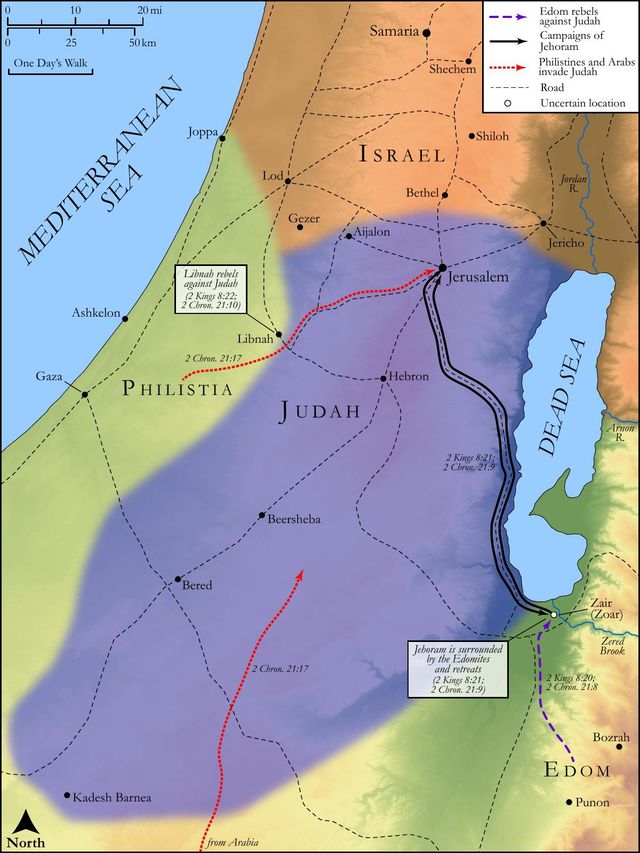
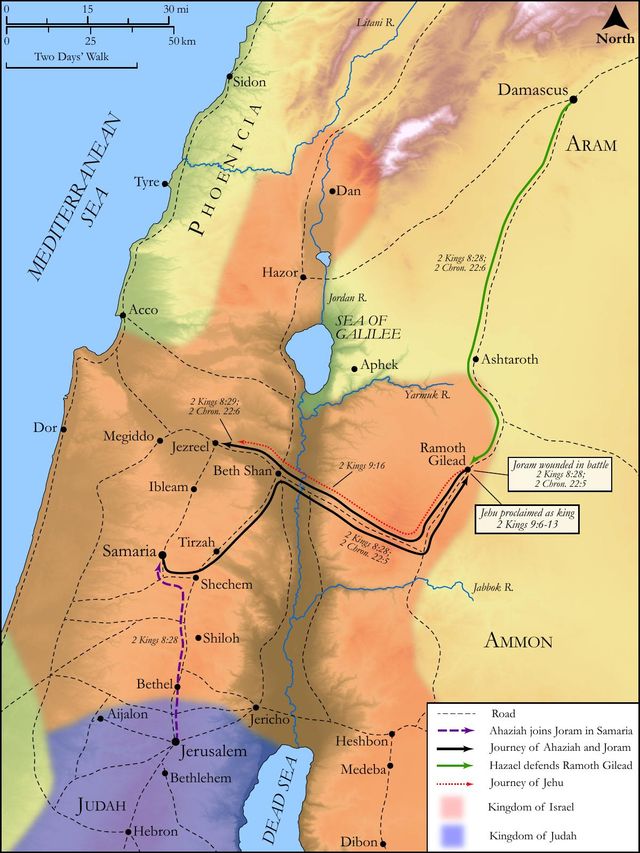
See on the biblical-era maps

Study this verse
Public-domain commentary
Matthew Henry
From his Commentary on the Whole Bible. Henry comments on passages, not single verses — this entry covers 2 Kings 8:1–6. His three-level outline is real structure in the source text, so it is rendered as structure.
Here we have,
I.The wickedness of Israel punished with a long famine, one of God's sore judgments often threatened in the law.
Canaan, that fruitful land, was turned into barrenness, for the iniquity of those that dwelt therein. The famine in Samaria was soon relieved by the raising of that siege, but neither that judgment nor that mercy had a due influence upon them, and therefore the Lord called for another famine; for when he judgeth he will overcome. If less judgments do not prevail to bring men to repentance, he will send greater and longer; they are at his beck, and will come when he calls for them. He does, by his ministers, call for reformation and obedience, and, if those calls be not regarded, we may expect he will call for some plague or other, for he will be heard. This famine continued seven years, as long again as that in Elijah's time; for if men will walk contrary to him, he will heat the furnace yet hotter.
II.The kindness of the good Shunammite to the prophet rewarded by the care that was taken of her in that famine; she was not indeed fed by miracle, as the widow of Sarepta was, but,
1.She had notice given her of this famine before it came, that she might provide accordingly, and was directed to remove to some other country; any where but in Israel she would find plenty. It was a great advantage to Egypt in Joseph's time that they had notice of the famine before it came, so it was to this Shunammite; others would be forced to remove at last, after they had long borne the grievances of the famine, and had wasted their substance, and could not settle elsewhere upon such good terms as she might that went early, before the crowd, and took her stock with her unbroken. It is our happiness to foresee an evil, and our wisdom, when we foresee an evil, and our wisdom, when we foresee it, to hide ourselves.
2.Providence gave her a comfortable settlement in the land of the Philistines, who, though subdued by David, yet were not wholly rooted out. It seems the famine was peculiar to the land of Israel, and other countries that joined close to them had plenty at the same time, which plainly showed the immediate hand of God in it (as in the plagues of Egypt, when they distinguished between the Israelites and the Egyptians) and that the sins of Israel, against whom this judgment was directly levelled, were more provoking to God than the sins of their neighbours, because of their profession of relation to God. You only have I known, therefore will I punish you, Amo 3:2. Other countries had rain when they had none, were free from locusts and caterpillars when they were eaten up with them; for some think this was the famine spoken of, Joe 1:3, Joe 1:4. It is strange that when there was plenty in the neighbouring countries there were not those that made it their business to import corn into the land of Israel, which might have prevented the inhabitants from removing; but, as they were befooled with their idolatries, so they were infatuated even in the matters of their civil interest.
III.Her petition to the king at her return, favoured by the seasonableness of her application to him.
1.When the famine was over she returned out of the land of the Philistines; that was no proper place for an Israelite to dwell any longer than there was a necessity for so doing, for there she could not keep her new moons and her sabbaths as she used to do in her own country, among the schools of the prophets, Kg2 4:23.
2.At her return she found herself kept out of the possession of her own estate, it being either confiscated to the exchequer, seized by the lord, or usurped in her absence by some of the neighbours; or perhaps the person she had entrusted with the management of it proved false, and would neither resign it to her nor come to an account with her for the profits: so hard is it to find a person that one can put a confidence in in a time of trouble, Pro 25:19; Mic 7:5.
3.She made her application to the king himself for redress; for, it seems (be it observed to his praise), he was easy of access, and did himself take cognizance of the complaint of his injured subjects. Time was when she dwelt so securely among her own people that she had no occasion to be spoken for to the king, or to the captain of the host (Kg2 4:13); but now her own familiar friends, in whom she trusted, proved so unjust and unkind that she was glad to appeal to the king against them. Such uncertainty there is in the creature that that may fail us which we most depend upon and that befriend us which we think we shall never need.
4.She found the king talking with Gehazi about Elisha's miracles, Kg2 8:4. It was his shame that he needed now to be informed concerning them, when he might have acquainted himself with them as they were done from Elisha himself, if he had not been wiling to shut his eyes against the convincing evidence of his mission; yet it was his praise that he was now better disposed, and would rather talk with a leper that was capable of giving a good account of them than continue ignorant of them. The law did not forbid all conversation with lepers, but only dwelling with them. There being then no priests in Israel, perhaps the king, or some one appointed by him, had the inspection of lepers, and passed the judgment upon them, which might bring him acquainted with Behazi.
5.This happy coincidence befriended both Behazi's narrative and her petition. Providence is to be acknowledged in ordering the circumstances of events, for sometimes those that are minute in themselves prove of great consequence, as this did, for,
(1.)It made the king ready to believe Gehazi's narrative when it was thus confirmed by the persons most nearly concerned: "This is the woman, and this her son; let them speak for themselves," Kg2 8:5. Thus did God even force him to believe what he might have had some colour to question if he had only had Gehazi's word for it, because he was branded for a liar, witness his leprosy.
(2.)It made him ready to grant her request; for who would not be ready to favour one whom heaven had thus favoured, and to support a life which was given once and again by miracle? In consideration of this the king gave orders that her land should be restored to her and all the profits that were made of it in her absence. If it was to himself that the land and profits had escheated, it was generous and kind to make so full a restitution; he would not (as Pharaoh did in Joseph's time) enrich the crown by the calamities of his subjects. If it was by some other person that her property was invaded, it was an act of justice in the king, and part of the duty of his place, to give her redress, Psa 82:3, Psa 82:4; Pro 31:9. It is not enough for those in authority that they do no wrong themselves, but they must support the right of those that are wronged.
Historical interpretation
Historical reception
1 surviving comment on this verse from the historical church.
“Now Elisha had said to the woman whose son he had restored to life, ‘Get up and go with your household.’ ” This is the Shunammite woman who had received Elisha in her home. And [the prophet] had taken care of her son too, who had died, by reviving him. Elisha predicted to her that a seven-year famine would occur and invited her to find a new home by emigrating. He chose for her Palestine, a close and fertile region, whose inhabitants were rich thanks to their maritime commerce. For the land of the Philistines is entirely situated along the coast, and it had, at that time, some renowned harbors which were full of countless vessels, as is testified by the Scripture in many passages. That is why the patriarchs Abraham and Isaac had looked there for their refuge.From the allegorical point of view, Palestine, which received the righteous who were in exile and symbolically far from the Lord, was a figure of the world. And the people of Palestine detested the people of God and ill-treated the children of Israel who feared God. Later they were defeated by David and gave up their weapons of war, but they took them up again now and then. The world hates the saints and constantly persecutes them. And even after our Lord has defeated it and its prince [the devil] has been thrown out, these two never cease from fighting against his servants, grabbing and destroying the idle and the ignorant.
Continue studying 2 Kings 8:6 across the web’s major study libraries — every link below opens this exact verse, chapter, or book on the destination site.
Read & Compare
 BibleGatewayThis verse in more than 200 translations and 70 languages.
 Bible.comThe YouVersion reader — hundreds of translations, reading plans, and highlights.
 ESV.orgCrossway's official English Standard Version reader.
 NET BibleThe NET translation with 60,000+ translators' notes on every rendering decision.
 STEP BibleTyndale House's free study tool — original text, vocabulary, and scholarly resources.
 BibliaLogos Bible Software's free web reader.
 USCCBThe New American Bible (Revised Edition) with the U.S. bishops' study notes.
Commentaries
 BibleHub CommentariesDozens of classic commentaries on this verse, gathered on one page.
 StudyLightMore than 100 commentary sets — the largest collection on the web.
 BibleRefPlain-English commentary on what this verse means, verse by verse.
 Enduring WordDavid Guzik's free commentary on this chapter, widely used by Bible teachers.
 Bible Study ToolsVerse commentary alongside Greek and Hebrew study aids.
Original Language & Research
- BibleHub InterlinearThe verse word by word — original language, transliteration, and English.
- BibleHub LexiconEvery word's original-language definition and Strong's entry.
 Blue Letter BibleDeep-study tools — Strong's numbers, concordance, and word studies.
 SefariaThe Hebrew text with Rashi and centuries of Jewish commentary.
Sermons, Hymns & Audio


TrulyRandomVerse is not affiliated with these sites and doesn’t control their content. They’re linked because they’re genuinely useful.
Summary
This verse culminates the remarkable narrative of the Shunammite woman, detailing the king's divinely orchestrated decree to fully restore her property and all its accumulated produce. After a seven-year famine forced her sojourn in the land of the Philistines, her return coincided with Gehazi, Elisha's servant, recounting the prophet's miracles to the king, including the raising of her son, thus paving the way for her urgent appeal and the king's comprehensive act of justice.
Context
ShowHideLiterary Context
This verse serves as the powerful culmination of a narrative arc spanning from 2 Kings 8:1 to 2 Kings 8:6. The story begins with the prophet Elisha's timely warning to the Shunammite woman to depart the land due to an impending seven-year famine, as detailed in 2 Kings 8:1-2. Her obedience led her to sojourn in the land of the Philistines. Upon her return, she found her house and land confiscated. The narrative then masterfully sets up a "divine coincidence": as she approaches the king to appeal for her property, the king happens to be conversing with Gehazi, Elisha's servant, who is recounting all the great deeds Elisha had performed, specifically mentioning the miraculous raising of the Shunammite woman's son from the dead, a pivotal event recorded in 2 Kings 4:36. The king's inquiry in this verse directly follows Gehazi's identification of the woman, making her appeal incredibly timely and compelling within the unfolding narrative.
Historical & Cultural Context
The famine described in 2 Kings 8:1 was a severe, prolonged event, indicative of either God's judgment or a natural disaster in a land heavily dependent on rainfall. During such times, land could be abandoned or seized, especially if its owners were absent for an extended period. The king mentioned here is likely Joram (Jehoram), son of Ahab, who reigned over Israel. While Joram was not a righteous king, he was often depicted as interacting with Elisha, sometimes seeking his counsel or being influenced by his prophetic authority. In the kingdoms of Israel and Judah, the king held ultimate judicial authority and could issue decrees regarding property, often acting as the supreme court, as Solomon judged between the two women who stood before him. The concept of land as an inalienable family inheritance was deeply ingrained in Israelite law and culture, making the loss of one's ancestral property a profound tragedy and its restoration a significant act of justice, echoing principles found in passages like Leviticus 25:23-28.
Key Themes
ShowHideThis verse powerfully underscores several major theological and narrative themes. Firstly, Divine Providence and Sovereignty are paramount; God orchestrates seemingly random events—the famine, the woman's return, Gehazi's conversation with the king—to converge for His purposes and the good of His faithful servant. The timing of her appeal is not accidental but divinely appointed, showcasing God's meticulous care. Secondly, the theme of Restoration and Justice is vividly portrayed. The king's command to "Restore all that was hers, and all the fruits of the field" goes beyond simple restitution of land; it mandates full compensation for lost income or produce, ensuring the woman is made completely whole, demonstrating a remarkable act of royal justice that reflects divine principles. Finally, this episode highlights God's Faithfulness to His Servants and the Reward for Obedience. The Shunammite woman had previously shown extraordinary hospitality and faith towards Elisha, as seen in 2 Kings 4:8-10, and her obedience to Elisha's warning about the famine, coupled with her bold appeal to the king, reflects her continued trust. Her restoration is a tangible blessing, affirming God's care for those who walk in His ways, a theme often found throughout the books of 1 Kings and 2 Kings.
Exposition and Analysis
ShowHideKey Word Analysis
ShowHideThis word (H4428) refers to the monarch, the supreme ruler of the kingdom. In this context, the "king" is Joram of Israel. His role here is crucial as the ultimate earthly authority capable of issuing a decree for comprehensive restitution. The fact that he acts decisively underscores the efficacy of the divine orchestration and the weight of the prophetic testimony he has just heard. His command is binding and ensures the woman's restoration.
The term (H5631) denotes a eunuch or, by implication, a minister of state or chamberlain. The king's immediate appointment of "a certain officer" demonstrates his commitment to implementing the decree effectively and efficiently. This officer would have the authority and means to execute the king's command, ensuring the physical return of the property and the calculation and delivery of the accumulated produce. It highlights the practical, administrative aspect of the king's justice.
This primitive root (H7725) means "to turn back" or "to bring back." In this legal and economic context, it signifies a complete and equitable "restitution" or "making whole." It implies not just the physical return of the land and house but a comprehensive reversal of the woman's loss, including the financial detriment incurred during her absence. This word emphasizes the thoroughness of the king's decree, aiming for full compensation.
Verse Breakdown
ShowHide"And when the king asked the woman, she told him."
This clause highlights the direct, personal interaction between the highest authority in the land and the Shunammite woman. The king's inquiry, prompted by Gehazi's testimony about her and her son, signifies his receptiveness and willingness to hear her case directly. Her immediate and presumably clear explanation of her plight underscores her courage, her desperate situation, and the compelling nature of her story, which was already validated by the prophet's servant.
"So the king appointed unto her a certain officer, saying, Restore all that [was] hers,"
The king's response is swift, authoritative, and decisive. He doesn't merely acknowledge her claim but immediately delegates authority to a specific, unnamed officer, ensuring the decree's prompt implementation. The command "Restore all that was hers" refers to the principal property—her ancestral house and land—which had been confiscated or occupied during her seven-year absence. This is the foundational act of restitution, returning her to her rightful place.
"and all the fruits of the field since the day that she left the land, even until now."
This is the most remarkable and comprehensive part of the decree, demonstrating the king's extraordinary justice and generosity. It extends the restoration beyond the physical property to include all the income, crops, or agricultural produce that the land would have yielded over the entire seven-year period of her sojourn. This ensures that she is not only returned to her former status as a landowner but also fully compensated for all lost earnings, making her financially whole despite her prolonged, forced absence and the economic hardship it entailed.
Literary Devices
ShowHideThe narrative of 2 Kings 8:1-6 culminating in this verse is rich with literary artistry. A prominent device is Divine Irony or Divine Coincidence, where seemingly random events converge with perfect timing. The fact that the Shunammite woman arrives to make her appeal at the exact moment Gehazi is recounting her son's resurrection to the king is a powerful example of God's unseen hand orchestrating human affairs. This "coincidence" is too perfect to be accidental, underscoring God's meticulous care for His faithful. There is also an element of Narrative Symmetry and Foreshadowing; just as Elisha had previously restored her son's life (her greatest loss), the king, under divine influence, now restores her livelihood and property (her material loss), completing the cycle of restoration for this faithful woman. The king's comprehensive decree also serves as a Symbol of ultimate divine justice, where not only the principal is returned but also all that was lost due to circumstances beyond one's control, pointing to a deeper theological truth about God's restorative nature.
Theological and Thematic Connections
ShowHideThe story of the Shunammite woman's restoration in 2 Kings 8:6 beautifully illustrates God's character as a God of meticulous care, justice, and comprehensive restoration. It affirms that even in times of severe hardship, loss, or displacement, God remains sovereign, orchestrating events to bring about His purposes for those who trust Him. Her experience is a powerful testament to the truth that God does not abandon His faithful, and His timing is perfect, often working through unexpected channels and human authorities to bring about His desired outcomes. This narrative offers profound hope that God can bring about comprehensive restoration in areas of our lives that seem utterly lost or forfeited, whether they be material, relational, or spiritual, demonstrating His active involvement in the lives of His people.
Reflection and Application
ShowHideThe story of the Shunammite woman's restoration in 2 Kings 8:6 offers profound encouragement for believers today. It reminds us that even when life's circumstances force us into periods of loss, displacement, or uncertainty, God's sovereign hand is at work behind the scenes. Her experience teaches us to trust in God's perfect timing and His intricate care, even when events seem coincidental or chaotic. We are called to cultivate a spirit of faithfulness and obedience, knowing that our past acts of devotion are not forgotten by God. Furthermore, this narrative inspires hope that God is a God of restoration, capable of bringing wholeness and recovery to areas of our lives that feel broken, lost, or stolen. Just as the king's decree was comprehensive, God's desire for our well-being and flourishing is holistic, extending to every aspect of our existence, from our material needs to our deepest spiritual longings. This story invites us to lean into God's providence, believing that He can redeem and restore even what seems irretrievable.
Questions for Reflection
ShowHideFAQ
ShowHideWho was the king mentioned in this verse?
ShowHideThe king mentioned in 2 Kings 8:6 is King Joram (also known as Jehoram) of Israel, the son of King Ahab. Although Joram was not a righteous king in the eyes of the Lord, he frequently interacted with the prophet Elisha, and in this instance, he appears to have been influenced by the powerful testimony of Elisha's servant, Gehazi, regarding the prophet's miracles.
Why was the timing of the Shunammite woman's appeal so significant?
ShowHideThe timing was divinely orchestrated, demonstrating God's perfect providence. As the Shunammite woman arrived to appeal to the king for her property, the king happened to be speaking with Gehazi, Elisha's servant. Gehazi was at that very moment recounting the great deeds of Elisha, specifically mentioning the miracle of Elisha raising the Shunammite woman's son from the dead, an event detailed in 2 Kings 4:36. This perfect convergence of events immediately validated the woman's identity and her connection to the revered prophet Elisha, making the king exceptionally receptive to her plea and ensuring her favorable outcome.
What does "fruits of the field" imply beyond mere land restoration?
ShowHideThe phrase "fruits of the field" (תְּבוּאַת הַשָּׂדֶה, t'vu'at ha-sadeh) signifies not just the return of the physical land itself, but also the accumulated produce, crops, or income that the land would have yielded during the entire seven-year period of her absence. This demonstrates an extraordinary level of comprehensive restitution, ensuring that the Shunammite woman was fully compensated for all financial losses incurred due to the famine and her forced sojourn, thereby restoring her economic well-being completely and making her whole.
Christ-Centered Fulfillment
ShowHideThe narrative of the Shunammite woman's comprehensive restoration in 2 Kings 8:6 finds its ultimate and most profound fulfillment in Jesus Christ. While an earthly king restored property and produce, Christ, the King of kings, offers a far greater and eternal restoration. He is the one who truly "restores our soul" (Psalm 23:3), bringing us back into right relationship with God, a relationship lost through sin. Just as the Shunammite woman experienced a reversal of loss, believers in Christ experience redemption from the curse of sin and death, receiving new life and an inheritance that is imperishable and undefiled (1 Peter 1:3-4). He is the ultimate restorer of all things, not just material possessions but also broken lives, shattered relationships, and lost hope. Through His atoning work on the cross, Jesus takes away the sin of the world (John 1:29), reconciling us to God (Colossians 1:19-20) and promising a future where all things are made new (Revelation 21:5). The comprehensive nature of the king's decree in 2 Kings foreshadows the boundless grace and complete restoration that Christ offers, not merely for a season, but for eternity, culminating in the new heavens and new earth where righteousness dwells (2 Peter 3:13).