


2 Kings 19:3
Bible text: King James Version (1769 Blayney text) · Public domain
Bible text: King James Version with Strong's numbers · Public domain
Bible text: Berean Standard Bible · Public domain
Bible text: American Standard Version (1901) · Public domain
Bible text: World English Bible, Messianic edition · Public domain
Bible text: Geneva Bible (1599) · Public domain
Bible text: Young's Literal Translation · Public domain
- וַיֹּאמְרוּvai·yo·me·Ruand they saidH559Conj-w ¦ V-Qal-ConsecImperf-3mpVerb Qal Consecutive Imperfect 3rd Plural Masculineוַandיֹּאמְרוּthey said
- אֵלָיו'e·Lavto himH413Prep ¦ 3msPrepositionאֵלָיtoוhim
- כֹּהkohthusH3541AdvAdverb
- אָמַר'a·Marhe saysH559V-Qal-Perf-3msVerb Qal Perfect 3rd Singular Masculine
- חִזְקִיָּהוּchiz·ki·Ya·huHezekiahH2396N-proper-mNoun Proper Masculine
- יוֹםyom[is] a day ofH3117N-mscNoun Singular Masculine Construct
- צָרָהtza·RahdistressH6869N-fsNoun Singular Feminine Absolute
- וְתוֹכֵחָהve·to·khe·Chahand rebukeH8433Conj-w ¦ N-fsNoun Singular Feminine Absoluteוְandתוֹכֵחָהrebuke
- וּנְאָצָהu·ne·'a·Tzahand insultH5007Conj-w ¦ N-fsNoun Singular Feminine Absoluteוּandנְאָצָהinsult
- הַיּוֹםhai·Yomthe dayH3117Art ¦ N-msNoun Singular Masculine Absoluteהַtheיּוֹםday
- הַזֶּהha·Zeh<the> thisH2088Art ¦ PrtParticle Demonstrativeהַ<the>זֶּהthis
- כִּיkiforH3588PrtParticle Conditional
- בָאוּVa·'uthey have comeH935V-Qal-Perf-3cpVerb Qal Perfect 3rd Plural common gender
- בָנִיםva·NimchildrenH1121N-mpNoun Plural Masculine Absolute
- עַד'adtoH5704PrepPreposition
- מַשְׁבֵּרmash·BerbirthH4866N-msNoun Singular Masculine Absolute
- וְכֹחַve·Kho·achand [is] strengthH3581Conj-w ¦ N-msNoun Singular Masculine Absoluteוְandכֹחַ[is] strength
- אַיִן'A·yinthere notH369N-msNoun Singular Masculine Absolute
- לְלֵדָהle·le·Dahfor giving birthH3205Prep-l ¦ N-fsNoun Singular Feminine Absoluteלְforלֵדָהgiving birth
English is a literal word-by-word gloss of the Hebrew, not the KJV's wording. Why?
This is the original text the KJV's translators worked from — each Hebrew word with its own literal English meaning in this verse, prepared by scholars at Tyndale House, Cambridge. The KJV translates whole sentences, not word by word, so its wording differs: one Hebrew word can become several English words, and the KJV may choose “the LORD” where the gloss reads “Yahweh”. Both are faithful — they answer different questions. For the KJV's own rendering, switch to the KJV text.
Details
See on the biblical-era map
Study this verse
Public-domain commentary
Matthew Henry
From his Commentary on the Whole Bible. Henry comments on passages, not single verses — this entry covers 2 Kings 19:1–7. His three-level outline is real structure in the source text, so it is rendered as structure.
The contents of Rabshakeh's speech being brought to Hezekiah, one would have expected (and it is likely Rabshakeh did expect) that he would call a council of war and it would be debated whether it was best to capitulate or no. Before the siege, he had taken counsel with his princes and his mighty men, Ch2 32:3. But that would not do now; his greatest relief is that he has a God to go to, and what passed between him and his God on this occasion we have here an account of.
I.Hezekiah discovered a deep concern at the dishonour done to God by Rabshakeh's blasphemy.
When he heard it, though at second hand, he rent his clothes and covered himself with sackcloth, Kg2 19:1. Good men were wont to do so when they heard of any reproach cast on God's name; and great men must not think it any disparagement to them to sympathize with the injured honour of the great God. Royal robes are not too good to be rent, nor royal flesh too good to be clothed with sackcloth, in humiliation for indignities done to God and for the perils and terrors of his Jerusalem. To this God now called, and was displeased with those who were not thus affected. Isa 22:12-14, Behold joy and gladness, slaying oxen and killing sheep, though it was a day of trouble and perplexity in the valley of vision (Kg2 19:5), which refers to this very event. The king was in sackcloth, but many of his subjects were in soft clothing.
II.He went up to the house of the Lord, according to the example of the psalmist, who, when he was grieved at the pride and prosperity of the wicked, went into the sanctuary of God and there understood their end, Psa 73:17. He went to the house of God, to meditate and pray, and get his spirit into a sedate composed frame, after this agitation. He was not considering what answer to return to Rabshakeh, but refers the matter to God. "Thou shalt answer, Lord, for me." - Herbert. In the house of the Lord he found a place both of rest and refuge, a treasury, a magazine, a council-chamber, and all he needed, all in God. Note, When the church's enemies are very daring and threatening it is the wisdom and duty of the church's friends to apply to God, appeal to him, and leave their cause with him.
III.He sent to the prophet Isaiah, by honourable messengers, in token of the great respect he had for him, to desire his prayers, Kg2 19:2-4.
Eliakim and Shebna were two of those that had heard the words of Rabshakeh and were the better able both to acquaint and to affect Isaiah with the case. The elders of the priests were themselves to pray for the people in time of trouble (Joe 2:17); but they must go to engage Isaiah's prayers, because he could pray better and had a better interest in heaven. The messengers were to go in sackcloth, because they were to represent the king, who was so clothed.
1.Their errand to Isaiah was, "Lift up thy prayer for the remnant that is left, that is, for Judah, which is but a remnant now that the ten tribes are gone - for Jerusalem, which is but a remnant now that the defenced cities of Judah are taken." Note,
(1.)It is very desirable, and what we should be desirous of when we are in trouble, to have the prayers of our friends for us. In begging to have them we honour God, we honour prayer, and we honour our brethren.
(2.)When we desire the prayers of others for us we must not think we are excused from praying for ourselves. When Hezekiah sent to Isaiah to pray for him he himself went into the house of the Lord to offer up his own prayers.
(3.)Those who speak from God to us we should in a particular manner desire to speak to God for us. He is a prophet, and he shall pray for thee, Gen 20:7. The great prophet is the great intercessor.
(4.)Those are likely to prevail with God that lift up their prayers, that is, that lift up their hearts in prayer.
(5.)When the interests of God's church are brought very low, so that there is but a remnant left, few friends, and those weak and at a loss, then it is time to lift up our prayer for that remnant.
2.Two things are urged to Isaiah, to engage his prayers for them: - (1.) Their fears of the enemy (Kg2 19:3): "He is insolent and haughty; it is a day of rebuke and blasphemy. We are despised. God is dishonoured. Upon this account it is a day of trouble. Never were such a king and kingdom so trampled on and abused as we are: our soul is exceedingly filled with the contempt of the proud, and it is a sword in our bones to hear them reproach our confidence in God, and say, Where is now your God? and, which is worst of all, we see not which way we can help ourselves and get clear of the reproach. Our cause is good, our people are faithful; but we are quite overpowered with numbers. The children are brought to the birth; now is the time, the critical moment, when, if ever, we must be relieved. One successful blow given to the enemy would accomplish our wishes. But, alas! we are not able to give it: There is not strength to bring forth. Our case is as deplorable, and calls for as speedy help, as that of a woman in travail, that is quite spent with her throes, so that she has not strength to bear the child. Compare with this Hos 13:13. We are ready to perish; if thou canst do any thing, have compassion upon us and help us." (2.) Their hopes in God. To him they look, on him they depend, to appear for them. One word from him will turn the scale, and save the sinking remnant. If he but reprove the words of Rabshakeh (that is, disprove them, Kg2 19:4) - if he undertake to convince and confound the blasphemer - all will be well. And this they trust he will do, not for their merit's sake, but for his own honour's sake, because he has reproached the living God, by levelling him with deaf and dumb idols. They have reason to think the issue will be good, for they can interest God in the quarrel. Psa 74:22, Arise O God! plead thy own cause. "He is the Lord thy God," say they to Isaiah - "thine, whose glory thou art concerned for, and whose favour thou art interested in. He has heard and known the blasphemous words of Rabshakeh, and therefore, it may be, he will hear and rebuke them. We hope he will. Help us with thy prayers to bring the cause before him, and then we are content to leave it with him."
IV.God, by Isaiah, sent to Hezekiah, to assure him that he would glorify himself in the ruin of the Assyrians.
Hezekiah sent to Isaiah, not to enquire concerning the event, as many did that sent to the prophets (Shall I recover? or the like), but to desire his assistance in his duty. It was this that he was solicitous about; and therefore God let him know what the event should be, in recompence of his care to do his duty, Kg2 19:6, Kg2 19:7.
1.God interested himself in the cause: They have blasphemed me.
2.He encouraged Hezekiah, who was much dismayed: Be not afraid of the words which thou hast heard; they are but words (though swelling and fiery words), and words are but wind.
3.He promised to frighten the king of Assyria worse than Rabshakeh had frightened him: "I will send a blast upon him (that pestilential breath which killed his army), upon which terrors shall seize him and drive him into his own country, where death shall meet him." This short threatening from the mouth of God would do execution, when all the impotent menaces that came from Rabshakeh's mouth would vanish into air.
Historical interpretation
Historical reception
1 surviving comment on this verse from the historical church.
Faith unguarded is armed by God. Hezekiah, through the power of faith, proved stronger with his puny force than Sennacherib, king of Babylon and rich Nineveh, with his thousands. Sennacherib had enlisted the forces of Assyria and the realm of the Medes. Laying waste with his huge legions all the neighbouring kingdoms, he proceeded towards the city sacred to the Lord and against it alone concentrated his whole massive war machine. But as he made preparations for this, God hindered him, for warfare delayed his unholy designs. He sent to Jerusalem a letter brusque in its arrogant threats. Hezekiah received it with grief and bore it to the Lord before the altar. There in prostrate prayer accompanied by his people in mourning black, he read out those harsh words and bedewed the letter with abundant tears, and so he prevailed on God. By prayer alone, though absent from the scene, he won a shattering victory over the Assyrians, who suffered a grievous death when God warred on them. This favour he won was so considerable that he did not even clap eyes on the enemy he conquered. Once his tears of complaint had passed above the constellations, once his lament from a humble heart had risen beyond the stars and his devoted words had assailed the ears of highest Father, the lofty doors of heaven swung open and a winged angel glided down, breathing the fragrant air on his smooth descent. Armed with the sword of the Word, he smote that wicked army, and glorying in the silent slaughter of the sleeping foe, he brought simultaneous death to one hundred and eighty thousand men. A single night was the accomplice engagement on that scale. Next morning the king arose still threatening but then took flight with his depleted column, wretched because his army was thus stripped of its slaughtered soldiers. He fled from Hezekiah, though the prophet was far removed in another district, and though he had only recently in his presence threatened to clap his fetters on him. At that time Isaias was mediator for Hezekiah.
Continue studying 2 Kings 19:3 across the web’s major study libraries — every link below opens this exact verse, chapter, or book on the destination site.
Read & Compare
 BibleGatewayThis verse in more than 200 translations and 70 languages.
 Bible.comThe YouVersion reader — hundreds of translations, reading plans, and highlights.
 ESV.orgCrossway's official English Standard Version reader.
 NET BibleThe NET translation with 60,000+ translators' notes on every rendering decision.
 STEP BibleTyndale House's free study tool — original text, vocabulary, and scholarly resources.
 BibliaLogos Bible Software's free web reader.
 USCCBThe New American Bible (Revised Edition) with the U.S. bishops' study notes.
Commentaries
 BibleHub CommentariesDozens of classic commentaries on this verse, gathered on one page.
 StudyLightMore than 100 commentary sets — the largest collection on the web.
 BibleRefPlain-English commentary on what this verse means, verse by verse.
 Enduring WordDavid Guzik's free commentary on this chapter, widely used by Bible teachers.
 Bible Study ToolsVerse commentary alongside Greek and Hebrew study aids.
Original Language & Research
- BibleHub InterlinearThe verse word by word — original language, transliteration, and English.
- BibleHub LexiconEvery word's original-language definition and Strong's entry.
 Blue Letter BibleDeep-study tools — Strong's numbers, concordance, and word studies.
 SefariaThe Hebrew text with Rashi and centuries of Jewish commentary.
Sermons, Hymns & Audio


TrulyRandomVerse is not affiliated with these sites and doesn’t control their content. They’re linked because they’re genuinely useful.
Summary
King Hezekiah, facing the existential threat of the Assyrian invasion and the deeply offensive blasphemies of Sennacherib's commander, sends a desperate and poignant message to the prophet Isaiah. This verse powerfully encapsulates Judah's dire predicament, expressing an overwhelming sense of national distress, profound humiliation, and spiritual outrage. The king's vivid and universally relatable metaphor of a child at the point of birth but without the strength to be delivered conveys the absolute helplessness of Judah and their utter reliance on divine intervention for salvation.
Context
ShowHideLiterary Context
This verse is strategically placed at a pivotal moment in the narrative of 2 Kings, immediately following the Assyrian Rabshakeh's audacious and blasphemous challenge to King Hezekiah and the people of Jerusalem. The Rabshakeh's messages, detailed in 2 Kings 18:17-35, were designed not only to undermine Judah's military resolve but, more critically, to mock and discredit Yahweh Himself. Hezekiah's immediate and profound response to this spiritual and military crisis is recorded in 2 Kings 19:1, where he tears his clothes, covers himself with sackcloth, and enters the house of the Lord. Verse 3 represents Hezekiah's direct communication of his deep distress and the nation's desperate state to the prophet Isaiah through his trusted officials, setting the crucial stage for Isaiah's subsequent prophecy of comfort and assurance of divine deliverance, which commences in 2 Kings 19:6. This account also finds a significant parallel in Isaiah 37:3.
Historical & Cultural Context
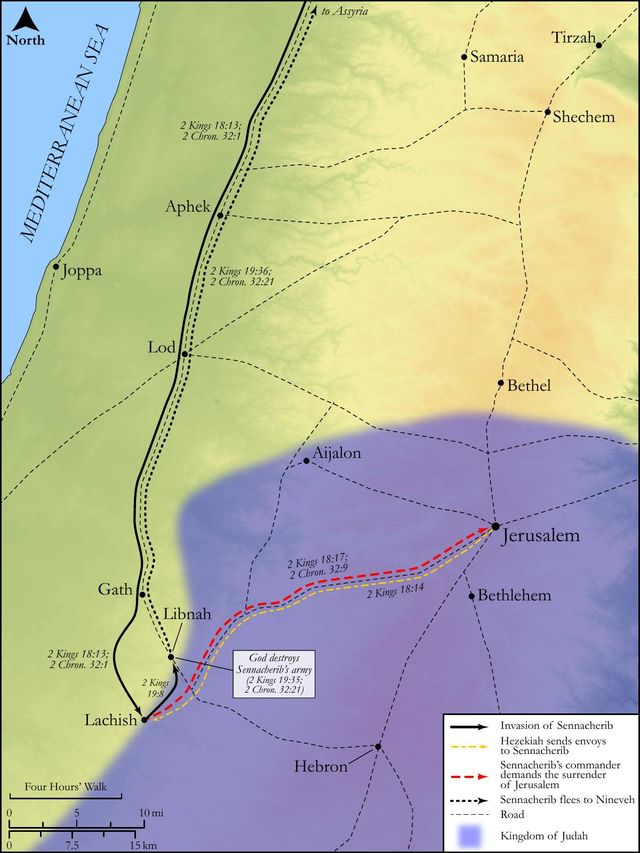
The events depicted in 2 Kings 19 unfolded around 701 BC during the reign of King Hezekiah of Judah. The Assyrian Empire, under the formidable Sennacherib, was the preeminent superpower among the nations of that day, notorious for its ruthless military campaigns, effective siege warfare, and psychological intimidation tactics. By this point, Sennacherib had already systematically conquered numerous fortified cities throughout Judah, leaving Jerusalem isolated, besieged, and seemingly indefensible. The Rabshakeh's public speech was a meticulously calculated act of psychological warfare, intended to shatter the morale of Jerusalem's inhabitants by emphasizing their isolation, ridiculing their reliance on Egypt, and, most significantly, blaspheming Yahweh by asserting His inability to deliver His people, just as the gods of other conquered nations had proven powerless. Hezekiah's actions of tearing his clothes and wearing sackcloth were deeply ingrained cultural expressions in ancient Israel, signifying profound mourning, repentance, and extreme distress. These acts communicated a state of national emergency and humble supplication before God, acknowledging human powerlessness and seeking divine intervention.
Key Themes
ShowHideThe central themes woven into this verse are Extreme Desperation and Helplessness, vividly articulated by Hezekiah's declaration and the powerful, agonizing birth metaphor. This highlights the inherent human inability to resolve crises of such overwhelming magnitude, thereby compelling a complete reliance on a higher, divine power. Furthermore, the theme of Spiritual Crisis and God's Honor is paramount; the Assyrian "blasphemy" transforms what might appear to be a purely military threat into a direct and profound challenge to Yahweh's sovereignty, reputation, and very character. Hezekiah astutely perceives that the conflict transcends a mere clash between Judah and Assyria, recognizing it as ultimately a confrontation between the living God and the impotent deities of the nations. Finally, the verse powerfully underscores the theme of Seeking Divine Intervention. Hezekiah's immediate and decisive action to send his officials to the prophet Isaiah demonstrates his unwavering faith and his conviction that only God's authoritative word and omnipotent power could provide the necessary, miraculous deliverance, setting the stage for a divine response that would dramatically vindicate God's name and save His people, as miraculously fulfilled in 2 Kings 19:35-36.
Exposition and Analysis
ShowHideKey Word Analysis
ShowHideThis Hebrew noun (H6869) denotes a state of deep distress, anguish, or affliction. It often carries the connotation of being in a "narrow" or "confined" place, from which escape seems impossible, thus emphasizing the overwhelming and suffocating nature of Judah's predicament. It speaks to the physical, emotional, and existential pressure of the Assyrian siege.
While this Hebrew noun (H8433) can signify reproof or correction, in this specific context, it refers to the scornful taunts, insults, and derision hurled by the Assyrians. It captures the profound humiliation and psychological assault inflicted upon Judah, particularly the public shaming and direct challenging of their faith and their God.
This Hebrew noun (H5007) signifies contempt, scorn, or reviling, specifically directed at God. It highlights the sacrilegious nature of the Assyrian challenge, where Yahweh's power, character, and very existence were openly mocked and defiled. This was not merely an insult to Judah, but a direct and egregious affront to the Lord Himself, elevating the crisis to a theological battle.
Verse Breakdown
ShowHide"And they said unto him, Thus saith Hezekiah"
This opening clause formally introduces the communication, establishing that Hezekiah, in his state of mourning and due to the gravity of the situation, sends his trusted officials (Eliakim, Shebna, and the elders of the priests, as noted in 2 Kings 19:2) to convey his precise and urgent message to the prophet Isaiah. This highlights Hezekiah's profound respect for Isaiah's prophetic office and his immediate reliance on divine counsel in a moment of national catastrophe.
"This day [is] a day of trouble, and of rebuke, and blasphemy"
Hezekiah's declaration succinctly and powerfully summarizes the multi-faceted nature of the crisis. "Trouble" refers to the existential military threat of the Assyrian army and the physical distress of the siege. "Rebuke" points to the humiliating and demoralizing taunts and insults of the Rabshakeh. Most critically, "blasphemy" underscores the ultimate spiritual dimension of the crisis, identifying the Assyrian challenge as a direct and unpardonable affront to God's honor and holy name. This tripartite description emphasizes the overwhelming, comprehensive, and spiritually grievous nature of their distress.
"for the children are come to the birth, and [there is] not strength to bring forth"
This profoundly powerful and vivid Hebrew idiom forms the heart of Hezekiah's desperate plea. It describes a situation of extreme, life-threatening crisis where a crucial and desperately needed outcome (the "birth" of deliverance or salvation) is imminent and urgent, yet the necessary strength, means, or ability to achieve it are utterly lacking. It conveys complete human impotence, a point of no return where failure and disaster are certain without external, supernatural intervention. The metaphor underscores Judah's absolute helplessness and their desperate need for God alone to act decisively.
Literary Devices
ShowHideThe King James Version text of 2 Kings 19:3 masterfully employs several potent literary devices to convey the profound depth of Hezekiah's despair and the extreme gravity of Judah's situation. The most prominent device is the Metaphor found in the phrase, "the children are come to the birth, and there is not strength to bring forth." This imagery, drawn from the excruciating, critical, and often life-or-death process of childbirth, serves as a poignant and universally relatable symbol for a crisis that has reached its absolute peak. It signifies a moment where the desired outcome (national survival and deliverance) is within grasp, yet utterly impossible to achieve through any human effort. This metaphor powerfully communicates a state of utter helplessness and impending doom without external, divine aid. Additionally, the verse effectively utilizes a Tricolon or a list of three escalating terms: "trouble, and of rebuke, and blasphemy." This rhetorical device builds intense emotional and theological crescendo, moving from general, pervasive distress ("trouble") to specific, public humiliation ("rebuke") and culminating in the most grievous offense, the direct affront to God's honor and name ("blasphemy"). This progression highlights the escalating nature of the crisis, culminating in its spiritual dimension, which ultimately necessitates immediate and miraculous divine intervention.
Theological and Thematic Connections
ShowHideHezekiah's desperate cry in 2 Kings 19:3 resonates deeply with the broader biblical narrative of God's people facing insurmountable odds, where human strength utterly fails, and only divine intervention can bring salvation. This moment of utter helplessness serves as a critical theological pivot point, emphasizing that God often allows His people to reach the absolute end of their own resources so that His omnipotent power and glorious character may be fully and unmistakably revealed. The "blasphemy" against God's holy name underscores the profound principle that God is fiercely jealous for His honor and will ultimately defend His reputation against all who defy or mock Him. This profound crisis, therefore, becomes a crucible of faith, an urgent call to prayer, and a dramatic demonstration of divine sovereignty over all earthly powers and empires. It powerfully teaches that even in the darkest and most impossible hours, when all human avenues are exhausted, God alone remains the ultimate and unfailing source of deliverance, capable of turning the tide against the most formidable and seemingly invincible foes.
Reflection and Application
ShowHideHezekiah's raw honesty and profound vulnerability in the face of an overwhelming and seemingly insurmountable crisis offer a powerful and enduring model for believers today. In our own lives, we frequently encounter situations that feel remarkably similar to a "day of trouble, and of rebuke, and blasphemy"—moments where our personal resources are utterly exhausted, our most diligent efforts seem futile, and the very foundations of our faith, values, or well-being are directly challenged. These can manifest as deeply personal crises, overwhelming societal pressures, or intense spiritual battles. Like Hezekiah, it is not a sign of weakness to acknowledge our utter helplessness; rather, it is an act of profound wisdom, genuine humility, and unwavering faith to recognize our human limitations and turn immediately and wholeheartedly to God. This verse powerfully reminds us that true strength is found not in misguided self-reliance or human ingenuity, but in humble, absolute dependence on the Almighty. It calls us to bring our deepest anxieties, our most impossible situations, and our most grievous hurts before the Lord, trusting implicitly that when human strength fails completely, God's infinite power is perfectly and gloriously displayed.
Questions for Reflection
ShowHideFAQ
ShowHideWhat is the significance of the phrase "the children are come to the birth, and there is not strength to bring forth"?
ShowHideThis phrase is a powerful and vivid Hebrew idiom (often referred to as a "birth pangs" metaphor) used to describe a situation of extreme, life-threatening crisis and utter helplessness. It paints a graphic picture of a woman in labor, with the child fully developed and ready to be born, but lacking the necessary strength to complete the delivery, leading to certain death for both mother and child without immediate intervention. Metaphorically, it means that the desired outcome (in this case, Judah's deliverance from the Assyrian threat) is desperately close and absolutely necessary, but the means or power to achieve it are completely absent. It signifies a point of no return, where failure and potential national demise are imminent without external, supernatural intervention. The idiom emphasizes that Judah had exhausted all their own strength and options, leaving them entirely dependent on God's miraculous power. This same critical idiom is found in other prophetic books, such as Hosea 13:13, reinforcing its meaning of a desperate, critical juncture demanding divine action.
Why does Hezekiah emphasize "blasphemy" in his description of the crisis?
ShowHideHezekiah's emphasis on "blasphemy" (Hebrew: נְאָצָה, nᵉʼâtsâh') elevates the crisis beyond a mere military or political threat to a profound spiritual and theological one. The Assyrian Rabshakeh had not only mocked Judah's military capabilities and political alliances but had directly challenged and reviled Yahweh Himself, asserting that He was no different from the powerless gods of other conquered nations (as vividly seen in 2 Kings 18:33-35). By highlighting this blasphemy, Hezekiah effectively makes the crisis God's own battle. He appeals directly to God's honor, reputation, and covenant faithfulness, implying that if Judah falls, it would be perceived by the nations as a failure of Yahweh, not just of His people. This strategic framing of the crisis as an affront to God's holy name is crucial, as it provides the theological basis for God's swift, decisive, and miraculous intervention, demonstrating His absolute sovereignty and vindicating His holy name before all the earth.
Christ-Centered Fulfillment
ShowHideHezekiah's desperate plea in 2 Kings 19:3, marked by utter helplessness and a fervent cry for divine intervention in the face of overwhelming odds and blatant blasphemy, finds its ultimate and most profound fulfillment in the person and redemptive work of Jesus Christ. Just as Judah was at a point of "birth" without the strength to bring forth deliverance, humanity stood condemned under the weight of sin, utterly powerless to save itself from the bondage of spiritual death and eternal separation from God. The "trouble" and "rebuke" experienced by Hezekiah foreshadow the ultimate suffering, scorn, and humiliation endured by Christ, the Suffering Servant, who was despised and rejected by men. The "blasphemy" against God's name, which so grieved Hezekiah, finds its chilling parallel in the false accusations, mockery, and reviling hurled at Jesus, the very Son of God, during His trial and crucifixion, where He was challenged to save Himself if He truly was the Son of God. Yet, it was precisely in this moment of ultimate human weakness and apparent defeat on the cross that God's greatest strength and humanity's eternal salvation were miraculously "brought forth." The Lamb of God, who takes away the sin of the world, embraced this profound helplessness, not through His own lack of divine power, but through His perfect obedience to the Father's will. His death, appearing as the ultimate act of weakness in human eyes, was the very strength that birthed eternal life, reconciliation, and redemption for all who believe. God's strength was made perfect in Christ's ultimate weakness, echoing the New Testament truth that God's power is made perfect in weakness. Through Christ's glorious resurrection, God definitively vindicated His name and demonstrated His sovereign power over sin, death, and all the forces of evil, bringing forth the ultimate deliverance that Hezekiah could only dimly anticipate.