


2 Kings 17:38
Bible text: King James Version (1769 Blayney text) · Public domain
Bible text: Berean Standard Bible · Public domain
Bible text: American Standard Version (1901) · Public domain
Bible text: World English Bible, Messianic edition · Public domain
Bible text: Geneva Bible (1599) · Public domain
Bible text: Young's Literal Translation · Public domain
- וְהַבְּרִיתve·ha·be·Ritand the covenantH1285Conj-w ¦ Art ¦ N-fsNoun Singular Feminine Absoluteוְandהַtheבְּרִיתcovenant
- אֲשֶׁר'a·SherwhichH834RelParticle Relative
- כָּרַתִּיka·Ra·tiI madeH3772V-Qal-Perf-1csVerb Qal Perfect 1st Singular common gender
- אִתְּכֶם'i·te·Khemwith youH854Prep ¦ 2mpPrepositionאִתְּwithכֶםyou
- לֹאlo'notH3808NegParticle Negative
- תִשְׁכָּחוּtish·Ka·chuyou must forgetH7911V-Qal-Imperf-2mpVerb Qal Imperfect 2nd Plural Masculine
- וְלֹאve·Lo'and notH3808Conj-w ¦ NegParticle Negativeוְandלֹאnot
- תִירְאוּti·re·'Uyou must fearH3372V-Qal-Imperf-2mpVerb Qal Imperfect 2nd Plural Masculine
- אֱלֹהִים'E·lo·HimgodsH430N-mpNoun Plural Masculine Absolute
- אֲחֵרִים'a·che·RimotherH312Adj-mpAdjective Plural Masculine Absolute
English is a literal word-by-word gloss of the Hebrew, not the KJV's wording. Why?
This is the original text the KJV's translators worked from — each Hebrew word with its own literal English meaning in this verse, prepared by scholars at Tyndale House, Cambridge. The KJV translates whole sentences, not word by word, so its wording differs: one Hebrew word can become several English words, and the KJV may choose “the LORD” where the gloss reads “Yahweh”. Both are faithful — they answer different questions. For the KJV's own rendering, switch to the KJV text.
Details
See on the biblical-era map
Study this verse
Public-domain commentary
Matthew Henry
From his Commentary on the Whole Bible. Henry comments on passages, not single verses — this entry covers 2 Kings 17:24–41. His two-level outline is real structure in the source text, so it is rendered as structure.
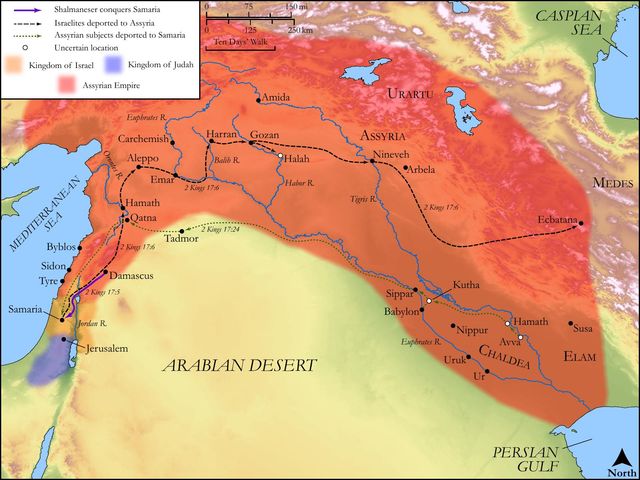
Never was land lost, we say, for want of an heir. When the children of Israel were dispossessed, and turned out of Canaan, the king of Assyria soon transplanted thither the supernumeraries of his own country, such as it could well spare, who should be servants to him and masters to the Israelites that remained; and here we have an account of these new inhabitants, whose story is related here that we may take our leave of Samaria, as also of the Israelites that were carried captive into Assyria.
I.Concerning the Assyrians that were brought into the land of Israel we are here told,
1.That they possessed Samaria and dwelt in the cities thereof, Kg2 17:24. It is common for lands to change their owners, but sad that the holy land should become a heathen land again. See what work sin makes.
2.That at their first coming God sent lions among them. They were probably insufficient to people the country, which occasioned the beasts of the field to multiply against them (Exo 23:29); yet, besides the natural cause, there was a manifest hand of God in it, who is Lord of hosts, of all the creatures, and can serve his own purposes by which he pleases, small or great, lice or lions. God ordered them this rough welcome to check their pride and insolence, and to let them know that though they had conquered Israel the God of Israel had power enough to deal with them - that he could have prevented their settling here, by ordering lions into the service of Israel, and that he permitted it, not for their righteousness, but the wickedness of his own people - and that they were now under his visitation. They had lived without God in their own land, and were not plagued with lions; but, if they do so in this land, it is at their peril.
3.That they sent a remonstrance of this grievance to the king their master, setting forth, it is likely, the loss their infant colony had sustained by the lions and the continual fear they were in of them, and stating that they looked upon it to be a judgment upon them for not worshipping the God of the land, which they could not, because they knew not how, Kg2 17:26. The God of Israel was the God of the whole world, but they ignorantly call him the God of the land, apprehending themselves therefore within his reach, and concerned to be upon good terms with him. Herein they shamed the Israelites, who were not so ready to hear the voice of God's judgments as they were, and who had not served the God of that land, though he was the God of their fathers and their great benefactor, and though they were well instructed in the manner of his worship. Assyrians begged to be taught that which Israelites hated to be taught.
4.That the king of Assyria took care to have them taught the manner of the God of the land (Kg2 17:27, Kg2 17:28), not out of any affection to that God, but to save his subjects from the lions. On this errand he sent back one of the priests whom he had carried away captive. A prophet would have done them more good, for this was but one of the priests of the calves, and therefore chose to dwell at Bethel for old acquaintance' sake, and, though he might teach them to do better than they did, he was not likely to teach them to do well, unless he had taught his own people better. However, he came and dwelt among them, to teach them how they should fear the Lord. Whether he taught them out of the book of the law, or only by word of mouth, is uncertain.
5.That, being thus taught, they made a mongrel religion of it, worshipped the God of Israel for fear and their own idols for love (Kg2 17:33): They feared the Lord, but they served their own gods. They all agreed to worship the God of the land according to the manner, to serve the Jewish festivals and rites of sacrificing, but every nation made gods of their own besides, not only for their private use in their own families, but to be put in the houses of their high places, Kg2 17:9. The idols of each country are here named, Kg2 17:30, Kg2 17:31. The learned are at a loss for the signification of several of these names, and cannot agree by what representations these gods were worshipped. If we may credit the traditions of the Jewish doctors, they tell us that Succoth-Benoth was worshipped in a hen and chickens, Nergal in a cock, Ashima in a smooth goat, Nibhaz in a dog, Tartak in an ass, Adrammelech in a peacock, Anammelech in a pheasant. Our own tell us, more probably, that Succoth-Benoth (signifying the tents of the daughters) was Venus. Nergal, being worshipped by the Cuthites, or Persians, was the fire, Adrammelech and Anammelech were only distinctions of Moloch. See how vain idolaters were in their imaginations, and wonder at their sottishness. Our very ignorance concerning these idols teaches us the accomplishment of that word which God has spoken, that these false gods should all perish (Jer 10:11); they are all buried in oblivion, while the name of the true God shall continue for ever.
6.This medley superstition is here said to continue unto this day (Kg2 17:41), till the time when this book was written and long after, above 300 years in all, till the time of Alexander the Great, when Manasse, brother to Jaddus the high priest of the Jews, having married the daughter of Sanballat, governor of the Samaritans, went over to them, got leave of Alexander to build a temple in Mount Gerizim, drew over many of the Jews to him, and prevailed with the Samaritans to cast away all their idols and to worship the God of Israel only; yet their worship was mixed with so much superstition that our Saviour told them they knew not what they worshipped, Joh 4:22.
II.Concerning the Israelites that were carried into the land of Assyria.
This historian has occasion to speak of them (Kg2 17:22), showing that their successors in the land did as they had done (after the manner of the nations whom they carried away), they worshipped both the God of Israel and those other gods; but what did the captives do in the land of their affliction? Were they reformed, and brought to repentance, by their troubles? No, they did after the former manner, Kg2 17:34. When the two tribes were afterwards carried into Babylon, they were cured by it of their idolatry, and therefore, after seventy years, they were brought back with joy; but the ten tribes were hardened in the furnace, and therefore were justly lost in it and left to perish. This obstinacy of theirs is here aggravated by the consideration,
1.Of the honour God had put upon them, as the seed of Jacob, whom he named Israel, and from him they were so named, but were a reproach to that worthy name by which they were called.
2.Of the covenant he made with them, and the charge he gave them upon that covenant, which is here very fully recited, that they should fear and serve the Lord Jehovah only, who had brought them up out of Egypt (Kg2 17:36), that, having received his statutes and ordinances in writing, they should observe to do them for evermore (Kg2 17:37), and never forget that covenant which God had made with them, the promises and conditions of that covenant, especially that great article of it which is here thrice repeated, because it had been so often inculcated and so much insisted on, that they should not fear other gods. He had told them that, if they kept close to him, he would deliver them out of the hand of all their enemies (Kg2 17:39); yet when they were in the hand of their enemies, and stood in need of deliverance, they were so stupid, and had so little sense of their own interest, that they did after the former manner (Kg2 17:40), they served both the true God and false gods, as if they knew no difference. Ephraim is joined to idols, let him alone. So they did, and so did the nations that succeeded them. Well might the apostle ask, What then, Are we better than they? No, in no wise, for both Jews and Gentiles are all under sin, Rom 3:9.
Continue studying 2 Kings 17:38 across the web’s major study libraries — every link below opens this exact verse, chapter, or book on the destination site.
Read & Compare
 BibleGatewayThis verse in more than 200 translations and 70 languages.
 Bible.comThe YouVersion reader — hundreds of translations, reading plans, and highlights.
 ESV.orgCrossway's official English Standard Version reader.
 NET BibleThe NET translation with 60,000+ translators' notes on every rendering decision.
 STEP BibleTyndale House's free study tool — original text, vocabulary, and scholarly resources.
 BibliaLogos Bible Software's free web reader.
 USCCBThe New American Bible (Revised Edition) with the U.S. bishops' study notes.
Commentaries
 BibleHub CommentariesDozens of classic commentaries on this verse, gathered on one page.
 StudyLightMore than 100 commentary sets — the largest collection on the web.
 BibleRefPlain-English commentary on what this verse means, verse by verse.
 Enduring WordDavid Guzik's free commentary on this chapter, widely used by Bible teachers.
 Bible Study ToolsVerse commentary alongside Greek and Hebrew study aids.
Original Language & Research
- BibleHub InterlinearThe verse word by word — original language, transliteration, and English.
- BibleHub LexiconEvery word's original-language definition and Strong's entry.
 Blue Letter BibleDeep-study tools — Strong's numbers, concordance, and word studies.
 SefariaThe Hebrew text with Rashi and centuries of Jewish commentary.
Sermons, Hymns & Audio


TrulyRandomVerse is not affiliated with these sites and doesn’t control their content. They’re linked because they’re genuinely useful.
Summary
Second Kings 17:38 serves as a profound encapsulation of Yahweh's covenantal demands upon Israel, specifically highlighting the twin pillars of covenant fidelity and exclusive worship. Situated amidst the tragic account of the Northern Kingdom's exile, this divine command underscores the foundational principles that, when neglected, inevitably led to national apostasy and divine judgment, serving as a timeless reminder of God's unwavering expectation of singular devotion from His people.
Context
ShowHideLiterary Context
This verse is deeply embedded within the somber narrative of 2 Kings 17, which recounts the final demise of the Northern Kingdom of Israel (Samaria) and its subsequent exile by the Assyrians. The chapter meticulously details the long history of Israel's persistent disobedience, particularly their abandonment of the Mosaic covenant and their rampant idolatry. Verse 38, though a general principle echoing earlier commands from the Torah, is strategically placed here as a direct divine indictment, emphasizing that Israel's catastrophic judgment was not arbitrary but a direct and inevitable consequence of their failure to heed such clear warnings. It functions as a summary statement of the very failures that led to their downfall, providing the theological rationale for the exile described in 2 Kings 17:6-18. The verse acts as a divine commentary on the preceding narrative of apostasy, clarifying that the nation's spiritual amnesia and syncretistic worship were direct violations of their foundational agreement with God.
Historical & Cultural Context
The fall of Samaria in 722 BCE to the Assyrian Empire under Sargon II marked a pivotal and devastating moment in Israelite history. The Assyrian policy of deportation and resettlement, vividly described in 2 Kings 17:24, aimed to break national identity and prevent rebellion by mixing populations. Foreign peoples brought into Samaria subsequently engaged in syncretistic religious practices—mixing their own pagan worship with a superficial reverence for Yahweh—further illustrating the very spiritual compromise and "fearing other gods" that this verse condemns. The concept of "covenant" (Hebrew: b'rit) was well understood in Israel, where men bound themselves by covenant, as Joshua did with the Gibeonites, and where at Sinai the LORD set His terms before the people, demanding loyalty and promising blessing for obedience, and curses for rebellion. Israel's covenant with Yahweh, while familiar in its oaths and terms, was unique in its theological depth, demanding exclusive devotion to the one true God, a demand fundamentally violated by their adoption of foreign deities.
Key Themes
ShowHideThe verse powerfully articulates several core themes central to the Pentateuch and prophetic literature. Covenant Fidelity is paramount; the command "the covenant that I have made with you ye shall not forget" refers directly to the Mosaic Covenant established at Mount Sinai, which laid out Israel's unique relationship with Yahweh and their responsibilities, including obedience to His laws (Exodus 19:5-6). Forgetting this covenant was not mere amnesia but a deliberate disregard for its terms, leading to spiritual and moral decay, as warned in Deuteronomy 8:11. Exclusive Worship (Monotheism) is the second critical theme, encapsulated in "neither shall ye fear other gods." This is a direct prohibition against idolatry and polytheism, echoing the first two commandments (Exodus 20:3-5). The Hebrew word for "fear" (yare') here signifies not just dread but also reverence, awe, and devoted allegiance, underscoring God's demand for Israel's sole worship and devotion as the one true God. Finally, the chapter implicitly highlights the Consequences of Disobedience, demonstrating that Israel's failure to uphold these twin commands directly led to their national downfall and exile, a stark reminder of divine justice.
Exposition and Analysis
ShowHideKey Word Analysis
ShowHideFrom a root meaning "to cut," this term (H1285) denotes a solemn, binding agreement, often initiated by a superior party (God) with specific terms, obligations, and consequences for adherence or violation. In the context of Israel, the bᵉrîyth with Yahweh was foundational to their identity and relationship with Him, distinguishing them from other nations. It was not merely a contract but a relationship of grace and expectation, revealing God's character and His plan for His people. Forgetting this covenant, therefore, was not a simple memory lapse but a profound act of spiritual rebellion and a rejection of their very identity as God's chosen people.
While literally meaning "to mislay" or "to be oblivious of" (H7911) from want of memory or attention, in a biblical and covenantal context, shâkach implies far more than a failure of memory. It signifies a deliberate disregard, a neglect of duties, a turning away from established truths, or a failure to act in accordance with what is remembered. To "not forget" the covenant means to actively live by its terms, to keep its commands, and to remain loyal to the God who made it. Israel's "forgetting" was manifested in their idolatry, injustice, and disobedience.
This word (H3372) is rich in meaning, encompassing both a healthy dread or awe of God's power and judgment, and a reverent worship or allegiance. When applied to "other gods," it means not to give them reverence, loyalty, or worship. The command "neither shall ye fear other gods" is thus a call to exclusive devotion to Yahweh, prohibiting any form of idolatry or syncretism where other deities might receive the awe and allegiance due only to the one true God.
Verse Breakdown
ShowHide"And the covenant that I have made with you ye shall not forget"
This clause emphasizes the enduring nature and critical importance of the Mosaic Covenant. "The covenant" refers to the entire body of law, statutes, and promises given at Sinai, which established Israel as God's special possession and outlined the terms of their relationship. The prohibition "ye shall not forget" is a command for active remembrance and adherence. It implies a continuous, conscious commitment to the stipulations of the covenant, ensuring that Israel's daily life, worship, and national decisions were always aligned with God's revealed will. Forgetting the covenant was thus a spiritual and practical abandonment of their divine calling and a rejection of the very relationship that defined them.
"neither shall ye fear other gods"
This second clause directly addresses the core issue of idolatry and polytheism, which was a pervasive temptation among the nations round about and a constant struggle for Israel. The command "neither shall ye fear" uses yârêʼ in the sense of giving reverence, worship, or allegiance. It is a demand for exclusive devotion to Yahweh. This prohibition is not merely against the physical act of bowing down to idols but against any spiritual or practical allegiance to anything other than the one true God, whether it be foreign deities, human leaders, or worldly systems that claim ultimate authority or offer false security. It underscores God's jealousy for His unique relationship with His people and His absolute sovereignty over all creation.
Literary Devices
ShowHideThe verse employs several potent literary devices to convey its urgent message. The primary device is Parallelism, specifically a form of synonymous or antithetical parallelism, where the two clauses reinforce the same core theological truth: exclusive devotion to Yahweh. "Not forgetting the covenant" implicitly includes "not fearing other gods," as the covenant explicitly prohibits idolatry. Conversely, "fearing other gods" is a direct manifestation of "forgetting the covenant." There is also a strong Didactic tone, characteristic of covenantal warnings and prophetic pronouncements, aiming to instruct and admonish the audience about the consequences of their actions. The use of direct Command/Prohibition ("shall not forget," "neither shall ye fear") creates an authoritative and non-negotiable imperative, reflecting the divine speaker's absolute authority and the gravity of the demands. Furthermore, the verse functions as a Summary Statement within the broader narrative of 2 Kings 17, encapsulating the essence of Israel's historical failure and the divine rationale for their judgment, providing a concise theological explanation for the national catastrophe.
Theological and Thematic Connections
ShowHideSecond Kings 17:38 stands as a timeless theological principle, extending far beyond the historical context of ancient Israel. It underscores God's unchanging nature as a jealous God who demands exclusive worship and unwavering fidelity from His people. The "covenant" represents the framework of God's relationship with humanity, always initiated by His grace but requiring a faithful response. Israel's failure to remember and live by their covenant, manifested in their fear of other gods, reveals the human propensity for idolatry—the tendency to place trust, hope, and allegiance in anything other than the one true God. This verse serves as a perpetual warning against spiritual amnesia and the allure of competing loyalties, reminding us that true security and blessing are found only in singular devotion to the Lord, who alone is worthy of all worship and allegiance.
Reflection and Application
ShowHideFor believers today, 2 Kings 17:38 resonates with profound spiritual relevance. While we live under the New Covenant established in the blood of Jesus Christ, the underlying principles of fidelity and exclusive devotion to God remain foundational. We are called to "not forget" the new covenant—the glorious reality of God's grace, forgiveness, and promises revealed in Christ. This means actively remembering our redemption, our new identity in Him, and the commands of love and holiness that flow from our relationship with God. It requires a conscious, daily commitment to live out the implications of being reconciled to God through Christ. Furthermore, the command "neither shall ye fear other gods" challenges us to identify and dismantle modern "idols" in our lives. These are not necessarily carved images but anything that competes for our ultimate loyalty, trust, or affection: materialism, career success, self-worship, worldly approval, political ideologies, or even spiritual practices that subtly displace Christ from His rightful supremacy. Our "fear" (reverence, awe, allegiance) must be reserved for God alone, leading to a life of worship, obedience, and trust that reflects our singular devotion to Him, knowing that true freedom and abundant life are found only in Him.
Questions for Reflection
ShowHideFAQ
ShowHideWhat does "forgetting the covenant" truly mean in a biblical sense?
ShowHideIn the Bible, "forgetting the covenant" (Hebrew: shakach b'rit) is much more than a simple lapse of memory. It signifies a profound and active disregard, a neglect of one's obligations, and a failure to live in accordance with the terms of the covenant. For Israel, it meant failing to obey God's laws, turning away from His worship, and pursuing idolatry or injustice, thereby breaking the relationship established by God Himself. It implies a spiritual amnesia that leads to practical disobedience and a rejection of God's authority and grace, as seen in passages like Deuteronomy 8:11-14 where prosperity leads to forgetting God and His commands.
How does "fearing other gods" apply to believers today, given that we don't worship physical idols?
ShowHideWhile most modern believers do not bow down to physical idols, the principle of "fearing other gods" remains profoundly relevant. The Hebrew word yare' for "fear" encompasses reverence, awe, and devoted allegiance. Therefore, "fearing other gods" today means giving ultimate trust, loyalty, or worship to anything other than the one true God. This can manifest as idolatry of materialism, success, self, power, pleasure, or even ideologies and philosophies that subtly replace God as the ultimate authority or source of meaning in our lives. Anything that takes precedence over God in our hearts and actions can become an "other god," as warned against in Colossians 3:5, which equates greed with idolatry.
Christ-Centered Fulfillment
ShowHideSecond Kings 17:38, with its dual command to remember the covenant and fear God alone, finds its ultimate fulfillment and perfect realization in Jesus Christ. The Old Covenant, which Israel so tragically "forgot" and violated by "fearing other gods," was a shadow pointing to the perfect, eternal New Covenant established through Christ's atoning sacrifice. Jesus Himself is the embodiment of this New Covenant, fulfilling its righteous demands and providing the means for humanity to truly "not forget" God's grace and to "fear" (revere and worship) Him exclusively. Through His death and resurrection, Christ inaugurated a covenant written not on stone tablets but on the hearts of believers by the Holy Spirit (Jeremiah 31:33). He is the ultimate Lamb of God who takes away the sin of the world, freeing us from the bondage of idolatry and the fear of anything other than God (John 1:29). In Christ, we are empowered to give our singular devotion to God, for He has delivered us from the dominion of darkness and transferred us to the kingdom of His beloved Son (Colossians 1:13). Our "fear" of God is transformed from dread of judgment into a reverent awe and loving obedience, knowing that in Christ, we have access to the Father and are called to worship Him in spirit and truth (John 4:24). Thus, Jesus not only fulfills the covenant but enables us, by His Spirit, to live out the very fidelity and exclusive worship that Israel failed to maintain.