


2 Chronicles 31:18
Bible text: King James Version (1769 Blayney text) · Public domain
Bible text: King James Version with Strong's numbers · Public domain
Bible text: Berean Standard Bible · Public domain
Bible text: American Standard Version (1901) · Public domain
Bible text: World English Bible, Messianic edition · Public domain
Bible text: Geneva Bible (1599) · Public domain
Bible text: Young's Literal Translation · Public domain
- וּלְהִתְיַחֵשׂu·le·hit·ya·Chesand to genealogical enrolmentH3188Conj-w ¦ Prep-l ¦ V-Hithpael-InfVerb Hithpael Infinitive Constructוּandלְtoהִתְיַחֵשׂgenealogical enrolment
- בְּכָלbe·kholwith allH3605Prep-b ¦ N-mscNoun Singular Masculine Constructבְּwithכָלall
- טַפָּםta·Pamtheir little one[s]H2945N-msc ¦ 3mpNoun Singular Masculine Constructטַפָּlittle one[s]םtheir
- נְשֵׁיהֶםne·shei·Hemtheir wivesH802N-mpc ¦ 3mpNoun Plural Masculine Constructנְשֵׁיwivesהֶםtheir
- וּבְנֵיהֶםu·ve·nei·Hemand their sonsH1121Conj-w ¦ N-mpc ¦ 3mpNoun Plural Masculine Constructוּandבְנֵיsonsהֶםtheir
- וּבְנוֹתֵיהֶםu·ve·no·tei·Hemand their daughtersH1323Conj-w ¦ N-fpc ¦ 3mpNoun Plural Feminine Constructוּandבְנוֹתֵיdaughtersהֶםtheir
- לְכָלle·kholto allH3605Prep-l ¦ N-mscNoun Singular Masculine Constructלְtoכָלall
- קָהָלka·Hal[the] assemblyH6951N-msNoun Singular Masculine Absolute
- כִּיkiforH3588PrtParticle Conditional
- בֶאֱמוּנָתָםve·'e·mu·na·Tamin their faithfulnessH530Prep-b ¦ N-fsc ¦ 3mpNoun Singular Feminine Constructבֶinאֱמוּנָתָfaithfulnessםtheir
- יִתְקַדְּשׁוּyit·ka·de·shuthey had consecrated themselvesH6942V-Hithpael-Imperf-3mpVerb Hithpael Imperfect 3rd Plural Masculine
- קֹדֶשׁKo·deshholinessH6944N-msNoun Singular Masculine Absolute
English is a literal word-by-word gloss of the Hebrew, not the KJV's wording. Why?
This is the original text the KJV's translators worked from — each Hebrew word with its own literal English meaning in this verse, prepared by scholars at Tyndale House, Cambridge. The KJV translates whole sentences, not word by word, so its wording differs: one Hebrew word can become several English words, and the KJV may choose “the LORD” where the gloss reads “Yahweh”. Both are faithful — they answer different questions. For the KJV's own rendering, switch to the KJV text.
Details
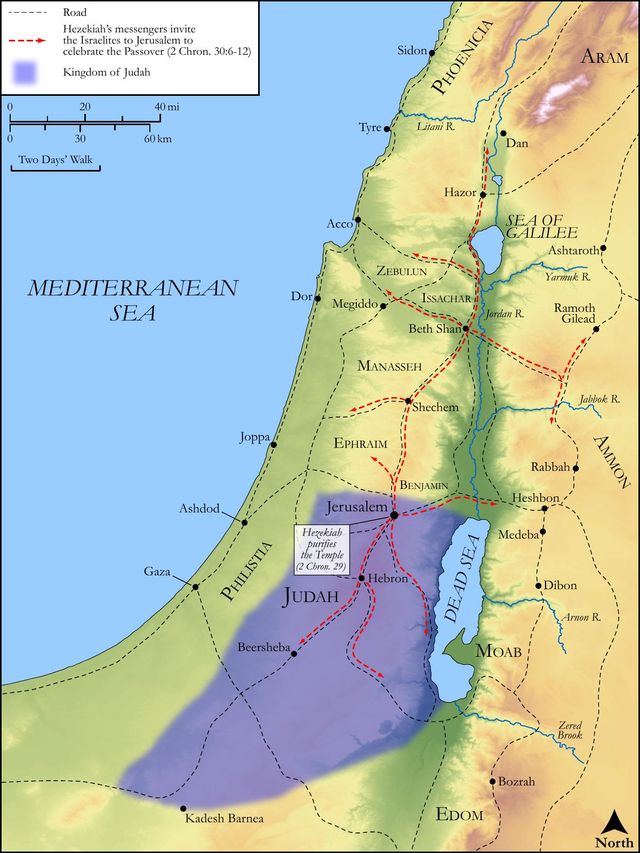
See on the biblical-era map
Study this verse
Public-domain commentary
Matthew Henry
From his Commentary on the Whole Bible. Henry comments on passages, not single verses — this entry covers 2 Chronicles 31:11–21. His three-level outline is real structure in the source text, so it is rendered as structure.
Here we have,
I.Two particular instances of the care of Hezekiah concerning church matters, having put them into good order, to keep them so. The tithes and other holy things being brought in, he provided,
1.That they should be carefully laid up, and not left exposed in loose heaps, liable to be wasted and embezzled. He ordered chambers to be made ready in some of the courts of the temple for store-chambers (Ch2 31:11), and into them the offerings were brought and there kept under lock and key, Ch2 31:12, Ch2 31:13. Treasures or store-keepers were appointed, who had the oversight of them, to see that moth and rust did not corrupt them nor thieves break through to steal. This wisdom of laying up the surplus in days of plenty we may learn from the ant, who provideth meat in summer. The laying up in store what was brought in was an encouragement to people to pay in their contributions. That will be given cheerfully by the public which appears to be well husbanded.
2.That they should be faithfully laid out, according to the uses they were intended for. Church treasures are not to be hoarded any longer than till there is occasion for them, lest even the rust should be a witness against those who hoard them. Officers were appointed, men (no doubt) of approved wisdom and faithfulness, to distribute the oblations of the Lord and the most holy things among the priests (Ch2 31:14), and to see that they all had a competent maintenance for themselves and their families. The law provided sufficient for them all, and therefore, if some had too little, it must be because others had too much; to prevent such inequality these officers were to go by some certain rule of proportion in the disposal of the incomes of the temple. It is said of the priests here (Ch2 31:18) that in their set office they sanctified themselves; in faith they sanctified themselves (so the word is), that is, as bishop Patrick explains it, they attended their ministry at the house of God, not doubting but they should be provided with all things necessary. Now, because they served God in that confidence, care was taken that they should not be made ashamed of their hope. Note, Those that sanctify themselves to God and his service in faith, believing that he will see them want for nothing that is good for them, shall certainly be fed. Out of the offerings of the Lord distribution was made,
(1.)To the priests in the cities (Ch2 31:15), who staid at home while their brethren went to Jerusalem, and did good there in teaching the good knowledge of the Lord. The preaching priests were maintained as well as the sacrificing priests, and those that abode by the stuff as well as those that warred the warfare.
(2.)To those that entered into the house of the Lord, all the males from three years old and upwards; for the male children even at that tender age, it seems, were allowed to come into the temple with their parents, and shared with them in this distribution, Ch2 31:16.
(3.)Even the Levites from twenty years old and upwards had their share, Ch2 31:17.
(4.)The wives and children of the priests and Levites had a comfortable maintenance out of those offerings, Ch2 31:18. In maintaining ministers, regard must be had to their families, that not they only, but theirs, may have food convenient. In some countries where ministers have their salary paid them by the state an addition is made to it upon the birth of a child.
(5.)The priests in the country, that lived in the fields of the suburbs, were not overlooked in this ministration, Ch2 31:19. Those also had their share who were inhabitants of the villages, though they might be supposed to live at a less expense.
II.A general character of Hezekiah's services for the support of religion, Ch2 31:20, Ch2 31:21.
1.His pious zeal reached to all the parts of his kingdom: Thus he did throughout all Judah; every part of the country, and not those only that lay next him, shared in the good fruits of his government.
2.He sincerely designed to please God, and approved himself to him in all he did: He wrought that which was good before the Lord his God; all his care was to do that which should be accepted of God, which was right (that is, agreeable to natural equity), and truth (that is, agreeable to divine revelation and his covenant with God), before the Lord; to do according to that law which is holy, just, and good.
3.What he began he went through with, prosecuted it with vigour, and did it with all his heart.
4.All his good intentions were brought to a good issue; whatever he did in the service of the house of God, and in the government of his kingdom, he prospered in it. Note, What is undertaken with a sincere regard to the glory of God will succeed to our own honour and comfort at last.
Continue studying 2 Chronicles 31:18 across the web’s major study libraries — every link below opens this exact verse, chapter, or book on the destination site.
Read & Compare
 BibleGatewayThis verse in more than 200 translations and 70 languages.
 Bible.comThe YouVersion reader — hundreds of translations, reading plans, and highlights.
 ESV.orgCrossway's official English Standard Version reader.
 NET BibleThe NET translation with 60,000+ translators' notes on every rendering decision.
 STEP BibleTyndale House's free study tool — original text, vocabulary, and scholarly resources.
 BibliaLogos Bible Software's free web reader.
 USCCBThe New American Bible (Revised Edition) with the U.S. bishops' study notes.
Commentaries
 BibleHub CommentariesDozens of classic commentaries on this verse, gathered on one page.
 StudyLightMore than 100 commentary sets — the largest collection on the web.
 BibleRefPlain-English commentary on what this verse means, verse by verse.
 Enduring WordDavid Guzik's free commentary on this chapter, widely used by Bible teachers.
 Bible Study ToolsVerse commentary alongside Greek and Hebrew study aids.
Original Language & Research
- BibleHub InterlinearThe verse word by word — original language, transliteration, and English.
- BibleHub LexiconEvery word's original-language definition and Strong's entry.
 Blue Letter BibleDeep-study tools — Strong's numbers, concordance, and word studies.
 SefariaThe Hebrew text with Rashi and centuries of Jewish commentary.
Sermons, Hymns & Audio


TrulyRandomVerse is not affiliated with these sites and doesn’t control their content. They’re linked because they’re genuinely useful.
Summary
2 Chronicles 31:18 meticulously details the comprehensive provision for the Levitical priests and their families during King Hezekiah's extensive religious reforms. This verse underscores that the widespread support, extending to every member of their households, was not only meticulously administered based on accurate genealogical records but was also fundamentally predicated upon their personal and collective consecration to God in their sacred service. It highlights the divine expectation for those ministering in the Temple to maintain a state of holiness, which in turn legitimized their service and qualified them and their families for the community's faithful sustenance.
Context
ShowHideLiterary Context
This verse is strategically placed within the larger narrative of King Hezekiah's sweeping religious revival, detailed in 2 Chronicles 29-31. Following the spiritual decline under previous kings, Hezekiah initiated a radical return to Yahweh worship. Chapters 29 and 30 recount the cleansing and rededication of the Temple, the re-establishment of proper sacrificial worship, and the joyous, albeit belated, celebration of Passover. Chapter 31 then shifts focus to the practical organization and sustained support of the priests and Levites, who were essential for maintaining the revived worship. After the people's overwhelming generosity in bringing tithes and offerings (2 Chronicles 31:5-10), Hezekiah commanded the construction of storage chambers for these provisions (2 Chronicles 31:11). Verses 12-19 elaborate on the meticulous administration and equitable distribution of these provisions to all who served, from the highest priests to the lowest gatekeepers, and crucially, to their entire families, based on their divisions and verified genealogical records. 2 Chronicles 31:18 specifically emphasizes the inclusion of the entire household and the foundational requirement of their holiness.
Historical & Cultural Context
King Hezekiah's reign (c. 715-686 BC) marked a pivotal moment in Judah's history, succeeding the idolatrous rule of King Ahaz, who had desecrated the Temple and promoted pagan practices. Hezekiah's reforms were a deliberate and thorough effort to restore adherence to the Mosaic Law and the covenant with Yahweh. In ancient Israel, the Levites, chosen by God for Temple service, did not receive a tribal land inheritance; their livelihood was divinely ordained to come from the tithes and offerings of the other tribes, as stipulated in the Law (e.g., Numbers 18:21-24). Genealogical records were of paramount importance in Israelite society, particularly for the priesthood, serving as the bedrock for establishing lineage, legitimacy for service, and entitlement to provisions (e.g., Ezra 2:62). The concept of "holiness" (Hebrew: qodesh) was central to their identity and function, signifying separation from the common and dedication exclusively to God, which necessitated both ritual purity and moral integrity.
Key Themes
ShowHideThis verse significantly contributes to several overarching themes within 2 Chronicles and the broader biblical narrative. Firstly, it highlights Divine Provision and Stewardship, illustrating God's established design for His dedicated servants to be sustained by the community's offerings, and simultaneously emphasizing the human responsibility to administer these sacred resources with integrity and faithfulness. Secondly, Holiness and Consecration in Service emerges as a dominant theme, unequivocally linking the right to receive support to the spiritual purity and dedicated service of the Levites. Their "set office" was not merely a civic duty but a sacred calling demanding genuine commitment to God, echoing the divine standard articulated in Leviticus 10:3. Thirdly, Order and Accountability are clearly evident in the explicit mention of "genealogy" and the phrase "through all the congregation," underscoring the meticulous organization and transparent fair sharing of goods, which ensured fairness, legitimacy, and prevented abuse. Lastly, the inclusive mention of "little ones, their wives, and their sons, and their daughters" profoundly emphasizes the theme of Family Support for Ministry, acknowledging that the dedication of the Levites encompassed their entire household. This signifies that God's care and the community's support extended holistically to the whole family unit, reflecting the communal nature of the covenant and the comprehensive care for those consecrated to God's service, reminiscent of principles found in Deuteronomy 12:12.
Exposition and Analysis
ShowHideKey Word Analysis
ShowHideFrom a primitive root meaning "to sprout," used as a denominative to mean "to enroll by pedigree." In this context, it refers to a meticulously kept registration or genealogical record. Its presence here underscores the orderly and legitimate nature of Hezekiah's reforms, ensuring that only those truly belonging to the Levitical families, and thus divinely qualified for service and support, received the provisions. This emphasis on lineage affirmed the established divine order for Temple service.
A primitive root meaning "to be (causatively, make, pronounce or observe as) clean (ceremonially or morally)." This verb signifies "to be set apart," "to be consecrated," or "to be made holy." For the Levites, it denotes their ritual and moral purification, rendering them fit for sacred service. It implies a deliberate, active, and ongoing process of dedication and separation from the common or profane, which was absolutely essential for approaching God and ministering in His holy Temple.
From the root qâdash, this noun refers to a sacred place or thing, and abstractly, sanctity. When used in conjunction with the verb "sanctified," as in "sanctified themselves in holiness," it forms an emphatic construction, powerfully stressing the absolute, genuine, and profound nature of their consecration. It encompasses not merely ceremonial purity but also an internal spiritual and moral integrity, reflecting the very character of God Himself (Leviticus 11:44).
Verse Breakdown
ShowHide"And to the genealogy of all their little ones, their wives, and their sons, and their daughters, through all the congregation:"
This opening clause comprehensively delineates the recipients of the provision. It clarifies that the support extended beyond the individual serving Levites to encompass their entire households. The phrase "to the genealogy" highlights that this distribution was not arbitrary but was rigorously based on official, meticulously maintained records, ensuring fairness, proper identification, and accountability for those entitled to sustenance. The enumeration of "little ones, their wives, and their sons, and their daughters" functions as a merism, signifying all members of the family unit, irrespective of age or gender, thereby underscoring the holistic and inclusive nature of the provision. The concluding phrase "through all the congregation" implies that this systematic and organized approach was applied consistently across all Levitical divisions and locations where they served, reflecting a unified and well-managed effort.
"for in their set office they sanctified themselves in holiness:"
This pivotal causal clause, introduced by "for," provides the essential rationale and condition for receiving such comprehensive support. It firmly establishes that the provision was not merely an entitlement based on lineage but was a direct consequence of their spiritual state and dedicated service. "In their set office" refers to their divinely appointed roles and duties as Levites, implying the specific functions they were consecrated to perform. The powerful phrase "they sanctified themselves in holiness" signifies their active, ongoing, and profound commitment to both ritual purity and moral integrity. This spiritual prerequisite was indispensable for their legitimate service and, consequently, for the sustenance of their families. Thus, their spiritual devotion was intrinsically and directly linked to their material provision.
Literary Devices
ShowHideThe verse effectively employs several literary devices to convey its profound message. Merism is prominently featured in the comprehensive listing of "their little ones, their wives, and their sons, and their daughters." This exhaustive enumeration serves to emphasize that every single member of the Levitical household was included in the provision, thereby underscoring the thoroughness and all-encompassing nature of the support system. The phrase "sanctified themselves in holiness" utilizes Emphasis through the repetition of the Hebrew root q-d-sh (verb "sanctified" and noun "holiness"), creating a forceful and unequivocal declaration of the absolute and genuine nature of their consecration. This emphatic construction highlights the fundamental requirement of spiritual purity for their sacred service. Furthermore, the use of the causal conjunction "for" introduces a Causal Clause, explicitly and directly linking the provision for the Levitical families to the spiritual condition and dedicated service of the Levites themselves. This establishes a clear and foundational theological principle: divine and communal support is intricately contingent upon faithful, consecrated service.
Theological and Thematic Connections
ShowHideThis verse powerfully illustrates the principle of reciprocal commitment within God's covenant relationship. God, in His faithfulness, provides for His servants, and the community is divinely mandated to facilitate that provision. However, this support is fundamentally contingent upon the servants' unwavering faithfulness and profound consecration. It underscores that true ministry transcends mere professional occupation; it is a sacred calling demanding a life wholly set apart for God. The meticulous record-keeping and the comprehensive family support demonstrate God's profound concern for divine order, justice, and the holistic well-being of those dedicated to His service. This Old Testament principle serves as a profound foreshadowing of the New Testament understanding of ministerial support and the universal call to holiness for all believers, recognizing that our service to God flows directly from our sanctified relationship with Him.
Reflection and Application
ShowHide2 Chronicles 31:18 offers profound and enduring insights for contemporary believers, particularly for those engaged in formal ministry and for the wider church community. It serves as a powerful reminder that dedicated service to God is rarely a solitary endeavor; it often involves and impacts the entire family unit. Consequently, the church bears a significant responsibility to faithfully and generously support those who commit their lives to ministry, thereby enabling them to focus on their sacred duties without undue worldly anxieties or distractions. This support, mirroring Hezekiah's reforms, should be administered with the utmost integrity, transparency, and meticulous care, reflecting a divine order. More broadly, the verse's emphatic call to "sanctified themselves in holiness" stands as a timeless and universal summons to all believers. Whether in formal vocational ministry or in the daily rhythms of life, our service to God is truly effective and pleasing to Him only when it emanates from a heart and life genuinely set apart for His purposes. Our outward actions for God are fundamentally rooted in an inward, ongoing commitment to purity and devotion. This implies actively pursuing holiness, not merely as a ceremonial or legalistic act, but as a genuine, continuous transformation of character, recognizing that our walk with God profoundly impacts our capacity to serve Him and our witness to a watching world.
Questions for Reflection
ShowHideFAQ
ShowHideWas the provision for the Levites purely based on their genealogy, or was their spiritual state also a factor?
ShowHideWhile genealogy was undeniably crucial for establishing legitimate lineage and entitlement to service, 2 Chronicles 31:18 explicitly states, "for in their set office they sanctified themselves in holiness." This causal clause unequivocally indicates that their spiritual state and active, ongoing dedication to holiness were a fundamental and non-negotiable prerequisite for receiving the comprehensive provisions. It was not merely a matter of birthright; it was also profoundly contingent upon their sustained spiritual integrity and their active consecration in their sacred duties. This principle of spiritual qualification alongside lineage is a recurring and vital theme in the Old Testament priesthood, consistently emphasizing that proximity to God's holiness necessitated personal purity and devotion.
What does "sanctified themselves in holiness" imply for believers today who are not priests or Levites?
ShowHideWhile the specific context of this verse applies to the Levitical priests and their unique role, the underlying principle of being "set apart" for God's purposes applies universally to all believers under the New Covenant. 1 Peter 2:9 powerfully describes all Christians as a "royal priesthood" and a "holy nation." Therefore, just as the Levites were called to maintain ritual and moral purity for their specific service, Christians are called to live lives of holiness, actively separated from sin and wholly dedicated to God in every facet of their existence (Romans 12:1-2). This involves a continuous, dynamic process of spiritual growth, unwavering moral integrity, and an active pursuit of God's will, enabling us to serve Him effectively in our diverse callings and vocations.
Christ-Centered Fulfillment
ShowHide2 Chronicles 31:18, with its profound emphasis on a consecrated priesthood sustained by the community and qualified by a life of holiness, finds its ultimate and perfect fulfillment in the person and work of Jesus Christ and the New Covenant He inaugurated. The Old Testament Levitical system, with its inherent need for ongoing purification and communal provision, served as a powerful pointer to the perfect High Priest, Jesus. He "sanctified" Himself not through ritual or lineage, but through His impeccably sinless life and His singular, once-for-all, all-sufficient sacrifice on the cross (John 17:19 and Hebrews 7:27). His holiness was not acquired but inherent, absolute, and eternal, making Him the only one truly qualified to mediate perfectly between a holy God and sinful humanity. Under the New Covenant, the need for a distinct, genealogically defined priestly class to receive communal sustenance in this manner is transformed, as all believers are now, by virtue of their union with Christ, part of a "royal priesthood" (1 Peter 2:9), called to offer spiritual sacrifices of praise and good works (Hebrews 13:15-16). While the church still rightly supports those dedicated to full-time gospel ministry (1 Timothy 5:17-18), the ultimate provision for our spiritual needs and the very foundation of our access to God is found solely in Christ's perfect work. His complete holiness and sacrificial offering ensure that all who are "in Him" are made holy and are eternally sustained by His boundless grace, no longer dependent on genealogical records or imperfect human sanctification for their standing before God (Colossians 1:22).