


2 Chronicles 31:15
Bible text: King James Version (1769 Blayney text) · Public domain
Bible text: King James Version with Strong's numbers · Public domain
Bible text: Berean Standard Bible · Public domain
Bible text: American Standard Version (1901) · Public domain
Bible text: World English Bible, Messianic edition · Public domain
Bible text: Geneva Bible (1599) · Public domain
Bible text: Young's Literal Translation · Public domain
- וְעַלve·'aland [were] onH5921Conj-w ¦ PrepPrepositionוְandעַל[were] on
- יָדוֹya·Dohis handH3027N-csc ¦ 3msNoun Singular common gender Constructיָדhandוֹhis
- עֵדֶן'E·denEdenH5731N-proper-mNoun Proper Masculine
- וּמִנְיָמִןU·min·ya·minand MiniaminH4509Conj-w ¦ N-proper-mNoun Proper MasculineוּandמִנְיָמִןMiniamin
- וְיֵשׁוּעַve·ye·Shu·a'and JeshuaH3442Conj-w ¦ N-properNoun Proper LocationוְandיֵשׁוּעַJeshua
- וּשְׁמַעְיָהוּu·she·ma'·Ya·huand ShemaiahH8098Conj-w ¦ N-proper-mNoun Proper MasculineוּandשְׁמַעְיָהוּShemaiah
- אֲמַרְיָהוּ'a·mar·Ya·huAmariahH568N-proper-mNoun Proper Masculine
- וּשְׁכַנְיָהוּu·she·khan·Ya·huand ShecaniahH7935Conj-w ¦ N-proper-mNoun Proper MasculineוּandשְׁכַנְיָהוּShecaniah
- בְּעָרֵיbe·'a·Reiin [the] cities ofH5892Prep-b ¦ N-mpcNoun Plural Masculine Constructבְּinעָרֵי[the] cities of
- הַכֹּהֲנִיםha·ko·ha·Nimthe priestsH3548Art ¦ N-mpNoun Plural Masculine Absoluteהַtheכֹּהֲנִיםpriests
- בֶּאֱמוּנָהbe·'e·mu·Nahin faithfulnessH530Prep-b ¦ N-fsNoun Singular Feminine Absoluteבֶּinאֱמוּנָהfaithfulness
- לָתֵתla·Tetto distributeH5414Prep-l ¦ V-Qal-InfVerb Qal Infinitive Constructלָtoתֵתdistribute
- לַאֲחֵיהֶםla·'a·chei·Hemto their brothersH251Prep-l ¦ N-mpc ¦ 3mpNoun Plural Masculine Constructלַtoאֲחֵיbrothersהֶםtheir
- בְּמַחְלְקוֹתbe·mach·le·Kotby divisionsH4256Prep-b ¦ N-fpNoun Plural Feminine Absoluteבְּbyמַחְלְקוֹתdivisions
- כַּגָּדוֹלka·ga·Dolas the greatH1419Prep-k ¦ Adj-msAdjective Singular Masculine Absoluteכַּas theגָּדוֹלgreat
- כַּקָּטָןka·ka·Tanas the smallH6996Prep-k ¦ Adj-msAdjective Singular Masculine Absoluteכַּas theקָּטָןsmall
English is a literal word-by-word gloss of the Hebrew, not the KJV's wording. Why?
This is the original text the KJV's translators worked from — each Hebrew word with its own literal English meaning in this verse, prepared by scholars at Tyndale House, Cambridge. The KJV translates whole sentences, not word by word, so its wording differs: one Hebrew word can become several English words, and the KJV may choose “the LORD” where the gloss reads “Yahweh”. Both are faithful — they answer different questions. For the KJV's own rendering, switch to the KJV text.
Details
See on the biblical-era map
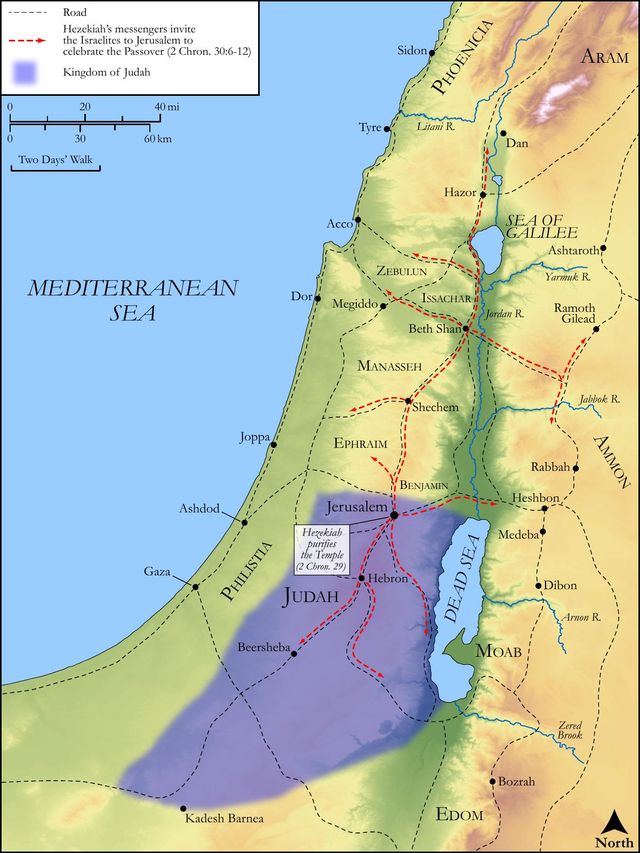
Study this verse
Public-domain commentary
Matthew Henry
From his Commentary on the Whole Bible. Henry comments on passages, not single verses — this entry covers 2 Chronicles 31:11–21. His three-level outline is real structure in the source text, so it is rendered as structure.
Here we have,
I.Two particular instances of the care of Hezekiah concerning church matters, having put them into good order, to keep them so. The tithes and other holy things being brought in, he provided,
1.That they should be carefully laid up, and not left exposed in loose heaps, liable to be wasted and embezzled. He ordered chambers to be made ready in some of the courts of the temple for store-chambers (Ch2 31:11), and into them the offerings were brought and there kept under lock and key, Ch2 31:12, Ch2 31:13. Treasures or store-keepers were appointed, who had the oversight of them, to see that moth and rust did not corrupt them nor thieves break through to steal. This wisdom of laying up the surplus in days of plenty we may learn from the ant, who provideth meat in summer. The laying up in store what was brought in was an encouragement to people to pay in their contributions. That will be given cheerfully by the public which appears to be well husbanded.
2.That they should be faithfully laid out, according to the uses they were intended for. Church treasures are not to be hoarded any longer than till there is occasion for them, lest even the rust should be a witness against those who hoard them. Officers were appointed, men (no doubt) of approved wisdom and faithfulness, to distribute the oblations of the Lord and the most holy things among the priests (Ch2 31:14), and to see that they all had a competent maintenance for themselves and their families. The law provided sufficient for them all, and therefore, if some had too little, it must be because others had too much; to prevent such inequality these officers were to go by some certain rule of proportion in the disposal of the incomes of the temple. It is said of the priests here (Ch2 31:18) that in their set office they sanctified themselves; in faith they sanctified themselves (so the word is), that is, as bishop Patrick explains it, they attended their ministry at the house of God, not doubting but they should be provided with all things necessary. Now, because they served God in that confidence, care was taken that they should not be made ashamed of their hope. Note, Those that sanctify themselves to God and his service in faith, believing that he will see them want for nothing that is good for them, shall certainly be fed. Out of the offerings of the Lord distribution was made,
(1.)To the priests in the cities (Ch2 31:15), who staid at home while their brethren went to Jerusalem, and did good there in teaching the good knowledge of the Lord. The preaching priests were maintained as well as the sacrificing priests, and those that abode by the stuff as well as those that warred the warfare.
(2.)To those that entered into the house of the Lord, all the males from three years old and upwards; for the male children even at that tender age, it seems, were allowed to come into the temple with their parents, and shared with them in this distribution, Ch2 31:16.
(3.)Even the Levites from twenty years old and upwards had their share, Ch2 31:17.
(4.)The wives and children of the priests and Levites had a comfortable maintenance out of those offerings, Ch2 31:18. In maintaining ministers, regard must be had to their families, that not they only, but theirs, may have food convenient. In some countries where ministers have their salary paid them by the state an addition is made to it upon the birth of a child.
(5.)The priests in the country, that lived in the fields of the suburbs, were not overlooked in this ministration, Ch2 31:19. Those also had their share who were inhabitants of the villages, though they might be supposed to live at a less expense.
II.A general character of Hezekiah's services for the support of religion, Ch2 31:20, Ch2 31:21.
1.His pious zeal reached to all the parts of his kingdom: Thus he did throughout all Judah; every part of the country, and not those only that lay next him, shared in the good fruits of his government.
2.He sincerely designed to please God, and approved himself to him in all he did: He wrought that which was good before the Lord his God; all his care was to do that which should be accepted of God, which was right (that is, agreeable to natural equity), and truth (that is, agreeable to divine revelation and his covenant with God), before the Lord; to do according to that law which is holy, just, and good.
3.What he began he went through with, prosecuted it with vigour, and did it with all his heart.
4.All his good intentions were brought to a good issue; whatever he did in the service of the house of God, and in the government of his kingdom, he prospered in it. Note, What is undertaken with a sincere regard to the glory of God will succeed to our own honour and comfort at last.
Continue studying 2 Chronicles 31:15 across the web’s major study libraries — every link below opens this exact verse, chapter, or book on the destination site.
Read & Compare
 BibleGatewayThis verse in more than 200 translations and 70 languages.
 Bible.comThe YouVersion reader — hundreds of translations, reading plans, and highlights.
 ESV.orgCrossway's official English Standard Version reader.
 NET BibleThe NET translation with 60,000+ translators' notes on every rendering decision.
 STEP BibleTyndale House's free study tool — original text, vocabulary, and scholarly resources.
 BibliaLogos Bible Software's free web reader.
 USCCBThe New American Bible (Revised Edition) with the U.S. bishops' study notes.
Commentaries
 BibleHub CommentariesDozens of classic commentaries on this verse, gathered on one page.
 StudyLightMore than 100 commentary sets — the largest collection on the web.
 BibleRefPlain-English commentary on what this verse means, verse by verse.
 Enduring WordDavid Guzik's free commentary on this chapter, widely used by Bible teachers.
 Bible Study ToolsVerse commentary alongside Greek and Hebrew study aids.
Original Language & Research
- BibleHub InterlinearThe verse word by word — original language, transliteration, and English.
- BibleHub LexiconEvery word's original-language definition and Strong's entry.
 Blue Letter BibleDeep-study tools — Strong's numbers, concordance, and word studies.
 SefariaThe Hebrew text with Rashi and centuries of Jewish commentary.
Sermons, Hymns & Audio


TrulyRandomVerse is not affiliated with these sites and doesn’t control their content. They’re linked because they’re genuinely useful.
Summary
2 Chronicles 31:15 meticulously records the appointment of six specific Levites—Eden, Miniamin, Jeshua, Shemaiah, Amariah, and Shecaniah—who were entrusted with the vital administrative responsibility of distributing the consecrated offerings and tithes. This divinely inspired and meticulously organized system, established under King Hezekiah's reforms, ensured that all priests and Levites, regardless of their status or assigned course of duty, received their rightful provisions equitably within their respective cities, thereby sustaining their dedicated service to God and preventing any neglect.
Context
ShowHideLiterary Context
This verse is deeply embedded within the broader narrative of King Hezekiah's profound religious reforms and the restoration of true worship in Judah, particularly following the cleansing and reconsecration of the Temple as detailed in 2 Chronicles 29. After the people's renewed faithfulness led to an overwhelming abundance of tithes and offerings, described in 2 Chronicles 31:5-10, a practical necessity arose for an organized system to manage and distribute these provisions. The preceding verses, 2 Chronicles 31:11-14, describe the establishment of storehouses and the appointment of key overseers and administrators like Kore. Verse 15 specifically names additional trusted individuals responsible for the equitable, decentralized distribution of these provisions "in the cities of the priests," ensuring that "their brethren by courses, as well to the great as to the small" were properly cared for. This highlights the crucial transition from spiritual revival to sustained, practical administration that undergirds faithful worship.
Historical & Cultural Context
King Hezekiah's reign (c. 715-686 BC) marked a pivotal period of spiritual resurgence after the severe apostasy and neglect of the Temple under his father, King Ahaz. Hezekiah's reforms aimed to reverse this decline and restore adherence to the Mosaic covenant. A cornerstone of this restoration was the proper support of the Levitical priesthood, who, unlike other tribes, possessed no tribal land inheritance and were entirely dependent on the tithes and offerings of the people for their livelihood, as stipulated in Mosaic Law (e.g., Numbers 18:21-24). The "cities of the priests" refer to the forty-eight Levitical cities scattered throughout Israel, where priests and Levites resided when not on duty at the Temple. The phrase "by courses" refers to the long-established system of priestly and Levitical divisions (meticulously detailed in 1 Chronicles 23-26) that rotated service at the Temple. This verse underscores the cultural and religious importance of administrative integrity in supporting the sacred institutions and those dedicated to their service, ensuring the continuity of worship and instruction.
Key Themes
ShowHideThis verse powerfully illustrates several enduring themes crucial to the life of God's people. Firstly, it emphasizes Organized Administration and Stewardship within God's kingdom. Hezekiah's reforms were not solely spiritual but also involved meticulous practical arrangements to ensure the proper management of sacred resources, reflecting God's character of order and accountability, a principle echoed in 1 Corinthians 14:40. Secondly, it highlights Equity and Comprehensive Care for God's Servants. The directive "to give to their brethren by courses, as well to the great as to the small" underscores a profound commitment to fairness, impartiality, and comprehensive provision for all who served God, preventing neglect and upholding the biblical principle of supporting those dedicated to spiritual service, a theme also found in Deuteronomy 14:28-29. Lastly, it speaks to Faithfulness in Appointed Roles. The individuals listed were "in their set office," indicating they were formally appointed and faithfully discharged their responsibilities, demonstrating that individual diligence and integrity are indispensable for the sustained operation and flourishing of God's work.
Exposition and Analysis
ShowHideKey Word Analysis
ShowHideThis term (H530, אֱמוּנָה) literally signifies "firmness" or "security," and figuratively "fidelity" or "faithfulness." In this context, it denotes a formally established and designated position of responsibility, implying not just an appointment but also the expectation of steadfastness, reliability, and integrity in discharging one's duties. It indicates that these individuals held official, recognized roles within the administrative structure, requiring unwavering faithfulness.
This word (H4256, מַחֲלֹקֶת) refers to "sections," "divisions," or "classes." It specifically points to the pre-existing, organized system of priestly and Levitical families who served in rotating shifts at the Temple in Jerusalem. This system, established by King David (e.g., 1 Chronicles 24), ensured that all eligible priests and Levites had an opportunity to serve and that their needs were met during their time of service and when they returned to their home cities.
This phrase (H1419, גָּדוֹל and H6996, קָטָן) is an idiomatic expression emphasizing universal reach and impartiality, meaning "both great and small," or "without distinction." It underscores the principle that the distribution of provisions was to be fair and equitable to all priests and Levites, regardless of their rank, seniority, or perceived importance. It ensures that no one, from the most prominent to the most humble servant, was overlooked or neglected in the provision.
Verse Breakdown
ShowHide"And next him [were] Eden, and Miniamin, and Jeshua, and Shemaiah, Amariah, and Shecaniah"
This clause provides a specific list of six individuals. These men were prominent Levites, likely chosen for their integrity, administrative capability, and trustworthiness, serving under the chief overseers (Kore and his assistants mentioned in 2 Chronicles 31:14). Their explicit naming highlights the meticulous organization and accountability within Hezekiah's reforms, emphasizing that specific, reliable persons were entrusted with significant responsibilities in managing sacred resources.
"in the cities of the priests"
This specifies the geographical scope of their administrative work. The distribution of provisions was not solely centralized at the Temple in Jerusalem but extended to the various Levitical cities throughout Judah where the priests and Levites resided. This decentralized approach ensured that provisions reached the ministers and their families where they lived, recognizing their dispersed nature and preventing hardship due to distance from Jerusalem.
"in [their] set office"
This phrase reiterates that these men were formally appointed and officially designated to their roles. Their work was not informal or ad-hoc but was part of an established, authorized administrative structure. This underscores the importance of order, official designation, and accountability in managing the sacred resources of the community, emphasizing the solemnity and responsibility of their positions.
"to give to their brethren by courses"
This defines the primary duty of these administrators: the systematic and equitable distribution of the consecrated offerings. "Their brethren" refers to the other priests and Levites who were part of the same spiritual and familial community. The phrase "by courses" indicates that the distribution followed the established divisions or rotations of service, ensuring that those who served received their due portion according to the pre-arranged schedule and structure of the Levitical ministry.
"as well to the great as to the small"
This final phrase encapsulates the principle of radical impartiality and comprehensive care that governed the distribution. It means that the provisions were to be fair and inclusive, without any favoritism or discrimination based on rank, status, or perceived importance. Every priest and Levite, from the most senior and influential to the most junior and humble, was to receive their rightful share, ensuring that the entire body of those serving God was adequately and justly provided for.
Literary Devices
ShowHideThe primary literary device at play in 2 Chronicles 31:15 is Enumeration or Listing, as evidenced by the specific naming of six individuals: Eden, Miniamin, Jeshua, Shemaiah, Amariah, and Shecaniah. This detailed listing serves to lend historical authenticity and precision to the narrative, emphasizing the concrete, practical nature of Hezekiah's reforms and the real people involved. It also highlights the importance of individual accountability within the larger administrative structure. Furthermore, the verse employs Emphasis through Detail, meticulously outlining not only who was appointed but also where ("in the cities of the priests"), how ("in their set office" and "by courses"), and to whom ("as well to the great as to the small"). This granular detail underscores the thoroughness and integrity of the system established by Hezekiah, reflecting a divine value for order, justice, and comprehensive care for those dedicated to sacred service. The Juxtaposition of "great as to the small" is a powerful rhetorical device that vividly conveys the principle of absolute impartiality and universal reach in the distribution, ensuring no one was overlooked.
Theological and Thematic Connections
ShowHide2 Chronicles 31:15 beautifully illustrates God's profound concern for order, justice, and the holistic well-being of those who serve Him. It reveals that spiritual revival is not merely an emotional or ritualistic experience but must translate into practical, organized systems that uphold righteousness and extend compassionate care throughout the community. The meticulous administration of tithes and offerings reflects a foundational divine principle: that God's people are called to be faithful stewards of the resources He provides, ensuring that those dedicated to ministry are adequately and justly supported. This support is not to be arbitrary but systematic, equitable, and impartial, reflecting God's own character of fairness and His valuing of every individual, regardless of their perceived status or position. The verse serves as a powerful reminder that the health and vitality of a spiritual community depend not only on fervent worship and spiritual zeal but also on diligent and just administration that extends comprehensive care to all its members.
Reflection and Application
ShowHideThis seemingly administrative verse offers profound and enduring lessons for contemporary believers and the church today. It reminds us that our faith is not solely about personal piety or individual spiritual experience but also about communal responsibility and practical stewardship within the body of Christ. Just as King Hezekiah ensured the meticulous management and equitable distribution of the people's offerings to support those serving God, we are called to be diligent and faithful stewards of all the resources—our time, talents, spiritual gifts, and finances—that God entrusts to us, both personally and corporately. This involves establishing clear systems, promoting transparent accountability, and ensuring that our resources are used efficiently, justly, and compassionately to advance God's kingdom. Furthermore, the powerful principle of caring for "great as to the small" challenges us to practice impartiality, generosity, and love within our spiritual communities. It compels us to ensure that all members, especially those who dedicate their lives to ministry or who might otherwise be overlooked, are valued, supported, and have their needs met. It calls us to consider how our churches and Christian organizations can embody this same spirit of equitable provision and administrative integrity, fostering environments where all can truly thrive in their service to God.
Questions for Reflection
ShowHideFAQ
ShowHideWhy are these specific names listed in 2 Chronicles 31:15?
ShowHideThe listing of specific names—Eden, Miniamin, Jeshua, Shemaiah, Amariah, and Shecaniah—serves several important purposes within the biblical narrative. Firstly, it lends historical authenticity and precision to the account, demonstrating that Hezekiah's far-reaching reforms were not vague ideals but concrete actions involving real people who held significant responsibilities. Secondly, it highlights the importance of individual accountability within the administrative structure of God's work. These men were entrusted with a vital and sacred duty, and their names memorialize their faithful service. It underscores that the success and sustained health of God's work often depend on the integrity, diligence, and specific contributions of individuals in their appointed roles. Ultimately, it emphasizes that God notices and values the faithful service of His servants, even in what might seem like purely administrative capacities.
What does "by courses" mean in the context of this verse?
ShowHideThe phrase "by courses" (Hebrew, machălôqeth') refers to the established and highly organized system of priestly and Levitical divisions or rotations for service in the Temple. King David had meticulously organized the descendants of Aaron and Levi into specific "courses" or groups (as detailed in 1 Chronicles 23-26) that would take turns serving at the Temple in Jerusalem throughout the year. When not on duty, these priests and Levites would return to their designated Levitical cities scattered across the land. Therefore, "to give to their brethren by courses" means that the administrators were to distribute the provisions to the priests and Levites systematically, according to their assigned divisions and where they resided, ensuring that all were provided for whether they were actively serving in Jerusalem or living in their home cities. This system ensured fairness, order, and comprehensive care for the entire Levitical body.
Christ-Centered Fulfillment
ShowHideWhile 2 Chronicles 31:15 vividly describes the administrative care for Old Testament priests and Levites, it subtly foreshadows the perfect and ultimate provision found in Christ. The Old Covenant system of tithes and offerings provided for the earthly ministers who facilitated access to God through sacrifices; this meticulous system, with its emphasis on order and equitable distribution, pointed to the divine order and God's desire to sustain those who serve Him. In the New Covenant, Jesus Christ is the great High Priest who offered the ultimate, once-for-all sacrifice, rendering the Levitical sacrificial system obsolete (Hebrews 7:27). Yet, the underlying principle of equitable provision and care for God's servants endures and is perfectly fulfilled in Christ's body, the Church. Just as the Levites were dependent on the offerings of the people, New Testament ministers are supported by the generosity of the church, enabling them to devote themselves fully to the ministry of the Word and prayer (Acts 6:4). Ultimately, Christ Himself is the inexhaustible source of all provision for His people, ensuring that every member of His body, "great as to the small," is nurtured, equipped, and sustained by His boundless grace (Ephesians 4:11-16). The administrative order seen in Hezekiah's reforms finds its perfect expression in the divine order of God's kingdom, where Christ perfectly cares for His church, guaranteeing that all who serve Him are ultimately sustained by His unfailing grace and sovereign provision.