


2 Chronicles 31:14
Bible text: King James Version (1769 Blayney text) · Public domain
Bible text: King James Version with Strong's numbers · Public domain
Bible text: Berean Standard Bible · Public domain
Bible text: American Standard Version (1901) · Public domain
Bible text: World English Bible, Messianic edition · Public domain
Bible text: Geneva Bible (1599) · Public domain
Bible text: Young's Literal Translation · Public domain
- וְקוֹרֵאve·ko·Re'and KoreH6981Conj-w ¦ N-proper-mNoun Proper MasculineוְandקוֹרֵאKore
- בֶןven[the] son ofH1121N-mscNoun Singular Masculine Construct
- יִמְנָהyim·NahImnahH3232N-proper-mNoun Proper Masculine
- הַלֵּוִיha·le·Vithe LeviteH3881Art ¦ N-msNoun Gentilic Singular Masculine AbsoluteהַtheלֵּוִיLevite
- הַשּׁוֹעֵרha·sho·'Erthe gatekeeperH7778Art ¦ N-msNoun Singular Masculine Absoluteהַtheשּׁוֹעֵרgatekeeper
- לַמִּזְרָחָהla·miz·Ra·chahto the east <towards>H4217Prep-l ¦ N-ms ¦ SfxNoun Singular Masculine Absoluteלַto theמִּזְרָחָeastה<towards>
- עַל'al[was] overH5921PrepPreposition
- נִדְבוֹתnid·Vot[the] freewill offerings ofH5071N-fpcNoun Plural Feminine Construct
- הָאֱלֹהִיםha·'E·lo·Him<the> GodH430Art ¦ N-mpNoun Plural Masculine Absoluteהָ<the>אֱלֹהִיםGod
- לָתֵתla·Tetto distributeH5414Prep-l ¦ V-Qal-InfVerb Qal Infinitive Constructלָtoתֵתdistribute
- תְּרוּמַתte·ru·Mat[the] contribution ofH8641N-fscNoun Singular Feminine Construct
- יְהוָהYah·wehYahwehH3068N-properNoun Proper Title
- וְקָדְשֵׁיve·ka·de·Sheiand [the] holy things ofH6944Conj-w ¦ N-mpcNoun Plural Masculine Constructוְandקָדְשֵׁי[the] holy things of
- הַקֳּדָשִׁיםha·ko·da·Shimthe holy thingsH6944Art ¦ N-mpNoun Plural Masculine Absoluteהַtheקֳּדָשִׁיםholy things
English is a literal word-by-word gloss of the Hebrew, not the KJV's wording. Why?
This is the original text the KJV's translators worked from — each Hebrew word with its own literal English meaning in this verse, prepared by scholars at Tyndale House, Cambridge. The KJV translates whole sentences, not word by word, so its wording differs: one Hebrew word can become several English words, and the KJV may choose “the LORD” where the gloss reads “Yahweh”. Both are faithful — they answer different questions. For the KJV's own rendering, switch to the KJV text.
Details
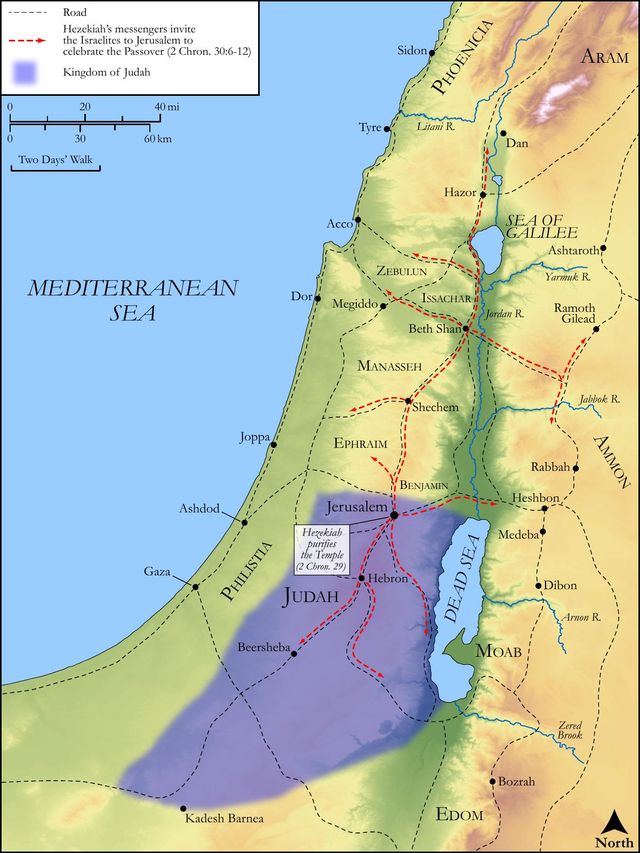
See on the biblical-era map
Study this verse
Public-domain commentary
Matthew Henry
From his Commentary on the Whole Bible. Henry comments on passages, not single verses — this entry covers 2 Chronicles 31:11–21. His three-level outline is real structure in the source text, so it is rendered as structure.
Here we have,
I.Two particular instances of the care of Hezekiah concerning church matters, having put them into good order, to keep them so. The tithes and other holy things being brought in, he provided,
1.That they should be carefully laid up, and not left exposed in loose heaps, liable to be wasted and embezzled. He ordered chambers to be made ready in some of the courts of the temple for store-chambers (Ch2 31:11), and into them the offerings were brought and there kept under lock and key, Ch2 31:12, Ch2 31:13. Treasures or store-keepers were appointed, who had the oversight of them, to see that moth and rust did not corrupt them nor thieves break through to steal. This wisdom of laying up the surplus in days of plenty we may learn from the ant, who provideth meat in summer. The laying up in store what was brought in was an encouragement to people to pay in their contributions. That will be given cheerfully by the public which appears to be well husbanded.
2.That they should be faithfully laid out, according to the uses they were intended for. Church treasures are not to be hoarded any longer than till there is occasion for them, lest even the rust should be a witness against those who hoard them. Officers were appointed, men (no doubt) of approved wisdom and faithfulness, to distribute the oblations of the Lord and the most holy things among the priests (Ch2 31:14), and to see that they all had a competent maintenance for themselves and their families. The law provided sufficient for them all, and therefore, if some had too little, it must be because others had too much; to prevent such inequality these officers were to go by some certain rule of proportion in the disposal of the incomes of the temple. It is said of the priests here (Ch2 31:18) that in their set office they sanctified themselves; in faith they sanctified themselves (so the word is), that is, as bishop Patrick explains it, they attended their ministry at the house of God, not doubting but they should be provided with all things necessary. Now, because they served God in that confidence, care was taken that they should not be made ashamed of their hope. Note, Those that sanctify themselves to God and his service in faith, believing that he will see them want for nothing that is good for them, shall certainly be fed. Out of the offerings of the Lord distribution was made,
(1.)To the priests in the cities (Ch2 31:15), who staid at home while their brethren went to Jerusalem, and did good there in teaching the good knowledge of the Lord. The preaching priests were maintained as well as the sacrificing priests, and those that abode by the stuff as well as those that warred the warfare.
(2.)To those that entered into the house of the Lord, all the males from three years old and upwards; for the male children even at that tender age, it seems, were allowed to come into the temple with their parents, and shared with them in this distribution, Ch2 31:16.
(3.)Even the Levites from twenty years old and upwards had their share, Ch2 31:17.
(4.)The wives and children of the priests and Levites had a comfortable maintenance out of those offerings, Ch2 31:18. In maintaining ministers, regard must be had to their families, that not they only, but theirs, may have food convenient. In some countries where ministers have their salary paid them by the state an addition is made to it upon the birth of a child.
(5.)The priests in the country, that lived in the fields of the suburbs, were not overlooked in this ministration, Ch2 31:19. Those also had their share who were inhabitants of the villages, though they might be supposed to live at a less expense.
II.A general character of Hezekiah's services for the support of religion, Ch2 31:20, Ch2 31:21.
1.His pious zeal reached to all the parts of his kingdom: Thus he did throughout all Judah; every part of the country, and not those only that lay next him, shared in the good fruits of his government.
2.He sincerely designed to please God, and approved himself to him in all he did: He wrought that which was good before the Lord his God; all his care was to do that which should be accepted of God, which was right (that is, agreeable to natural equity), and truth (that is, agreeable to divine revelation and his covenant with God), before the Lord; to do according to that law which is holy, just, and good.
3.What he began he went through with, prosecuted it with vigour, and did it with all his heart.
4.All his good intentions were brought to a good issue; whatever he did in the service of the house of God, and in the government of his kingdom, he prospered in it. Note, What is undertaken with a sincere regard to the glory of God will succeed to our own honour and comfort at last.
Continue studying 2 Chronicles 31:14 across the web’s major study libraries — every link below opens this exact verse, chapter, or book on the destination site.
Read & Compare
 BibleGatewayThis verse in more than 200 translations and 70 languages.
 Bible.comThe YouVersion reader — hundreds of translations, reading plans, and highlights.
 ESV.orgCrossway's official English Standard Version reader.
 NET BibleThe NET translation with 60,000+ translators' notes on every rendering decision.
 STEP BibleTyndale House's free study tool — original text, vocabulary, and scholarly resources.
 BibliaLogos Bible Software's free web reader.
 USCCBThe New American Bible (Revised Edition) with the U.S. bishops' study notes.
Commentaries
 BibleHub CommentariesDozens of classic commentaries on this verse, gathered on one page.
 StudyLightMore than 100 commentary sets — the largest collection on the web.
 BibleRefPlain-English commentary on what this verse means, verse by verse.
 Enduring WordDavid Guzik's free commentary on this chapter, widely used by Bible teachers.
 Bible Study ToolsVerse commentary alongside Greek and Hebrew study aids.
Original Language & Research
- BibleHub InterlinearThe verse word by word — original language, transliteration, and English.
- BibleHub LexiconEvery word's original-language definition and Strong's entry.
 Blue Letter BibleDeep-study tools — Strong's numbers, concordance, and word studies.
 SefariaThe Hebrew text with Rashi and centuries of Jewish commentary.
Sermons, Hymns & Audio


TrulyRandomVerse is not affiliated with these sites and doesn’t control their content. They’re linked because they’re genuinely useful.
Summary
Second Chronicles 31:14 introduces Kore, a Levite from the family of Imnah, who served in a pivotal administrative role during King Hezekiah's sweeping religious reforms. Identified as "the porter toward the east," Kore was entrusted with the weighty responsibility of overseeing and distributing the abundant freewill offerings, oblations, and "most holy things" that the people generously brought to the Temple. This verse highlights the meticulous organization, faithful stewardship, and profound reverence required to manage the sacred provisions intended for the priests and Levites, underscoring Hezekiah's unwavering commitment to restoring order, integrity, and divine provision within the worship life of Judah.
Context
ShowHideLiterary Context
This verse is strategically placed within the Chronicler's detailed account of King Hezekiah's comprehensive religious reforms, spanning 2 Chronicles 29-31. Following years of spiritual apostasy under King Ahaz, Hezekiah initiated a profound national revival. Chapters 29 and 30 vividly describe the cleansing and rededication of the Temple, the re-establishment of the Levitical courses, and a monumental Passover celebration, marking a renewed covenant relationship with God. The overwhelming response of the people, characterized by an unprecedented outpouring of tithes and offerings (as detailed in 2 Chronicles 31:5-10), created an immense surplus. This abundance necessitated a highly structured system for storage, management, and equitable distribution, which is precisely what 2 Chronicles 31:11-19 elaborates upon. Kore's specific appointment and duties as an overseer of these sacred provisions are presented as an integral component of this newly organized administrative framework, emphasizing that every function, no matter how seemingly mundane, was vital for maintaining the sanctity and efficacy of Temple worship and ensuring the proper sustenance of its ministers.
Historical & Cultural Context
King Hezekiah ruled Judah from approximately 715 to 686 BCE, a tumultuous era dominated by the encroaching power of the Assyrian Empire. His reforms represented a radical break from the idolatrous syncretism of his father, Ahaz, and aimed to centralize worship exclusively at the Jerusalem Temple, in strict accordance with Mosaic Law. The Levites, as the tribe divinely set apart for Temple service, fulfilled a wide array of roles, encompassing musical worship, teaching, gatekeeping, and complex administration. The "porter" (Hebrew: sho'er) was far more than a mere guard; this position often entailed significant administrative responsibilities, including managing the Temple treasuries, overseeing storerooms, and distributing portions of offerings to the priestly and Levitical classes. The system of offerings—comprising freewill gifts, obligatory contributions, and "most holy things"—was foundational to Israelite worship and crucial for the economic support of the priests and Levites, as meticulously prescribed in the Pentateuch (e.g., Numbers 18). Hezekiah's meticulous organization reflects a profound commitment to restoring Mosaic principles and ensuring the proper, reverent functioning of the national cult.
Key Themes
ShowHideKore's appointment and detailed responsibilities in 2 Chronicles 31:14 contribute significantly to several overarching themes present in this chapter and the broader book of Chronicles. Firstly, it powerfully illustrates the theme of Faithful Stewardship, highlighting the responsible and integrity-driven management of God's provisions and the community's resources. Kore's oversight of the offerings exemplifies the biblical call for faithfulness in all entrusted responsibilities, echoing principles articulated later in passages like 1 Corinthians 4:2. Secondly, the passage underscores the critical importance of Organized Worship and Ministry Support. The detailed administrative structure, including Kore's precise role, reveals Hezekiah's dedication to orderly worship and his commitment to ensuring that those serving in the Temple (priests and Levites) were adequately sustained, thereby preventing them from abandoning their sacred duties to seek livelihood (Nehemiah 13:10-14). Lastly, the explicit mention of "most holy things" emphasizes the theme of Holiness and Reverence, highlighting the supremely sacred nature of items dedicated to God and the exacting precision required in their handling and distribution. This reflects the pervasive biblical principle that God's presence, provisions, and worship demand the highest degree of respect, purity, and adherence to divine instruction.
Exposition and Analysis
ShowHideKey Word Analysis
ShowHideFrom the root meaning "to open" or "to gate," a shôwʻêr was a doorkeeper or gatekeeper. However, in the Temple context, this role was far more expansive than merely guarding entrances. Porters were often high-ranking officials responsible for managing the Temple treasuries, overseeing storerooms where offerings were kept, and distributing portions of the offerings to priests and Levites. Kore's designation as "the porter toward the east" indicates a specific, significant administrative post, likely involving the main eastern entrance and its associated storage facilities, from which the distribution of offerings would commence. This position demanded exceptional trustworthiness, integrity, and organizational skill.
Derived from a root meaning "to be willing" or "to volunteer," nᵉdâbâh refers to spontaneous, voluntary gifts given from a willing and generous heart, beyond any obligatory tithes or prescribed sacrifices. These offerings were expressions of profound gratitude, devotion, or the fulfillment of a vow. Their unprecedented abundance during Hezekiah's revival (2 Chronicles 31:5) powerfully signifies the people's renewed spiritual fervor and their generous, heartfelt response to God's grace, necessitating the careful management by trusted individuals like Kore.
While the full phrase is "holy of holies" (qôdesh haqqodashim), the root word qôdesh signifies a "sacred place or thing," or abstractly, "sanctity" or "holiness." When used in the plural or intensified, as here ("most holy things"), it denotes the highest category of sacred items, portions of sacrifices, or dedicated articles that were supremely set apart for God. These were often specific portions of grain offerings, sin offerings, or guilt offerings reserved exclusively for the priests to eat within the sacred precincts, or other items consecrated to the Lord that could not be consumed by laypersons. Kore's responsibility over these items underscores the extreme reverence, ritual purity, and precision required in handling God's dedicated provisions, ensuring their proper allocation according to Mosaic Law.
Verse Breakdown
ShowHide"And Kore the son of Imnah the Levite"
This opening clause precisely identifies the individual, Kore, establishing his lineage (son of Imnah) and his tribal affiliation (Levite). This detail is crucial, as it validates his legitimate claim to a role within the Temple administration, given that Levites were divinely appointed for such sacred service. His identity grounds the administrative structure in the established, God-ordained order of Israel.
"the porter toward the east"
This phrase delineates Kore's specific administrative function and his designated location within the expansive Temple complex. The "east gate" was a highly prominent and significant entrance, often associated with substantial traffic and considerable administrative oversight. His position indicates that he was a key point of access and control for the flow of offerings and resources into the Temple treasuries and storerooms.
"[was] over the freewill offerings of God"
This clause defines Kore's primary area of responsibility: the comprehensive oversight and meticulous management of the voluntary contributions brought by the people. The appended phrase "of God" profoundly emphasizes the divine ownership and inherently sacred nature of these gifts, highlighting the profound spiritual significance of Kore's administrative task, which transcended mere logistics.
"to distribute the oblations of the LORD"
This specifies Kore's active and crucial duty—the equitable distribution of "oblations." "Oblations" (Hebrew: terumah) were contributions, often "heave offerings" that were physically lifted up as a dedication to the Lord. This aspect of his role involved ensuring that these contributions, whether voluntary or more structured, reached their intended recipients, primarily the priests and other Levites, for their sustenance and the maintenance of their families.
"and the most holy things"
This final phrase adds the most sacred and ritually sensitive category of items to Kore's charge. His responsibility extended to the handling and precise distribution of the "most holy things," which were portions of sacrifices or dedicated items reserved exclusively for the priests. This underscores the extreme care, ritual purity, and strict adherence to Mosaic law required in fulfilling his duties, reflecting the profound sanctity of these provisions.
Literary Devices
ShowHideThe Chronicler's account in 2 Chronicles 31:14 masterfully employs Detailing and Emphasis to underscore the meticulous nature of King Hezekiah's reforms and the paramount importance of administrative integrity within God's house. The precise naming of Kore, his specific lineage, and his exact administrative role ("porter toward the east") demonstrates a profound concern for historical accuracy and highlights that even seemingly administrative positions were vital to the seamless functioning of Temple worship. The comprehensive listing of the types of offerings—"freewill offerings," "oblations," and "most holy things"—provides a full scope of Kore's extensive responsibilities, thereby emphasizing the vast quantity and varied nature of the sacred provisions entrusted to him. This Emphasis on order, accountability, and proper management serves to validate the spiritual success of Hezekiah's revival, demonstrating that genuine spiritual renewal was inextricably linked with practical, organized, and ethical administration. Furthermore, Kore's diligent service can be interpreted as a powerful Symbolism of faithful stewardship; his careful management of the Temple's resources becomes a timeless model for all who are entrusted with God's provisions, whether material, spiritual, or relational.
Theological and Thematic Connections
ShowHideKore's role in 2 Chronicles 31:14 serves as a powerful illustration of the enduring biblical principles of faithful stewardship, the necessity of order in divine worship, and God's providential care for those who serve Him. His oversight of the "freewill offerings," "oblations," and "most holy things" profoundly underscores that all resources dedicated to God's service, regardless of their origin or specific designation, are inherently sacred and must be managed with the utmost integrity, precision, and reverence. This passage affirms that administrative roles, though often operating behind the scenes, are absolutely vital to the health, credibility, and flourishing of God's people and their corporate worship. It highlights God's expectation for His people to bring their offerings generously and for His servants to manage those gifts responsibly, ensuring that the needs of the ministry are met and that the sanctity of God's provisions is upheld. This divinely ordered system of giving and distribution reflects God's design for a well-ordered community that honors Him in every aspect, from spontaneous generosity to meticulous and transparent administration.
Reflection and Application
ShowHideThe seemingly administrative detail of Kore's appointment in 2 Chronicles 31:14 carries profound and enduring implications for contemporary believers and the church today. It serves as a powerful reminder that every role within God's work, from the most visible leadership positions to the often-unseen administrative and logistical tasks, is invaluable, essential, and imbued with spiritual significance. Kore's diligent service in managing the Temple's sacred resources—the freewill offerings and the most holy things—stands as a timeless model for faithful stewardship in all areas of life, particularly in the support and administration of Christian ministry. It emphasizes that order, integrity, transparency, and the careful, fair sharing of goods are not merely good business practices but are, in fact, spiritual disciplines foundational for the health, credibility, and flourishing of God's people and their corporate worship. In a world often characterized by skepticism towards religious organizations, the meticulous accountability demonstrated here serves as a timeless call for ethical financial management and the profound valuing of every individual who contributes to the body of Christ, whether through generous giving or through diligent, behind-the-scenes service.
Questions for Reflection
ShowHideFAQ
ShowHideWho was Kore and why is his specific role highlighted in this passage?
ShowHideKore, the son of Imnah, was a Levite appointed by King Hezekiah to a crucial administrative position within the Temple during a period of significant religious revival and reform. He is specifically identified as "the porter toward the east," indicating a particular and important gatekeeping role that extended far beyond merely guarding entrances. His primary responsibility was to meticulously oversee and equitably distribute the vast amounts of freewill offerings, oblations, and "most holy things" that the people generously brought to the Temple. His role is highlighted by the Chronicler to underscore the meticulous organization, profound integrity, and divine order that characterized Hezekiah's reforms, ensuring that the abundant provisions for the priests and Levites were managed and distributed fairly and properly, reflecting a return to biblical order in worship and ministry support (2 Chronicles 31:11-19).
What were "freewill offerings" and "most holy things," and why was their management so important?
ShowHide"Freewill offerings" (Hebrew: nᵉdâbâh) were voluntary gifts given by the people from a willing and generous heart, distinct from obligatory tithes or prescribed sacrifices. They represented spontaneous acts of devotion, gratitude, or the fulfillment of a vow. "Most holy things" (Hebrew: qôdesh, in its intensified usage) referred to the most sacred portions of offerings (e.g., specific parts of grain or sin offerings) or dedicated items that were exclusively reserved for the priests to consume within the holy precincts of the Temple, or were otherwise set apart as supremely consecrated to God. Their management was critically important because it involved handling sacred provisions directly dedicated to God and ensuring the sustenance of the priests and Levites, who were entirely dependent on these offerings for their livelihood. Proper and meticulous management ensured that God was honored, that the Temple ministry could function without hindrance, and that those serving God were adequately provided for, preventing them from having to abandon their sacred duties to seek sustenance (Nehemiah 13:10-14).
How does this passage relate to modern church administration and financial integrity?
ShowHideThis passage provides a timeless and foundational model for modern church administration and financial integrity. Kore's role profoundly underscores the importance of transparent, accountable, and diligent management of resources within God's house. Just as Kore was entrusted with "freewill offerings" and "most holy things" that were consecrated to God, modern churches are entrusted with the generous contributions of believers, which are likewise consecrated for God's work and kingdom purposes. The meticulous organization under King Hezekiah, including the appointment of trustworthy individuals like Kore to oversee finances, serves as a clear biblical precedent for establishing clear systems for receiving, safeguarding, and distributing funds and resources. It emphasizes that financial stewardship is not merely a secular business practice but a profoundly spiritual matter, requiring the highest levels of integrity, faithfulness, and a commitment to ensuring that resources are used effectively to support ministry and honor God, thereby fostering deep trust within the congregation and demonstrating a credible witness to the world (Acts 6:1-7 for an early church example of administrative integrity).
Christ-Centered Fulfillment
ShowHideKore's diligent service in managing the "freewill offerings" and "most holy things" within the earthly Temple complex powerfully foreshadows the ultimate and perfect stewardship of Jesus Christ. While Kore oversaw the distribution of physical provisions for the Levitical priesthood, Christ Himself is the true and eternal High Priest, who not only perfectly provides for His people but is the ultimate "most holy thing" offered for the redemption of the world. The abundance of offerings managed by Kore points to the spiritual abundance found in Christ, who generously gives Himself as the bread of life and the source of living water. He is the one who perfectly administers the new covenant, ensuring that all spiritual provisions—including forgiveness, righteousness, eternal life, and the very presence of God—are freely distributed to all who believe. Just as Kore ensured the sustenance of the earthly ministers, Christ perfectly sustains His church, the new spiritual Temple, by His Holy Spirit and His life-giving Word. Ultimately, Kore's faithful management of earthly resources finds its glorious fulfillment in Christ's perfect and eternal administration of all things, for He is head over everything for the church, ensuring its provision, protection, and flourishing until His triumphant return.