


2 Chronicles 31:17
Bible text: King James Version (1769 Blayney text) · Public domain
Bible text: King James Version with Strong's numbers · Public domain
Bible text: Berean Standard Bible · Public domain
Bible text: American Standard Version (1901) · Public domain
Bible text: World English Bible, Messianic edition · Public domain
Bible text: Geneva Bible (1599) · Public domain
Bible text: Young's Literal Translation · Public domain
- וְאֵתve·'Etand <obj.>H853Conj-w ¦ DirObjMParticle Object Indicatorוְandאֵת<obj.>
- הִתְיַחֵשׂhit·ya·Ches[the] genealogical enrolment ofH3188V-Hithpael-InfVerb Hithpael Infinitive Construct
- הַכֹּהֲנִיםha·ko·ha·Nimthe priestsH3548Art ¦ N-mpNoun Plural Masculine Absoluteהַtheכֹּהֲנִיםpriests
- לְבֵיתle·Veitto [the] house ofH1004Prep-l ¦ N-mscNoun Singular Masculine Constructלְtoבֵית[the] house of
- אֲבוֹתֵיהֶם'a·vo·tei·Hemtheir ancestorsH1N-fpc ¦ 3mpNoun Plural Feminine Constructאֲבוֹתֵיancestorsהֶםtheir
- וְהַלְוִיִּםve·Hal·vi·Yimand the LevitesH3881Conj-w ¦ Art ¦ N-mpNoun Gentilic Plural Masculine AbsoluteוְandהַtheלְוִיִּםLevites
- מִבֶּןmi·Benfrom a son ofH1121Prep-m ¦ N-mscNoun Singular Masculine Constructמִfromבֶּןa son of
- עֶשְׂרִים'es·RimtwentyH6242N-mpNoun Plural Masculine Absolute
- שָׁנָהsha·Nahyear[s]H8141N-fsNoun Singular Feminine Absolute
- וּלְמָעְלָהu·le·Ma·'e·lahand <to> upwards <towards>H4605Conj-w ¦ Prep-l ¦ Adj-cs ¦ SfxAdjective Numerical Singular common gender Absoluteוּandלְ<to>מָעְלָupwardsה<towards>
- בְּמִשְׁמְרוֹתֵיהֶםbe·mish·me·ro·tei·Hemby their dutiesH4931Prep-b ¦ N-fpc ¦ 3mpNoun Plural Feminine Constructבְּbyמִשְׁמְרוֹתֵיdutiesהֶםtheir
- בְּמַחְלְקוֹתֵיהֶםbe·mach·le·ko·tei·Hemby their divisionsH4256Prep-b ¦ N-fpc ¦ 3mpNoun Plural Feminine Constructבְּbyמַחְלְקוֹתֵיdivisionsהֶםtheir
English is a literal word-by-word gloss of the Hebrew, not the KJV's wording. Why?
This is the original text the KJV's translators worked from — each Hebrew word with its own literal English meaning in this verse, prepared by scholars at Tyndale House, Cambridge. The KJV translates whole sentences, not word by word, so its wording differs: one Hebrew word can become several English words, and the KJV may choose “the LORD” where the gloss reads “Yahweh”. Both are faithful — they answer different questions. For the KJV's own rendering, switch to the KJV text.
Details
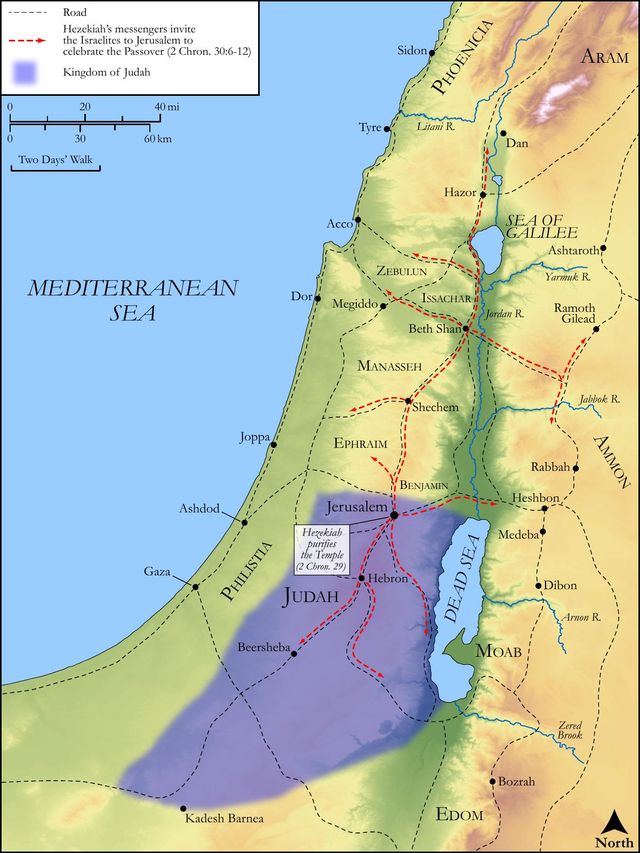
See on the biblical-era map
Study this verse
Public-domain commentary
Matthew Henry
From his Commentary on the Whole Bible. Henry comments on passages, not single verses — this entry covers 2 Chronicles 31:11–21. His three-level outline is real structure in the source text, so it is rendered as structure.
Here we have,
I.Two particular instances of the care of Hezekiah concerning church matters, having put them into good order, to keep them so. The tithes and other holy things being brought in, he provided,
1.That they should be carefully laid up, and not left exposed in loose heaps, liable to be wasted and embezzled. He ordered chambers to be made ready in some of the courts of the temple for store-chambers (Ch2 31:11), and into them the offerings were brought and there kept under lock and key, Ch2 31:12, Ch2 31:13. Treasures or store-keepers were appointed, who had the oversight of them, to see that moth and rust did not corrupt them nor thieves break through to steal. This wisdom of laying up the surplus in days of plenty we may learn from the ant, who provideth meat in summer. The laying up in store what was brought in was an encouragement to people to pay in their contributions. That will be given cheerfully by the public which appears to be well husbanded.
2.That they should be faithfully laid out, according to the uses they were intended for. Church treasures are not to be hoarded any longer than till there is occasion for them, lest even the rust should be a witness against those who hoard them. Officers were appointed, men (no doubt) of approved wisdom and faithfulness, to distribute the oblations of the Lord and the most holy things among the priests (Ch2 31:14), and to see that they all had a competent maintenance for themselves and their families. The law provided sufficient for them all, and therefore, if some had too little, it must be because others had too much; to prevent such inequality these officers were to go by some certain rule of proportion in the disposal of the incomes of the temple. It is said of the priests here (Ch2 31:18) that in their set office they sanctified themselves; in faith they sanctified themselves (so the word is), that is, as bishop Patrick explains it, they attended their ministry at the house of God, not doubting but they should be provided with all things necessary. Now, because they served God in that confidence, care was taken that they should not be made ashamed of their hope. Note, Those that sanctify themselves to God and his service in faith, believing that he will see them want for nothing that is good for them, shall certainly be fed. Out of the offerings of the Lord distribution was made,
(1.)To the priests in the cities (Ch2 31:15), who staid at home while their brethren went to Jerusalem, and did good there in teaching the good knowledge of the Lord. The preaching priests were maintained as well as the sacrificing priests, and those that abode by the stuff as well as those that warred the warfare.
(2.)To those that entered into the house of the Lord, all the males from three years old and upwards; for the male children even at that tender age, it seems, were allowed to come into the temple with their parents, and shared with them in this distribution, Ch2 31:16.
(3.)Even the Levites from twenty years old and upwards had their share, Ch2 31:17.
(4.)The wives and children of the priests and Levites had a comfortable maintenance out of those offerings, Ch2 31:18. In maintaining ministers, regard must be had to their families, that not they only, but theirs, may have food convenient. In some countries where ministers have their salary paid them by the state an addition is made to it upon the birth of a child.
(5.)The priests in the country, that lived in the fields of the suburbs, were not overlooked in this ministration, Ch2 31:19. Those also had their share who were inhabitants of the villages, though they might be supposed to live at a less expense.
II.A general character of Hezekiah's services for the support of religion, Ch2 31:20, Ch2 31:21.
1.His pious zeal reached to all the parts of his kingdom: Thus he did throughout all Judah; every part of the country, and not those only that lay next him, shared in the good fruits of his government.
2.He sincerely designed to please God, and approved himself to him in all he did: He wrought that which was good before the Lord his God; all his care was to do that which should be accepted of God, which was right (that is, agreeable to natural equity), and truth (that is, agreeable to divine revelation and his covenant with God), before the Lord; to do according to that law which is holy, just, and good.
3.What he began he went through with, prosecuted it with vigour, and did it with all his heart.
4.All his good intentions were brought to a good issue; whatever he did in the service of the house of God, and in the government of his kingdom, he prospered in it. Note, What is undertaken with a sincere regard to the glory of God will succeed to our own honour and comfort at last.
Continue studying 2 Chronicles 31:17 across the web’s major study libraries — every link below opens this exact verse, chapter, or book on the destination site.
Read & Compare
 BibleGatewayThis verse in more than 200 translations and 70 languages.
 Bible.comThe YouVersion reader — hundreds of translations, reading plans, and highlights.
 ESV.orgCrossway's official English Standard Version reader.
 NET BibleThe NET translation with 60,000+ translators' notes on every rendering decision.
 STEP BibleTyndale House's free study tool — original text, vocabulary, and scholarly resources.
 BibliaLogos Bible Software's free web reader.
 USCCBThe New American Bible (Revised Edition) with the U.S. bishops' study notes.
Commentaries
 BibleHub CommentariesDozens of classic commentaries on this verse, gathered on one page.
 StudyLightMore than 100 commentary sets — the largest collection on the web.
 BibleRefPlain-English commentary on what this verse means, verse by verse.
 Enduring WordDavid Guzik's free commentary on this chapter, widely used by Bible teachers.
 Bible Study ToolsVerse commentary alongside Greek and Hebrew study aids.
Original Language & Research
- BibleHub InterlinearThe verse word by word — original language, transliteration, and English.
- BibleHub LexiconEvery word's original-language definition and Strong's entry.
 Blue Letter BibleDeep-study tools — Strong's numbers, concordance, and word studies.
 SefariaThe Hebrew text with Rashi and centuries of Jewish commentary.
Sermons, Hymns & Audio


TrulyRandomVerse is not affiliated with these sites and doesn’t control their content. They’re linked because they’re genuinely useful.
Summary
Second Chronicles 31:17 meticulously details King Hezekiah's administrative reforms, focusing on the systematic organization of temple personnel. Following a period of spiritual decline and idolatry, Hezekiah initiated a comprehensive spiritual revival, which included the cleansing and rededication of the temple, and the restoration of the Passover. This verse specifically outlines the precise registration of priests by their verified genealogies and the Levites by their age and assigned duties, ensuring that all individuals essential for the temple's continuous and legitimate operation were properly accounted for and diligently served in their designated roles and rotational divisions, reflecting a profound commitment to divine order and biblically faithful worship.
Context
ShowHideLiterary Context
This verse is deeply embedded within the narrative of King Hezekiah's extensive religious reforms in Judah, primarily chronicled in 2 Chronicles 29-31. The preceding chapters detail the initial phases of this revival: Chapter 29 describes the cleansing and rededication of the defiled temple, while Chapter 30 recounts the joyous, albeit belated, celebration of the Passover, drawing participants from both Judah and Israel. Having addressed the spiritual and ceremonial aspects of worship, Hezekiah then turns to the practical and administrative foundations necessary for sustained temple service. Chapter 31 outlines the destruction of idolatrous altars, the re-establishment of financial support for the priests and Levites through tithes and offerings, and, critically, the meticulous organization of the temple's human resources. Verse 17, therefore, serves as a crucial administrative detail, demonstrating the thoroughness of Hezekiah's commitment to establishing not merely a temporary spiritual fervor, but a sustainable, orderly, and biblically faithful system of worship for the long term. It underscores that genuine spiritual revival necessitates practical, disciplined adherence to God's commands, extending beyond emotional zeal to systematic implementation.
Historical & Cultural Context
King Hezekiah's reign (c. 715–686 BC) represented a dramatic reversal from the apostasy of his father, King Ahaz, who had actively promoted idolatry and closed the temple. Hezekiah's reforms aimed to restore Judah to covenant faithfulness, aligning the nation with Mosaic law. In ancient Israel, the priesthood and Levitical service were not arbitrary but hereditary and highly regulated. Priests were required to be direct descendants of Aaron, and their lineage was meticulously recorded to ensure legitimacy, a practice underscored by post-exilic records like Nehemiah 7:64, where those unable to prove their genealogy were excluded. Levites, while not priests, held vital roles in temple maintenance, music, gatekeeping, and assisting the priests. Their age for active service was also prescribed, typically from 20 or 25 years old, as indicated in texts such as Numbers 4:3 and 1 Chronicles 23:24. The "courses" system, established much earlier by King David (1 Chronicles 23-26), ensured that all priestly and Levitical families served in rotation throughout the year, providing continuous and organized service. Hezekiah's actions in this verse reflect a profound restoration of these divinely ordained structures, which were absolutely vital for the proper functioning of the Jerusalem temple, the spiritual and religious heart of the nation.
Key Themes
ShowHideThis verse significantly contributes to several overarching themes within 2 Chronicles and the broader biblical narrative. Firstly, it powerfully illustrates the theme of Order and Accountability in divine service. God is consistently revealed as a God of order, not chaos, and His worship was designed to be systematic and disciplined. The meticulous record-keeping of genealogies and the organization into "charges by their courses" ensured that every individual was accounted for and served according to their specific, divinely appointed role, reflecting divine precision. Secondly, it reinforces the theme of Divine Mandate and Qualification for sacred service. The emphasis on proper lineage for priests and age requirements for Levites underscores that service to God is not arbitrary but demands specific qualifications and adherence to established divine guidelines. This ensures the legitimacy, purity, and reverence of worship. Thirdly, the verse is a compelling testament to the theme of Restoration of True Worship. Hezekiah's reforms were not superficial; they delved into the foundational administrative details necessary for sustained, legitimate worship. This thoroughness demonstrates that genuine spiritual revival requires not only a return to God's commands in spirit but also in practical, organized implementation, mirroring the comprehensive nature of God's covenant with His people, as seen in the detailed instructions for the tabernacle in Exodus 25-31.
Exposition and Analysis
ShowHideKey Word Analysis
ShowHideThis term (H3187) refers to the act of enrolling by pedigree or being reckoned by genealogies. For the priesthood, it was absolutely critical to prove direct descent from Aaron, as mandated by God in Exodus 28:1. Without a verified genealogy, a priest could not legitimately serve, as exemplified by those who could not prove their lineage after the exile (Nehemiah 7:64). This word underscores the divine emphasis on proper qualification and the purity of the priestly line, ensuring legitimacy in sacred service.
This word (H4931) denotes a watch, custody, post, or, figuratively, an observance, duty, usage, or party. In this context, it refers to the specific tasks, responsibilities, and functions that the priests and Levites were appointed to perform within the temple. These duties encompassed everything from sacrificial rites and ceremonial purity to temple maintenance, musical worship, and guarding the sacred precincts. The use of this term highlights the structured, specialized, and accountable nature of their service, emphasizing that each individual had a distinct, divinely appointed role.
This term (H4256) signifies a section, company, division, or portion. It refers to the system established by King David, where priestly and Levitical families were organized into 24 divisions that served in the temple on a rotational basis throughout the year (1 Chronicles 24:1-19). This system ensured continuous service, equitable distribution of duties among the numerous families, and efficient management of the large number of personnel required for the complex operations of the temple, preventing overburdening and maintaining order.
Verse Breakdown
ShowHide"Both to the genealogy of the priests by the house of their fathers"
This clause highlights the paramount requirement for priests to meticulously prove their direct, unbroken descent from Aaron through their paternal lineage. This genealogical verification was not merely a bureaucratic formality but a divine mandate, essential for their legitimacy to serve in the most sacred roles within the temple. It ensured adherence to God's specific commands regarding the priesthood, underscoring the importance of divine appointment and the purity of the line for those who mediated between God and His people.
"and the Levites from twenty years old and upward"
This part specifies the age requirement for Levites to actively participate in their service. While earlier Mosaic laws (Numbers 4:3) mentioned 25 or 30, by the time of David and Hezekiah, 20 years old had become the accepted age for readiness for service, as seen in 1 Chronicles 23:24. This age likely signified a level of physical strength, maturity, and practical experience necessary for the demanding and varied duties of the Levites, which included assisting priests, carrying sacred vessels, maintaining the temple, and leading worship.
"in their charges by their courses;"
This final clause describes the systematic organization of both priests and Levites. "Charges" refers to their specific, assigned duties and responsibilities within the temple, ensuring that every necessary function was covered. "Courses" refers to the rotational divisions (established by David) that ensured these duties were continuously and efficiently covered throughout the year by different families taking turns. This highlights the meticulous order, administrative precision, and commitment to sustained, proper functioning that Hezekiah implemented for God's house.
Literary Devices
ShowHideThe verse employs several literary devices to convey its meaning and emphasize the thoroughness of Hezekiah's reforms. There is a clear use of Merism in the phrase "priests... and the Levites," which serves to encompass all categories of sacred personnel involved in temple service, indicating a comprehensive and exhaustive accounting of those dedicated to God's work. The phrase "by the house of their fathers" employs Metonymy, where "house" stands for the entire ancestral lineage or family line, emphasizing the hereditary and divinely established nature of the priesthood. Furthermore, the verse's highly detailed and administrative language demonstrates a strong Emphasis on order, precision, and adherence to divine law. The meticulous enumeration of qualifications (genealogy, age) and organizational structures (charges, courses) underscores the profound importance of proper, legitimate, and systematic worship in the eyes of God and King Hezekiah. This detailed focus serves to highlight the thoroughness of the reform and the seriousness with which sacred service was regarded, reflecting God's own character of order.
Theological and Thematic Connections
ShowHideThis verse, though seemingly administrative, carries profound theological weight, underscoring God's character as a God of order, not chaos. The meticulous organization of the temple personnel reflects the divine expectation for all aspects of worship and service to be conducted with precision, integrity, and according to established divine mandates. It reveals that true devotion is not merely spiritual fervor but also disciplined adherence to God's revealed will, extending to the practical logistics of ministry. The emphasis on qualification (genealogy, age) for sacred service points to the principle that those who serve God must be properly called and equipped, reflecting a reverence for the holy nature of God's work. This Old Testament principle of order and qualification foreshadows the New Testament emphasis on proper conduct in the church and the importance of integrity and spiritual maturity for those in leadership and service, ensuring that God's house is built and maintained according to His design.
Reflection and Application
ShowHideThe administrative precision detailed in 2 Chronicles 31:17 offers timeless principles for believers and the church today. Just as King Hezekiah diligently organized the temple service, we are called to approach our spiritual responsibilities with intentionality, order, and integrity. This verse reminds us that effective ministry and vibrant spiritual communities thrive on clear roles, accountability, and a commitment to doing things "decently and in order." It challenges us to consider how we are stewarding the gifts and responsibilities God has entrusted to us, whether in formal church leadership, small group ministry, family life, or our daily vocations. Our service, no matter how seemingly small or grand, should reflect a profound reverence for God's holiness and a fervent desire to honor Him through our diligence, faithfulness, and commitment to excellence. It encourages us to embrace systems and structures that promote clarity, prevent chaos, and enable the body of Christ to function effectively for the glory of God and the edification of His people, recognizing that God values both the spirit and the practical execution of our service.
Questions for Reflection
ShowHideFAQ
ShowHideWhy was genealogy so important for priests in ancient Israel?
ShowHideGenealogy was critically important for priests because their right to serve was strictly hereditary, tracing back directly to Aaron, the first High Priest, as commanded by God in Exodus 28:1. This divine mandate ensured the legitimacy, purity, and continuity of the priestly line, which was essential for mediating between God and His people and for performing the sacred rituals of the temple. Without verified lineage, a person could not serve as a priest, as powerfully illustrated in the post-exilic period where some were excluded from the priesthood because they could not prove their genealogy (Nehemiah 7:64). This emphasis underscored the unique, set-apart nature of the Aaronic priesthood and God's precise requirements for those who would approach Him on behalf of the people.
What was the significance of the "twenty years old and upward" requirement for Levites?
ShowHideThe age requirement of "twenty years old and upward" for Levites signified a practical and spiritual maturity necessary for their demanding service. While earlier Mosaic texts like Numbers 4:3 mention 30 or 25, by the time of David and Hezekiah, 20 years old had become the accepted age for Levites to begin active service, as also noted in 1 Chronicles 23:24. This age ensured that those serving were physically strong enough for tasks like carrying temple vessels, mature enough to handle sacred duties with reverence, and experienced enough to assist the priests effectively. It reflected a standard of readiness, capability, and responsibility for those dedicated to the Lord's work, ensuring the integrity and efficiency of temple operations.
What does "in their charges by their courses" mean regarding temple service?
ShowHide"In their charges by their courses" refers to the highly organized and systematic way in which the priests and Levites performed their duties within the temple. "Charges" denotes their specific responsibilities and assigned tasks, which ranged from sacrificial duties for priests to musical worship, gatekeeping, and maintenance for Levites. "Courses" refers to the rotational divisions (established by King David in 1 Chronicles 23-26) that ensured these families served in the temple for specific periods throughout the year. This comprehensive system guaranteed continuous service, efficient coverage of all temple functions, and equitable distribution of duties among the numerous priestly and Levitical families, preventing chaos and promoting order, discipline, and reverence in worship.
Christ-Centered Fulfillment
ShowHideThe meticulous order and genealogical requirements for the Old Testament priesthood and Levitical service, as highlighted in 2 Chronicles 31:17, find their ultimate fulfillment and transformation in Jesus Christ. While the Old Covenant system relied on human priests from a specific lineage and age, Christ is the perfect and eternal High Priest who transcends all earthly requirements. His "genealogy," though traced through human lineage in Matthew 1 and Luke 3, is ultimately divine, and His priesthood is not "after the order of Aaron" but "after the order of Melchizedek" (Hebrews 7:11-17), signifying a superior, unchangeable, and eternal priesthood. He perfectly fulfills all the "charges" and "courses" of the Old Testament system by offering the one, perfect, and final sacrifice for sins, thereby establishing a new and better covenant that grants direct access to God. Through His finished work, all believers are now made part of a "royal priesthood" (1 Peter 2:9), no longer limited by earthly lineage or age, but qualified by faith in Him to offer spiritual sacrifices of praise and service. The Old Testament's emphasis on order and divine appointment in temple service thus points forward to the perfect order and divine precision of God's redemptive plan, fully realized in Christ, who is both the ultimate Priest and the perfect sacrifice, enabling direct, unhindered access to God for all who believe.