


1 Samuel 20:32
Bible text: King James Version (1769 Blayney text) · Public domain
Bible text: Berean Standard Bible · Public domain
Bible text: American Standard Version (1901) · Public domain
Bible text: World English Bible, Messianic edition · Public domain
Bible text: Geneva Bible (1599) · Public domain
Bible text: Young's Literal Translation · Public domain
- וַיַּעַןvai·Ya·'anand he answeredH6030Conj-w ¦ V-Qal-ConsecImperf-3msVerb Qal Consecutive Imperfect 3rd Singular Masculineוַandיַּעַןhe answered
- יְהוֹנָתָןye·Ho·na·TanJonathanH3083N-proper-mNoun Proper Masculine
- אֶת'et<obj.>H853DirObjMParticle Object Indicator
- שָׁאוּלsha·'UlSaulH7586N-proper-mNoun Proper Masculine
- אָבִיו'a·Vivhis fatherH1N-msc ¦ 3msNoun Singular Masculine Constructאָבִיfatherוhis
- וַיֹּאמֶרvai·Yo·merand he saidH559Conj-w ¦ V-Qal-ConsecImperf-3msVerb Qal Consecutive Imperfect 3rd Singular Masculineוַandיֹּאמֶרhe said
- אֵלָיו'e·Lavto himH413Prep ¦ 3msPreposition Definiteאֵלָיtoוhim
- לָמָּהLa·mah<to> why?H4100Prep-l ¦ InterrogPronoun Interrogativeלָ<to>מָּהwhy?
- יוּמַתyu·Matwill he be put to deathH4191V-Hophal-Imperf-3msVerb Hophal Imperfect 3rd Singular Masculine
- מֶהmehwhat?H4100InterrogPronoun Interrogative
- עָשָׂה'a·Sahhas he doneH6213V-Qal-Perf-3msVerb Qal Perfect 3rd Singular Masculine
English is a literal word-by-word gloss of the Hebrew, not the KJV's wording. Why?
This is the original text the KJV's translators worked from — each Hebrew word with its own literal English meaning in this verse, prepared by scholars at Tyndale House, Cambridge. The KJV translates whole sentences, not word by word, so its wording differs: one Hebrew word can become several English words, and the KJV may choose “the LORD” where the gloss reads “Yahweh”. Both are faithful — they answer different questions. For the KJV's own rendering, switch to the KJV text.
Details
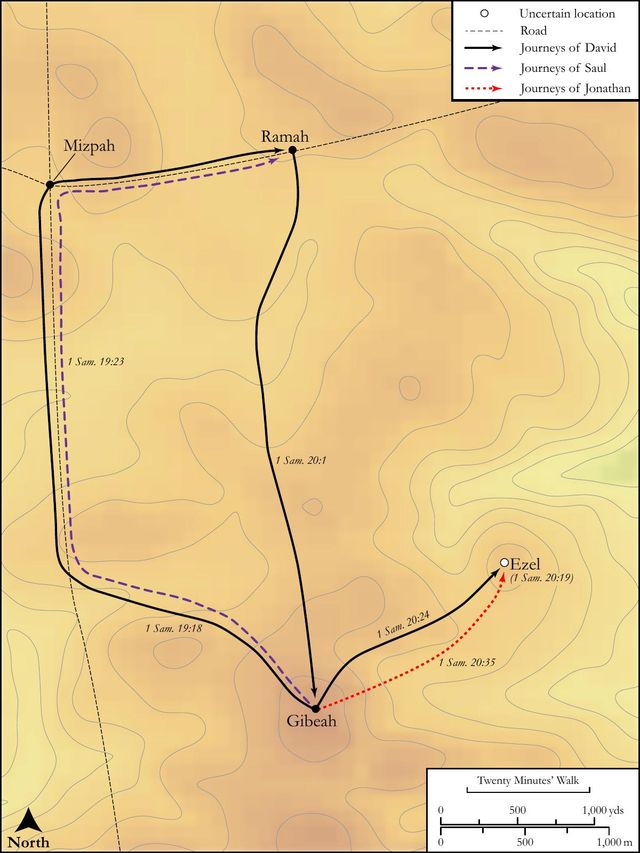
See on the biblical-era map
Study this verse
Public-domain commentary
Matthew Henry
From his Commentary on the Whole Bible. Henry comments on passages, not single verses — this entry covers 1 Samuel 20:24–34. His two-level outline is real structure in the source text, so it is rendered as structure.
Jonathan is here effectually convinced of that which he was so loth to believe, that his father had an implacable enmity to David, and would certainly be the death of him if it were in his power; and he had like to have paid very dearly himself for the conviction.
I.David is missed from the feast on the first day, but nothing is said of him.
The king sat upon his seat, to feast upon the peace-offerings as at other times (Sa1 20:25), and yet had his heart as full of envy and malice against David as it could hold. He should first have been reconciled to him, and then have come and offered his gift; but, instead of that, he hoped, at this feast, to drink the blood of David. What an abomination was that sacrifice which was brought with such a wicked mind as this! Pro 21:27. When the king came to take his seat Jonathan arose, in reverence to him both as a father and as his sovereign; every one knew his place, but David's was empty. It did not use to be so. None more content than he in attending holy duties; nor had he been absent now but that he must have come at the peril of his life; self-preservation obliged him to withdraw. In imminent peril present opportunities may be waived, nay, we ought not to throw ourselves into the mouth of danger. Christ himself absconded often, till he knew that his hour had come. But that day Saul took no notice that he missed David, but said within himself, "Surely he is not clean, Sa1 20:26. Some ceremonial pollution has befallen him, which forbids him to eat of the holy things till he has washed his clothes, and bathed his flesh in water, and been unclean until the evening." Saul knew what conscience David made of the law, and that he would rather keep away from the holy feast than come in his uncleanness. Blessed be God, no uncleanness is now a restraint upon us, but what we may by faith and repentance be washed from in the fountain opened, Psa 26:6.
II.He is enquired for the second day, Sa1 20:27.
Saul asked Jonathan, who he knew was his confidant, Wherefore cometh not the son of Jesse to meat? He was his own son by marriage, but he calls him in disdain, the son of Jesse. He asks for him as if he were not pleased that he should be absent from a religious feast; and so it should be example to masters of families to see to it that those under their charge be not absent from the worship of God, either in public or in the family. It is a bad thing for us, except in case of necessity, to omit an opportunity of statedly attending on God in solemn ordinances. Thomas lost a sight of Christ by being once absent from a meeting of the disciples. But that which displeased Saul was that hereby he missed the opportunity he expected of doing David a mischief.
III.Jonathan makes his excuse, Sa1 20:28, Sa1 20:29.
1.That he was absent upon a good occasion, keeping the feast in another place, though not here, sent for by his elder brother, who was now more respectful to him than he had been (Sa1 17:28), and that he had gone to pay his respects to his relations, for the keeping up of brotherly love; and no master would deny a servant liberty to do that in due time. He pleads,
2.That he did not go without leave humbly asked and obtained from Jonathan, who, as his superior officer, was proper to be applied to for it. Thus he represents David as not wanting in any instance of respect and duty to the government.
IV.Saul hereupon breaks out into a most extravagant passion, and rages like a lion disappointed of his prey.
David was out of his reach, but he falls upon Jonathan for his sake (Sa1 20:30, Sa1 20:31), gives him base language, not fit for a gentleman, a prince, to give to any man, especially his own son, heir apparent to his crown, a son that served him, the greatest stay and ornament of his family, before a great deal of company, at a feast, when all should be in good humour, at a sacred feast, by which all irregular passions should be mortified and subdued; yet he does in effect call him,
1.A bastard: Thou son of the perverse rebellious woman; that is, according to the foolish filthy language of men's brutish passion now a day, "Thou son of a whore." He tells him he was born to the confusion of his mother, that is, he had given the world cause to suspect that he was not the legitimate son of Saul, because he loved him whom Saul hated and supported him who would be the destruction of their family.
2.A traitor: Thou son of a perverse rebellion (so the word is), that is, "thou perverse rebel." At other times he reckoned no counsellor or commander that he had more trusty and well-beloved than Jonathan; yet now in this passion he represents him as dangerous to his crown and life.
3.A fool: Thou hast chosen the son of Jesse for thy friend to thy own confusion, for while he lives thou shalt never be established. Jonathan indeed did wisely and well for himself and family to secure an interest in David, whom Heaven had destined to the throne, yet, for this, he is branded as most impolitic. It is good taking God's people for our people and going with those that have him with them. It will prove to our advantage at last, however for the present it may be thought a disparagement, and a prejudice to our secular interest. It is probable Saul knew that David was anointed to the kingdom by the same hand that anointed him, and then not Jonathan, but himself, was the fool, to think to defeat the counsels of God. Yet nothing will serve him but David must die, and Jonathan must fetch him to execution. See how ill Saul's passion looks, and let it warn us against the indulgence of any thing like it in ourselves. Anger is madness, and he that hates his brother is a murderer.
V.Jonathan is sorely grieved and put into disorder by his father's barbarous passion, and the more because he had hoped better things, Sa1 20:2. He was troubled for his father, that he should be such a brute, troubled for his friend, whom he knew to be a friend of God, that he should be so basely abused; he was grieved for David (Sa1 20:34), and troubled for himself too, because his father had done him shame, and, though most unjustly, yet he must submit to it. One would pity Jonathan to see how he was put,
1.Into the peril of sin. Much ado that wise and good man had to keep his temper, upon such a provocation as this. His father's reflections upon himself made no return to; it becomes inferiors to bear with meekness and silence the contempts put upon them in wrath and passion. When thou art the anvil lie thou still. But his dooming David to die he could not bear: to that he replied with some heat (Sa1 20:32), Wherefore shall he be slain? What has he done? Generous spirits can much more easily bear to be abused themselves than to hear their friends abused.
2.Into the peril of death. Saul was now so outrageous that he threw his javelin at Jonathan, Sa1 20:33. He seemed to be in great care (Sa1 20:31) than Jonathan should be established in his kingdom, and yet now he himself aims at his life. What fools, what savage beasts and worse does anger make men! How necessary it is to put a hook in its nose and a bridle in its jaws! Jonathan was fully satisfied that evil was determined against David, which put him out of frame exceedingly: he rose from table, thinking it high time when his life was struck at, and would eat no meat, for they were not to eat of the holy things in their mourning. All the guests, we may suppose, were discomposed, and the mirth of the feast was spoiled. He that is cruel troubles his own flesh, Pro 11:17.
Historical interpretation
Three Centuries of Reception
4 surviving comments on this verse. Each one is dated, so this reads as a timeline rather than a list.
Select a marker to jump to its quote. Markers stagger vertically where authors wrote within a few decades of each other.
For that commendable friendship which maintains virtue is to be preferred most certainly to wealth or honors or power. It is not apt to be preferred to virtue indeed, but to follow after it. So it was with Jonathan, who for his affection’s sake avoided neither his father’s displeasure nor the danger to his own safety.
Who would not have loved him [David], when they saw how dear he was to his friends? For as he truly loved his friends, so he thought that he was loved as much in return by his own friends. No, parents put him even before their own children, and children loved him more than their parents. Therefore Saul was very angry and strove to strike Jonathan his son with a spear because he thought that David’s friendship held a higher place in his esteem than either filial piety or a father’s authority.
For love “does nothing unseemly,” but as it were with certain golden wings covers up all the offenses of the beloved. Thus also Jonathan loved David and heard the scorn of his father as one … “who has nothing of a man, but lives to the shame of himself and the mother who bore you.” What then? Did he grieve at these things, and hide his face and turn away from his beloved [David]? No, quite the contrary; he displayed his fondness as an ornament. And yet the one was at that time a king, and a king’s son, even Jonathan; the other a fugitive and a wanderer, David. But not even in this circumstance was he ashamed of his friendship. “For love does not act inappropriately.” This is its remarkable quality that it not only does not suffer the injured to grieve and feel irritated but even disposes him to rejoice. Accordingly, the one of whom we are speaking, after all these things, just as though he had a crown put on him, went away and fell on David’s neck. For love does not know what sort of thing shame is. Therefore it glories in those things for which another hides his face. The shame is in “not knowing how to love” rather than “incurring danger and enduring all for the beloved” when you do love.
But Jonathan answering his father Saul, said, etc. The assembly of the faithful in Christ, answering the unbelievers, said: Why does the Christian religion perish? Why is Christ Himself torn apart by you with a rapid bite, whom the governor himself, who gave Him over to death, first confessed to be innocent and just? Whom the thief, who also received the same sentence of death, testified to have done no evil? Indeed, co-heirs of Christ, persisting in the defense of the faith, the perfidious took up arms to conquer them; and because, after the glory of the resurrection, they could not reach Christ, nor lay hands on Him a second time, they struck His members in His place.
Continue studying 1 Samuel 20:32 across the web’s major study libraries — every link below opens this exact verse, chapter, or book on the destination site.
Read & Compare
 BibleGatewayThis verse in more than 200 translations and 70 languages.
 Bible.comThe YouVersion reader — hundreds of translations, reading plans, and highlights.
 ESV.orgCrossway's official English Standard Version reader.
 NET BibleThe NET translation with 60,000+ translators' notes on every rendering decision.
 STEP BibleTyndale House's free study tool — original text, vocabulary, and scholarly resources.
 BibliaLogos Bible Software's free web reader.
 USCCBThe New American Bible (Revised Edition) with the U.S. bishops' study notes.
Commentaries
 BibleHub CommentariesDozens of classic commentaries on this verse, gathered on one page.
 StudyLightMore than 100 commentary sets — the largest collection on the web.
 BibleRefPlain-English commentary on what this verse means, verse by verse.
 Enduring WordDavid Guzik's free commentary on this chapter, widely used by Bible teachers.
 Bible Study ToolsVerse commentary alongside Greek and Hebrew study aids.
Original Language & Research
- BibleHub InterlinearThe verse word by word — original language, transliteration, and English.
- BibleHub LexiconEvery word's original-language definition and Strong's entry.
 Blue Letter BibleDeep-study tools — Strong's numbers, concordance, and word studies.
 SefariaThe Hebrew text with Rashi and centuries of Jewish commentary.
Sermons, Hymns & Audio


TrulyRandomVerse is not affiliated with these sites and doesn’t control their content. They’re linked because they’re genuinely useful.
Summary
1 Samuel 20:32 captures a pivotal moment of profound moral courage as Jonathan, son of King Saul, directly confronts his enraged father regarding the king's murderous intent towards David. With two piercing questions—"Wherefore shall he be slain? what hath he done?"—Jonathan boldly intercedes for his friend, highlighting David's blamelessness and exposing the baseless, destructive nature of Saul's escalating paranoia and unjust decree. This verse stands as a powerful testament to Jonathan's unwavering loyalty, integrity, and self-sacrificial love in the face of tyranny and personal danger.
Context
ShowHideLiterary Context
This verse is a dramatic and climactic turning point within the larger narrative of King Saul's decline and David's rise, centrally featuring the enduring, covenantal friendship between David and Jonathan. The chapter opens with David seeking Jonathan's counsel to discern Saul's true intentions, leading to a renewal of their deep covenant of friendship (1 Samuel 20:16-17). They devise a plan for David's absence from the new moon feast, which serves as a test of Saul's disposition. Saul's subsequent furious reaction to David's empty seat, culminating in his explicit declaration that David must die (1 Samuel 20:31), sets the immediate stage for Jonathan's courageous intervention in verse 32. Jonathan's desperate plea for reason and justice directly precedes Saul's violent attempt to strike his own son with a spear (1 Samuel 20:33), further underscoring the king's irrationality and the perilous nature of Jonathan's advocacy. This sequence solidifies the irreparable rift between Saul and his son, and between Saul and God's chosen successor.
Historical & Cultural Context
The setting is the nascent period of the Israelite monarchy, a time of transition from a tribal confederacy to a centralized kingdom. Saul, Israel's first king, was divinely chosen but later rejected by God due to his disobedience (1 Samuel 15:23). David, though not yet publicly recognized, had already been secretly anointed by Samuel as God's chosen successor (1 Samuel 16:13). In this patriarchal and monarchical society, a son challenging his father, especially a king, was an act of extreme defiance and carried immense personal risk, potentially even death. Kings were expected to uphold justice, protect their subjects, and rule righteously, making Saul's unprovoked murderous intent against an innocent, loyal servant a severe breach of his royal duty and a sign of his moral decay. The new moon feast was a significant religious and communal event, and David's conspicuous absence would have been noticed, providing the perfect catalyst for Saul's public display of rage.
Key Themes
ShowHideThis verse powerfully highlights several critical themes central to the Books of Samuel. Firstly, Jonathan's unwavering loyalty and courageous defense of the weak are paramount. Despite being Saul's son and heir, Jonathan consistently prioritizes his covenant with David over his familial ties and personal ambition, demonstrating extraordinary moral integrity and self-sacrifice. His actions here underscore the biblical value of true friendship and covenant faithfulness, even when it demands great personal cost. Secondly, Saul's destructive jealousy and unjustifiable rage are starkly exposed. His desire to kill David is not based on any wrongdoing by David but on his own deep-seated insecurity, envy, and paranoia, illustrating how unchecked negative emotions can lead to irrationality, tyranny, and self-destruction. This theme is pervasive throughout Saul's later reign. Thirdly, the theme of defense of the innocent is central, as Jonathan acts as David's advocate, demanding justification for the proposed execution of a blameless man. This underscores the biblical imperative to uphold truth and justice, and to speak up for those who are wrongly accused or persecuted, even at great personal cost, reflecting God's own character as a defender of the righteous.
Exposition and Analysis
ShowHideKey Word Analysis
ShowHideThis word means "to heed, i.e. pay attention; by implication, to respond; by extension to begin to speak." In this context, Jonathan's "answer" is not merely a reply but a deliberate, courageous, and direct response to Saul's murderous declaration. It signifies a conscious decision to engage, challenge, and intercede, demonstrating an active and intentional opposition to his father's unjust decree. It's a verbal act of defiance born of conviction.
This is the Hophal imperfect form of the verb "to die," meaning "to be put to death" or "to be killed." The Hophal stem indicates a passive causation, emphasizing that David is the object of an external, unjust act. Jonathan's use of this word highlights David's innocence and the arbitrary nature of Saul's intent, portraying David as a victim of an unprovoked and illegitimate royal decree, rather than someone who deserves death.
This verb means "to do or make, in the broadest sense and widest application." Jonathan's question, "what hath he done?", is a direct inquiry into David's actions, demanding a specific charge or offense. It implicitly asserts David's blamelessness and forces Saul to confront the complete absence of any wrongdoing that would warrant such a severe punishment. It is a challenge to Saul to provide any factual basis for his murderous rage, exposing its irrationality.
Verse Breakdown
ShowHide"And Jonathan answered Saul his father, and said unto him,"
This opening phrase immediately establishes the setting as a direct, verbal confrontation between son and father, but more significantly, between the heir apparent and the reigning king. The verb "answered" implies a deliberate and courageous response to Saul's previous declaration of intent to kill David, indicating Jonathan's conscious decision to intercede despite the inherent danger of challenging royal authority and paternal command. It highlights the immense personal risk Jonathan undertook for David.
"Wherefore shall he be slain?"
This is Jonathan's initial, bold challenge to Saul's murderous decree. It is a rhetorical question that demands a logical, moral, or legal justification for such an extreme and unjust action. By asking "why," Jonathan implicitly asserts that no valid reason exists for David's execution, thereby exposing the irrationality and moral bankruptcy of Saul's command. It is a desperate plea for reason and justice to prevail over unbridled rage and paranoia, appealing to Saul's conscience and duty as king.
"what hath he done?"
This second question reinforces the first, shifting the focus from the abstract "why" to the concrete "what." Jonathan challenges Saul to articulate any specific offense or wrongdoing committed by David that would warrant death. This question serves as a powerful defense of David's innocence, forcing Saul to confront the absence of any legitimate charge against his loyal servant and exposing the king's actions as purely arbitrary, malicious, and entirely without foundation. It underscores David's blamelessness and Saul's unrighteousness.
Literary Devices
ShowHideThe verse is rich in Dialogue, presenting a direct, high-stakes verbal exchange between Jonathan and Saul. This immediate confrontation heightens the dramatic tension of the narrative, allowing the reader to witness the raw emotion and moral conflict. Jonathan's questions are prime examples of Rhetorical Questions; they are not posed to elicit information but to challenge Saul's authority, expose his irrationality, and underscore David's blamelessness. They serve to highlight the profound injustice and moral vacuum in Saul's decree, forcing him to confront the absence of any legitimate cause for his actions. The verse also employs stark Contrast, juxtaposing Jonathan's unwavering loyalty, moral clarity, and courageous defense of the weak with Saul's escalating paranoia, destructive rage, and tyrannical tendencies. This stark difference in character illuminates the spiritual and moral decline of Saul's kingship and the integrity of Jonathan's character. Furthermore, this pivotal moment Foreshadows the tragic trajectory of Saul's reign and his ultimate downfall, as his inability to tolerate innocence and respond to reason signals his unsuitability for leadership and the inevitable transfer of the kingdom.
Theological and Thematic Connections
ShowHideJonathan's courageous intercession for David in 1 Samuel 20:32 resonates deeply with biblical themes of justice, the defense of the innocent, and the sovereign protection of God's anointed. His willingness to rebuke the powerful, even risking his own life, reflects a profound commitment to righteousness that aligns with God's character. Jonathan acts as a moral compass in a kingdom increasingly adrift due to Saul's spiritual and emotional instability, demonstrating what true covenant loyalty looks like. His plea for David underscores the divine expectation that leaders, and indeed all people, should uphold justice and protect the vulnerable, not persecute them without cause. This moment is a powerful reminder that God often uses faithful individuals to stand against injustice and advocate for those who are wrongly accused, demonstrating His concern for equity and truth in human affairs and His providential care for those He has chosen.
Reflection and Application
ShowHideJonathan's bold stand in 1 Samuel 20:32 offers profound lessons for believers today, challenging us to embody similar courage and moral clarity in our own lives. His example calls us to cultivate a deep commitment to justice and truth, urging us to speak up against injustice and defend the innocent, even when it is difficult, unpopular, or personally risky. This might involve challenging prevailing opinions in our workplaces, confronting those in positions of authority who abuse their power, or pleading the cause of the poor and needy (Proverbs 31:9). Furthermore, Jonathan's unwavering loyalty to David, despite the immense personal cost and the threat it posed to his own succession, reminds us of the immense value of true, God-honoring friendship—a bond marked by sacrifice, mutual support, and a shared commitment to righteousness that transcends self-interest. Finally, Saul's story serves as a stark warning about the consuming and destructive nature of unchecked envy, insecurity, and paranoia. It compels us to guard our own hearts against such corrosive emotions, recognizing their potential to lead to irrationality, violence, and harm to ourselves and others, and instead to seek God's grace to cultivate humility, contentment, and sacrificial love.
Questions for Reflection
ShowHideFAQ
ShowHideWhy was Saul so determined to kill David?
ShowHideSaul's determination to kill David stemmed primarily from profound insecurity, escalating jealousy, and deep-seated paranoia. After David's miraculous victory over Goliath and subsequent military successes, his popularity among the people soared, symbolized by the women's song, "Saul has slain his thousands, and David his tens of thousands" (1 Samuel 18:7). This fueled Saul's envy, as he perceived David as a direct threat to his kingship and the future of his dynasty. Furthermore, the Spirit of the Lord had departed from Saul, and an evil spirit from the Lord tormented him (1 Samuel 16:14), contributing to his irrational behavior, violent outbursts, and a distorted perception of reality. Saul's fear was rooted in the belief that God had rejected him and favored David, making David an existential threat to his throne and very existence in his eyes.
What was the nature of David and Jonathan's friendship?
ShowHideThe friendship between David and Jonathan was one of the most profound, celebrated, and unique relationships in the Old Testament, characterized by deep affection, unwavering loyalty, and covenantal commitment. It began when Jonathan's soul was "knit with the soul of David, and Jonathan loved him as his own soul" (1 Samuel 18:1). Their bond transcended political ambition and familial ties; Jonathan, as the heir apparent, willingly relinquished his claim to the throne, recognizing God's anointing on David's life and actively supporting his ascension. They made a solemn covenant, pledging mutual protection and care for each other's descendants, a covenant they renewed multiple times (1 Samuel 20:14-17). Their friendship serves as a powerful biblical archetype of loyal, self-sacrificing, and God-honoring companionship, demonstrating true agape love in action, even in the face of extreme adversity and personal cost.
Christ-Centered Fulfillment
ShowHideJonathan's courageous intercession for David in 1 Samuel 20:32, where he pleads for the innocent, finds its ultimate and most profound fulfillment in the person and work of Jesus Christ. Jonathan, an earthly prince, risked his life and his inheritance to defend a blameless friend who was unjustly pursued by a vengeful king. This act powerfully foreshadows Christ, our heavenly King and ultimate advocate, who did not merely risk His life but willingly laid it down for us, His friends, who were far from innocent. Just as Jonathan asked, "Wherefore shall he be slain? what hath he done?", the world could find no legitimate charge against Christ, as even Pilate declared, "I find no guilt in him" (John 19:4). Yet, unlike David, who was innocent of the charges against him, humanity stands guilty before a holy God, justly condemned by our own sin. It is here that Christ's fulfillment shines most brightly: He became our perfect intercessor and advocate (1 John 2:1), taking upon Himself the guilt we justly deserved. He is the Lamb of God who takes away the sin of the world, providing the ultimate answer to the question of "what hath he done?" for us, the guilty. Through His perfect sacrifice, He secured our acquittal and eternal life, demonstrating a love and self-sacrifice infinitely greater than Jonathan's, for He interceded for His enemies to make them friends (Romans 5:8).