


1 Kings 9:16
Bible text: King James Version (1769 Blayney text) · Public domain
Bible text: King James Version with Strong's numbers · Public domain
Bible text: Berean Standard Bible · Public domain
Bible text: American Standard Version (1901) · Public domain
Bible text: World English Bible, Messianic edition · Public domain
Bible text: Geneva Bible (1599) · Public domain
Bible text: Young's Literal Translation · Public domain
- פַּרְעֹהpar·'OhPharaohH6547N-msNoun Title Singular Masculine Absolute
- מֶלֶךְMe·lekh[the] king ofH4428N-mscNoun Singular Masculine Construct
- מִצְרַיִםmitz·Ra·yimEgyptH4714N-properNoun Proper Location
- עָלָה'a·Lahhe had gone upH5927V-Qal-Perf-3msVerb Qal Perfect 3rd Singular Masculine
- וַיִּלְכֹּדvai·yil·Kodand he had capturedH3920Conj-w ¦ V-Qal-ConsecImperf-3msVerb Qal Consecutive Imperfect 3rd Singular Masculineוַandיִּלְכֹּדhe had captured
- אֶת'et<obj.>H853DirObjMParticle Object Indicator
- גֶּזֶרge·zerGezerH1507N-properNoun Proper Location
- וַיִּשְׂרְפָהּvai·yis·re·Fahand he had burned itH8313Conj-w ¦ V-Qal-ConsecImperf-3ms ¦ 3fsVerb Qal Consecutive Imperfect 3rd Singular Masculineוַandיִּשְׂרְפָhe had burnedהּit
- בָּאֵשׁba·'Eshwith <the> fireH784Prep-b ¦ N-csNoun Singular common gender Absoluteבָּwith <the>אֵשׁfire
- וְאֶתve·'Etand <obj.>H853Conj-w ¦ DirObjMParticle Object Indicatorוְandאֶת<obj.>
- הַכְּנַעֲנִיha·ke·na·'a·Nithe Canaanite[s]H3669Art ¦ N-msNoun Gentilic Singular Masculine AbsoluteהַtheכְּנַעֲנִיCanaanite[s]
- הַיֹּשֵׁבhai·yo·Shevwho was dwellingH3427Art ¦ V-Qal-Prtcpl-msVerb Qal Participle Singular Masculine Absoluteהַwhoיֹּשֵׁבwas dwelling
- בָּעִירba·'Irin the cityH5892Prep-b ¦ N-fsNoun Singular Feminine Absoluteבָּin theעִירcity
- הָרָגha·Raghe had killedH2026V-Qal-Perf-3msVerb Qal Perfect 3rd Singular Masculine
- וַיִּתְּנָהּvai·yi·te·Nahand he had given itH5414Conj-w ¦ V-Qal-ConsecImperf-3ms ¦ 3fsVerb Qal Consecutive Imperfect 3rd Singular Masculineוַandיִּתְּנָhe had givenהּit
- שִׁלֻּחִיםshi·lu·Chimdowri<es>H7964N-mpNoun Plural Masculine Absolute
- לְבִתּוֹle·vi·Toto his daughterH1323Prep-l ¦ N-fsc ¦ 3msNoun Singular Feminine Constructלְtoבִתּdaughterוֹhis
- אֵשֶׁת'E·shet[the] wife ofH802N-fscNoun Singular Feminine Construct
- שְׁלֹמֹהshe·lo·MohSolomonH8010N-proper-mNoun Proper Masculine
English is a literal word-by-word gloss of the Hebrew, not the KJV's wording. Why?
This is the original text the KJV's translators worked from — each Hebrew word with its own literal English meaning in this verse, prepared by scholars at Tyndale House, Cambridge. The KJV translates whole sentences, not word by word, so its wording differs: one Hebrew word can become several English words, and the KJV may choose “the LORD” where the gloss reads “Yahweh”. Both are faithful — they answer different questions. For the KJV's own rendering, switch to the KJV text.
Details
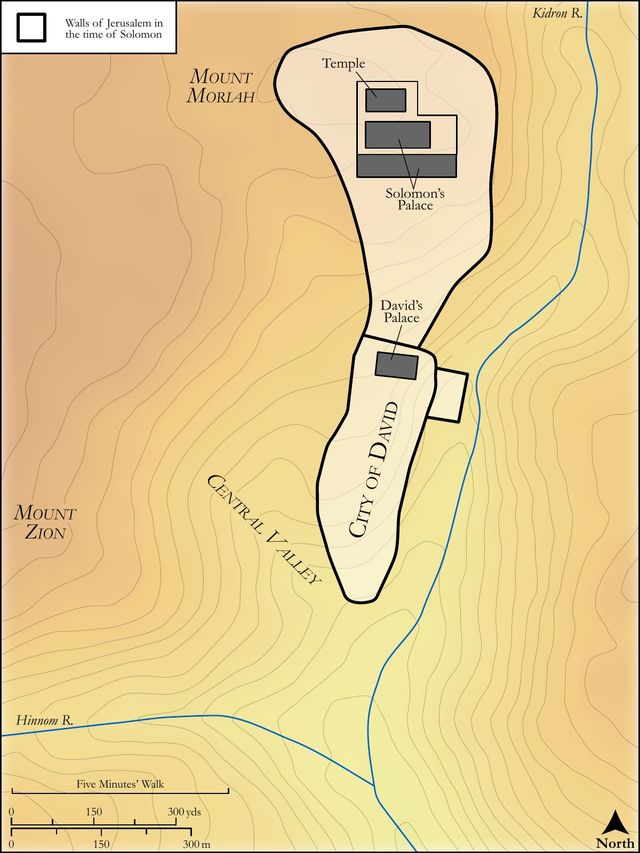
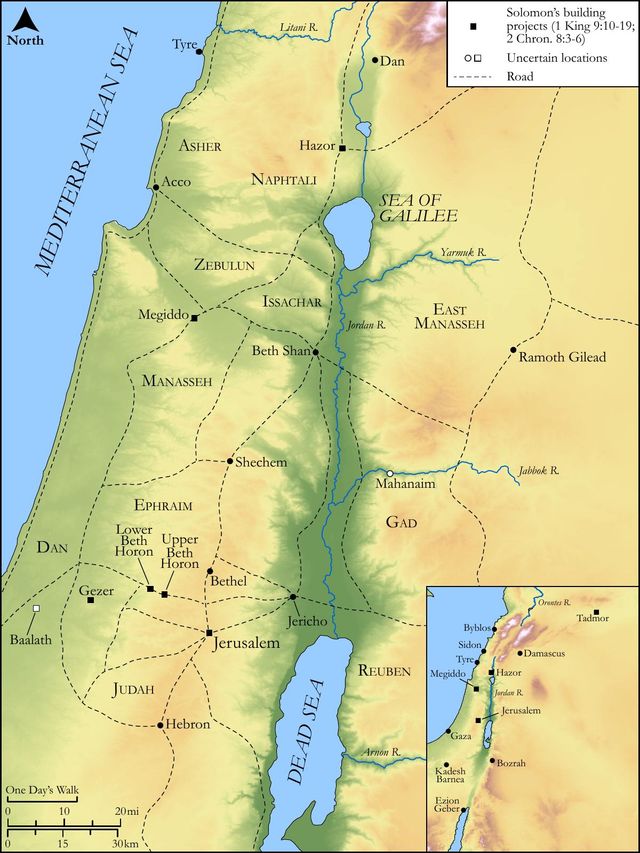
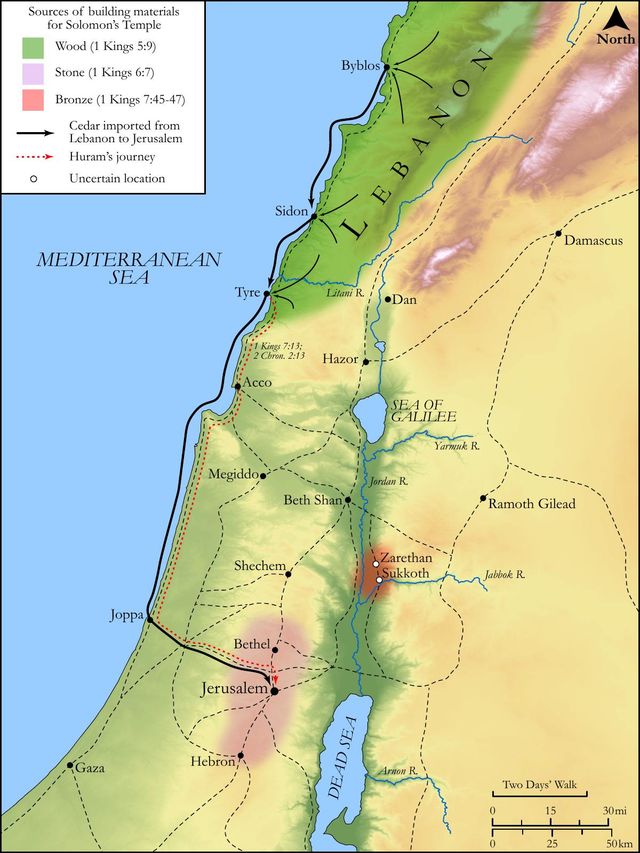
See on the biblical-era maps
Study this verse
Public-domain commentary
Matthew Henry
From his Commentary on the Whole Bible. Henry comments on passages, not single verses — this entry covers 1 Kings 9:15–28. His two-level outline is real structure in the source text, so it is rendered as structure.
We have here a further account of Solomon's greatness.
I.His buildings.
He raised a great levy both of men and money, because he projected a great deal of building, which would both employ many hands and put him to a vast expense, Kg1 9:15. And he was a wise builder, who sat down first, and counted the cost, and would not begin to build till he found himself able to finish. Perhaps there was some complaint of the heaviness of the taxes, which the historian excuses from the greatness of his undertakings. He raised it, not for war (as other princes), which would spend the blood of his subjects, but for building, which would require only their labour and purses. Perhaps David observed Solomon's genius to lie towards building, and foresaw he would have his head and hands full of it, when he penned that song of degrees for Solomon, which begins, Except the Lord build the house, those labour in vain that build it (Psa 127:1), directing him to acknowledge God in all his ways, and, by prayer and faith in his providence, to take him along with him in all his designs of this kind. And Solomon verily began his work at the right end, for he built God's house first, and finished that before he began his own; and then God blessed him, and he prospered in all his other buildings. If we begin with God, he will go on with us. Let the first-fruits be his, and the after-fruits will the more comfortably be ours, Mat 6:33. Solomon built a church first and then he was enabled to build houses, and cities, and walls. Those consult not their own interest that defer to the last what they design for pious uses. The further order in Solomon's buildings is observable. God's house first for religion, then his own for his own convenience, then a house for his wife, to which she removed as soon as it was ready for her (Kg1 9:24), then Millo, the town-house or guild-hall, then the wall of Jerusalem, the royal city, then some cities of note and strength in the country, which were decayed and unfortified, Hazor, Megiddo, etc. As he rebuilt these at his own charge, the inhabitants would be not only his subjects, but his tenants, which would increase the revenues of the crown for the benefit of his successors. Among the rest, he built Gezer, which Pharaoh took out of the hands of the Canaanites, and made a present of to his daughter, Solomon's wife, Kg1 9:16. See how God maketh the earth to help the woman. Solomon was not himself a warlike prince, but the king of Egypt, who was, took cities for him to build. Then he built cities for convenience, for store, for his chariots, and for his horsemen, Kg1 9:19. And, lastly, he built for pleasure in Lebanon, for his hunting perhaps, or other diversions there. Let piety begin, and profit proceed, and leave pleasure to the last.
II.His workmen and servants.
In doing such great works, he must needs employ abundance of workmen. The honour of great men is borrowed from their inferiors, who do that which they have the credit of.
1.Solomon employed those who remained of the conquered and devoted nations in all the slavish work, Kg1 9:20, Kg1 9:21. We may suppose that they renounced their idolatry and submitted to Solomon's government, so that he could not, in honour, utterly destroy them, and they were so poor that he could not levy money on them; therefore he served himself of their labour. Herein he observed God's law (Lev 25:44, Thy bondmen shall be of the heathen), and fulfilled Noah's curse upon Canaan, A servant of servants shall he be unto his brethren, Gen 9:25.
2.He employed Israelites in the more creditable services (Kg1 9:22, Kg1 9:23): Of them he made no bondmen, for they were God's freemen, but he made them soldiers and courtiers, and gave them offices, as he saw them qualified, among his chariots and horsemen, appointing some to support the service of the inferior labourers. Thus he preserved the dignity and liberty of Israel and honoured their relation to God as a kingdom of priests.
III.His piety and devotion (Kg1 9:25):
Three times in a year he offered burnt-offerings extraordinary (namely, at the three yearly feasts, the passover, pentecost, and feast of tabernacles) in honour of the divine institution, besides what he offered at other times, both statedly and upon special occasions. With his sacrifices he burnt incense, not himself (that was king Uzziah's crime), but the priest for him, at his charge, and for his particular use. It is said, He offered on the altar which he himself built. He took care to build it, and then,
1.He himself made use of it. Many will assist the devotions of others that neglect their own. Solomon did not think his building an altar would excuse him from sacrificing, but rather engage him the more to it.
2.He himself had the benefit and comfort of it. Whatever pains we take, for the support of religion, to the glory of God and the edification of others, we ourselves are likely to have the advantage of it.
IV.His merchandise.
He built a fleet of trading ships at Ezion-geber (Kg1 9:26), a port on the coast of the Red Sea, the furthest stage of the Israelites when they wandered in the wilderness, Num 33:35. Probably that wilderness now began to be peopled by the Edomites, which it was not then. To them this port had belonged, but, David having subdued the Edomites, it now pertained to the crown of Judah. The fleet traded to Ophir in the East Indies, supposed to be that which is now called Ceylon. Gold was the commodity traded for, substantial wealth. It should seem, Solomon had before been Hiram's partner, or put a venture into his ships, which made him a rich return of 120 talents (Kg1 9:14), which encouraged him to build a fleet of his own. The success of others in any employment should quicken our industry; for in all labour there is profit. Solomon sent his own servants as factors, and merchants, and super-cargoes, but hired Tyrians for sailors, for they had knowledge of the sea, Kg1 9:27. Thus one nation needs another, Providence so ordering it that there may be mutual commerce and assistance; for not only as Christians, but as men, we are members one of another. The fleet brought home to Solomon 420 talents of gold, Kg1 9:28. Canaan, the holy land, the glory of all lands, had no gold in it, which teaches us that that part of the wealth of this world which is for hoarding and trading is not the best part of it, but that which is more immediately for the present support and comfort of life, our own and others'; such were the productions of Canaan. Solomon got much by his merchandise, but, it should seem, David got much more by his conquests. What were Solomon's 420 talents to David's 100,000 talents of gold? Ch1 22:14; Ch1 29:4. Solomon got much by his merchandise, and yet has directed us to a better trade, within reach of the poorest, having assured us from his own experience of both that the merchandise of wisdom is better than the merchandise of silver and the gain thereof than fine gold, Pro 3:14.
Continue studying 1 Kings 9:16 across the web’s major study libraries — every link below opens this exact verse, chapter, or book on the destination site.
Read & Compare
 BibleGatewayThis verse in more than 200 translations and 70 languages.
 Bible.comThe YouVersion reader — hundreds of translations, reading plans, and highlights.
 ESV.orgCrossway's official English Standard Version reader.
 NET BibleThe NET translation with 60,000+ translators' notes on every rendering decision.
 STEP BibleTyndale House's free study tool — original text, vocabulary, and scholarly resources.
 BibliaLogos Bible Software's free web reader.
 USCCBThe New American Bible (Revised Edition) with the U.S. bishops' study notes.
Commentaries
 BibleHub CommentariesDozens of classic commentaries on this verse, gathered on one page.
 StudyLightMore than 100 commentary sets — the largest collection on the web.
 BibleRefPlain-English commentary on what this verse means, verse by verse.
 Enduring WordDavid Guzik's free commentary on this chapter, widely used by Bible teachers.
 Bible Study ToolsVerse commentary alongside Greek and Hebrew study aids.
Original Language & Research
- BibleHub InterlinearThe verse word by word — original language, transliteration, and English.
- BibleHub LexiconEvery word's original-language definition and Strong's entry.
 Blue Letter BibleDeep-study tools — Strong's numbers, concordance, and word studies.
 SefariaThe Hebrew text with Rashi and centuries of Jewish commentary.
Sermons, Hymns & Audio


TrulyRandomVerse is not affiliated with these sites and doesn’t control their content. They’re linked because they’re genuinely useful.
Summary
1 Kings 9:16 serves as a crucial parenthetical explanation within the broader narrative of Solomon's extensive building projects, detailing the unique and strategic acquisition of the city of Gezer. This verse illuminates a significant aspect of Solomon's foreign policy—a diplomatic marriage alliance with Pharaoh, king of Egypt—and underscores the geopolitical realities and Israel's elevated international standing during his reign. It highlights how a key strategic city came under Israelite control not through conquest, but as a "present," cementing a powerful political bond that would have far-reaching implications.
Context
ShowHideLiterary Context
This verse is strategically placed as an explanatory interjection within a broader section detailing Solomon's extensive building endeavors and his administrative organization, particularly his forced labor (corvée) system (compare 1 Kings 9:15 with 1 Kings 9:20-22). Immediately preceding it, 1 Kings 9:15 lists several cities Solomon built or fortified, including Gezer. Verse 16 then interrupts the flow to provide essential background, clarifying how Gezer came into Solomon's possession—not through his own military conquest, but through a prior event involving Pharaoh. Following this explanation, 1 Kings 9:17 resumes the narrative, stating that Solomon indeed rebuilt Gezer, implying its prior destruction. This parenthetical detail is vital for understanding the source of Solomon's control over this strategic city and the nature of his relationship with Egypt, which was first introduced with his marriage to Pharaoh's daughter in 1 Kings 3:1.
Historical & Cultural Context
Among the kings of that day, marriage alliances between royal houses were common and served as powerful diplomatic tools to secure peace, trade routes, and mutual defense. The union between Solomon and Pharaoh's daughter was highly unusual, as Egyptian pharaohs rarely gave their daughters in marriage to foreign rulers, typically only taking foreign princesses into their own harems. This fact alone speaks volumes about Israel's burgeoning power and prestige under Solomon, making it a formidable entity on the international stage. Gezer itself was a strategically vital city, situated on the Via Maris, a major international trade route connecting Egypt with Mesopotamia. Its destruction by Pharaoh and subsequent gifting as a dowry (or "present") underscores its immense value as a territorial asset and the depth of the diplomatic ties forged between Egypt and Israel, reflecting a significant shift in regional power dynamics.
Key Themes
ShowHideThe acquisition of Gezer through this marriage alliance highlights several key themes in the book of 1 Kings. Firstly, it exemplifies Political Alliances and Diplomacy as a cornerstone of Solomon's foreign policy, aiming to secure peace and prosperity without constant warfare. Secondly, it showcases Solomon's Wealth and Influence, as the ability to command such a significant "present" from a powerful Pharaoh indicates Israel's elevated status and Solomon's renowned wisdom and resources. Thirdly, there's an element of Divine Providence, as Pharaoh's actions of burning Gezer and slaying its Canaanite inhabitants, though driven by his own imperial agenda, inadvertently fulfilled a long-standing divine command to dispossess the Canaanites from the land (e.g., Deuteronomy 7:2). Finally, while initially beneficial, this marriage alliance with a foreign princess, particularly from Egypt, subtly Foreshadows Compromise. Such unions, especially with women who retained their foreign religious practices, would later prove to be a significant spiritual downfall for Solomon, as detailed in 1 Kings 11:1-8, where his many foreign wives turned his heart after other gods.
Exposition and Analysis
ShowHideKey Word Analysis
ShowHideThis term (H7964) derives from a root meaning "to send" or "to dismiss," and in the plural, it can denote "presents" or "dower." In this context, it refers to a diplomatic gift or dowry. It signifies a strategic transfer of territory, not merely a personal token of affection, but a state-level offering that cemented the political and marital alliance between the two powerful nations. It underscores the transactional nature of the diplomacy of kings in that day, where land and cities were valuable commodities in royal exchanges.
The verb (H2026) means "to smite with deadly intent," "to kill," or "to murder." Its use here emphasizes the decisive and complete eradication of the Canaanite inhabitants of Gezer by Pharaoh's forces. This was not merely a defeat but a wholesale elimination, ensuring no lingering resistance or claim to the land, thus making the city truly "empty" and ready for its new Israelite ownership. This act, though by a pagan king, aligns with the divine mandate to dispossess the Canaanites.
The verb (H8313) means "to be on fire" or "to consume with fire." This detail indicates a total destruction of the city's existing structures, signifying a complete conquest and a clearing of the slate. It prepared Gezer for a complete rebuilding under Solomon, as mentioned in the subsequent verse, rather than merely occupying existing Canaanite fortifications. The act of burning also served as a powerful symbol of dominance and conquest, as when Joshua "burnt Hazor with fire."
Verse Breakdown
ShowHide"[For] Pharaoh king of Egypt had gone up, and taken Gezer"
This initial clause provides the background action, explaining the historical event that led to Gezer's transfer. The "For" (KJV) or "Indeed" (NIV) indicates this is an explanatory interjection, clarifying how Solomon came to possess Gezer. It highlights Pharaoh's military might and his successful campaign against Gezer, establishing the context for the city's subsequent acquisition by Solomon.
"and burnt it with fire, and slain the Canaanites that dwelt in the city"
This part details the thoroughness and brutality of Pharaoh's conquest. The burning signifies complete destruction of the city's infrastructure, while the slaying of the inhabitants ensures no remaining population or claim, making the city a tabula rasa for its new owner. This act, though by a pagan king, inadvertently aligns with God's long-standing command for the dispossessing of the Canaanites from the Promised Land.
"and given it [for] a present unto his daughter, Solomon's wife"
This final clause reveals the ultimate purpose and outcome of Pharaoh's conquest: the city was presented as a diplomatic gift, likely a dowry, to his daughter upon her marriage to King Solomon. This act solidified the powerful alliance between Egypt and Israel, demonstrating the high value placed on the union and the strategic importance of Gezer in securing the border and trade routes.
Literary Devices
ShowHideThe primary literary device at play in 1 Kings 9:16 is Parenthesis. The verse functions as an explanatory interjection, interrupting the direct flow of Solomon's building activities (as listed in 1 Kings 9:15 and 1 Kings 9:17) to provide crucial background information about how Gezer came into Solomon's possession. This allows the narrative to maintain focus on Solomon's reign while providing necessary historical context. There is also a strong element of Irony present; Pharaoh, a pagan king, in his pursuit of imperial and diplomatic goals, unknowingly fulfills a divine mandate to dispossess the Canaanites from the land, demonstrating God's sovereignty over the actions of all nations, even those hostile to His people. Furthermore, the very nature of this significant alliance, while seemingly a triumph for Solomon, serves as a subtle Foreshadowing of the spiritual compromises that would later plague his reign, particularly through his foreign wives, leading to his eventual spiritual decline.
Theological and Thematic Connections
ShowHide1 Kings 9:16, though a seemingly minor historical detail, carries profound theological weight. It illustrates God's sovereign hand at work even through the actions of foreign, non-covenant nations. Pharaoh's conquest of Gezer and the slaying of its Canaanite inhabitants, while driven by geopolitical ambition, inadvertently served God's long-standing purpose of dispossessing the Canaanites from the Promised Land, a task Israel had often failed to complete (e.g., Judges 1:29). This demonstrates that God can utilize any agent, even those unaware of His will, to advance His divine plan. Furthermore, the verse subtly introduces the theme of the dangers of unholy alliances. While politically astute, Solomon's marriage to Pharaoh's daughter, a foreign princess, represents a step away from the covenant principles that warned against intermarriage with foreign nations due to the risk of idolatry (e.g., Deuteronomy 7:3-4). This seemingly beneficial alliance foreshadows the spiritual compromises that would ultimately lead to Solomon's downfall, reminding us that worldly wisdom, when divorced from divine wisdom, can lead to spiritual peril.
Reflection and Application
ShowHideThe account of Gezer's acquisition through a diplomatic marriage offers a compelling case study in the tension between worldly wisdom and divine principles. Solomon, renowned for his wisdom, made a politically brilliant move, securing peace with a major regional power and gaining a strategic city without military cost. Yet, this alliance, rooted in human strategy and convenience, ultimately laid the groundwork for spiritual compromise. It prompts us to examine our own lives: where do we seek security and advantage? Are we tempted to make compromises, even seemingly minor ones, in our pursuit of success, stability, or acceptance? This verse reminds us that true security and lasting prosperity are found not in strategic human alliances or accumulation of power, but in unwavering obedience and devotion to God. Our choices, even those that appear beneficial on the surface, must be weighed against their potential spiritual cost and their alignment with God's will. We are called to prioritize God's kingdom and righteousness above all else, trusting that He will provide for our needs and guide our paths.
Questions for Reflection
ShowHideFAQ
ShowHideWhy was Gezer considered such an important city in ancient times?
ShowHideGezer was strategically vital because of its location on the Via Maris, a major international trade route that connected Egypt in the south with Mesopotamia and Anatolia in the north. Controlling Gezer meant controlling access to and taxation of this crucial artery of commerce and military movement. Its elevated position also offered excellent defensive capabilities and a commanding view of the surrounding plains. Its importance is underscored by the fact that both Pharaoh and Solomon valued it highly, with Pharaoh destroying it to ensure its complete transfer and Solomon immediately rebuilding and fortifying it (as seen in 1 Kings 9:17).
Was it common for Egyptian Pharaohs to give cities as dowries or diplomatic gifts?
ShowHideIt was highly unusual for an Egyptian Pharaoh to give his daughter in marriage to a foreign ruler, let alone to include a city as a dowry or diplomatic gift. Typically, Pharaohs would receive foreign princesses into their harems as a sign of tribute or alliance, but they rarely sent their own daughters abroad. The fact that Pharaoh gave his daughter to Solomon, along with a strategic city like Gezer, speaks volumes about the immense power, wealth, and international standing of Solomon's kingdom at that time. It was an exceptional act, demonstrating the respect and strategic importance Egypt placed on its relationship with Israel.
Did God approve of Solomon's marriage to Pharaoh's daughter?
ShowHideThe biblical text does not explicitly state God's approval of this specific marriage. However, the broader Mosaic Law clearly prohibited intermarriage with foreign nations, particularly those who worshipped other gods, due to the risk of spiritual apostasy (e.g., Deuteronomy 7:3-4). While this marriage brought political stability and a strategic city, it also set a precedent for Solomon's later, more numerous foreign marriages, which ultimately led him to idolatry and spiritual decline, as detailed in 1 Kings 11:1-8. From a theological perspective, while God used Pharaoh's actions for His purposes, Solomon's choice to enter into such a covenant-breaking marriage was a step away from complete obedience, foreshadowing his eventual spiritual downfall.
Christ-Centered Fulfillment
ShowHideThe narrative of Solomon's acquisition of Gezer through a strategic marriage alliance, while showcasing his worldly wisdom and power, ultimately points to the superior wisdom and ultimate reign of Jesus Christ. Solomon sought peace and security through human alliances and the accumulation of wealth and territory, symbolized by the gift of Gezer. In contrast, Christ is our peace, not through political maneuvering or strategic marriages, but through His sacrificial death and resurrection, reconciling humanity to God and to one another (as proclaimed in Ephesians 2:14). Solomon's kingdom, built on human ingenuity and compromise, eventually fractured and fell due to the very foreign influences he embraced (1 Kings 11:9-13). Jesus, the true Son of David, establishes an eternal kingdom not through the acquisition of earthly cities as gifts, but by conquering sin and death, thereby acquiring a people for Himself through redemption (Colossians 1:13-14). The foreshadowing of compromise in Solomon's reign highlights the need for a perfect King who would never turn His heart from God, a King who is perfectly obedient and faithful, unlike Solomon. Christ, the Lamb of God, does not receive a city as a dowry; rather, He gives Himself as a ransom for many, inheriting all nations not through political gifts but through His cross and resurrection, fulfilling God's ultimate plan for the nations through the power of the Gospel (Matthew 28:18-20).