


1 Kings 13:28
Bible text: King James Version (1769 Blayney text) · Public domain
Bible text: King James Version with Strong's numbers · Public domain
Bible text: Berean Standard Bible · Public domain
Bible text: American Standard Version (1901) · Public domain
Bible text: World English Bible, Messianic edition · Public domain
Bible text: Geneva Bible (1599) · Public domain
Bible text: Young's Literal Translation · Public domain
- וַיֵּלֶךְvai·Ye·lekhand he wentH1980Conj-w ¦ V-Qal-ConsecImperf-3msVerb Qal Consecutive Imperfect 3rd Singular Masculineוַandיֵּלֶךְhe went
- וַיִּמְצָאvai·yim·Tza'and he foundH4672Conj-w ¦ V-Qal-ConsecImperf-3msVerb Qal Consecutive Imperfect 3rd Singular Masculineוַandיִּמְצָאhe found
- אֶת'et<obj.>H853DirObjMParticle Object Indicator
- נִבְלָתוֹniv·la·Tohis corpseH5038N-fsc ¦ 3msNoun Singular Feminine Constructנִבְלָתcorpseוֹhis
- מֻשְׁלֶכֶתmush·Le·khetthrown downH7993V-Hophal-PassPrtcpl-fsVerb Hophal Participle Passive Singular Feminine Absolute
- בַּדֶּרֶךְba·De·rekhin the roadH1870Prep-b ¦ N-csNoun Singular common gender Absoluteבַּin theדֶּרֶךְroad
- וַחֲמוֹרva·cha·mOrand [the] donkeyH2543Conj-w ¦ N-csNoun Singular common gender Absoluteוַandחֲמוֹר[the] donkey
- וְהָאַרְיֵהve·Ha·'ar·Yehand the lionH738Conj-w ¦ Art ¦ N-msNoun Singular Masculine Absoluteוְandהָtheאַרְיֵהlion
- עֹמְדִים'o·me·Dim[were] standingH5975V-Qal-Prtcpl-mpVerb Qal Participle Plural Masculine Absolute
- אֵצֶל'E·tzelbesideH681N-cscNoun Singular common gender Construct
- הַנְּבֵלָהha·ne·ve·Lahthe corpseH5038Art ¦ N-fsNoun Singular Feminine Absoluteהַtheנְּבֵלָהcorpse
- לֹאlo'notH3808NegParticle Negative
- אָכַל'a·Khalit had eatenH398V-Qal-Perf-3msVerb Qal Perfect 3rd Singular Masculine
- הָאַרְיֵהha·'ar·Yehthe lionH738Art ¦ N-msNoun Singular Masculine Absoluteהָtheאַרְיֵהlion
- אֶת'et<obj.>H853DirObjMParticle Object Indicator
- הַנְּבֵלָהha·ne·ve·Lahthe corpseH5038Art ¦ N-fsNoun Singular Feminine Absoluteהַtheנְּבֵלָהcorpse
- וְלֹאve·Lo'and notH3808Conj-w ¦ NegParticle Negativeוְandלֹאnot
- שָׁבַרsha·Varit had mauledH7665V-Qal-Perf-3msVerb Qal Perfect 3rd Singular Masculine
- אֶת'et<obj.>H853DirObjMParticle Object Indicator
- הַחֲמוֹרha·cha·Morthe donkeyH2543Art ¦ N-csNoun Singular common gender Absoluteהַtheחֲמוֹרdonkey
English is a literal word-by-word gloss of the Hebrew, not the KJV's wording. Why?
This is the original text the KJV's translators worked from — each Hebrew word with its own literal English meaning in this verse, prepared by scholars at Tyndale House, Cambridge. The KJV translates whole sentences, not word by word, so its wording differs: one Hebrew word can become several English words, and the KJV may choose “the LORD” where the gloss reads “Yahweh”. Both are faithful — they answer different questions. For the KJV's own rendering, switch to the KJV text.
Details
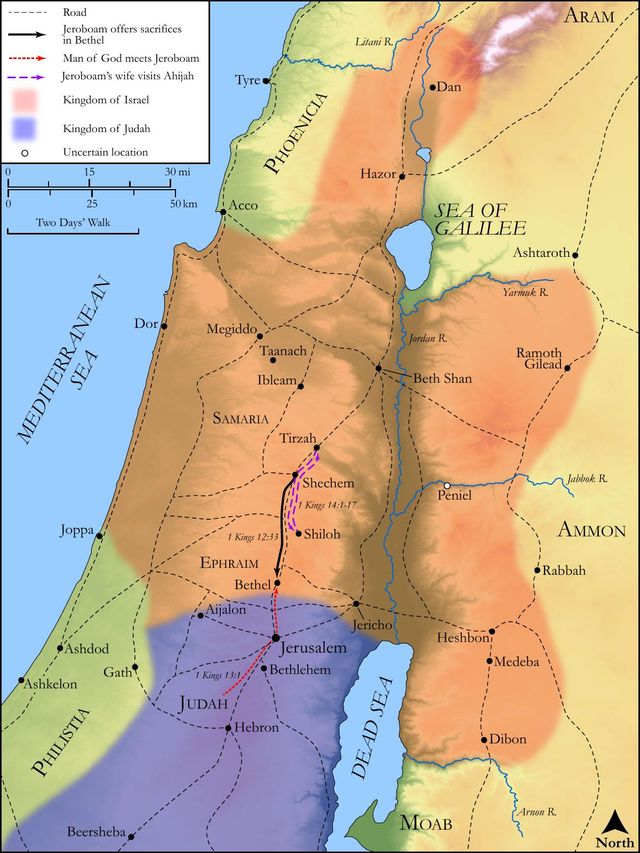
See on the biblical-era maps

Study this verse
Public-domain commentary
Matthew Henry
From his Commentary on the Whole Bible. Henry comments on passages, not single verses — this entry covers 1 Kings 13:23–34. His two-level outline is real structure in the source text, so it is rendered as structure.
Here is, I. The death of the deceived disobedient prophet. The old prophet that had deluded him, as if he would make him some amends for the wrong he had done him or help to prevent the mischief threatened him, furnished him with an ass to ride home on; but by the way a lion set upon him, and killed him, Kg1 13:23, Kg1 13:24. He did but return back to refresh himself when he was hungry, and behold he must die for it; see Sa1 14:43. But we must consider, 1. That his offence was great, and it would by no means justify him that he was drawn into it by a lie; he could not be so certain of the countermand sent by another as he was of the command given to himself, nor had he any ground to think that the command would be recalled, when the reason of it remained in force, which was that he might testify his detestation of the wickedness of that place. He had great reason to suspect the honesty of this old prophet, who did not himself bear his testimony, nor did God think fit to make use of him as a witness against the idolatry of the city he lived in. However, he should have taken time to beg direction from God, and not have complied so soon. Did he think this old prophet's house safer to eat in than other houses at Beth-el, when God had forbidden him to eat in any? That was to refine upon the command, and make himself wiser than God. Did he think to excuse himself that he was hungry? Had he never read that man lives not by bread alone? 2. That his death was for the glory of God; for by this it appeared, (1.) That nothing is more provoking to him than disobedience to an express command, though in a small matter, which makes his proceedings against our first parents, for eating the forbidden fruit, the easier to be accounted for. (2.) That God is displeased at the sins of his own people, and no man shall be protected in disobedience by the sanctity of his profession, the dignity of his office, his nearness to God, or any good services he has done for him. Perhaps God by this intended, in a way of righteous judgment, to harden Jeroboam's heart, since he was not reformed by the withering of his hand; for he would be apt to make a bad use of it, and to say that the prophet was well enough served for meddling with his altar, he had better have staid at home; any, he would say that Providence had punished him for his insolence, and the lion had done that which his withered hand might not do. However, by this God intended to warn all those whom he employs strictly to observe their orders, at their peril.
II.The wonderful preservation of his dead body, which was a token of God's mercy remembered in the midst of wrath.
The lion that gently strangled him, or tore him, did not devour his dead body, nor so much as tear the ass, Kg1 13:24, Kg1 13:25, Kg1 13:26. Nay, what was more, he did not set upon the travellers that passed by and saw it, nor upon the old prophet (who had reason enough to fear it) when he came to take up the corpse. His commission was to kill the prophet; hitherto he should go, but no further. Thus God showed that, though he was angry with him, his anger was turned away, and the punishment went no further than death.
III.The care which the old prophet took of his burial.
When he heard of this unusual accident, he concluded it was the man of God, who was disobedient to his Master (and whose fault was that?), therefore the Lord has delivered him to the lion, Kg1 13:26. It would well have become him to ask why the lion was not sent against him and his house, rather than against the good man whom he had cheated. He took up the corpse, Kg1 13:29. If there by any truth in the vulgar opinion, surely the corpse bled afresh when he touched it, for he was in effect the murderer, and it was but a poor reparation for the injury to inter the dead body. Perhaps when he cheated him into his ruin he intended to laugh at him; yet now his conscience so far relents that he weeps over him, and, like Joab at Abner's funeral, is compelled to be a mourner for him whom he had been the death of. They said, Alas! my brother, Kg1 13:30. The case was indeed very lamentable that so good a man, a prophet so faithful, and so bold in God's cause, should, for one offence, die as a criminal, while an old lying prophet lives at ease and an idolatrous prince in pomp and power. Thy way, O God! is in the sea, and thy path in the great waters. We cannot judge of men by their sufferings, nor of sins by their present punishments; with some the flesh is destroyed that the spirit may be saved, while with others the flesh is pampered that the soul may ripen for hell.
IV.The charge which the old prophet gave his sons concerning his own burial, that they should be sure to bury him in the same grave where the man of God was buried (Kg1 13:3): "Lay my bones beside his bones, close by them, as near as may be, so that my dust may mingle with his." Though he was a lying prophet, yet he desired to die the death of a true prophet. "Gather not my soul with the sinners of Beth-el, but with the man of God." The reason he gives is because what he cried against the altar of Beth-el, that men's bones should be burnt upon it, shall surely come to pass, Kg1 13:32. Thus,
1.He ratifies the prediction, that out of the mouth of two witnesses (and one of them such a one as St. Paul quotes, Tit 1:12, one of themselves, even a prophet of their own) the word might be established, if possible to convince and reclaim Jeroboam.
2.He does honour to the deceased prophet, as one whose word would not fall to the ground, though he did. Ministers die, die prematurely it may be; but the word of the Lord endures for ever, and does not die with them.
3.He consults his own interest. It was foretold that men's bones should be burnt upon Jeroboam's altar: "Lay mine (says he) close to his, and then they will not be disturbed;" and it was, accordingly, their security, as we find, Kg2 23:18. Sleeping and waking, living and dying, it is safe being in good company. No mention is made here of the inscription on the prophet's tomb; but it is spoken of Kg2 23:17, where Josiah asks, What title is that? and is told, It is the sepulchre of the man of God that came from Judah, who proclaimed these things which thou hast done; so that the epitaph upon the prophet's grave preserved the remembrance of his prophecy, and was a standing testimony against the idolatries of Beth-el, which it would not have been so remarkably if he had died and been buried elsewhere. The cities of Israel are here called cities of Samaria, though that name was not yet known; for, however the old prophet spoke, the inspired historian wrote in the language of his own time.
V.The obstinacy of Jeroboam in his idolatry (Kg1 13:33):
He returned not from his evil way; some hand was found that durst repair the altar God had rent, and then Jeroboam offered sacrifice on it again, and the more boldly because the prophet who disturbed him before was in his grave (Rev 11:10) and because the prophecy was for a great while to come. Various methods had been used to reclaim him, but neither threats nor signs, neither judgments nor mercies, wrought upon him, so strangely was he wedded to his calves. He did not reform, no, not his priesthood, but whoever would, he filled his hand, and made him priest, though ever so illiterate or immoral, and of what tribe soever; and this became sin, that is, a snare first, and then a ruin, to Jeroboam's house, to cut if off, Kg1 13:34. Note, The diminution, disquiet, and desolation of families, are the fruit of sin; he promised himself that the calves would secure the crown to his family, but it proved they lost it, and sunk his family. Those betray themselves that think by any sin to support themselves.
Historical interpretation
Four Centuries of Reception
5 surviving comments on this verse. Each one is dated, so this reads as a timeline rather than a list.
Select a marker to jump to its quote. Markers stagger vertically where authors wrote within a few decades of each other.
It is not to be imagined that one has been so annihilated by the teeth of a beast that his soul has then been snatched away to infernal punishment, since the same lion who killed his very body guarded it. Even the beast of burden on which the man had been riding was unhurt and with great courage stood in the presence of the wild beast at the destruction of his master. By this miraculous sign it is made clear that the man of God was corrected temporarily even at the point of death rather than that he was punished after death. On this subject the apostle Paul, when he had made mention of certain unpleasant infirmities and death experienced by many, said, “But if we judged ourselves, we should not thus be judged by the Lord. But when we are judged, we are being chastised by the Lord, that we may not be condemned with the world.”
We know that even saintly men have been given over in the flesh to Satan and to great afflictions for some very slight faults, since the divine mercy will not tolerate the very least spot or stain to be found in them on the day of judgment, and purges away in this world every spot of their filth, as the prophet, or rather God himself says, in order that he may commit them to eternity as gold or silver refined and needing no penal purification. “And,” he says,“I will clean purge away your dross, and I will take away all your sin; and after this you will be called the city of the just, a faithful city.” And again: “Just as silver and gold are tried in the furnace, so the Lord chooses hearts.” 18 And again: “The fire tries gold and silver, but man is tried in the furnace of humiliation.” And this also: “For the Lord chastens those whom he loves, and he disciplines every son whom he receives.” We see a clear instance of this in the case of the prophet and man of God in the third book of Kings who was immediately destroyed by a lion for a single disobedience, in which he was implicated not of set purpose nor by the fault of his own will but by the enticement of another. As the Scripture says of him: “It is the man of God, who disobeyed the word of the Lord, and the Lord delivered him to the lion, and it killed him according to the word of the Lord, which he spoke.” The punishment for his present offense and his careless error—together with the reward for his righteousness—for which the Lord gave over his prophet in this world to the destroyer appeared in the moderation and abstinence of the beast of prey, when that most savage creature did not dare even to taste the carcass that was given over to him.
Moreover, we know that even holy men have been given over bodily to Satan or to great sufferings on account of some slight sins. For the divine clemency does not permit the least blemish or stain to be found in them on the day of judgment. According to the words of the prophet, which are in fact God’s, he purges away all the dross of their uncleanness in the present so that he may bring them to eternity like fire-tried gold or silver, in need of no penal cleansing. “And I will,” he says, “utterly purge away your dross, and I will remove all your alloy. And after this you shall be called the city of the righteous, the faithful city.” And again: “Just as silver and gold are tried in a furnace, so the Lord chooses hearts.” And again: “Fire tries gold and silver, but a man is tried in the furnace of humiliation.” And this also: “The Lord chastises the one whom he loves, and he scourges every son whom he receives.” In the Third Book of Kings we see this clearly exemplified in the case of that prophet and man of God who was immediately destroyed by a lion because of a single sin of disobedience that he contracted not even out of the workings or the viciousness of his own will but through another’s deceptive behavior. Scripture says of him, “That is the man of God who was disobedient to the word of the Lord, and the Lord delivered him over to a lion, and it destroyed him, according to the word of the Lord which he spoke.” When this happened, the very sparingness and abstinence of the predator (for the voracious beast did not dare to eat anything at all of the corpse that had fallen to him) appeared as not only the punishment for his present offense and heedless error but also as the deserts of his righteousness, on account of which the Lord delivered over his prophet for a time to the tormenter. - "Conference 7.25.2-26.1"
It is written in the Scriptures, “But the just man, though he die early, shall be at rest.” What, then, does it matter to the just if they undergo harsh treatment at death, since they are on their way to eternal life? Sometimes, perhaps, it is a fault of theirs, slight though it be, that has to be expiated by such a death. For this reason the reprobate are given power over the just while they are still alive. But, once the just have died, the wicked are punished all the more severely because of the cruel power they exercised against holy people. This is demonstrated in the case of the barbarian who was permitted by God to strike down the deacon but was not allowed to rejoice over his death. It is also verified in holy Scripture. The man of God, for instance, who was sent to Samaria stopped on the way for a meal, contrary to God’s command. For this disobedience he was killed by a lion. But Scripture at once adds that the donkey and the lion were standing by the dead prophet, and “the lion had not eaten of the dead body.” From this passage we see that the sin of disobedience was atoned for by his death, because the lion attacked the living prophet and killed him, yet did not dare touch him once he was dead. God allowed the beast to kill, but not to eat of its kill, because the prophet, though blameworthy in life, was sanctified in the death he suffered as a punishment for his disobedience. In the first instance the lion took away the life of a sinner; in the second he stood guard over the body of a just man.
Through the words “a lion killed him” [the Scripture] shows that [the lion] strangled and killed him according to God’s command. And through the sentence “it did not eat him,” it shows that [the animal] was not urged by hunger but acted in compliance with God’s order. And this was done in order that Jeroboam and his priests might understand that, if this had happened to the prophet just because he had eaten, something extremely more serious would happen to those who made offerings to the idols.
Continue studying 1 Kings 13:28 across the web’s major study libraries — every link below opens this exact verse, chapter, or book on the destination site.
Read & Compare
 BibleGatewayThis verse in more than 200 translations and 70 languages.
 Bible.comThe YouVersion reader — hundreds of translations, reading plans, and highlights.
 ESV.orgCrossway's official English Standard Version reader.
 NET BibleThe NET translation with 60,000+ translators' notes on every rendering decision.
 STEP BibleTyndale House's free study tool — original text, vocabulary, and scholarly resources.
 BibliaLogos Bible Software's free web reader.
 USCCBThe New American Bible (Revised Edition) with the U.S. bishops' study notes.
Commentaries
 BibleHub CommentariesDozens of classic commentaries on this verse, gathered on one page.
 StudyLightMore than 100 commentary sets — the largest collection on the web.
 BibleRefPlain-English commentary on what this verse means, verse by verse.
 Enduring WordDavid Guzik's free commentary on this chapter, widely used by Bible teachers.
 Bible Study ToolsVerse commentary alongside Greek and Hebrew study aids.
Original Language & Research
- BibleHub InterlinearThe verse word by word — original language, transliteration, and English.
- BibleHub LexiconEvery word's original-language definition and Strong's entry.
 Blue Letter BibleDeep-study tools — Strong's numbers, concordance, and word studies.
 SefariaThe Hebrew text with Rashi and centuries of Jewish commentary.
Sermons, Hymns & Audio


TrulyRandomVerse is not affiliated with these sites and doesn’t control their content. They’re linked because they’re genuinely useful.
Summary
First Kings 13:28 presents a profoundly unusual and divinely orchestrated tableau: the lifeless body of the disobedient prophet from Judah, slain by a lion for violating God's explicit command, lies unconsumed on the roadside, with the lion itself and the prophet's ass standing peacefully beside the corpse. This extraordinary scene serves as an undeniable divine witness, meticulously highlighting God's absolute sovereignty over all creation, the severe and immediate consequences of disobedience to His revealed will, and the unmistakable nature of His judgment, even when executed through seemingly natural, yet supernaturally controlled, means.
Context
ShowHideLiterary Context
This verse provides the dramatic and tragic conclusion to the narrative of the unnamed "man of God from Judah" in 1 Kings chapter 13. The chapter opens with this prophet delivering a powerful, divinely commissioned prophecy against King Jeroboam's idolatrous altar at Bethel, a message accompanied by a miraculous sign. Crucially, God gives him a strict, explicit command: he must not eat, drink, or return by the same way while on this sacred mission (1 Kings 13:9). After successfully delivering the message and witnessing the altar split, he is tragically deceived by an older prophet who falsely claims to have received a new divine word permitting him to eat and drink (1 Kings 13:18). For this act of disobedience, God sends a lion to kill him on his return journey (1 Kings 13:24). Verse 28 describes the discovery of the prophet's body by the old prophet, emphasizing the supernatural elements of the scene—the unconsumed body, the unharmed ass, and the restrained lion—which unequivocally confirm that this was a direct divine act of judgment, not a random predatory attack.
Historical & Cultural Context
The events of 1 Kings 13 are set in the tumultuous period immediately following the division of the united monarchy into the northern kingdom of Israel and the southern kingdom of Judah, during the reigns of Jeroboam I (Israel) and Rehoboam (Judah). Jeroboam, driven by political expediency and a fear that pilgrimages to Jerusalem would draw his people back to Judah, established alternative worship sites at Dan and Bethel, complete with golden calves, thereby instituting state-sponsored idolatry (1 Kings 12:26-33). Bethel, historically a sacred site where Jacob had a vision of a ladder (Genesis 28:10-22), was now a center of apostasy. Prophets played a crucial and dangerous role in this era as God's direct messengers, often confronting kings and rebuking the powerful, even at great personal risk. The strictness of the command given to the prophet from Judah, and the severity of its consequence, underscore the gravity of prophetic obedience and the sacredness of God's word in a time of widespread spiritual compromise and moral decline.
Key Themes
ShowHideThis narrative powerfully illustrates several profound theological themes. Firstly, Divine Sovereignty is paramount; God demonstrates His absolute and meticulous control over all creation, even over wild animals, to execute His will and judgment with precision. The utterly unnatural behavior of the lion and the ass is a clear and unmistakable sign of His direct intervention, overriding natural instincts to serve His purpose. Secondly, the passage highlights the Seriousness of Obedience to God's explicit commands. Even a prophet, chosen by God for a significant mission and empowered with miraculous signs, faces immediate and fatal consequences for disobedience, emphasizing that God's word is not to be trifled with, regardless of the perceived source of contradictory information or the seemingly minor nature of the transgression. Thirdly, the scene serves as an Unmistakable Divine Witness. The unconsumed body, the unharmed donkey, and the lion standing guard proclaim to any passerby that this was no ordinary accident, but a direct, divinely orchestrated act of justice, serving as a visible and terrifying sign to all who beheld it, confirming the truth of God's word and the certainty of His judgment against disobedience.
Exposition and Analysis
ShowHideKey Word Analysis
ShowHideThis noun (נְבֵלָה, H5038) derives from a root meaning "to be flabby" or "to fall," and refers specifically to a dead body, often one that has fallen or is abandoned, particularly one that is unburied or left exposed. In the context of the Law, it frequently denotes an unclean corpse (e.g., Leviticus 11:8). Here, its use emphasizes not merely the prophet's death, but the ignominious and public state of his body as a direct result of divine judgment, left exposed as a stark spectacle and a testimony to God's unwavering justice.
The term (אַרְיֵה, H738) for lion is used here to denote a powerful and fearsome predator, known for its violence. Yet, in this specific instance, its natural predatory instinct is supernaturally restrained. The lion's role is not to consume its prey but to execute judgment by killing the prophet and then to stand guard over the "carcase," thereby serving as a precise instrument of God's will rather than merely acting on its own inherent nature. This highlights God's absolute dominion over the animal kingdom, even over its most ferocious inhabitants.
The verb (שָׁבַר, H7665) primarily means "to burst," "to break," or "to shatter," and in this context, it signifies "to tear apart" or "to maul." The explicit statement that the lion "had not eaten the carcase, nor torn the ass" (וְלֹא־אָכַל אֶת־הַנְּבֵלָה וְלֹא שִׁבַּר אֶת־הַחֲמוֹר) underscores the profoundly miraculous nature of the scene. It's not merely that the lion refrained from eating, but that it did not inflict any further damage upon the body or the ass, further emphasizing the divine control over its every action and the precise, limited scope of its divinely appointed task.
Verse Breakdown
ShowHide"And he went and found his carcase cast in the way"
This initial clause describes the discovery made by the old prophet, who, upon hearing of the incident, went to retrieve the body of the man he had deceived. The phrase "cast in the way" (literally, "fallen in the way" or "thrown in the way") emphasizes the public and exposed nature of the prophet's death. His body was not hidden but lay openly on a thoroughfare, making it a visible and undeniable sign to anyone passing by. This public display signifies the ignominy of his end, a direct and visible consequence of his disobedience.
"and the ass and the lion standing by the carcase"
This is the most striking and miraculous element of the verse, portraying an utterly unnatural and awe-inspiring scene. The ass, typically a vulnerable prey animal, and the lion, its natural and formidable predator, are depicted not in conflict but standing together peacefully and motionlessly beside the dead prophet. This defies all natural law and immediately signals a profound divine intervention, unequivocally indicating that this was no ordinary predatory kill or accident, but a supernaturally orchestrated event.
"the lion had not eaten the carcase, nor torn the ass"
This final clause explicitly confirms and elaborates upon the miraculous restraint of the lion. It directly negates the expected actions of a predator, which would naturally consume its kill and potentially attack other animals nearby. The lion, having precisely fulfilled its role as an instrument of divine judgment by killing the prophet, then ceases its predatory behavior entirely. This supernatural control over the lion's instincts serves as undeniable, public proof that the entire event was orchestrated by God, a powerful and terrifying testimony to His absolute sovereignty and the certainty of His word.
Literary Devices
ShowHideThe narrative in 1 Kings 13, culminating in the stark imagery of verse 28, employs several powerful literary devices to convey its profound message. Irony is profoundly prominent, as a prophet, a divinely appointed messenger, is himself judged and killed by God for disobedience, highlighting the impartial and unyielding severity of divine justice. The lion, typically a Symbol of untamed strength, ferocity, and danger, here becomes a precise instrument of God's controlled judgment, acting not out of instinct but as a direct agent of divine will. The ass, normally a symbol of humble service and often a victim, also plays a symbolic role, standing unharmed as a silent, living Witness to the miraculous nature of the judgment. The entire scene is a powerful demonstration of Divine Intervention, where the very laws of nature are suspended and overridden to underscore the supernatural origin and purpose of the event. This suspension of natural order creates a profound sense of Awe and Fear of the Lord, emphasizing God's absolute and terrifying sovereignty over all creation, even the most ferocious beasts, to accomplish His righteous purposes.
Theological and Thematic Connections
ShowHideThe scene in 1 Kings 13:28 is profoundly theological, serving as a stark and unforgettable reminder of God's unwavering commitment to His word and the absolute gravity of obedience. It underscores the principle that divine judgment, while severe and often terrifying, is always just, purposeful, and executed with precision, even when it falls upon those who have been called to serve Him. The miraculous restraint of the lion and the preservation of the ass testify to God's absolute sovereignty over creation, demonstrating that He is not merely a distant observer but an active, controlling force in the world, capable of overriding natural laws to achieve His specific ends. This event also highlights the insidious danger of spiritual deception, even from those who claim to speak for God, stressing the critical need for rigorous discernment and unwavering adherence to God's clear, established commands over any new, contradictory "revelation."
Reflection and Application
ShowHideThe tragic narrative culminating in 1 Kings 13:28 offers enduring and sobering lessons for believers today, serving as a potent reminder that obedience to God's explicit commands is paramount, regardless of the source of contradictory advice or the perceived minor nature of the transgression. In a world saturated with competing voices, diverse spiritual claims, and a tendency towards spiritual relativism, this story implores us to exercise rigorous and constant discernment, grounding our faith firmly and exclusively in the established, unchanging Word of God rather than being swayed by deceptive "new revelations," even if they emanate from seemingly credible spiritual authorities or respected figures within the faith community. It also calls us to cultivate a deeper reverence for God's holiness, His justice, and His unyielding truth, understanding that His decrees are not arbitrary but reflect His perfect, righteous character. The divine control over creation, so vividly evident in the lion's miraculous restraint, should inspire both profound awe at God's limitless power and a sober, humble understanding that He holds all things, including our very lives and destinies, in His sovereign hand. Our walk with God demands unwavering fidelity, vigilant discernment, and a humble, complete submission to His revealed will.
Questions for Reflection
ShowHideFAQ
ShowHideWhy did God use a lion to kill the prophet, and why did the lion not eat the body or harm the ass?
ShowHideGod used a lion as an instrument of judgment to demonstrate His absolute sovereignty and the severe consequences of disobedience to His explicit command. The lion's natural predatory instincts were supernaturally restrained; it killed the prophet but did not consume the body or harm the ass. This miraculous restraint was crucial because it served as an undeniable, public sign that this was not a random animal attack but a direct, divinely orchestrated act of judgment. The unconsumed body and the peaceful coexistence of predator and prey clearly indicated God's hand, leaving no doubt about the cause of the prophet's death and confirming the truth of the old prophet's subsequent prophecy concerning the divine judgment (1 Kings 13:26). The scene was a visible, terrifying testimony to God's power and the certainty of His word.
What was the prophet's specific sin that led to his death?
ShowHideThe prophet's sin was direct and deliberate disobedience to God's explicit command. When sent to Bethel to prophesy against Jeroboam's idolatrous altar, God strictly commanded him: "Eat no bread, nor drink water, nor turn again by the same way that thou camest" (1 Kings 13:9). After fulfilling his mission, he was tragically deceived by an older prophet who lied, claiming an angel had given him a new word from God, permitting the younger prophet to eat and drink (1 Kings 13:18). The younger prophet chose to believe this "new" and contradictory word over God's clear, original instruction, leading to his immediate and fatal judgment as a direct consequence of his disobedience. His sin was a failure to prioritize God's clear word above all other voices, even those claiming divine authority.
Christ-Centered Fulfillment
ShowHideWhile 1 Kings 13:28 vividly portrays the severity of divine judgment for disobedience, its profound Christ-centered fulfillment lies in the ultimate resolution of God's righteous demands through the perfect person and atoning work of Jesus Christ. The prophet's death underscores the universal principle that breaking God's law carries a deadly consequence, demonstrating that "the wages of sin is death" (Romans 6:23). Yet, in Christ, we witness the glorious intersection of God's perfect justice and His boundless mercy. Jesus, the true and ultimate Prophet, perfectly obeyed every command of God, fulfilling all righteousness, even to the point of sacrificial death on a cross (Philippians 2:8). He became the "Lamb of God, which taketh away the sin of the world" (John 1:29), bearing the full curse and judgment that our disobedience justly deserves, so that all who believe in Him might receive forgiveness, reconciliation, and eternal life, rather than judgment (John 3:16-18). The lion's supernatural restraint in 1 Kings 13:28 hints at God's absolute control over life and death, a control fully and triumphantly manifested in Christ's resurrection, where death itself was swallowed up in victory (1 Corinthians 15:54-57). Thus, the stark warning of judgment in the Old Testament finds its ultimate and merciful fulfillment in the perfect obedience and atoning sacrifice of Jesus, who redeems us from the consequences of our own disobedience and offers new life in Him.