


1 Kings 13:16
Bible text: King James Version (1769 Blayney text) · Public domain
Bible text: Berean Standard Bible · Public domain
Bible text: American Standard Version (1901) · Public domain
Bible text: World English Bible, Messianic edition · Public domain
Bible text: Geneva Bible (1599) · Public domain
Bible text: Young's Literal Translation · Public domain
- וַיֹּאמֶרvai·Yo·merand he saidH559Conj-w ¦ V-Qal-ConsecImperf-3msVerb Qal Consecutive Imperfect 3rd Singular Masculineוַandיֹּאמֶרhe said
- לֹאlo'notH3808NegParticle Negative
- אוּכַל'u·KhalI am ableH3201V-Qal-Imperf-1csVerb Qal Imperfect 1st Singular common gender
- לָשׁוּבla·Shuvto turn backH7725Prep-l ¦ V-Qal-InfVerb Qal Infinitive Constructלָtoשׁוּבturn back
- אִתָּךְ'i·Takhwith youH854Prep ¦ 2msPrepositionאִתָּwithךְyou
- וְלָבוֹאve·la·Vo'and to goH935Conj-w ¦ Prep-l ¦ V-Qal-InfVerb Qal Infinitive Constructוְandלָtoבוֹאgo
- אִתָּךְ'i·Takhwith youH854Prep ¦ 2msPrepositionאִתָּwithךְyou
- וְלֹאve·lo'and notH3808Conj-w ¦ NegParticle Negativeוְandלֹאnot
- אֹכַל'O·khalI will eatH398V-Qal-Imperf-1csVerb Qal Imperfect 1st Singular common gender
- לֶחֶםLe·chembreadH3899N-msNoun Singular Masculine Absolute
- וְלֹאve·lo'and notH3808Conj-w ¦ NegParticle Negativeוְandלֹאnot
- אֶשְׁתֶּה'esh·TehI will drinkH8354V-Qal-Imperf-1csVerb Qal Imperfect 1st Singular common gender
- אִתְּךָ'i·te·Khawith youH854Prep ¦ 2msPrepositionאִתְּwithךָyou
- מַיִםMa·yimwaterH4325N-mpNoun Plural Masculine Absolute
- בַּמָּקוֹםba·ma·Komin the placeH4725Prep-b ¦ N-msNoun Singular Masculine Absoluteבַּin theמָּקוֹםplace
- הַזֶּהha·Zeh<the> thisH2088Art ¦ PrtParticle Demonstrativeהַ<the>זֶּהthis
English is a literal word-by-word gloss of the Hebrew, not the KJV's wording. Why?
This is the original text the KJV's translators worked from — each Hebrew word with its own literal English meaning in this verse, prepared by scholars at Tyndale House, Cambridge. The KJV translates whole sentences, not word by word, so its wording differs: one Hebrew word can become several English words, and the KJV may choose “the LORD” where the gloss reads “Yahweh”. Both are faithful — they answer different questions. For the KJV's own rendering, switch to the KJV text.
Details
See on the biblical-era maps
Study this verse
Public-domain commentary
Matthew Henry
From his Commentary on the Whole Bible. Henry comments on passages, not single verses — this entry covers 1 Kings 13:11–22. His two-level outline is real structure in the source text, so it is rendered as structure.
The man of God had honestly and resolutely refused the king's invitation, though he promised him a reward; yet he was over-persuaded by an old prophet to come back with him, and dine in Beth-el, contrary to the command given him. Here we find how dearly his dinner cost him. Observe with wonder,
I.The old prophet's wickedness.
I cannot but call him a false prophet and a bad man, it being much easier to believe that from one of such a bad character should be extorted a confirmation of what the man of God said (as we find, Kg1 13:32) than that a true prophet, and a good man, should tell such a deliberate lie as he did, and father it upon God. A good tree could never bring forth such corrupt fruit. Perhaps he was trained up among the sons of the prophets, in one of Samuel's colleges not far off, whence he retained the name of a prophet, but, growing worldly and profane, the spirit of prophecy had departed from him. If he had been a good prophet he would have reproved Jeroboam's idolatry, and not have suffered his sons to attend his altars, as, it should seem, they did. Now,
1.Whether he had any good design in fetching back the man of God is not certain. One may hope that he did it in compassion to him, concluding he wanted refreshment, and out of a desire to be better acquainted with him and more fully to understand his errand than he could from the report of his sons; yet his sons having told him all that passed, and particularly that the prophet was forbidden to eat or drink there, which he had openly told Jeroboam, I suppose it was done with a bad design, to draw him into a snare, and so to expose him; for false prophets have ever been the worst enemies to the true prophets, usually aiming to destroy them, but sometimes, as here, to debauch them and draw them from their duty. Thus they gave the Nazarites wine to drink (Amo 2:12), that they might glory in their fall. But,
2.It is certain that he took a very bad method to bring him back. When the man of God had told him, "I may not, and therefore I will not, return to eat bread with thee" (his resolutions concurring with the divine command, Kg1 13:16, Kg1 13:17), he wickedly pretended that he had an order from heaven to fetch him back. He imposed upon him by asserting his quondam character as a prophet: I am a prophet also as thou art; he pretended he had a vision of an angel that sent him on this errand. But it was all a lie; it was a banter upon prophecy, and profane in the highest degree. When this old prophet is spoken of (Kg2 23:18) he is called the prophet that came out of Samaria, whereas there was no such place as Samaria till long after, Kg1 16:24. Therefore I take it he is so called there, though he was of Beth-el, because he was like those who were afterwards the prophets of Samaria, who caused God's people Israel to err, Jer 23:13.
II.The good prophet's weakness, in suffering himself to be thus imposed upon:
He went back with him, Kg1 13:19. He that had resolution enough to refuse the invitation of the king, who promised him a reward, could not resist the insinuations of one that pretended to be a prophet. God's people are more in danger of being drawn from their duty by the plausible pretences of divinity and sanctity than by external inducements; we have therefore need to beware of false prophets, and not believe every spirit.
III.The proceedings of divine justice hereupon; and here we may well wonder that the wicked prophet, who told the lie and did the mischief, went unpunished, while the holy man of God, that was drawn by him into sin, was suddenly and severely punished for it. What shall we make of this! The judgments of God are unfathomable. The deceived and the deceiver are his, and he giveth not account of any of his matters. Certainly there must be a judgment to come, when these things will be called over again, and when those that sinned most and suffered least, in this world, will receive according to their works. 1. The message delivered to the man of God was strange. His crime is recited, Kg1 13:21, Kg1 13:22. It was, in one word, disobedience to an express command. Judgment is given upon it: Thy carcase shall not come to the sepulchre of thy fathers, that is, "Thou shalt never reach thy own house, but shalt be a carcase quickly, nor shall thy dead body be brought to the place of thy fathers' sepulchres, to be interred." 2. Yet it was more strange that the old prophet himself should be the messenger. Of this we can give no account but that God would have it so, as he spoke to Balaam by his ass and read Saul his doom by the devil in Samuel's likeness. We may think God designed hereby, (1.) To startle the lying prophet, and make him sensible of his sin. The message could not but affect him the more when he himself had the delivering of it, and had so strong an impression made upon his spirit by it that he cried out, as one in an agony, Kg1 13:21. He had reason to think, if he must die for his disobedience in a small matter who sinned by surprise, of how much sorer punishment he should be thought worthy who had belied an angel of God and cheated a man of God by a deliberate forgery. If this were done to the green tree, what shall be done to the dry? Perhaps it had a good effect upon him. Those who preach God's wrath to others have hard hearts indeed if they fear it not themselves. (2.) To put the greater mortification upon the prophet that was deceived, and to show what those must expect who hearken to the great deceiver. Those that yield to him as a tempter will be terrified by him as a tormentor; whom he now fawns upon he will afterwards fly upon, and whom he now draws into sin he will do what he can to drive to despair.
Continue studying 1 Kings 13:16 across the web’s major study libraries — every link below opens this exact verse, chapter, or book on the destination site.
Read & Compare
 BibleGatewayThis verse in more than 200 translations and 70 languages.
 Bible.comThe YouVersion reader — hundreds of translations, reading plans, and highlights.
 ESV.orgCrossway's official English Standard Version reader.
 NET BibleThe NET translation with 60,000+ translators' notes on every rendering decision.
 STEP BibleTyndale House's free study tool — original text, vocabulary, and scholarly resources.
 BibliaLogos Bible Software's free web reader.
 USCCBThe New American Bible (Revised Edition) with the U.S. bishops' study notes.
Commentaries
 BibleHub CommentariesDozens of classic commentaries on this verse, gathered on one page.
 StudyLightMore than 100 commentary sets — the largest collection on the web.
 BibleRefPlain-English commentary on what this verse means, verse by verse.
 Enduring WordDavid Guzik's free commentary on this chapter, widely used by Bible teachers.
 Bible Study ToolsVerse commentary alongside Greek and Hebrew study aids.
Original Language & Research
- BibleHub InterlinearThe verse word by word — original language, transliteration, and English.
- BibleHub LexiconEvery word's original-language definition and Strong's entry.
 Blue Letter BibleDeep-study tools — Strong's numbers, concordance, and word studies.
 SefariaThe Hebrew text with Rashi and centuries of Jewish commentary.
Sermons, Hymns & Audio


TrulyRandomVerse is not affiliated with these sites and doesn’t control their content. They’re linked because they’re genuinely useful.
Summary
1 Kings 13:16 records the unwavering initial resolve of the unnamed man of God from Judah, as he firmly reiterates his commitment to a direct divine prohibition. Despite an offer of hospitality from an old prophet, he declares his absolute refusal to eat, drink, or return with him, demonstrating a clear understanding and steadfast adherence to God's explicit command not to partake in anything in Bethel or deviate from his prescribed path.
Context
ShowHideLiterary Context
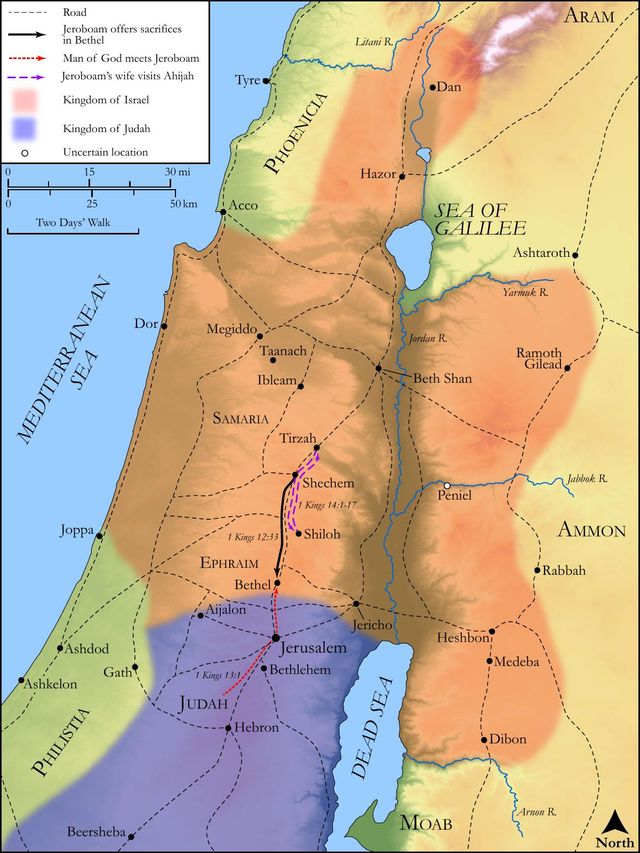
This verse is spoken by the unnamed man of God immediately following his divinely empowered prophetic act against King Jeroboam's idolatrous altar in Bethel. God had given him a precise and strict command: he was not to eat bread or drink water in Bethel, nor was he to return by the same way he came (1 Kings 13:9). The old prophet, having heard of the man of God's powerful demonstration and message, pursued him to offer hospitality. The man of God's firm and clear refusal in this verse highlights his immediate and strong commitment to the divine prohibition, setting a crucial stage for the tragic events that unfold later in 1 Kings 13.
Historical & Cultural Context
The narrative is set in the newly divided Kingdom of Israel, where Jeroboam, king of the northern tribes, had established golden calves in Bethel and Dan as illegitimate worship centers, directly defying the covenant with Yahweh and the true worship in Jerusalem. In Israel, hospitality was a deeply ingrained and sacred social obligation. Refusing an invitation to eat and drink was a significant act, often perceived as a rejection of fellowship, trust, or even an act of hostility. For the man of God to refuse such an offer, especially from another prophet, underscores the absolute nature of the divine command he was under, prioritizing God's explicit word over deeply held social conventions and personal comfort in a place profoundly corrupted by idolatry.
Key Themes
ShowHideThis verse is pivotal in highlighting several key themes within the broader narrative of 1 Kings. Foremost is the theme of Unwavering Obedience to Divine Command, as the man of God's words reflect his firm initial commitment to God's explicit instructions, emphasizing that divine commands are non-negotiable, even when seemingly benignly challenged. This also introduces the theme of Temptation and Deception, as the old prophet's invitation, though appearing benevolent, serves as a test of the man of God's resolve, underscoring the need for vigilance against any persuasion that would lead one away from God's path. Furthermore, the verse touches upon the Integrity of the Prophetic Word and Messenger, illustrating that a prophet's personal adherence to God's commands is paramount for the credibility and authority of the message they deliver. This initial steadfastness provides a stark contrast to his later fall, amplifying the tragedy of his subsequent disobedience detailed in 1 Kings 13:18-24.
Exposition and Analysis
ShowHideKey Word Analysis
ShowHideThis word (H3201) signifies more than a personal preference or a simple inability; it conveys a strong sense of divine prohibition or a binding obligation that prevents an action. It means "I am not permitted," "I am forbidden," or "I am unable by divine constraint." The man of God is stating that he is under a higher authority that absolutely restricts him from accepting the invitation, underscoring the non-negotiable nature of God's command.
This term (H3899) refers to food in general, but specifically bread, which was a staple of ancient diets and a fundamental element of hospitality and shared fellowship. Its mention here, alongside water, directly echoes the divine prohibition and emphasizes the man of God's refusal to partake in any form of sustenance or communal meal within the defiled context of Bethel.
This word (H4325) refers to water, essential for life and often included in acts of hospitality. Its specific mention alongside bread reinforces the comprehensive nature of the divine command against partaking in any form of sustenance in Bethel. The man of God's refusal to even drink water underscores his complete and unwavering commitment to absolute separation from the idolatrous "place."
Verse Breakdown
ShowHide"And he said,"
This opening phrase establishes the man of God's direct and authoritative response to the old prophet's invitation. It signifies a clear, verbal declaration of his stance, leaving no room for ambiguity.
"I may not return with thee, nor go in with thee:"
This clause presents a two-fold refusal. "I may not return with thee" indicates a prohibition against altering his divinely appointed return path. "nor go in with thee" specifically refuses to enter the old prophet's home or accompany him further, signifying a complete rejection of any form of association or fellowship that would violate the spirit or letter of God's command.
"neither will I eat bread nor drink water with thee in this place:"
This is the core of the prohibition, directly quoting God's specific instructions given in 1 Kings 13:9. The inclusion of "in this place" (referring to Bethel) underscores the geographical specificity of the command, linking it to the defilement of Jeroboam's idolatrous worship and emphasizing the man of God's commanded separation from it.
Literary Devices
ShowHideThe verse employs several potent literary devices. Repetition is evident as the man of God's words directly echo the divine command given in 1 Kings 13:9, reinforcing his clear understanding and initial commitment to the precise terms of God's instruction. This strong declaration also serves as powerful foreshadowing, ironically setting the stage for his tragic later fall. His steadfastness here makes his subsequent disobedience, brought about by deception, even more poignant and highlights the profound danger of subtle temptation. Furthermore, the man of God's unwavering stance creates a stark contrast with the deceptive nature of the old prophet's invitation, establishing a clear moral and spiritual dichotomy between true, uncompromising obedience and the insidious allure of compromise.
Theological and Thematic Connections
ShowHideThe man of God's initial refusal in 1 Kings 13:16 underscores a fundamental biblical principle: the absolute necessity of unreserved obedience to God's explicit commands. God's word is not subject to human negotiation, convenience, or even the seemingly good intentions of others. This narrative highlights the danger of external pressures, even from those who appear to be fellow believers or spiritual authorities, when they contradict a clear divine directive. It emphasizes the importance of spiritual discernment and the steadfast resolve required to maintain integrity in the face of temptation, reminding us that true faithfulness is demonstrated not only in what we do for God but also in what we refuse to do against His clear will.
Reflection and Application
ShowHideThis verse serves as a powerful and sobering reminder of the constant vigilance required to walk in obedience to God. In our lives, we frequently encounter situations where God's clear commands might seem inconvenient, socially awkward, or even challenged by well-meaning individuals or our own desires for comfort and acceptance. The man of God's initial response teaches us the profound importance of knowing God's word intimately, standing firm against any persuasion that would lead us astray, and exercising spiritual discernment, even when the source of temptation appears benign or even godly. His steadfastness here, though tragically short-lived in the broader narrative, offers a crucial lesson on the critical first step in faithful living: an immediate and unequivocal "I may not" when confronted with anything that contradicts God's revealed will.
Questions for Reflection
ShowHideFAQ
ShowHideWhy was the command about eating and drinking so specific and important?
ShowHideThe command was highly specific because it served as a symbolic act of complete separation and non-fellowship from Jeroboam's idolatrous kingdom and its defiled worship in Bethel. Eating and drinking with someone in Israel signified fellowship, peace, and shared identity. By forbidding the man of God from partaking in any sustenance in "this place" (Bethel), God was underscoring the severity of Jeroboam's sin and ensuring the prophet's absolute dissociation from the spiritual pollution and rebellion against the true worship of Yahweh. It was a crucial test of his obedience, demonstrating that his loyalty was solely to God and His commands, not to human custom or comfort in a place of apostasy. This command also served as a prophetic sign, demonstrating God's rejection of Jeroboam's illegitimate religious system, as seen in 1 Kings 13:1-6.
What does "in this place" refer to?
ShowHide"In this place" refers explicitly to Bethel, the city where King Jeroboam had established one of his golden calves as an alternative worship site to Jerusalem (1 Kings 12:28-30). By specifying "in this place," God emphasized the defilement of Bethel due to Jeroboam's idolatry and ensured that the man of God's mission, which included prophesying against the altar in Bethel, would be accompanied by a complete and visible separation from any association with the city's spiritual corruption. This geographical specificity highlighted the pervasive nature of the spiritual corruption that had taken root in the Northern Kingdom.
Christ-Centered Fulfillment
ShowHideThe man of God's initial, firm obedience in 1 Kings 13:16, though tragically marred by later compromise, points forward to the perfect, unwavering obedience of Jesus Christ. Unlike the man of God who eventually succumbed to deception, Jesus faced every temptation—from the devil in the wilderness (Matthew 4:1-11) to the allure of worldly power—and never once deviated from His Father's will. He perfectly embodied the "I may not" when confronted with anything that contradicted God's divine command, famously declaring, "My food is to do the will of him who sent me and to accomplish his work" (John 4:34). Christ's entire life was a testament to uncompromising faithfulness, culminating in His ultimate obedience even to death on a cross (Philippians 2:8). He is the true Prophet who perfectly fulfilled the divine mandate, never compromising His message or mission for comfort, social acceptance, or deceptive counsel. Through His perfect obedience, Christ secured salvation for us, and by His indwelling Spirit, He empowers believers to live lives of increasing obedience, reflecting His own steadfast commitment to the Father's will (Romans 8:4).