


1 Kings 1:45
Bible text: King James Version (1769 Blayney text) · Public domain
Bible text: King James Version with Strong's numbers · Public domain
Bible text: Berean Standard Bible · Public domain
Bible text: American Standard Version (1901) · Public domain
Bible text: World English Bible, Messianic edition · Public domain
Bible text: Geneva Bible (1599) · Public domain
Bible text: Young's Literal Translation · Public domain
- וַיִּמְשְׁחוּvai·yim·she·Chuand they have anointedH4886Conj-w ¦ V-Qal-ConsecImperf-3mpVerb Qal Consecutive Imperfect 3rd Plural Masculineוַandיִּמְשְׁחוּthey have anointed
- אֹתוֹ'o·To<obj.> himH853DirObjM ¦ 3msParticle Object Indicatorאֹת<obj.>וֹhim
- צָדוֹקtza·DokZadokH6659N-proper-mNoun Proper Masculine
- הַכֹּהֵןha·ko·Henthe priestH3548Art ¦ N-msNoun Singular Masculine Absoluteהַtheכֹּהֵןpriest
- וְנָתָןve·na·Tanand NathanH5416Conj-w ¦ N-proper-mNoun Proper MasculineוְandנָתָןNathan
- הַנָּבִיאha·na·Vi'the prophetH5030Art ¦ N-msNoun Singular Masculine Absoluteהַtheנָּבִיאprophet
- לְמֶלֶךְle·Me·lekhto kingH4428Prep-l ¦ N-msNoun Singular Masculine Absoluteלְtoמֶלֶךְking
- בְּגִחוֹןbe·gi·Chonat GihonH1521Prep-b ¦ N-properNoun Proper LocationבְּatגִחוֹןGihon
- וַיַּעֲלוּvai·ya·'a·Luand they have gone upH5927Conj-w ¦ V-Qal-ConsecImperf-3mpVerb Qal Consecutive Imperfect 3rd Plural Masculineוַandיַּעֲלוּthey have gone up
- מִשָּׁםmi·Shamfrom thereH8033Prep-m ¦ AdvAdverbמִfromשָּׁםthere
- שְׂמֵחִיםse·me·ChimjoyfulH8056Adj-mpAdjective Plural Masculine Absolute
- וַתֵּהֹםva·te·Homand it was excitedH1949Conj-w ¦ V-Niphal-ConsecImperf-3fsVerb Niphal Consecutive Imperfect 3rd Singular Feminineוַandתֵּהֹםit was excited
- הַקִּרְיָהha·kir·Yahthe townH7151Art ¦ N-fsNoun Singular Feminine Absoluteהַtheקִּרְיָהtown
- הוּאhu'thatH1931Pro-3msPronoun Personal 3rd Singular Masculine
- הַקּוֹלha·Kol[is] the noiseH6963Art ¦ N-msNoun Singular Masculine Absoluteהַ[is] theקּוֹלnoise
- אֲשֶׁר'a·SherwhichH834RelParticle Relative
- שְׁמַעְתֶּםshe·ma'·Temyou have heardH8085V-Qal-Perf-2mpVerb Qal Perfect 2nd Plural Masculine
English is a literal word-by-word gloss of the Hebrew, not the KJV's wording. Why?
This is the original text the KJV's translators worked from — each Hebrew word with its own literal English meaning in this verse, prepared by scholars at Tyndale House, Cambridge. The KJV translates whole sentences, not word by word, so its wording differs: one Hebrew word can become several English words, and the KJV may choose “the LORD” where the gloss reads “Yahweh”. Both are faithful — they answer different questions. For the KJV's own rendering, switch to the KJV text.
Details
See on the biblical-era maps

Study this verse
Public-domain commentary
Matthew Henry
From his Commentary on the Whole Bible. Henry comments on passages, not single verses — this entry covers 1 Kings 1:41–53. His three-level outline is real structure in the source text, so it is rendered as structure.
We have here,
I.The tidings of Solomon's inauguration brought to Adonijah and his party, in the midst of their jollity:
They had made an end of eating, and, it should seem, it was a great while before they made an end, for all the affair of Solomon's anointing was ordered and finished while they were at dinner, glutting themselves. Thus those who serve not our Lord Christ, but oppose him, are commonly such as serve their own belly (Rom 16:18) and made a god of it, Phi 3:19. Their long feast intimates likewise that they were very secure and confident of their interest, else they would not have lost so much time. The old world and Sodom were eating and drinking, secure and sensual, when their destruction came, Luk 17:26, etc. When they made an end of eating, and were preparing themselves to proclaim their king, and bring him in triumph into the city, they heard the sound of the trumpet (Kg1 1:41), and a dreadful sound it was in their ears, Job 15:21. Joab was an old man, and was alarmed at it, apprehending the city to be in an uproar; but Adonijah was very confident that the messenger, being a worthy man, brought good tidings, Kg1 1:42. Usurpers flatter themselves with the hopes of success, and those are commonly least timorous whose condition is most dangerous. But how can those who do evil deeds expect to have good tidings? No, the worthiest man will bring them the worst news, as the priest's son did here to Adonijah, Kg1 1:43. "Verily, the best tidings I have to bring you is that Solomon is made king, so that your pretensions are all quashed." He relates to them very particularly,
1.With what great solemnity Solomon was made king (Kg1 1:44, Kg1 1:45), and that he was now sitting on the throne of the kingdom, Kg1 1:46. Adonijah thought to have stepped into the throne before him, but Solomon was too quick for him.
2.With what general satisfaction Solomon was made king, so that that which was done was not likely to be undone again.
(1.)The people were pleased, witness their joyful acclamations, Kg1 1:45.
(2.)The courtiers were pleased: The kings servants attended him with an address of congratulation upon this occasion, Kg1 1:47. We have here the heads of their address: They blessed king David, applauded his prudent care for the public welfare, acknowledged their happiness under his government, and prayed heartily for his recovery. They also prayed for Solomon, that God would make his name better than his father's, which it might well be when he had his father's foundation to build upon. A child, on a giant's shoulders, is higher than the giant himself.
(3.)The king himself was pleased: He bowed himself upon the bed, not only to signify his acceptance of his servants' address, but to offer up his own address to God (Kg1 1:48): "Blessed be the Lord God of Israel, who, as Israel's God, for Israel's good, has brought this matter to such a happy issue, my eyes even seeing it." Note, It is a great satisfaction to good men, when they are going out of the world, to see the affairs of their families in a good posture, their children rising up in their stead to serve God and their generation, and especially to see peace upon Israel and the establishment of it.
II.The effectual crush which this gave to Adonijah's attempt.
It spoiled the sport of his party, dispersed the company, and obliged every man to shift for his own safety. The triumphing of the wicked is short. They were building a castle in the air, which, having no foundation, would soon fall and crush them. They were afraid of being taken in the fact, while they were together hatching their treason, and therefore each one made the best of his way.
III.The terror Adonijah himself was in, and the course he took to secure himself.
he was now as much depressed as he had been elevated, Kg1 1:42, Kg1 1:50. He had despised Solomon as not worthy to be his guest (Kg1 1:10), but now he dreads him as his judge: He feared because of Solomon. Thus those who oppose Christ and his kingdom will shortly be made to tremble before him, and call in vain to rocks and mountains to shelter them from his wrath. He took hold on the horns of the altar, which was always looked upon as a sanctuary, or place of refuge (Exo 21:14), intimating hereby that he durst not stand a trial, but threw himself upon the mercy of his prince, in suing for which he relied upon no other plea than the mercy of God, which was manifested in the institution and acceptance of the sacrifices that were offered on that altar and the remission of sin thereupon. Perhaps Adonijah had formerly slighted the service of the altar, yet now he courts the protection of it. Many who in the day of their security neglect the great salvation, under the arrests of the terrors of the Lord would gladly be beholden to Christ and his merit, and, when it is too late, will catch hold of the horns of the altar.
IV.His humble address to Solomon for mercy.
By those who brought Solomon tidings where he was, he sent a request for his life (Kg1 1:51): Let king Solomon swear to me that he will not slay his servant. He owns Solomon for his prince, and himself his servant, dares not justify himself, but makes supplication to his judge. It was a great change with him. He that in the morning was grasping at a crown is before night begging for his life. Then Adonijah reigned, now Adonijah trembles, and cannot think himself safe unless Solomon promise, with an oath, not to put him to death.
V.The orders Solomon gave concerning him.
He discharges him upon his good behaviour, Kg1 1:52, Kg1 1:53. He considered that Adonijah was his brother, and that it was the first offence. Perhaps, being so soon made sensible of his error and then not persisting in his rebellion, he might prove not only a peaceable, but a serviceable subject, and therefore, if he will conduct himself well for the future, what is past shall be pardoned: but if he be fond disaffected, turbulent, and aspiring, this offence shall be remembered against him, he shall be called up upon his former conviction (as our law speaks), and execution shall be awarded against him. Thus the Son of David receives those to mercy that have been rebellious: if they will return to their allegiance, and be faithful to their Sovereign, their former crimes shall not be mentioned against them; but, if still they continue in the interests of the world and the flesh, this will be their ruin. Adonijah is sent for, and told upon what terms he stands, which he signifies his grateful submission to, and then is told to go to his house and live retired there. Solomon not only gave him his life, but his estate, thus establishing his throne by mercy.
Continue studying 1 Kings 1:45 across the web’s major study libraries — every link below opens this exact verse, chapter, or book on the destination site.
Read & Compare
 BibleGatewayThis verse in more than 200 translations and 70 languages.
 Bible.comThe YouVersion reader — hundreds of translations, reading plans, and highlights.
 ESV.orgCrossway's official English Standard Version reader.
 NET BibleThe NET translation with 60,000+ translators' notes on every rendering decision.
 STEP BibleTyndale House's free study tool — original text, vocabulary, and scholarly resources.
 BibliaLogos Bible Software's free web reader.
 USCCBThe New American Bible (Revised Edition) with the U.S. bishops' study notes.
Commentaries
 BibleHub CommentariesDozens of classic commentaries on this verse, gathered on one page.
 StudyLightMore than 100 commentary sets — the largest collection on the web.
 BibleRefPlain-English commentary on what this verse means, verse by verse.
 Enduring WordDavid Guzik's free commentary on this chapter, widely used by Bible teachers.
 Bible Study ToolsVerse commentary alongside Greek and Hebrew study aids.
Original Language & Research
- BibleHub InterlinearThe verse word by word — original language, transliteration, and English.
- BibleHub LexiconEvery word's original-language definition and Strong's entry.
 Blue Letter BibleDeep-study tools — Strong's numbers, concordance, and word studies.
 SefariaThe Hebrew text with Rashi and centuries of Jewish commentary.
Sermons, Hymns & Audio


TrulyRandomVerse is not affiliated with these sites and doesn’t control their content. They’re linked because they’re genuinely useful.
Summary
First Kings 1:45 vividly recounts the pivotal moment of Solomon's anointing as king, a sacred ceremony orchestrated by Zadok the priest and Nathan the prophet at the Gihon spring. This event, mandated by the aging King David, served to publicly legitimize Solomon's succession and decisively counter Adonijah's attempted usurpation. The verse powerfully depicts the immediate and overwhelming public rejoicing that followed, as the city erupted in celebration, signaling widespread acceptance and divine favor upon the new monarch and solidifying his rightful claim to the throne of Israel.
Context
ShowHideLiterary Context
This verse is situated at a critical juncture in the narrative of King David's final days, specifically within 1 Kings 1. The preceding verses detail the immediate crisis: David is old and frail, and his ambitious son Adonijah, presuming the throne, has gathered significant support from key figures like Joab and Abiathar, attempting to seize power (1 Kings 1:5-10). Bathsheba, Solomon's mother, and Nathan the prophet intervene, reminding David of his solemn oath to make Solomon king (1 Kings 1:11-27). Roused to action, David issues a swift decree for Solomon's immediate anointing, bypassing Adonijah's rebellion. Verse 45 describes the rapid execution of this command, serving as the dramatic culmination of the power struggle and the definitive establishment of Solomon's reign. The subsequent verses (1 Kings 1:46-53) detail the news reaching Adonijah and his fearful reaction, confirming Solomon's secure position.
Historical & Cultural Context
Anointing with oil was a deeply significant ritual in ancient Israel, symbolizing divine selection and empowerment for specific roles, particularly for priests, prophets, and kings. The act of anointing a king was not merely a political coronation but a sacred consecration, signifying God's choice and the transfer of divine authority. The location, Gihon, was a natural spring outside Jerusalem, providing a vital water source for the city. Its choice for the anointing was symbolic, evoking life, purity, and perhaps echoing the anointing of David himself, who was also anointed in a public, divinely sanctioned manner (2 Samuel 5:3). The public acclamation, with the city "ringing again," was crucial for legitimizing the new king in the eyes of the populace, demonstrating popular consent alongside divine appointment. This public display effectively countered Adonijah's private, conspiratorial self-proclamation, ensuring broad recognition of Solomon's legitimate rule.
Key Themes
ShowHideThe central themes in 1 Kings 1 and specifically in verse 45 revolve around Divine Sovereignty and Succession. God's plan for the Davidic dynasty, as promised to David (2 Samuel 7:12-16), is powerfully asserted despite human machinations and attempts at usurpation. Solomon's anointing by God's representatives (Zadok and Nathan) underscores his Legitimate Authority, contrasting sharply with Adonijah's illegitimate ambition. The theme of Public Acclamation and Joy highlights the importance of popular consent and the people's recognition of God's chosen leader, which also serves as a deterrent to further rebellion. Furthermore, the narrative emphasizes God's Faithfulness to His Covenant, as the promise of a successor from David's lineage is fulfilled, paving the way for the building of the Temple and the establishment of a stable kingdom, as prophesied in 1 Chronicles 22:9-10.
Exposition and Analysis
ShowHideKey Word Analysis
ShowHideThis verb (H4886) literally means "to smear" or "to rub with oil." In the Old Testament, it signifies consecration, setting apart an individual or object for a sacred purpose. Kings, priests, and sometimes prophets were anointed, symbolizing their divine selection, empowerment by God's Spirit, and investment with divine authority for their office. This act was crucial for establishing legitimacy and divine sanction. The very terms "Messiah" (Hebrew Mashiach) and "Christ" (Greek Christos) derive from this root, referring to "the Anointed One."
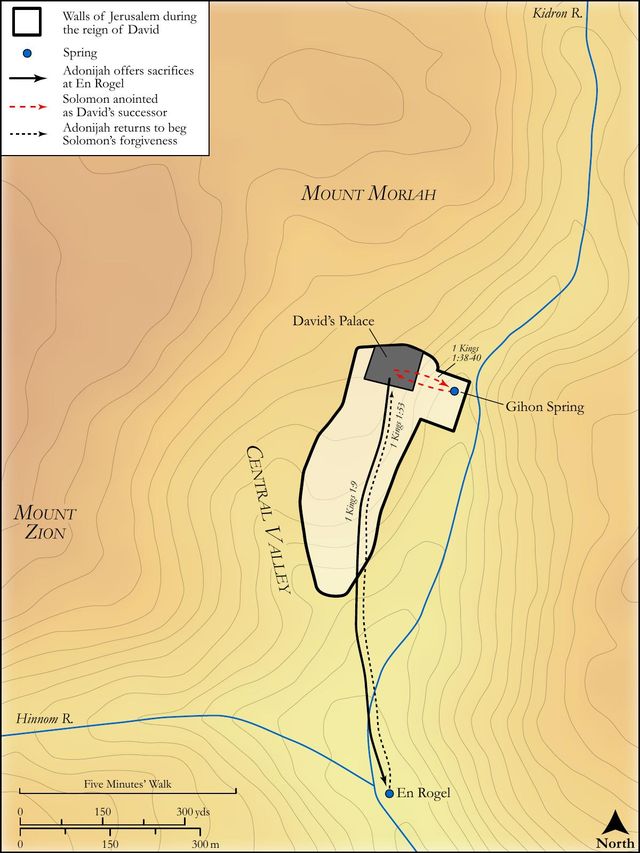
Gihon (H1521) was a significant natural spring and vital water source located in the Kidron Valley, just outside the walls of ancient Jerusalem. Its selection as the site for Solomon's anointing was highly symbolic. Springs are sources of life and purity, and the public nature of the anointing at Gihon, rather than within the palace, underscored the legitimacy and public acceptance of Solomon's kingship. It was a place of vital importance to the city, making the ceremony visible and impactful, signaling a fresh, divinely sanctioned start.
This phrase (H1949) conveys the sense of a loud, echoing sound, a clamor, or a roaring noise. It is used here hyperbolically to describe the overwhelming volume of the people's shouts and celebrations. It emphasizes the widespread, spontaneous, and enthusiastic public acclamation of Solomon's kingship, indicating universal approval and joy that reverberated through the entire city, making the event undeniable and its impact far-reaching.
Verse Breakdown
ShowHide"And Zadok the priest and Nathan the prophet have anointed him king in Gihon:"
This clause identifies the key figures responsible for the anointing: Zadok, the high priest, representing the religious authority and divine sanction, and Nathan, the prophet, God's direct messenger, who had previously conveyed God's covenant to David and revealed David's sin. Their joint participation underscored the divine legitimacy of Solomon's kingship, making it clear that this was not merely a political maneuver but a sacred act ordained by God. The location, Gihon, emphasizes the public and symbolic nature of the event, ensuring its visibility to the populace.
"and they are come up from thence rejoicing, so that the city rang again."
This describes the immediate aftermath of the anointing. The procession, including Solomon and his supporters, returned from Gihon to the city, accompanied by an overwhelming display of public jubilation. The phrase "the city rang again" is a powerful hyperbole, conveying the immense volume of the celebratory shouts, music, and general clamor from the populace. It signifies the widespread joy and popular acceptance of Solomon's ascension, demonstrating a clear mandate from the people in addition to divine appointment, effectively silencing any opposition.
"This [is] the noise that ye have heard."
This concluding statement serves as a direct address, likely from the narrator or one of David's loyalists (perhaps Jonathan, Abiathar's son, who relays the news in 1 Kings 1:42-43), to Adonijah and his co-conspirators. It clarifies the source of the celebratory uproar they were hearing, which had interrupted their own feast. This statement dramatically reveals to Adonijah that his attempted coup has been decisively thwarted by David's swift action and God's clear favor on Solomon, bringing his illicit celebration to an abrupt and fearful end.
Literary Devices
ShowHideThe passage employs several potent literary devices to convey its message. Hyperbole is strikingly evident in the phrase "the city rang again," which vividly exaggerates the sound of celebration to convey the overwhelming scale of public rejoicing and acclamation. This emphasizes the undeniable popular support for Solomon and the futility of Adonijah's rebellion. Symbolism is rich throughout, particularly with the act of anointing, which represents divine consecration, the transfer of authority, and the impartation of God's blessing. The choice of Gihon, a life-giving spring, as the site for the anointing also carries symbolic weight, suggesting the fresh start, vitality, and purity of Solomon's reign. Furthermore, the narrative employs Contrast between the legitimate, divinely sanctioned, and publicly celebrated anointing of Solomon and Adonijah's clandestine, self-proclaimed, and ultimately illegitimate attempt to seize the throne. This contrast powerfully highlights the triumph of God's sovereign will over human ambition and conspiracy.
Theological and Thematic Connections
ShowHideThe anointing of Solomon in 1 Kings 1:45 is a profound theological statement about divine sovereignty and the establishment of legitimate authority. It underscores that true leadership is not self-appointed or achieved through human maneuvering, but is divinely ordained and publicly affirmed. God's faithfulness to His covenant with David, promising an enduring dynasty, is visibly demonstrated, even amidst political intrigue and succession crises. The overwhelming joy of the people signifies their recognition of God's hand in Solomon's ascent, reflecting a communal affirmation of God's chosen king. This event serves as a powerful reminder that God's purposes will prevail, and He will establish His chosen instruments for His kingdom work, always in accordance with His divine plan and promises.
Reflection and Application
ShowHideThe vivid account of Solomon's anointing offers enduring lessons for believers today. It powerfully illustrates that God's plans are sovereign and cannot be thwarted by human ambition or conspiracy. Just as God established Solomon's reign despite Adonijah's attempts, so too does God work out His perfect will in our lives and in the world, often in ways that defy human expectation or logic. This narrative calls us to trust in God's timing and His anointing, recognizing that true authority and lasting peace come from His divine order, not from our own striving or self-promotion. It encourages us to rejoice when God's will is clearly manifested, to align ourselves with His purposes, and to find our security not in worldly power structures but in the steadfastness of His covenant promises. The public celebration also reminds us of the joy that accompanies God's blessings and the importance of communal affirmation of His work, prompting us to celebrate God's faithfulness in our own contexts.
Questions for Reflection
ShowHideFAQ
ShowHideWhy was Solomon anointed at Gihon, and what is its significance?
ShowHideSolomon was anointed at Gihon, a natural spring outside Jerusalem, for several significant reasons. Firstly, it was a vital water source for the city, making it a prominent and easily accessible location for a public ceremony. Secondly, the choice of a spring symbolized life, purity, and renewal, fitting for the inauguration of a new reign and implying a fresh, divinely blessed start. Historically, David himself was anointed in a public setting, and performing Solomon's anointing at Gihon, outside the palace, emphasized its public nature and legitimacy, directly countering Adonijah's more private, conspiratorial self-proclamation. This public display ensured that the entire city witnessed and could participate in the joyous acclamation of the new king, solidifying his authority in the eyes of the people. The location underscored that Solomon's kingship was not merely a palace intrigue but a divinely sanctioned event for all Israel, ensuring widespread recognition and acceptance.
Christ-Centered Fulfillment
ShowHideThe anointing of Solomon in 1 Kings 1:45 finds its ultimate and glorious fulfillment in Jesus Christ, the true and eternal "Anointed One." Solomon, a son of David, was anointed with oil by a priest and a prophet, establishing his earthly reign and foreshadowing a greater King. Jesus, as the Son of God and the ultimate Son of David, was not anointed with oil by human hands but by the Holy Spirit at His baptism, when the Spirit descended upon Him like a dove (Matthew 3:16-17). This divine anointing marked Him as the Christ, the Messiah, set apart by God for His eternal priestly, prophetic, and kingly offices. While Solomon's anointing led to the city "ringing again" with earthly joy, Jesus's anointing ushered in a spiritual kingdom that evokes heavenly rejoicing and the promise of eternal life for all who believe (Luke 15:7). Unlike Solomon's temporary and flawed reign, Jesus's kingship is eternal, righteous, and brings true peace and salvation (Isaiah 9:6-7; Luke 1:32-33). He is the Lamb of God who takes away the sin of the world, the ultimate fulfillment of God's covenant with David, establishing a kingdom that will never end and bringing ultimate joy to all who acknowledge His reign.