


1 Chronicles 16:43
Bible text: King James Version (1769 Blayney text) · Public domain
Bible text: Berean Standard Bible · Public domain
Bible text: American Standard Version (1901) · Public domain
Bible text: World English Bible, Messianic edition · Public domain
Bible text: Geneva Bible (1599) · Public domain
Bible text: Young's Literal Translation · Public domain
- וַיֵּלְכוּvai·ye·le·Khuand they wentH1980Conj-w ¦ V-Qal-ConsecImperf-3mpVerb Qal Consecutive Imperfect 3rd Plural Masculineוַandיֵּלְכוּthey went
- כָלkholallH3605N-mscNoun Singular Masculine Construct
- הָעָםha·'Amthe peopleH5971Art ¦ N-msNoun Singular Masculine Absoluteהָtheעָםpeople
- אִישׁ'isheveryoneH376N-msNoun Singular Masculine Absolute
- לְבֵיתוֹle·vei·Toto his houseH1004Prep-l ¦ N-msc ¦ 3msNoun Singular Masculine Constructלְtoבֵיתhouseוֹhis
- וַיִּסֹּבvai·yi·Soand he turnedH5437Conj-w ¦ V-Qal-ConsecImperf-3msVerb Qal Consecutive Imperfect 3rd Singular Masculineוַandיִּסֹּבhe turned
- דָּוִידda·VidDavidH1732N-proper-mNoun Proper Masculine
- לְבָרֵךְle·va·Rekhto blessH1288Prep-l ¦ V-Piel-InfVerb Piel Infinitive Constructלְtoבָרֵךְbless
- אֶת'et<obj.>H853DirObjMParticle Object Indicator
- בֵּיתוֹbei·Tohis houseH1004N-msc ¦ 3msNoun Singular Masculine Constructבֵּיתhouseוֹhis
English is a literal word-by-word gloss of the Hebrew, not the KJV's wording. Why?
This is the original text the KJV's translators worked from — each Hebrew word with its own literal English meaning in this verse, prepared by scholars at Tyndale House, Cambridge. The KJV translates whole sentences, not word by word, so its wording differs: one Hebrew word can become several English words, and the KJV may choose “the LORD” where the gloss reads “Yahweh”. Both are faithful — they answer different questions. For the KJV's own rendering, switch to the KJV text.
Details
See on the biblical-era map
Study this verse
Public-domain commentary
Matthew Henry
From his Commentary on the Whole Bible. Henry comments on passages, not single verses — this entry covers 1 Chronicles 16:37–43.
The worship of God is not only to be the work of a solemn day now and then, brought in to grace a triumph; but it ought to be the work of every day. David therefore settles it here for a constancy, puts it into a method, which he obliged those that officiated to observe in their respective posts. In the tabernacle of Moses, and afterwards in the temple of Solomon, the ark and the altar were together; but, ever since Eli's time, they had been separated, and still continued so till the temple was built. I cannot conceive what reason there was why David, who knew the law and was zealous for it, did not either bring the ark to Gibeon, where the tabernacle and the altar were, or bring them to Mount Zion, where the ark was. Perhaps the curtains and hangings of Moses's tabernacle were so worn with time and weather that they were not fit to be removed, nor fit to be a shelter for the ark; and yet he would not make all new, but only a tent for the ark, because the time was at hand when the temple should be built. Whatever was the reason, all David's time they were asunder, but he took care that neither of them should be neglected. 1. At Jerusalem, where the ark was, Asaph and his brethren were appointed to attend, to minister before the ark continually, with songs of praise, as every day's work required, Ch1 16:37. No sacrifices were offered there, nor incense burnt, because the altars were not there: but David's prayers were directed as incense, and the lifting up of his hands as the evening sacrifice (Psa 141:2), so early did spiritual worship take place of ceremonial. 2. Yet the ceremonial worship, being of divine institution, must by no means be omitted; and therefore at Gibeon were the altars where the priests attended, for their work was to sacrifice and burn incense, which they did continually, morning and evening, according to the law of Moses, Ch1 16:39, Ch1 16:40. These must be kept up because, however in their own nature they were inferior to the moral services of prayer and praise, yet, as they were types of the mediation of Christ, they had a great deal of honour put upon them, and the observance of them was of great consequence. Here Zadok attended, to preside in the service of the altar; as (it is probable) Abiathar settled at Jerusalem, to attend the ark, because he had the breast-plate of judgment, which must be consulted before the ark: this is the reason why we read in David's time both Zadok and Abiathar were the priests (Sa2 8:17; Sa2 20:25), one where the altar was and the other where the ark was. At Gibeon, where the altars were, David also appointed singers to give thanks to the Lord, and the burden of all their songs must be, For his mercy endureth for ever, Ch1 16:41. They did it with musical instruments of God, such instruments as were appointed and appropriated to this service, not such as they used on other occasions. Between common mirth and holy joy there is a vast difference, and the limits and distances between them must be carefully observed and kept up. Matters being thus settled, and the affairs of religion put into a happy channel, (1.) The people were satisfied, and went home pleased. (2.) David returned to bless his house, resolving to keep up family worship still, which public worship must not supersede.
Continue studying 1 Chronicles 16:43 across the web’s major study libraries — every link below opens this exact verse, chapter, or book on the destination site.
Read & Compare
 BibleGatewayThis verse in more than 200 translations and 70 languages.
 Bible.comThe YouVersion reader — hundreds of translations, reading plans, and highlights.
 ESV.orgCrossway's official English Standard Version reader.
 NET BibleThe NET translation with 60,000+ translators' notes on every rendering decision.
 STEP BibleTyndale House's free study tool — original text, vocabulary, and scholarly resources.
 BibliaLogos Bible Software's free web reader.
 USCCBThe New American Bible (Revised Edition) with the U.S. bishops' study notes.
Commentaries
 BibleHub CommentariesDozens of classic commentaries on this verse, gathered on one page.
 StudyLightMore than 100 commentary sets — the largest collection on the web.
 BibleRefPlain-English commentary on what this verse means, verse by verse.
 Enduring WordDavid Guzik's free commentary on this chapter, widely used by Bible teachers.
 Bible Study ToolsVerse commentary alongside Greek and Hebrew study aids.
Original Language & Research
- BibleHub InterlinearThe verse word by word — original language, transliteration, and English.
- BibleHub LexiconEvery word's original-language definition and Strong's entry.
 Blue Letter BibleDeep-study tools — Strong's numbers, concordance, and word studies.
 SefariaThe Hebrew text with Rashi and centuries of Jewish commentary.
Sermons, Hymns & Audio


TrulyRandomVerse is not affiliated with these sites and doesn’t control their content. They’re linked because they’re genuinely useful.
Summary
1 Chronicles 16:43 serves as a poignant conclusion to the monumental day of the Ark of the Covenant's arrival in Jerusalem, depicting the orderly dispersal of the people after a grand national celebration and King David's immediate, intentional return to his own home to "bless his house." This verse beautifully encapsulates the balance between public, corporate worship and private, familial devotion, highlighting David's exemplary leadership as one who understood that true piety extends from the national sphere into the intimate confines of one's household, a model for integrated spiritual responsibility.
Context
ShowHideLiterary Context
This verse provides the concise summary and orderly conclusion to the extensive narrative found in 1 Chronicles 16. The chapter begins with the Ark's placement in the tent David had prepared, followed by the offering of burnt offerings and peace offerings (1 Chronicles 16:1-2). David then blesses the people and distributes food, demonstrating his pastoral care (1 Chronicles 16:2-3). The bulk of the chapter details David's appointment of Levites to minister before the Ark, leading worship with a magnificent psalm of thanksgiving that recounts God's faithfulness from Abraham to the establishment of the covenant (1 Chronicles 16:4-36). The chapter concludes with the ongoing, daily ministry of the Levites (1 Chronicles 16:37-42). Thus, 1 Chronicles 16:43 marks the end of the public festivities and transitions to David's personal, domestic spiritual responsibility, emphasizing the comprehensive nature of his leadership.
Historical & Cultural Context
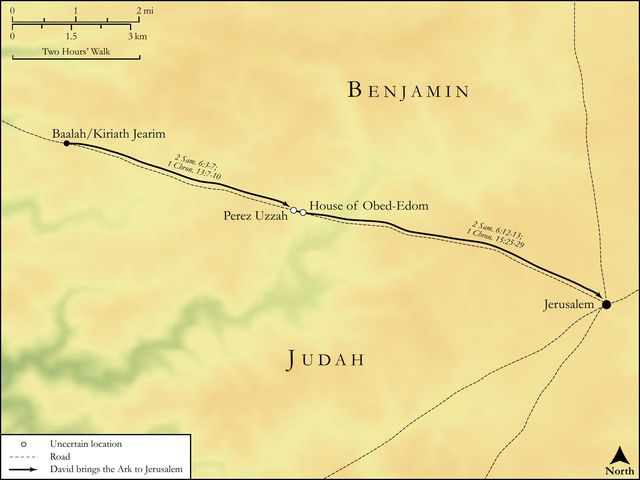
The setting is the early period of David's reign in Jerusalem, following his capture of the city and establishment of it as the political and spiritual capital of Israel. The Ark of the Covenant, representing God's presence, was central to Israelite worship and national identity. Its transfer from Kirjath-jearim to Jerusalem (1 Chronicles 13 and 1 Chronicles 15) was a pivotal moment, signifying the consolidation of the kingdom under Yahweh's authority through David. In ancient Israelite society, the household (Hebrew: bayit) was the fundamental unit, encompassing immediate family, servants, and often extended relatives. The head of the household, typically the father, held significant spiritual responsibility, acting as a priest within his own home, offering prayers, instruction, and blessings. David, as king, embodied this role on both a national and familial scale, demonstrating a holistic understanding of leadership that encompassed both public and private spheres.
Key Themes
ShowHideThis verse contributes to several key themes within 1 Chronicles:
Order and Completion of Worship
The phrase "all the people departed every man to his house" underscores the successful and orderly culmination of a major national and religious event. It reflects a well-organized society operating under divine blessing and proper leadership, contrasting with earlier, less successful attempts to move the Ark. This orderly conclusion highlights God's favor upon a people who have honored Him.
David's Exemplary Leadership
After leading the entire nation in worship and publicly blessing them (1 Chronicles 16:2), David's immediate return "to bless his house" highlights his personal commitment to God and his understanding of his spiritual responsibility not only as king of Israel but also as the spiritual head of his own family. This demonstrates a holistic and integrated piety, where public role does not negate private duty.
Balance of Public and Private Piety
1 Chronicles 16:43 beautifully illustrates the indispensable importance of both corporate worship and personal, family devotion. Public celebration of God's presence is vital for national identity and communal faith, but it must be complemented by private spiritual leadership and nurturing within one's home, ensuring faith is lived out consistently in all spheres of life, from the grand assembly to the intimate family dinner.
Exposition and Analysis
ShowHideKey Word Analysis
ShowHideA primitive root meaning "to walk (literally or figuratively); causatively, to carry (in various senses)." In this context, it signifies an orderly and complete dispersal. It implies that the grand public ceremony had reached its intended conclusion, and the people, having participated fully, were now returning to their normal lives, carrying the spiritual impact of the day with them. The use of "every man to his house" emphasizes the individual and domestic nature of this return, indicating a peaceful and organized conclusion to the national gathering.
A primitive root meaning "to revolve, surround, or border; used in various applications, literally and figuratively; bring, cast, fetch, lead, make, walk, whirl, round about, be about on every side, apply, avoid, beset (about), besiege, bring again, carry (about), change, cause to come about, circuit, (fetch a) compass (about, round), drive, environ, on every side, beset (close, come, compass, go, stand) round about, inclose, remove, return, set, sit down, turn (self) (about, aside, away, back)." Here, it highlights David's specific and intentional action. Unlike the general dispersal of the people, David's return is presented as a deliberate movement towards a particular purpose: to bless his house. This underscores his personal commitment and the importance he placed on his familial spiritual duties, indicating a conscious turning from public to private responsibility.
A primitive root meaning "to kneel; by implication to bless God (as an act of adoration), and (vice-versa) man (as a benefit); also (by euphemism) to curse (God or the king, as treason); abundantly, altogether, at all, blaspheme, bless, congratulate, curse, greatly, indeed, kneel (down), praise, salute, still, thank." This rich Hebrew word carries multiple layers of meaning. In this context, David's act of "blessing his house" is far more than a mere greeting. It implies a solemn, authoritative, and priestly or paternal act of invoking God's favor, protection, and prosperity upon his family. It is an act of spiritual leadership and consecration, acknowledging God's sovereignty over his household and actively seeking His presence and grace within it.
Verse Breakdown
ShowHide"And all the people departed every man to his house"
This clause signifies the successful and orderly conclusion of the national celebration surrounding the Ark's arrival. The phrase "every man to his house" emphasizes the individual return to domestic life, suggesting a sense of peace, contentment, and the re-establishment of normal routines after a momentous public gathering. It highlights the widespread participation in the worship and the subsequent, disciplined dispersal, indicative of a well-ordered society under God's blessing and the effective leadership of David.
"and David returned to bless his house"
This clause pivots from the national scene to David's personal piety and leadership within his own family. David, having fulfilled his public duties as king and spiritual leader of the nation, immediately turns his attention to his private responsibilities. "To bless his house" indicates an intentional act of spiritual care, likely involving prayer, instruction, or a formal invocation of God's favor upon his family. It portrays David as a man whose devotion was not confined to public spectacle but permeated every sphere of his life, beginning with his own household, thereby demonstrating the authenticity and depth of his faith.
Literary Devices
ShowHideThe verse employs several literary devices to convey its profound message. Juxtaposition is prominent, contrasting the grand, national scale of the public celebration and the dispersal of "all the people" with the intimate, personal act of David returning to "his house." This contrast highlights the essential balance between corporate worship and individual, familial devotion, emphasizing that neither can truly thrive without the other. There is also a subtle parallelism in the movement: the people depart to their respective houses, and David returns to his specific house, emphasizing a shared return to the domestic sphere but with David having a distinct, active purpose. The term "house" functions as a synecdoche, representing not just the physical dwelling but the entire family, household, and lineage, underscoring the holistic nature of David's spiritual concern for his descendants and all who resided under his roof. Finally, the act of "blessing" is symbolic of spiritual leadership, protection, and the invocation of divine favor, demonstrating David's role as a spiritual patriarch to his own family, mirroring his role as king to the nation.
Theological and Thematic Connections
ShowHide1 Chronicles 16:43 profoundly underscores the biblical imperative for spiritual leadership to extend from the public sphere into the private domain of the home. David's example teaches that genuine piety is not merely demonstrated in grand corporate worship but is deeply rooted in and expressed through the intentional spiritual nurture of one's family. This holistic approach to faith acknowledges that the household is the primary incubator of faith, where values are transmitted, and the covenant relationship with God is lived out daily. It challenges believers to recognize their domestic responsibilities as integral to their walk with God, ensuring that the blessings received in communal worship are actively brought into and applied within the home, creating a consistent testimony of faith.
Reflection and Application
ShowHideDavid's immediate return to bless his house after a day of national celebration offers a powerful and enduring model for believers today. It reminds us that our spiritual duties do not conclude with public worship services or corporate ministry, but rather, true devotion permeates every aspect of our lives, beginning with the most intimate sphere: our families. For parents and heads of households, this verse is a clarion call to intentional spiritual leadership within the home. It challenges us to actively cultivate an environment where God's presence is acknowledged, His Word is taught, and His blessings are sought through prayer and faithful living. Our homes should be places where the truths celebrated publicly are lived out privately, fostering a consistent and authentic faith that impacts generations and demonstrates the transforming power of the Gospel in everyday life.
Questions for Reflection
ShowHideFAQ
ShowHideWhat does it mean for David "to bless his house" in this context?
ShowHideFor David "to bless his house" (Hebrew: bârak') means to invoke God's divine favor, protection, and prosperity upon his family. It was a solemn, authoritative act of spiritual leadership, akin to a priestly or paternal blessing. After leading the nation in worship and publicly blessing them, David extended this same spiritual care to his immediate household. This likely involved prayer, perhaps a formal declaration of God's goodness, and an intentional act of consecration, acknowledging God's sovereignty over his family and seeking His continued presence and grace within his domestic sphere. It underscores that David's piety was not just for public display but was deeply personal and extended to his most intimate relationships, echoing the sentiment found in Joshua 24:15 where Joshua declares his household's commitment to the Lord.
Christ-Centered Fulfillment
ShowHide1 Chronicles 16:43, with David's transition from public celebration to private blessing of his house, beautifully foreshadows the comprehensive and holistic ministry of Jesus Christ. David, as king and spiritual leader, acts as a type of Christ, who is the ultimate King and High Priest. Just as David blessed the nation and then returned to bless his own household, so Christ, having completed His public ministry of salvation on the cross and ascended to the right hand of the Father, continues to intercede for and bless His "house"—the Church, His spiritual family. He is the one who has built His house (Hebrews 3:6) and continually nourishes and cherishes it (Ephesians 5:29). David's act of blessing his earthly household points to Christ's ongoing work of sanctifying and presenting His bride, the Church, without blemish (Ephesians 5:25-27), ensuring her spiritual well-being. Through His Spirit, Christ indwells believers, making their very bodies and homes temples of the Holy Spirit (1 Corinthians 6:19), ensuring that the blessings of the New Covenant permeate every aspect of their lives, from the corporate gathering to the intimate family unit, establishing a spiritual household built on His grace and truth.