


1 Chronicles 1:44
Bible text: King James Version (1769 Blayney text) · Public domain
Bible text: Berean Standard Bible · Public domain
Bible text: American Standard Version (1901) · Public domain
Bible text: World English Bible, Messianic edition · Public domain
Bible text: Geneva Bible (1599) · Public domain
Bible text: Young's Literal Translation · Public domain
- וַיָּמָתvai·Ya·motand he diedH4191Conj-w ¦ V-Qal-ConsecImperf-3msVerb Qal Consecutive Imperfect 3rd Singular Masculineוַandיָּמָתhe died
- בָּלַעBa·la'BelaH1106N-proper-mNoun Proper Masculine
- וַיִּמְלֹךְvai·yim·Lokhand he reignedH4427Conj-w ¦ V-Qal-ConsecImperf-3msVerb Qal Consecutive Imperfect 3rd Singular Masculineוַandיִּמְלֹךְhe reigned
- תַּחְתָּיוtach·Tavin place of himH8478N-mpc ¦ 3msNoun Plural Masculine Constructתַּחְתָּיin place ofוhim
- יוֹבָבyo·VavJobabH3103N-proper-mNoun Proper Masculine
- בֶּןben[the] son ofH1121N-mscNoun Singular Masculine Construct
- זֶרַחZe·rachZerahH2226N-proper-mNoun Proper Masculine
- מִבָּצְרָהmi·ba·tze·Rahfrom BozrahH1224Prep-m ¦ N-properNoun Proper LocationמִfromבָּצְרָהBozrah
English is a literal word-by-word gloss of the Hebrew, not the KJV's wording. Why?
This is the original text the KJV's translators worked from — each Hebrew word with its own literal English meaning in this verse, prepared by scholars at Tyndale House, Cambridge. The KJV translates whole sentences, not word by word, so its wording differs: one Hebrew word can become several English words, and the KJV may choose “the LORD” where the gloss reads “Yahweh”. Both are faithful — they answer different questions. For the KJV's own rendering, switch to the KJV text.
Details
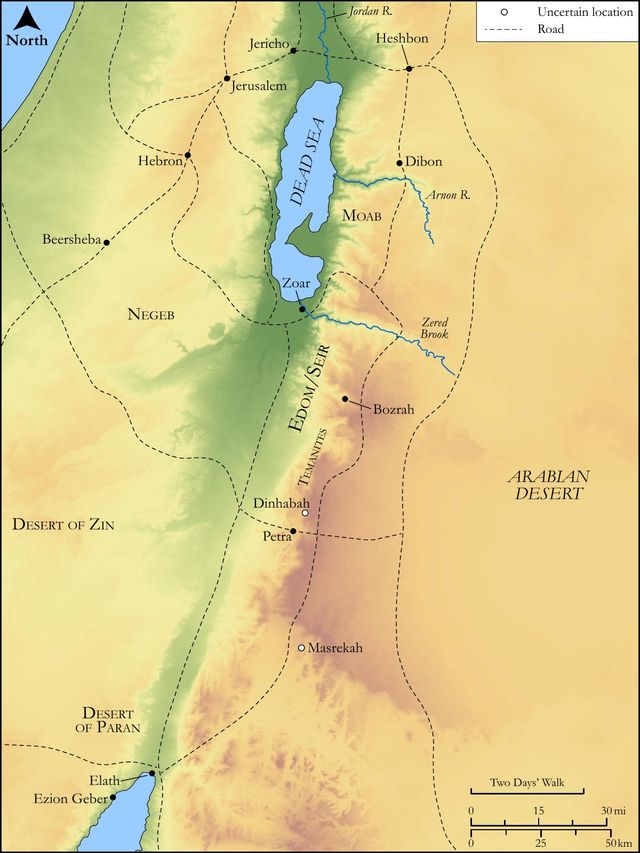
See on the biblical-era map
Study this verse
Public-domain commentary
Matthew Henry
From his Commentary on the Whole Bible. Henry comments on passages, not single verses — this entry covers 1 Chronicles 1:28–54. His two-level outline is real structure in the source text, so it is rendered as structure.
All nations but the seed of Abraham are already shaken off from this genealogy: they have no part nor lot in this matter. The Lord's portion is his people. Of them he keeps an account, knows them by name; but those who are strangers to him he beholds afar off. Not that we are to conclude that therefore no particular persons of any other nation but the seed of Abraham found favour with God. It was a truth, before Peter perceived it, that in every nation he that feared God and wrought righteousness was accepted of him. Multitudes will be brought to heaven out of all nations (Rev 7:9), and we are willing to hope there were many, very many, good people in the world, that lay out of the pale of God's covenant of peculiarity with Abraham, whose names were in the book of life, though not descended from any of the following families written in this book. The Lord knows those that are his. But Israel was a chosen nation, elect in type; and no other nation, in its national capacity, was so dignified and privileged as the Jewish nation was. That is the holy nation which is the subject of the sacred story; and therefore we are next to shake off all the seed of Abraham but the posterity of Jacob only, which were all incorporated into one nation and joined to the Lord, while the other descendants from Abraham, for aught that appears, were estranged both from God and from one another.
I.We shall have little to say of the Ishmaelites.
They were the sons of the bondwoman, that were to be cast out and not to be heirs with the child of the promise; and their case was to represent that of the unbelieving Jews, who were rejected (Gal 4:22, etc.), and therefore there is little notice taken of that nation. Ishmael's twelve sons are just named here (Ch1 1:29-31), to show the performance of the promise God made to Abraham, in answer to his prayer for him, that, for Abraham's sake, he should become a great nation, and particularly that he should beget twelve princes, Gen 17:20.
II.We shall have little to say of the Midianites, who descended from Abraham's children by Keturah.
They were children of the east (probably Job was one of them), and were separated from Isaac, the heir of the promise (Gen 25:6), and therefore they are only named here, Ch1 1:32. The sons of Jokshan, the son of Keturah, are named also, and the sons of Midian (Ch1 1:32, Ch1 1:33), who became most eminent, and perhaps gave denomination to all these families, as Judah to the Jews.
III.We shall not have much to say of the Edomites.
They had an inveterate enmity to God's Israel; yet because they descended from Esau, the son of Isaac, we have here an account of their families, and the names of some of their famous men, Ch1 1:35 to the end. Some slight differences there are between some of the names here, and as we had them in Gen. 36, whence this whole account is taken. Three of four names that were written with a Vau there are written with a Jod here, probably the pronunciation being altered, as is usual in other languages. we now write many words very differently from what they were written but 200 years ago. Let us take occasion, from the reading of these genealogies, to think,
1.Of the multitudes that have gone through this world, have acted their part in it, and then quitted it. Job, even in his early day, saw not only every man drawing after him, but innumerable before him, Job 21:33. All these, and all theirs, had their day; many of them made a mighty noise and figure in the world; but their day came to fall, and their place knew them no more. The paths of death are trodden paths, but vestigia nulla retrorsum - none can retrace their steps.
2.Of the providence of God, which keeps up the generations of men, and so preserves that degenerate race, though guilty and obnoxious, in being upon earth. How easily could he cut it off without either a deluge or a conflagration! Write but all the children of men childless, as some are, and in a few years the earth will be eased of the burden under which it groans; but the divine patience lets the trees that cumber the ground not only grow, but propagate. As one generation, even of sinful men, passes away, another comes (Ecc 1:4; Num 32:14), and will do so while the earth remains. Destroy it not, for a blessing is in it.
Historical interpretation
Historical reception
3 surviving comments on this verse. Each one is dated, so this reads as a timeline rather than a list.
The Chronicles also speak about the tabernacle because a temple of the Lord had not yet been built by either Samuel or David. The text also adds that that the holy services were held in the tabernacle. Worship was observed at that time according to the number of the days of the week. For it also says, “and their kindred who were in their villages were obliged to come in every seven days, in turn, to be with them.” With regard to the holy utensils it says, “Some of them had charge of the utensils of service, for they were required to count them when they were brought in and taken out. Others of them were appointed over the furniture, and over all the holy utensils, also over the choice flour, the wine, the oil, the incense and the spices.” And about the priests it says, “Others, of the sons of the priests, prepared the mixing of the spices.” With regard to the tomb of Saul the Chronicles gives us much information, and in the Book of Kings itself we read that his bones were gathered and buried in the land of Jabesh.
There is abundant information in the books of Chronicles which were written to continue the books of the Kings and to preserve the memory of such important events. The first book begins with a genealogy that sets out to demonstrate how the human race came from a single man. Since it focuses only on the single kingdom of Judah, it can tell us about its cities and the villages, and from where they took their names. Here we come to know Nathan, from whom the blessed Luke constructed the beginning of his genealogy of our Lord and Savior, Son of David and Solomon’s brother4 on his mother’s side: “The following children were born to him in Jerusalem: Shimeah, Shobab, Nathan and Solomon, that is, the four children he fathered with Bersabea, daughter of Ammiel.” And Rechab6 herself, who is mentioned in many books of Scripture, is said to have come from the tribe of Judah.It also clearly explains why Reuben lost his birthright and Joseph gained it and also, finally, the reason why the tribe of Judah obtained the highest honor: “The sons of Reuben the firstborn of Israel. He was the firstborn, but because he defiled his father’s bed his birthright was given to the sons of Joseph son of Israel, so that he is not enrolled in the genealogy according to the birthright; though Judah became prominent among his brothers and a ruler came from him, yet the birthright belonged to Joseph.” It also explains the reason why such a great honor was conceded to Joseph. By the will of God Judah had the dignity of receiving the Lord who was born from him according to the flesh. This is the sense tacitly expressed with the words “a leader from him.” Indeed the passage seems to assert that not only the kings of the earth derived from Judah, but also the eternal king himself who had no beginning and will never end.
It also describes the situation of the tribes beyond the Jordan, those of Reuben and Gad, and even the tribes of Manasseh which later were received into those of the Hagarites and the Itureans, and talks about the tribes of the Naphiseans, and all those peoples who entered into conflict with them. In addition the text relates how they fought and won, and made the Hagarites flee. And it also reports the reason for the victory: “When they received help against them, the Hagarites and all who were with them were given into their hands, for they cried to God in the battle, and he granted their entreaty because they trusted in him.” It also describes the amount of the spoils of war: “They captured their livestock: 50, of their camels, 250, sheep, 2, donkeys and 100, captives. Many were slain because the war was from God. And they lived in their territory until the exile.”
The genealogy of the priests and the Levites comes after this. It relates that Zadok, who was high priest at the time of David, had been the eleventh from Aaron; that Azariah, nephew of Zadok, had been the first to receive the priestly anointing in the temple built by Solomon. Among them there was also Jehozadak, who was brought to Babylon as a war prisoner. Jesus9 was his son, a high priest as well, who delivered the people from bondage together with Zerubbabel, and built a temple for the Lord. Here we also learn that Korah, who revolted against the great Moses, was a nephew of Isaar, son of Caath and brother of Amram, Aaron’s and Moses’ father. According to this lineage he was related to the first legislator. But he himself paid in the desert for his errors, although his children did not share the punishment of their father. From here Samuel13 came and then Aeman, who intoned Psalms and was a nephew of the prophet Samuel. In fact he was the son of Joel, son of Samuel. On the other hand, Asaph, one of the singers, came from the lineage of Gerson, son of Levi and brother of Caath. Aetham, who also belonged to the group of the singers, had Merari, the third son of Levi, as great-grandfather.The text also explains the difference between the priests and the Levites. It relates that the Levites were initiated into all the ministries of the holy altar of God: “But Aaron and his sons made offerings on the altar of burnt offering and on the altar of incense, doing all the work of the most holy place, to make atonement for Israel, according to all that Moses the servant of God had commanded.” It seems to me, in fact, that this book was written after the return from Babylon. For this reason it also talks about the bondage and explains its cause: “So all Israel was enrolled by genealogies; and these are written in the book of the Kings of Israel. And Judah was taken into exile in Babylon because of their unfaithfulness. Now the first to live again in their possessions in their towns were Israelites, priests, Levites, and temple servants.” These accounts show that the book was begun after the captivity. Indeed no historian ever relates facts that happened afterwards, but what happened before or during his times. And actually only the prophets have the power to foretell the future. In addition it says that also those who had inhabited that land before them had been enslaved. And actually many of them still live with them: the Canaanites, Chettites, Jebusites, who had been their companions in such a misfortune. Also the priests and the Levites were brought into captivity with the Israelites. I believe that those who were called “the saints’ servants” were then called Nathinim. Many of them, in fact, consecrated themselves to the ministries of the priests and the Levites. There were among them also those who were entrusted with the carrying of the water, the gathering of wood and other necessary duties. Indeed, if it was imposed to the Gabaonites, who were foreigners, to follow Joshua in the praises and to perform some works as porters or carpenters, this task was even more the duty of the Israelites. As a proof of this I have found in the interpretation of Hebrew names that this name means “house of Iaō,” that is, “of the God who is.” The text, in fact, mentions the children of Israel and among them Judah and Benjamin, and Ephraim18 and Manasseh. It also mentions the priests and the Levites, who inhabited those cities. About the Korēnites it says that they derived from Korah. It also says that among them there had been the guardians of the temple of God as well, and it seems that this custom had been introduced by Samuel and David. “All these, who were chosen as gatekeepers at the thresholds, were two hundred twelve. They were enrolled by genealogies in their villages. David and the prophet Samuel established them in their office of trust. So they and their descendants were in charge of the gates of the house of the Lord, that is, the house of the tent, as guards. The gatekeepers were on the four sides, east, west, north, and south.”
Continue studying 1 Chronicles 1:44 across the web’s major study libraries — every link below opens this exact verse, chapter, or book on the destination site.
Read & Compare
 BibleGatewayThis verse in more than 200 translations and 70 languages.
 Bible.comThe YouVersion reader — hundreds of translations, reading plans, and highlights.
 ESV.orgCrossway's official English Standard Version reader.
 NET BibleThe NET translation with 60,000+ translators' notes on every rendering decision.
 STEP BibleTyndale House's free study tool — original text, vocabulary, and scholarly resources.
 BibliaLogos Bible Software's free web reader.
 USCCBThe New American Bible (Revised Edition) with the U.S. bishops' study notes.
Commentaries
 BibleHub CommentariesDozens of classic commentaries on this verse, gathered on one page.
 StudyLightMore than 100 commentary sets — the largest collection on the web.
 BibleRefPlain-English commentary on what this verse means, verse by verse.
 Enduring WordDavid Guzik's free commentary on this chapter, widely used by Bible teachers.
 Bible Study ToolsVerse commentary alongside Greek and Hebrew study aids.
Original Language & Research
- BibleHub InterlinearThe verse word by word — original language, transliteration, and English.
- BibleHub LexiconEvery word's original-language definition and Strong's entry.
 Blue Letter BibleDeep-study tools — Strong's numbers, concordance, and word studies.
 SefariaThe Hebrew text with Rashi and centuries of Jewish commentary.
Sermons, Hymns & Audio


TrulyRandomVerse is not affiliated with these sites and doesn’t control their content. They’re linked because they’re genuinely useful.
Summary
1 Chronicles 1:44 precisely documents a significant transfer of royal authority within the ancient kingdom of Edom, identifying Jobab, son of Zerah, from the city of Bozrah, as the successor to King Bela. This concise genealogical entry is meticulously placed within the opening chapters of 1 Chronicles, which are dedicated to extensive ancestral records. Its inclusion highlights the Chronicler's commitment to comprehensive historical detail and subtly underscores the overarching scope of God's sovereign oversight, extending even to nations outside the direct covenant line of Israel, setting the stage for the subsequent focus on the Davidic lineage and the history of God's chosen people.
CONTEXT
ShowHideLiterary Context: 1 Chronicles begins with an expansive genealogical record, tracing humanity's origins from Adam, through the patriarchal lines of Noah, Shem, and Abraham, before meticulously detailing the lineages of Ishmael, Keturah's descendants, and then Esau (Edom). Verses 1 Chronicles 1:43-54 specifically enumerate the kings who reigned in Edom prior to the establishment of the monarchy in Israel, directly mirroring the account found in Genesis 36. This particular verse, therefore, is embedded within a non-Israelite genealogy, serving to establish a broad historical backdrop before the Chronicler's narrative narrows its focus to the tribes of Israel, the Davidic dynasty, and the Levitical priesthood. Its deliberate placement underscores the Chronicler's intention to present a universal history, even as the divine narrative progressively converges upon the covenant people.
Historical & Cultural Context: The Edomites, descendants of Esau (Jacob's brother), occupied the rugged, mountainous terrain situated to the south and east of the Dead Sea. Bozrah, mentioned as Jobab's origin, was a preeminent and strategically vital city within Edom, frequently recognized as its capital or a formidable stronghold. The practice of meticulously documenting successions of kings and their reigns was a standard and critical custom among the kings, as the books of Kings refer again and again to "the book of the chronicles of the kings of Israel." Such records served not only as vital historical archives but also as instruments to legitimize dynastic claims and provide essential chronological frameworks. The Chronicler, writing for the post-exilic Jewish community returning to Judah, employed these ancient records not merely as dry historical data but as a profound means to re-establish a continuous historical narrative. This reminded the returning exiles of their deep ancestral roots, God's enduring faithfulness across vast stretches of history, and His sovereign hand over all nations, including their often-antagonistic neighbors.
Key Themes:
Exposition and Analysis
ShowHideKey Word Analysis
ShowHideThis refers to the previous king of Edom, whose death is explicitly stated as the necessary condition for the subsequent royal succession. As per the Strong's data, this name identifies an Edomite king, distinct from other biblical figures who bear the same name.
Identified as the succeeding king, this name, derived from a root meaning "howler," denotes the individual who assumed the throne after Bela. While the name "Jobab" appears elsewhere in the biblical record, here it specifically designates this particular Edomite monarch, son of Zerah.
This primitive root signifies the act of exercising royal authority. It encompasses the ascension to the throne and the subsequent act of ruling or governing. Its inclusion here confirms the formal transfer of power and the establishment of Jobab's kingship in Edom.
Verse Breakdown
ShowHide"And when Bela was dead"
This opening clause establishes the critical precondition for the subsequent event, marking the end of one king's reign. It underscores the finite nature of human authority and the cyclical pattern of succession inherent in earthly monarchies.
"Jobab the son of Zerah"
This phrase identifies the new monarch by his personal name and, crucially, by his patronymic (father's name). This method of identification was standard and essential in the records of Israel for establishing an individual's identity, legitimacy, and any hereditary claims to power or status.
"of Bozrah"
This geographical descriptor specifies the city or region from which Jobab originated. Its inclusion provides vital geographical specificity, grounding the historical record in a known and significant location within Edom, thereby adding authenticity and precision to the genealogical account.
"reigned in his stead"
This concluding phrase succinctly communicates the formal assumption of the throne by Jobab, directly succeeding Bela. It confirms the complete transfer of royal authority and the continuation of the Edomite monarchy, maintaining the historical flow of the king list.
Literary Devices
ShowHideThe primary literary device evident in 1 Chronicles 1:44, and indeed throughout the initial chapters of the book, is Genealogy. This is a structured, often linear, list of ancestors and descendants, meticulously crafted to establish lineage, validate claims of legitimacy, and ensure historical continuity. The verse itself functions as a concise entry within a larger King List, which is a specialized form of genealogical record specifically designed to track the chronological succession of rulers within a kingdom or dynasty. The Chronicler's inclusion of this detail, almost verbatim from the book of Genesis, exemplifies Intertextuality, where one biblical text directly references, echoes, or incorporates content from another, thereby reinforcing the unity, consistency, and divine inspiration of the overarching sacred narrative. The direct, declarative, and unadorned style employed in this verse is characteristic of Historical Record, aiming for factual accuracy and an objective presentation of events without embellishment.
Theological and Thematic Connections
ShowHideThis seemingly straightforward genealogical entry, detailing the succession of an Edomite king, subtly yet profoundly illuminates several core theological truths. It reflects God's meticulous attention to the unfolding of history and His unwavering sovereign rule over all nations, not exclusively Israel. The Chronicler's deliberate inclusion of such details, even concerning nations that were often antagonistic to Israel, powerfully emphasizes that God's overarching redemptive plan encompasses the entirety of humanity. It reinforces the profound theological truth that every life, every reign, and every historical transition, regardless of its perceived distance from the immediate covenant narrative, plays a significant part in the unfolding of God's grand and purposeful design. This comprehensive historical record served to remind the post-exilic community of God's faithfulness across generations and His ultimate control over all earthly kingdoms, providing a foundational source of hope and stability for their future.
Reflection and Application
ShowHideWhile a verse detailing the succession of an ancient Edomite king might initially appear distant from contemporary life, it offers profound insights for personal and communal reflection. It serves as a potent reminder that God is the sovereign Lord of all history, meticulously overseeing every detail, even those that seem peripheral or insignificant to our immediate concerns. Just as He recorded the rise and fall of kings in Edom, He is intimately aware of the transitions, changes, and challenges that mark our own lives and the world around us. This verse encourages us to cultivate a deep trust in God's overarching sovereignty, knowing with certainty that He orchestrates all things according to His perfect purpose, even when we cannot immediately discern the significance of particular events. It calls us to recognize the inherent importance of every life and every role within God's grand narrative, whether prominent or seemingly obscure, and to live with a profound awareness that our individual lives are integral parts of a larger, divinely orchestrated story, contributing to His eternal purposes and glory.
Questions for Reflection
ShowHideFAQ
ShowHideWhy does the Chronicler include genealogies of non-Israelite peoples like the Edomites?
ShowHideThe Chronicler's inclusion of non-Israelite genealogies, such as the comprehensive list of Edomite kings in 1 Chronicles 1:43-54, serves several crucial theological and historical purposes. Firstly, it powerfully demonstrates the comprehensive scope of God's historical plan, which encompasses all humanity and not solely the nation of Israel. It explicitly shows that God is sovereign over all nations and their rulers, even those outside the direct covenant line of Abraham. Secondly, it provides a broader historical and geographical context for Israel's own unfolding story, illustrating their relationship to surrounding peoples, particularly those descended from Abraham's extended family, like Esau (Edom). Thirdly, by drawing directly from and reproducing earlier biblical texts like Genesis 36, the Chronicler reinforces the continuity, consistency, and accuracy of the biblical record, affirming the shared heritage and divine inspiration of these ancient accounts for the post-exilic community.
What is the significance of "Bozrah" in this verse?
ShowHide"Bozrah" (Hebrew: בׇּצְרָה, Botsrâh) was a highly significant and strategically important city within the territory of Edom, often identified as its capital or a major stronghold. Its specific mention in 1 Chronicles 1:44, as well as in other prophetic texts (e.g., Isaiah 34:6 and Jeremiah 49:13), lends crucial geographical and historical specificity to the genealogical record. It firmly grounds the account in a known and verifiable location, thereby adding to the authenticity and historical verifiability of the biblical narrative. For the Chronicler's original audience, Bozrah would have been a recognizable reference point, connecting the ancient past to their contemporary understanding of the broader geopolitical landscape.
How does this verse relate to the book of Genesis?
ShowHide1 Chronicles 1:44 is almost verbatim identical to Genesis 36:33. This direct and precise parallel highlights the Chronicler's deliberate reliance on and affirmation of earlier biblical texts as authoritative sources. By reproducing these ancient records, the Chronicler powerfully emphasizes the historical continuity and theological consistency of God's dealings with humanity, tracing a singular narrative from creation through the patriarchs and beyond. This intentional connection served to validate the ancient records for the post-exilic community, assuring them that their heritage and the enduring promises of God are rooted in a consistent, reliable, and divinely inspired historical narrative that extends back to the very foundations of the world.
Christ-Centered Fulfillment
ShowHideWhile 1 Chronicles 1:44 directly concerns the succession of an Edomite king, its inclusion within the broader, divinely inspired biblical narrative points to the meticulous and purposeful unfolding of God's redemptive plan, which ultimately culminates in Jesus Christ. The Chronicler's comprehensive genealogies, including those of non-Israelite nations, serve to underscore God's absolute sovereignty over all kingdoms and peoples, demonstrating that even seemingly peripheral historical details are integral to His grand design. This historical precision, meticulously tracing lineages and successions, ultimately foreshadows the coming of the true and eternal King, Jesus Christ. Unlike earthly kings whose reigns are finite and inevitably marked by death, as clearly seen with Bela in this verse, Christ's reign is everlasting, without end, and supreme, for He is the King of kings and Lord of lords. The meticulous recording of human history, from the lineage of Adam to the various nations and their rulers, sets the providential stage for the incarnation of the Son of David, through whom all the families of the earth would ultimately be blessed, fulfilling the ancient promise made to Abraham. Thus, even a verse about an Edomite king subtly contributes to the vast, intricate tapestry of God's providential work, guiding all of history toward the glorious establishment of His eternal kingdom under the Messiah.