


Ruth 4:9
Bible text: King James Version (1769 Blayney text) · Public domain
Bible text: King James Version with Strong's numbers · Public domain
Bible text: Berean Standard Bible · Public domain
Bible text: American Standard Version (1901) · Public domain
Bible text: World English Bible, Messianic edition · Public domain
Bible text: Geneva Bible (1599) · Public domain
Bible text: Young's Literal Translation · Public domain
- וַיֹּאמֶרvai·yo·Merand he saidH559Conj-w ¦ V-Qal-ConsecImperf-3msVerb Qal Consecutive Imperfect 3rd Singular Masculineוַandיֹּאמֶרhe said
- בֹּעַזBo·'azBoazH1162N-proper-mNoun Proper Masculine
- לַזְּקֵנִיםla·ze·ke·Nimto the eldersH2205Prep-l ¦ Adj-mpAdjective Plural Masculine Absoluteלַto theזְּקֵנִיםelders
- וְכָלve·kholand allH3605Conj-w ¦ N-mscNoun Singular Masculine Constructוְandכָלall
- הָעָםha·'Amthe peopleH5971Art ¦ N-msNoun Singular Masculine Absoluteהָtheעָםpeople
- עֵדִים'e·Dim[are] witnessesH5707N-mpNoun Plural Masculine Absolute
- אַתֶּם'a·TemyouH859Pro-2mpPronoun Personal 2nd Plural Masculine
- הַיּוֹםhai·Yomthis dayH3117Art ¦ N-msNoun Singular Masculine Absoluteהַthisיּוֹםday
- כִּיkithatH3588PrtParticle Conditional
- קָנִיתִיka·Ni·tiI acquireH7069V-Qal-Perf-1csVerb Qal Perfect 1st Singular common gender
- אֶת'et<obj.>H853DirObjMParticle Object Indicator
- כָּלkolallH3605N-msNoun Singular Masculine Absolute
- אֲשֶׁר'a·SherthatH834RelParticle Relative
- לֶאֱלִימֶלֶךְle·'e·li·Me·lekh[belonged] to ElimelechH458Prep-l ¦ N-proper-mNoun Proper Masculineלֶ[belonged] toאֱלִימֶלֶךְElimelech
- וְאֵתve·'Etand <obj.>H853Conj-w ¦ DirObjMParticle Object Indicatorוְandאֵת<obj.>
- כָּלkolallH3605N-msNoun Singular Masculine Absolute
- אֲשֶׁר'a·SherthatH834RelParticle Relative
- לְכִלְיוֹןle·khil·Yon[belonged] to KilionH3630Prep-l ¦ N-proper-mNoun Proper Masculineלְ[belonged] toכִלְיוֹןKilion
- וּמַחְלוֹןu·mach·Lonand MahlonH4248Conj-w ¦ N-proper-mNoun Proper MasculineוּandמַחְלוֹןMahlon
- מִיַּדmi·Yadfrom [the] hand ofH3027Prep-m ¦ N-cscNoun Singular common gender Constructמִfromיַּד[the] hand of
- נָעֳמִיno·'o·MiNaomiH5281N-proper-fNoun Proper Feminine
English is a literal word-by-word gloss of the Hebrew, not the KJV's wording. Why?
This is the original text the KJV's translators worked from — each Hebrew word with its own literal English meaning in this verse, prepared by scholars at Tyndale House, Cambridge. The KJV translates whole sentences, not word by word, so its wording differs: one Hebrew word can become several English words, and the KJV may choose “the LORD” where the gloss reads “Yahweh”. Both are faithful — they answer different questions. For the KJV's own rendering, switch to the KJV text.
Details
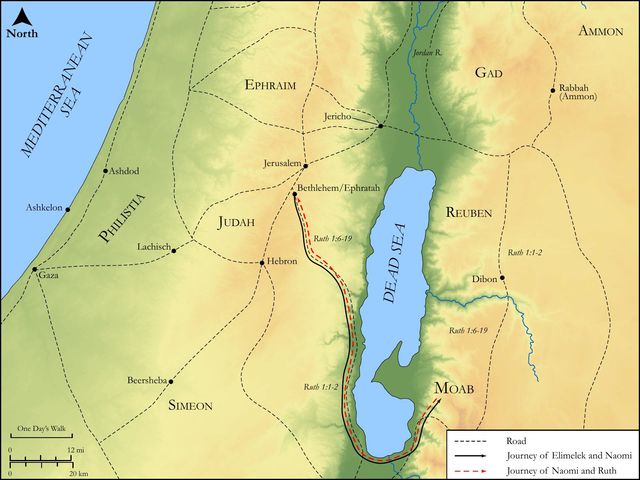
See on the biblical-era map
Study this verse
Public-domain commentary
Matthew Henry
From his Commentary on the Whole Bible. Henry comments on passages, not single verses — this entry covers Ruth 4:9–12. His three-level outline is real structure in the source text, so it is rendered as structure.
Boaz now sees his way clear, and therefore delays not to perform his promise made to Ruth that he would do the kinsman's part, but in the gate of the city, before the elders and all the people, publishes a marriage-contract between himself and Ruth the Moabitess, and therewith the purchase of all the estate that belonged to the family of Elimelech. If he had not been (Rut 2:1) a mighty man of wealth, he could not have compassed this redemption, nor done this service to his kinsman's family. What is a great estate good for, but that it enables a man to do so much the more good in his generation, and especially to those of his own household, if he have but a heart to use it so! Now concerning this marriage it appears,
I.That it was solemnized, or at least published, before many witnesses, Rut 4:9, Rut 4:10.
"You are witnesses," 1. "That I have bought the estate. Whoever has it, or any part of it, mortgaged to him, let him come to me and he shall have his money, according to the value of the land," which was computed by the number of years to the year of jubilee (Lev 25:15), when it would have returned of course to Elimelech's family. The more public the sales of estates are the better they are guarded against frauds. 2. "That I have purchased the widow to be my wife." He had no portion with her; what jointure she had was encumbered, and he could not have it without giving as much for it as it was worth, and therefore he might well say he purchased her; and yet, being a virtuous woman, he reckoned he had a good bargain. House and riches are the inheritance of fathers, but a prudent wife is more valuable, is from the Lord as a special gift. He designed, in marrying her, to preserve the memory of the dead, that the name of Mahlon, though he left no son to bear it up, might not be cut off from the gate of his place, but by this means might be preserved, that it should be inserted in the public register that Boaz married Ruth the widow of Mahlon, the son of Elimelech, which posterity, whenever they had occasion to consult the register, would take particular notice of. And this history, being preserved for the sake of that marriage and the issue of it, proved an effectual means to perpetuate the name of Mahlon, even beyond the thought or intention of Boaz, to the world's end. And observe that because Boaz did this honour to the dead, as well as this kindness to the living, God did him the honour to bring him into the genealogy of the Messiah, by which his family was dignified above all the families of Israel; while the other kinsman, that was so much afraid of diminishing himself, and marring his inheritance, by marrying the widow, has his name, family, and inheritance, buried in oblivion and disgrace. A tender and generous concern for the honour of the dead and the comfort of poor widows and strangers, neither of which can return the kindness (Luk 14:14), is sure what God will be well pleased with and will surely recompense. Our Lord Jesus is our Goel, our Redeemer, our everlasting Redeemer. He looked, like Boaz, with compassion on the deplorable state of fallen mankind. At a vast expense he redeemed the heavenly inheritance for us, which by sin was mortgaged, and forfeited into the hands of divine justice, and which we should never have been able to redeem. He likewise purchased a peculiar people, whom he would espouse to himself, though strangers and foreigners, like Ruth, poor and despised, that the name of that dead and buried race might not be cut off for ever. He ventured the marring of his own inheritance, to do this, for, though he was rich, yet for our sakes he became poor; but he was abundantly recompensed for it by his Father, who, because he thus humbled himself, hath highly exalted him, and given him a name above every name. Let us own our obligations to him, make sure our contract with him, and study all our days how to do him honour. Boaz, by making a public declaration of this marriage and purchase, not only secured his title against all pretenders, as it were by a fine with proclamations, but put honour upon Ruth, showed that he was not ashamed of her, and her parentage and poverty, and left a testimony against clandestine marriages. It is only that which is evil that hates the light and comes not to it. Boaz called witnesses to what he did, for it was what he could justify, and would never disown; and such regard was then had, even to the contemned crowd, that not only the elders, but all the people that were in the gate, passing and re-passing, were appealed to (Rut 4:9), and hearkened to (Rut 4:11) when they said, We are witnesses.
II.That it was attended with many prayers.
The elders and all the people, when they witnessed to it, wished well to it, and blessed it, Rut 4:11, Rut 4:12. Ruth, it should seem, was now sent for; for they speak of her (Rut 4:12) as present: This young woman; and, he having taken her to wife, they look upon her as already come into his house. And very heartily they pray for the new-married couple.
1.The senior elder, it is likely, made this prayer, and the rest of the elders, with the people, joined in it, and therefore it is spoken of as made by them all; for in public prayers, though but one speaks, we must all pray. Observe,
(1.)Marriages ought to be blessed, and accompanied with prayer, because every creature and every condition are that to us, and no more, that God makes them to be. It is civil and friendly to wish all happiness to those who enter into that condition; and what good we desire we should pray for from the fountain of all good. The minister who gives himself to the word and prayer, as he is the fittest person to exhort, so he is the fittest to bless and pray for those that enter into this relation.
(2.)We ought to desire and pray for the welfare and prosperity one of another, so far from envying or grieving at it.
2.Now here, (1.) They prayed for Ruth: The Lord make the woman that has come into thy house like Rachel and Leah, that is, "God make her a good wife and a fruitful mother." Ruth was a virtuous woman, and yet needed the prayers of her friends, that by the grace of God she might be made a blessing to the family she had come into. They prayed that she might be like Rachel and Leah, rather than like Sarah and Rebekah, for Sarah had but one son, and Rebekah but one that was in covenant, the other was Esau, who was rejected; but Rachel and Leah did build up the house of Israel: all their children were in the church, and their offspring was numerous. "May she be a flourishing, fruitful, faithful vine by thy house side." (2.) They prayed for Boaz, that he might continue to do worthily in the city to which he was an ornament, and might there be more and more famous. They desired that the wife might be a blessing in the private affairs of the house, and the husband a blessing in the public business of the town, that she in her place, and he in his, might be wise, virtuous, and successful. Observe, The way to be famous is to do worthily. Great reputation must be obtained by great merits. It is not enough not to do unworthily, to be harmless and inoffensive, but we must do worthily, be useful and serviceable to our generation. Those that would be truly illustrious must in their places shine as lights. (3.) They prayed for the family: "Let thy house be like the house of Pharez," that is, "let it be very numerous, let it greatly increase and multiply, as the house of Pharez did." The Bethlehemites were of the house of Pharez, and knew very well how numerous it was; in the distribution of the tribes, that grandson of Jacob had the honour which none of the rest had but Manasseh and Ephraim, that his posterity was subdivided into two distinct families, Hezron and Hamul, Num 26:21. Now they prayed that the family of Boaz, which was one branch of that stock, might in process of time become as numerous and great as the whole stock now was.
Historical interpretation
Two Centuries of Reception
4 surviving comments on this verse. Each one is dated, so this reads as a timeline rather than a list.
Select a marker to jump to its quote. Markers stagger vertically where authors wrote within a few decades of each other.
For, by the law, when a man died, the marriage bond with his wife was passed on to his brother or other male next of kin, in order that the seed of the brother or next of kin might renew the life of the house. And so it was that Ruth, though she was foreign-born, had possessed a husband of the Jewish people who had left a kinsman of near relation. Although she was seen and loved by Boaz while gleaning and maintaining herself and her mother-in-law with what she gleaned, she could not become the wife of Boaz until she had first loosed the shoe from him whose wife she ought, by the law, to have become.The story is a simple one, but deep are its hidden meanings, for that which was done was the outward signs of something more. If indeed we should stretch the sense so as to fit the letter exactly, we should almost find the words an occasion of a certain shame and horror, that we should regard them as intending and conveying the thought of common bodily intercourse. Rather it was the foreshadowing of one who was to arise from the Jewish people—whence Christ was, after the flesh—who should, with the seed of heavenly teaching, revive the seed of his dead kinsman, that is to say, the people, and to whom the precepts of the law, in their spiritual significance, assigned the sandal of marriage, for the espousals of the church.
Those things which happened to Ruth should be seen as figures. For she was an outsider and had fallen into extreme penury; but Boaz, seeing her, did not despise her on account of her poverty, nor was he horrified on account of her impiety; even as Christ received the church, who was both a stranger and laboring, in need of great good things. Ruth is not joined with her consort before forsaking her parents and her nation and her native land: never was anyone so much ennobled by marriage. Thus the church was not made loveable to her spouse before she had forsaken her prior customs. The prophet says, “Forget your people.”
The elders confirmed the marriage with a blessing, saying, “The Lord made this woman,” etc. Moreover, “So that she may be an example of virtue in Ephrathah,” they predicted the salvific birth through which Bethlehem was made famous among all people.
It was an old custom that if a groom wished to divorce his bride he took off his sandal and this was the sign of the divorce. Consequently, he was ordered to take off his sandals, lest he approach the church wearing sandals like a bridegroom; for this office was reserved for Christ, who is the true bridegroom. However, the blessing of the ten elders showed that all Gentile peoples were saved and blessed in the name of Christ. For iota signifies ten in Greek, and this first letter will signify the name of the Lord Jesus in full; which shows, as we said, that all peoples are saved through him and are blessed. Therefore, let no one doubt these things that were said, since it may be seen that they were everywhere and from the beginning prefigured by antecedent figures; and they were clearly fulfilled in this way through the advent of the Lord; and which were superfluous, being completed in this way by the accord of all voiced in truth; and by all “figures” of the holy Scriptures, which he who promised [them] fulfilled through his son, Jesus Christ our Lord, king, and redeemer and savior, with whom is honor and glory from age to age. Amen.
Continue studying Ruth 4:9 across the web’s major study libraries — every link below opens this exact verse, chapter, or book on the destination site.
Read & Compare
 BibleGatewayThis verse in more than 200 translations and 70 languages.
 Bible.comThe YouVersion reader — hundreds of translations, reading plans, and highlights.
 ESV.orgCrossway's official English Standard Version reader.
 NET BibleThe NET translation with 60,000+ translators' notes on every rendering decision.
 STEP BibleTyndale House's free study tool — original text, vocabulary, and scholarly resources.
 BibliaLogos Bible Software's free web reader.
 USCCBThe New American Bible (Revised Edition) with the U.S. bishops' study notes.
Commentaries
 BibleHub CommentariesDozens of classic commentaries on this verse, gathered on one page.
 StudyLightMore than 100 commentary sets — the largest collection on the web.
 BibleRefPlain-English commentary on what this verse means, verse by verse.
 Enduring WordDavid Guzik's free commentary on this chapter, widely used by Bible teachers.
 Bible Study ToolsVerse commentary alongside Greek and Hebrew study aids.
Original Language & Research
- BibleHub InterlinearThe verse word by word — original language, transliteration, and English.
- BibleHub LexiconEvery word's original-language definition and Strong's entry.
 Blue Letter BibleDeep-study tools — Strong's numbers, concordance, and word studies.
 SefariaThe Hebrew text with Rashi and centuries of Jewish commentary.
Sermons, Hymns & Audio


TrulyRandomVerse is not affiliated with these sites and doesn’t control their content. They’re linked because they’re genuinely useful.
Summary
Ruth 4:9 captures the pivotal moment at the Bethlehem city gate where Boaz publicly declares his intent to redeem the family property of Elimelech, Naomi's deceased husband, and his sons Chilion and Mahlon. Addressing the elders and all the gathered people, Boaz formally announces his acquisition of the land from Naomi, establishing his legal right and commitment as the kinsman-redeemer. This public declaration is a crucial step in the narrative, ensuring the restoration of the family's lineage and property, setting the stage for the book's redemptive climax and the continuation of the Messianic line.
Context
ShowHideLiterary Context
This verse serves as the legal culmination of the proceedings initiated by Boaz at the city gate, as detailed in Ruth 4:1. Following the unnamed closer kinsman's refusal to exercise his right of redemption due to the potential encumbrance on his own inheritance, as recorded in Ruth 4:6, Boaz immediately steps forward to assume the responsibility. Verse 9 represents his formal, public acceptance of the property redemption, which directly precedes his declaration in Ruth 4:10 to also acquire Ruth as his wife. This dual act ensures the raising up of the deceased's name upon his inheritance, fulfilling both the land redemption and levirate marriage aspects of the kinsman-redeemer's role. The entire scene at the gate, spanning Ruth 4:1-12, is meticulously structured as a legal drama, culminating in this solemn public pronouncement, which resolves the narrative's central conflict regarding Naomi and Ruth's future.
Historical & Cultural Context
The city gate in ancient Israel was far more than a mere entrance; it functioned as the primary civic, commercial, and judicial center of the community. It was the designated place where legal transactions were finalized, disputes settled, and public announcements made, all under the watchful eyes of the community's elders and citizens. This public setting ensured transparency, accountability, and the legal validity of agreements, as evidenced by the presence of "elders" (H2205, zâqên) and "all the people" (H5971, ‘am). The transaction itself relates to the intricate laws of land redemption and levirate marriage, primarily found in Leviticus 25 and Deuteronomy 25:5-10. The concept of the go'el (kinsman-redeemer) was vital for preserving family lineage, property, and dignity, especially for vulnerable widows like Naomi and Ruth. Boaz's actions here are a faithful adherence to these ancient covenantal obligations, reflecting the societal values of justice, compassion, and the preservation of family identity within the covenant community.
Key Themes
ShowHideThe central theme underscored by this verse is Redemption. Boaz's declaration is the active fulfillment of the kinsman-redeemer's role, not just in theory but in concrete, costly action. This act of "buying" back the land ensures that Elimelech's family heritage is not lost, providing economic security for Naomi and a foundation for Ruth's future. Another prominent theme is Public Witness and Legal Integrity. The emphasis on "Ye are witnesses this day" highlights the indispensable importance of community validation for legal transactions in ancient Israel, ensuring the legitimacy and enforceability of the agreement. This public covenant-making reflects a society where agreements were made before God and man, preventing future disputes. Furthermore, the verse contributes to the overarching theme of God's Providence and Covenant Faithfulness. While Boaz acts, his actions are implicitly guided by divine providence, demonstrating how God works through faithful individuals to restore hope and secure the future of His people, ultimately pointing towards the lineage of David and, ultimately, the Messiah. This act of redemption is a testament to the Lord's kindness and faithfulness, as Naomi herself acknowledges in Ruth 2:20.
Exposition and Analysis
ShowHideKey Word Analysis
ShowHideThe Hebrew verb קָנָה (H7069, qânâh) signifies "to acquire," "to buy," or "to obtain." In this specific legal context, it denotes a formal acquisition through a transaction, involving payment or agreement. It implies a transfer of ownership and rights. This is not merely a charitable act, but a legally binding purchase, reinforcing the integrity of Boaz's commitment and the formal nature of the proceedings at the gate. The use of qânâh here is crucial as it establishes the legal foundation for all subsequent actions, particularly Boaz's right to marry Ruth and perpetuate the family line.
The Hebrew word עֵד (H5707, ‘êd), used here in its plural form ‘êdîm, means "witnesses." Their presence was indispensable for validating any legal transaction in ancient Israel. They served to confirm the facts of the agreement, ensuring its legitimacy and providing a record for future reference. The public declaration "Ye are witnesses this day" transforms the gathered elders and people into official attestors of Boaz's solemn commitment, underscoring the transparency and binding nature of the agreement. Their testimony would prevent future disputes and uphold the integrity of the community's legal system.
The Hebrew word יָד (H3027, yâd) literally means "hand," but it is used with great latitude, often figuratively, to denote power, possession, agency, or control. In the phrase "of the hand of Naomi," it signifies that the property was legally under Naomi's control or disposition, as the surviving heir or the one with the right to initiate the redemption process. Boaz is acquiring the property from her legal authority or stewardship, emphasizing the proper legal transfer of rights and ownership.
Verse Breakdown
ShowHide"And Boaz said unto the elders, and [unto] all the people,"
This opening clause establishes the formal setting and the comprehensive audience for Boaz's declaration. The "elders" represent the judicial authority and leadership of Bethlehem, while "all the people" signify the broader community, ensuring that the transaction is publicly known and legally recognized by the entire town. This public address underscores the transparency, gravity, and official nature of the legal proceedings taking place at the city gate.
"Ye [are] witnesses this day,"
This phrase is a direct, imperative appeal to the assembled community to serve as legal witnesses. It confirms that the subsequent declaration is a solemn, binding legal act, not a private arrangement. The emphasis on "this day" highlights the immediate and present nature of their witnessing, making the transaction effective from that moment forward and legally verifiable by those present, thus preventing any future challenge to its legitimacy.
"that I have bought all that [was] Elimelech's, and all that [was] Chilion's and Mahlon's, of the hand of Naomi."
This is the core of Boaz's declaration, explicitly stating his acquisition of the land that belonged to Naomi's deceased husband, Elimelech, and her two deceased sons, Chilion (H3630, Kilyôwn) and Mahlon (H4248, Machlôwn). The phrase "of the hand of Naomi" indicates that Naomi (H5281, Noʻŏmîy), as the surviving heir or the one with the legal right to sell or initiate redemption, was the one from whom the property was acquired. This act of purchase secures the family's inheritance, preventing its permanent loss and ensuring its return to the family line, thereby fulfilling a key aspect of the kinsman-redeemer's duty.
Literary Devices
ShowHideThe verse primarily employs Legal Formalism and Public Declaration. The setting at the city gate, the direct address to the "elders" and "all the people," and the explicit call for them to be "witnesses" are all quintessential elements of a formal legal proceeding in ancient Israel. The language used, such as "bought" and the precise naming of the deceased (Elimelech, Chilion, and Mahlon), is precise and transactional, typical of legal dealings in Israel, whether by deed or by spoken contract before witnesses, as in Abraham's purchase of the field of Machpelah at the gate of his city. This Legal Formalism underscores the binding nature of Boaz's commitment and his meticulous adherence to Israelite law regarding land redemption and family lineage. The entire scene is a Public Declaration, emphasizing transparency and community accountability, ensuring that the agreement is widely known and cannot be easily disputed later. This public nature also serves to highlight Boaz's integrity and his commitment to fulfilling his responsibilities before the entire community, elevating the act beyond a mere transaction to a communal affirmation of justice and faithfulness.
Theological and Thematic Connections
ShowHideRuth 4:9 is a profound theological statement wrapped in a legal transaction. It highlights God's faithfulness working through human instruments to bring about redemption and restoration. Boaz's willingness to "buy" the property and later, to "buy" Ruth, reflects the divine principle of redemption, where something lost or alienated is recovered through a costly act. This act of redemption is not merely economic but deeply spiritual, ensuring the continuation of a lineage that will ultimately lead to King David and, by extension, the Messiah. It underscores the theme that even in the midst of personal tragedy and loss, God's providential hand is at work, orchestrating events to fulfill His larger redemptive plan, demonstrating His care for the vulnerable and His commitment to His covenant promises. Boaz's actions exemplify the self-sacrificial love and covenant loyalty that God desires from His people, making him a living parable of divine redemption.
Reflection and Application
ShowHideBoaz's public declaration in Ruth 4:9 is a powerful testament to integrity, faithfulness, and the selfless fulfillment of covenantal obligations. In a world often characterized by self-interest and private dealings, Boaz's actions stand out as a model of transparent and community-oriented commitment. For believers today, this narrative encourages us to live lives of integrity, where our words align with our actions, and our commitments are honored, not just in private but also before the watching world. It reminds us that our faith is not merely a private affair but has public implications, calling us to embody God's justice, compassion, and faithfulness in our daily interactions and legal dealings. Furthermore, Boaz's willingness to embrace a costly responsibility for the sake of another's welfare serves as a profound example of sacrificial love and a tangible expression of God's redemptive work through human agents. We are called to be instruments of God's restoration in our communities, seeking to bring hope and healing to those who are vulnerable or in need, just as Boaz did for Naomi and Ruth, reflecting the very character of God.
Questions for Reflection
ShowHideFAQ
ShowHideWhy was it necessary for Boaz to make this declaration publicly at the city gate?
ShowHideIn ancient Israel, the city gate served as the primary legal and administrative hub of the community. All significant transactions, legal judgments, and public declarations were conducted there to ensure transparency, accountability, and legal validity. The presence of the "elders" (the town's judicial authorities) and "all the people" meant that the agreement was witnessed by the entire community, making it legally binding and preventing future disputes. This public setting provided an official record and communal endorsement of Boaz's commitment to redeem the land and lineage, as seen in similar public land transactions like the one in Jeremiah 32:6-15. It solidified the legal standing of the transaction before God and man.
What was the significance of Boaz "buying" the land from Naomi's hand?
ShowHideThe act of "buying" (Hebrew: qânâh) the land from Naomi's hand was a formal legal acquisition. It meant that Boaz was taking ownership of the property that belonged to Elimelech and his sons, which had been alienated due to their deaths and Naomi's subsequent poverty. This purchase was a crucial step in fulfilling the role of the kinsman-redeemer (go'el), whose responsibility included restoring family property to its original lineage. By purchasing it, Boaz ensured the land would remain within Elimelech's family line, providing economic security for Naomi and setting the stage for the continuation of the family name through Ruth, as explained more fully in Ruth 4:10. The phrase "from Naomi's hand" indicates her legal right to initiate the sale or redemption process, making the transaction entirely legitimate.
Christ-Centered Fulfillment
ShowHideRuth 4:9, with Boaz's public declaration of redemption, powerfully foreshadows the ultimate redemptive work of Jesus Christ. Boaz, as the kinsman-redeemer, willingly steps forward to "buy back" what was lost—the land and the hope of a continuing lineage for Elimelech's family. This costly act of acquisition, made publicly before witnesses, mirrors Christ's work on the cross. Just as Boaz paid a price to redeem the property and secure the future of Naomi and Ruth, Jesus Christ paid the ultimate price—His own life—to redeem humanity from the slavery of sin and death (1 Peter 1:18-19). He "bought" us back, not with perishable things like silver or gold, but with His precious blood, making us His own possession (1 Corinthians 6:20). This divine transaction, publicly witnessed by heaven and earth, ensures our spiritual inheritance and secures our place within God's family, fulfilling the grandest act of redemption in the history of the world (Ephesians 1:7). Boaz's integrity and selfless commitment at the city gate serve as a beautiful type of our Lord, who, through His public sacrifice on Calvary, declared His claim over us, bringing us into His eternal family and securing our future and inheritance in Him (Colossians 1:13-14).