

 TRV
TRV
- English
- King James KJV
- Complete Jewish CJB
- World English WEBM
- Berean Standard BSB
- American Standard ASV
- Geneva GNV
- Young's Literal YLT
- Douay-Rheims DRC
- International
- Shqip ALB
- العربية SVD
- বাংলা BN-IRV
- မြန်မာ Judson
- 简体文 CUV-S
- 繁體中文 CUV-T
- Čeština BKR
- Nederlands STVE
- Français LSG
- Deutsch SCH
- Ελληνικά Vamvas
- ગુજરાતી GU-IRV
- Hausa HCB
- עברית Hebrew
- हिन्दी HCV
- Magyar KAROLI
- Bahasa Indonesia INDO-TB
- Italiano Diodati
- 日本語 Kougo
- 한국어 Korean
- മലയാളം MAL
- मराठी MRCV
- Norsk DNB
- فارسی OPV
- Polski BG
- Português Almeida
- Română Cornilescu
- Русский Synodal
- Español RVG
- Kiswahili Neno
- Svenska SV1917
- Tagalog TAG-ADB
- தமிழ் TCV
- తెలుగు TSA
- ภาษาไทย THAI-KJV
- Українська Ohienko
- Tiếng Việt CADMAN
- Yorùbá YCB
The Request for Land East of Jordan
Numbers 32:1-5
The Request for Land East of Jordan
1
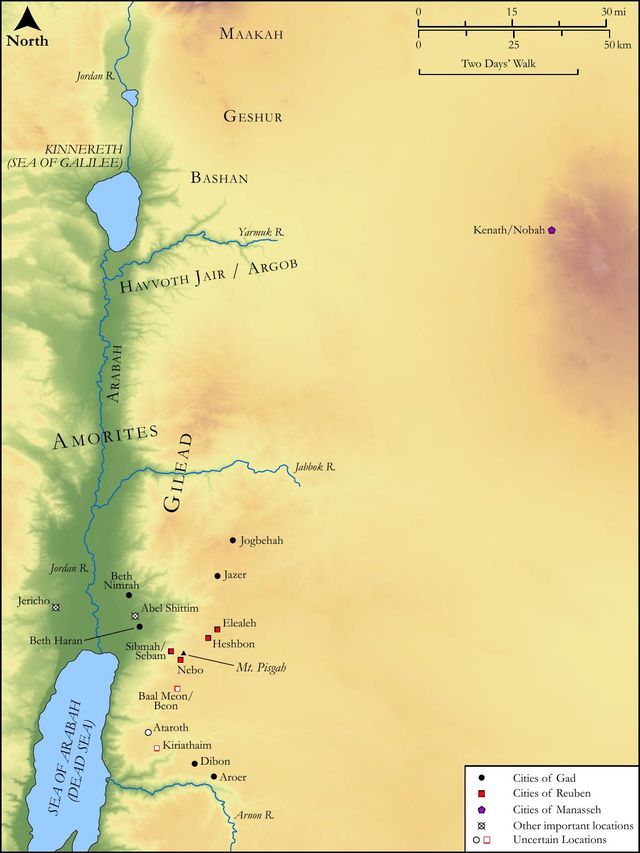
Now the children of Reuben and the children of Gad had a very great multitude of cattle: and when they saw the land of Jazer, and the land of Gilead, that, behold, the place was a place for cattle;
2
the children of Gad and the children of Reuben came and spake unto Moses, and to Eleazar the priest, and unto the princes of the congregation, saying,
3
Ataroth, and Dibon, and Jazer, and Nimrah, and Heshbon, and Elealeh, and Sebam, and Nebo, and Beon,
4
the land which Jehovah smote before the congregation of Israel, is a land for cattle; and thy servants have cattle.
5
And they said, If we have found favor in thy sight, let this land be given unto thy servants for a possession; bring us not over the Jordan.
Study this passage
Commentary written on this passage, not on a single verse.
- Who
- Where
- When
- About
Where else Scripture says this.
Numbers 21:32
And Moses sent to spy out Jazer; and they took the towns thereof, and drove out the Amorites that were there.from verse 1Numbers 21:34
And Jehovah said unto Moses, Fear him not: for I have delivered him into thy hand, and all his people, and his land; and thou shalt do to him as thou didst unto Sihon king of the Amorites, who dwelt at Heshbon.from verse 4Genesis 13:10
And Lot lifted up his eyes, and beheld all the Plain of the Jordan, that it was well watered every where, before Jehovah destroyed Sodom and Gomorrah, like the garden of Jehovah, like the land of Egypt, as thou goest unto Zoar.from verse 1Genesis 13:11
So Lot chose him all the Plain of the Jordan; and Lot journeyed east: and they separated themselves the one from the other.from verse 1Isaiah 16:8
For the fields of Heshbon languish, and the vine of Sibmah; the lords of the nations have broken down the choice branches thereof, which reached even unto Jazer, which wandered into the wilderness; its shoots were spread abroad, they passed over the sea.from verse 1Isaiah 16:9
Therefore I will weep with the weeping of Jazer for the vine of Sibmah; I will water thee with my tears, O Heshbon, and Elealeh: for upon thy summer fruits and upon thy harvest the battle shout is fallen.from verse 1Numbers 32:3
Ataroth, and Dibon, and Jazer, and Nimrah, and Heshbon, and Elealeh, and Sebam, and Nebo, and Beon,from verse 1Numbers 32:35
and Atroth-shophan, and Jazer, and Jogbehah,from verse 1Jeremiah 48:34
From the cry of Heshbon even unto Elealeh, even unto Jahaz have they uttered their voice, from Zoar even unto Horonaim, to Eglath-shelishiyah: for the waters of Nimrim also shall become desolate.from verse 3Joshua 13:17
Heshbon, and all its cities that are in the plain; Dibon, and Bamoth-baal, and Beth-baal-meon,from verse 3Numbers 32:34
And the children of Gad built Dibon, and Ataroth, and Aroer,from verse 3Numbers 32:38
and Nebo, and Baal-meon, (their names being changed,) and Sibmah: and they gave other names unto the cities which they builded.from verse 3
Historical interpretation
Two Centuries of Reception
2 surviving comments on this passage. Each one is dated, so this reads as a timeline rather than a list.
Post-NiceneEarly Medieval
400500600
Select a marker to jump to its quote. Markers stagger vertically where authors wrote within a few decades of each other.
There are some in the church who despise being little ones. Even where humility should prevail, they hardly cease being grand in their own eyes. You can see them being exalted with honors, enjoying pleasures, being entertained by the sheer number of things. Often they seek nothing except being in command of others. They enjoy being feared by many. They fail to live upright lives yet desire to be known as leading an upright life. They seek out flatterers; they swell up with admiration shown them. Since they are eager for things in the present life, they do not seek the joys to come. When complex business occupies them, it demonstrates that they are absent even from themselves. But if a temptation against faith arises—for in this area they are quite restrained—they defend the faith by words and labors. They defend the heavenly fatherland, but they do not love it. In the books of Moses, the sons of Reuben and Gad and the half tribe of Manasseh exemplify these men well. They possessed great flocks of sheep and herds of cattle. While they were beyond the Jordan, they wanted the pastureland that they saw. They did not wish to have their inheritance in the land of promise and said, “The land that the Lord struck in the sight of the sons of Israel is a rich region, good for pasturing animals; and we, your servants, have great herds. We ask you, if we find favor before you, to give us, your servants, this land as our possession, and do not make us cross the Jordan.” They own many cattle and refuse to cross the Jordan. Those who have many entanglements in this world do not seek a dwelling in the heavenly fatherland. Those entanglements hold them by their appearance. Faith threatens them, lest they grow languid in their enjoyment of leisure. By their example, they keep others from putting up with work and from dedication to patience. Thus God says to them through Moses, “Will your brethren go to battle, and you will sit here? Why do you undermine the hearts of the children of Israel?” Since they blushed at not defending what they believed, they hasten to battle for the same faith that they professed and defend it, not for themselves but for their neighbor. So they say to Moses, “We will build folds for our sheep and stables for our cattle and fortified cities for our little ones; but we will go forth to battle armed and girded before the children of Israel.” They go forth as brave men for others; they free the land of promise from their enemies and then leave it and return to feed their flocks across the Jordan. By analogy many people, although they are believers, are occupied with present cares, as if they were feeding flocks across the Jordan. Contrary to the faith they professed in baptism, they serve perishable things with their whole minds and all their desires. But, as we said, when a temptation against faith arises, they gird on arms to defend it. They cut down the enemies of the faith and conquer them and defend the heritage of the land of promise. That is, they do not love the fruits of faith and fight for it in such a way that they leave the spoils of the battle outside the faith. Because they have little ones outside the land, they do not love to dwell in it. So they return to the plains, because they will fall off the high peaks of the mountains as they do from hope for heavenly things. Outside the land of promise they pasture brute animals, because they work to pasture the irrational movements of the soul with empty desires. They do not know how clear the eternal light is, because they are blinded by transitory concerns. And while they take pride in earthly things, they shut the door to heavenly light. Exposition of the Old and New Testament, Numbers
There are some in the church who despise being little ones. Even where humility should prevail, they hardly cease being grand in their own eyes. You can see them being exalted with honors, enjoying pleasures, being entertained by the sheer number of things. Often they seek nothing except being in command of others. They enjoy being feared by many. They fail to live upright lives yet desire to be known as leading an upright life. They seek out flatterers; they swell up with admiration shown them. Since they are eager for things in the present life, they do not seek the joys to come. When complex business occupies them, it demonstrates that they are absent even from themselves. But if a temptation against faith arises—for in this area they are quite restrained—they defend the faith by words and labors. They defend the heavenly fatherland, but they do not love it. In the books of Moses, the sons of Reuben and Gad and the half tribe of Manasseh exemplify these men well. They possessed great flocks of sheep and herds of cattle. While they were beyond the Jordan, they wanted the pastureland that they saw. They did not wish to have their inheritance in the land of promise and said, “The land that the Lord struck in the sight of the sons of Israel is a rich region, good for pasturing animals; and we, your servants, have great herds. We ask you, if we find favor before you, to give us, your servants, this land as our possession, and do not make us cross the Jordan.” They own many cattle and refuse to cross the Jordan. Those who have many entanglements in this world do not seek a dwelling in the heavenly fatherland. Those entanglements hold them by their appearance. Faith threatens them, lest they grow languid in their enjoyment of leisure. By their example, they keep others from putting up with work and from dedication to patience. Thus God says to them through Moses, “Will your brethren go to battle, and you will sit here? Why do you undermine the hearts of the children of Israel?” Since they blushed at not defending what they believed, they hasten to battle for the same faith that they professed and defend it, not for themselves but for their neighbor. So they say to Moses, “We will build folds for our sheep and stables for our cattle and fortified cities for our little ones; but we will go forth to battle armed and girded before the children of Israel.” They go forth as brave men for others; they free the land of promise from their enemies and then leave it and return to feed their flocks across the Jordan.By analogy many people, although they are believers, are occupied with present cares, as if they were feeding flocks across the Jordan. Contrary to the faith they professed in baptism, they serve perishable things with their whole minds and all their desires. But, as we said, when a temptation against faith arises, they gird on arms to defend it. They cut down the enemies of the faith and conquer them and defend the heritage of the land of promise. That is, they do not love the fruits of faith and fight for it in such a way that they leave the spoils of the battle outside the faith. Because they have little ones outside the land, they do not love to dwell in it. So they return to the plains, because they will fall off the high peaks of the mountains as they do from hope for heavenly things. Outside the land of promise they pasture brute animals, because they work to pasture the irrational movements of the soul with empty desires. They do not know how clear the eternal light is, because they are blinded by transitory concerns. And while they take pride in earthly things, they shut the door to heavenly light.
Study Note
Settings