

 TRV
TRV
- English
- King James KJV
- Complete Jewish CJB
- World English WEBM
- Berean Standard BSB
- American Standard ASV
- Geneva GNV
- Young's Literal YLT
- Douay-Rheims DRC
- International
- Shqip ALB
- العربية SVD
- বাংলা BN-IRV
- မြန်မာ Judson
- 简体文 CUV-S
- 繁體中文 CUV-T
- Čeština BKR
- Nederlands STVE
- Français LSG
- Deutsch SCH
- Ελληνικά Vamvas
- ગુજરાતી GU-IRV
- Hausa HCB
- עברית Hebrew
- हिन्दी HCV
- Magyar KAROLI
- Bahasa Indonesia INDO-TB
- Italiano Diodati
- 日本語 Kougo
- 한국어 Korean
- മലയാളം MAL
- मराठी MRCV
- Norsk DNB
- فارسی OPV
- Polski BG
- Português Almeida
- Română Cornilescu
- Русский Synodal
- Español RVG
- Kiswahili Neno
- Svenska SV1917
- Tagalog TAG-ADB
- தமிழ் TCV
- తెలుగు TSA
- ภาษาไทย THAI-KJV
- Українська Ohienko
- Tiếng Việt CADMAN
- Yorùbá YCB
Jesus Feeds Four Thousand
Jesus Feeds Four Thousand
In this passage
- Who
- Where
- When
- About
See also
Where else Scripture says this.
Matthew 9:8
But when the multitudes saw it, they were afraid, and glorified God, who had given such authority unto men.from verse 31Luke 6:17
and he came down with them, and stood on a level place, and a great multitude of his disciples, and a great number of the people from all Judæa and Jerusalem, and the sea coast of Tyre and Sidon, who came to hear him, and to be healed of their diseases;from verse 30Luke 6:19
And all the multitude sought to touch him; for power came forth from him, and healed them all.from verse 30Luke 22:19
And he took bread, and when he had given thanks, he brake it, and gave to them, saying, This is my body which is given for you: this do in remembrance of me.from verse 36Romans 14:6
He that regardeth the day, regardeth it unto the Lord: and he that eateth, eateth unto the Lord, for he giveth God thanks; and he that eateth not, unto the Lord he eateth not, and giveth God thanks.from verse 36Matthew 4:18
And walking by the sea of Galilee, he saw two brethren, Simon who is called Peter, and Andrew his brother, casting a net into the sea; for they were fishers.from verse 29Acts 5:15
insomuch that they even carried out the sick into the streets, and laid them on beds and couches, that, as Peter came by, at the least his shadow might overshadow some one of them.from verse 30Acts 5:16
And there also came together the multitude from the cities round about Jerusalem, bringing sick folk, and them that were vexed with unclean spirits: and they were healed every one.from verse 30Luke 18:43
And immediately he received his sight, and followed him, glorifying God: and all the people, when they saw it, gave praise unto God.from verse 31Luke 12:29
And seek not ye what ye shall eat, and what ye shall drink, neither be ye of doubtful mind.from verse 32Luke 12:30
For all these things do the nations of the world seek after: but your Father knoweth that ye have need of these things.from verse 32Mark 8:10
And straightway he entered into the boat with his disciples, and came into the parts of Dalmanutha.from verse 32
Where this happens
Study this passage
Commentary written on this passage, not on a single verse.
Public-domain commentary
Matthew Henry
From his Commentary on the Whole Bible. Henry comments on passages, not single verses — this entry covers Matthew 15:29–39. His four-level outline is real structure in the source text, so it is rendered as structure.
Here is, I. A general account of Christ's cures, his curing by wholesale. The tokens of Christ's power and goodness are neither scarce nor scanty; for there is in him an overflowing fulness. Now observe,
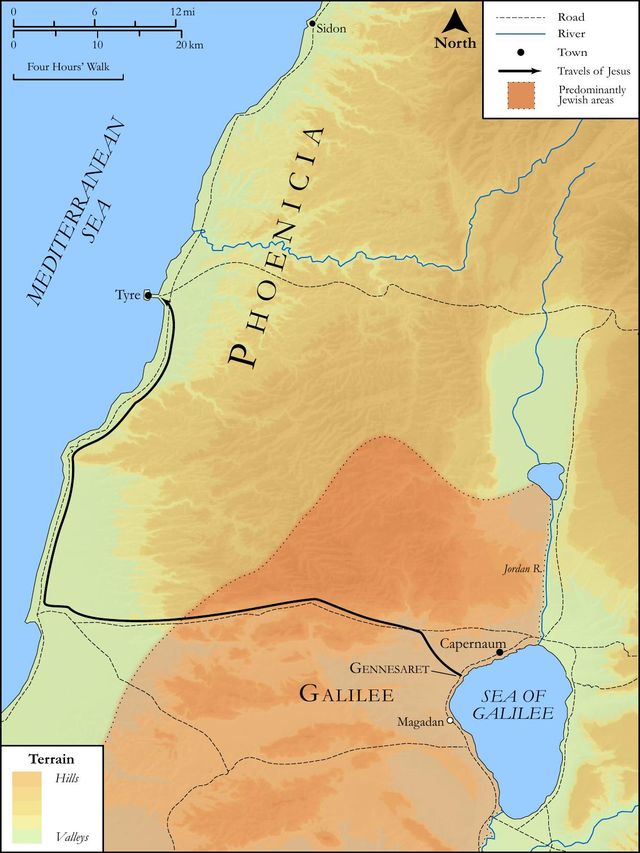
1.The place where these cures were wrought; it was near the sea of Galilee, a part of the country Christ was much conversant with. We read not of any thing he did in the coasts of Tyre and Sidon, but the casting of the devil out of the woman of Canaan's daughter, as if he took that journey on purpose, with that in prospect. Let not ministers grudge their pains to do good, though but to few. He that knows the worth of souls, would go a great way to help to save one from death and Satan's power.
But Jesus departed thence. Having let fall that crumb under table, he here returns to make a full feast for the children. We may do that occasionally for one, which we may not make a constant practice of. Christ steps into the coast of Tyre and Sidon, but he sits down by the sea of Galilee (Mat 15:29), sits down not on a stately throne, or tribunal of judgment, but on a mountain: so mean and homely were his most solemn appearances in the days of his flesh! He sat down on a mountain, that all might see him, and have free access to him; for he is an open Saviour. He sat down there, as one tired with his journey, and willing to have a little rest; or rather, as one waiting to be gracious. He sat, expecting patients, as Abraham at his tent-door, ready to entertain strangers. He settled himself to this good work.
2.The multitudes and maladies that were healed by him (Mat 15:30); Great multitudes came to him; that the scripture might be fulfilled, Unto him shall the gathering of the people be, Gen 49:10. If Christ's ministers could cure bodily diseases as Christ did, there would be more flocking to them than there is; we are soon sensible of bodily pain and sickness, but few are concerned about their souls and their spiritual diseases.
Now, (1.) Such was the goodness of Christ, that he admitted all sorts of people; the poor as well as the rich are welcome to Christ, and with him there is room enough for all comers. He never complained of crowds or throngs of seekers, or looked with contempt upon the vulgar, the herd, as they are called; for the souls of peasants are as precious with him as the souls of princes.
(2.)Such was the power of Christ, that he healed all sorts of diseases; those that came to him, brought their sick relations and friends along with them, and cast them down at Jesus' feet, Mat 15:30. We read not of any thing they said to him, but they laid them down before him as objects of pity, to be looked upon by him. Their calamities spake more for them than the tongue of the most eloquent orator could. David showed before God his trouble, that was enough, he then left it with him, Psa 142:2. Whatever our case is, the only way to find ease and relief, is, to lay it at Christ's feet, to spread it before him, and refer it to his cognizance, and then submit it to him, and refer it to his disposal. Those that would have spiritual healing from Christ, must lay themselves at his feet, to be ruled and ordered as he pleaseth.
Here were lame, blind, dumb, maimed, and many others, brought to Christ. See what work sin has made! It has turned the world into a hospital: what various diseases are human bodies subject to! See what work the Saviour makes! He conquers those hosts of enemies to mankind. Here were such diseases as a flame of fancy could contribute neither to the cause of nor to the cure of; as lying not in the humours, but in the members of the body; and yet these were subject to the commands of Christ. He sent his word, and healed them. Note, All diseases are at the command of Christ, to go and come as he bids them. This is an instance of Christ's power, which may comfort us in all our weaknesses; and of his pity, which may comfort us in all our miseries.
3.The influence that this had upon the people, Mat 15:31.
(1.)They wondered, and well they might. Christ's works should be our wonder. It is the Lord's doing, and it is marvellous, Psa 118:23. The spiritual cures that Christ works are wonderful. When blind souls are made to see by faith, the dumb to speak in prayer, the lame to walk in holy obedience, it is to be wondered at. Sing unto the Lord a new song, for thus he has done marvellous things.
(2.)They glorified the God of Israel, whom the Pharisees, when they saw these things, blasphemed. Miracles, which are the matter of our wonder, must be the matter of our praise; and mercies, which are the matter of our rejoicing, must be the matter of our thanksgiving. Those that were healed, glorified God; if he heal our diseases, all that is within us must bless his holy name; and if we have been graciously preserved from blindness, and lameness, and dumbness, we have as much reason to bless God as if we had been cured of them; nay, and the standers-by glorified God. Note, God must be acknowledged with praise and thankfulness in the mercies of others as in our own. They glorified him as the God of Israel, his church's God, a God in covenant with his people, who hath sent the Messiah promised; and this is he. See Luk 1:68. Blessed be the Lord God of Israel. This was done by the power of the God of Israel, and no other could do it.
II.Here is a particular account of his feeding four thousand men with seven loaves, and a few little fishes, as he had lately fed five thousand with five loaves. The guests indeed were now not quite so many as then, and the provision a little more; which does not intimate that Christ's arm was shortened, but that he wrought his miracles as the occasion required, and not for ostentation, and therefore he suited them to the occasion: both then and now he took as many as were to be fed, and made use of all that was at hand to feed them with. When once the utmost powers of nature are exceeded, we must say, This is the finger of God; and it is neither here nor there how far they are outdone; so that this is no less a miracle than the former.
Here is, 1. Christ's pity (Mat 15:32); I have compassion on the multitude. He tells his disciples this, both to try and to excite their compassion. When he was about to work this miracle, he called them to him, and made them acquainted with his purpose, and discoursed with them about it; not because he needed their advice, but because he would give an instance of his condescending love to them. He called them not servants, for the servant knows not what his Lord doeth, but treated them as his friends and counsellors. Shall I hide from Abraham the thing that I do? Gen 18:17. In what he said to them, Observe,
(1.)The case of the multitude; They continue with me now three days, and have nothing to eat. This is an instance of their zeal, and the strength of their affection to Christ and his word, that they not only left their callings, to attend upon him on week-days, but underwent a deal of hardship, to continue with him; they wanted their natural rest, and, for aught that appeared, lay like soldiers in the field; they wanted necessary food, and had scarcely enough to keep life and soul together. In those hotter countries they could better bear long fasting than we can in these colder climates: but though it could not but be grievous to the body, and might endanger their health, yet the zeal of God's house thus ate them up, and they esteemed the words of Christ more than their necessary food. We think three hours too much to attend upon public ordinances; but these people staid together three days, and yet snuffed not at it, nor said, Behold, what a weariness is it! Observe, With what tenderness Christ spoke of it; I have compassion on them. It had become them to have compassion on him, who took so much pains with them for three days together, and was so indefatigable in teaching and healing; so much virtue had gone out of him, and yet for aught that appears he was fasting too: but he prevented them with his compassion. Note, Our Lord Jesus keeps an account how long his followers continue their attendance on him, and takes notice of the difficulty they sustain in it (Rev 2:2); I know thy works, and thy labour, and thy patience: and it shall in no wise lose its reward.
Now the exigence the people were reduced to serves to magnify. [1.] The mercy of their supply: he fed them when they were hungry; and then food was doubly welcome. He treated them as he did Israel of old; he suffered them to hunger, and then fed them (Deu 8:3); for that is sweet to the hungry soul, which the full soul loathes. [2.] The miracle of their supply: having been so long fasting, their appetites were the more craving. If two hungry meals make the third a glutton, what would three hungry days do? And yet they did all eat and were filled. Note, There are mercy and grace enough with Christ, to give the most earnest and enlarged desire an abundant satisfaction; Open thy mouth wide, and I will fill it. He replenisheth even the hungry soul.
(2.)The care of our master concerning them; I will not send them away fasting, lest they should faint by the way; which would be a discredit to Christ and his family, and a discouragement both to them and to others. Note, It is the unhappiness of our present state, that when our souls are in some measure elevated and enlarged, our bodies cannot keep pace with them in good duties. The weakness of the flesh is a great grievance to the willingness of the spirit. It will not be so in heaven, where the body shall be made spiritual, where they rest not, day and night, from praising God, and yet faint not; where they hunger no more, nor thirst any more, Rev 7:16.
Here is, 2. Christ's power. His pity of their wants sets his power on work for their supply. Now observe,
(1.)How his power was distrusted by his disciples (Mat 15:23); whence should we have so much bread in the wilderness? A proper question, one would think, like that of Moses (Num 11:22). Shall the flocks and the herds be slain to suffice them? But it was here an improper question, considering not only the general assurance the disciples had of the power of Christ, but the particular experience they lately had of a seasonable and sufficient provision by miracle in a like case; they had been not only the witnesses, but the ministers, of the former miracle; the multiplied bread went through their hands; so that it was an instance of great weakness for them to ask, Whence shall we have bread? Could they be at a loss, while they had their Master with them? Note, Forgetting former experiences leaves us under present doubts.
Christ knew how slender the provision was, but he would know it from them (Mat 15:34); How many loaves have ye? Before he would work, he would have it seen how little he had to work on, that his power might shine the brighter. What they had, they had for themselves, and it was little enough for their own family; but Christ would have them bestow it all upon the multitude, and trust Providence for more. Note, it becomes Christ's disciples to be generous, their Master was so: what we have, we should be free of, as there is occasion; given to hospitality; not like Nabal (Sa1 25:11), but like Elisha, Kg2 4:42. Niggardliness today, out of thoughtfulness for tomorrow, is a complication of corrupt affection that ought to be mortified. If we be prudently kind and charitable with what we have, we may piously hope that God will send more. Jehovah-jireh, The Lord will provide. The disciples asked, Whence should we have bread? Christ asked, How many loaves have ye? Note, When we cannot have what we would, we must make the best of what we have, and do good with it as far as it will go; we must not think so much of our wants as of our havings. Christ herein went according to the rule he gave to Martha, not to be troubled about many things, nor cumbered about much serving. Nature is content with little, grace with less, but lust with nothing.
(2.)How his power was discovered to the multitude, in the plentiful provision he made for them; the manner of which is much the same as before, Mat 14:18, etc. Observe here,
[1.]The provision that was at hand; seven loaves, and a few fishes: the fish not proportionable to the bread, for bread is the staff of life. It is probable that the fish was such as they had themselves taken; for they were fishers, and were now near the sea. Note, It is comfortable to eat the labour of our hands (Psa 128:2), and to enjoy that which is any way the product of our own industry, Pro 12:27. And what we have got by God's blessing on our labour we should be free of; for therefore we must labour, that we may have to give, Eph 4:28.
[2.]The putting of the people in a posture to receive it (Mat 15:35); He commanded the multitude to sit down on the ground. They saw but very little provision, yet they must sit down, in faith that they should have a meal's meat out of it. They who would have spiritual food from Christ, must sit down at his feet, to hear his word, and expect it to come in an unseen way.
[3.]The distributing of the provision among them. He first gave thanks - eucharistēsas. The word used in the former miracle was eulogēse - he blessed. It comes all to one; giving thanks to God is a proper way of craving a blessing from God. And when we come to ask and receive further mercy, we ought to give thanks for the mercies we have received. He then broke the loaves (for it was in the breaking that the bread multiplied) and gave to his disciples, and they to the multitude. Though the disciples had distrusted Christ's power, yet he made use of them now as before; he is not provoked, as he might be, by the weakness and infirmities of his ministers, to lay them aside; but still he gives to them, and they to his people, of the word of life.
[4.]The plenty there was among them (Mat 15:37). They did all eat, and were filled. Note, Those whom Christ feeds, he fills. While we labour for the world, we labour for that which satisfieth not (Isa 55:2); but those that duly wait on Christ shall be abundantly satisfied with the goodness of his house, Psa 65:4. Christ thus fed people once and again, to intimate that though he was called Jesus of Nazareth, yet he was of Bethlehem, the house of bread; or rather, that he was himself the Bread of Life.
To show that they had all enough, there was a great deal left - seven baskets full of broken meat; not so much as there was before, because they did not gather after so many eaters, but enough to show that with Christ there is bread enough, and to spare; supplies of grace for more than seek it, and for those that seek more.
[5.]The account taken of the guests; not that they might pay their share (here was no reckoning to be discharged, they were fed gratis), but that they might be witnesses to the power and goodness of Christ, and that this might be some resemblance of that universal providence that gives food to all flesh, Psa 136:25. Here were four thousand men fed; but what were they to that great family which is provided for by the divine care every day? God is a great Housekeeper, on whom the eyes of all the creatures wait, and he giveth them their food in due season, Psa 104:27; Psa 145:15.
[6.]The dismission of the multitude, and Christ's departure to another place (Mat 15:39). He sent away the people. Though he had fed them twice, they must not expect miracles to be their daily bread. Let them now go home to their callings, and to their own tables. And he himself departed by ship to another place; for, being the Light of the world, he must be still in motion, and go about to do good.
Historical interpretation
Ten Centuries of Reception
48 surviving comments on this passage. Each one is dated, so this reads as a timeline rather than a list.
Select a marker to jump to its quote. Markers stagger vertically where authors wrote within a few decades of each other.
Be attentive to the difference between those things that are written in the various places in regard to the loaves. I think that this passage belongs to a different order than the others. Note the differences. Those were fed on a mountain, these in a desert place. These were fed after they had continued three days with Jesus, but those one day, on the evening of which they were fed. Is there an implication that those to whom Jesus shows kindness are superior when he fed them on the spot to demonstrate his kindness? And according to John, the twelve baskets contained leftovers of barley loaves, but nothing of this kind is said here. Is one preferred to another? In the one case he healed the sick, but in this case he is healing, along with the multitudes, those who are blind, lame, deaf and maimed. Note that the four thousand marveled, but no such thing is said about the sick. And I think we can distinguish those who ate of the seven loaves, for which thanks were given, from those who ate of the five loaves, which were blessed. These who ate the few little fishes are distinguished from those who ate of the two. Those who sat down upon the ground are distinguished from those who sat down on the grass. Note that those from fewer loaves left twelve baskets, but these from a greater number left seven baskets. Perhaps they were able more fully to receive.
Again Jesus went up on the mountain where he sat down. Not only people who were healthy but also those suffering from various disorders went up on the mountain where Jesus was sitting. Think of this mountain to which Jesus went up and sat as the church. It has been set up through the word of God over the rest of the world, and all sorts of people come to it. To this assembly have come not only the disciples, as if they were leaving behind the multitudes, as they did in the case of the Beatitudes. Rather, there are great crowds here, many of whom are deaf or suffer from many afflictions. Look at the crowds who come to this mountain where the Son of God sits. Some of them have become deaf to the things that have been promised. Others have become blind in soul, not looking toward the true light. Others are lame and not able to walk according to reason. Others are maimed and unable to work profitably. Each of these who are suffering in soul from such things go up along with the multitudes into the mountain where Jesus sits.Some who do not draw near to the feet of Jesus are not healed. But those who are brought by the multitude and cast at his feet are being healed. Even those who come only to the edges, just the extremities of the body of Christ, who feel themselves unworthy to obtain such things, are being healed. So now you come into the congregation of what is more commonly called the church.
See the catechumens? They are, as it were, cast in the far side or back of those who are the extreme end of the body, as if they were coming merely to the feet of the body of Jesus—the church. They are coming to it with their own deafness and blindness and lameness and crookedness. In time they will be cured according to the Word. Observing this you would not be wrong in saying that these people have gone up with the multitudes into the church, up to the mountain where Jesus sits, and have been cast at his feet and are being healed. And so the multitudes are astonished at beholding the transformations that are taking place. They behold those who are being converted from such great evils to that which is so much better.
He does this not only once but also a second time, in order that we should know his strength. This strength by which he feeds the multitudes when he wishes and without bread finds its source in his divinity. He does this in order to bring them to believe that he himself is the one who earlier had fed Israel for forty years in the wilderness. And Jesus not only fed them with a few loaves of bread, but he even produced a surplus of seven baskets, so that he might be shown as incomparably surpassing Elijah, who himself also caused a multiplication of the widow’s small quantity of oil and flour. Nevertheless, when Jesus produced a multiplication of seven baskets from seven loaves, he did not go beyond what was needed, lest the difference between these miracles should again be forgotten by the disciples.
In this way, by his speech, Christ had so disposed their souls that they had even become self-forgetful and had taken no care to provide for food or other inevitable needs. They had not grown weary, even in the desert, of being with Christ. But Christ understood the weakness of our nature and that we require food for the health of our bodies. He makes preparation even for this, that it might be evident that he is concerned not only about our souls but about our bodies as well. For he himself is the Creator of both soul and body. He is not merely the Lord of one or the other, as the lunacies of the Manichaeans hold. They teach different creators, one for the soul and another for the body.
Remember that the context is the plea of the Canaanite woman. Remember that the Lord’s silence with her had proceeded from a consideration of the gradual timing of revelation and not from any problem of her volition. So when he said, “O woman, great is your faith,” she is now certain of being saved. Indeed, he also comes to the whole Gentile community, when those who accordingly believe will at once be freed like the girl from any power of the unclean spirits. And faith in the deed therefore follows. What follows immediately after the Gentile people are prefigured in the daughter of the Canaanite woman? Those afflicted with different kinds of diseases are offered by the crowd to the Lord on the mountain. That is, the faithless and the sick are instructed by the believers to fall down and adore. They are made well again, and all the functions of mind and body are being restored for hearing, contemplating, praising and following the Lord.
This was in response to everything that had happened before. So we must probe the corresponding reason for this entire situation and especially of the relation of Jews and Gentiles. We will then see that the promises that had earlier applied to the Jewish people were to be received by the Gentile people.There is an order, then, in the Lord’s words that holds true in the receiving of grace. Those who approach baptism declare first that they believe in the Son of God and in his Passion and resurrection; a commitment is then made to this sign of profession. In this way a certain truth about the things themselves may result from this verbal promise. Those who devote the entire time in fasting to commemorate the Lord’s Passion are joined to the Lord in a sort of fellowship of compassion. Therefore both by the sign of their promise and by their fasting, they spend all the time involved in the Lord’s Passion with the Lord.
Do you see the mystery? The Lord has compassion on this hopeful following of believers and says they have been with him for three days! Lest they weaken in the course of their worldly lives, in their workaday world, he wants now to feed them with his food and fortify them with his bread. In this way they can complete the formidable task of the entire journey, for the disciples were complaining that there was no bread in the desert. Indeed, they had previously imbibed the lesson that nothing is impossible with God. But what is signified by certain events can exceed the measure of our understanding. Indeed, how greatly favored the apostles were in saving Israel is told in the epistles of blessed Paul. And so, with the same devotion but now in the gathering of Gentiles, both the multiplying of bread and the silence of fasting are introduced.