

 TRV
TRV
- English
- King James KJV
- Complete Jewish CJB
- World English WEBM
- Berean Standard BSB
- American Standard ASV
- Geneva GNV
- Young's Literal YLT
- Douay-Rheims DRC
- International
- Shqip ALB
- العربية SVD
- বাংলা BN-IRV
- မြန်မာ Judson
- 简体文 CUV-S
- 繁體中文 CUV-T
- Čeština BKR
- Nederlands STVE
- Français LSG
- Deutsch SCH
- Ελληνικά Vamvas
- ગુજરાતી GU-IRV
- Hausa HCB
- עברית Hebrew
- हिन्दी HCV
- Magyar KAROLI
- Bahasa Indonesia INDO-TB
- Italiano Diodati
- 日本語 Kougo
- 한국어 Korean
- മലയാളം MAL
- मराठी MRCV
- Norsk DNB
- فارسی OPV
- Polski BG
- Português Almeida
- Română Cornilescu
- Русский Synodal
- Español RVG
- Kiswahili Neno
- Svenska SV1917
- Tagalog TAG-ADB
- தமிழ் TCV
- తెలుగు TSA
- ภาษาไทย THAI-KJV
- Українська Ohienko
- Tiếng Việt CADMAN
- Yorùbá YCB
Prophecy Concerning King Zedekiah
Prophecy Concerning King Zedekiah
In this passage
- Who
- Where
- When
- About
See also
Where else Scripture says this.
Jeremiah 32:4
and Zedekiah king of Judah shall not escape out of the hand of the Chaldeans, but shall surely be delivered into the hand of the king of Babylon, and shall speak with him mouth to mouth, and his eyes shall behold his eyes;from verse 3Jeremiah 21:10
For I have set my face upon this city for evil, and not for good, saith Jehovah: it shall be given into the hand of the king of Babylon, and he shall burn it with fire.from verse 2Jeremiah 21:7
And afterward, saith Jehovah, I will deliver Zedekiah king of Judah, and his servants, and the people, even such as are left in this city from the pestilence, from the sword, and from the famine, into the hand of Nebuchadrezzar king of Babylon, and into the hand of their enemies, and into the hand of those that seek their life: and he shall smite them with the edge of the sword; he shall not spare them, neither have pity, nor have mercy.from verse 32 Chronicles 16:14
And they buried him in his own sepulchres, which he had hewn out for himself in the city of David, and laid him in the bed which was filled with sweet odors and divers kinds of spices prepared by the perfumers’ art: and they made a very great burning for him.from verse 5Jeremiah 22:18
Therefore thus saith Jehovah concerning Jehoiakim the son of Josiah, king of Judah: they shall not lament for him, saying, Ah my brother! or, Ah sister! They shall not lament for him, saying Ah lord! or, Ah his glory!from verse 5Joshua 10:3
Wherefore Adoni-zedek king of Jerusalem sent unto Hoham king of Hebron, and unto Piram king of Jarmuth, and unto Japhia king of Lachish, and unto Debir king of Eglon, saying,from verse 7Jeremiah 1:15
For, lo, I will call all the families of the kingdoms of the north, saith Jehovah; and they shall come, and they shall set every one his throne at the entrance of the gates of Jerusalem, and against all the walls thereof round about, and against all the cities of Judah.from verse 1Jeremiah 34:22
Behold, I will command, saith Jehovah, and cause them to return to this city; and they shall fight against it, and take it, and burn it with fire: and I will make the cities of Judah a desolation, without inhabitant.from verse 22 Kings 25:4
Then a breach was made in the city, and all the men of war fled by night by the way of the gate between the two walls, which was by the king’s garden (now the Chaldeans were against the city round about); and the king went by the way of the Arabah.from verse 32 Kings 25:7
And they slew the sons of Zedekiah before his eyes, and put out the eyes of Zedekiah, and bound him in fetters, and carried him to Babylon.from verse 32 Chronicles 36:12
and he did that which was evil in the sight of Jehovah his God; he humbled not himself before Jeremiah the prophet speaking from the mouth of Jehovah.from verse 12 Kings 25:1
And it came to pass in the ninth year of his reign, in the tenth month, in the tenth day of the month, that Nebuchadnezzar king of Babylon came, he and all his army, against Jerusalem, and encamped against it; and they built forts against it round about.from verse 1
Where this happens
Study this passage
Commentary written on this passage, not on a single verse.
Public-domain commentary
Matthew Henry
From his Commentary on the Whole Bible. Henry comments on passages, not single verses — this entry covers Jeremiah 34:1–7. His two-level outline is real structure in the source text, so it is rendered as structure.
This prophecy concerning Zedekiah was delivered to Jeremiah, and by him to the parties concerned, before he was shut up in the prison, for we find this prediction here made the ground of his commitment, as appears by the recital of some passages out of it, Jer 32:4. Observe,
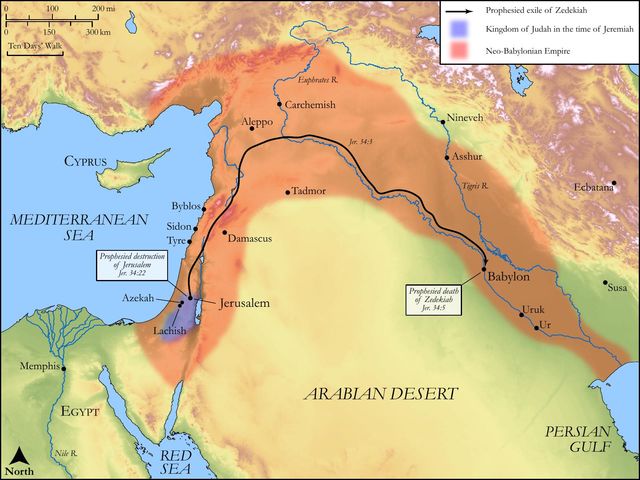
I.The time when this message was sent to Zedekiah; it was when the king of Babylon, with all his forces, some out of all the kingdoms of the earth that were within his jurisdiction, fought against Jerusalem and the cities thereof (Jer 34:1), designing to destroy them, having often plundered them. The cities that now remained, and yet held out, are named (Jer 34:7), Lachish and Azekah. This intimates that things were now brought to the last extremity, and yet Zedekiah obstinately stood it out, his heart being hardened to his destruction.
II.The message itself that was sent to him.
1.Here is a threatening of wrath. He is told that again which he had been often told before, that the city shall be taken by the Chaldeans and burnt with fire (Jer 34:2), that he shall himself fall into the enemy's hands, shall be made a prisoner, shall be brought before that furious prince Nebuchadnezzar, and be carried away captive into Babylon (Jer 34:3); yet Ezekiel prophesied that he should not see Babylon; nor did he, for his eyes were put out, Eze 12:13. This Zedekiah brought upon himself from God by his other sins and from Nebuchadnezzar by breaking his faith with him.
2.Here is a mixture of mercy. He shall die a captive, but he shall not die by the sword he shall die a natural death (Jer 34:4); he shall end his days with some comfort, shall die in peace, Jer 34:5. He never had been one of the worst of the kings, but we are willing to hope that what evil he had done in the sight of the Lord he repented of in his captivity, as Manasseh had done, and it was forgiven to him; and, God being reconciled to him, he might truly be said to die in peace, Note, A man may die in a prison and yet die in peace. Nay, he shall end his days with some reputation, more than one would expect, all things considered. He shall be buried with the burnings of his fathers, that is, with the respect usually shown to their kings, especially those that had done good in Israel. It seems, in his captivity he had conducted himself so well towards his own people that they were willing to do him this honour, and towards Nebuchadnezzar that he suffered it to be done. If Zedekiah had continued in his prosperity, perhaps he would have grown worse and would have departed at last without being desired; but his afflictions wrought such a change in him that his death was looked upon as a great loss. It is better to live and die penitent in a prison than to live and die impenitent in a palace. They will lament thee, saying, Ah lord! an honour which his brother Jehoiakim had not, Jer 22:18. The Jews say that they lamented thus over him, Alas! Zedekiah is dead, who drank the dregs of all the ages that went before him, that is, who suffered for the sins of his ancestors, the measure of iniquity being filled up in his days. They shall thus lament him, saith the Lord, for I have pronounced the word; and what God hath spoken shall without fail be made good.
III.Jeremiah's faithfulness in delivering this message.
Though he knew it would be ungrateful to the king, and might prove, as indeed it did, dangerous to himself (for he was imprisoned for it), yet he spoke all these words to Zedekiah, Jer 34:6. It is a mercy to great men to have those about them that will deal faithfully with them, and tell them the evil consequences of their evil courses, that they may reform and live.
Historical interpretation
Historical Reception
One surviving comment on this passage from the historical church.
[Daniel 7:1] "In the first year of Belshazzar, King of Babylon, Daniel beheld a dream. And a vision of his head upon his bed. And when he wrote the dream down, he comprehended it in a few words and gave a brief summary of it, saying..." This section which we now undertake to explain, and also the subsequent section which we are going to discuss, is historically prior to the two previous sections. For this present section and that which follows it are recorded to have taken place in the first and third years of the reign of King Belshazzar (Jeremiah 39) [Jerome's citation of Jeremiah 39 seems quite pointless in this connection]. But the section which we read previously to the one just preceding this, is recorded to have taken place in the last year, indeed on the final day, of Belshaz-zar's reign. And we meet this phenomenon not only in Daniel but also in Jeremiah [cf. Jeremiah 35 and Jeremiah 34] and Ezekiel (Ezekiel 17), as we shall be able to show, if life spares us that long. But in the earlier portion of the book, the historical order has been followed, namely the events which occurred in the time of Nebuchadnezzar, and Belshazzar, and Darius or Cyrus. But in the passages now before us an account is given of various visions which were beheld on particular occasions and of which only the prophet himself was aware, and which therefore lacked any importance as signs or revelations so far as the barbarian nations were concerned. But they were written down only that a record of the things beheld might be preserved for posterity.