


Matthew 5:2
Bible text: King James Version (1769 Blayney text) · Public domain
Bible text: Berean Standard Bible · Public domain
Bible text: American Standard Version (1901) · Public domain
Bible text: World English Bible, Messianic edition · Public domain
Bible text: Geneva Bible (1599) · Public domain
Bible text: Young's Literal Translation · Public domain
- καὶkaiAndG2532CONJConjunction
- ἀνοίξαςanoixasopeningG455V-AAP-NSMVerb Aorist Active Participle Nominative Singular Masculine
- τὸtotheG3588T-ASNDefinite article Accusative Singular Neuter
- στόμαstomamouthG4750N-ASNNoun Accusative Singular Neuter
- αὐτοῦautouof HimG846P-GSMPersonal pronoun Genitive Singular Masculine
- ἐδίδασκενedidaskenHe was teachingG1321V-IAI-3SVerb Imperfect Active Indicative 3rd Singular
- αὐτοὺςautousthemG846P-APMPersonal pronoun Accusative Plural Masculine
- λέγων·legōnsayingG3004V-PAP-NSMVerb Present Active Participle Nominative Singular Masculine
English is a literal word-by-word gloss of the Greek, not the KJV's wording. Why?
This is the original text the KJV's translators worked from — each Greek word with its own literal English meaning in this verse, prepared by scholars at Tyndale House, Cambridge. The KJV translates whole sentences, not word by word, so its wording differs: one Greek word can become several English words, and the KJV may choose “charity” where the gloss reads “love”. Both are faithful — they answer different questions. For the KJV's own rendering, switch to the KJV text.
Details
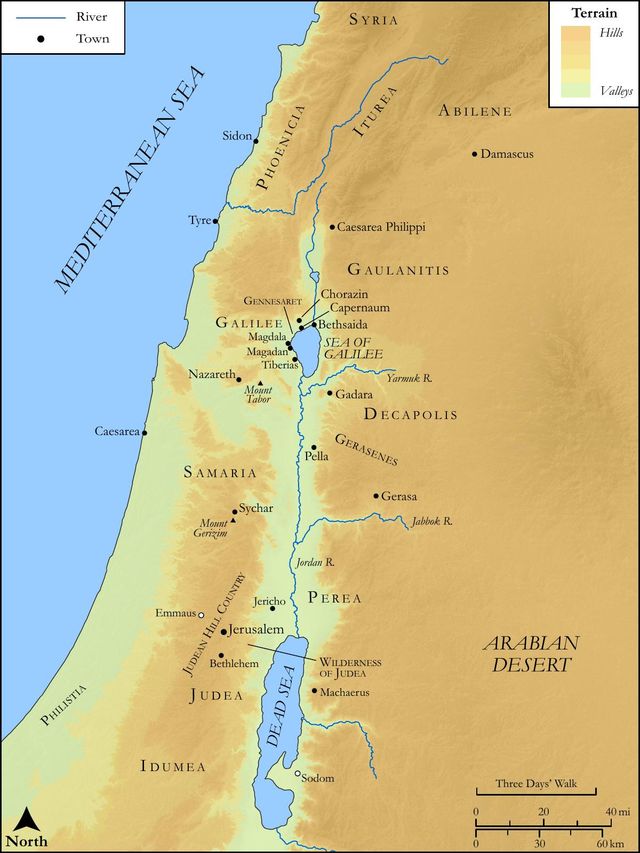
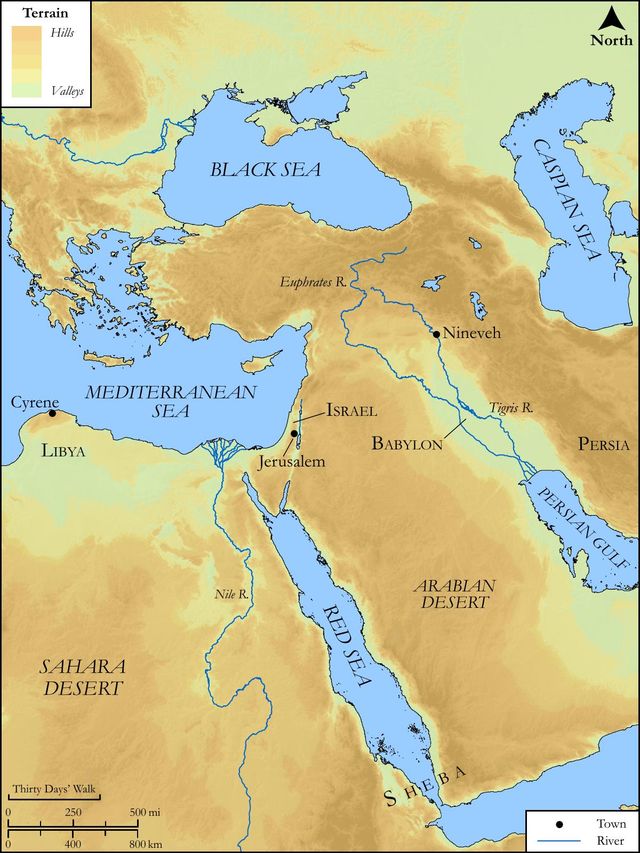
See on the biblical-era maps

Study this verse
Public-domain commentary
Matthew Henry
From his Commentary on the Whole Bible. Henry comments on passages, not single verses — this entry covers Matthew 5:1–2.
We have here a general account of this sermon.
I.The Preacher was our Lord Jesus, the Prince of preachers, the great Prophet of his church, who came into the world, to be the Light of the world. The prophets and John had done virtuously in preaching, but Christ excelled them all. He is the eternal Wisdom, that lay in the bosom of the Father, before all worlds, and perfectly knew his will (Joh 1:18); and he is the eternal Word, by whom he has in these last days spoken to us. The many miraculous cures wrought by Christ in Galilee, which we read of in the close of the foregoing chapter, were intended to make way for this sermon, and to dispose people to receive instructions from one in whom there appeared so much of a divine power and goodness; and, probably, this sermon was the summary, or rehearsal, of what he had preached up and down in the synagogues of Galilee. His text was, Repent, for the kingdom of heaven is at hand. This is a sermon on the former part of that text, showing what it is to repent; it is to reform, both in judgment and practice; and here he tells us wherein, in answer to that question (Mal 3:7), Wherein shall we return? He afterward preached upon the latter part of the text, when, in divers parables, he showed what the kingdom of heaven is like, ch. 13.
II.The place was a mountain in Galilee.
As in other things, so in this, our Lord Jesus was but ill accommodated; he had no convenient place to preach in, any more than to lay his head on. While the scribes and Pharisees had Moses' chair to sit in, with all possible ease, honour, and state, and there corrupted the law; our Lord Jesus, the great Teacher of truth, is driven out to the desert, and finds no better a pulpit than a mountain can afford; and not one of the holy mountains neither, not one of the mountains of Zion, but a common mountain; by which Christ would intimate that there is no such distinguishing holiness of places now, under the gospel, as there was under the law; but that it is the will of God that men should pray and preach every where, any where, provided it be decent and convenient. Christ preached this sermon, which was an exposition of the law, upon a mountain, because upon a mountain the law was given; and this was also a solemn promulgation of the Christian law. But observe the difference: when the law was given, the Lord came down upon the mountain; now the Lord went up: then, he spoke in thunder and lightning; now, in a still small voice: then the people were ordered to keep their distance; now they are invited to draw near: a blessed change! If God's grace and goodness are (as they certainly are) his glory, then the glory of the gospel is the glory that excels, for grace and truth came by Jesus Christ, Co2 3:7; Heb 12:18, etc. It was foretold of Zebulun and Issachar, two of the tribes of Galilee (Deu 33:19), that they shall call the people to the mountain; to this mountain we are called, to learn to offer the sacrifices of righteousness. Now was this the mountain of the Lord, where he taught us his ways, Isa 2:2, Isa 2:3; Mic 4:1, Mic 4:2.
III.The auditors were his disciples, who came unto him; came at his call, as appears by comparing Mar 3:13, Luk 6:13.
To them he directed his speech, because they followed him for love and learning, while others attended him only for cures. He taught them, because they were willing to be taught (the meek will he teach his way); because they would understand what he taught, which to others was foolishness; and because they were to teach others; and it was therefore requisite that they should have a clear and distinct knowledge of these things themselves. The duties prescribed in this sermon were to be conscientiously performed by all those that would enter into that kingdom of heaven which they were sent to set up, with hope to have the benefit of it. But though this discourse was directed to the disciples, it was in the hearing of the multitude; for it is said (Mat 7:28), The people were astonished. No bounds were set about this mountain, to keep the people off, as were about mount Sinai (Exo 19:12); for, through Christ, we have access to God, not only to speak to him, but to hear from him. Nay, he had an eye to the multitude, in preaching this sermon. When the fame of his miracles had brought a vast crowd together, he took the opportunity of so great a confluence of people, to instruct them. Note, It is an encouragement to a faithful minister to cast the net of the gospel where there are a great many fishes, in hope that some will be caught. The sight of a multitude puts life into a preacher, which yet must arise from a desire of their profit, not his own praise.
IV.The solemnity of his sermon is intimated in that word, when he was set.
Christ preached many times occasionally, and by interlocutory discourses; but this was a set sermon, kathisantos autou, when he had placed himself so as to be best heard. He sat down as a Judge or Lawgiver. It intimates with what sedateness and composure of mind the things of God should be spoken and heard. He sat, that the scriptures might be fulfilled (Mal 3:3), He shall sit as a refiner, to purge away the dross, the corrupt doctrines of the sons of Levi. He sat as in the throne, judging right (Psa 9:4); for the word he spoke shall judge us. That phrase, He opened his mouth, is only a Hebrew periphrasis of speaking, as Job 3:1. Yet some think it intimates the solemnity of this discourse; the congregation being large, he raised his voice, and spoke louder than usual. He had spoken long by his servants the prophets, and opened their mouths (Eze 3:27; Eze 24:27; Eze 33:22); but now he opened his own, and spoke with freedom, as one having authority. One of the ancients has this remark upon it; Christ taught much without opening his mouth. that is, by his holy and exemplary life; nay, he taught, when, being led as a lamb to the slaughter, he opened not his mouth, but now he opened his mouth, and taught, that the scriptures might be fulfilled, Pro 8:1, Pro 8:2, Pro 8:6. Doth not wisdom cry - cry on the top of high places? And the opening of her lips shall be right things. He taught them, according to the promise (Isa 54:13), All thy children shall be taught of the Lord; for this purpose he had the tongue of the learned (Isa 50:4), and the Spirit of the Lord, Isa 61:1. He taught them, what was the evil they should abhor, and what was the good they should abide and abound in; for Christianity is not a matter of speculation, but is designed to regulate the temper of our minds and the tenour of our conversations; gospel-time is a time of reformation (Heb 9:10); and by the gospel we must be reformed, must be made good, must be made better. The truth, as it is in Jesus, is the truth which is according to godliness, Tit 1:1.
Historical interpretation
Nine Centuries of Reception
14 surviving comments on this verse. Each one is dated, so this reads as a timeline rather than a list.
Select a marker to jump to its quote. Markers stagger vertically where authors wrote within a few decades of each other.
Or, He ascends the mountain, because it is placed in the loftiness of His Father's Majesty that He gives the commands of heavenly life.
(De Officiis i. 16.) In the eye of Heaven blessedness begins there where misery begins in human estimation.
(Hom. xv.) By not choosing His seat in the city, and the market place, but on a mountain in a desert, He has taught us to do nothing with ostentation, and to depart from crowds, above all when we are to be employed in philosophy, or in speaking of serious things.
He ascended a mountain, first, that He might fulfil the prophecy of Esaias, Get thee up into a mountain; (Is. 40:9.) secondly, to show that as well he who teaches, as he who hears the righteousness of God should stand on an high ground of spiritual virtues; for none can abide in the valley and speak from a mountain. If thou stand on the earth, speak of the earth; if thou speak of heaven, stand in heaven. Or, He ascended into the mountain to show that all who would learn the mysteries of the truth should go up into the Mount of the Church of which the Prophet speaks, The hill of God is a hill of fatness. (Ps. 68:15.)
Or, that we may understand that He sometimes teaches by opening His mouth in speech, sometimes by that voice which resounds from His works.
Or, He here calls all loftiness of soul and temper spirit; for as there are many humble against their will, constrained by their outward condition, they have no praise; the blessing is on those who humble themselves by their own choice. Thus He begins at once at the root, pulling up pride which is the root and source of all evil, setting up as its opposite humility as a firm foundation. If this be well laid, other virtues may be firmly built thereon; if that be sapped, whatever good yon gather upon it perishes.
Or, the poor in spirit may be those who fear and tremble at God's commandments, whom the Lord by the Prophet Isaiah commends. Though why more than simply humble? Of the humble there may be in this place but few, in that again an abundance.
See how unambitious He was, and void of boasting: in that He did not lead people about with Him, but whereas, when healing was required, He had Himself gone about everywhere, visiting both towns and country places; now when the multitude is become very great, He sits in one spot: and that not in the midst of any city or forum, but on a mountain and in a wilderness; instructing us to do nothing for display, and to separate ourselves from the tumults of ordinary life, and this most especially, when we are to study wisdom, and to discourse of things needful to be done.
But when He had gone up into the mount, and was set down, His disciples came unto Him. Seest thou their growth in virtue? and how in a moment they became better men? Since the multitude were but gazers on the miracles, but these from that hour desired also to hear some great and high thing. And indeed this it was set Him on His teaching, and made Him begin this discourse.
For it was not men's bodies only that He was healing, but He was also amending their souls; and again from the care of these He would pass to attendance on the other. Thus He at once varied the succor that He gave, and likewise mingled with the instruction afforded by His words, the manifestation of His glory from His works; and besides, He stopped the shameless mouths of the heretics, signifying by this His care of both parts of our being, that He Himself is the Maker of the whole creation. Therefore also on each nature He bestowed abundant providence, now amending the one, now the other.
And it is said, that He opened His mouth, and taught them. And wherefore is the clause added, He opened His mouth? To inform thee that in His very silence He gave instruction, and not when He spoke only: but at one time by opening His mouth, at another uttering His voice by the works which He did.
But when thou hearest that He taught them, do not think of Him as discoursing with His disciples only, but rather with all through them. For since the multitude was such as a multitude ever is, and consisted moreover of such as creep on the ground, He withdraws the choir of His disciples, and makes His discourse unto them: in His conversation with them providing that the rest also, who were yet very far from the level of His sayings, might find His lesson of self-denial no longer grievous unto them.
Some of the less learned brethren suppose the Lord to have spoken what follows from the Mount of Olives, which is by no means the case; what went before and what follows fixes the place in Galilee. aMount Tabor. we may suppose, or any other high mountain.
He spoke to them sitting and not standing, for they could not have understood Him had He appeared in His own Majesty.
The poor in spirit are those who embrace a voluntary poverty for the sake of the Holy Spirit.
(Chapter 5, Verses 1, 2.) But Jesus, seeing the crowds, went up the mountain, and when he had sat down, his disciples came to him. And opening his mouth, he taught them, saying, 'The Lord goes up to the mountains, so that he may draw the multitudes to higher things with him. But the crowds are not able to ascend. And the disciples follow, to whom he speaks not standing, but sitting and huddled. For they were not able to understand him shining in his majesty.' According to the letter, some of the simpler brothers think that he taught the Beatitudes and the rest that follow on the Mount of Olives, which is not at all the case: for from what precedes and follows, the place is shown to be in Galilee, which we thought was either Mount Tabor or any other lofty mountain. Finally, after he finished his speeches, it immediately follows: But when he entered Capernaum.
(de Serm. in Mont. i. 1.) Or, the phrase is introductory of an address longer than ordinary.
(ubi sup.) Whoever will take the trouble to examine with a pious and sober spirit, will find in this sermon a perfect code of the Christian life as far as relates to the conduct of daily life. Accordingly the Lord concludes it with the words, Every man who heareth these words of mine and doeth them, I will liken him to a wise man, & c.
The circumlocution before us, which runs, And He opened His mouth, perhaps gracefully intimates by the mere pause that the sermon will be somewhat longer than usual, unless, perchance, it should not be without meaning, that now He is said to have opened His own mouth, whereas under the old law He was accustomed to open the mouths of the prophets.
Every man in his own trade or profession rejoices when he sees an opportunity of exercising it; the carpenter if he sees a goodly tree desires to have it to cut down to employ his skill on, and the Priest when he sees a full Church, his heart rejoices, he is glad of the occasion to teach. So the Lord seeing a great congregation of people was stirred to teach them.
Blessed are the poor in spirita, or, according to the literal rendering of the Greek, 'they who beg,' that the humble may learn that they should be ever begging at God's almshouse. For there are many naturally humble and not of faith, who do not knock at God's almshouse; but they alone are humble who are so of faith.
For as all other vices, but chiefly pride, casts down to hell; so all other virtues, but chiefly humility, conduct to Heaven; it is proper that he that humbles himself should be exalted.
This should be known, that the Lord had three places of retirement that we read of, the ship, the mountain, and the desert; to one of these He was wont to withdraw whenever He was pressed by the multitude.
Wherever it is said that the Lord opened His mouth, we may know how great things are to follow.
(Moral. iv. 1.) When the Lord on the mountain is about to utter His sublime precepts, it is said, Opening his month he taught them, He who had before opened the mouth of the Prophets.
Mystically, this sitting down of Christ is His incarnation; had He not taken flesh on Him, mankind could not have come unto Him.
Why does the evangelist say, "He opened His mouth"? It would appear that this is superfluous; but it is not. For He also taught without opening His mouth. How did He do this? By His life and His miracles. But now He opens His mouth and teaches.
He taught not only His disciples, but the multitude as well. He begins with the beatitudes, "Blessed are they," just as David began the Psalms with the beatitude, "Blessed is the man" (Ps. 1:1).
(interlin.) The riches of Heaven are suitably promised to those who at this present are in poverty.
Continue studying Matthew 5:2 across the web’s major study libraries — every link below opens this exact verse, chapter, or book on the destination site.
Read & Compare
 BibleGatewayThis verse in more than 200 translations and 70 languages.
 Bible.comThe YouVersion reader — hundreds of translations, reading plans, and highlights.
 ESV.orgCrossway's official English Standard Version reader.
 NET BibleThe NET translation with 60,000+ translators' notes on every rendering decision.
 STEP BibleTyndale House's free study tool — original text, vocabulary, and scholarly resources.
 BibliaLogos Bible Software's free web reader.
 USCCBThe New American Bible (Revised Edition) with the U.S. bishops' study notes.
Commentaries
 BibleHub CommentariesDozens of classic commentaries on this verse, gathered on one page.
 StudyLightMore than 100 commentary sets — the largest collection on the web.
 BibleRefPlain-English commentary on what this verse means, verse by verse.
 Enduring WordDavid Guzik's free commentary on this chapter, widely used by Bible teachers.
 Bible Study ToolsVerse commentary alongside Greek and Hebrew study aids.
Original Language & Research
- BibleHub InterlinearThe verse word by word — original language, transliteration, and English.
- BibleHub LexiconEvery word's original-language definition and Strong's entry.
 Blue Letter BibleDeep-study tools — Strong's numbers, concordance, and word studies.
 CNTR CollationThe earliest Greek manuscripts of this verse, collated letter by letter.
Sermons, Hymns & Audio


TrulyRandomVerse is not affiliated with these sites and doesn’t control their content. They’re linked because they’re genuinely useful.
Summary
Matthew 5:2 serves as the solemn and deliberate introduction to Jesus' most extensive and foundational discourse, known as the Sermon on the Mount. This verse meticulously sets the stage for a profound teaching session, signaling that what follows is not casual conversation but an authoritative and weighty declaration of the principles governing life in the Kingdom of Heaven, delivered by Jesus to His gathered disciples and the surrounding multitude.
Context
ShowHideLiterary Context
This verse immediately follows Matthew 5:1, which depicts Jesus ascending a mountain, with His disciples drawing near and a great crowd assembling. The deliberate act of "opening His mouth" in Matthew 5:2 signifies the commencement of a formal, significant, and extensive teaching. It is the very beginning of Jesus' public teaching ministry in Matthew's Gospel, establishing the tone and authority for the subsequent chapters, particularly the revolutionary teachings of the Beatitudes and the deeper exposition of the Law that follows in Matthew 5.
Historical & Cultural Context
The setting of Jesus teaching from a mountain carries profound historical and theological resonance for a Jewish audience, immediately evoking parallels with Moses receiving the Law on Mount Sinai (Exodus 19). This subtly positions Jesus not merely as another rabbi, but as a new and greater Lawgiver, or at least the definitive interpreter of God's will. In Hebrew speech, a teacher "opening his mouth" was an idiom that conveyed the initiation of a formal, weighty, and often lengthy discourse, distinct from casual conversation. The audience, comprising both His inner circle of disciples and a larger, curious multitude, underscores the universal relevance of His message, intended for both committed followers and those seeking truth.
Key Themes
ShowHideMatthew 5:2 introduces several crucial themes that permeate the Sermon on the Mount and the broader Gospel of Matthew. Firstly, it highlights Jesus' Divine Authority as a teacher; unlike the scribes and Pharisees, He speaks with an inherent power that would later astonish the crowds (Matthew 7:28-29). Secondly, it emphasizes Intentional Instruction, indicating that Jesus was not merely conversing but deliberately imparting foundational principles for righteous living and understanding the Kingdom of God. This deliberate action acts as a Preparation for Revelation, signaling to the listeners that radical and transformative truths about God's character and His kingdom are about to be unveiled, beginning with the counter-cultural declarations of the Beatitudes.
Exposition and Analysis
ShowHideKey Word Analysis
ShowHideFrom the root meaning "to open up," this word signifies a deliberate act of unsealing or making accessible. In this context, it's not a casual opening but the initiation of a significant, formal discourse, emphasizing the intentionality and gravity of Jesus' subsequent words.
While literally referring to the physical mouth, in biblical idiom, "mouth" often represents the source of speech, wisdom, and authority. When combined with "opened," it forms an idiomatic expression for beginning a solemn or important declaration, highlighting the weight and significance of the words about to be uttered.
This verb means "to teach" in a broad, comprehensive sense, implying systematic instruction. It denotes the imparting of knowledge, principles, and doctrine. Here, it underscores Jesus' role as a master teacher, delivering authoritative and foundational truths rather than mere opinions or suggestions.
This primary verb means "to lay forth" or "to relate in words," often implying a systematic or set discourse. It emphasizes that Jesus' teaching was not random or extemporaneous but a structured and purposeful communication, a formal declaration of truth.
Verse Breakdown
ShowHide"And he opened his mouth,"
This phrase is a significant biblical idiom, not merely a literal description of Jesus beginning to speak. It signals the commencement of a formal, weighty, and authoritative discourse. It prepares the listeners for profound and deliberate instruction, setting a tone of solemnity and importance for the teachings that follow. This is not casual conversation but a divine pronouncement.
"and taught them,"
This clause identifies Jesus' primary action and role in this moment: that of a teacher. The verb "taught" (Greek: didáskō) implies systematic instruction and the imparting of truth. It highlights Jesus' authority and His intentionality in conveying foundational principles to His audience, encompassing both His disciples and the broader crowd. His teaching was purposeful, designed to transform understanding and behavior.
"saying,"
This word further emphasizes the nature of what is to follow as a direct, articulated message. It acts as a direct introduction to the content of Jesus' discourse, indicating that the subsequent words are His precise and authoritative declarations. It transitions from the act of teaching to the actual content of the teaching, preparing the listener for the profound truths of the Sermon on the Mount.
Literary Devices
ShowHideThe verse employs several significant literary devices. The phrase "opened his mouth" is a powerful Idiom in biblical literature, consistently used to introduce a formal, weighty, or significant discourse (e.g., Acts 10:34). This idiom immediately elevates the subsequent words beyond casual conversation, imbuing them with solemnity and authority. The setting on a mountain serves as Symbolism, intentionally evoking the imagery of Mount Sinai and Moses receiving the Law (Exodus 19). This Typology subtly positions Jesus as the new and greater Lawgiver, or the definitive interpreter of God's will, thereby establishing His supreme authority. The concise nature of the verse, acting as a direct preamble to the extensive Sermon, also functions as Foreshadowing, hinting at the profound and transformative truths that Jesus is about to reveal, setting the stage for one of the most impactful teachings in history.
Theological and Thematic Connections
ShowHideMatthew 5:2 is profoundly significant as it introduces the definitive exposition of Kingdom ethics and the nature of true righteousness directly from the mouth of Jesus. It underscores the divine origin and authority of Jesus' teachings, establishing Him not merely as a wise sage but as the ultimate revealer of God's will. The deliberate act of "opening His mouth" signals a moment of profound theological revelation, where the very principles of the Kingdom of God are articulated for humanity. This verse sets the stage for understanding that Jesus' words are not suggestions but authoritative declarations, forming the foundation for discipleship and true spiritual life.
Reflection and Application
ShowHideMatthew 5:2, though brief, carries immense weight for contemporary believers. It calls us to approach the words of Jesus with the same reverence and anticipation as those who gathered on the mountain. Just as Jesus deliberately "opened His mouth" to impart foundational truths, we are called to deliberately open our hearts and minds to receive them. This verse reminds us that Jesus' teachings are not optional advice but divine instruction for living a life that reflects the values of God's Kingdom. It challenges us to move beyond superficial engagement with Scripture and to truly listen, learn, and apply His authoritative words, recognizing that they are transformative principles for our lives, guiding us toward genuine righteousness and a deeper relationship with God.
Questions for Reflection
ShowHideFAQ
ShowHideWhy is the phrase "he opened his mouth" used, instead of just "he spoke"?
ShowHideThe phrase "he opened his mouth" (Greek: anoígō to stóma) is a specific biblical idiom used to introduce a formal, solemn, and significant discourse, rather than casual conversation. It signals that what follows is a weighty declaration, a profound teaching, or an important pronouncement. For example, in Acts 8:35, Philip "opened his mouth" to preach the good news about Jesus, and in Acts 10:34, Peter "opened his mouth" to deliver a pivotal sermon to Cornelius. This idiom emphasizes the deliberate and authoritative nature of Jesus' teaching in the Sermon on the Mount, preparing the audience for truths of immense spiritual importance.
What is the significance of Jesus teaching from a mountain?
ShowHideThe mountain setting in Matthew 5:1 carries profound symbolic and theological significance, especially for a Jewish audience. It deliberately evokes the imagery of Mount Sinai, where Moses received the Law from God (Exodus 19). By teaching from a mountain, Jesus is subtly presented as a new and greater Moses, the definitive interpreter and fulfiller of God's Law. This highlights His divine authority and positions His teachings as the new covenant revelation, surpassing and fulfilling the old. It underscores that the Sermon on the Mount is not just moral advice but a foundational declaration of the principles of the Kingdom of God, delivered by the ultimate authority.
Christ-Centered Fulfillment
ShowHideMatthew 5:2, by portraying Jesus as the authoritative teacher who "opened his mouth" to deliver the Sermon on the Mount, profoundly points to His unique identity as the Christ, the promised Messiah and ultimate revealer of God. Unlike the prophets of old who spoke "thus says the Lord," Jesus speaks with inherent, divine authority, fulfilling the prophecy of a prophet like Moses (Deuteronomy 18:18) but with even greater power. His teachings are not merely interpretations of the Law but the very embodiment and re-articulation of God's righteous standards, revealing the heart of the Father (John 14:9). The truths He declares, beginning with the Beatitudes (Matthew 5:3-12), are the very principles of the Kingdom He inaugurates through His life, death, and resurrection. Ultimately, the authority with which Jesus taught in Matthew 5:2 is the same authority He later claims over all heaven and earth (Matthew 28:18), confirming that His words are not just wise counsel but the life-giving truth of God incarnate (John 1:14).