


Mark 14:45
Bible text: King James Version (1769 Blayney text) · Public domain
Bible text: Berean Standard Bible · Public domain
Bible text: American Standard Version (1901) · Public domain
Bible text: World English Bible, Messianic edition · Public domain
Bible text: Geneva Bible (1599) · Public domain
Bible text: Young's Literal Translation · Public domain
- καὶkaiAndG2532CONJConjunction
- ἐλθὼνelthōnhaving arrivedG2064V-2AAP-NSMVerb 2nd Aorist Active Participle Nominative Singular Masculine
- εὐθὺςeuthusimmediatelyG2112ADVAdverb
- προσελθὼνproselthōnhaving come upG4334V-2AAP-NSMVerb 2nd Aorist Active Participle Nominative Singular Masculine
- αὐτῷautōto HimG846P-DSMPersonal pronoun Dative Singular Masculine
- λέγειlegeihe saysG3004V-PAI-3SVerb Present Active Indicative 3rd Singular
- ῥαββίrhabbiRabbiG4461N-VSM-TNoun Vocative Singular Masculine Person Gentilic
- ῥαββίrhabbiRabbi!G4461N-VSM-TNoun Vocative Singular Masculine Person Gentilic
- καὶkaiAndG2532CONJConjunction
- κατεφίλησενkatephilēsenhe kissedG2705V-AAI-3SVerb Aorist Active Indicative 3rd Singular
- αὐτόνautonHimG846P-ASMPersonal pronoun Accusative Singular Masculine
English is a literal word-by-word gloss of the Greek, not the KJV's wording. Why?
This is the original text the KJV's translators worked from — each Greek word with its own literal English meaning in this verse, prepared by scholars at Tyndale House, Cambridge. The KJV translates whole sentences, not word by word, so its wording differs: one Greek word can become several English words, and the KJV may choose “charity” where the gloss reads “love”. Both are faithful — they answer different questions. For the KJV's own rendering, switch to the KJV text.
Details
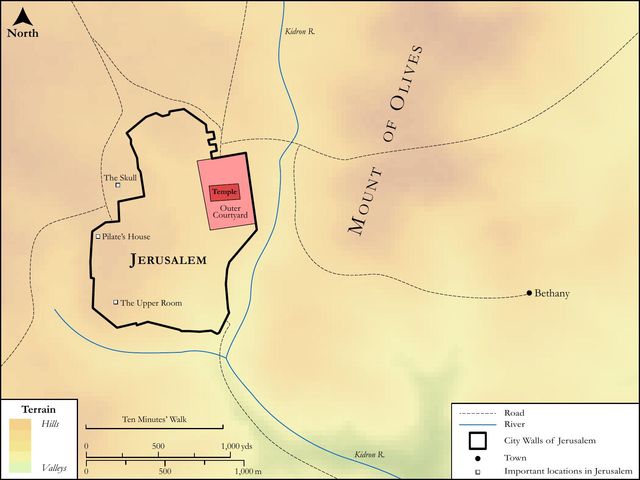
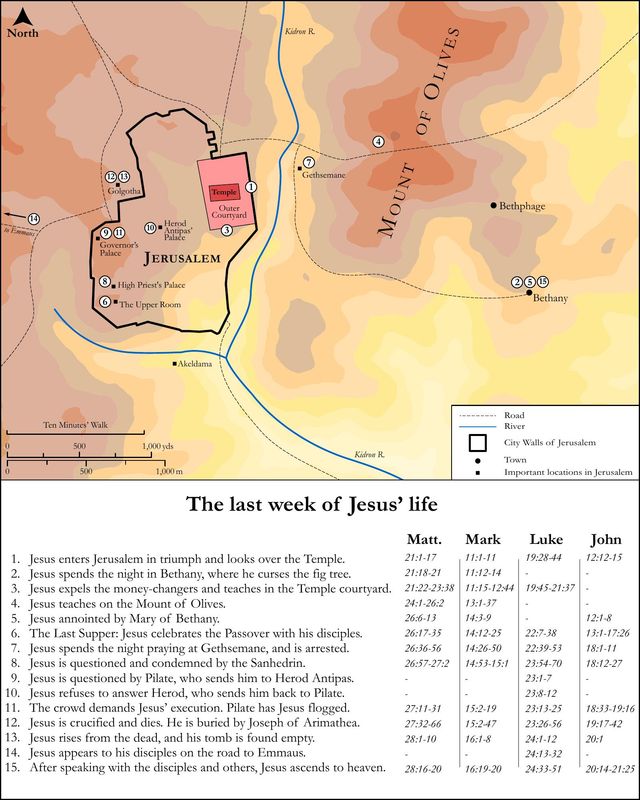
See on the biblical-era maps

Study this verse
Public-domain commentary
Matthew Henry
From his Commentary on the Whole Bible. Henry comments on passages, not single verses — this entry covers Mark 14:43–52. His three-level outline is real structure in the source text, so it is rendered as structure.
We have here the seizing of our Lord Jesus by the officers of the chief priests. This was what his enemies had long aimed at, they had often sent to take him; but he had escaped out of their hands, because his hour was not come, nor could they now have taken him, had he not freely surrendered himself. He began first to suffer in his soul, but afterward suffered in his body, that he might satisfy for sin, which begins in the heart, but afterwards makes the members of the body instruments of unrighteousness.
I.Here is a band of rude miscreants employed to take our Lord Jesus and make him a prisoner; a great multitude with swords and staves.
There is no wickedness so black, no villany so horrid, but there may be found among the children of men fit tools to be made use of, that will not scruple to be employed; so miserably depraved and vitiated is mankind. At the head of this rabble is Judas, one of the twelve, one of those that had been many years intimately conversant with our Lord Jesus, had prophesied in his name, and in his name cast out devils, and yet betrayed him. It is no new thing for a very fair and plausible profession to end in a shameful and fatal apostasy. How art thou fallen, O Lucifer!
II.Men of no less figure than the chief priests, and the scribes, and the elders, sent them, and set them on work, who pretended to expect the Messiah, and to be ready to welcome him; and yet, when he is come, and has given undeniable proofs that it is he that should come, because he doth not make court to them, nor countenance and support their pomp and grandeur, because he appears not as a temporal prince, but sets up a spiritual kingdom, and preaches repentance, reformation, and a holy life, and directs men's thoughts, and affections, and aims, to another world, they set themselves against him, and, without giving the credentials he produces an impartial examination, resolve to run him down.
III.Judas betrayed him with a kiss; abusing the freedom Christ used to allow his disciples of kissing his cheek at their return when they had been any time absent. He called him, Master, Master, and kissed him; he said, Rabbi, Rabbi, as if he had been now more respectful to him than ever. It is enough to put one for ever out of conceit with being called of men Rabbi, Rabbi (Mat 23:7), since it was with this compliment that Christ was betrayed. He bid them take him, and lead him away safely. Some think that he spoke this ironically, knowing that they could not secure him unless he pleased, that this Samson could break their bonds asunder as threads of tow, and make is escape, and then he should get the money, and Christ the honour, and no harm done; and I should think so too, but that Satan was entered into him, so that the worst and most malicious intention of this action is not too black to be supposed. Nay, he had often heard his Master say, that, being betrayed, he should be crucified, and had no reason to think otherwise.
IV.They arrested him, and made him their prisoner (Mar 14:46); They laid their hands on him, rude and violent hands, and took him into custody; triumphing, it is likely, that they had done that which has been often before attempted in vain.
V.Peter laid about him in defence of his Master, and wounded one of the assailants, being for the present mindful of his promise, to venture his life with his Master. He was one of them that stood by, of them that were with him (so the word signifies), of those three disciples that were with him in the garden; he drew a sword, and aimed, it is likely, to cut off the head, but missed his blow, and only cut off the ear, of a servant of the high priest, Mar 14:47. It is easier to fight for Christ, than to die for him; but Christ's good soldiers overcome, not by taking other people's lives, but by laying down their own, Rev 12:11.
VI.Christ argues with them that had seized him, and shows them the absurdity of their proceedings against him.
1.That they came out against him, as against a thief, whereas he was innocent of any crime; he taught daily in the temple, and if he had any wicked design, there it would some time or other have been discovered; nay, these officers of the chief priests, being retainers to the temple, may be supposed to have heard his sermons there (I was with you in the temple); and had he not taught them excellent doctrine, even his enemies themselves being judges? Were not all the words of his mouth in righteousness? Was there any thing froward or perverse in them? Pro 8:8. By his fruits he was known to be a good tree; why then did they come out against him as a thief?
2.That they came to take him thus privately, whereas he was neither ashamed nor afraid to appear publicly in the temple. He was none of those evil-doers that hate the light, neither come to the light, Joh 3:20. If their masters had any thing to say to him, they might meet him any day in the temple, where he was ready to answer all challenges, all charges; and there they might do as they pleased with him, for the priests had the custody of the temple, and the command of the guards about it: but to come upon him thus at midnight, and in the place of his retirement, was base and cowardly. This was to do as David's enemy, that sat in the lurking places of the villages, to murder the innocent, Psa 10:8. But this was not all.
3.They came with swords and staves, as if he had been in arms against the government, and must have the posse comitatus raised to reduce him. There was no occasion for those weapons; but they made this ado,
(1.)To secure themselves from the rage of some; they came armed, because they feared the people; but thus were they in great fear, where no fear was, Psa 53:5.
(2.)To expose him to the rage of others. By coming with swords and staves to take him, they represented him to the people (who are apt to take impressions this way) as a dangerous turbulent man, and so endeavored to incense them against him, and make them cry out, Crucify him, crucify him, having no other way to gain their point.
VII.He reconciled himself to all this injurious, ignominious treatment, by referring himself to the Old Testament predictions of the Messiah.
I am hardly used, but I submit, for the scriptures must be fulfilled, Mar 14:49.
1.See here what a regard Christ had to the scriptures; he would bear any thing rather than that the least jot or tittle of the word of God should fall to the ground; and as he had an eye to them in his sufferings, so he has in his glory; for what is Christ doing in the government of the world, but fulfilling the scriptures?
2.See what use we are to make of the Old Testament; we must search for Christ, the true treasure hid in that field: as the history of the New Testament expounds the prophecies of Old, so the prophecies of the Old Testament illustrate the history of the New.
VIII.All Christ's disciples, hereupon, deserted him (Mar 14:50); They all forsook him, and fled.
They were very confident that they should adhere to him; but even good men know not what they will do, till they are tried. If it was such a comfort to him as he had lately intimated, that they had hitherto continued with him in his lesser trials (Luk 22:28), we may well imagine what a grief it was to him, that they deserted him now in the greatest, when they might have done him some service - when he was abused, to protect him, and when accused, to witness for him. Let not those that suffer for Christ, think it strange, if they be thus deserted, and if all the herd shun the wounded deer; they are not better than their Master, nor can expect to be better used either by their enemies or by their friends. When St. Paul was in peril, none stood by him, but all men forsook him, Ti2 4:16.
IX.The noise disturbed the neighbourhood, and some of the neighbours were brought into danger by the riot, Mar 14:51, Mar 14:52.
This passage of story we have not in any other of the evangelists. Here is an account of a certain young man, who, as it should seem, was no disciple of Christ, nor, as some have imagined, a servant of the house wherein Christ had eaten the passover, who followed him to see what would become of him (as the sons of the prophets, when they understood that Elijah was to be taken up, went to view afar off, Kg2 2:7), but some young man that lived near the garden, perhaps in the house to which the garden belonged. Now observe concerning him,
1.How he was frightened out of his bed, to be a spectator of Christ's sufferings. Such a multitude, so armed, and coming with so much fury, and in the dead of night, and in a quiet village, could not but produce a great stir; this alarmed our young man, who perhaps thought they was some tumult or rising in the city, some uproar among the people, and had the curiosity to go, and see what the matter was, and was in such haste to inform himself, that he could not stay to dress himself, but threw a sheet about him, as if he would appear like a walking ghost, in grave clothes, to frighten those who had frightened him, and ran among the thickest of them with this question, What is to do here? Being told, he had a mind to see the issue, having, no doubt, heard much of the fame of this Jesus; and therefore, when all his disciples had quitted him, he continued to follow him, desirous to hear what he would say, and see what he would do. Some think that his having no other garment than this linen cloth upon his naked body, intimates that he was one of those Jews who made a great profession of piety that their neighbours, in token of which, among other instances of austerity and mortification of the body, they used no clothes but one linen garment, which, though contrived to be modest enough, was thin and cold. But I rather think that this was not his constant wear.
2.See how he was frightened into his bed again, when he was in danger of being made a sharer in Christ's sufferings. His own disciples had run away from him; but this young man, having no concern for him, thought he might securely attend him, especially being so far from being armed, that he was not so much as clothed; but the young men, the Roman soldiers, who were called to assist, laid hold of him, for all was fish that came to their net. Perhaps they were now vexed at themselves, that they had suffered the disciples to run away, and they being got out of their reach they resolved to seize the first they could lay their hands on; though this young man was perhaps one of the strictest sect of the Jewish church, yet the Roman soldiers made no conscience of abusing him upon this occasion. Finding himself in danger, he left the linen cloth by which they had caught hold of him, and fled away naked. This passage is recorded to show what a barbarous crew this was, that was sent to seize Christ, and what a narrow escape the disciples had of falling into their hands, out of which nothing could have kept them but their Master's care of them; If ye seek me, let these go their way, Joh 18:8. It also intimates that there is no hold of those who are led by curiosity only, and not by faith and conscience, to follow Christ.
Historical interpretation
Five Centuries of Reception
4 surviving comments on this verse. Each one is dated, so this reads as a timeline rather than a list.
Select a marker to jump to its quote. Markers stagger vertically where authors wrote within a few decades of each other.
The threefold sleep of the disciples points out the three dead, whom our Lord raised up; the first, in a house; the second, at the tomb; the third, from the tomb. And the threefold watch of the Lord teaches us in our prayers, to beg for the pardon of past, future, and present sins.
For he who despairs of help from God, has recourse to the power of the world.
Judas gives the kiss as a token, with poisonous guile, just as Cain offered a crafty, reprobate sacrifice.
PSEUDO-JEROME.w This is the Joseph who was sold by his brethren, (Ps. 105:18) and into whose soul the iron entered. There follows: And one of them that stood by drew a sword, and smote a servant of the High Priest, and cut off his ear.
Just as Joseph left his mantle behind him, and fled naked from the wanton woman; so also let him, who would escape the hands of the evil ones, quit in mind all that is of the world, and fly after Jesus.
(Mor. 14. 49) Or, he says this of John, who, although he afterwards returned to the cross to hear the words of the Redeemer, at first was frightened and fled.
(ubi sup.) After that our Lord had prayed three times, and had obtained by His prayers that the fear of the Apostles should be amended by future repentance, He, being tranquil as to His Passion, goes to His persecutors, concerning the coming of whom the Evangelist says, And immediately, while he yet spake, cometh Judas Iscariot, one of the twelve.
(ubi sup.) But Judas had still something of the shame of a disciple, for he did not openly betray Him to his persecutors, but by the token of a kiss. Wherefore it goes on: And he that betrayed him had given them a token, saying, Whomsoever I shall kiss, that same is he; take him, and lead him away safely.
(ubi sup.) With envy and with a wicked confidence, he calls Him master, and gives Him a kiss, in betraying Him. But the Lord receives the kiss of the traitor, not to teach us to deceive, but lest he should seem to avoid betrayal, and at the same time to fulfil that Psalm, Among them that are enemies unto peace, I labour for peace. (Ps. 120:5) It goes on: And they laid hands on him, and took him.
(ubi sup.) Peter did this, as John declares, with the same ardent mind with which he did all things; for he knew how Phineas had by punishing sacrilegious persons received the reward of righteousness and of perpetual priesthood.
(ubi sup.) As if He had said, it is foolish to seek with swords and staves Him, who offers Himself to you of His own accord, and to search, as for one who hides Himself, by night and by means of a traitor, for Him who taught daily in the temple.
(ubi sup.) In this is fulfilled the word, which the Lord had spoken, that all His disciples should be offended in Him that same night. There follows: And there followed him a certain young man, having a linen cloth cast about his naked body, that is, he had no other clothing but this linen cloth. It goes on: And they laid hold on him, and he left the linen cloth, and fled from them naked. That is, he fled from them, whose presence and whose deeds he abhorred, not from the Lord, for whom his love remained fixed in his mind, when absent from Him in body.
(ubi sup.) For that he was a young man at that time, is evident from his long sojourn in the flesh. Perhaps he escaped from the hands of those who held him for the time, and afterwards got back his garment and returned, mingling under cover of the darkness with those who were leading Jesus, as though he was one of them, until he arrived at the door of the High Priest, to whom he was known, as he himself testifies in the Gospel. But as Peter, who washed away the sin of his denial with the tears of penitence, shows the recovery of those who fall away in time of martyrdom, so the other disciples who prevented their actual seizure, teach the prudence of flight to those who feel themselves unequal to undergo tortures.
This is not put without reason, but to the greater conviction of the traitor, since though he was of the chief company amongst the disciples, he turned himself to furious enmity against our Lord. There follows: And with him a great multitude with swords and staves from the Chief Priests and the Scribes and the elders.
See how in his blindness he thought to deceive Christ by the kiss, so as to be looked upon by Him as His friend. But if thou wert a friend, Judas, how didst thou come with His enemies? But wickedness is ever without foresight. It goes on: And as soon as he was come, he goeth straightway to him, and saith, Master, master; and kissed him.
Mark conceals his name, lest he should seem to be praising his master for his zeal for Christ. Again, the action of Peter points out that they were disobedient and unbelieving, despising the Scriptures; for if they had had ears to hear the Scriptures, they would not have crucified the Lord of glory. But he cut off the ear of a servant of the High Priest, for the Chief Priests especially passed over the Scriptures, like disobedient servants. It goes on: And Jesus answered and said unto them, Are ye come out, as against a thief, with swords and with staves to take me?
This, however, is a proof of His divinity, for when He taught in the temple they were unable to take Him, although He was in their power, because the time of His Passion had not yet come; but when He Himself was willing, then He gave Himself up, that the Scriptures might be fulfilled, for he was led as a lamb to the slaughter, not crying nor raising His voice, but suffering willingly. It goes on: And they all forsook him and fled.
It appears probable that this young man was of that house, where they had eaten the Passover. But some say that this young man was James, the brother of our Lord, who was called Just; who after the ascension of Christ received from the Apostles the throne of the bishopric of Jerusalem.
Continue studying Mark 14:45 across the web’s major study libraries — every link below opens this exact verse, chapter, or book on the destination site.
Read & Compare
 BibleGatewayThis verse in more than 200 translations and 70 languages.
 Bible.comThe YouVersion reader — hundreds of translations, reading plans, and highlights.
 ESV.orgCrossway's official English Standard Version reader.
 NET BibleThe NET translation with 60,000+ translators' notes on every rendering decision.
 STEP BibleTyndale House's free study tool — original text, vocabulary, and scholarly resources.
 BibliaLogos Bible Software's free web reader.
 USCCBThe New American Bible (Revised Edition) with the U.S. bishops' study notes.
Commentaries
 BibleHub CommentariesDozens of classic commentaries on this verse, gathered on one page.
 StudyLightMore than 100 commentary sets — the largest collection on the web.
 BibleRefPlain-English commentary on what this verse means, verse by verse.
 Enduring WordDavid Guzik's free commentary on this chapter, widely used by Bible teachers.
 Bible Study ToolsVerse commentary alongside Greek and Hebrew study aids.
Original Language & Research
- BibleHub InterlinearThe verse word by word — original language, transliteration, and English.
- BibleHub LexiconEvery word's original-language definition and Strong's entry.
 Blue Letter BibleDeep-study tools — Strong's numbers, concordance, and word studies.
 CNTR CollationThe earliest Greek manuscripts of this verse, collated letter by letter.
Sermons, Hymns & Audio


TrulyRandomVerse is not affiliated with these sites and doesn’t control their content. They’re linked because they’re genuinely useful.
Summary
Mark 14:45 records the chilling moment of Judas Iscariot's betrayal of Jesus in the Garden of Gethsemane. Having arrived with a large crowd sent by the religious authorities, Judas immediately approaches Jesus, addresses Him with the respectful title "Master, master," and then seals the pre-arranged signal of identification with a fervent kiss, thereby delivering Jesus into the hands of His captors. This act stands as a stark testament to profound hypocrisy and the willing submission of Christ to the Father's redemptive plan.
Context
ShowHideLiterary Context
This verse is the climactic moment of betrayal within the Gethsemane narrative, immediately following Jesus' agonizing prayer and His disciples' repeated failure to stay awake and pray with Him (Mark 14:32-42). Judas Iscariot, one of the twelve disciples, arrives with a crowd armed with swords and clubs, sent by the chief priests, scribes, and elders (Mark 14:43). The preceding verse, Mark 14:44, explicitly states Judas's pre-arranged signal: "Whomsoever I shall kiss, that same is he; take him, and lead him away safely." Mark 14:45 details the precise fulfillment of this dark pledge, marking the transition from Jesus' private anguish to His public arrest and the beginning of His passion.
Historical & Cultural Context
The Garden of Gethsemane, located on the Mount of Olives, was a familiar place for Jesus and His disciples (John 18:2). In ancient Jewish culture, a kiss was a common form of greeting, a sign of respect, affection, or even allegiance between teacher and disciple. By using this intimate gesture as a sign for arrest, Judas perverted a symbol of loyalty into one of ultimate treachery. The crowd accompanying Judas likely included temple guards and possibly Roman soldiers, indicating the official nature of the arrest sanctioned by both Jewish and Roman authorities, though the primary instigators were the Jewish religious leaders. The late hour of the arrest (night) suggests a desire for secrecy and to avoid public disturbance.
Key Themes
ShowHideMark 14:45 contributes significantly to several major themes within the Gospel of Mark and the broader biblical narrative. It powerfully illustrates the theme of betrayal, particularly by one from within Jesus' inner circle, fulfilling ancient prophecies like that found in Psalm 41:9. The verse also underscores the profound hypocrisy of Judas, who uses a gesture of affection to accomplish a malicious act. Furthermore, it highlights Jesus' willing submission to the divine plan, as He allows the betrayal to unfold despite His foreknowledge (John 13:21). This moment initiates the passion narrative, emphasizing Jesus' journey towards the cross as a deliberate act of obedience and sacrifice for humanity's redemption, a theme central to the entire Gospel of Mark.
Exposition and Analysis
ShowHideKey Word Analysis
ShowHideThis word (G4334) means "to approach, i.e. (literally) come near, visit, or (figuratively) worship, assent to." In this context, it emphasizes Judas's direct and immediate movement toward Jesus, highlighting the deliberate and purposeful nature of his act. There is no hesitation; he goes directly to his target to execute the pre-arranged signal.
This term (G4461) is of Hebrew origin, meaning "my master" or "my great one," an official title of honor for a teacher or rabbi. Judas's use of this respectful address, repeated for emphasis ("Master, master"), creates a jarring and chilling contrast with his act of betrayal. It underscores the profound irony and hypocrisy of the moment, as he outwardly acknowledges Jesus' authority while inwardly delivering Him to His enemies.
This verb (G2705) is a compound word formed from katá (down, intensifying) and philéō (to love, to kiss). It signifies "to kiss earnestly," implying a fervent, repeated, or even passionate kiss, rather than a mere polite greeting. This intensified form of kissing deepens the poignancy and treachery of Judas's act, making the betrayal all the more profound and painful. It was not a casual peck but an emphatic, perhaps even lingering, gesture of false intimacy.
Verse Breakdown
ShowHide"And as soon as he was come"
This phrase emphasizes the immediacy of Judas's arrival and his swift execution of the betrayal. There is no delay between his appearance with the crowd and his approach to Jesus.
"he goeth straightway to him"
This highlights Judas's direct and purposeful movement. He doesn't wander or hesitate but moves with clear intent toward Jesus, confirming his role as the identifier.
"and saith, Master, master;"
Judas addresses Jesus with the honorific title "Rabbi," a term of respect and deference used by disciples for their teacher. The repetition of "Master" (or "Rabbi, Rabbi") adds emphasis, making the subsequent act of betrayal even more shocking and hypocritical. It's a verbal affirmation of loyalty immediately preceding the ultimate act of disloyalty.
"and kissed him."
This is the pre-arranged signal and the act of betrayal itself. The Greek word for "kissed" (kataphiléō) denotes an intense, fervent kiss, not a casual greeting. This makes the betrayal profoundly personal and deeply painful, transforming a gesture of affection into an instrument of treachery.
Literary Devices
ShowHideMark 14:45 is replete with powerful literary devices that amplify its dramatic and theological impact. The most prominent is Irony, specifically dramatic irony, as the audience is aware of Judas's malicious intent while the act itself is cloaked in a gesture of affection. The kiss, universally understood as a sign of love or greeting, is perverted into a signal of betrayal, creating a profound and disturbing contrast between appearance and reality. This act also functions as Symbolism, where the "kiss of Judas" has become an enduring symbol of ultimate treachery and hypocrisy throughout history. Furthermore, the scene contains elements of foreshadowing, as this direct act of betrayal immediately precipitates Jesus' arrest, trials, and crucifixion, setting in motion the final events of the passion narrative. The repetition of "Master, master" (Rabbi, Rabbi) by Judas also serves as a form of repetition for emphasis, highlighting the profound respect Judas feigns even as he commits the most disrespectful act.
Theological and Thematic Connections
ShowHideThis pivotal verse profoundly illustrates the nature of sin and the depth of human depravity, even within the closest circles of fellowship. Judas, a chosen disciple who walked intimately with Jesus, demonstrates how greed and spiritual blindness can lead to the ultimate betrayal of divine love. Yet, even in this darkest moment, the verse powerfully underscores God's sovereignty and Jesus' active submission to His Father's will. Jesus willingly allows this betrayal to unfold, knowing it is part of the divine plan for humanity's redemption. His calm acceptance in the face of such profound treachery highlights His unwavering commitment to the cross, demonstrating that His suffering was not a failure but a deliberate act of self-sacrifice for the salvation of the world. The "kiss of Judas" thus becomes a stark reminder of the cost of sin and the unfathomable love that endures and triumphs over it.
Reflection and Application
ShowHideMark 14:45 offers profound lessons for believers today, challenging us to examine our own hearts and allegiances. The stark reality of betrayal, even by those closest to us, is a painful but undeniable aspect of the human experience. This verse reminds us that Jesus Himself endured such profound treachery, offering us a model of grace and steadfastness in the face of injustice. It also serves as a potent warning against hypocrisy, urging us to ensure that our outward expressions of faith align with our inward convictions and actions. True discipleship demands integrity, where our words and deeds are consistent, reflecting genuine love and loyalty to Christ. Ultimately, this scene calls us to trust in God's sovereign plan, even when circumstances seem chaotic or unjust, recognizing that His purposes will prevail. Just as Jesus willingly submitted to the Father's will, we are called to embrace obedience and faith, even when it leads through suffering or misunderstanding, knowing that God works all things for the good of those who love Him.
Questions for Reflection
ShowHideFAQ
ShowHideWhy did Judas use a kiss to identify Jesus?
ShowHideJudas used a kiss because it was a common and intimate form of greeting and respect between a disciple and a rabbi in that culture. This made it a natural, unsuspecting way to identify Jesus to the arresting party without causing immediate alarm or suspicion among the other disciples. However, by twisting this gesture of affection into a signal for betrayal, Judas's act became profoundly hypocritical and deeply symbolic of his treachery, as explicitly pre-arranged in Mark 14:44.
What is the significance of Judas calling Jesus "Master, master"?
ShowHideThe Greek word translated "Master" is rhabbí (Rabbi), a respectful title meaning "my teacher" or "my great one." Judas's use of this honorific, even repeating it for emphasis, is laden with profound irony. It highlights the stark contrast between his outward show of deference and his inner malicious intent. He acknowledges Jesus's authority and identity even as he delivers Him to His enemies, underscoring the depth of his hypocrisy and the chilling nature of his betrayal.
Christ-Centered Fulfillment
ShowHideMark 14:45, the moment of Judas's betrayal, is a critical juncture in the passion narrative, powerfully fulfilling Old Testament prophecies and ultimately pointing to Christ's redemptive work. Jesus, the true "Master" and Son of God, willingly submitted to this act of treachery, not as a victim, but as the sovereign Lamb of God destined for sacrifice. His acceptance of the betrayer's kiss, despite His divine foreknowledge, underscores His profound obedience to the Father's will (John 10:18). This moment directly leads to His arrest, trial, and crucifixion, which collectively constitute the ultimate act of atonement for humanity's sin. Through this betrayal, Jesus fulfills the prophetic suffering of the righteous servant (Isaiah 53:7), demonstrating that His life was given as a ransom for many (Mark 10:45). The "kiss of Judas," a symbol of the world's rejection and sin, paradoxically becomes the catalyst for the very event that secures salvation, revealing Christ's unwavering commitment to His mission to reconcile humanity to God through His sacrificial love on the cross (Romans 5:8).