


Luke 19:2
Bible text: King James Version (1769 Blayney text) · Public domain
Bible text: Berean Standard Bible · Public domain
Bible text: American Standard Version (1901) · Public domain
Bible text: World English Bible, Messianic edition · Public domain
Bible text: Geneva Bible (1599) · Public domain
Bible text: Young's Literal Translation · Public domain
- καὶkaiAndG2532CONJConjunction
- ἰδοὺidoubeholdG2400INJInterjection
- ἀνὴρanēra manG435N-NSMNoun Nominative Singular Masculine
- ὀνόματιonomatiby nameG3686N-DSNNoun Dative Singular Neuter
- καλούμενοςkaloumenosbeing calledG2564V-PPP-NSMVerb Present Passive Participle Nominative Singular Masculine
- ΖακχαῖοςZakchaiosZacchaeusG2195N-NSM-PNoun Nominative Singular Masculine Individual
- καὶkaiandG2532CONJConjunction
- αὐτὸςautoshe himselfG846P-NSMPersonal pronoun Nominative Singular Masculine
- ἦνēnwasG1510V-IAI-3SVerb Imperfect Active Indicative 3rd Singular
- ἀρχιτελώνηςarchitelōnēsa chief tax collectorG754N-NSMNoun Nominative Singular Masculine
- καὶkaiandG2532CONJConjunction
- αὐτὸςautoshe himselfG846P-NSMPersonal pronoun Nominative Singular Masculine
- ἦνēnwasG1510V-IAI-3SVerb Imperfect Active Indicative 3rd Singular
- πλούσιος·plousiosrichG4145A-NSMAdjective Nominative Singular Masculine
English is a literal word-by-word gloss of the Greek, not the KJV's wording. Why?
This is the original text the KJV's translators worked from — each Greek word with its own literal English meaning in this verse, prepared by scholars at Tyndale House, Cambridge. The KJV translates whole sentences, not word by word, so its wording differs: one Greek word can become several English words, and the KJV may choose “charity” where the gloss reads “love”. Both are faithful — they answer different questions. For the KJV's own rendering, switch to the KJV text.
Details
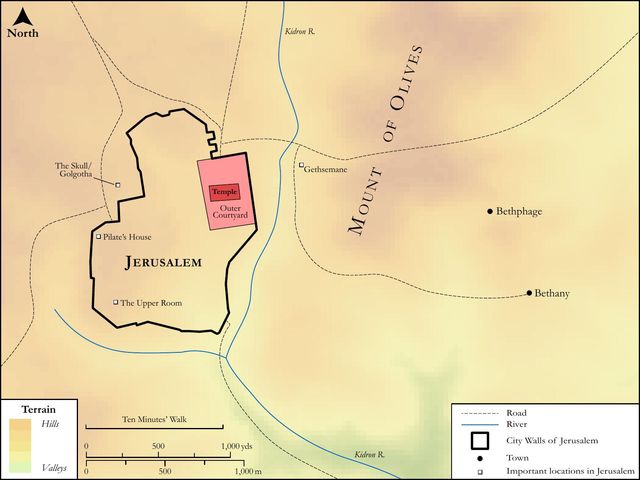
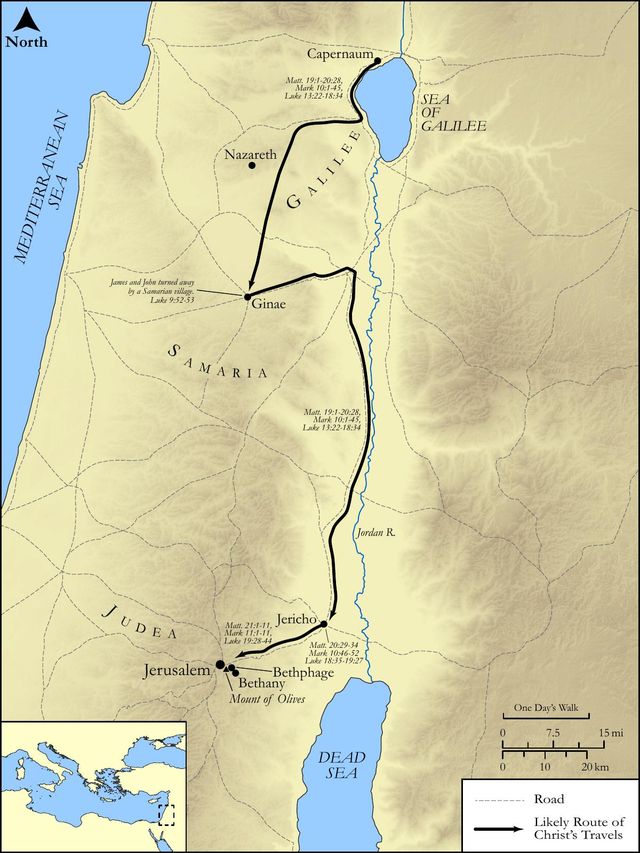
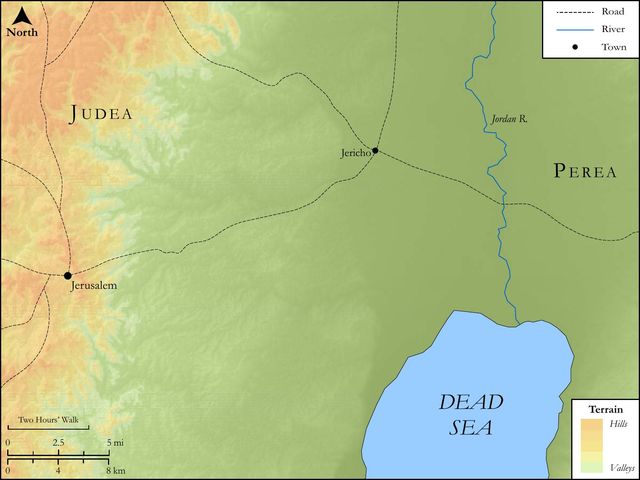
See on the biblical-era maps
Study this verse
Public-domain commentary
Matthew Henry
From his Commentary on the Whole Bible. Henry comments on passages, not single verses — this entry covers Luke 19:1–10. His three-level outline is real structure in the source text, so it is rendered as structure.
Many, no doubt, were converted to the faith of Christ of whom no account is kept in the gospels; but the conversion of some, whose case had something in it extraordinary, is recorded, as this of Zaccheus. Christ passed through Jericho, Luk 19:1. This city was build under a curse, yet Christ honoured it with his presence, for the gospel takes away the curse. Though it ought not to have been built, yet it was not therefore a sin to live in it when it was built. Christ was now going from the other side Jordan to Bethany near Jerusalem, to raise Lazarus to life; when he was going to do one good work he contrived to do many by the way. He did good both to the souls and to the bodies of people; we have here an instance of the former. Observe,
I.Who, and what, this Zaccheus was.
His name bespeaks him a Jew. Zaccai was a common name among the Jews; they had a famous rabbi, much about this time, of that name. Observe,
1.His calling, and the post he was in: He was the chief among the publicans, receiver-general; other publicans were officers under him; he was, as some think, farmer of the customs. We often read of publicans coming to Christ; but here was one that was chief of the publicans, was in authority, that enquired after him. God has his remnant among all sorts. Christ came to save even the chief of publicans.
2.His circumstances in the world were very considerable: He was rich. The inferior publicans were commonly men of broken fortunes, and low in the world; but he that was chief of the publicans had raised a good estate. Christ had lately shown how hard it is for rich people to enter into the kingdom of God, yet presently produces an instance on one rich man that had been lost, and was found, and that not as the prodigal by being reduced to want.
II.How he came in Christ's way, and what was the occasion of his acquaintance with him.
1.He had a great curiosity to see Jesus, what kind of a man he was, having heard great talk of him, Luk 19:3. It is natural to us to come in sight, if we can, of those whose fame has filled our ears, as being apt to imagine there is something extraordinary in their countenances; at least, we shall be able to say hereafter that we have seen such and such great men. But the eye is not satisfied with seeing. We should now seek to see Jesus with an eye of faith, to see who he is; we should address ourselves in holy ordinances with this in our eye, We would see Jesus.
2.He could not get his curiosity gratified in this matter because he was little, and the crowd was great. Christ did not study to show himself, was not carried on men's shoulders (as the pope is in procession), that all men might see him; neither he nor his kingdom came with observation. He did not ride in an open chariot, as princes do, but, as one of us, he was lost in a crowd; for that was the day of his humiliation. Zaccheus was low of stature, and over-topped by all about him, so that he could not get a sight of Jesus. Many that are little of stature have large souls, and are lively in spirit. Who would not rather be a Zaccheus than a Saul, though he was higher by head and shoulders than all about him? Let not those that are little of stature take thought of adding cubits to it.
3.Because he would not disappoint his curiosity he forgot his gravity, as chief of the publicans, and ran before, like a boy, and climbed up into a sycamore-tree, to see him. Note, Those that sincerely desire a sight of Christ will use the proper means for gaining a sight of him, and will break through a deal of difficulty and opposition, and be willing to take pains to see him. Those that find themselves little must take all the advantages they can get to raise themselves to a sight of Christ, and not be ashamed to own that they need them, and all little enough. Let not dwarfs despair, with good help, by aiming high to reach high.
III.The notice Christ took of him, the call he gave him to a further acquaintance (Luk 19:5), and the efficacy of that call, Luk 19:6.
1.Christ invited himself to Zaccheus's house, not doubting of his hearty welcome there; nay, wherever Christ comes, as he brings his own entertainment along with him, so he brings his own welcome; he opens the heart, and inclines it to receive him. Christ looked up into the tree, and saw Zaccheus. He came to look upon Christ, and resolved to take particular notice of him, but little thought of being taken notice of by Christ. That was an honour too great, and too far above his merit, for him to have any thought of. See how Christ prevented him with the blessings of his goodness, and outdid his expectations; and see how he encouraged very weak beginnings, and helped them forward. He that had a mind to know Christ shall be known of him; he that only courted to see him shall be admitted to converse with him. Note, Those that are faithful in a little shall be entrusted with more. And sometimes those that come to hear the word of Christ, as Zaccheus did, only for curiosity, beyond what they thought of, have their consciences awakened, and their hearts changed. Christ called him by name, Zaccheus, for he knows his chosen by name; are they not in his book? He might ask, as Nathanael did (Joh 1:48), Whence knowest thou me? But before he climbed the sycamore-tree Christ saw him, and knew him. He bade him make haste, and come down. Those that Christ calls must come down, must humble themselves, and not think to climb to heaven by any righteousness of their own; and they must make haste and come down, for delays are dangerous. Zaccheus must not hesitate, but hasten; he knows it is not a matter that needs consideration whether he should welcome such a guest to his house. He must come down, for Christ intends this day to bait at his house, and stay an hour or two with him. Behold, he stands at the door and knocks.
2.Zaccheus was overjoyed to have such an honour put upon his house (Luk 19:6): He made haste, and came down, and received him joyfully; and his receiving him into his house was an indication and token of his receiving him into his heart. Note, When Christ calls to us we must make haste to answer his calls; and when he comes to us we must receive him joyfully. Lift up your heads, O ye gates. We may well receive him joyfully who brings all good along with him, and, when he takes possession of the soul, opens springs of joy there which shall flow to eternity. How often has Christ said to us, Open to me, when we have, with the spouse, made excuses! Sol 5:2, Sol 5:3. Zaccheus's forwardness to receive Christ will shame us. We have not now Christ to entertain in our houses, but we have his disciples, and what is done to them he takes as done to himself.
IV.The offence which the people took at this kind greeting between Christ and Zaccheus.
Those narrow-souled censorious Jews murmured, saying that he was gone to be a guest with a man that is a sinner, para hamartōlō andri - with a sinful man; and were not they themselves sinful men? Was it not Christ's errand into the world to seek and save men that are sinners? But Zaccheus they think to be a sinner above all men that dwelt in Jericho, such a sinner as was not fit to be conversed with. Now this was very unjust to blame Christ for going to his house; for,
1.Though he was a publican, and many of the publicans were bad men, it did not therefore follow that they were all so. We must take heed of condemning men in the lump, or by common fame, for at God's bar every man will be judged as he is.
2.Though he had been a sinner, it did not therefore follow that he was now as bad as he had been; though they knew his past life to be bad, Christ might know his present frame to be good. God allows room for repentance, and so must we.
3.Though he was now a sinner, they ought not to blame Christ for going to him, because he was in no danger of getting hurt by a sinner, but in great hopes of doing good to a sinner; whither should the physician go but to the sick? Yet see how that which is well done may be ill construed.
V.The proofs which Zaccheus gave publicly that, though he had been a sinner, he was now a penitent, and a true convert, Luk 19:8.
He does not expect to be justified by his works as the Pharisee who boasted of what he had done, but by his good works he will, through the grace of God, evidence the sincerity of his faith and repentance; and here he declares what his determination was. He made this declaration standing, that he might be seen and heard by those who murmured at Christ for coming to his house; with the mouth confession is made of repentance as well as faith. He stood, which denotes his saying it deliberately and with solemnity, in the nature of a vow to God. He addressed himself to Christ in it, not to the people (they were not to be his judges), but to the Lord, and he stood as it were at his bar. What we do that is good we must do as unto him; we must appeal to him, and approve ourselves to him, in our integrity, in all our good purposes and resolutions. He makes it appear that there is a change in his heart (and that is repentance), for there is a change in his way. His resolutions are of second-table duties; for Christ, upon all occasions, laid great stress on them: and they are such as are suited to his condition and character; for in them will best appear the truth of our repentance.
1.Zaccheus had a good estate, and, whereas he had been in it hitherto laying up treasure for himself, and doing hurt to himself, now he resolves that for the future he will be all towards God, and do good to others with it: Behold, Lord, the half of my goods I give to the poor. Not, "I will give it by my will when I die," but, "I do give it now." Probably he had heard of the command of trial which Christ gave to another rich man to sell what he had, and give to the poor (Mat 19:21), and how he broke with Christ upon it. "But so will not I," saith Zaccheus; "I agree to it at the first word; though hitherto I have been uncharitable to the poor, now I will relieve them, and give so much the more for having neglected the duty so long, even the half of my goods." This is a very large proportion to be set apart for works of piety and charity. The Jews used to say that a fifth part of a man's income yearly was very fair to be given to pious uses, and about that share the law directed; but Zaccheus would go much further, and give one moiety to the poor, which would oblige him to retrench all his extravagant expenses, as his retrenching these would enable him to relieve many with his superfluities. If we were but more temperate and self-denying, we should be more charitable; and, were we content with less ourselves, we should have the more to give to them that need. This he mentions here as a fruit of his repentance. Note, It well becomes converts to God to be charitable to the poor.
2.Zaccheus was conscious to himself that he had not gotten all he had honestly and fairly, but some by indirect and unlawful means, and of what he had gotten by such means he promises to make restitution: "If I have taken any thing from any man by false accusation, or if I have wronged any man in the way of my business as a publican, exacting more than was appointed, I promise to restore him four-fold." This was the restitution that a thief was to make, Exo 22:1.
(1.)He seems plainly to own that he had done wrong; his office, as a publican, gave him opportunity to do wrong, imposing upon the merchants to curry favour with the government. True penitents will own themselves not only in general guilty before God, but will particularly reflect upon that which has been their own iniquity, and which, by reason of their business and employment in the world, has most easily beset them.
(2.)That he had done wrong by false accusation; this was the temptation of the publicans, which John Baptist had warned them of particularly, Luk 3:14. They had the ear of the government, and every thing would be stretched in favour of the revenue, which gave them an opportunity of gratifying their revenge if they bore a man an ill will.
(3.)He promises to restore four-fold, as far as he could recollect or find by his books that he had wronged any man. He does not say, "If I be sued, and compelled to it, I will make restitution" (some are honest when they cannot help it); but he will do it voluntarily: It shall be my own act and deed. Note, Those who are convinced of having done wrong cannot evidence the sincerity of their repentance but by making restitution. Observe, He does not think that his giving half his estate to the poor will atone for the wrong he has done. God hates robbery for burnt-offerings, and we must first do justly and then love mercy. It is no charity, but hypocrisy, to give that which is none of our own; and we are not to reckon that our own which we have not come honestly by, nor that our own which is not so when all our debts are paid, and restitution made for wrong done.
VI.Christ's approbation and acceptance of Zaccheus's conversion, by which also he cleared himself from any imputation in going to be a guest with him, Luk 19:9, Luk 19:10.
1.Zaccheus is declared to be now a happy man. Now he is turned from sin to God; now he has bidden Christ welcome to his house, and is become an honest, charitable, good man: This day is salvation come to this house. Now that he is converted he is in effect saved, saved from his sins, from the guilt of them, from the power of them; all the benefits of salvation are his. Christ is come to his house, and, where Christ comes, he brings salvation along with him. He is, and will be, the Author of eternal salvation to all that own him as Zaccheus did. Yet this is not all. Salvation this day comes to his house.
(1.)When Zaccheus becomes a convert, he will be, more than he had been, a blessing to his house. He will bring the means of grace and salvation to his house, for he is a son of Abraham indeed now, and therefore, like Abraham, will teach his household to keep the way of the Lord. He that is greedy of gain troubles his own house, and brings a curse upon it (Hab 2:9), but he that is charitable to the poor does a kindness to his own house, and brings a blessing upon it and salvation to it, temporal at least, Psa 112:3.
(2.)When Zaccheus is brought to Christ himself his family also become related to Christ, and his children are admitted members of his church, and so salvation comes to his house, for that he is a son of Abraham, and therefore interested in God's covenant with Abraham, that blessing of Abraham which comes upon the publicans, upon the Gentiles, through faith, that God will be a God to them and to their children; and therefore, when he believes, salvation comes to his house, as the gaoler's to whom it was said, Believe in the Lord Jesus Christ, and thou shalt be saved, and thy house, Act 16:31. Zaccheus is by birth a son of Abraham, but, being a publican, he was deemed a heathen; they are put upon a level, Mat 18:17. And as such the Jews were shy of conversing with him, and expected Christ should be so; but he shows that, being a true penitent, he is become rectus in curia - upright in court, as good a son of Abraham as if he had never been an publican, which therefore ought not to be mentioned against him.
2.What Christ had done to make him, in particular, a happy man, was consonant to the great design and intention of his coming into the world, Luk 19:10. With the same argument he had before justified his conversing with publicans, Mat 9:13. There he pleaded that he came to call sinners to repentance; now that he came to seek and save that which was lost, to apolōlos - the lost thing. Observe,
(1.)The deplorable case of the sons of men: they were lost; and here the whole race of mankind is spoken of as one body. Note, The whole world of mankind, by the fall, is become a lost world: lost as a city is lost when it has revolted to the rebels, as a traveller is lost when he has missed his way in a wilderness, as a sick man is lost when his disease is incurable, or as a prisoner is lost when sentence is passed upon him.
(2.)The gracious design of the Son of God: he came to seek and save, to seek in order to saving. He came from heaven to earth (a long journey), to seek that which was lost (which had wandered and gone astray), and to bring it back (Mat 18:11, Mat 18:12), and to save that which was lost, which was perishing, and in a manner destroyed and cut off. Christ undertook the cause when it was given up for lost: undertook to bring those to themselves that were lost to God and all goodness. Observe, Christ came into this lost world to seek and save it. His design was to save, when there was not salvation in any other. In prosecution of that design, he sought, took all probable means to effect that salvation. He seeks those that were not worth seeking to; he seeks those that sought him not, and asked not for him, as Zaccheus here.
Historical interpretation
Seven Centuries of Reception
11 surviving comments on this verse. Each one is dated, so this reads as a timeline rather than a list.
Select a marker to jump to its quote. Markers stagger vertically where authors wrote within a few decades of each other.
The seed of salvation had begun to spring up in him, for he desired to see Jesus, having never seen Him. For if he had seen Him, he would long since have given up the Publican's wicked life. No one that sees Jesus can remain any longer in wickedness. But there were two obstacles to his seeing Him. The multitude not so much of men as of his sins prevented him, for he was little of stature.
But he discovered a good device; running before he climbed up into a sycamore, and saw Him whom he had long wished for, i. e. Jesus, passing by. Now Zacchæus desired no more than to see, but He who is able to do more than we ask for, granted to Him far above what he expected; as it follows, And when Jesus came to the place, he looked up, and saw him. He saw the soul of the man striving earnestly to live a holy life, and converts him to godliness.
Zacchæus in the sycamore, the blind man by the way side: upon the one our Lord waits to show mercy, upon the other He confers the great glory of abiding in his house. The chief among the Publicans is here fitly introduced. For who will hereafter despair of himself, now that he attains to grace who gained his living by fraud. And he too moreover a rich man, that we may know that not all rich men are covetous.
What means the Evangelist by describing his stature, and that of none other? It is perhaps because he was young in wickedness, or as yet weak in the faith. For he was not yet prostrate in sin who could climb up. He had not yet seen Christ.
Uninvited he invites Himself to his house; as it follows, Zacchæus, make haste, and come down, & c. for He knew how richly He would reward his hospitality. And though He had not yet heard the word of invitation, He had already seen the will.
Let the rich learn that guilt attaches not to the goods themselves, but to those who know not how to use them. For riches, as they are hindrances to virtue in the unworthy, so are they means of advancing it in the good.
He has well added, that our Lord was to pass that way, either where the sycamore-tree was, or where he was who was about to believe, that so He might preserve the mystery, and sow the seeds of grace. For He had so come as that through the Jews He came to the Gentiles. He sees then Zacchæus above, for already the excellence of his faith shone forth amidst the fruits of good works, and the loftiness of the fruitful tree; but Zacchæus stands out above the tree, as one who is above the law.
There certainly is much truth in a certain saying of a philosopher, “Every rich man is either wicked or the heir of wickedness.” That is why the Lord and Savior says that it is difficult for the rich to enter the kingdom of heaven. Someone may raise the objection, “How did wealthy Zacchaeus enter the kingdom of heaven?” He gave away his wealth and immediately replaced it with the riches of the heavenly kingdom. The Lord and Savior did not say that the rich would not enter the kingdom of heaven but that they will enter with difficulty.
Come and let us see what was the method of Zacchaeus’s conversion. He desired to see Jesus and therefore climbed into a sycamore tree, and so a seed of salvation sprouted within him. Christ saw this with the eyes of deity. Looking up, he also saw Zacchaeus with the eyes of humanity, and since it was his purpose for all to be saved, he extends his gentleness to him. To encourage him, he says, “Come down quickly.” Zacchaeus searched to see Christ, but the multitude prevented him, not so much that of the people but of his sins. He was short of stature, not merely in a bodily point of view but also spiritually. He could not see him unless he were raised up from the earth and climbed into the sycamore, by which Christ was about to pass. The story contains a puzzle. In no other way can a person see Christ and believe in him except by climbing up into the sycamore, by making foolish his earthly members of fornication, uncleanness, etc.
Zacchaeus was leader of the tax collectors, a man entirely abandoned to greed, whose only goal was the increase of his gains. This was the practice of the tax collectors, although Paul calls it idolatry, possibly as being suitable only for those who have no knowledge of God. Since they shamelessly, openly professed this vice, the Lord very justly joined them with the prostitutes, saying to the leaders of the Jews, “The prostitutes and the tax collectors go before you into the kingdom of God.” Zacchaeus did not continue to be among them, but he was counted worthy of mercy at Christ’s hands. He calls near those who are far away and gives light to those who are in darkness.
But Zacchæus made no delay in what he did, and so was accounted worthy of the favour of God, which gives sight to the blind, and calls them who are afar off.
The crowd is the tumultuous state of an ignorant multitude, which cannot see the lofty top of wisdom. Zacchæus therefore, while he was in the crowd, saw not Christ, but having advanced beyond the vulgar ignorance, was thought worthy to entertain Him, whom he desired to look upon.
(Hom. de cæc. et Zacc.) Observe the gracious kindness of the Saviour. The innocent associates with the guilty, the fountain of justice with covetousness, which is the source of injustice. Having entered the publican's house, He suffers no stain from the mists of avarice, but disperses them by the bright beam of His righteousness. But those who deal with biting words and reproaches, try to cast a slur upon the things which were done by Him; for it follows, And when they saw it, they all murmured, saying, That he was gone to be guest with a man that is a sinner. But He, though accused of being a wine-bibber and a friend of publicans, regarded it not, so long as He could accomplish His end. As a physician sometimes can not save his patients from their diseases without the defilement of blood. And so it happened here, for the publican was converted, and lived a better life. Zacchæus stood, and said unto the Lord, Behold, Lord, the half of my goods I give to the poor; and if I have defrauded any man, I restore him fourfold. Behold here is a marvel: without learning he obeys. And as the sun pouring its rays into a house enlightens it not by word, but by work, so the Saviour by the rays of righteousness put to flight the darkness of sin; for the light shineth in darkness. Now every thing united is strong, but divided, weak; therefore Zacchæus divides into two parts his substance. But we must be careful to observe, that his wealth was not made up from unjust gains, but from his patrimony, else how could he restore fourfold what he had unjustly extorted. He knew that the law ordered what was wrongly taken away to be restored fourfold, that if the law deterred not, a man's losses might soften him. Zacchæus waits not for the judgment of the law, but makes himself his own judge.
(ubi sup.) Why do ye accuse me if I bring sinners to righteousness? So far am I from hating them, that for their sakes I came. For I came to heal, not to judge, therefore am I the constant guest of those that are sick, and I suffer their noisomeness that I may supply remedies. But some one may ask, how does Paul bid us, If we have a brother that is a fornicator or covetous man, with such not even to take food; (1 Cor. 5:11.) whereas Christ was the guest of publicans? They were not as yet so far advanced as to be brethren, and besides, St. Paul bids us avoid our brethren only when they persist in evil, but these were converted.
(Mor. 27. c. 46.) Or because the sycamore is from its name called the foolish fig, the little Zacchæus gets up into the sycamore and sees the Lord, for they who humbly choose the foolish things of this world are those who contemplate most closely the wisdom of God. For what is more foolish in this world than not to seek for what is lost, to give our possessions to robbers, to return not injury for injury? However, by this wise foolishness, the wisdom of God is seen, not yet really as it is, but by the light of contemplation.
See here, the camel disencumbered of his hunch passes through the eye of a needle, that is, the rich man and the publican abandoning his love of riches, and loathing his dishonest gains, receives the blessing of his Lord's company. It follows, And he made haste, and came down, and received him joyfully.
Zacchæus is called the son of Abraham, not because he was born of Abraham's seed, but because he imitates his faith, that as Abraham left his country and his father's house, so he abandoned all his goods in giving them to the poor. And He well says, "He also," to declare that not only those who had lived justly, but those who are raised up from a life of injustice, belong to the sons of promise.
Mystically, Zacchæus, which is by interpretation "justified," signifies the Gentile believers, who were depressed and brought very low by their worldly occupations, but sanctified by God. And he was desirous to see our Saviour entering Jericho, inasmuch as he sought to share in that faith which Christ brought into the world.
Or the crowd, that is, the general habit of vice, which rebuked the blind man crying out, lest he should seek the light, also impedes Zacchæus looking up, that he might not see Jesus; that as by crying out the more the blind man overcame the crowd, so the man weak in the faith by forsaking earthly things, and climbing the tree of the Cross, surmounts the opposing multitude. The sycamore, which is a tree resembling the mulberry in foliage, but exceeding it in height, whence by the Latins it is called "lofty," is called the "foolish fig-tree;" and so the Cross of our Lord sustains believers, as the fig-tree figs, and is mocked by unbelievers as foolishness. This tree Zacchæus, who was little in stature, climbed up, that he might be raised together with Christ; for every one who is humble, and conscious of his own weakness, cries out, God forbid that I should glory, save in the cross of our Lord Jesus Christ. (Gal. 6:14.)
The Lord as He journeyed came to the place where Zacchæus had climbed the sycamore, for having sent His preachers throughout the world in whom He Himself spoke and went, He comes to the Gentile people, who were already raised up on high through faith in His Passion, and whom when He looked up He saw, for He chose them through grace. Now our Lord once abode in the house of the chief of the Pharisees, but when He did works such as none but God could do, they railed at Him. Wherefore hating their deeds He departed, saying, Your house shall be left unto you desolate; (Matt. 23:38.) but now He must needs stay at the house of the weak Zacchæus, that is, by the grace of the new law brightly shining, He must take rest in the hearts of the lowly nations. But that Zacchæus is bid to come down from the sycamore tree, and prepare an abode for Christ, this is what the Apostle says, Yea, though we have known Christ after the flesh, yet now henceforth know we Him no more. (2 Cor. 5:16.) And again elsewhere, For though he was crucified through weakness, yet he liveth by the power of God. (2 Cor. 13:4.) It is plain that the Jews always hated the salvation of the Gentiles; but salvation, which formerly filled the houses of the Jews, has this day shone upon the Gentiles, forasmuch as this people also by believing on God is a son of Abraham.
And entering, he was passing through Jericho; and behold, a man named Zacchaeus, who was a chief tax collector, and he was rich. And he was seeking to see Jesus, who he was, and he could not because of the crowd, for he was of short stature. And running ahead, he climbed up into a sycamore tree to see him, because he was to pass that way. What is impossible with men is possible with God (Luke XVIII). Behold, a camel, having laid down its hump load, passes through the eye of a needle (Matthew XIX), that is, a rich man and a tax collector, having left the burden of riches, having despised the sense of frauds, ascends the narrow gate and the difficult way that leads to life (Matthew VII). With an extraordinary devotion of faith to see the Savior, what was lacking in nature, he supplied by climbing the tree, and thus justly, although he did not dare to ask, he received the blessing of the Lord’s visitation, which he desired. Mystically, Zacchaeus, who is interpreted as "justified," signifies a believing people from the Gentiles. The more occupied he was with worldly cares, the more he was made humble by the oppressive devices. But he was washed, he was sanctified, he was justified in the name of our Lord Jesus Christ and in the Spirit of our God, who was seeking to see the Savior passing through Jericho but could not because of the crowd. Because he desired to partake of the grace of faith which the Savior brought to the world, but the ingrained habit of vices obstructed him from reaching his desire. The same crowd of harmful habits that rebuked the blind man crying out so that he might not seek the light, also delays the tax collector looking upward so that he might not see Jesus. But just as the blind man overcame the voices of the crowds by crying out more and more, so the short man must overcome the obstacle of the harmful crowd by seeking higher things, leaving earthly things behind, ascending the tree of the cross. The sycamore tree, which is a tree with leaves similar to the mulberry, but excelling in height, and is therefore called lofty by the Latins, is called the foolish fig. And the same is the Lord’s cross, which nourishes believers like a fig, but is ridiculed by unbelievers as foolishness. For we preach Christ crucified, to the Jews indeed a stumbling block, and to the Gentiles foolishness. But to those who are called, Jews and Greeks, Christ the power of God and the wisdom of God (1 Corinthians I). This very tree Zacchaeus of short stature climbs in order to be exalted, when anyone humble and aware of his own weakness, trusting in the Lord, proclaims: But far be it from me to boast except in the cross of our Lord Jesus Christ (Galatians VI). Having climbed the sycamore, he sees the Lord passing by, because through this commendable foolishness, even if not yet solidly, yet already fleetingly, and as if in passing, he gazes upon the light of heavenly wisdom.
If we examine more closely, we shall see that nothing was left of his own property. For having given half of his goods to the poor, out of the remainder he restored fourfold to those whom he had injured. He not only promised this, but did it. For he says not, "I will give the half, and I will restore fourfold, but, I give, and I restore. To such Christ announces salvation; Jesus saith unto him, This day is salvation come to this house, signifying that Zacchæus had attained to salvation, meaning by the house the inhabitant thereof. And it follows, forasmuch as he also is a son of Abraham. For He would not have given the name of a son of Abraham to a lifeless building.
He said not that he "was" a son of Abraham, but that he now is. For before when he was the chief among the publicans, and bore no likeness to the righteous Abraham, he was not his son. But because some murmured that he tarried with a man who was a sinner, he adds in order to restrain them, For the Son of man came to seek and to save that which was lost.
It is easy to turn this to a moral use. For whoever surpasses many in wickedness is small in spiritual growth, and cannot see Jesus for the crowd. For disturbed by passion and worldly things, he beholds not Jesus walking, that is, working in us, not recognising His operation. But he climbs up to the top of a sycamore-tree, in that he rises above the sweetness of pleasure, which is signified by a fig, and subduing it, and so becoming more exalted, he sees and is seen by Christ.
The Lord said to him, Make haste and come down, that is, "Thou hast ascended by penitence to a place too high for thee, come down by humility, lest thy exaltation cause thee to slip. I must abide in the house of a humble man. We have two kinds of goods in us, bodily, and spiritual; the just man gives up all his bodily goods to the poor, but he forsakes not his spiritual goods, but if he has extorted any thing from any one, he restores to him fourfold; signifying thereby that if a man by repentance walks in the opposite path to his former perverseness, he by the manifold practice of virtue heals all his old offences, and so merits salvation, and is called the son of Abraham, because he went out from his own kindred, that is, from his ancient wickedness.
Continue studying Luke 19:2 across the web’s major study libraries — every link below opens this exact verse, chapter, or book on the destination site.
Read & Compare
 BibleGatewayThis verse in more than 200 translations and 70 languages.
 Bible.comThe YouVersion reader — hundreds of translations, reading plans, and highlights.
 ESV.orgCrossway's official English Standard Version reader.
 NET BibleThe NET translation with 60,000+ translators' notes on every rendering decision.
 STEP BibleTyndale House's free study tool — original text, vocabulary, and scholarly resources.
 BibliaLogos Bible Software's free web reader.
 USCCBThe New American Bible (Revised Edition) with the U.S. bishops' study notes.
Commentaries
 BibleHub CommentariesDozens of classic commentaries on this verse, gathered on one page.
 StudyLightMore than 100 commentary sets — the largest collection on the web.
 BibleRefPlain-English commentary on what this verse means, verse by verse.
 Enduring WordDavid Guzik's free commentary on this chapter, widely used by Bible teachers.
 Bible Study ToolsVerse commentary alongside Greek and Hebrew study aids.
Original Language & Research
- BibleHub InterlinearThe verse word by word — original language, transliteration, and English.
- BibleHub LexiconEvery word's original-language definition and Strong's entry.
 Blue Letter BibleDeep-study tools — Strong's numbers, concordance, and word studies.
 CNTR CollationThe earliest Greek manuscripts of this verse, collated letter by letter.
Sermons, Hymns & Audio


TrulyRandomVerse is not affiliated with these sites and doesn’t control their content. They’re linked because they’re genuinely useful.
Summary
Luke 19:2 introduces Zacchaeus, a man of significant yet despised status in Jericho, serving as the chief tax collector for the Roman Empire. This verse succinctly establishes his identity as a prominent figure within a profession widely reviled by his Jewish compatriots due to its association with foreign occupation and perceived corruption, further highlighting his considerable wealth, likely accumulated through these controversial means. This initial portrayal sets the stage for a dramatic encounter with Jesus, hinting at the Lord's unique mission to engage with and transform those considered outcasts by society.
Context
ShowHideLiterary Context
This verse immediately follows Jesus's journey into and through Jericho, as recounted in Luke 19:1. Prior to this, Jesus had just healed a blind beggar near Jericho's gates, an event that drew a large crowd and demonstrated His compassionate power (Luke 18:35-43). The introduction of Zacchaeus right after this miracle, and as Jesus passes through the city, signals a shift in focus from a public display of healing to a more personal, individual encounter. It sets up the narrative of a specific, wealthy, and socially overlooked individual being sought out by Jesus, contrasting with the general crowd that followed Him. The story of Zacchaeus then culminates in his repentance and Jesus's profound declaration about His mission to seek and save the lost (Luke 19:10).
Historical & Cultural Context
Jericho, a prosperous city due to its location on a major trade route and its fertile oasis, was a significant hub for Roman tax collection. During the Roman occupation of Judea, the Roman government outsourced tax collection to local individuals, often Jews, who were known as "publicans" (Latin: publicani, Greek: telōnai). These publicans were deeply despised by their fellow Jews for several reasons: they were seen as collaborators with the oppressive Roman regime, they often extorted more than the required tax for personal gain, and their handling of Gentile money and goods made them ritually unclean. Zacchaeus's title, "chief among the publicans," indicates he was not just a tax collector but a supervisor, overseeing other tax collectors in the region. This position would have afforded him considerable power and wealth, as explicitly stated, but simultaneously cemented his status as a social pariah and a traitor in the eyes of his community, making him an archetypal outcast.
Key Themes
ShowHideLuke 19:2 introduces several key themes that resonate throughout the Gospel of Luke and the broader biblical narrative. Firstly, it highlights the theme of neglect and exclusion, portraying Zacchaeus as a wealthy but deeply alienated figure. Despite his material prosperity, his profession rendered him an outcast, underscoring the societal judgments and divisions of the era. Secondly, the verse subtly introduces the theme of wealth and its moral implications, suggesting the controversial means by which Zacchaeus's riches were acquired. This sets the stage for Jesus's consistent teaching on the dangers of wealth and the difficulty it poses for entering the Kingdom of God, as seen in the preceding narrative of the rich young ruler (Luke 18:18-30). Finally, and most significantly, this introduction foreshadows God's divine initiative and universal reach. The very act of introducing such a reviled figure immediately before Jesus's encounter with him anticipates the core of Jesus's ministry: to seek out and save those considered "lost" or "unworthy" by human standards, a mission explicitly articulated by Jesus later in this very chapter (Luke 19:10).
Exposition and Analysis
ShowHideKey Word Analysis
ShowHideFrom Hebrew origin, meaning "pure" or "innocent." This name, ironically, stands in stark contrast to his profession as a chief publican, which was associated with impurity, corruption, and exploitation. The name itself might be a subtle irony or foreshadowing of the spiritual cleansing and transformation he is about to experience through his encounter with Jesus.
This compound word combines archē (meaning "chief" or "first") and telōnēs (meaning "tax collector"). It denotes a principal tax-gatherer, emphasizing Zacchaeus's supervisory role and higher authority within the despised tax collection system. This position would have allowed him to accumulate significant wealth, but also made him particularly notorious and hated among his Jewish peers, as he was seen as a leading figure in their oppression.
Derived from ploutos (wealth), this word describes someone who is wealthy or abounding with possessions. In the context of Zacchaeus, it highlights his material prosperity. However, in the Gospels, "rich" often carries a negative connotation, especially when wealth is acquired unjustly or becomes an idol, hindering spiritual growth (e.g., Luke 18:24-25). His richness is presented as a defining characteristic, setting the stage for Jesus's challenge to conventional values.
Verse Breakdown
ShowHide"And, behold, [there was] a man named Zacchaeus,"
The opening "And, behold" (Greek: kai idou) serves as an attention-grabbing interjection, signaling the introduction of a significant character or event. It immediately draws the reader's focus to Zacchaeus, emphasizing his sudden appearance in the narrative. The naming of Zacchaeus, with its ironic meaning of "pure," sets up an immediate tension with his known profession.
"which was the chief among the publicans,"
This clause defines Zacchaeus's profession and status. Being a "chief publican" meant he supervised other tax collectors, making him particularly powerful and wealthy, but also deeply reviled by his Jewish community. This detail establishes his social standing as an outcast and a sinner in the eyes of many.
"and he was rich."
This final clause confirms Zacchaeus's material prosperity, which was a direct consequence of his profession. His wealth, likely acquired through the exploitative practices common among tax collectors, further solidifies his negative societal perception and sets up a theological tension, as Jesus often challenged the spiritual implications of material riches.
Literary Devices
ShowHideLuke's introduction of Zacchaeus employs several powerful literary devices. The use of "behold" (Greek: idou) at the beginning of the verse acts as a dramatic interjection, immediately drawing the reader's attention to the significance of the character being introduced. This device creates a sense of immediacy and importance, signaling that Zacchaeus is not just another passerby but a central figure in the unfolding narrative. There is also a strong element of juxtaposition in the description of Zacchaeus: he is "chief among the publicans," a position of considerable power and wealth, yet one that rendered him a social and religious pariah. This contrast highlights the paradox of his status—materially rich but socially ostracized. Furthermore, the verse serves as a powerful piece of foreshadowing, hinting at the transformative encounter that is about to occur. By explicitly identifying Zacchaeus as a reviled figure, Luke sets up the expectation that Jesus's interaction with him will be profoundly counter-cultural and illustrative of His mission to seek and save the lost.
Theological and Thematic Connections
ShowHideLuke 19:2, in its concise introduction of Zacchaeus, immediately plunges the reader into profound theological and thematic waters. It highlights God's universal reach and Jesus's counter-cultural ministry, which consistently reached beyond societal norms and religious prejudices to embrace those deemed unworthy. Zacchaeus's status as a wealthy chief publican, a figure of both power and profound social contempt, perfectly illustrates the kind of individual Jesus came to redeem. This introduction challenges human preconceptions about who is "worthy" of divine attention, underscoring that God's grace extends to all, regardless of their past sins or societal standing. It sets the stage for a demonstration of divine love that transcends human judgment, emphasizing that no one is beyond the reach of God's transforming power.
Reflection and Application
ShowHideThe introduction of Zacchaeus in Luke 19:2 serves as a powerful reminder that God's perspective on worthiness often radically differs from human judgment. In a world quick to label and dismiss based on profession, wealth, or past mistakes, this verse invites us to reconsider our own biases and extend grace. Zacchaeus, despite his societal condemnation, was seen by Jesus not as a "sinner" to be avoided, but as a "lost" soul to be sought. This challenges us to look beyond superficial appearances and social standing, recognizing the inherent dignity and potential for transformation in every individual. It also prompts us to examine our own lives: are we allowing our possessions or positions to define us, or are we open to the radical transformation that comes from an encounter with Christ? The story beginning here offers profound hope, demonstrating that even those most estranged from God or society can find redemption and a new beginning in Christ.
Questions for Reflection
ShowHideFAQ
ShowHideWhy were publicans, and especially "chief publicans" like Zacchaeus, so despised by their fellow Jews?
ShowHidePublicans were Jewish individuals who collected taxes for the Roman Empire, which was the occupying power in Judea. They were despised for several key reasons: firstly, they were seen as collaborators with the enemy, betraying their own people for personal gain. Secondly, they often extorted more money than legally required, enriching themselves at the expense of their fellow Jews. This corruption and exploitation led to widespread resentment. Thirdly, their close association with Gentiles and their handling of "unclean" money and goods made them ritually impure in the eyes of devout Jews. As a "chief publican," Zacchaeus would have been even more reviled, as he supervised other tax collectors and likely amassed even greater wealth through these practices, making him a prominent symbol of oppression and moral compromise.
What is the significance of Zacchaeus being explicitly called "rich" in this verse?
ShowHideThe explicit mention of Zacchaeus's wealth is highly significant, especially in the Gospel of Luke. It immediately establishes a tension, as Jesus frequently taught about the dangers and spiritual challenges associated with riches. For example, just prior to this account, Jesus had a conversation with a rich young ruler who was unable to give up his possessions to follow Christ (Luke 18:18-30). Zacchaeus's wealth, likely acquired through unjust means as a tax collector, highlights the spiritual obstacle it often presents. However, in Zacchaeus's case, his wealth becomes a backdrop for a powerful demonstration of repentance and transformation, showing that while riches can be a hindrance, they are not an insurmountable barrier to salvation when one encounters Jesus and responds with genuine faith, as seen in Luke 19:8.
Christ-Centered Fulfillment
ShowHideLuke 19:2, by introducing Zacchaeus, a wealthy and reviled chief tax collector, profoundly sets the stage for a Christ-centered fulfillment that resonates throughout the New Testament. This verse immediately highlights Jesus's divine mission to seek and save the lost, as declared later in this very chapter in Luke 19:10. Zacchaeus, an outcast by societal and religious standards, becomes a living illustration of the very people Jesus came to redeem—not the righteous, but sinners (Matthew 9:13). His story, beginning with this verse, beautifully embodies the truth that salvation is not earned through social standing or adherence to religious norms, but is a gift of grace extended by Christ to those who respond in faith and repentance, regardless of their past. Jesus's intentional pursuit of Zacchaeus demonstrates His boundless compassion and willingness to cross social barriers, revealing Him as the Good Shepherd who leaves the ninety-nine to find the one who is lost (Luke 15:3-7). Ultimately, Zacchaeus's transformation, initiated by this introduction, foreshadows the new creation that occurs in Christ, where old identities rooted in sin and societal condemnation are exchanged for a new life of righteousness and reconciliation (2 Corinthians 5:17).