


Judges 9:50
Bible text: King James Version (1769 Blayney text) · Public domain
Bible text: Berean Standard Bible · Public domain
Bible text: American Standard Version (1901) · Public domain
Bible text: World English Bible, Messianic edition · Public domain
Bible text: Geneva Bible (1599) · Public domain
Bible text: Young's Literal Translation · Public domain
- וַיֵּלֶךְvai·Ye·lekhand he wentH1980Conj-w ¦ V-Qal-ConsecImperf-3msVerb Qal Consecutive Imperfect 3rd Singular Masculineוַandיֵּלֶךְhe went
- אֲבִימֶלֶךְ'a·vi·Me·lekhAbimelechH40N-proper-mNoun Proper Masculine
- אֶל'eltoH413PrepPreposition
- תֵּבֵץte·VetzThebezH8405N-properNoun Proper Location
- וַיִּחַןvai·Yi·chanand he encampedH2583Conj-w ¦ V-Qal-ConsecImperf-3msVerb Qal Consecutive Imperfect 3rd Singular Masculineוַandיִּחַןhe encamped
- בְּתֵבֵץbe·te·Vetzat ThebezH8405Prep-b ¦ N-properNoun Proper LocationבְּatתֵבֵץThebez
- וַיִּלְכְּדָהּVai·yil·ke·Dahand he captured itH3920Conj-w ¦ V-Qal-ConsecImperf-3ms ¦ 3fsVerb Qal Consecutive Imperfect 3rd Singular Masculineוַandיִּלְכְּדָhe capturedהּit
English is a literal word-by-word gloss of the Hebrew, not the KJV's wording. Why?
This is the original text the KJV's translators worked from — each Hebrew word with its own literal English meaning in this verse, prepared by scholars at Tyndale House, Cambridge. The KJV translates whole sentences, not word by word, so its wording differs: one Hebrew word can become several English words, and the KJV may choose “the LORD” where the gloss reads “Yahweh”. Both are faithful — they answer different questions. For the KJV's own rendering, switch to the KJV text.
Details
See on the biblical-era maps
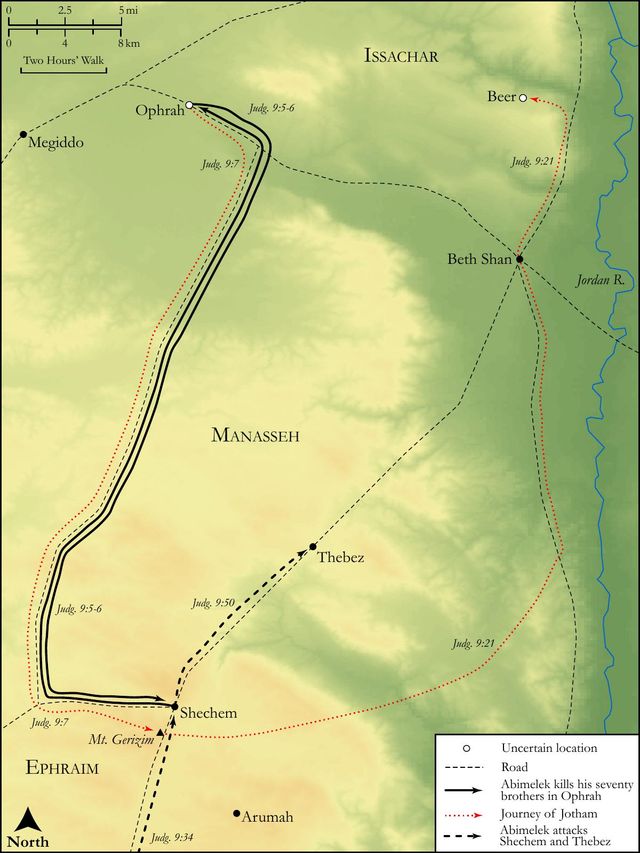
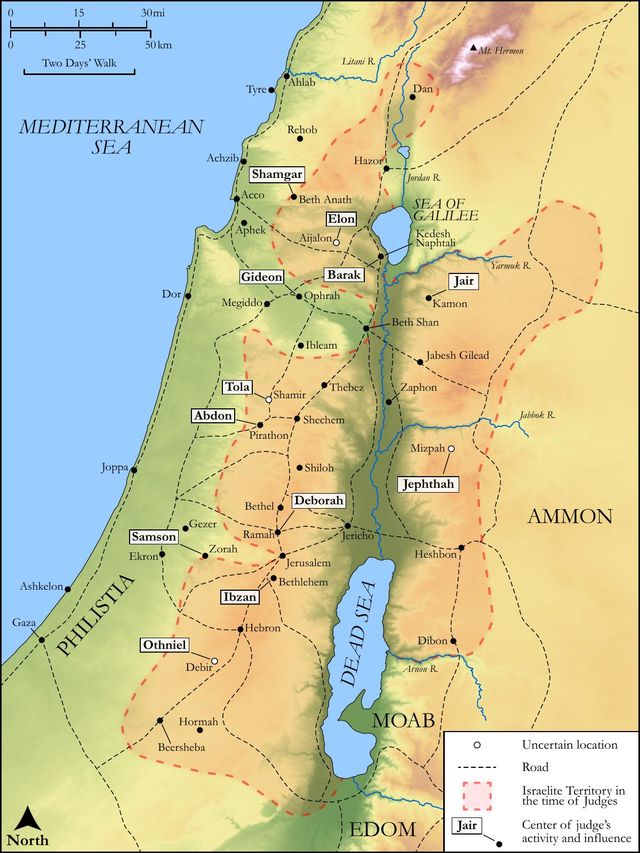
Study this verse
Public-domain commentary
Matthew Henry
From his Commentary on the Whole Bible. Henry comments on passages, not single verses — this entry covers Judges 9:50–57. His two-level outline is real structure in the source text, so it is rendered as structure.
We have seen the ruin of the Shechemites completed by the hand of Abimelech; and now it comes to his turn to be reckoned with who was their leader in villany. Thebez was a small city, probably not far from Shechem, dependent upon it, and in confederacy with it. Now,
I.Abimelech attempted the destruction of this city (Jdg 9:50), drove all the inhabitants of the town into the castle, or citadel, Jdg 9:51.
When he had them there he did not doubt but he should do the same execution here that he had lately done at the strong-hold of the temple of Baal-berith, not considering that the tower of an idol-temple lay more exposed to divine vengeance than any other tower. He attempted to set fire to this tower, at least to burn down the door, and so force an entrance, Jdg 9:52. Those who have escaped and succeeded well in one desperate attempt are apt to think the like attempt another time not desperate. This instance was long after quoted to show how dangerous it is to come near the call of a besieged city, Sa2 11:20, etc. But God infatuates those whom he will ruin.
II.In the attempt he was himself destroyed, having his brains knocked out with a piece of a millstone, Jdg 9:57.
No doubt this man was a murderer, whom, though he had escaped the dangers of the war with Shechem, yet vengeance suffered not to live, Act 28:4. Evil pursues sinners, and sometimes overtakes them when they are not only secure, but triumphant. Thebez, we may suppose, was a weak inconsiderable place, compared with Shechem. Abimelech, having conquered the greater, makes no doubt of being master of the less without any difficulty, especially when he had taken the city, and had only the tower to deal with; yet he lays his bones by that, and there is all his honour buried. Thus are the mighty things of the world often confounded by the weakest and those things that are most made light of. See here what rebukes those are justly put under many times by the divine providence that are unreasonable in their demands of satisfaction for injuries received. Abimelech had some reason to chastise the Shechemites, and he had done it with a witness; but when he will carry his revenges further, and nothing will serve but that Thebez also must be sacrificed to his rage, he is not only disappointed there, but destroyed; for verily there is a God that judges in the earth. Three circumstances are worthy of observation in the death of Abimelech: - 1. That he was slain with a stone, as he had slain his brethren all upon one stone. 2. That he had his skull broken. Vengeance aimed at that guilty head which had worn the usurped crown. 3. That the stone was cast upon him by a woman, Jdg 9:53. He saw the stone come; it was therefore strange he did not avoid it, but, no doubt, this made it so much the greater mortification to him to see from what hand it came. Sisera died by a woman's hand and knew it not; but Abimelech not only fell by the hand of a woman but knew it, and, when he found himself ready to breathe his last, nothing troubled him so much as this, that it should be said, A woman slew him. See, (1.) His foolish pride, in laying so much to heart this little circumstance of his disgrace. Here was no care taken about his precious soul, no concern what would become of that, no prayer to God for his mercy; but very solicitous he is to patch up his shattered credit, when there is no patching his shattered skull. "O let it never be said that such a mighty man as Abimelech was killed by a woman!" The man was dying, but his pride was alive and strong, and the same vain-glorious humour that had governed him all along appears now at last. Qualis vita, finis ita - As was his life, such was his death. As God punished his cruelty by the manner of his death, so he punished his pride by the instrument of it. (2.) His foolish project to avoid this disgrace; nothing could be more ridiculous; his own servant must run him through, not to rid him the sooner out of his pain, but that men say not, A woman slew him. Could he think that this would conceal what the woman had done, and not rather proclaim it the more? Nay, it added to the infamy of his death, for hereby he became a self-murderer. Better have it said, A woman slew him, than that it should be said, His servant slew him by his own order; yet now both will be said of him to his everlasting reproach. And it is observable that this very thing which Abimelech was in such care to conceal appears to have been more particularly remembered by posterity than most passages of his history; for Joab speaks of it as that which he expected David would reproach him with, for coming so nigh the wall, Sa2 11:21. The ignominy we seek to avoid by sin we do but perpetuate the remembrance of.
III.The issue of all is that Abimelech being slain,
1.Israel's peace was restored, and an end was put to this civil war; for those that followed him departed every man to his place, Jdg 9:55.
2.God's justice was glorified (Jdg 9:56, Jdg 9:57): Thus God punished the wickedness of Abimelech, and of the men of Shechem, and fulfilled Jotham's curse, for it was not a curse causeless. Thus he preserved the honour of his government, and gave warning to all ages to expect blood for blood. The Lord is known by the judgments which he executes, when the wicked is snared in the work of his own hands. Though wickedness may prosper awhile, it will not prosper always.
Historical interpretation
Historical reception
1 surviving comment on this verse from the historical church.
The homicide Abimelech, bastard son of Gideon, killed the seventy legitimate sons, and, thinking he had hit upon a ruse for securing his grasp on the royal power, he destroyed his accomplices in the crime. He, however, was in turn destroyed by them and in the end was slain with a stone cast by a woman’s hand.… In short, countless examples teach us that the profit of human wisdom is illusory, for it is a meager and lowly thing and not a great and preeminent good.
Continue studying Judges 9:50 across the web’s major study libraries — every link below opens this exact verse, chapter, or book on the destination site.
Read & Compare
 BibleGatewayThis verse in more than 200 translations and 70 languages.
 Bible.comThe YouVersion reader — hundreds of translations, reading plans, and highlights.
 ESV.orgCrossway's official English Standard Version reader.
 NET BibleThe NET translation with 60,000+ translators' notes on every rendering decision.
 STEP BibleTyndale House's free study tool — original text, vocabulary, and scholarly resources.
 BibliaLogos Bible Software's free web reader.
 USCCBThe New American Bible (Revised Edition) with the U.S. bishops' study notes.
Commentaries
 BibleHub CommentariesDozens of classic commentaries on this verse, gathered on one page.
 StudyLightMore than 100 commentary sets — the largest collection on the web.
 BibleRefPlain-English commentary on what this verse means, verse by verse.
 Enduring WordDavid Guzik's free commentary on this chapter, widely used by Bible teachers.
 Bible Study ToolsVerse commentary alongside Greek and Hebrew study aids.
Original Language & Research
- BibleHub InterlinearThe verse word by word — original language, transliteration, and English.
- BibleHub LexiconEvery word's original-language definition and Strong's entry.
 Blue Letter BibleDeep-study tools — Strong's numbers, concordance, and word studies.
 SefariaThe Hebrew text with Rashi and centuries of Jewish commentary.
Sermons, Hymns & Audio


TrulyRandomVerse is not affiliated with these sites and doesn’t control their content. They’re linked because they’re genuinely useful.
Summary
Judges 9:50 provides a stark, concise account of Abimelech's continued military campaign, detailing his advance to the city of Thebez, his subsequent siege, and its successful capture. This brief verse serves as a critical narrative bridge, highlighting Abimelech's relentless ambition and brutal efficiency in consolidating his self-proclaimed kingship, immediately preceding the dramatic and divinely ordained climax of his reign. It underscores the destructive nature of unchecked power and sets the stage for the swift justice that awaits him.
Context
ShowHideLiterary Context
Judges 9:50 is situated within the tumultuous narrative of Abimelech's rise and precipitous fall, a stark deviation from the divinely appointed judges who preceded him. Immediately prior to this verse, Abimelech has brutally suppressed the rebellion in Shechem, utterly destroying the city and sowing it with salt as a symbol of its desolation, as recorded in Judges 9:45. His actions at Shechem were a direct response to the city's betrayal after they had initially crowned him king. The swift move to Thebez signifies Abimelech's continued, relentless campaign to crush any remaining resistance and solidify his tyrannical grip on the region, demonstrating his unwavering resolve to eliminate all opposition following the Shechemite uprising. This verse thus marks a continuation of his violent consolidation of power, serving as the immediate prelude to his dramatic and ignominious demise.
Historical & Cultural Context
The period of the Judges was characterized by a profound lack of central authority, as articulated by the recurring refrain, "In those days there was no king in Israel; everyone did what was right in his own eyes," found in passages like Judges 21:25. This power vacuum allowed ambitious individuals like Abimelech, the illegitimate son of Gideon, to seize control through force and intimidation. Cities such as Shechem and Thebez were typically fortified settlements, often with internal political structures (like the "lords of Shechem" mentioned in Judges 9:2). A siege, as implied by "encamped against," was a common military tactic involving surrounding a city to cut off supplies, weaken its inhabitants, and eventually breach its defenses. The swift capture of Thebez suggests either a less formidable defense compared to the protracted conflict at Shechem or Abimelech's increased military efficiency, yet it still represents a significant, calculated military maneuver in the days of the judges.
Key Themes
ShowHideThis verse contributes to several overarching themes prevalent in Judges 9 and the broader book of Judges. Firstly, it powerfully exemplifies the Relentless Ambition and Conquest of Abimelech, who, having murdered his seventy brothers to seize power as recounted in Judges 9:5, continues to pursue total dominion through military might. Secondly, it reinforces the pervasive theme of Cycles of Violence and Retribution, where Abimelech's initial bloodshed leads to further conflict, culminating in the destruction of cities and the loss of life. The narrative consistently illustrates that unrighteous leadership inevitably begets chaos and suffering. Finally, while not explicitly stated in this verse, it subtly underscores the theme of Divine Justice and Sovereignty. The conquest of Thebez, though seemingly a success for Abimelech, immediately precedes the fulfillment of Jotham's curse, first spoken in Judges 9:20, foreshadowing God's ultimate judgment against Abimelech's wickedness and the violence he perpetrated.
Exposition and Analysis
ShowHideKey Word Analysis
ShowHideFrom the primitive root H3212, meaning "to walk (literally or figuratively); causatively, to carry." In this context, it signifies Abimelech's purposeful and strategic movement towards Thebez. It is not a casual journey but a deliberate military advance, indicating his unwavering determination to extend his dominion and suppress any remaining pockets of resistance after his victory at Shechem.
From the primitive root H2583, meaning "properly, to incline; by implication, to decline (of the slanting rays of evening); specifically, to pitch a tent; gen. to encamp (for abode or siege)." This word precisely describes the military action taken by Abimelech's forces. It implies the establishment of a siege camp around Thebez, signaling a deliberate and organized military operation aimed at isolating and conquering the city, rather than a mere skirmish.
From the primitive root H3920, meaning "to catch (in a net, trap or pit); generally, to capture or occupy; also to choose (by lot); figuratively, to cohere." Here, it denotes the successful military conquest and occupation of Thebez. The directness of this verb emphasizes the swift and decisive nature of Abimelech's military action, portraying him as an effective, albeit ruthless, conqueror who achieved his objective.
Verse Breakdown
ShowHide"Then went Abimelech to Thebez"
This opening clause establishes the immediate geographical and narrative progression. Following his devastating victory at Shechem, Abimelech's movement to Thebez is a calculated strategic decision, demonstrating his relentless pursuit of power and his determination to quash any remaining opposition to his self-proclaimed kingship. It highlights his proactive and aggressive military posture.
"and encamped against Thebez"
This phrase details the specific military action taken upon Abimelech's arrival. The act of "encamping against" a city signifies the initiation of a siege, a common and often prolonged tactic in ancient warfare designed to isolate, weaken, and ultimately conquer fortified settlements. This suggests a deliberate, organized military operation, underscoring Abimelech's tactical approach and the seriousness of his intent.
"and took it"
This final, terse clause states the immediate and successful outcome of the siege. The brevity and directness of this statement convey the efficiency and brutal effectiveness of Abimelech's campaign. It marks another victory in his bloody ascent, completing the military objective and setting the immediate stage for the dramatic, divinely ordained events that will follow, culminating in his downfall.
Literary Devices
ShowHideJudges 9:50 employs several literary techniques to convey its powerful message. The verse's most striking feature is its Conciseness and Brevity, delivering a stark, factual account of military action without embellishment. This unadorned reporting underscores the brutal efficiency and relentless nature of Abimelech's campaign, reflecting the grim reality of his tyrannical reign. The implicit repetition of "Thebez" (first explicitly mentioned, then implied by "it") also serves as a subtle form of Emphasis, drawing the reader's attention to the specific target of Abimelech's aggression and the continuous nature of his conquests. Furthermore, while the verse itself is purely descriptive, its strategic placement within the broader narrative creates a powerful sense of Foreshadowing. The swift conquest of Thebez, though seemingly another triumph for Abimelech, immediately precedes his dramatic and ignominious downfall in the very next verses, building narrative tension and preparing the reader for the inevitable fulfillment of Jotham's curse and God's justice.
Theological and Thematic Connections
ShowHideJudges 9:50, though a brief military report, powerfully illustrates the profound consequences of human depravity and the inherent dangers of unrighteous ambition. Abimelech's relentless pursuit of power, marked by fratricide and the destruction of cities, stands in stark contrast to the divine call for righteous leadership and justice, which prioritizes the well-being of the community over personal gain. His actions reveal the destructive cycle that ensues when individuals prioritize self-interest and control over God's established order and moral law. Yet, even in this period of chaos and violence, the narrative subtly points to God's overarching sovereignty. Abimelech's "success" in taking Thebez is immediately followed by his dramatic judgment, serving as a powerful reminder that human wickedness, no matter how seemingly triumphant in the short term, cannot ultimately thwart divine justice. This verse underscores the biblical principle that actions have consequences, and that pride and violence inevitably lead to a downfall.
Reflection and Application
ShowHideJudges 9:50 offers a sobering glimpse into the destructive path of unchecked ambition and the inevitable consequences of unrighteous leadership. Abimelech's story serves as a profound cautionary tale, reminding us that power divorced from moral integrity and divine guidance invariably leads to tyranny, violence, and ultimately, self-destruction. This verse, though brief, highlights the relentless pursuit of control that characterized Abimelech's reign, a pursuit that brought immense suffering to others and eventually to himself. For us today, it prompts reflection on the nature of leadership in all spheres—personal, communal, and societal. Do we seek power for selfish gain or for the good of others? Are our ambitions tempered by humility, a commitment to justice, and a recognition of God's ultimate authority? The swiftness with which Abimelech "took" Thebez belies the immediate and severe judgment awaiting him, a powerful reminder that our actions, whether good or ill, have repercussions that extend beyond the immediate moment. It calls us to trust in God's ultimate justice, even when evil seems to prevail, knowing that His sovereignty ensures that every seed sown will eventually yield its harvest.
Questions for Reflection
ShowHideFAQ
ShowHideWhat was the significance of Thebez in Abimelech's campaign?
ShowHideThebez was significant as another fortified city that likely resisted Abimelech's self-proclaimed rule, similar to Shechem. His campaign against Thebez, immediately following the destruction of Shechem, demonstrates his relentless determination to eliminate all opposition and consolidate his tyrannical grip on the region. Its capture marked a continuation of his violent expansion of power, setting the stage for the dramatic and divinely ordained climax of his reign.
How does this verse relate to the broader narrative of Judges 9?
ShowHideJudges 9:50 is a pivotal verse that marks the culmination of Abimelech's military "successes" just before his dramatic downfall. It highlights his character as a ruthless conqueror, driven by ambition. More importantly, it sets the immediate scene for the fulfillment of Jotham's curse from Judges 9:20 and Judges 9:57, which prophesied that fire would come out from Abimelech and consume the people, and fire would come out from the people and consume Abimelech. The events immediately following the capture of Thebez directly lead to Abimelech's death, demonstrating God's justice in action.
Does this verse imply God's approval of Abimelech's actions?
ShowHideNo, the verse does not imply God's approval. The book of Judges, particularly the narrative of Abimelech, consistently portrays a period of moral decay and human depravity where "everyone did what was right in his own eyes," as stated in Judges 21:25. While Abimelech achieves military success, this is presented as a consequence of human ambition and violence, not divine endorsement. The subsequent verses reveal God's judgment against Abimelech, fulfilling the curse of Jotham and demonstrating that God ultimately holds even the most powerful human rulers accountable for their wickedness.
Christ-Centered Fulfillment
ShowHideThe brutal and self-serving kingship of Abimelech, culminating in his violent conquest of Thebez, stands in stark contrast to the righteous and redemptive reign of Jesus Christ. Abimelech seized power through murder and maintained it through oppression and destruction, ultimately meeting a humiliating end in his relentless quest for earthly dominion. His story is a tragic illustration of humanity's desperate need for a true king, one who rules not by force or self-aggrandizement but by sacrificial love and divine authority. Jesus, the true Son of David and the rightful King of Israel, did not come to conquer cities through bloodshed but to conquer sin and death through His perfect, self-sacrificial life. He came not to destroy but to seek and to save the lost, as declared in Luke 19:10, laying down His life as the ultimate Lamb of God, who takes away the sin of the world, as proclaimed in John 1:29. Unlike Abimelech, whose reign brought only chaos and judgment, Christ's kingdom is one of peace, justice, and eternal life, as prophesied in Isaiah 9:6-7. He is the King who willingly submitted to humiliation and death on a cross, as described in Philippians 2:8, to secure a victory far greater than any earthly conquest, offering true freedom and reconciliation to all who believe, having delivered us from the domain of darkness and transferred us to the kingdom of His beloved Son, as celebrated in Colossians 1:13-14. Abimelech's failed kingship points forward to the absolute necessity and glorious reality of Christ's perfect, eternal, and redemptive reign.