


Judges 6:31
- וַיֹּאמֶרvai·Yo·merand he saidH559Conj-w ¦ V-Qal-ConsecImperf-3msVerb Qal Consecutive Imperfect 3rd Singular Masculineוַandיֹּאמֶרhe said
- יוֹאָשׁyo·'AshJoashH3101N-proper-mNoun Proper Masculine
- לְכֹלle·Kholto allH3605Prep-l ¦ N-msNoun Singular Masculine Absoluteלְtoכֹלall
- אֲשֶׁר'a·Sher[those] whoH834RelParticle Relative
- עָמְדוּ'a·me·Duthey stoodH5975V-Qal-Perf-3cpVerb Qal Perfect 3rd Plural common gender
- עָלָיו'a·Lavon himH5921Prep ¦ 3msPreposition Definiteעָלָיonוhim
- הַאַתֶּםha·'a·Tem¿ youH859Interrog ¦ Pro-2mpPronoun Personal 2nd Plural Masculineהַ¿אַתֶּםyou
- תְּרִיבוּןte·ri·Vunwill you conduct a case !H7378V-Qal-Imperf-2mp ¦ SfxVerb Qal Imperfect 2nd Plural Masculineתְּרִיבוּwill you conduct a caseן!
- לַבַּעַלla·Ba·'alfor <the> BaalH1168Prep-l ¦ N-msNoun Title Singular Masculine Absoluteלַfor <the>בַּעַלBaal
- אִם'imor?H518PrtParticle Conditional
- אַתֶּם'a·TemyouH859Pro-2mpPronoun Personal 2nd Plural Masculine
- תּוֹשִׁיעוּןto·shi·'Unwill you deliver !H3467V-Hiphil-Imperf-2mp ¦ SfxVerb Hiphil Imperfect 2nd Plural Masculineתּוֹשִׁיעוּwill you deliverן!
- אוֹתוֹ'o·To<obj.> himH853DirObjM ¦ 3msParticle Object Indicatorאוֹת<obj.>וֹhim
- אֲשֶׁר'a·Sher[the one] whoH834RelParticle Relative
- יָרִיבya·Rivhe will conduct a caseH7378V-Qal-Imperf-3msVerb Qal Imperfect 3rd Singular Masculine
- לוֹlofor <the> himPrep-l ¦ 3msSuffix Personal 3rd Singular Masculineלfor <the>וֹhim
- יוּמַתyu·Mathe will be put to deathH4191V-Hophal-Imperf-3msVerb Hophal Imperfect 3rd Singular Masculine
- עַד'aduntilH5704PrepPreposition
- הַבֹּקֶרha·Bo·kerthe morningH1242Art ¦ N-msNoun Singular Masculine Absoluteהַtheבֹּקֶרmorning
- אִם'imifH518PrtParticle Conditional
- אֱלֹהִים'E·lo·Him[is] a godH430N-mpNoun Plural Masculine Absolute
- הוּאhu'heH1931Pro-3msPronoun Personal 3rd Singular Masculine
- יָרֶבYa·revlet him conduct a caseH7378V-Qal-Imperf-3msVerb Qal Imperfect 3rd Singular Masculine
- לוֹlofor <the> himselfPrep-l ¦ 3msSuffix Personal 3rd Singular Masculineלfor <the>וֹhimself
- כִּיkiifH3588PrtParticle Conditional
- נָתַץna·Tatzsomeone has torn downH5422V-Qal-Perf-3msVerb Qal Perfect 3rd Singular Masculine
- אֶת'et<obj.>H853DirObjMParticle Object Indicator
- מִזְבְּחוֹmiz·be·Chohis altarH4196N-msc ¦ 3msNoun Singular Masculine Constructמִזְבְּחaltarוֹhis
English is a literal word-by-word gloss of the Hebrew, not the KJV's wording. Why?
This is the original text the KJV's translators worked from — each Hebrew word with its own literal English meaning in this verse, prepared by scholars at Tyndale House, Cambridge. The KJV translates whole sentences, not word by word, so its wording differs: one Hebrew word can become several English words, and the KJV may choose “the LORD” where the gloss reads “Yahweh”. Both are faithful — they answer different questions. For the KJV's own rendering, switch to the KJV text.
Details
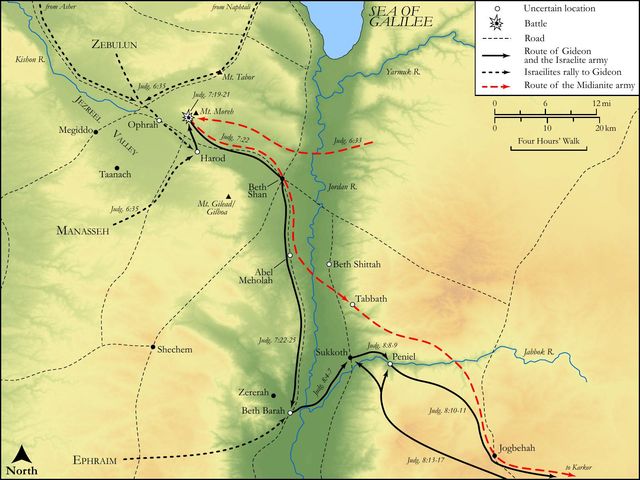
See on the biblical-era map

Study this verse
Public-domain commentary
Matthew Henry
From his Commentary on the Whole Bible. Henry comments on passages, not single verses — this entry covers Judges 6:25–32. His four-level outline is real structure in the source text, so it is rendered as structure.
Here, I. Orders are given to Gideon to begin his government with the reformation of his father's house, Jdg 6:25, Jdg 6:26. A correspondence being settled between God and Gideon, by the appearance of the angel to him, it was kept up in another way; the same night after he had seen God, when he was full of thoughts concerning what had passed, which probably he had not yet communicated to any, The Lord said unto him in a dream, Do so and so. Note, God's visits, if gratefully received, shall be graciously repeated. Bid God welcome, and he will come again. Gideon is appointed, 1. To throw down Baal's altar, which it seems hi father had, either for his own house or perhaps for the whole town. See the power of God's grace, that he could raise up a reformer, and the condescensions of his grace, that he would raise up a deliverer, out of the family of one that was a ring-leader in idolatry. But Gideon must not now think it enough not to worship at that altar, which we charitably hope he had not done, but he must throw it down; not consecrate the same altar to God (tit is bishop Hall's observation), but utterly demolish it. God first commands down the monuments of superstition, and then enjoins his own service. He must likewise cut down the grove that was by it, the plantation of young trees, designed to beautify the place. The learned bishop Patrick, by the grove, understands the image in the grove, probably the image of Ashtaroth (for the word for a grove is Ashereh), which stood upon or close by the altar. 2. The erect an altar to God, to Jehovah his God, which probably was to be notified by an inscription upon the altar to that purport - to Jehovah, Gideon's God, or Israel's. It would have been an improper thing for him to build an altar, even to the God of Israel, especially for burnt-offering and sacrifice, and would have been construed into a contempt of the altar at Shiloh, if God, who has not tied up himself to his own laws, had not bidden him to do it. But now it was his duty and honour to be thus employed. God directs him to the place where he should build it, on the top of the rock, perhaps in the same place in which the angel had appeared to him, near to the altar he had already built: and he must not do it in a hurry, but with the decency that became a religious action (in an orderly manner, as it is in the margin), according to the ancient law for altars raised on particular occasions, that they must be of earth not of hewn stone. The word here used for the rock on which the altar was to be built signifies a fortress, or strong-hold, erected, some think, to secure them from the Midianites; if so, it was no security while the altar of Baal was so near it, but it was effectually fortified when an altar to the Lord was built on the top of it, for that is the best defence upon our glory. On this altar, (1.) He was to offer sacrifice. Two bullocks he must offer: his father's young bullock, and the second bullock of seven years old, so it should rather be read, not even the second as we read it. The former, we may suppose, he was to offer for himself, the latter for the sins of the people whom he was to deliver. It was requisite he should thus make peace with God, before he made war on Midian. Till sin be pardoned through the great sacrifice, no good is to be expected. These bullocks, it is supposed, were intended for sacrifices on the altar of Baal, but were now converted to a better use. Thus, when the strong man armed is overcome and dispossessed, the stronger than he divides the spoil, seizes that for himself which was prepared for Baal. Let him come whose right it is, and give it to him. (2.) Ball's grove, or image, or whatever it was that was the sanctity or beauty of his altar, must not only be burnt, but must be used as fuel for God's altar, to signify not only that whatever sets up itself in opposition to God shall be destroyed, but that the justice of God will be glorified in its destruction. God ordered Gideon to do this, [1.] To try his zeal for religion, which it was necessary he should give proofs of before he took the field, to give proof of his valour there. [2.] That some steps might hereby to taken towards Israel's reformation, which must prepare the way for their deliverance. Sin, the cause, must be taken away, else how should the trouble, which was but the effect, come to an end? And it might be hoped that this example of Gideon's, who was now shortly to appear so great a man, would be followed by the rest of the cities and tribes, and the destruction of this one altar of Baal would be the destruction of many.
II.Gideon was obedient to the heavenly vision, Jdg 6:27.
He that was to command the Israel of God must be subject to the God of Israel, without disputing, and, as a type of Christ, must first save his people from their sins, and then save them from their enemies.
1.He had servants of his own, whom he could confide in, who, we may suppose, like him, had kept their integrity, and had not bowed the knee to Baal, and therefore were forward to assist him in destroying the altar of Baal.
2.He did not scruple taking his father's bullock and offering it to God without his father's consent, because God, who expressly commanded him to do so, had a better title to it than his father had, and it was the greatest real kindness he could do to his father to prevent his sin.
3.He expected to incur the displeasure of his father's household by it, and the ill-will of his neighbours, yet he did it, remembering how much it was Levi's praise that, in the cause of God, he said to his father and mother, I have not seen him, Deu 33:9. And, while he was sure of the favour of God, he feared not the anger of men; he that bade him do it would bear him out. Yet,
4.Though he feared not their resentment when it was done, to prevent their resistance in the doing of it he prudently chose to do it by night, that he might not be disturbed in these sacred actions. And some think it was the same night in which God spoke to him to do it, and that, as soon as ever he had received the orders, he immediately applied himself to the execution of them, and finished before morning.
III.He was brought into peril of his life for doing it, Jdg 6:28-30.
1.It was soon discovered what was done. Gideon, when he had gone through with the business, did not desire the concealment of it, nor could it be hid, for the men of the city rose early in the morning, as it should seem, to say their matins at Baal's altar, and so to begin the day with their god, such a one as he was, a shame to those who say the true God is their God, and yet, in the morning, direct no prayer to him, nor look up.
2.It was soon discovered who had done it. Strict enquiry was made. Gideon was known to be disaffected to the worship of Baal, which brought him into suspicion, and positive proof immediately came against him: "Gideon, no doubt, has done this thing." 3. Gideon being found guilty of the fact, to such a pitch of impiety had these degenerate Israelites arrived that they take it for law he must die for the same, and require his own father (who, by patronising their idolatry, had given them too much cause to expect he would comply with them herein) to deliver him up: Bring out thy son, that he may die. Be astonished, O heavens! at this, and tremble, O earth! By the law of God the worshippers of Baal were to die, but these wicked men impiously turn the penalty upon the worshippers of the God of Israel. How prodigiously mad were they upon their idols! Was it not enough to offer the choicest of their bullocks to Baal, but must the bravest youth of their city fall as a sacrifice to that dunghill-deity, when they pretended he was provoked? How soon will idolaters become persecutors!
IV.He was rescued out of the hands of his persecutors by his own father, Jdg 6:31.
1.There were those that stood against Gideon, that not only appeared at the first to make a demand, but insisted on it, and would have him put to death. Notwithstanding the heavy judgments they were at this time under for their idolatry, yet they hated to be reformed, and walked contrary to God even when he was walking contrary to them.
2.Yet then Joash stood for him; he was one of the chief men of the city. Those that have power may do a great deal for the protection of an honest man and an honest cause, and when they so use their power they are ministers of God for good.
(1.)This Joash had patronised Baal's altar, yet now protects him that had destroyed it,
[1.]Out of natural affection to his son, and perhaps a particular esteem for him as a virtuous, valiant, valuable, young man, and never the worse for not joining with him in the worship of Baal. Many that have not courage enough to keep their integrity themselves yet have so much conscience left as makes them love and esteem those that do. If Joash had a kindness for Baal, yet he had a greater kindness for his son. Or,
[2.]Out of a care for the public peace. The mob grew riotous, and, he feared, would grow more so, and therefore, as some think, he bestirred himself to repress the tumult: "Let it be left to the judges; it is not for you to pass sentence upon any man;" he that offers it, let him be put to death: he means not as an idolater, but as a disturber of the peace, and the mover of sedition. Under this same colour Paul was rescued at Ephesus from those that were as zealous for Diana as these were for Baal, Act 19:40. Or,
[3.]Out of a conviction that Gideon had done well. His son, perhaps, had reasoned with him, or God, who has all hearts in his hands, had secretly and effectually influenced him to appear thus against the advocates for Baal, though he had complied with them formerly in the worship of Baal. Note, It is good to appear for God when we are called to it, though there be few or none to second us, because God can incline the hearts of those to stand by us from whom we little expect assistance. Let us do our duty, and then trust God with our safety.
(2.)Two things Joash urges: - [1.] That it was absurd for them to plead for Baal. "Will you that are Israelites, the worshippers of the one only living and true God, plead for Baal, a false god? Will you be so sottish, so senseless? Those whose fathers' god Baal was, and who never knew any other, are more excusable in pleading for him than you are, that are in covenant with Jehovah, and have been trained up in the knowledge of him. You that have smarted so much for worshipping Baal, and have brought all this mischief and calamity upon yourselves by it, will you yet plead for Baal?" Note, It is bad to commit sin, but it is great wickedness indeed to plead for it, especially to plead for Baal, that idol, whatever it is, which possesses that room in the heart which God should have. [2.] That it was needless for them to plead for Baal. If he were not a god, as was pretended, they could have nothing to say for him; if he were, he was able to plead for himself, as the God of Israel had often done by fire from heaven, or some other judgment against those who put contempt upon him. Here is a fair challenge to Baal to do either good or evil, and the result convinced his worshippers of their folly in praying to one to help them that could not avenge himself; after this Gideon remarkably prospered, and thereby it appeared how unable Baal was to maintain his own cause.
(3.)Gideon's father hereupon gave him a new name (Jdg 6:32); he called him Jerubbaal: "Let Baal plead; let him plead against him if he can; if he have any thing to say for himself against his destroyer, let him say it." This name was a standing defiance to Baal: "Now that Gideon is taking up arms against the Midianites that worship Baal, let him defend his worshippers if he can." It likewise gave honour to Gideon (a sworn enemy to that great usurper, and that had carried the day against him), that encouragement to his soldiers, that they fought under one that fought for God against this great competitor with him for the throne. It is the probable conjecture of the learned that that Jerombalus whom Sanchoniathon (one of the most ancient of all the heathen writers) speaks of as a priest of the god Jao (a corruption of the name Jehovah), and one to whom he was indebted for a great deal of knowledge, was this Jerubbaal. He is called Jerubbesheth (Sa2 11:12), Baal, a lord, being fitly turned into Besheth, shame.
Continue studying Judges 6:31 across the web’s major study libraries — every link below opens this exact verse, chapter, or book on the destination site.
Read & Compare
 BibleGatewayThis verse in more than 200 translations and 70 languages.
 Bible.comThe YouVersion reader — hundreds of translations, reading plans, and highlights.
 ESV.orgCrossway's official English Standard Version reader.
 NET BibleThe NET translation with 60,000+ translators' notes on every rendering decision.
 STEP BibleTyndale House's free study tool — original text, vocabulary, and scholarly resources.
 BibliaLogos Bible Software's free web reader.
 USCCBThe New American Bible (Revised Edition) with the U.S. bishops' study notes.
Commentaries
 BibleHub CommentariesDozens of classic commentaries on this verse, gathered on one page.
 StudyLightMore than 100 commentary sets — the largest collection on the web.
 BibleRefPlain-English commentary on what this verse means, verse by verse.
 Enduring WordDavid Guzik's free commentary on this chapter, widely used by Bible teachers.
 Bible Study ToolsVerse commentary alongside Greek and Hebrew study aids.
Original Language & Research
- BibleHub InterlinearThe verse word by word — original language, transliteration, and English.
- BibleHub LexiconEvery word's original-language definition and Strong's entry.
 Blue Letter BibleDeep-study tools — Strong's numbers, concordance, and word studies.
 SefariaThe Hebrew text with Rashi and centuries of Jewish commentary.
Sermons, Hymns & Audio


TrulyRandomVerse is not affiliated with these sites and doesn’t control their content. They’re linked because they’re genuinely useful.
Summary
Judges 6:31 captures a pivotal moment of courage and theological clarity as Joash, Gideon's father, confronts an enraged mob demanding his son's life for destroying the local Baal altar. With astounding boldness, Joash challenges the very premise of their idolatry, asserting that if Baal were truly a god, he would be capable of defending himself against the desecration of his own altar. This declaration not only saves Gideon but powerfully exposes the impotence of false deities and underscores the self-sufficient sovereignty of the one true God, Yahweh.
Context
ShowHideLiterary Context
This verse immediately follows Gideon's initial act of obedience to the Lord's command. Having been called by the Angel of the Lord to deliver Israel from Midian, Gideon's first task was to cleanse his own household and community of idolatry. God specifically instructed him to tear down his father's altar to Baal and cut down the Asherah pole beside it, then build an altar to the Lord and offer a burnt offering using the wood of the Asherah pole and a bull from his father's herd, as detailed in Judges 6:25-27. Gideon, fearing his household and the men of the city, carried out this daring act under the cover of night. The discovery the next morning ignited the fury of the townspeople, who recognized Gideon's handiwork and demanded his life. Joash's unexpected and courageous intervention in this verse marks a turning point, not only for Gideon but potentially for Joash's own spiritual allegiance, setting the stage for Gideon's subsequent actions in Judges 7.
Historical & Cultural Context
The period of the Judges (c. 1375–1050 BC) was characterized by a cyclical pattern of apostasy, oppression, repentance, and deliverance. After the conquest, Israel often failed to fully dispossess the Canaanites, leading to syncretism—the blending of Yahwistic worship with Canaanite religious practices, particularly the worship of Baal and Asherah. Baal was the Canaanite storm and fertility god, believed to control rain, crops, and livestock, making his worship highly appealing in an agrarian society. Asherah was his consort, a goddess of fertility. These cults often involved ritual prostitution and, at times, child sacrifice, directly opposing Yahweh's commands. The townspeople's violent reaction to the destruction of Baal's altar highlights the deep entrenchment of Baal worship in Israelite society, even among those who nominally identified as Israelites. Joash's challenge, therefore, was not merely a family defense but a direct confrontation with the dominant religious and cultural norms of his community, reflecting the pervasive spiritual compromise of the era described throughout the book of Judges.
Key Themes
ShowHideJudges 6:31 powerfully articulates several key themes. Foremost is the impotence of idols contrasted with the sovereignty of the true God. Joash's rhetorical question exposes the absurdity of worshipping a deity incapable of defending itself, echoing later prophetic critiques of idolatry (e.g., Isaiah 44:9-20 and Psalm 115:4-7). This moment also highlights courage and conviction, as Joash, likely a participant in Baal worship himself, undergoes a dramatic shift, risking his life to defend his son and the Lord's honor. His declaration also foreshadows the broader theme of divine vindication, where God ultimately proves His power and truth, often through unexpected human instruments, as seen throughout the book of Judges and in later narratives like 1 Kings 18, where Elijah challenges the prophets of Baal.
Exposition and Analysis
ShowHideKey Word Analysis
ShowHideThis term, meaning "lord" or "master," was the common name for the chief Canaanite deity associated with storm, fertility, and kingship. In the context of Israel's apostasy, "Baal" became synonymous with idolatry and the worship of false gods. Joash's direct reference to "Baal" is not merely naming a deity but challenging the very concept of a god who requires human intervention and defense, contrasting sharply with the self-sufficient, omnipotent God of Israel.
The verb rîyb signifies "to contend," "to strive," "to argue a legal case," or "to go to court." Joash's repeated use of this word is highly significant. He is not merely asking if they will speak for Baal, but if they will litigate on his behalf, acting as his legal advocates in a divine courtroom. This imbues the challenge with a legal and judicial weight, implying that if Baal is truly a god, he should be able to present his own case and defend his own honor, rather than relying on human defense. The implication is that Baal has no case, no power, and no true existence as a deity.
This plural noun can refer to "gods in the ordinary sense" or, with the article, to the supreme God of Israel. Joash's use of "god" (without the article, suggesting a generic sense of deity) in his challenge "if he [be] a god" underscores the fundamental criterion for divinity: inherent power and self-sufficiency. By inviting Baal to "plead for himself," Joash implicitly contrasts Baal's impotence with the true nature of ʼĕlôhîym—the living God who is capable of mighty acts and requires no human defense.
Verse Breakdown
ShowHide"And Joash said unto all that stood against him"
This phrase dramatically sets the scene. Joash, Gideon's father, steps forward to address the enraged mob of townspeople who are demanding Gideon's death. This is a moment of profound personal risk and a surprising display of courage, as Joash was previously implicated in the very idolatry Gideon was commanded to dismantle. His intervention shifts the focus from Gideon's actions to the nature of the deity they are defending.
"Will ye plead for Baal? will ye save him?"
These are powerful rhetorical questions, designed not to elicit an answer but to expose the absurdity and futility of the mob's position. Joash challenges their dedication to a deity that appears utterly helpless. The use of "plead" (rîyb) suggests a legal defense, implying that Baal is on trial and needs human advocates. The follow-up, "will ye save him?", further highlights Baal's perceived weakness and dependence on his worshippers, a stark contrast to the true God who saves His people and needs no saving Himself.
"he that will plead for him, let him be put to death whilst [it is yet] morning:"
Joash escalates the stakes dramatically, issuing a direct challenge that implies anyone who attempts to defend Baal should face the ultimate penalty. The phrase "whilst it is yet morning" emphasizes the immediacy and decisiveness of his judgment, daring anyone to step forward and prove their conviction. This is a bold and dangerous move, effectively silencing the mob through intimidation and a reversal of their own death threats, demonstrating a newfound resolve or a deeper, latent conviction.
"if he [be] a god, let him plead for himself, because [one] hath cast down his altar."
This is the theological crux of Joash's argument and the powerful climax of his challenge. He asserts the fundamental principle that a true god possesses inherent power and self-sufficiency. If Baal is genuinely divine, he should be able to demonstrate his power by defending his own property and honor. The fact that his altar was easily destroyed by a single individual (Gideon) without any divine retaliation serves as irrefutable evidence of his impotence and non-existence as a true deity. This statement is a profound declaration of Yahweh's unique sovereignty and the utter void of idols.
Literary Devices
ShowHideJudges 6:31 is rich with Rhetorical Questions, particularly "Will ye plead for Baal? will ye save him?" and "if he [be] a god, let him plead for himself." These questions are not posed to elicit information but to provoke critical thought, expose the irrationality of the mob's position, and underscore the central theological point: a true god does not need human defense. The verse also employs profound Irony and Dramatic Irony. The townspeople believe Baal is powerful and worthy of their wrath, yet Joash reveals the irony that their "god" is so weak he cannot even defend his own altar. The dramatic irony lies in the audience's knowledge that Yahweh, not Baal, is the true sovereign, making the mob's devotion to a powerless idol all the more futile. Furthermore, there is a strong element of Antithesis, contrasting the perceived need for human defense of Baal with the inherent self-sufficiency and power of the true God. Joash's challenge forces the mob to confront the logical inconsistency and spiritual bankruptcy of their idolatry.
Theological and Thematic Connections
ShowHideJoash's audacious declaration in Judges 6:31 serves as a profound theological statement on the nature of true deity versus the futility of idolatry. It encapsulates the core biblical teaching that God is self-existent, self-sufficient, and utterly sovereign, requiring no human defense or assistance to prove His power or vindicate His name. Idols, by contrast, are lifeless creations, dependent on human hands for their existence and human voices for their defense. This moment highlights Israel's ongoing struggle with syncretism and the constant temptation to worship created things rather than the Creator. Joash's challenge forces a confrontation with the logical and spiritual bankruptcy of such worship, pointing towards the exclusive claim of Yahweh as the only living and true God, who alone is worthy of worship and capable of delivering His people.
Reflection and Application
ShowHideJoash's courageous stand in Judges 6:31 offers powerful and enduring lessons for believers today. In a world saturated with distractions and competing allegiances, we are constantly faced with "modern Baals"—anything that demands our ultimate devotion, promises ultimate satisfaction, or subtly usurps God's rightful place in our lives. These can manifest as materialism, career ambition, self-worship, comfort, or even political ideologies. Joash's challenge compels us to examine our own hearts and communities, asking whether we are inadvertently "pleading for" or "saving" idols that cannot truly help themselves or us. His example calls us to cultivate a similar courage and conviction, to stand for God's truth even when it is unpopular or puts us at odds with prevailing cultural norms. Ultimately, this verse reminds us that the true God is fully capable of defending His own name, His truth, and His people. Our role is not to "save" God, but to faithfully serve Him, trusting in His sovereign power to vindicate Himself and His purposes in the world, knowing that He alone is worthy of our complete allegiance.
Questions for Reflection
ShowHideFAQ
ShowHideWhy was Joash's response so surprising and courageous?
ShowHideJoash's response was surprising because he was Gideon's father and had a Baal altar on his property, suggesting he was either a participant in or at least tolerant of Baal worship. For him to suddenly turn against the enraged mob, risk his own life, and publicly challenge the efficacy of their god demonstrated a profound and unexpected shift in allegiance or conviction. It was courageous because he was confronting an angry, armed mob who sought to kill his son, and by extension, him for defending Gideon. His willingness to defy the prevailing religious and social norms, and to stake his life on the impotence of Baal, marked a pivotal moment of faith and conviction. This act not only saved Gideon but also publicly declared the supremacy of Yahweh over the false gods of Canaan, echoing the later prophetic confrontations like Elijah on Mount Carmel.
What does this event tell us about the nature of true God versus idols?
ShowHideThis event profoundly illustrates the fundamental difference between the living God and lifeless idols. Joash's rhetorical challenge, "if he [be] a god, let him plead for himself," highlights that true divinity is characterized by inherent power, self-sufficiency, and the ability to act independently. Idols, by contrast, are inanimate objects, created by human hands, requiring human defense, and utterly incapable of self-preservation or intervention. The fact that Baal's altar was easily destroyed without any divine retaliation proves his impotence. This contrasts sharply with the God of Israel, who demonstrates His power through mighty acts, defends His people, and needs no human assistance to prove His existence or sovereignty. The event serves as a powerful reminder of the biblical truth that "the Lord is the true God; he is the living God and the everlasting King" (Jeremiah 10:10).
Christ-Centered Fulfillment
ShowHideJoash's bold challenge to Baal's impotence in Judges 6:31 finds its ultimate fulfillment in the person and work of Jesus Christ. While Joash dared the false god to defend himself, Jesus, the true God incarnate, needed no defense, for He perfectly revealed the Father and decisively defeated all spiritual "Baals"—sin, death, and the powers of darkness. The ultimate test of a "god" is their ability to overcome death, and unlike Baal, who could not defend his altar, Christ willingly laid down His life and then powerfully took it up again, demonstrating His divine authority and self-sufficiency (John 10:18). Through His crucifixion, Jesus dismantled the altars of sin and idolatry, and through His resurrection, He proved Himself to be the living God, the true Lord who needs no human "pleading" or "saving." He is the one who pleads for us as our advocate (1 John 2:1) and saves us from our sins (Matthew 1:21). The victory of Christ on the cross and His subsequent resurrection serve as the definitive answer to Joash's challenge, revealing the true God who not only defends His own name but also actively vindicates and redeems His people, calling all to worship Him alone, for He is the one "in whom we live and move and have our being" (Acts 17:28).