


Judges 19:17
- וַיִּשָּׂאvai·yi·Sa'and he lifted upH5375Conj-w ¦ V-Qal-ConsecImperf-3msVerb Qal Consecutive Imperfect 3rd Singular Masculineוַandיִּשָּׂאhe lifted up
- עֵינָיו'ei·Navhis eyesH5869N-fdc ¦ 3msNoun Dual Feminine Constructעֵינָיeyesוhis
- וַיַּרְאvai·Yar'and he sawH7200Conj-w ¦ V-Qal-ConsecImperf-3msVerb Qal Consecutive Imperfect 3rd Singular Masculineוַandיַּרְאhe saw
- אֶת'et<obj.>H853DirObjMParticle Object Indicator
- הָאִישׁha·'Ishthe manH376Art ¦ N-msNoun Singular Masculine Absoluteהָtheאִישׁman
- הָאֹרֵחַha·'o·Re·achwho was travelingH732Art ¦ V-Qal-Prtcpl-msVerb Qal Participle Singular Masculine Absoluteהָwhoאֹרֵחַwas traveling
- בִּרְחֹבbir·Choin [the] open square ofH7339Prep-b ¦ N-fscNoun Singular Feminine Constructבִּinרְחֹב[the] open square of
- הָעִירha·'Irthe cityH5892Art ¦ N-fsNoun Singular Feminine Absoluteהָtheעִירcity
- וַיֹּאמֶרvai·Yo·merand he saidH559Conj-w ¦ V-Qal-ConsecImperf-3msVerb Qal Consecutive Imperfect 3rd Singular Masculineוַandיֹּאמֶרhe said
- הָאִישׁha·'Ishthe manH376Art ¦ N-msNoun Singular Masculine Absoluteהָtheאִישׁman
- הַזָּקֵןha·za·Ken<the> oldH2205Art ¦ Adj-msAdjective Singular Masculine Absoluteהַ<the>זָּקֵןold
- אָנָה'A·nahwhere?H575InterrogParticle Interrogative
- תֵלֵךְte·Lekhare you goingH1980V-Qal-Imperf-2msVerb Qal Imperfect 2nd Singular Masculine
- וּמֵאַיִןu·me·'A·yinand from where?H370Conj-w ¦ Prep-m ¦ InterrogParticle Interrogativeוּandמֵfromאַיִןwhere?
- תָּבוֹאta·Vo'are you comingH935V-Qal-Imperf-2msVerb Qal Imperfect 2nd Singular Masculine
English is a literal word-by-word gloss of the Hebrew, not the KJV's wording. Why?
This is the original text the KJV's translators worked from — each Hebrew word with its own literal English meaning in this verse, prepared by scholars at Tyndale House, Cambridge. The KJV translates whole sentences, not word by word, so its wording differs: one Hebrew word can become several English words, and the KJV may choose “the LORD” where the gloss reads “Yahweh”. Both are faithful — they answer different questions. For the KJV's own rendering, switch to the KJV text.
Details
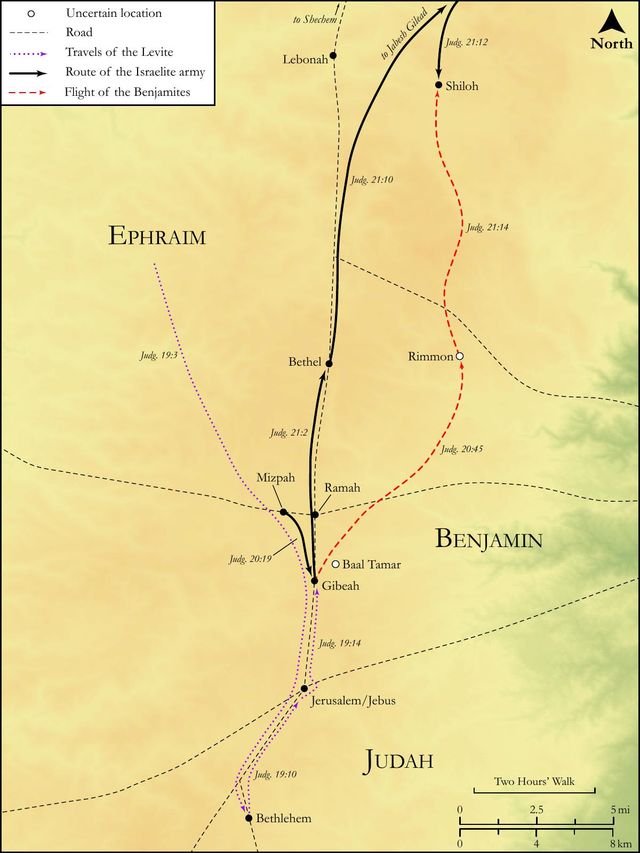
See on the biblical-era map

Study this verse
Public-domain commentary
Matthew Henry
From his Commentary on the Whole Bible. Henry comments on passages, not single verses — this entry covers Judges 19:16–21. His two-level outline is real structure in the source text, so it is rendered as structure.
Though there as not one of Gibeah, yet it proved there was one in Gibeah, that showed some civility to this distressed Levite, who was glad that any one took notice of him. It was strange that some of those wicked people, who, when it was dark, designed so ill to him and his concubine, did not, under pretence of kindness, invite them in, that they might have a fairer opportunity of perpetrating their villany; but either they had not wit enough to be so designing, or not wickedness enough to be so deceiving. Or, perhaps, none of them separately thought of such a wickedness, till in the black and dark night they got together to contrive what mischief they should do. Bad people in confederacy make one another much worse than any of them would be by themselves. When the Levite, and his wife, and servant, were beginning to fear that they must lie in the street all night (and as good have laid in a den of lions) they were at length invited into a house, and we are here told,
I.Who that kind man was that invited them.
1.He was a man of Mount Ephraim, and only sojourned in Gibeah, Jdg 19:16. Of all the tribes of Israel, the Benjamites had most reason to be kind to poor travellers, for their ancestor, Benjamin, was born upon the road, his mother being then upon a journey, and very near to this place, Gen 35:16, Gen 35:17. Yet they were hard-hearted to a traveller in distress, while an honest Ephraimite had compassion on him, and, no doubt, was the more kind to him, when, upon enquiry, he found that he was his countryman, of Mount Ephraim likewise. He that was himself but a sojourner in Gibeah was the more compassionate to a wayfaring man, for he knew the heart of a stranger, Exo 23:9; Deu 10:19. Good people, that look upon themselves but as strangers and sojourners in this world, should for this reason be tender to one another, because they all belong to the same better country and are not at home here.
2.He was an old man, one that retained some of the expiring virtue of an Israelite. The rising generation was entirely corrupted; if there was any good remaining among them, it was only with those that were old and going off.
3.He was coming home from his work out of the field at eventide. The evening calls home labourers, Psa 104:23. But, it should seem, this was the only labourer that this evening brought home to Gibeah. The rest had given themselves up to sloth and luxury, and no marvel there was among them, as in Sodom, abundance of uncleanness, when there was among them, as in Sodom, abundance of idleness, Eze 16:49. But he that was honestly diligent in his business all day was disposed to be generously hospitable to these poor strangers at night. Let men labour, that they may have to give, Eph 4:28. It appears from Jdg 19:21 that he was a man of some substance, and yet had been himself at work in the field. No man's estate will privilege him in idleness.
II.How free and generous he was in his invitation.
He did not stay till they applied to him to beg for a night's lodging; but when he saw them (Jdg 19:17) enquired into their circumstances, and anticipated them with his kindness. Thus our good God answers before we call. Note, A charitable disposition expects only opportunity, not importunity, to do good, and will succour upon sight, unsought unto. Hence we read of a bountiful eye, Pro 22:9. If Gibeah was like Sodom, this old man was like Lot in Sodom, who sat in the gate to invite strangers, Gen 19:1. Thus Job opened his doors to the traveller, and would not suffer him to lodge in the street, Job 31:32. Observe,
1.How ready he was to give credit to the Levite's account of himself when he saw no reason at all to question the truth of it. Charity is not apt to distrust, but hopeth all things (Co1 13:7) and will not make use of Nabal's excuse for his churlishness to David, Many servants now-a-days break away from their masters, Sa1 25:10. The Levite, in his account of himself, professed that he was now going to the house of the Lord (Jdg 19:18), for there he designed to attend, either with a trespass-offering for the sins of his family, or with a peace-offering for the mercies of his family, or both, before he went to his own house. And, if the men of Gibeah had any intimation of his being bound that way, probably they would therefore be disinclined to entertain him. The Samaritans would not receive Christ because his face was towards Jerusalem, Luk 9:53. But for this reason, because he was a Levite and was now going to the house of the Lord, this good old man was the more kind to him. Thus he received a disciples in the name of a disciple, a servant of God for his Master's sake.
2.How free he was to give him entertainment. The Levite was himself provided with all necessaries (Jdg 19:19), wanted nothing but a lodging, but his generous host would be himself at the charge of his entertainment (Jdg 19:20): Let all thy wants be upon me; so he brought him into his house, Jdg 19:21. Thus God will, some way or other, raise up friends for his people and ministers, even when they seem forlorn.
Historical interpretation
Historical reception
2 surviving comments on this verse. Each one is dated, so this reads as a timeline rather than a list.
When some little progress was made, though night was threatening to come on, and they were close by the town of the Jebusites, on the slave’s request that his lord should turn aside there, he refused, because it was not a city of the children of Israel. He meant to get as far as Gibeah, which was inhabited by the people of the tribe of Benjamin. But when they arrived there was no one to receive them with hospitality, except a stranger of advanced age—when he had looked upon them he asked the Levite, “Where are you going and from where have you come?” On his answering that he was traveling and was making for Mount Ephraim and that there was no one to take him in, the old man offered him hospitality and prepared a meal.
He set out on his journey in happy spirits because he had recovered his dearly beloved wife. One servant was with him, and as day was already declining they sped on their way with swift steps. The woman rode on an ass; her husband felt no weariness, taking joy in his desire and lightening his journey with talk at times with the woman, at times with the slave. When at length they neared Jerusalem, about thirty stades away, a place inhabited then by Jebusites, the servant boy suggested that they turn into the city, especially since night makes even safe places suspect and one must guard against the uncertainties of darkness, and particularly since the inhabitants of this locality were not of the children of Israel. They should beware lest treachery be done with hostile design, for the night’s darkness is opportune enough for any tricksters to perpetrate evil. But his master did not care for the servant’s idea of seeking lodging among foreigners, since Gaba [Gibeah] and Rama, cities of Benjamin, were not far distant. His strong will overrode the servant’s suggestion, as though advice takes its value from one’s condition [of birth] rather than that through advice a lowly condition may be raised. The sun was now setting and he agreed reluctantly to go into the city [Gibeah], for he was overtaken by evening. The Gabanites lived there, unfriendly, harsh, unbearable people, who could stand anything but to receive people hospitably. Indeed, it would have been much more suitable had the Levite not sought hospitality in Gaba [Gibeah]. That his treatment be utterly offensive, he found on entering the city that there was no inn. And when he sat on the road imploring the mercy of these strangers, an old man from the fields happened to stumble on him, for evening had compelled him to leave his work in the fields at night. Seeing him, he asked where he was from and where he was going. He answered, “I came from Bethlehem of Judah, I am going to Mount Ephrem, and my wife is here with me. But I have learned that there is no one here to give hospitality and provide us a chance to rest.” He needed no food or drink for himself nor food for his flock, but they had been refused the hospitality of shelter. They had everything; only a bare lodging was needed. To this the old man kindly and calmly said, “Peace to you! Come in as my guest and fellow citizen, for I am also from the region of Mount Ephrem, and here is a lodging place; someone who lived here a long time laid its foundations.” Having received them into his home, he attentively and carefully provided for his guests and entertained them.
Continue studying Judges 19:17 across the web’s major study libraries — every link below opens this exact verse, chapter, or book on the destination site.
Read & Compare
 BibleGatewayThis verse in more than 200 translations and 70 languages.
 Bible.comThe YouVersion reader — hundreds of translations, reading plans, and highlights.
 ESV.orgCrossway's official English Standard Version reader.
 NET BibleThe NET translation with 60,000+ translators' notes on every rendering decision.
 STEP BibleTyndale House's free study tool — original text, vocabulary, and scholarly resources.
 BibliaLogos Bible Software's free web reader.
 USCCBThe New American Bible (Revised Edition) with the U.S. bishops' study notes.
Commentaries
 BibleHub CommentariesDozens of classic commentaries on this verse, gathered on one page.
 StudyLightMore than 100 commentary sets — the largest collection on the web.
 BibleRefPlain-English commentary on what this verse means, verse by verse.
 Enduring WordDavid Guzik's free commentary on this chapter, widely used by Bible teachers.
 Bible Study ToolsVerse commentary alongside Greek and Hebrew study aids.
Original Language & Research
- BibleHub InterlinearThe verse word by word — original language, transliteration, and English.
- BibleHub LexiconEvery word's original-language definition and Strong's entry.
 Blue Letter BibleDeep-study tools — Strong's numbers, concordance, and word studies.
 SefariaThe Hebrew text with Rashi and centuries of Jewish commentary.
Sermons, Hymns & Audio


TrulyRandomVerse is not affiliated with these sites and doesn’t control their content. They’re linked because they’re genuinely useful.
Summary
Judges 19:17 marks a profoundly significant and foreboding moment in one of the Bible's most disturbing narratives, introducing the interaction between a vulnerable traveling Levite and an old man in the public square of Gibeah. This seemingly innocuous exchange, where the old man inquires about the Levite's origin and destination, serves as the singular instance of human kindness offered to the exposed travelers, standing in stark contrast to the pervasive apathy and moral decay of the city's inhabitants, thereby setting the stage for the horrific acts of depravity that soon unfold and underscoring the profound spiritual crisis gripping Israel.
Context
ShowHideLiterary Context
This verse is strategically placed within the latter half of the book of Judges, a section grimly characterized by the repeated refrain, "In those days there was no king in Israel; everyone did what was right in his own eyes" (Judges 17:6 and Judges 21:25). The preceding verses (Judges 19:1-16) meticulously detail the Levite's arduous journey from Bethlehem-Judah with his concubine and servant. Having retrieved his concubine, who had previously left him, he makes a deliberate choice to bypass Jebus (the future Jerusalem), which was still under Jebusite control, opting instead for Gibeah, a city of Israelite Benjamin, hoping to find lodging for the night among his own people. The narrative pointedly emphasizes their exposed and vulnerable position in the public square, as no one initially extends the customary offer of hospitality. The old man's appearance and his inquiry in verse 17 thus emerge as the first, and tragically almost only, glimmer of human concern in a city that will swiftly reveal its profound moral corruption, leading directly into the unspeakable violence of the subsequent verses.
Historical & Cultural Context
The period of the Judges (approximately 14th-11th century BC) was defined by a decentralized tribal confederacy, marked by cycles of apostasy, oppression, and a severe lack of consistent spiritual and political leadership. Within the ancient Near East, and particularly in Israelite society, hospitality was far more than a mere social custom; it was a sacred duty, a covenantal obligation, and a vital necessity for travelers in a land without established public inns. To refuse hospitality to a stranger, especially a fellow Israelite and a Levite (a man consecrated to God's service), was considered a grave offense, indicative of a profound societal and spiritual breakdown. The scene in Gibeah, where a Levite and his company are left unattended and vulnerable in the city square at night, speaks volumes about the moral decay of the Benjaminites. This shocking lack of basic human decency and communal responsibility chillingly foreshadows the extreme depravity akin to that found in Sodom, where Lot's hospitality was similarly challenged by the city's wicked inhabitants, highlighting Israel's descent into Canaanite-like practices.
Key Themes
ShowHideJudges 19:17 subtly yet powerfully introduces several critical themes that permeate both the immediate narrative of Judges 19 and the broader book. The most prominent is the absence or perversion of hospitality, which was a cornerstone of ancient Israelite society and a tangible reflection of covenant faithfulness. The old man's inquiry, a traditional prelude to offering shelter, highlights the expected norm, while the chilling silence of the other Gibeahites underscores its tragic and dangerous absence. This directly relates to the overarching theme of moral decline and lawlessness, where the lack of a central king and the principle of "every man doing what was right in his own eyes" leads to a complete disintegration of social order, justice, and basic human decency. The vulnerability of the Levite and his companions in the public square also emphasizes the precarious position of the unprotected in a society devoid of moral compass or central authority, setting the stage for the horrific violence that ensues and illustrating the depths of Israel's spiritual and ethical apostasy.
Exposition and Analysis
ShowHideKey Word Analysis
ShowHideA primitive root meaning "to travel." In this context, it describes the Levite as a "traveler" or "sojourner." The term underscores his transient status and, by extension, his vulnerability and dependence on the hospitality of others. A "wayfaring man" was inherently exposed to the elements and potential dangers, making the community's failure to offer shelter a profound moral lapse.
Meaning "a width, i.e. (concretely) avenue or area; broad place (way), street." This refers to the public square or open space within the city gates, often where elders would sit, judgments would be rendered, and public life would unfold. The fact that the Levite and his company were sitting there, exposed and uninvited, for an extended period, highlights the profound lack of hospitality and communal responsibility among the Gibeahites. It was a place of public interaction, yet the city offered no welcome.
A primitive root meaning "to walk (literally or figuratively); causatively, to carry." This verb, used in the old man's question "Whither goest thou?", is a fundamental inquiry about direction and purpose of travel. It is part of the customary greeting for strangers, designed not merely for curiosity but as an opening to assess the traveler's needs and extend an offer of lodging, food, and water, signaling a traditional act of care.
Verse Breakdown
ShowHide"And when he had lifted up his eyes, he saw a wayfaring man in the street of the city"
This clause establishes the old man's active observation and the Levite's exposed situation. The Levite, his concubine, and his servant are not hidden; they are in plain sight, yet conspicuously ignored by the city's other inhabitants. The old man's act of "lifting up his eyes" implies an intentional and compassionate observation, a moment of noticing where others had failed to see or care, setting him apart from the indifferent populace.
"and the old man said"
This simple yet profoundly significant phrase marks the first and only voice of concern or welcome from anyone other than the Levite's own company within Gibeah's public square. It immediately sets the old man apart from the callous and indifferent populace, positioning him as a potential source of refuge and decency in an otherwise hostile and morally bankrupt environment.
"Whither goest thou? and whence comest thou?"
These are the customary and polite questions posed to a traveler in the ancient Near East. They are not merely inquisitive but represent the crucial first step in the ritual of hospitality, designed to understand the traveler's journey, assess their needs, and facilitate an offer of shelter and sustenance. In this dire context, they represent a solitary spark of human decency and traditional values in a city otherwise consumed by moral darkness, foreshadowing the old man's eventual invitation to his home.
Literary Devices
ShowHideJudges 19:17 employs several potent literary devices to underscore the narrative's grim themes. Foreshadowing is prominent, as the city's initial lack of hospitality and the Levite's exposed vulnerability subtly hint at the extreme depravity and horrific violence that will soon erupt within Gibeah. The old man's solitary act of kindness creates a stark contrast with the callous indifference of the other Gibeahites, emphasizing the profound moral decay of the city and its inhabitants. There is also a strong sense of irony in that the only person to extend the sacred duty of hospitality is himself a sojourner, a "wayfaring man" from Ephraim (Judges 19:16), highlighting the utter failure of the native Benjaminites to uphold fundamental societal and religious norms. This scene masterfully uses these devices to build tension, underscore the pervasive moral crisis gripping Israel, and set the stage for the chapter's tragic climax.
Theological and Thematic Connections
ShowHideJudges 19:17, though brief, serves as a chilling testament to the spiritual and moral abyss into which Israel had fallen during the period of the Judges. The failure of the Gibeahites to extend basic hospitality to a fellow Israelite, particularly a Levite, reveals a profound disregard for the covenant obligations and divine commands that underpinned their national identity. Hospitality was not merely a social nicety but a reflection of God's own character and His gracious welcome to His people, rooted in the memory of their own sojourning in Egypt (Deuteronomy 10:19). The old man's singular act of kindness stands as a beacon against the backdrop of pervasive societal breakdown, illustrating that when "every man did what was right in his own eyes," the very fabric of communal life, including sacred duties like hospitality, disintegrated, paving the way for unimaginable wickedness and a complete perversion of justice.
Reflection and Application
ShowHideJudges 19:17 serves as a powerful, albeit somber, reminder of the enduring importance of hospitality and the insidious dangers of moral apathy within a community. The old man's simple act of inquiry, leading to an offer of shelter, stands in stark contrast to the chilling silence and indifference of the rest of Gibeah. This challenges us to examine our own hearts and communities: Are we quick to notice and respond to the needs of the vulnerable traveler, the stranger, or the lowly in our midst? Or do we, like the silent citizens of Gibeah, allow indifference to harden our hearts and erode the bonds of compassion and communal responsibility? The narrative implicitly calls us to cultivate a culture of genuine welcome, recognizing that true hospitality extends beyond mere politeness to a sacrificial willingness to share our resources, time, and protection. It also serves as a potent warning against the societal decay that can occur when basic human decency, covenantal obligations, and spiritual values are neglected, leading to a climate where horrific acts become not only possible but tragically inevitable. While the story is extreme, it underscores the need for constant vigilance against moral compromise and the erosion of communal responsibility.
Questions for Reflection
ShowHideFAQ
ShowHideWhy is the old man the only one to offer hospitality to the Levite?
ShowHideThe text indicates that the old man was himself a sojourner from the hill country of Ephraim, residing in Gibeah. This detail is crucial: as a fellow traveler, he likely understood the vulnerability and desperate need for shelter that the Levite and his company faced. Unlike the native inhabitants of Gibeah, who displayed a profound moral decay and disregard for the sacred duty of hospitality, the old man retained the traditional values of his upbringing. His act highlights the pervasive wickedness of Gibeah's citizens, who, despite seeing the travelers in their public square, offered no welcome, underscoring the depth of their societal and spiritual corruption.
What does this verse tell us about the state of Israel during the period of the Judges?
ShowHideThis verse, and indeed the entire narrative of Judges 19, offers a grim snapshot of the moral and spiritual anarchy that characterized Israel during the Judges period. The repeated refrain, "In those days there was no king in Israel; everyone did what was right in his own eyes" (Judges 17:6; Judges 21:25), finds its most shocking illustration here. The failure of the Gibeahites to offer hospitality, a fundamental covenant obligation, and their subsequent descent into extreme violence, demonstrates a complete breakdown of God's law, communal order, and basic human decency. It portrays a society where tribal loyalty had supplanted divine commands, leading to widespread moral depravity and a tragic perversion of justice.
Is there a parallel to Sodom in this story?
ShowHideYes, the parallels between the narrative in Judges 19 and the account of Sodom in Genesis 19 are striking and intentional. Both stories feature a traveler seeking shelter, a host (Lot in Sodom, the old man in Gibeah) who offers hospitality, and a mob of city men who demand the sexual abuse of the guests. In both cases, the host attempts to protect his guests by offering his own daughters or the concubine to the mob. These intentional parallels underscore the extreme depravity of Gibeah, likening it to one of the most infamous examples of wickedness in biblical history, and emphasizing that even within Israel, the people had fallen to a level of sin comparable to the Canaanite nations God had judged.
Christ-Centered Fulfillment
ShowHideJudges 19:17, with its stark depiction of a vulnerable traveler seeking shelter and the city's chilling indifference, finds profound resonance and ultimate fulfillment in the person and work of Jesus Christ. Jesus himself was the ultimate "wayfaring man," a divine sojourner who "had nowhere to lay his head" (Matthew 8:20). He came to His own people, Israel, yet tragically, "His own people did not receive Him" (John 1:11). The lack of hospitality shown to the Levite in Gibeah foreshadows the world's rejection of its true King, who came not to be served, but to serve and to give His life as a ransom for many (Mark 10:45). Yet, in a beautiful and redemptive reversal, Christ, the rejected sojourner, becomes the ultimate Host, inviting all who are weary and burdened to find rest in Him (Matthew 11:28). His perfect hospitality, extended to us through His atoning sacrifice on the cross, transforms us from alienated strangers and foreigners into fellow citizens with the saints and members of God's household (Ephesians 2:19). The Church, as the body of Christ, is therefore called to embody this divine hospitality, welcoming strangers and loving neighbors, reflecting the radical, self-sacrificial welcome we have received from God in Christ Jesus, who has made us His own.