


Judges 14:13
Bible text: King James Version (1769 Blayney text) · Public domain
Bible text: King James Version with Strong's numbers · Public domain
Bible text: Berean Standard Bible · Public domain
Bible text: American Standard Version (1901) · Public domain
Bible text: World English Bible, Messianic edition · Public domain
Bible text: Geneva Bible (1599) · Public domain
Bible text: Young's Literal Translation · Public domain
- וְאִםve·'imand ifH518Conj-w ¦ PrtParticle Conditionalוְandאִםif
- לֹאlo'notH3808NegParticle Negative
- תוּכְלוּtu·khe·Luyou will be ableH3201V-Qal-Imperf-2mpVerb Qal Imperfect 2nd Plural Masculine
- לְהַגִּידle·ha·Gidto tellH5046Prep-l ¦ V-Hiphil-InfVerb Hiphil Infinitive Constructלְtoהַגִּידtell
- לִיlito <the> mePrep-l ¦ 1csSuffix Personal 1st Singular common genderלִto <the>יme
- וּנְתַתֶּםu·ne·ta·Temand you will giveH5414Conj-w ¦ V-Qal-ConsecPerf-2mpVerb Qal Consecutive Perfect 2nd Plural Masculineוּandנְתַתֶּםyou will give
- אַתֶּם'a·TemyouH859Pro-2mpPronoun Personal 2nd Plural Masculine
- לִיlito <the> mePrep-l ¦ 1csSuffix Personal 1st Singular common genderלִto <the>יme
- שְׁלֹשִׁיםshe·lo·ShimthirtyH7970N-mpNoun Plural Masculine Absolute
- סְדִינִיםse·di·Nimlinen garmentsH5466N-mpNoun Plural Masculine Absolute
- וּשְׁלֹשִׁיםu·she·lo·Shimand thirtyH7970Conj-w ¦ N-mpNoun Plural Masculine Absoluteוּandשְׁלֹשִׁיםthirty
- חֲלִיפוֹתcha·li·Fotchanges ofH2487N-fpcNoun Plural Feminine Construct
- בְּגָדִיםbe·ga·DimgarmentsH899N-mpNoun Plural Masculine Absolute
- וַיֹּאמְרוּvai·Yo·me·ruand they saidH559Conj-w ¦ V-Qal-ConsecImperf-3mpVerb Qal Consecutive Imperfect 3rd Plural Masculineוַandיֹּאמְרוּthey said
- לוֹloto <the> himPrep-l ¦ 3msSuffix Personal 3rd Singular Masculineלto <the>וֹhim
- חוּדָהChu·dahask [the] riddle !H2330V-Qal-Imp-2ms ¦ SfxVerb Qal Imperative 2nd Singular Masculineחוּדָask [the] riddleה!
- חִידָתְךָchi·da·te·Khayour riddleH2420N-fsc ¦ 2msNoun Singular Feminine Constructחִידָתְriddleךָyour
- וְנִשְׁמָעֶנָּהve·nish·ma·'E·nahso we may hear itH8085Conj-w ¦ V-Qal-ConjImperf-1cp ¦ 3fsVerb Qal Conjunction+Imperfect 1st Plural common genderוְsoנִשְׁמָעֶwe may hearנָּהit
English is a literal word-by-word gloss of the Hebrew, not the KJV's wording. Why?
This is the original text the KJV's translators worked from — each Hebrew word with its own literal English meaning in this verse, prepared by scholars at Tyndale House, Cambridge. The KJV translates whole sentences, not word by word, so its wording differs: one Hebrew word can become several English words, and the KJV may choose “the LORD” where the gloss reads “Yahweh”. Both are faithful — they answer different questions. For the KJV's own rendering, switch to the KJV text.
Details
See on the biblical-era maps
Study this verse
Public-domain commentary
Matthew Henry
From his Commentary on the Whole Bible. Henry comments on passages, not single verses — this entry covers Judges 14:10–20. His two-level outline is real structure in the source text, so it is rendered as structure.
We have here an account of Samson's wedding feast and the occasion it gave him to fall foul upon the Philistines.
I.Samson conformed to the custom of the country in making a festival of his nuptial solemnities, which continued seven days, Jdg 14:10.
Though he was a Nazarite, he did not affect, in a thing of this nature, to be singular, but did as the young men used to do upon such occasions. It is no part of religion to go contrary to the innocent usages of the places where we live: nay, it is a reproach to religion when those who profess it give just occasion to others to call them covetous, sneaking, and morose. A good man should strive to make himself, in the best sense, a good companion.
II.His wife's relations paid him the accustomed respect of the place upon that occasion, and brought him thirty young men to keep him company during the solemnity, and to attend him as his grooms-men (Jdg 14:11): When they saw him, what a comely man he was, and what an ingenuous graceful look he had, they brought him these to do him honour, and to improve by his conversation while he staid among them. Or, rather, when they saw him, what a strong stout man he was, they brought these, seemingly to be his companions, but really to be a guard upon him, or spies to observe him. Jealous enough they were of him, but would have been more so had they known of his victory over the lion, which therefore he had industriously concealed. The favours of Philistines have often some mischief or other designed in them.
III.Samson, to entertain the company, propounds a riddle to them, and lays a wager with them that they cannot find it out in seven days, Jdg 14:12-14. The usage, it seems, was very ancient upon such occasions, when friends were together, to be innocently merry, not to spend all the time in dull eating and drinking, as bishop Patrick expresses it, or in other gratifications of sense, as music, dancing, or shows, but to propose questions, by which their learning and ingenuity might be tried and improved. This becomes men, wise men, that value themselves by their reason; but very unlike to it are the infamous and worse than brutish entertainments of this degenerate age, which send nothing round but the glass and the health, till reason is drowned, and wisdom sunk. Now,
1.Samson's riddle was his own invention, for it was his own achievement that gave occasion for it: Out of the eater came forth meat, and out of the strong came forth sweetness. Read my riddle, what is this? Beasts of prey do not yield meat for man, yet food came from the devourer; and those creatures that are strong when they are alive commonly smell strong and are every way offensive when they are dead, as horses, and yet out of the strong, or out of the bitter, so the Syriac and Arabic read it, came sweetness. If they had but so much sense as to consider what eater is most strong, and what meat is most sweet, they would have found out the riddle, and neither lions nor honey were such strangers to their country that the thoughts of them needed to be out of the way; and the solving of the riddle would have given him occasion to tell them the entertaining story on which it was founded. This riddle is applicable to many of the methods of divine providence and grace. When God, by an over-ruling providence, brings good out of evil to his church and people, - when that which threatened their ruin turns to their advantage, - when their enemies are made serviceable to them, and the wrath of men turns to God's praise, - then comes meat out of the eater and sweetness out of the strong. See Phi 1:12.
2.His water was more considerable to him than to them, because he was one against thirty partners. It was not a wager laid upon God's providence, or upon the chance of a die or a card, but upon their ingenuity, and amounted to no more than an honorary recompence of wit and a disgrace upon stupidity.
IV.His companions, when they could not expound the riddle themselves, obliged his wife to get from him the exposition of it, Jdg 14:15.
Whether they were really of a dull capacity, or whether under a particular infatuation at this time, it was strange that none of the thirty could in all this time stumble upon so plain a thing as that, What is sweeter than honey and what stronger than a lion? It should seem that in wit, as well as manners, they were barbarous - barbarous indeed to threaten the bride that, if she would not use means with the bridegroom to let them into the meaning of it, they would burn her and her father's house with fire. Could any thing be more brutish? It was base enough to turn a jest into earnest, and those were unworthy of conversation that would grow so outrageous rather than confess their ignorance and lose so small a wager; nor would it save their credit at all to tell the riddle when they were told it. It was yet more villainous to engage Samson's wife to be a traitor to her own husband, and to pretend a greater interest in her than he had. Now that she was married she must forget her own people. Yet most inhuman of all was it to threaten, if she could not prevail, to burn her and all her relations with fire, and all for fear of losing each of them the value of a shirt and a coat: Have you called us to take what we have? Those must never lay wagers that cannot lose more tamely and easily than thus.
V.His wife, by unreasonable importunity, obtains from him a key to his riddle.
It was on the seventh day, that is, the seventh day of the week (as Dr. Lightfoot conjectures), but the fourth day of the feast, that they solicited her to entice her husband (Jdg 14:15), and she did it,
1.With great art and management (Jdg 14:16), resolving not to believe he loved her, unless he would gratify her in this thing. She knew he could not bear to have his love questioned, and therefore, if any thing would work upon him, that would: "Thou dost but hate me, and lovest me not, if thou deniest me;" whereas he had much more reason to say, "Thou dost but hate me, and lovest me not, if thou insistest on it." And, that she might not make this the test of his affection, he assures her he had not told his own parents, notwithstanding the confidence he reposed in them. If this prevail not, she will try the powerful eloquence of tears: she wept before him the rest of the days of the feast, choosing rather to mar the mirth, as the bride's tears must needs do, than not gain her point, and oblige her countrymen, Jdg 14:17.
2.With great success. At last, being quite wearied with her importunity, he told her what was the meaning of his riddle, and though we may suppose she promised secresy, and that if he would but let her know she would tell nobody, she immediately told it to the children of her people; nor could he expect better from a Philistine, especially when the interests of her country were ever so little concerned. See Mic 7:5, Mic 7:6. The riddle is at length unriddled (Jdg 14:18): What is sweeter than honey, or a better meat? Pro 24:13. What is stronger than a lion, or a greater devourer? Samson generously owns they had won the wager, though he had good reason to dispute it, because they had not declared the riddle, as the bargain was (Jdg 14:12), but it had been declared to them. But he only thought fit to tell them of it: If you had not ploughed with my heifer, made use of your interest with my wife, you would not have found out my riddle. Satan, in his temptations, could not do us the mischief he does if he did not plough with the heifer of our own corrupt nature.
VI.Samson pays his wager to these Philistines with the spoils of others of their countrymen, Jdg 14:19.
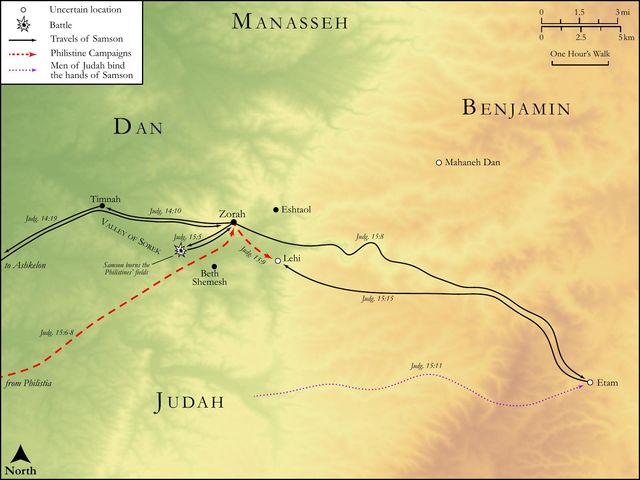
He took this occasion to quarrel with the Philistines, went down to Ashkelon, one of their cities, where probably he knew there was some great festival observed at this time, to which many flocked, out of whom he picked out thirty, slew them, and took their clothes, and gave them to those that had expounded the riddle; so that, in balancing the account, it appeared that the Philistines were the losers, for one of the lives they lost was worth all the suits of clothes they won: the body is more than raiment. The Spirit of the Lord came upon him, both to authorize and to enable him to do this.
VII.This proves a good occasion of weaning Samson from his new relations.
He found how his companions had abused him and how his wife had betrayed him, and therefore his anger was kindled, Jdg 14:19. Better be angry with Philistines than in love with them, because, when we join ourselves to them, we are most in danger of being ensnared by them. And, meeting with this ill usage among them, he went up to his father's house. It were well for us if the unkindnesses we meet with from the world, and our disappointments in it, had but this good effect upon us, to oblige us by faith and prayer to return to our heavenly Father's house and rest there. The inconveniences that occur in our way should make us love home and long to be there. No sooner had he gone than his wife was disposed of to another, Jdg 14:20. Instead of begging his pardon for the wrong she had done him, when he justly signified his resentment of it only by withdrawing in displeasure for a time, she immediately marries him that was the chief of the guests, the friend of the bridegroom, whom perhaps she loved too well, and was too willing to oblige, when she got her husband to tell her the riddle. See how little confidence is to be put in man, when those may prove our enemies whom we have used as our friends.
Continue studying Judges 14:13 across the web’s major study libraries — every link below opens this exact verse, chapter, or book on the destination site.
Read & Compare
 BibleGatewayThis verse in more than 200 translations and 70 languages.
 Bible.comThe YouVersion reader — hundreds of translations, reading plans, and highlights.
 ESV.orgCrossway's official English Standard Version reader.
 NET BibleThe NET translation with 60,000+ translators' notes on every rendering decision.
 STEP BibleTyndale House's free study tool — original text, vocabulary, and scholarly resources.
 BibliaLogos Bible Software's free web reader.
 USCCBThe New American Bible (Revised Edition) with the U.S. bishops' study notes.
Commentaries
 BibleHub CommentariesDozens of classic commentaries on this verse, gathered on one page.
 StudyLightMore than 100 commentary sets — the largest collection on the web.
 BibleRefPlain-English commentary on what this verse means, verse by verse.
 Enduring WordDavid Guzik's free commentary on this chapter, widely used by Bible teachers.
 Bible Study ToolsVerse commentary alongside Greek and Hebrew study aids.
Original Language & Research
- BibleHub InterlinearThe verse word by word — original language, transliteration, and English.
- BibleHub LexiconEvery word's original-language definition and Strong's entry.
 Blue Letter BibleDeep-study tools — Strong's numbers, concordance, and word studies.
 SefariaThe Hebrew text with Rashi and centuries of Jewish commentary.
Sermons, Hymns & Audio


TrulyRandomVerse is not affiliated with these sites and doesn’t control their content. They’re linked because they’re genuinely useful.
Summary
Judges 14:13 details the formalization of a high-stakes wager between Samson and his thirty Philistine companions during his wedding feast in Timnath. Samson proposes that if they fail to solve his riddle within the seven days of the feast, they must provide him with thirty fine linen garments and thirty changes of festive apparel. Conversely, if they succeed, he is bound to give them the same. This challenge, rooted in Samson's unique experience and cunning, establishes a significant point of tension and sets the stage for the escalating conflict and deception that characterize this pivotal episode in the narrative of Samson's interactions with the Philistines.
Context
ShowHideLiterary Context
Judges 14:13 is embedded within the tumultuous narrative of Samson, a Nazirite whose life, though divinely purposed for Israel's deliverance, is consistently marked by personal impulsiveness and entanglement with the Philistines. The immediate context is Samson's wedding feast in Timnah, a union with a Philistine woman that directly contravenes God's commands against intermarriage for Israel (Deuteronomy 7:3-4). Earlier in the chapter, Samson's encounter with a lion and his subsequent discovery of honey within its carcass (Judges 14:5-9) provide the secret basis for the riddle he poses in Judges 14:12. This verse, Judges 14:13, explicitly lays out the conditions of the wager. The narrative then unfolds with the Philistines' inability to solve the riddle, their coercive tactics against Samson's wife (Judges 14:15-17), and Samson's violent retaliation, which ultimately leads to the breakdown of his marriage and further conflict with the Philistines (Judges 14:19-20).
Historical & Cultural Context
The custom of posing riddles at feasts was a widespread and popular form of entertainment and intellectual competition among the nations round about, often accompanied by significant wagers. Samson's participation in this tradition, particularly with his Philistine "companions" (who were likely young men provided by his father-in-law as customary attendants for the groom), highlights the complex cultural intermingling and underlying tension between the Israelites and their Philistine overlords during the period of the Judges. The value of the wager—"thirty sheets and thirty change of garments"—was substantial, indicating considerable wealth. Such garments were not merely utilitarian; they were symbols of status, prosperity, and social standing. Linen was a costly material, and "changes of garments" implied multiple sets of fine, festive attire. This context underscores that the stakes were not just intellectual pride, but also significant financial burden and public honor within Israelite society.
Key Themes
ShowHideThis verse significantly contributes to several overarching themes within the book of Judges and the Samson narrative. Firstly, it accentuates Samson's flawed character and his repeated tendency to operate according to his own desires and cunning rather than strict adherence to his Nazirite vows or divine guidance. His engagement with the Philistines, even in a social setting, reflects a pattern of compromise. Secondly, it vividly portrays the ongoing conflict and oppression Israel faced from the Philistines; what begins as a social game quickly escalates into a power struggle, demonstrating the pervasive nature of this antagonism. Thirdly, the episode introduces and develops the theme of deception and betrayal, which becomes a dominant motif throughout Samson's life, foreshadowing the ultimate treachery by Delilah. Finally, the high stakes of the wager underscore the theme of consequences for choices, illustrating how Samson's actions, though clever, often lead to unintended and destructive outcomes, further complicating his role as a divinely appointed deliverer for Israel (Judges 13:5).
Exposition and Analysis
ShowHideKey Word Analysis
ShowHideFrom the root chûwd (H2330), meaning "to tie a knot" or "to propound a riddle," chîydâh (H2420) refers to a puzzle, conundrum, or dark saying. It implies something obscure, difficult to understand, or requiring keen insight to decipher. In this context, it is an intellectual challenge designed to test the wit and knowledge of the listeners, often with a hidden meaning known only to the proposer.
This term (H5466) refers to fine linen garments, often worn as outer wraps or undergarments. Linen was a highly valued commodity in Israel and in Egypt, requiring extensive labor to cultivate and weave. Possessing thirty such garments would signify considerable wealth and luxury, far beyond mere utilitarian clothing, indicating a high-quality, perhaps even ceremonial, textile.
The word chălîyphâh (H2487), derived from a root meaning "to alternate," signifies an alternation or a complete set. When paired with "garments" (H899, beged), it specifically refers to a full set of festive or ceremonial clothing, implying a change of attire for special occasions. These were not everyday clothes but rather valuable, often ornate, outfits reserved for significant events, further emphasizing the substantial value of the wager.
Verse Breakdown
ShowHide"But if ye cannot declare [it] me"
This clause establishes the condition for the Philistines' failure to solve the riddle. "Declare it me" (from H5046, nâgad) means to make known, explain, or announce the solution to Samson's satisfaction. It implies a demand for a clear and correct interpretation of the hidden meaning within the riddle, setting a high bar for their intellectual prowess.
"then shall ye give me thirty sheets and thirty change of garments."
This specifies the immense consequence of their failure. Samson's demand for thirty fine linen garments and thirty complete sets of festive attire highlights the extraordinary value of the wager. This substantial prize serves not only as material gain but also as a public symbol of his intellectual victory and their defeat, underscoring his confidence in the riddle's insolubility without insider knowledge.
"And they said unto him, Put forth thy riddle, that we may hear it."
This response indicates the Philistine companions' acceptance of the terms. "Put forth thy riddle" (from H2330, chûwd) is an eager invitation for Samson to present the challenge. Their collective voice ("they said") suggests a unified agreement to the high stakes, demonstrating their initial confidence or perhaps their underestimation of the riddle's difficulty, thereby binding them to the costly wager. This sets the immediate stage for Samson to reveal the riddle in Judges 14:14.
Literary Devices
ShowHideJudges 14:13 is rich with literary devices that amplify the narrative's tension and thematic depth. The entire interaction is framed as a Wager/Contest, a classic narrative trope that propels the plot forward by creating clear stakes and opposition. This verse specifically formalizes the terms of this intellectual battle. There is significant Foreshadowing at play; the exorbitant demand for garments, coupled with the Philistines' acceptance, subtly hints at the desperate and deceitful measures they will resort to in order to avoid payment, directly leading to the coercion of Samson's wife and subsequent violence. The situation is also imbued with Irony, as Samson, chosen by God to deliver Israel from Philistine oppression, is here engaging in a social contest that ultimately deepens the conflict rather than resolving it. Furthermore, the "thirty sheets and thirty change of garments" function as powerful Symbolism of wealth, status, and the high cost of the deception and betrayal that will soon unfold within the narrative.
Theological and Thematic Connections
ShowHideJudges 14:13, though detailing a seemingly mundane social custom, carries profound theological implications. It underscores the pervasive theme in Judges of Israel's spiritual decline and the dire consequences of compromising with the pagan nations round about. Samson's choice to marry a Philistine woman and engage in this culturally ambiguous contest reflects a broader pattern of Israel's failure to maintain their distinct identity and purity as God's chosen people. This compromise leads not to liberation, but to entanglement and further oppression. The high stakes of the riddle serve as a microcosm for the larger spiritual battle: Samson's reliance on his own cunning rather than divine wisdom, and the Philistines' eventual resort to deceit, vividly illustrate the destructive nature of human pride and unrighteousness. This episode highlights the dangers of being "unequally yoked" (2 Corinthians 6:14) and the inevitable conflict that arises when God's people compromise their distinct identity for worldly gain or acceptance, ultimately leading to a harvest of negative consequences.
Reflection and Application
ShowHideJudges 14:13 serves as a powerful reminder that even seemingly innocuous social engagements can carry profound spiritual and practical consequences, especially when we compromise our values or align ourselves with those who do not share our commitment to truth and integrity. Samson's cleverness, though impressive, was ultimately self-serving and led to a cycle of deceit and violence rather than genuine deliverance or peace. For believers today, this passage challenges us to critically examine our motivations in competitive situations and our willingness to engage in "games" where the rules of integrity might be bent or where our witness for Christ could be compromised. It highlights the crucial importance of seeking and applying divine wisdom, not just human cunning, in our dealings, recognizing that true wisdom comes from God and leads to life and righteousness, not further entanglement or destructive outcomes. The story of Samson reminds us that even divinely gifted individuals can fall prey to their own desires and pride, leading to painful and far-reaching consequences. We are called to live with discernment, understanding that our choices, particularly in relationships and challenges, have ripple effects that impact not only ourselves but also those around us and our ultimate testimony for God.
Questions for Reflection
ShowHideFAQ
ShowHideWhy was the wager so valuable?
ShowHideThe wager of "thirty sheets and thirty change of garments" was extraordinarily valuable in ancient times because these items represented significant wealth, status, and luxury. "Sheets" (Hebrew sadîn) referred to fine linen garments, which were costly to produce due to the labor-intensive process of cultivating flax and weaving the fabric. "Change of garments" (Hebrew ḥălîpôt bĕgādîm) denoted complete sets of festive or ceremonial clothing, not everyday wear, but reserved for special occasions. Owning multiple sets of such high-quality apparel was a clear indicator of affluence and social standing. Samson's demand for such a large quantity underscored the immense difficulty of his riddle and his absolute confidence in its insolubility without insider knowledge, making the potential loss a considerable financial burden for the Philistines. This high value also served to heighten the dramatic tension and pressure on the Philistines to solve the riddle, ultimately leading to their desperate and deceitful measures later in the chapter (Judges 14:15).
Why did Samson propose a riddle at his wedding feast?
ShowHideProposing riddles at feasts was a common custom in Israel and among the nations round about, serving as a popular form of entertainment and an intellectual contest. Samson, known for his extraordinary strength and cunning, utilized this tradition to challenge his thirty Philistine companions. His riddle was based on a unique and personal experience—his encounter with a lion and the subsequent discovery of honey within its carcass (Judges 14:8-9)—making it virtually impossible to solve without direct, privileged knowledge of his secret. By proposing such a riddle with a high-stakes wager, Samson was asserting his dominance and wit over the Philistines, who were oppressing Israel at the time. It was a personal challenge, a display of intellectual superiority, and a strategic move that, while seemingly social, ultimately escalated the deep-seated conflict between him and his Philistine adversaries, setting the stage for further acts of judgment and retaliation.
Christ-Centered Fulfillment
ShowHideWhile Judges 14:13 details a moment of human cunning and a high-stakes wager, it subtly points to the ultimate "riddle" and "wager" fulfilled in Christ. Samson, though a flawed and often self-serving deliverer, foreshadows the one true Deliverer who would conquer the enemy and pay the ultimate price. Just as Samson's riddle was unsolvable by human wisdom alone, the mystery of God's redemptive plan was hidden for ages but has been gloriously revealed in Christ (Ephesians 3:9-10). The "wager" in Judges 14:13 involved material garments, but Christ's victory involved the shedding of His own garments and blood, ultimately securing for us the "garments of salvation" and the "robe of righteousness" (Isaiah 61:10). Unlike Samson, whose cunning led to further conflict and personal ruin, Jesus, the true wisdom of God (1 Corinthians 1:24), perfectly fulfilled the Father's will, not through a riddle that traps and condemns, but through a truth that liberates (John 8:32). His life, sacrificial death, and glorious resurrection represent the ultimate triumph over sin, death, and the powers of darkness, a victory freely given to all who believe, far surpassing any earthly wager or material gain (Romans 5:8).