


Judges 13:13
Bible text: King James Version (1769 Blayney text) · Public domain
Bible text: Berean Standard Bible · Public domain
Bible text: American Standard Version (1901) · Public domain
Bible text: World English Bible, Messianic edition · Public domain
Bible text: Geneva Bible (1599) · Public domain
Bible text: Young's Literal Translation · Public domain
- וַיֹּאמֶרvai·Yo·merand he saidH559Conj-w ¦ V-Qal-ConsecImperf-3msVerb Qal Consecutive Imperfect 3rd Singular Masculineוַandיֹּאמֶרhe said
- מַלְאַךְmal·'Akh[the] angel ofH4397N-mscNoun Singular Masculine Construct
- יְהוָהYah·wehYahwehH3068N-properNoun Proper Title
- אֶל'eltoH413PrepPreposition
- מָנוֹחַma·No·achManoahH4495N-proper-mNoun Proper Masculine
- מִכֹּלmi·Kolfrom allH3605Prep-m ¦ N-msNoun Singular Masculine Absoluteמִfromכֹּלall
- אֲשֶׁר'a·SherthatH834RelParticle Relative
- אָמַרְתִּי'a·Mar·tiI saidH559V-Qal-Perf-1csVerb Qal Perfect 1st Singular common gender
- אֶל'eltoH413PrepPreposition
- הָאִשָּׁהha·'i·Shahthe womanH802Art ¦ N-fsNoun Singular Feminine Absoluteהָtheאִשָּׁהwoman
- תִּשָּׁמֵרti·sha·Mershe will take careH8104V-Niphal-Imperf-3fsVerb Niphal Imperfect 3rd Singular Feminine
English is a literal word-by-word gloss of the Hebrew, not the KJV's wording. Why?
This is the original text the KJV's translators worked from — each Hebrew word with its own literal English meaning in this verse, prepared by scholars at Tyndale House, Cambridge. The KJV translates whole sentences, not word by word, so its wording differs: one Hebrew word can become several English words, and the KJV may choose “the LORD” where the gloss reads “Yahweh”. Both are faithful — they answer different questions. For the KJV's own rendering, switch to the KJV text.
Details
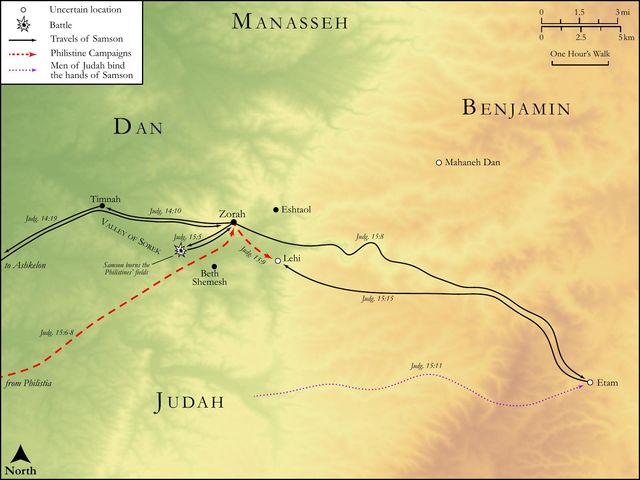
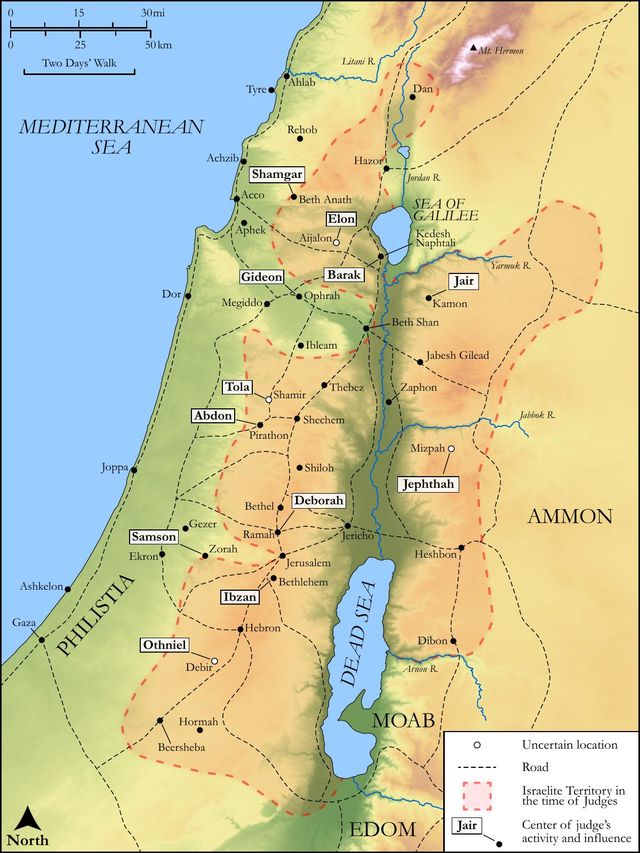
See on the biblical-era maps
Study this verse
Public-domain commentary
Matthew Henry
From his Commentary on the Whole Bible. Henry comments on passages, not single verses — this entry covers Judges 13:8–14. His two-level outline is real structure in the source text, so it is rendered as structure.
We have here an account of a second visit which the angel of God made to Manoah and his wife.
I.Manoah earnestly prayed for it, Jdg 13:8.
He was not incredulous of the story his wife told him; he knew she was a virtuous woman, and therefore the heart of her husband did safely trust in her; he knew she would not go about to impose upon him, much less was he, as Josephus unworthily represents him, jealous of his wife's conversation with this stranger; but,
1.He takes it for granted that this child of promise shall in due time be given them, and speaks without hesitation of the child that shall be born. There was not found so great faith, no, not in Zechariah, a priest, then in waiting at the altar of the Lord, and to whom the angel himself appeared, as was in this honest Danite. Things hidden from the wise and prudent, who value themselves upon the niceness of their enquiries, are often revealed unto babes, who know how to prize God's gifts and to take God's word. Blessed are those that have not seen and yet, as Manoah here, have believed.
2.All his care is what they should do to the child that should be born. Note, Good men are more solicitous and desirous to know the duty that is to be done by them than to know the events that shall occur concerning them; for duty is ours, events are God's. Solomon enquires concerning the good men should do, not the good they should have, Ecc 2:3.
3.He therefore prays to God to send the same blessed messenger again, to give them further instructions concerning the management of this Nazarite, fearing lest his wife's joy for the promise might have made her forget some part of the precept, in which he was desirous to be fully informed, and lie under no mistake: "Lord, let the man of God come again unto us, for we desire to be better acquainted with him." Note, Those that have heard from heaven cannot but wish to hear more thence, again and again to meet with the man of God. Observe, He does not go or send his servants abroad, to find out this man of God, but seeks him upon his knees, prays to God to send him, and, thus seeking, finds him. Would we have God's messengers, the ministers of his gospel, to bring a word proper for us, and for our instruction? Entreat the Lord to send them to us, to teach us, Rom 15:30, Rom 15:32.
II.God graciously granted it:
God hearkened to the voice of Manoah, Jdg 13:9. Note, God will not fail some way or other to guide those by his counsel that are sincerely desirous to know their duty, and apply themselves to him to teach them, Psa 25:8, Psa 25:9.
1.The angel appears the second time also to the wife, when she is sitting alone, probably tending the flocks, or otherwise well employed in the field where she has retired. Solitude is often a good opportunity of communion with God; good people have thought themselves never less alone than when alone, if God be with them.
2.She goes in all haste to call her husband, doubtless humbly beseeching the stay of this blessed messenger till she should return and her husband with her, Jdg 13:10, Jdg 13:11. She did not desire him to go with her to her husband, but would fetch her husband to him. Those that would meet with God must attend where he is pleased to manifest himself. "Oh," says she, overjoyed, "my dear love, thy prayers are answered - yonder is the man of God, come to make us another visit - he that came the other day," or, as some read it, this day, for other is not in the original, and it is probable enough that both these visits were on the same day, and at the same place, and that the second time she sat expecting him. The man of God is very willing she should call her husband, Joh 4:16. Those that have an acquaintance with the things of God themselves should invite others to the same acquaintance, Joh 1:45, Joh 1:46. Manoah is not disgusted that the angel did not this second time appear to him, but very willingly goes after his wife to the man of God. To atone (as it were) for the first fatal miscarriage, when Eve earnestly pressed Adam to that which was evil, and he too easily yielded to her, let yoke-fellows excite one another to love and good works; and, if the wife will lead, let not the husband think it any disparagement to him to follow her in that which is virtuous and praiseworthy.
3.Manoah having come to the angel, and being satisfied by him that he was the same that had appeared to his wife, does, with all humility, (1.) Welcome the promise (Jdg 13:12): Now let thy words come to pass; this was the language, not only of his desire, but of his faith, like that of the blessed Virgin, Luk 1:38. "Be it according to thy word. Lord, I lay hold on what thou hast said, and depend upon it; let it come to pass." (2.) Beg that the prescriptions given might be repeated: How shall we order the child? The directions were given to his wife, but he looks upon himself as concerned to assist her in the careful management of this promised seed, according to order; for the utmost care of both the parents, and their constant joint endeavour, are little enough to be engaged for the good ordering of children that are devoted to God and to be brought up for him. Let not one devolve it on the other, but both do their best. Observe from Manoah's enquiry, [1.] In general, that, when God is pleased to bestow any mercy upon us, our great care must be how to use it well, and as we ought, because it is then only a mercy indeed when it is rightly managed. God has given us bodies, souls, estates; how shall we order them, that we may answer the intent of the donor, and give a good account of them? [2.] In particular, those to whom God has given children must be very careful how they order them, and what they do unto them, that they may drive out the foolishness that is bound up in their hearts, form their minds and manners well betimes, and train them in the way wherein they should go. Herein pious parents will beg divine assistance. "Lord, teach us how we may order our children, that they may be Nazarites, and living sacrifices to thee."
4.The angel repeats the directions he had before given (Jdg 13:13, Jdg 13:14): Of all that I forbad let her beware; and all that I commanded her let her observe. Note, There is need of a good deal both of caution and observation, for the right ordering both of ourselves and of our children. Beware and observe; take heed not only of drinking wine or strong drink, but of eating any thing that cometh of the vine. Those that would preserve themselves pure must keep at a distance from that which borders upon sin or leads to it. When she was with child of a Nazarite, she must not eat any unclean thing; so those in whom Christ is formed must carefully cleanse themselves from all filthiness of flesh and spirit, and do nothing to the prejudice of that new man.
Historical interpretation
Historical reception
1 surviving comment on this verse from the historical church.
Let her refrain: By the Latin text it is not clear whether this abstinence was prescribed to the mother, or to the child; but the Hebrew (in which the verbs relating thereto are of the feminine gender) determineth it to the mother. But then the child also was to refrain from the like things, because he was to be from his infancy a Nazarite of God, ver. 5, that is, one set aside, in a particular manner, and consecrated to God: now the Nazarites by the law were to abstain from all these things.
Continue studying Judges 13:13 across the web’s major study libraries — every link below opens this exact verse, chapter, or book on the destination site.
Read & Compare
 BibleGatewayThis verse in more than 200 translations and 70 languages.
 Bible.comThe YouVersion reader — hundreds of translations, reading plans, and highlights.
 ESV.orgCrossway's official English Standard Version reader.
 NET BibleThe NET translation with 60,000+ translators' notes on every rendering decision.
 STEP BibleTyndale House's free study tool — original text, vocabulary, and scholarly resources.
 BibliaLogos Bible Software's free web reader.
 USCCBThe New American Bible (Revised Edition) with the U.S. bishops' study notes.
Commentaries
 BibleHub CommentariesDozens of classic commentaries on this verse, gathered on one page.
 StudyLightMore than 100 commentary sets — the largest collection on the web.
 BibleRefPlain-English commentary on what this verse means, verse by verse.
 Enduring WordDavid Guzik's free commentary on this chapter, widely used by Bible teachers.
 Bible Study ToolsVerse commentary alongside Greek and Hebrew study aids.
Original Language & Research
- BibleHub InterlinearThe verse word by word — original language, transliteration, and English.
- BibleHub LexiconEvery word's original-language definition and Strong's entry.
 Blue Letter BibleDeep-study tools — Strong's numbers, concordance, and word studies.
 SefariaThe Hebrew text with Rashi and centuries of Jewish commentary.
Sermons, Hymns & Audio


TrulyRandomVerse is not affiliated with these sites and doesn’t control their content. They’re linked because they’re genuinely useful.
Summary
The Angel of the LORD, appearing to Manoah, reiterates and affirms the precise instructions previously given to Manoah's wife concerning the prenatal care and lifelong consecration of their promised son, Samson. This divine communication underscores the unchangeable nature of God's plan, the critical importance of strict adherence to the Nazarite vow from the womb, and the shared parental responsibility in upholding this sacred mandate for Samson's unique role as Israel's deliverer.
Context
ShowHideLiterary Context
Judges 13:13 is situated within the miraculous birth narrative of Samson, serving as a pivotal moment of divine confirmation and clarification. The chapter opens with Israel's oppression by the Philistines and their cry to the LORD, leading to the initial appearance of the Angel of the LORD to Manoah's barren wife (Judges 13:1-5). She reports the encounter and the promise of a son who would be a Nazarite from birth to Manoah (Judges 13:6-7). Seeking further assurance and specific guidance, Manoah prays for the divine messenger to return (Judges 13:8). The Angel reappears, first to the wife, who then fetches Manoah (Judges 13:9-10). Manoah questions the Angel about the child's upbringing and work (Judges 13:11-12). Judges 13:13 is the Angel's direct response, affirming the exact instructions already given to the woman, thus reinforcing their divine origin and unchangeable nature, before the narrative continues with Manoah's offering and the Angel's miraculous ascension (Judges 13:15-20).
Historical & Cultural Context
This period in the Book of Judges (Judges 13:1) describes Israel's forty-year oppression by the Philistines, reflecting a recurring cycle of apostasy, oppression, and divine deliverance. The concept of the Nazarite vow was well-established in ancient Israelite culture, detailed in Numbers 6. It was a special form of consecration to God, either temporary or lifelong, involving specific prohibitions such as abstaining from grape products, not cutting one's hair, and avoiding contact with the dead. For Samson, this vow was unique as it was imposed from birth, making his mother's adherence to the dietary and lifestyle restrictions during pregnancy crucial for his prenatal consecration. Barrenness was a significant social stigma in ancient Israel, making the miraculous birth of Samson a powerful sign of God's intervention and favor, echoing similar narratives of divinely appointed births for key figures like Isaac, Samuel, and John the Baptist.
Key Themes
ShowHideThis verse contributes to several overarching themes within Judges and the broader biblical narrative. It highlights Divine Intervention in human affairs, as God actively responds to Israel's distress by raising a deliverer, even when His people are unfaithful. The Angel's reiteration underscores the theme of Divine Instruction and Obedience, emphasizing that God's plans are meticulous and require human cooperation and vigilance for their fulfillment. The specific commands regarding the mother's diet and the child's hair point to the theme of Consecration and Dedication, particularly through the Nazarite vow, which sets Samson apart for God's purposes from the womb (as mentioned in Judges 13:5). Finally, the interaction between the Angel and Manoah, following the initial revelation to his wife, brings to the forefront the theme of Parental Responsibility in nurturing a child according to God's specific calling and commands, laying the groundwork for the child's destiny.
Exposition and Analysis
ShowHideKey Word Analysis
ShowHideThis significant phrase, combining H4397 (mălʼâk, "messenger" or "angel") and H3068 (Yᵉhôvâh, "the self-Existent or Eternal," the personal name of God), often denotes a pre-incarnate appearance of Jesus Christ or a divine messenger who speaks with the full authority of God Himself, sometimes even being identified with God (e.g., Genesis 16:7-13; Exodus 3:2-6). In this context, it underscores the absolute divine origin and authoritative nature of the instructions given to Manoah and his wife, elevating them beyond mere human counsel to direct commands from the Almighty. The Angel's patient and clear communication reinforces the gravity of the divine mandate.
Derived from H8104 (shâmar), meaning "to hedge about (as with thorns), i.e. guard; generally, to protect, attend to, etc.; beward, be circumspect, take heed (to self), keep(-er, self), mark, look narrowly, observe, preserve, regard, reserve, save (self), sure, (that lay) wait (for), watch(-man)." This imperative carries a strong connotation of vigilance, careful attention, and strict adherence. It is not a mere suggestion but a serious warning to diligently observe the given conditions, implying the potential for negative consequences if neglected. For Manoah's wife, it meant a solemn obligation to protect the consecrated status of her unborn child through her own disciplined lifestyle.
Verse Breakdown
ShowHide"And the angel of the LORD said unto Manoah"
This opening clause establishes the divine speaker and the direct recipient of the message. Manoah had specifically prayed for the "man of God" to return to provide further guidance regarding the child's upbringing (Judges 13:8). This statement is God's direct and gracious answer to Manoah's request, demonstrating divine responsiveness and a willingness to provide clarity for His servants.
"Of all that I said unto the woman"
This phrase serves as a direct reference back to the detailed instructions previously given to Manoah's wife in Judges 13:4-5. These instructions included abstaining from wine, strong drink, and any unclean thing, as the child was to be a Nazarite from birth. The Angel's reiteration confirms the consistency and immutability of God's commands, emphasizing that the initial message was complete and authoritative.
"let her beware"
This concluding imperative is a powerful command for diligent observance. The Hebrew term implies a strong warning to be watchful, to take heed, and to guard carefully against any deviation from the prescribed lifestyle. It highlights the mother's crucial and active role in the prenatal consecration of Samson, underscoring that her obedience directly impacted the child's unique status, supernatural strength, and future calling as Israel's divinely appointed deliverer.
Literary Devices
ShowHideThe passage employs several literary devices to enhance its meaning and impact. Repetition is prominent, as the Angel of the LORD reiterates the instructions first given to Manoah's wife, now directly to Manoah. This repetition emphasizes the critical importance and divine authority of the commands concerning Samson's Nazarite vow, ensuring both parents fully grasp their responsibility. The very presence of the "Angel of the LORD" functions as a powerful symbol of Divine Authority and intervention, elevating the conversation from a mere human dialogue to a direct encounter with the divine will. Furthermore, the meticulous instructions concerning the mother's conduct and the child's future status serve as Foreshadowing, hinting at Samson's unique, consecrated, and often turbulent life as a Nazarite dedicated to God's service, and the direct link between his strength and his adherence to the vow.
Theological and Thematic Connections
ShowHideJudges 13:13 profoundly illustrates God's sovereign initiative in raising up deliverers for His people, even in their periods of spiritual decline and oppression. It underscores the theological principle that God's plans are meticulous and require human obedience for their unfolding. The specific instructions concerning Samson's prenatal consecration highlight the sanctity of life from the womb and the profound impact of parental choices on a child's destiny and divine calling. The Angel's reiteration to Manoah emphasizes shared responsibility in upholding God's commands, ensuring that both parents are fully aware and committed to the divine mandate for their son. This divine concern for specific details reveals God's active involvement in the lives of His chosen instruments and the importance of human faithfulness in response to divine revelation.
Reflection and Application
ShowHideJudges 13:13 serves as a powerful reminder of the profound significance of divine instructions in our lives and the seriousness with which we are called to approach them. Just as Samson's unique calling and strength were intrinsically linked to the careful adherence to the Nazarite vow, so too are our spiritual effectiveness and the unfolding of God's purpose for us often tied to our diligent obedience. This passage challenges us to recognize that God's plans are often detailed, requiring our active participation, vigilance, and commitment. It encourages us to consider how our personal choices, particularly in areas of consecration, discipline, and ethical living, can profoundly impact not only our own spiritual journey but also the spiritual legacy we pass on to future generations. We are called to "beware"—to be watchful, discerning, and obedient stewards of the divine mandates given to us, understanding that even seemingly small acts of obedience contribute to God's grand and redemptive design.
Questions for Reflection
ShowHideFAQ
ShowHideWhy did the Angel of the LORD repeat the instructions to Manoah?
ShowHideThe Angel of the LORD repeated the instructions to Manoah primarily to confirm and reinforce the divine mandate concerning the prenatal care and future dedication of Samson. Manoah had specifically prayed for the "man of God" to return, asking, "what shall be the manner of the child, and how shall we do unto him?" (Judges 13:12). The repetition served several purposes: to assure Manoah of the consistency and authority of the divine message, to emphasize the critical importance of the instructions for Samson's unique calling, and to ensure that both parents understood their shared responsibility in upholding the Nazarite vow for their son. It underscores God's patience and desire for clarity in communicating His will.
What was the significance of Samson being a Nazarite from birth?
ShowHideThe significance of Samson being a Nazarite from birth was profound, setting him apart as uniquely consecrated to God for a special purpose. The Nazarite vow, outlined in Numbers 6, involved specific abstentions (from grape products, not cutting hair, avoiding contact with the dead) as a sign of dedication. For Samson, this lifelong vow was directly linked to his supernatural strength and his role as a deliverer of Israel from the Philistines (Judges 13:5). His mother's adherence to the vow during pregnancy was crucial for his prenatal consecration, signifying that his life and mission were divinely ordained and set apart from the very beginning, a testament to God's sovereign plan.
How does the mother's role in this passage relate to parental responsibility today?
ShowHideThe mother's role in Judges 13:13, specifically her adherence to the Nazarite restrictions during pregnancy, underscores the profound and enduring principle of parental responsibility in nurturing a child's spiritual path. Just as Manoah's wife was instructed to "beware" and diligently observe the divine commands for Samson's sake, parents today have a sacred duty to create an environment that fosters spiritual growth and aligns with God's design for their children. This involves not only teaching biblical truths but also modeling faith, making choices that honor God, and praying for their children's unique callings. The passage highlights that parental choices, even before a child's birth, can have a significant impact on their future and their ability to fulfill God's purposes.
Christ-Centered Fulfillment
ShowHideJudges 13:13, with its emphasis on a divinely appointed birth and a life set apart by specific consecration, powerfully foreshadows the coming of Jesus Christ. Like Samson, Jesus's birth was miraculous, announced by an angel, and His life was uniquely consecrated to God from the womb (Luke 1:31-35). While Samson's Nazarite vow involved external restrictions and was often imperfectly kept, Christ's consecration was intrinsic, a perfect and sinless dedication to His Father's will (Hebrews 10:5-7). Samson was called to begin to deliver Israel from the Philistines, but Jesus is the ultimate Deliverer, the true Lamb of God who takes away the sin of the world (John 1:29), delivering humanity not from physical oppression but from the eternal bondage of sin and death (Romans 6:23). The meticulous instructions given to Samson's parents highlight God's sovereign plan for His chosen instruments, culminating in the perfect Son, who fulfilled all righteousness and perfectly accomplished the Father's redemptive purpose through His obedient life, sacrificial death, and glorious resurrection (Philippians 2:8).