


John 9:11
- ἀπεκρίθηapekrithēAnsweredG611V-ADI-3SVerb Aorist Middle Deponent Indicative 3rd Singular
- ἐκεῖνοςekeinosHeG1565D-NSMDemonstrative pronoun Nominative Singular Masculine
- καὶkaiandG2532CONJConjunction
- εἶπεν·eipensaidG2036V-2AAI-3SVerb 2nd Aorist Active Indicative 3rd Singular
- ἄνθρωποςanthrōposmanG444N-NSMNoun Nominative Singular Masculine
- λεγόμενοςlegomenosis being namedG3004V-PPP-NSMVerb Present Passive Participle Nominative Singular Masculine
- ἸησοῦςIēsousJesusG2424N-NSM-PNoun Nominative Singular Masculine Individual
- πηλὸνpēlonclayG4081N-ASMNoun Accusative Singular Masculine
- ἐποίησενepoiēsenmadeG4160V-AAI-3SVerb Aorist Active Indicative 3rd Singular
- καὶkaiandG2532CONJConjunction
- ἐπέχρισένepechrisenHe anointedG2025V-AAI-3SVerb Aorist Active Indicative 3rd Singular
- μουmoumyG3165P-1GSPersonal pronoun Genitive 1st Singular
- τοὺςtous<the>G3588T-APMDefinite article Accusative Plural Masculine
- ὀφθαλμοὺςophthalmouseyesG3788N-APMNoun Accusative Plural Masculine
- καὶkaiandG2532CONJConjunction
- εἶπένeipenHe saidG2036V-2AAI-3SVerb 2nd Aorist Active Indicative 3rd Singular
- μοιmoito meG3165P-1DSPersonal pronoun Dative 1st Singular
- ὕπαγεhupagedo goG5217V-PAM-2SVerb Present Active Imperative 2nd Singular
- εἰςeistoG1519PREPPreposition
- τοῦtou<the>G3588T-GSMDefinite article Genitive Singular Masculine
- κολυμβήθρανkolumbēthranpoolG2861N-ASFNoun Accusative Singular Feminine
- τὸνton<the>G3588T-ASMDefinite article Accusative Singular Masculine
- ΣιλωὰμSilōamSiloamG4611N-ASM-LNoun Accusative Singular Masculine Location
- καὶkaiandG2532CONJConjunction
- νίψαιnipsaido wash. yourselfG3538V-AMM-2SVerb Aorist Middle Imperative 2nd Singular
- ἀπελθὼνapelthōnHaving goneG565V-2AAP-NSMVerb 2nd Aorist Active Participle Nominative Singular Masculine
- οὖνounthereforeG3767CONJConjunction
- καὶkaiandG2532CONJConjunction
- νιψάμενοςnipsamenoshaving washedG3538V-AMP-NSMVerb Aorist Middle Participle Nominative Singular Masculine
- ἀνέβλεψαaneblepsaI received sightG308V-AAI-1SVerb Aorist Active Indicative 1st Singular
English is a literal word-by-word gloss of the Greek, not the KJV's wording. Why?
This is the original text the KJV's translators worked from — each Greek word with its own literal English meaning in this verse, prepared by scholars at Tyndale House, Cambridge. The KJV translates whole sentences, not word by word, so its wording differs: one Greek word can become several English words, and the KJV may choose “charity” where the gloss reads “love”. Both are faithful — they answer different questions. For the KJV's own rendering, switch to the KJV text.
Details
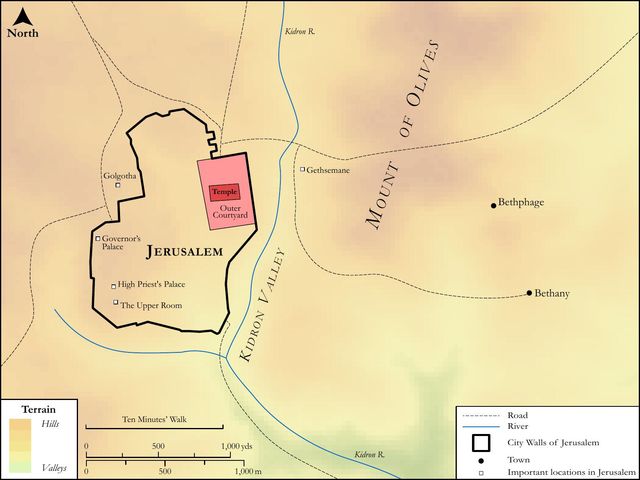
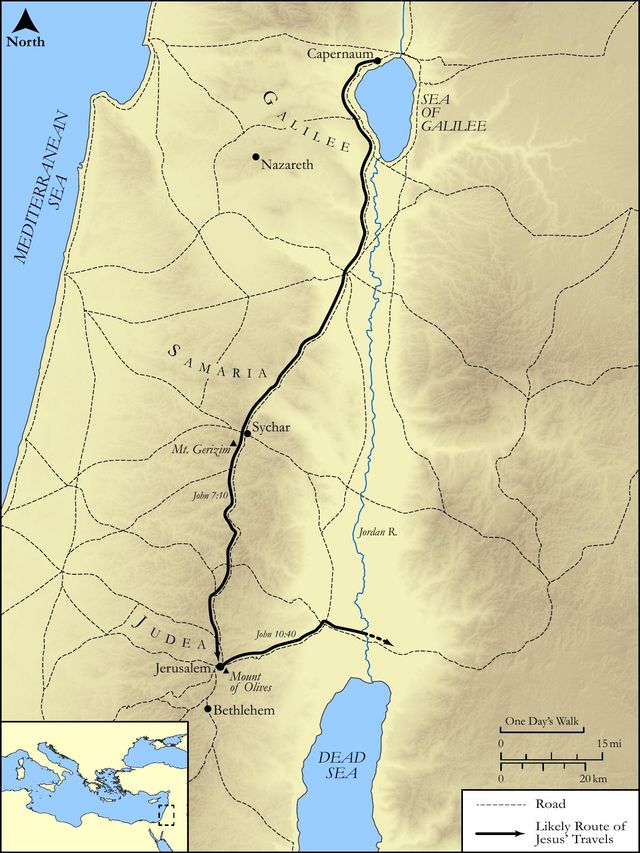
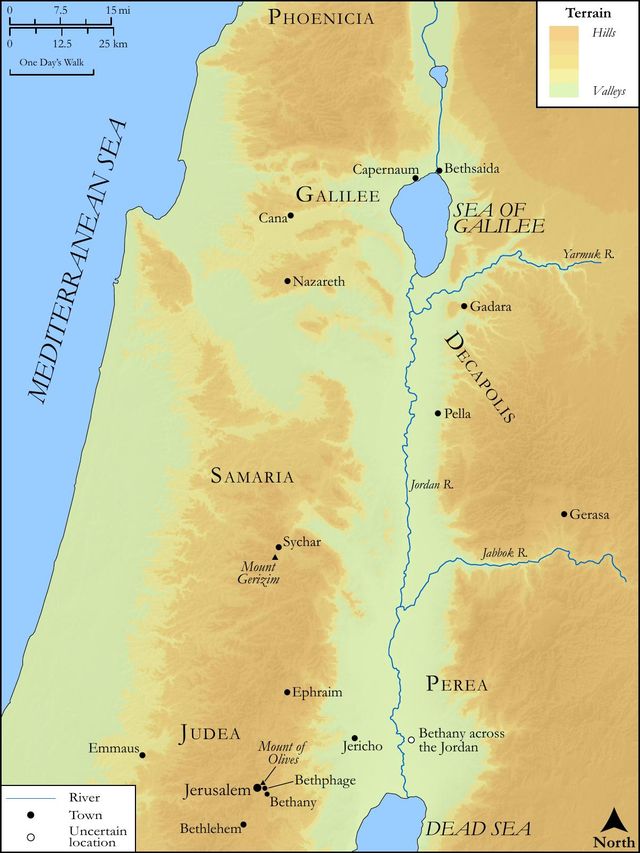
See on the biblical-era map
Study this verse
Public-domain commentary
Matthew Henry
From his Commentary on the Whole Bible. Henry comments on passages, not single verses — this entry covers John 9:8–12. His four-level outline is real structure in the source text, so it is rendered as structure.
Such a wonderful event as the giving of sight to a man born blind could not but be the talk of the town, and many heeded it no more than they do other town-talk, that is but nine days' wonder; but here we are told what the neighbours said of it, for the confirmation of the matter of fact. That which at first was not believed without scrutiny may afterwards be admitted without scruple. Two things are debated in this conference about it: -
I.Whether this was the same man that had before been blind, Joh 9:8.
1.The neighbours that lived near the place where he was born and bred, and knew that he had been blind, could not but be amazed when they saw that he had his eye-sight, had it on a sudden, and perfectly; and they said, Is not this he that sat and begged? It seems, this blind man was a common beggar, being disabled to work for his living; and so discharged from the obligation of the law, that if any would not work, neither should he eat. When he could not go about, he sat; if we cannot work for God, we must sit still quietly for him. When he could not labour, his parents not being able to maintain him, he begged. Note, Those who cannot otherwise subsist must not, like the unjust steward, be ashamed to beg; let no man be ashamed of anything but sin. There are some common beggars that are objects of charity, that should be distinguished; and we must not let the bees starve for the sake of the drones or wasps that are among them. As to this man,
(1.)It was well ordered by Providence that he on whom this miracle was wrought should be a common beggar, and so generally known and remarkable, by which means the truth of the miracle was better attested, and there were more to witness against those infidel Jews who would not believe that he had been blind than if he had been maintained in his father's house.
(2.)It was the greater instance of Christ's condescension that he seemed (as I may say) to take more pains about the cure of a common beggar than of others. When it was for the advantage of his miracles that they should be wrought on those that were remarkable, he pitched upon those that were made so by their poverty and misery; not by their dignity.
2.In answer to this inquiry,
(1.)Some said, This is he, the very same man; and these are witnesses to the truth of the miracle, for they had long known him stone-blind.
(2.)Others, who could not think it possible that a man born blind should thus on a sudden receive his sight, for that reason, and no other, said, He is not he, but is like him, and so, by their confession, if it be he, it is a great miracle that is wrought upon him. Hence we may take occasion to think,
[1.]Of the wisdom and power of Providence in ordering such a universal variety of the faces of men and women, so that no two are so alike but that they may be distinguished, which is necessary to society, and commerce, and the administration of justice. And,
[2.]Of the wonderful change which the converting grace of God makes upon some who before were very wicked and vile, but are thereby so universally and visibly altered that one would not take them to be the same persons.
3.This controversy was soon decided by the man himself: He said, I am he, the very man that so lately sat and begged; "I am he that was blind, and was an object of the charity of men, but now see, and am a monument of the mercy and grace of God." We do not find that the neighbours appealed to him in this matter, but he, hearing the debate, interposed, and put an end to it. It is a piece of justice we owe to our neighbours to rectify their mistakes, and to set things before them, as far as we are able, in a true light. Applying it spiritually, it teaches us that those who are savingly enlightened by the grace of God should be ready to own what they were before that blessed change was wrought, Ti1 1:13, Ti1 1:14.
II.How he came to have his eyes opened, Joh 9:10-12.
They will now turn aside, and see this great sight, and enquire further concerning it. He did not sound a trumpet when he did these alms, nor perform his cures upon a stage; and yet, like a city upon a hill, they could not be hid. Two things these neighbours enquire after: -
1.The manner of the cure: How were thine eyes opened? The works of the Lord being great, they ought to be sought out, Psa 111:2. It is good to observe the way and method of God's works, and they will appear the more wonderful. We may apply it spiritually; it is strange that blind eyes should be opened, but more strange when we consider how they are opened; how weak the means are that are used, and how strong the opposition that is conquered. In answer to this enquiry the poor man gives them a plain and full account of the matter: A man that is called Jesus made clay, - and I received sight. Joh 9:11. Note, Those who have experienced special instances of God's power and goodness, in temporal or spiritual things, should be ready upon all occasions to communicate their experiences, for the glory of God and the instruction and encouragement of others. See David's collection of his experiences, his own and others', Psa 34:4-6. It is a debt we owe to our benefactor, and to our brethren. God's favours are lost upon us, when they are lost with us, and go no further.
2.The author of it (Joh 9:12): Where is he? Some perhaps asked this question out of curiosity. "Where is he, that we may see him?" A man that did such cures as these might well be a show, which one would go a good way for the sight of. Others, perhaps, asked out of ill-will. "Where is he, that we may seize him?" There was a proclamation out for the discovering and apprehending of him (Joh 11:57); and the unthinking crowd, in spite of all reason and equity, will have ill thoughts of those that are put into an ill name. Some, we hope, asked this question out of good-will. "Where is he, that we may be acquainted with him? Where is he, that we may come to him, and share in the favours he is so free of?" In answer to this, he could say nothing: I know not. As soon as Christ had sent him to the pool of Siloam, it should seem, he withdrew immediately (as he did, Joh 5:13), and did not stay till the man returned, as if he either doubted of the effect or waited for the man's thanks. Humble souls take more pleasure in doing good than in hearing of it again; it will be time enough to hear of it in the resurrection of the just. The man had never seen Jesus, for by the time that he had gained his sight he had lost his Physician; and he asked, it is probable, Where is he? None of all the new and surprising objects that presented themselves could be so grateful to him as one sight of Christ, but as yet he knew no more of him than that he was called, and rightly called, Jesus - a Saviour. Thus in the work of grace wrought upon the soul we see the change, but see not the hand that makes it; for the way of the Spirit is like that of the wind, which thou hearest the sound of, but canst not tell whence it comes nor whither it goes.
Historical interpretation
Three Centuries of Reception
6 surviving comments on this verse. Each one is dated, so this reads as a timeline rather than a list.
Select a marker to jump to its quote. Markers stagger vertically where authors wrote within a few decades of each other.
"They said unto him, How were thine eyes opened? He answered and said, A man that is called Jesus." What sayest thou? Doth "a man" work such deeds? As yet he knew nothing great concerning Him. "A man that is called Jesus made clay, and anointed mine eyes." Observe how truthful he is. He saith not whence He made it, for he speaks not of what he doth not know; he saw not that He spat on the ground, but that He spread it on he knew from sense and touch. "And said unto me, Go, wash in the pool of Siloam." This too his hearing witnessed to him. But how did he recognize His voice? From His conversation with the disciples. And saying all this, and having received the witness by the works, the manner (of the cure) he cannot tell. Now if faith is needed in matters which are felt and handled, much more in the case of things invisible.
(Hom. lvii. s. 2) He was not ashamed of his former blindness, nor afraid of the fury of the people, nor averse to show himself, and proclaim his Benefactor. Therefore said they unto him, How were thine eyes opened? How they were, neither he nor any one knew: he only knew the fact; he could not explain it. He answered and said, A man that is called Jesus made clay, and anointed mine eyes. Mark his exactness. He does not say how the clay was made; for he could not see that our Lord spat on the ground; he does not say what he does not know; but that He anointed him he could feel. And said unto me, Go to the pool of Siloam, and wash. This too he could declare from his own hearing; for he had heard our Lord converse with His disciples, and so knew His voice. Lastly, he shows how strictly he had obeyed our Lord. He adds, And I went, and washed, and received sight.
"The neighbors therefore, and those who saw him previously, for he was a beggar, said, Is not this he who sat and begged? Some said, It is he: others, No; but he is like him." The opening of his eyes had altered his countenance. "He said, I am he." His voice utters its gratitude, that it might not be condemned as ungrateful. "Therefore said they unto him, How were thine eyes opened? He answered, The man who is called Jesus made clay, and anointed mine eyes, and said unto me, Go to the pool of Siloam, and wash: and I went and washed, and saw." See, he is become the herald of grace; see, he preaches the gospel; endowed with sight, he becomes a confessor. That blind man makes confession, and the heart of the wicked was troubled; for they had not in their heart what he had now in his countenance.
He appears still to be ignorant that the Savior is by nature God, for otherwise he would not have spoken of him in such an unworthy way. He probably thought of him as a holy man, forming this opinion from the rumors that were circulating around Jerusalem.
(viii. Moral. c. xxx. [49.]) Or thus: By His spittle understand the savour of inward contemplation. It runs down from the head into the mouth, and gives us the taste of revelation from the Divine splendour even in this life. The mixture of His spittle with clay is the mixture of supernatural grace, even the contemplation of Himself with our carnal knowledge, to the soul's enlightenment, and restoration of the human understanding from its original blindness.
Thus he represents the state of the catechumen, who believes in Jesus, but does not, strictly speaking, know Him, not being yet washed. It fell to the Pharisees to confirm or deny the miracle.
Continue studying John 9:11 across the web’s major study libraries — every link below opens this exact verse, chapter, or book on the destination site.
Read & Compare
 BibleGatewayThis verse in more than 200 translations and 70 languages.
 Bible.comThe YouVersion reader — hundreds of translations, reading plans, and highlights.
 ESV.orgCrossway's official English Standard Version reader.
 NET BibleThe NET translation with 60,000+ translators' notes on every rendering decision.
 STEP BibleTyndale House's free study tool — original text, vocabulary, and scholarly resources.
 BibliaLogos Bible Software's free web reader.
 USCCBThe New American Bible (Revised Edition) with the U.S. bishops' study notes.
Commentaries
 BibleHub CommentariesDozens of classic commentaries on this verse, gathered on one page.
 StudyLightMore than 100 commentary sets — the largest collection on the web.
 BibleRefPlain-English commentary on what this verse means, verse by verse.
 Enduring WordDavid Guzik's free commentary on this chapter, widely used by Bible teachers.
 Bible Study ToolsVerse commentary alongside Greek and Hebrew study aids.
Original Language & Research
- BibleHub InterlinearThe verse word by word — original language, transliteration, and English.
- BibleHub LexiconEvery word's original-language definition and Strong's entry.
 Blue Letter BibleDeep-study tools — Strong's numbers, concordance, and word studies.
 CNTR CollationThe earliest Greek manuscripts of this verse, collated letter by letter.
Sermons, Hymns & Audio


TrulyRandomVerse is not affiliated with these sites and doesn’t control their content. They’re linked because they’re genuinely useful.
Summary
John 9:11 captures the concise and powerful testimony of the man born blind, who, when questioned about his newfound sight, attributes his healing directly to "a man that is called Jesus." This pivotal verse serves as the man's initial, unembellished account of the miraculous transformation, detailing Jesus' unique method of using clay and the subsequent instruction to wash in the Pool of Siloam, culminating in his immediate restoration of vision. It stands as a straightforward declaration of fact, setting the stage for the escalating theological and social conflict that follows in the narrative.
Context
ShowHideLiterary Context
This verse is embedded within the broader narrative of John Chapter 9, which details one of Jesus' most significant miracles. The story begins with Jesus and His disciples encountering the man, prompting a discussion about the cause of his blindness, which Jesus refutes as being due to sin, declaring instead that it was "that the works of God should be made manifest in him" (John 9:3). Immediately following this declaration, Jesus performs the healing by spitting on the ground, making clay, anointing the man's eyes, and then instructing him to wash in the Pool of Siloam. Verse 11 is the man's direct and simple response to the astonishment and skepticism of his neighbors and the Pharisees who question how he received his sight, preceding their more intense interrogation.
Historical & Cultural Context
In ancient Israel, blindness was often perceived as a consequence of sin or divine judgment, a belief challenged by Jesus in John 9:2-3. Jesus' act of healing on the Sabbath (implied by the setting and later explicitly stated in John 9:14) was a significant point of contention with the Jewish religious authorities, as it was considered "work" and thus unlawful. The use of saliva and clay, while sometimes associated with folk remedies, was not a standard medical practice and likely served to highlight Jesus' unique, creative power, perhaps echoing God's creation of humanity from dust in Genesis 2:7. The Pool of Siloam, a real historical site in Jerusalem, was fed by the Gihon Spring and held ceremonial significance, particularly during the Feast of Tabernacles, where water was drawn from it for a libation ceremony. Its name, meaning "Sent," adds symbolic depth to Jesus' instruction.
Key Themes
ShowHideJohn 9:11 contributes significantly to several overarching themes in the Gospel of John and the broader biblical narrative. Foremost is the theme of Jesus as the Light of the World, explicitly stated in John 9:5, where His healing of the blind man physically manifests this spiritual truth. The verse also underscores the theme of divine sovereignty over suffering, as Jesus declares the man's blindness was not a result of sin but for God's glory (John 9:3). The man's simple obedience and faith in following Jesus' unusual instructions are central, highlighting that divine healing often requires human response. Finally, the man's straightforward testimony becomes a powerful witness, contrasting sharply with the spiritual blindness of the Pharisees who, despite having physical sight, fail to recognize Jesus' divine authority and identity, a theme explored throughout John Chapter 9.
Exposition and Analysis
ShowHideKey Word Analysis
ShowHideThis verb (G4160) signifies to "make or do (in a very wide application, more or less direct)." Here, it emphasizes Jesus' active, creative agency in forming the clay, an act that points to His divine power, reminiscent of the Creator. It is not merely a passive action but a deliberate, purposeful making.
The word (G2025) means "to smear over." It precisely describes the physical action of Jesus applying the clay to the man's eyes. This specific term highlights the direct, tangible nature of Jesus' intervention, distinguishing it from a mere touch or spoken word, and emphasizing the physical contact involved in the healing process.
This verb (G308) means "to look up; by implication, to recover sight." In this context, it unequivocally denotes the miraculous restoration of the man's vision. The term captures both the physical act of seeing again and the profound, immediate change that occurred, underscoring the supernatural nature of the healing.
Verse Breakdown
ShowHide"He answered and said"
This phrase immediately establishes the setting as an interrogation, likely by the man's neighbors or the Pharisees, who are questioning the unprecedented nature of his healing. The man's response is direct and unhesitating, indicating his clear recollection of the events.
"A man that is called Jesus made clay, and anointed mine eyes"
The man identifies Jesus as the agent of his healing, using His common name. He then describes the specific, unusual method employed: Jesus making clay (from saliva and dust, as described in John 9:6) and applying it to his eyes. This detail is crucial, as it sets the stage for the later controversy regarding Jesus' actions on the Sabbath.
"and said unto me, Go to the pool of Siloam, and wash"
The man recounts Jesus' specific instruction, which involved an act of obedience on his part. The command to go to the Pool of Siloam and wash was an integral part of the healing process, not merely a follow-up, and it tested the man's willingness to follow an unconventional directive.
"and I went and washed, and I received sight"
This final clause powerfully conveys the man's simple, immediate obedience and the miraculous, undeniable outcome. The sequence of "went," "washed," and "received sight" highlights the direct cause-and-effect relationship between his obedience to Jesus' command and the restoration of his vision. It is a factual, irrefutable statement of his personal experience.
Literary Devices
ShowHideThe verse employs several significant literary devices. Testimony is paramount, as the entire verse functions as the man's direct, factual, and unembellished account of his healing. This simple declaration stands in stark contrast to the complex theological debates and legalistic arguments that follow. There is also a subtle Irony present: the man who was physically blind now "sees" clearly—both literally and spiritually, recognizing Jesus' power—while the sighted religious leaders remain spiritually blind to Jesus' true identity and authority. The act of Jesus making clay can be seen as Symbolism, echoing God's creative act in forming humanity from dust in Genesis 2:7, suggesting Jesus' divine power to recreate and restore. The Pool of Siloam also carries Symbolic weight, as its name means "Sent," linking the physical act of washing to Jesus, the "Sent One" from God. The narrative structure itself demonstrates Cause and Effect, clearly linking the man's obedience to Jesus' instructions with the immediate and profound restoration of his sight.
Theological and Thematic Connections
ShowHideJohn 9:11 powerfully illustrates the intersection of divine power, human obedience, and the nature of testimony. The man's simple statement underscores Jesus' absolute authority over physical infirmity, revealing Him as the one through whom "the works of God should be made manifest" (John 9:3). His willingness to follow Jesus' unconventional instructions, even when they seemed illogical, highlights the transformative power of simple faith and obedience. This verse also establishes the man's personal experience as an irrefutable witness to Jesus' identity and power, setting the stage for his courageous defense of Jesus against the skeptical religious authorities. It serves as a foundational declaration of what Jesus has done, providing concrete evidence for His divine claims.
Reflection and Application
ShowHideThe man born blind's testimony in John 9:11 offers profound lessons for contemporary believers. His response is characterized by its simplicity, directness, and focus on what Jesus did. He doesn't offer theological explanations or engage in philosophical debate; he merely states the undeniable facts of his experience. This challenges us to consider the power of our own personal testimonies. What has Jesus done in our lives? Can we articulate it with such clarity and conviction? Furthermore, the man's immediate obedience to Jesus' unusual instruction to wash in the Pool of Siloam, despite his blindness and the unconventional nature of the command, underscores the importance of trusting God's methods, even when they seem counterintuitive. Our faith is often tested not in understanding everything, but in simply obeying. This verse encourages us to be bold and clear in sharing our encounters with Christ, recognizing that our personal stories are powerful tools for evangelism and a testament to God's ongoing work in the world.
Questions for Reflection
ShowHideFAQ
ShowHideWhy did Jesus use clay and saliva to heal the man?
ShowHideJesus' method of making clay with saliva and anointing the man's eyes was not a standard medical practice of the time, nor was it His only method of healing. In Mark 7:33 and Mark 8:23, Jesus also used saliva in healing. One interpretation is that the clay, formed from the earth, symbolically harks back to God's original act of creation, where He formed humanity from the dust of the ground (Genesis 2:7). This would signify Jesus' divine power not merely to heal, but to "re-create" or bring about a new creation. It also served as a test of the man's faith and obedience, requiring him to participate actively in the healing process by going to the Pool of Siloam. The unusual method ensured that the miracle was clearly attributed to Jesus and not to any conventional means.
What is the significance of the Pool of Siloam in this narrative?
ShowHideThe Pool of Siloam was a real, historically significant pool in Jerusalem, fed by the Gihon Spring. Its name, "Siloam," means "Sent" (from the Hebrew shalach, to send). This meaning is highly symbolic in the context of John's Gospel, where Jesus frequently refers to Himself as the one "sent" by the Father (John 5:23, John 6:29). By instructing the man to wash in the Pool of Siloam, Jesus not only required an act of obedience but also subtly linked the physical healing to His own identity as the "Sent One" who brings light and salvation. Furthermore, the pool was used for ritual purification, especially during the Feast of Tabernacles, adding a layer of spiritual cleansing to the physical restoration.
Christ-Centered Fulfillment
ShowHideThe physical healing recounted in John 9:11 serves as a profound pointer to the spiritual sight and new creation that Jesus Christ brings. Just as Jesus made clay to restore physical vision, He performs a deeper work of new creation in the human heart, transforming those who are spiritually blind into those who can truly "see" God and His truth. Jesus Himself declares, "I am the light of the world" (John 8:12, John 9:5), and His healing of the blind man is a tangible demonstration of this claim. Through His atoning work, Christ opens the eyes of those blinded by the god of this world (2 Corinthians 4:4) and grants spiritual understanding, enabling them to perceive the glory of God in His face (2 Corinthians 4:6). The man's simple obedience and subsequent testimony foreshadow the call to all believers to respond to Christ's saving work with faith and to bear witness to the transformative power of the Gospel, which brings light and life to those who were once in darkness (Ephesians 5:8). In Christ, we receive not just restored physical sight, but eternal spiritual vision, enabling us to walk in the light of God's truth.