


Job 36:24
- זְכֹרZe·khorrememberH2142V-Qal-Imp-2msVerb Qal Imperative 2nd Singular Masculine
- כִּיkithatH3588PrtParticle Conditional
- תַשְׂגִּיאtas·Gi'you will magnifyH7679V-Hiphil-Imperf-2msVerb Hiphil Imperfect 2nd Singular Masculine
- פָעֳלוֹfo·'o·Lohis workH6467N-msc ¦ 3msNoun Singular Masculine Constructפָעֳלworkוֹhis
- אֲשֶׁר'a·SherwhichH834RelParticle Relative
- שֹׁרְרוּsho·re·Ruthey have sungH7891V-Piel-Perf-3cpVerb Piel Perfect 3rd Plural common gender
- אֲנָשִׁים'a·na·ShimpeopleH582N-mpNoun Plural Masculine Absolute
English is a literal word-by-word gloss of the Hebrew, not the KJV's wording. Why?
This is the original text the KJV's translators worked from — each Hebrew word with its own literal English meaning in this verse, prepared by scholars at Tyndale House, Cambridge. The KJV translates whole sentences, not word by word, so its wording differs: one Hebrew word can become several English words, and the KJV may choose “the LORD” where the gloss reads “Yahweh”. Both are faithful — they answer different questions. For the KJV's own rendering, switch to the KJV text.
Details
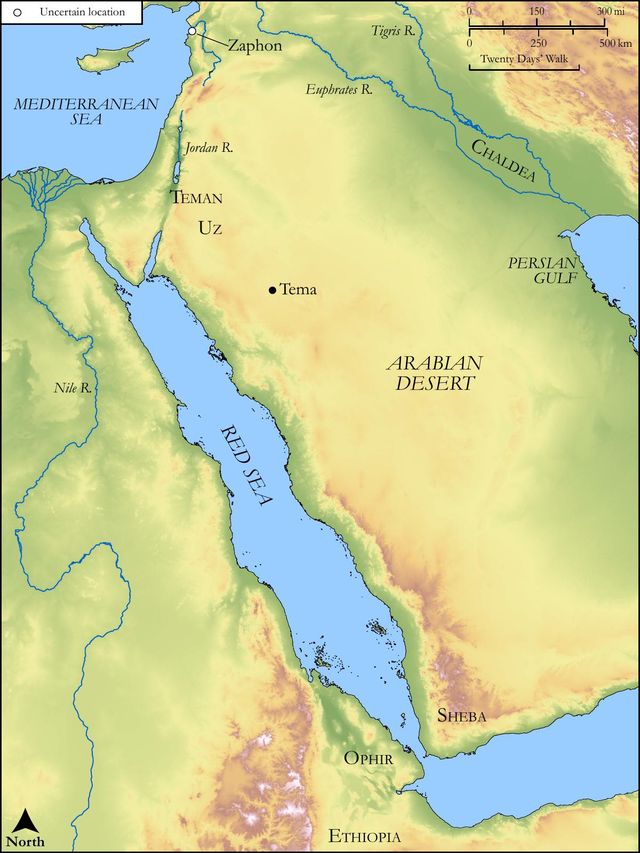
See on the biblical-era map
Study this verse
Public-domain commentary
Matthew Henry
From his Commentary on the Whole Bible. Henry comments on passages, not single verses — this entry covers Job 36:24–33. His three-level outline is real structure in the source text, so it is rendered as structure.
Elihu is here endeavouring to possess Job with great and high thoughts of God, and so to persuade him into a cheerful submission to his providence.
I.He represents the work of God, in general, as illustrious and conspicuous, Job 36:24.
His whole work is so. God does nothing mean. This is a good reason why we should acquiesce in all the operations of his providence concerning us in particular. His visible works, those of nature, and which concern the world in general, are such as we admire and commend, and in which we observe the Creator's wisdom, power, and goodness; shall we then find fault with his dispensations concerning us, and the counsels of his will concerning our affairs? We are here called to consider the work of God, Ecc 7:13.
1.It is plain before our eyes, nothing more obvious: it is what men behold. Every man that has but half an eye may see it, may behold it afar off. Look which way we will, we see the productions of God's wisdom and power; we see that done, and that doing, concerning which we cannot but say, This is the work of God, the finger of God; it is the Lord's doing. Every man may see, afar off, the heaven and all its lights, the earth and all its fruits, to be the work of Omnipotence; much more when we behold them nigh at hand. Look at the minutest works of nature through a microscope; do they not appear curious? The eternal power and godhead of the Creator are clearly seen and understood by the things that are made, Rom 1:20. Every man, even those that have not the benefit of divine revelation, may see this; for there is no speech or language where the voice of these natural constant preachers is not heard, Psa 19:3.
2.It ought to be marvellous in our eyes. The beauty and excellency of the work of God, and the agreement of all the parts of it, are what we must remember to magnify and highly to extol, not only justify it as right and good, and what cannot be blamed, but magnify it as wise and glorious, and such as no creature could contrive or produce. Man may see his works, and is capable of discerning his hand in them (which the beasts are not), and therefore ought to praise them and give him the glory of them.
II.He represents God, the author of them, as infinite and unsearchable, Job 36:26.
The streams of being, power, and perfection should lead us to the fountain. God is great, infinitely so, - great in power, for he is omnipotent and independent, - great in wealth, for he is self-sufficient and all-sufficient, - great in himself, - great in all his works, - great, and therefore greatly to be praised, - great, and therefore we know him not. We know that he is, but not what he is. We know what he is not, but not what he is. We know in part, but not in perfection. This comes in here as a reason why we must not arraign his proceedings, nor find fault with what he does, because it is speaking evil of the things that we understand not and answering a matter before we hear if. We know not the duration of his existence, for it is infinite. The number of his years cannot possibly be searched out, for he is eternal; there is no number of them. He is a Being without beginning, succession, or period, who ever was, and ever will be, and ever the same, the great I AM. This is a good reason why we should not prescribe to him, nor quarrel with him, because, as he is, such are his operations, quite out of our reach.
III.He gives some instances of God's wisdom, power, and sovereign dominion, in the works of nature and the dispensations of common providence, beginning in this chapter with the clouds and the rain that descends from them. We need not be critical in examining either the phrase or the philosophy of this noble discourse. The general scope of it is to show that God is infinitely great, and the Lord of all, the first cause and supreme director of all the creatures, and has all power in heaven and earth (whom therefore we ought, with all humility and reverence, to adore, to speak well of, and to give honour to), and that it is presumption for us to prescribe to him the rules and methods of his special providence towards the children of men, or to expect from him an account of them, when the operations even of common providences about the meteors are so various and so mysterious and unaccountable. Elihu, to affect Job with God's sublimity and sovereignty, had directed him (Job 35:5) to look unto the clouds. In these verses he shows us what we may observe in the clouds we see which will lead us to consider the glorious perfections of their Creator. Consider the clouds,
1.As springs to this lower world, the source and treasure of its moisture, and the great bank through which it circulates - a very necessary provision, for its stagnation would be as hurtful to this lower world as that of the blood to the body of man. It is worth while to observe in this common occurrence,
(1.)That the clouds above distil upon the earth below. If the heavens become brass, the earth becomes iron; therefore thus the promise of plenty runs, I will hear the heavens and they shall hear the earth. This intimates to us that every good gift is from above, from him who is both Father of lights and Father of the rain, and it instructs us to direct our prayers to him and to look up.
(2.)That they are here said to distil upon man (v. 28); for, though indeed God causes it to rain in the wilderness where no man is (Job 38:26, Psa 104:11), yet special respect is had to man herein, to whom the inferior creatures are all made serviceable and from whom the actual return of the tribute of praise is required. Among men, he causes his rain to fall upon the just and upon the unjust, Mat 5:45.
(3.)They are said to distil the water in small drops, not in spouts, as when the windows of heaven were opened, Gen 7:11. God waters the earth with that with which he once drowned it, only dispensing it in another manner, to let us know how much we lie at his mercy, and how kind he is, in giving rain by drops, that the benefit of it may be the further and the more equally diffused, as by an artificial water-pot.
(4.)Though sometimes the rain comes in very small drops, yet, at other times, it pours down in great rain, and this difference between one shower and another must be resolved into the divine Providence which orders it so.
(5.)Though it comes down in drops, yet it distils upon man abundantly (Job 36:28), and therefore is called the river of God which is full of water, Psa 65:9.
(6.)The clouds pour down according to the vapour that they draw up, Job 36:27. So just the heavens are to the earth, but the earth is not so in the return it makes.
(7.)The produce of the clouds is sometimes a great terror, and at other times a great favour, to the earth, Job 36:31. When he pleases by them he judges the people he is angry with. Storms, and tempests, and excessive rains, destroying the fruits of the earth and causing inundations, come from the clouds; but, on the other hand, from them, usually, he gives meat in abundance; they drop fatness upon the pastures that are clothed with flocks, and the valleys that are covered with corn, Psa 65:11-13.
(8.)Notice is sometimes given of the approach of rain, Job 36:33. The noise thereof, among other things, shows concerning it. Hence we read (Kg1 18:41) of the sound of abundance of rain, or (as it is in the margin) a sound of a noise of rain, before it came; and a welcome harbinger it was then. As the noise, so the face of the sky, shows concerning it, Luk 12:56. The cattle also, by a strange instinct, are apprehensive of a change in the weather nigh at hand, and seek for shelter, shaming man, who will not foresee the evil and hide himself.
2.As shadows to the upper world (Job 36:29): Can any understand the spreading of the clouds? They are spread over the earth as a curtain or canopy; how they come to be so, how stretched out, and how poised, as they are, we cannot understand, though we daily see they are so. Shall we then pretend to understand the reasons and methods of God's judicial proceedings with the children of men, whose characters and cases are so various, when we cannot account for the spreadings of the clouds, which cover the light? Job 36:32. It is a cloud coming betwixt, Job 36:32; Job 26:9. And this we are sensible of, that, by the interposition of the clouds between us and the sun, we are,
(1.)Sometimes favoured; for they serve as an umbrella to shelter us from the violent heat of the sun, which otherwise would beat upon us. A cloud of dew in the heat of harvest is spoken of as a very great refreshment. Isa 18:4.
(2.)Sometimes we are by them frowned upon; for they darken the earth at noon-day and eclipse the light of the sun. Sin is compared to a cloud (Isa 44:22), because it comes between us and the light of God's countenance and obstructs the shining of it. But though the clouds darken the sun for a time, and pour down rain, yet (post nubila Phoebus - the sun shines forth after the rain), after he has wearied the cloud, he spreads his light upon it, Job 36:30. There is a clear shining after rain, Sa2 23:4. The sunbeams are darted forth, and reach to cover even the bottom of the sea, thence to exhale a fresh supply of vapours, and so raise recruits for the clouds, Job 36:30. In all this, we must remember to magnify the work of God.
Historical interpretation
Historical reception
2 surviving comments on this verse. Each one is dated, so this reads as a timeline rather than a list.
“Remember that you do not know the works of him whom men have sung.” … Therefore people sing to the Lord when the angelic spirits or the perfect doctors teach us his power. But they do not know his works, because they, who are now preaching, worship his judgments without understanding them. And so they know him whom they are preaching but ignore his works, because they know him through grace who created them, but [they] cannot understand his judgments, which occur through his agency even above them.… “All people have looked on him; everyone watches him from far away.” Every person, because he is endowed with reason, must infer from his own reason that God created him. To observe through reasoning his dominion undoubtedly is like seeing him already. After saying, “All people looked on him,” he rightly adds, “everyone watches him from far away.” To watch him from far away is not like seeing him directly yet, but it is like considering him by simply admiring his works.
6. In Holy Scripture sometimes Angels, and sometimes persons [‘homines’] of perfect life, are called ‘men.’ [‘viri.’] For that an Angel is sometimes called a man, the Prophet Daniel bears witness, saying, Behold, the man Gabriel. [Dan. 9, 21] And again, that persons of perfect life are called by the name of ‘men,’ Wisdom declares in the Proverbs, saying, Unto you, O men, I call. [Prov. 8, 4] Men then sing of the Lord, when either spirits from above, or perfect teachers, make known to us His power. But yet His work is not known; because doubtless even they who preach Him, venerate His unpenetrated judgments. They, therefore, both know Him, Whom they preach, and yet know not His works: because they know, by grace, Him, by Whom they were made, but yet cannot understand His judgments, which are wrought by Him even above their understanding. For that Almighty God is not clearly seen in His doings the Psalmist bears witness, saying, Who hath made darkness His secret place. [Ps. 18, 11] And again, Thy judgments are a great deep. [Ps. 36, 6] And again, The deep like a garment is His clothing. [Ps. 104, 6] Whence also it is well said by Solomon, As thou knowest not what is the way of the spirit, nor how the bones grow together in the belly of her that is with child, so thou knowest not the works of God, Who is the Maker of all things. [Eccles. 11, 5]
7. For to state one thing out of many, two little ones come to this light: but to one it is granted to return to redemption by Baptism; the other is taken away before the regenerating water bedews it. And the son of faithful parents is often taken off without faith, while that of unbelievers is renewed by the grant of the Sacrament of faith. But some one may perhaps say, that God knew that he would act wickedly even after Baptism, and that He did not, on that account, bring him to the grace of Baptism. But if this is the case, the sins of some persons are without doubt punished even before they are committed. And who, that thinks rightly, would say this, that Almighty God, Who releases some from the sins they have committed, condemns, in others, these very sins, even when not committed? His judgments are, therefore, hidden; and they ought to be reverenced with an humility, as great as the obscurity by which they cannot be seen. Let him say then, Remember that thou knowest not His work, of Whom men have sung. As if he were to say plainly, The works of Him, of Whom mighty men have spoken, are concealed from the eyes of thy mind; because they surpass the measure of thy knowledge, inasmuch as thou art circumscribed by thy humanity.
Continue studying Job 36:24 across the web’s major study libraries — every link below opens this exact verse, chapter, or book on the destination site.
Read & Compare
 BibleGatewayThis verse in more than 200 translations and 70 languages.
 Bible.comThe YouVersion reader — hundreds of translations, reading plans, and highlights.
 ESV.orgCrossway's official English Standard Version reader.
 NET BibleThe NET translation with 60,000+ translators' notes on every rendering decision.
 STEP BibleTyndale House's free study tool — original text, vocabulary, and scholarly resources.
 BibliaLogos Bible Software's free web reader.
 USCCBThe New American Bible (Revised Edition) with the U.S. bishops' study notes.
Commentaries
 BibleHub CommentariesDozens of classic commentaries on this verse, gathered on one page.
 StudyLightMore than 100 commentary sets — the largest collection on the web.
 BibleRefPlain-English commentary on what this verse means, verse by verse.
 Enduring WordDavid Guzik's free commentary on this chapter, widely used by Bible teachers.
 Bible Study ToolsVerse commentary alongside Greek and Hebrew study aids.
Original Language & Research
- BibleHub InterlinearThe verse word by word — original language, transliteration, and English.
- BibleHub LexiconEvery word's original-language definition and Strong's entry.
 Blue Letter BibleDeep-study tools — Strong's numbers, concordance, and word studies.
 SefariaThe Hebrew text with Rashi and centuries of Jewish commentary.
Sermons, Hymns & Audio


TrulyRandomVerse is not affiliated with these sites and doesn’t control their content. They’re linked because they’re genuinely useful.
Summary
Job 36:24 encapsulates Elihu's profound admonition, urging Job and all humanity to actively acknowledge and extol the magnificent works of God, which are plainly visible throughout creation. Situated within Elihu's comprehensive discourse on God's omnipotence and wisdom as revealed through His providential care and natural phenomena, this verse serves as a powerful call to shift focus from questioning divine justice to revering the Creator's incomprehensible power and majesty. It underscores the human responsibility to not merely observe but to actively "magnify" God's creative and sustaining acts, fostering a posture of awe, humility, and worship.
Context
ShowHideLiterary Context
Job 36:24 is deeply embedded within Elihu's final and most extensive discourse, spanning chapters 32-37. Elihu, presented as a younger and more insightful observer than Job's three friends, steps in to offer a fresh, nuanced perspective on God's justice and sovereignty, aiming to correct what he perceives as the flawed arguments of both Job and his companions. Chapters 36 and 37 specifically focus on God's majestic power as demonstrated through natural phenomena—rain, clouds, lightning, and storms. Elihu argues that God uses these elements not only to sustain creation but also as instruments of discipline, instruction, and revelation. This verse, therefore, acts as a pivotal exhortation, urging Job (and the reader) to look beyond personal suffering and instead contemplate the undeniable evidence of God's greatness displayed in the visible world. It sets the stage for God's direct intervention from the whirlwind in Job 38, which similarly emphasizes divine power in creation as the ultimate answer to Job's questioning.
Historical & Cultural Context
The book of Job is set in the ancient Near East (ANE), a region where natural forces like weather patterns, droughts, and storms were profoundly impactful and often attributed directly to divine activity. In this cultural milieu, the power and wisdom of a deity were frequently demonstrated through control over creation and the elements. Elihu's arguments resonate with the broader ANE understanding that the natural world provides tangible evidence of a deity's might and wisdom. The wisdom literature tradition, to which Job belongs, often encouraged observation of creation as a means to gain understanding about the divine order and the Creator. For the audience of Job, facing the harsh realities of life and the seemingly arbitrary nature of suffering, Elihu's call to "magnify" God's work would have been a direct challenge to their prevailing worldview, urging them to find divine purpose and power even amidst inexplicable hardship.
Key Themes
ShowHideThis verse contributes significantly to several key themes woven throughout the book of Job and Elihu's speeches. Foremost is the theme of Divine Sovereignty and Omnipotence, emphasizing God's absolute control over all creation and His unchallengeable power, a point that God Himself will powerfully reinforce in Job 38-41. It also highlights General Revelation, the concept that God's attributes (power, wisdom, majesty) are revealed through the observable world, as articulated later in Psalm 19:1-4 and Romans 1:20. The imperative "Remember that thou magnify" introduces the theme of Human Responsibility to Worship and Acknowledge God, shifting the focus from Job's complaints to a proper posture of reverence and awe. Elihu's discourse also touches on the Incomprehensibility of God's Ways, suggesting that human understanding is limited compared to God's infinite wisdom, a theme central to the entire book and ultimately affirmed by God's own words.
Exposition and Analysis
ShowHideKey Word Analysis
ShowHideThis is more than a mere mental recall; it implies an active, intentional engagement to mark or bring something to mind so as to be recognized and acted upon. In this context, it's a command to deliberately acknowledge and internalize the significance of God's works, leading to a purposeful response of recognition and worship. It suggests a conscious effort to keep God's deeds at the forefront of one's thoughts and actions.
A primitive root meaning "to grow" or, causatively, "to enlarge" and, figuratively, "to laud." This imperative calls for an active elevation of God's work in one's perception, speech, and attitude. It is not about making God's work physically larger, but about recognizing its true, immense scale and giving it the honor, praise, and reverence it deserves, thereby glorifying the Creator. It is an invitation to extol God's greatness.
Refers concretely to God's actions, deeds, and particularly His creative acts. This encompasses the tangible evidence of God's power, wisdom, and artistry, from the grand cosmic order to the intricate details of nature, and even His providential dealings with humanity. It is the visible manifestation of God's attributes.
Verse Breakdown
ShowHide"Remember that thou magnify his work,"
This is a direct, imperative command from Elihu, urging Job to consciously and deliberately elevate the perception and praise of God's creative and providential acts. It's a call to shift from a self-focused or suffering-focused perspective to a God-focused one, actively acknowledging the greatness of what God has accomplished. The emphasis is on an internal posture of awe and an external expression of praise, recognizing God's immense power and wisdom displayed in all He does.
"which men behold."
This clause highlights the accessibility and undeniable nature of God's "work." It is not hidden or obscure but is openly displayed for all humanity to see and observe. The visibility of creation serves as a universal testimony to God's power and wisdom, making it inexcusable for humanity to ignore or fail to magnify Him. It underscores the concept of general revelation, where God's attributes are made known through the natural world, available to any who would simply look.
Literary Devices
ShowHideThe verse primarily employs Imperative Mood, as seen in "Remember that thou magnify," which functions as a direct command, emphasizing the urgency and importance of Elihu's message. This didactic tone is characteristic of wisdom literature, where instruction and moral exhortation are paramount. There is also a strong element of Emphasis through Observation, as the phrase "which men behold" highlights the visible and undeniable nature of God's works, making them a clear testimony. This appeals to the human capacity for empirical observation as a pathway to divine knowledge and accountability. Furthermore, the concept of "magnifying" God's "work" can be seen as a form of Metonymy, where the work stands for the worker, implying that by magnifying God's creation, one is inherently magnifying God Himself. The verse's concise structure also lends it an Aphoristic quality, making it memorable and impactful as a piece of wisdom.
Theological and Thematic Connections
ShowHideJob 36:24 serves as a profound theological statement on the nature of divine revelation and human responsibility. It asserts that God's power and wisdom are not abstract concepts but are concretely displayed in the created order, accessible to all who observe. This aligns with the biblical theme of general revelation, where the natural world bears witness to its Creator, leaving humanity without excuse for failing to acknowledge Him. The command to "magnify" God's work calls for a proper response of worship, humility, and awe in the face of His incomprehensible greatness, shifting focus from human suffering to divine sovereignty and the glory of God.
Reflection and Application
ShowHideElihu's admonition in Job 36:24 is a timeless call to intentionality in our spiritual lives. In a world saturated with distractions, noise, and often consumed by personal struggles, it challenges us to lift our gaze and consciously engage with the undeniable evidence of God's handiwork all around us. This is not merely an intellectual exercise but a spiritual discipline that cultivates awe, humility, and worship. To "magnify" God's work means to actively seek out and celebrate His power, wisdom, and beauty in creation—from the intricate design of a snowflake to the vastness of the cosmos, from the resilience of life to the predictability of natural laws. Such contemplation shifts our perspective, reminding us that our problems, however great, are dwarfed by the infinite majesty of the Creator. It encourages a posture of trust and surrender, knowing that the God who orchestrates the universe is also intimately involved in our lives, deserving of our praise and adoration.
Questions for Reflection
ShowHideFAQ
ShowHideWhat does "magnify his work" truly mean in this context?
ShowHideTo "magnify his work" means more than simply acknowledging God's actions; it's an active, intentional command to extol, praise, and glorify God by recognizing the immense greatness and wonder of His deeds, particularly His creation and providential care. It implies elevating God's work in one's mind, speech, and attitude, giving it the honor and reverence it deserves. It is a call to view God's visible acts with awe and to proclaim their majesty, rather than dismissing them or taking them for granted. This concept is beautifully echoed in Psalm 34:3, where the psalmist invites others to "magnify the Lord with me."
Is Elihu's perspective on God's justice entirely correct in the book of Job?
ShowHideWhile Elihu offers valuable insights into God's power and sovereignty, and correctly emphasizes God's incomprehensibility, his understanding of God's justice, particularly concerning suffering, is not entirely complete or flawless. Like Job's three friends, Elihu operates under the assumption that suffering is primarily a consequence of sin, though he introduces the idea that suffering can also be a disciplinary tool for purification and instruction (e.g., Job 33:14-30). However, the book's ultimate resolution, with God's direct intervention in Job 38-41 and His vindication of Job, demonstrates that human suffering is far more complex than any of the human characters fully grasp. Elihu's contribution is significant in shifting the focus to God's majesty, but his theological framework, while more nuanced than the friends', still falls short of the full biblical revelation on suffering.
Christ-Centered Fulfillment
ShowHideJob 36:24, with its call to "magnify his work, which men behold," finds its ultimate and most profound fulfillment in Jesus Christ. While Elihu rightly points to God's power revealed in creation, the New Testament reveals that all creation was brought into being through Christ and for Him, as declared in John 1:3 and Colossians 1:16. Therefore, when we behold and magnify God's work, we are implicitly magnifying the creative power of the Son. Furthermore, if the natural world reveals God's invisible attributes, then Jesus Christ is the perfect and complete revelation of God's glory, the "brightness of his glory, and the express image of his person" (Hebrews 1:3). He is the ultimate "work" of God, the one through whom God's character, power, and redemptive plan are fully and perfectly displayed. To truly "magnify His work" today is to acknowledge the unparalleled work of redemption accomplished by Christ on the cross, His victory over sin and death, and His ongoing work of salvation and transformation. In Him, we not only behold God's power but also His unfathomable love and grace, inviting us to worship the Creator and Redeemer in Spirit and truth, as Jesus Himself taught in John 4:24.