


Job 36:16
Bible text: King James Version (1769 Blayney text) · Public domain
Bible text: King James Version with Strong's numbers · Public domain
Bible text: Berean Standard Bible · Public domain
Bible text: American Standard Version (1901) · Public domain
Bible text: World English Bible, Messianic edition · Public domain
Bible text: Geneva Bible (1599) · Public domain
Bible text: Young's Literal Translation · Public domain
- וְאַףve·'Afand alsoH637Conj-w ¦ PrtParticle Interjectionוְandאַףalso
- הֲסִיתְךָha·si·te·Khahe has allured youH5496V-Hiphil-Perf-3ms ¦ 2msVerb Hiphil Perfect 3rd Singular Masculineהֲסִיתְhe has alluredךָyou
- מִפִּיmi·pifrom [the] mouth ofH6310Prep-m ¦ N-mscNoun Singular Masculine Constructמִfromפִּי[the] mouth of
- צָרTzarenemyH6862Adj-msAdjective Singular Masculine Absolute
- רַחַבRa·chava broad placeH7338Adj-msAdjective Singular Masculine Absolute
- לֹאlo'notH3808NegParticle Negative
- מוּצָקmu·TzakconstraintH4164N-msNoun Singular Masculine Absolute
- תַּחְתֶּיהָtach·Tei·haits in placeH8478N-mpc ¦ 3fsNoun Plural Masculine Constructתַּחְתֶּיin placeהָits
- וְנַחַתve·Na·chatand [the] quietness ofH5183Conj-w ¦ N-fscNoun Singular Feminine Constructוְandנַחַת[the] quietness of
- שֻׁלְחָנְךָShul·cha·ne·Khayour tableH7979N-msc ¦ 2msNoun Singular Masculine Constructשֻׁלְחָנְtableךָyour
- מָלֵאMa·le'it was fullH4390V-Qal-Perf-3msVerb Qal Perfect 3rd Singular Masculine
- דָשֶׁןDa·shenfatnessH1880N-msNoun Singular Masculine Absolute
English is a literal word-by-word gloss of the Hebrew, not the KJV's wording. Why?
This is the original text the KJV's translators worked from — each Hebrew word with its own literal English meaning in this verse, prepared by scholars at Tyndale House, Cambridge. The KJV translates whole sentences, not word by word, so its wording differs: one Hebrew word can become several English words, and the KJV may choose “the LORD” where the gloss reads “Yahweh”. Both are faithful — they answer different questions. For the KJV's own rendering, switch to the KJV text.
Details
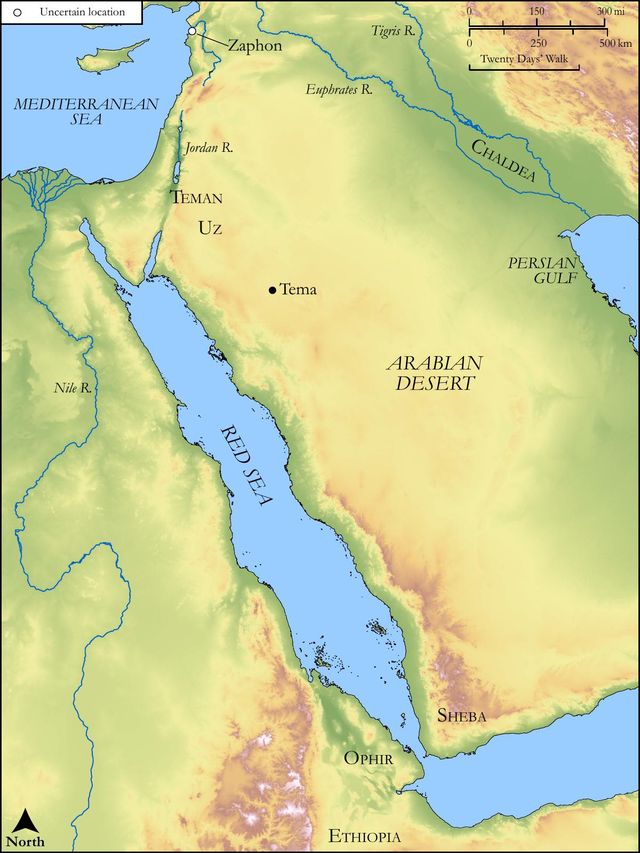
See on the biblical-era map
Study this verse
Public-domain commentary
Matthew Henry
From his Commentary on the Whole Bible. Henry comments on passages, not single verses — this entry covers Job 36:15–23. His three-level outline is real structure in the source text, so it is rendered as structure.
Elihu here comes more closely to Job; and,
I.He tells him what God would have done for him before this if he had been duly humbled under his affliction.
"We all know how ready God is to deliver the poor in his affliction (Job 36:15); he always was so. The poor in spirit, those that are of a broken and contrite heart, he looks upon with tenderness, and, when they are in affliction, is ready to help them. He opens their ears, and makes them to hear joy and gladness, even in their oppressions; while he does not yet deliver them he speaks to them good words and comfortable words, for the encouragement of their faith and patience, the silencing of their fears, and the balancing of their griefs; and even so (Job 36:16) would he have done to thee if thou hadst submitted to his providence and conducted thyself well; he would have delivered and comforted thee, and we should have had none of these complaints. If thou hadst accommodated thyself to the will of God, thy liberty and plenty would have been restored to thee with advantage." 1. "Thou wouldst have been enlarged, and not confined thus by thy sickness and disgrace: He would have removed thee into a broad place where is no straitness, and thou wouldst no longer have been cramped thus and have had all thy measures broken." 2. "Thou wouldst have been enriched, and wouldst not have been left in this poor condition; thou wouldst have had thy table richly spread, not only with food convenient, but with the finest of the wheat" (see Deu 32:14) "and the fattest of the flesh." Note, It ought to silence us under our afflictions to consider that, if we were better, it would be every way better with us: if we had answered the ends of an affliction, the affliction would be removed; and deliverance would come if we were ready for it. God would have done well for us if we had conducted ourselves well; Psa 81:13, Psa 81:14; Isa 48:18.
II.He charges him with standing in his own light, and makes him the cause of the continuance of his own trouble (Job 36:17):
"But thou hast fulfilled the judgment of the wicked," that is, "Whatever thou art really, in this thing thou hast conducted thyself like a wicked man, hast spoken and done like the wicked, hast gratified them and served their cause; and therefore judgment and justice take hold on thee as a wicked man, because thou goest in company with them, actest as if thou wert in their interest, aiding and abetting. Thou hast maintained the cause of the wicked; and such as a man's cause is such will the judgment of God be upon him;" so bishop Patrick. It is dangerous being on the wrong side: accessaries to treason will be dealt with as principals.
III.He cautions him not to persist in his frowardness. Several good cautions he gives him to this purport.
1.Let him not make light of divine vengeance, nor be secure, as if he were in no danger of it (Job 36:18): "Because there is wrath" (that is, "because God is a righteous governor, who resents all the affronts given to his government, because he has revealed his wrath from heaven against all ungodliness and unrighteousness of men, and because thou hast reason to fear that thou art under God's displeasure) therefore beware lest he take thee away suddenly with his stroke, and be so wise as to make thy peace with him quickly and get his anger turned away from thee." A warning to this purport Job had given his friends (Job 19:29): Be you afraid of the sword, for wrath brings the punishment of the sword. Thus contenders are apt, with too much boldness, to bind one another over to the judgment of God and threaten one another with his wrath; but he that keeps a good conscience needs not fear the impotent menaces of proud men. But his was a friendly caution to Job, and necessary. Even good men have need to be kept to their duty by the fear of God's wrath. "Thou art a wise and good man, but beware lest he take thee away, for the wisest and best have enough in them to deserve his stroke."
2.Let him not promise himself that, if God's wrath should kindle against him, he could find out ways to escape the strokes of it.
(1.)There is no escaping by money, no purchasing a pardon with silver, or gold, and such corruptible things: "Even a great ransom cannot deliver thee when God enters into judgment with thee. His justice cannot be bribed, nor any of the ministers of his justice. Will he esteem thy riches, and take from them a commutation of the punishment? No, not gold, Job 36:19. If thou hadst as much wealth as ever thou hadst, that would not ease thee, would not secure thee from the strokes of God's wrath, in the day of the revelation of which riches profit not," Pro 11:4. See Psa 49:7, Psa 49:8.
(2.)There is no escaping by rescue: "If all the forces of strength were at thy command, if thou couldst muster ever so many servants and vassals to appear for thee to force thee out of the hands of divine vengeance, it were all in vain; God would not regard it. There is none that can deliver out of his hand." (3.) There is no escaping by absconding (Job 36:20): "Desire not the night, which often favours the retreat of a conquered army and covers it; think not that thou canst so escape the righteous judgment of God, for the darkness hideth not from him," Psa 139:11, Psa 139:12. See Job 34:22. "Think not, because in the night people retire to their place, go up to their beds, and it is then easy to escape being discovered by them, that God also ascends to his place, and cannot see thee. No; he neither slumbers nor sleeps. His eyes are open upon the children of men, not only in all places, but at all times. No rocks nor mountains can shelter us from his eye." Some understand it of the night of death; that is the night by which men are cut off from their place, and Job had earnestly breathed for that night, as the hireling desires the evening, Job 7:2. "But do not do so," says Elihu; "for thou knowest not what the night of death is." Those that passionately wish for death, in hopes to make that their shelter from God's wrath, may perhaps be mistaken. There are those whom wrath pursues into that night.
3.Let him not continue his unjust quarrel with God and his providence, which hitherto he had persisted in when he should have submitted to the affliction (Job 36:21): "Take heed, look well to thy own spirit, and regard not iniquity, return not to it (so some), for it is at thy peril if thou do." Let us never dare to think a favourable thought of sin, never indulge it, nor allow ourselves in it. Elihu thinks Job had need of this caution, he having chosen iniquity rather than affliction, that is, having chosen rather to gratify his own pride and humour in contending with God than to mortify it by a submission to him and accepting the punishment. We may take it more generally, and observe that those who choose iniquity rather than affliction make a very foolish choice. Those that ease their cares by sinful pleasures, increase their wealth by sinful pursuits, escape their troubles by sinful projects, and evade sufferings for righteousness' sake by sinful compliances against their consciences, make a choice they will repent of; for there is more evil in the least sin than in the greatest affliction. It is an evil, and only evil.
4.Let him not dare to prescribe to God, nor give him his measures (Job 36:22, Job 36:23): "Behold, God exalteth by his power," that is, "He does, may, and can set up and pull down whom he pleases, and therefore it is not for thee nor me to contend with him." The more we magnify God the more do we humble and abase ourselves. Now consider,
(1.)That God is an absolute sovereign: He exalts by his own power, and not by strength derived from any other. He exalts whom he pleases, exalts those that were afflicted and cast down, by the strength and power which he gives his people; and therefore who has enjoined him his way? Who presides above him in his way? Is there any superior from whom he has his commission and to whom he is accountable? No; he himself is supreme and independent. Who puts him in mind of his way? so some. Does the eternal Mind need a remembrancer? No; his own way, as well as ours, is ever before him. He has not received orders or instructions from any (Isa 60:13, Isa 60:14), nor is he accountable to any. He enjoins to all the creatures their way; let not us then enjoin him his, but leave it to him to govern the world, who is fit to do it.
(2.)That he is an incomparable teacher: Who teaches like him? It is absurd for us to teach him who is himself the fountain of light, truth, knowledge, and instruction. He that teaches man knowledge, and so as none else can, shall not he know? Psa 94:9, Psa 94:10. Shall we light a candle to the sun? Observe, When Elihu would give glory to God as a ruler he praises him as a teacher, for rulers must teach. God does so. He binds with the cords of a man. In this, as in other things, he is unequalled. None so fit to direct his own actions as he himself is. He knows what he has to do, and how to do it for the best, and needs no information nor advice. Solomon himself had a privy-council to advise him, but the King of kings has none. Nor is any so fit to direct our actions as he is. None teaches with such authority and convincing evidence, with such condescension and compassion, nor with such power and efficacy, as God does. He teaches by the Bible, and that is the best book, teaches by his Son, and he is the best Master.
(3.)That he is unexceptionably just in all his proceedings: Who can say, Thou hast wrought iniquity? Not, Who dares say it? (many do iniquity, and those who tell them of it do so at their peril), but Who can say it? Who has any cause to say it? Who can say it and prove it? It is a maxim undoubtedly true, without limitation, that the King of kings can do no wrong.
Historical interpretation
Historical reception
1 surviving comment on this verse from the historical church.
65. Every one who forsakes the way of life, and casts himself down into the darkness of sins, plunges himself, as it were, into a well or pitfall. But if, through long commission he is also so weighed down by a habit of sin, as to be unable to rise upward, he is pent in, as it were, in the narrow opening of a well. Whence David the Prophet entreats in the person of sinners, saying, Let not the tempest of water drown me, neither let the deep swallow me up, and let not the well press its mouth upon me. [Ps. 69, 15] For a tempest of water has, as it were, hurried away him, whom the iniquity of evil doing has moved from stability in goodness. But if it has not yet prevailed by long custom, it has not overwhelmed. He has already fallen into a well, who has done that, which the law of God forbids. But if long custom does not yet weigh him down, the well has not contracted its mouth. He escapes therefore with greater ease, the less closely he is pent in by habit. Whence the prophet Jeremiah, when beholding that Judaea had been overwhelmed, through long habit, by iniquities, bewails himself in his lamentations, under her person, and says, My life is fallen into a well, and they have placed a stone over me. [Lam. 3, 53] For one’s life falls into a pit, when it is denied with the pollution of iniquity. But a stone is placed over, when the mind is also consumed by sin, through long habit, so that, though willing to rise, it is quite unable to do so, because the weight of evil habit presses on it from above. But because it submits to the power of God, and is brought back to the large room of good deeds, after the confinement of evil habit, it is said, He will bring thee safely from a narrow opening into a broad place. For he is safely brought from a narrow opening into a broad place, who, after having borne the yoke of iniquity, is brought back by penitence to the liberty of good works.
66. For it is, as it were, the narrowness of a confined opening, to wish, and yet to be unable to rise from an overpowering evil habit; to tend, in desire, to things above, but yet still to remain in deed in things below, to advance in heart, but not to follow in act, and to endure one’s self as a kind of self-contradiction within one’s self. But when a soul, proceeding thus, is assisted by the hand of grace to raise it up, it arrives from a narrow opening to a broad place: because, having overcome its difficulties, it performs the good works which it desires. The prophet David had beheld the enclosure of a narrow opening, when he said, Thou hast delivered my soul from necessities, and hast not shut me up into the hands of the enemy. [Ps. 3l, 7. 8.] But he found that he had been brought safely into a broad place, when he added, Thou hast set my feet in a large room. [ibid.] For our feet are firmly placed in a large room, when we journey to those good things which are fitted for us, and are not impeded by any difficulty. For we are proceeding, as it were, through a wide place whither we please, because we are not hard pressed by any difficulties placed in our way.
67. But Eliu would say this rightly, if his opinion were but suitable to blessed Job. For he believed, that he had been scourged for his faults, and therefore decided that he had fallen into a narrow opening. For with the heavier blows he beheld him afflicted, with the more abominable iniquities he believed him to be weighed down; being surely ignorant that his scourges were an increase of his merits, not a punishment for his sin. But when he declares that he had fallen into a narrow opening, he proceeds, as it were, to speak more fully of the profound depth in which Job is plunged: and says,
And which hath no foundation beneath it.
68. Every sin has no foundation; because it has no subsistence in its own proper nature. For evil has no substance. But that which any how exists, unites with the nature of good. The narrow opening is said, then, to have no foundation beneath it, because the pollution of sin has no power of subsisting by itself. But since foundation is derived from fundum, (bottom,) we may without impropriety understand that ‘foundation’ is put for bottom, as hearing is derived from ear, and yet the ear itself is frequently designated by the word hearing. When speaking then of a narrow opening, he added, as wishing fully to describe the profound abyss, And which hath no foundation (or bottom) beneath it. For the infernal pit swallows up him, whom iniquity hurries away. But the infernal pit is rightly believed not to have a bottom; because every one who is swept away by it, is devoured by the boundless profound. For the Prophet, wishing to describe fully its boundless immensity, says, The infernal pit hath enlarged its soul, and hath opened its mouth without measure. [Is. 5, 14] As therefore that is said to be enlarged without measure which attracts very many to itself, so it is not improperly believed to be deep, and without a bottom, because it absorbs, as it were, into the boundless abyss of its immensity those, whom it receives into itself. And therefore when saying, He will bring thee safely from a narrow opening into a broad place, he fitly subjoined, And which hath no foundation beneath it. As if he were saying, He will bring thee safely from a narrow opening, which has no bottom under it. For since it is through sin that we tend to the pit, He brings safely from a narrow opening him whom He delivers from sin. But him whom He rescues from the narrow opening, He withdraws from the depths of hell.
69. Though it can also be understood in another sense. For as he who is plunged into a well, is confined in the bottom of it; so would the mind fall in, and remain, as it were, at the bottom, if, after having once fallen, it were to confine itself within any measure of sin. But when it cannot be contented with the sin into which it has fallen, while it is daily plunging into worse offences, it finds, as it were, no bottom to the well into which it has fallen, on which to rest. For there would be a bottom to the well, if there were any bounds to his sin. Whence it is well said in another place, When a sinner hath come into the lowest depth of sins, he contemneth. [Prov. 18, 3] For he puts by returning, because he has no hope that he can be forgiven. But when he sins still more through despair, he withdraws, as it were, the bottom from the well, so as to find therein no resting place. It follows,
But the rest of thy table shall be full of fatness.
70. The rest of the table, is the refreshment of inward satiety: which is said to be full of fatness, because it is set forth with the delight of eternal pleasure. The Prophet was hungering after the feasts of this table, when saying, I shall be satisfied, when Thy glory shall be manifested. [Ps. 17, 15] He was thirsting for the cups of this table, when saying, My soul thirsted for the living God; when shall I come and appear before the face of God? [Ps. 42, 2] Eliu, therefore, wishing to console the temporal sufferings of blessed Job, by an eternal compensation, promises him, as if freely, from himself, that which was justly due to him as his desert, saying, But the rest of thy table shall be full of fatness.
Continue studying Job 36:16 across the web’s major study libraries — every link below opens this exact verse, chapter, or book on the destination site.
Read & Compare
 BibleGatewayThis verse in more than 200 translations and 70 languages.
 Bible.comThe YouVersion reader — hundreds of translations, reading plans, and highlights.
 ESV.orgCrossway's official English Standard Version reader.
 NET BibleThe NET translation with 60,000+ translators' notes on every rendering decision.
 STEP BibleTyndale House's free study tool — original text, vocabulary, and scholarly resources.
 BibliaLogos Bible Software's free web reader.
 USCCBThe New American Bible (Revised Edition) with the U.S. bishops' study notes.
Commentaries
 BibleHub CommentariesDozens of classic commentaries on this verse, gathered on one page.
 StudyLightMore than 100 commentary sets — the largest collection on the web.
 BibleRefPlain-English commentary on what this verse means, verse by verse.
 Enduring WordDavid Guzik's free commentary on this chapter, widely used by Bible teachers.
 Bible Study ToolsVerse commentary alongside Greek and Hebrew study aids.
Original Language & Research
- BibleHub InterlinearThe verse word by word — original language, transliteration, and English.
- BibleHub LexiconEvery word's original-language definition and Strong's entry.
 Blue Letter BibleDeep-study tools — Strong's numbers, concordance, and word studies.
 SefariaThe Hebrew text with Rashi and centuries of Jewish commentary.
Sermons, Hymns & Audio


TrulyRandomVerse is not affiliated with these sites and doesn’t control their content. They’re linked because they’re genuinely useful.
Summary
In Job 36:16, Elihu, a younger counselor, articulates a profound aspect of God's redemptive purpose, suggesting that divine discipline, when rightly received, is intended to transition an individual from a state of severe distress and confinement into a condition of expansive freedom, abundant provision, and rich blessing. He posits that God's ultimate desire is not merely to punish, but to restore and lavishly provide for those who heed His instruction and turn towards Him, thereby transforming their circumstances from restriction to boundless prosperity.
Context
ShowHideLiterary Context
This verse is embedded within Elihu's extensive speeches (Job 32-37), which serve as the final human attempt to explain Job's suffering before God Himself speaks from the whirlwind. Elihu distinguishes himself from Job's three friends by asserting that God uses suffering not solely as punishment for sin, but often as a pedagogical tool—a means of instruction, correction, and refinement. He argues that God reveals Himself through affliction to lead individuals to repentance and a deeper relationship, thereby averting greater calamity and opening the door to restoration. In this particular passage, Elihu is hypothetically addressing Job, implying that if Job had responded with humility and understanding to God's disciplinary hand, he would have experienced a dramatic reversal of his fortunes, moving from his current anguish to a state of profound ease and prosperity. This statement serves as a hopeful, albeit conditional, promise within Elihu's theological framework, offering a path to deliverance from the very "straitness" Job currently endures.
Historical & Cultural Context
In the land of Uz, prosperity and a large, secure household were often seen as indicators of divine favor, while suffering and destitution were frequently interpreted as signs of divine displeasure or punishment for sin. The imagery used by Elihu—"straitness," "broad place," and a "table full of fatness"—resonates deeply with the cultural understanding of well-being and blessing. "Straitness" (or "narrowness") evoked feelings of being trapped, besieged, or in a desperate situation, akin to being confined in a narrow pass or a besieged city. Conversely, a "broad place" symbolized freedom, security, expansion, and the ability to move unhindered, often associated with safety and prosperity, as seen in the deliverance of David. A "table full of fatness" was a vivid picture of lavish hospitality, abundant food, and material wealth, signifying not just survival but overflowing provision and a life of comfort and honor, a stark contrast to the famine and deprivation often known in that day.
Key Themes
ShowHideThis verse contributes significantly to several overarching themes within the book of Job and the broader biblical narrative. Firstly, it highlights Divine Restoration and Deliverance, emphasizing God's sovereign power and benevolent inclination to rescue individuals from their afflictions and lead them into a state of freedom and well-being. Elihu's argument posits that God is not merely a punisher but a deliverer who seeks to bring His people out of distress. Secondly, the theme of Prosperity and Abundance is prominent, depicted through the imagery of the "broad place" and "table full of fatness," which symbolize not just relief from suffering but an overflowing measure of peace, security, and material blessings. This echoes the covenant blessings promised for faithfulness in the Old Testament, such as those found throughout Deuteronomy 28. Lastly, and perhaps most distinctly for Elihu, the verse underscores God's Purpose in Suffering. Elihu's unique contribution to the dialogue is his assertion that suffering can be a pedagogical tool, a means by which God disciplines and instructs His beloved, leading to spiritual growth, repentance, and ultimately, a deeper experience of God's grace and provision. This perspective aligns with later biblical teachings that God's discipline is a mark of His love, as articulated in Hebrews 12:6.
Exposition and Analysis
ShowHideKey Word Analysis
ShowHideThis term denotes narrowness, a tight place, or figuratively, distress, anguish, and tribulation. It conveys a powerful sense of being hemmed in, oppressed, or in a desperate, constricted situation, both physically and emotionally. It speaks to a lack of options, a feeling of being trapped, and the acute pain associated with such circumstances, perfectly describing Job's profound suffering and confinement.
In stark contrast to "strait," rachab signifies width, breadth, openness, spaciousness, freedom, and expansion. It denotes a place of relief, security, and unhindered movement, where one is no longer confined by danger or distress. Biblically, it often symbolizes liberation, prosperity, and the enjoyment of God's favor, a place where life can flourish without constraint.
This word refers to the fat, abstractly fatness, or figuratively, abundance and richness. In the biblical idiom, "fatness" is a strong symbol of prosperity, well-being, and divine blessing. It implies not just sufficiency but overflowing provision—a table laden with the best, most nourishing food, indicative of a life of plenty, satisfaction, and robust health, both materially and spiritually.
Verse Breakdown
ShowHide"Even so would he have removed thee out of the strait"
Elihu posits a hypothetical scenario for Job, using the phrase "Even so" (or "Indeed, he would have enticed you") to suggest God's proactive intention. This clause implies that God's desire was to draw Job out of his current state of severe distress and confinement. The "strait" refers to Job's profound suffering, his physical pain, emotional anguish, and the social ostracism he experienced, which had left him feeling trapped and without recourse. Elihu implies that God's disciplinary hand was meant to be an invitation to a better path, leading to liberation from this constricted existence.
"[into] a broad place, where [there is] no straitness"
This clause describes the comprehensive nature of God's intended deliverance. The "broad place" is a powerful metaphor for a state of freedom, security, and abundance, a place where all forms of confinement, pressure, and distress are absent. It signifies not merely relief from suffering, but a complete reversal of circumstances, leading to a life characterized by ease, peace, and unrestricted flourishing, emphasizing the holistic nature of God's redemptive work.
"and that which should be set on thy table [should be] full of fatness"
This vivid imagery further elaborates on the nature of the promised abundance, moving beyond mere relief to overflowing provision. The "table" symbolizes sustenance, hospitality, and provision, while "full of fatness" denotes lavish, rich, and overflowing blessings. It speaks to material prosperity, bountiful provision, and a life of satisfaction and plenty, far beyond mere survival. This implies that God's restoration is not minimal but exceedingly generous, reflecting His character as a provider who delights in blessing His children.
Literary Devices
ShowHideJob 36:16 is rich with Imagery and Metaphor, painting a vivid picture of contrasting states. The central device is Antithesis or Contrast, juxtaposing "the strait" (צַר, tsar') with "a broad place, where there is no straitness" (רָחָב, rachab). This stark opposition highlights the dramatic transformation God is capable of enacting—from confinement, distress, and anguish to freedom, security, and boundless ease. The "strait" metaphorically represents Job's current suffering, while the "broad place" symbolizes a state of liberation and well-being. Furthermore, the phrase "table full of fatness" employs Synecdoche (where "fatness" represents the abundance of the entire meal and, by extension, overall prosperity) and Metaphor to convey overflowing provision and rich blessing. This imagery appeals to the senses, evoking a tangible sense of comfort, satisfaction, and divine favor, making the promise of restoration deeply relatable and desirable.
Theological and Thematic Connections
ShowHideElihu's perspective in Job 36:16, while not entirely complete in its understanding of suffering, nonetheless captures a crucial aspect of God's character: His desire for the well-being and flourishing of His people. He articulates a theology of divine discipline as a pathway to restoration, where God's hand, even in affliction, is ultimately aimed at leading individuals out of distress into a place of expansive freedom and abundant provision. This aligns with a broader biblical understanding that God's ultimate intention for His faithful is blessing and life, not perpetual suffering. It underscores the concept of God as a benevolent Father who uses various means, including hardship, to refine, instruct, and draw His children into a deeper experience of His grace and provision, ultimately leading them to a place of peace and prosperity, both spiritual and, at times, material.
Reflection and Application
ShowHideJob 36:16 offers a powerful lens through which to view our own seasons of difficulty and limitation. It challenges us to consider that even when we feel hemmed in by circumstances, suffering, or spiritual dryness—our "straitness"—God may be at work, not merely to punish, but to draw us into a deeper understanding of His purposes and ultimately, to lead us into a "broad place" of greater freedom, peace, and abundance. This verse encourages a posture of hopeful expectation, reminding us that God's transformative power can turn even the most dire situations into opportunities for profound blessing. It calls us to trust in His character as a lavish provider who desires to set a "table full of fatness" before us, not just in material terms, but in spiritual richness, joy, and the fullness of His presence. Our response to perceived discipline or hardship can determine whether we remain in the "strait" or move into the "broad place" God intends, inviting us to embrace God's refining hand with faith, knowing His ultimate aim is our flourishing.
Questions for Reflection
ShowHideFAQ
ShowHideDoes Elihu's view of suffering accurately represent God's character throughout the Bible?
ShowHideElihu's view, while containing elements of truth, is a partial and incomplete understanding of suffering, particularly as revealed in the full biblical narrative. He correctly identifies that God uses suffering for discipline and instruction, aiming for restoration and growth (as seen in Hebrews 12:5-11 and Proverbs 3:11-12). However, Elihu, like Job's other friends, operates within a limited framework that often links suffering directly to individual sin or a lack of proper response, failing to account for the complexities of suffering that are not punitive, such as suffering for righteousness' sake (e.g., 1 Peter 3:14), the suffering of the innocent, or suffering as part of God's larger, mysterious redemptive plan. The book of Job itself ultimately reveals that God's ways are often beyond human comprehension, and suffering can serve purposes far grander than human understanding, not always directly tied to personal sin or a need for correction. While God does indeed desire to lead His people into a "broad place" of blessing, this is not always contingent on a specific human response to a specific disciplinary act, nor does it negate the reality of suffering in a fallen world.
Christ-Centered Fulfillment
ShowHideJob 36:16, though spoken by Elihu in a pre-Christian context, finds its ultimate and most profound fulfillment in the person and work of Jesus Christ. Humanity, in its fallen state, is universally in "straitness"—confined by sin, enslaved by death, and alienated from God. This is the ultimate "narrow place" from which we cannot escape on our own. Christ, however, came to remove us from this spiritual "straitness." Through His atoning sacrifice on the cross, He broke the bonds of sin and death, offering true liberation. He leads us into a "broad place" of spiritual freedom, where "there is no straitness" of condemnation for those who are in Christ Jesus. This "broad place" is the new covenant life, characterized by grace, peace with God, and the indwelling of the Holy Spirit, as promised in John 14:27. Furthermore, the promise of a "table full of fatness" is fulfilled in the spiritual abundance found in Christ. He is the bread of life, offering spiritual nourishment that truly satisfies, and He invites us to a feast of His presence and provision. In Him, we receive not merely relief from spiritual destitution, but an overflowing measure of grace, forgiveness, eternal life, and all spiritual blessings, truly a table laden with the "fatness" of God's unfailing love and boundless resources, as described in Ephesians 1:3.