


Jeremiah 22:25
Bible text: King James Version (1769 Blayney text) · Public domain
Bible text: King James Version with Strong's numbers · Public domain
Bible text: Berean Standard Bible · Public domain
Bible text: American Standard Version (1901) · Public domain
Bible text: World English Bible, Messianic edition · Public domain
Bible text: Geneva Bible (1599) · Public domain
Bible text: Young's Literal Translation · Public domain
- וּנְתַתִּיךָu·ne·ta·Ti·khaand I will give youH5414Conj-w ¦ V-Qal-ConsecPerf-1cs ¦ 2msVerb Qal Consecutive Perfect 1st Singular common genderוּandנְתַתִּיI will giveךָyou
- בְּיַדbe·Yadin [the] hand ofH3027Prep-b ¦ N-cscNoun Singular common gender Constructבְּinיַד[the] hand of
- מְבַקְשֵׁיme·vak·Shei[those who] seekH1245V-Piel-Prtcpl-mpVerb Piel Participle Plural Masculine Construct
- נַפְשֶׁךָnaf·She·kha<of> your lifeH5315N-fsc ¦ 2msNoun Singular Feminine Constructנַפְשֶׁ<of> lifeךָyour
- וּבְיַדu·ve·Yadand in [the] hand ofH3027Conj-w ¦ Prep-b ¦ N-cscNoun Singular common gender Constructוּandבְinיַד[the] hand of
- אֲשֶׁר'a·Sher[those] whomH834RelParticle Relative
- אַתָּה'a·TahyouH859Pro-2msPronoun Personal 2nd Singular Masculine
- יָגוֹרya·Gor[are] fearfulH3016Adj-msAdjective Singular Masculine Absolute
- מִפְּנֵיהֶםmi·pe·nei·Hemof <before> themH6440Prep-m ¦ N-mpc ¦ 3mpNoun Plural Masculine Constructמִofפְּנֵי<before>הֶםthem
- וּבְיַדu·ve·Yadand in [the] hand ofH3027Conj-w ¦ Prep-b ¦ N-cscNoun Singular common gender Constructוּandבְinיַד[the] hand of
- נְבוּכַדְרֶאצַּרne·vu·khad·re·TzarNebuchadnezzarH5019N-proper-mNoun Proper Masculine
- מֶלֶךְMe·lekh[the] king ofH4428N-mscNoun Singular Masculine Construct
- בָּבֶלba·VelBabylonH894N-properNoun Proper Location
- וּבְיַדu·ve·Yadand in [the] hand ofH3027Conj-w ¦ Prep-b ¦ N-cscNoun Singular common gender Constructוּandבְinיַד[the] hand of
- הַכַּשְׂדִּיםha·kas·Dimthe ChaldeansH3778Art ¦ N-mpNoun Gentilic Plural Masculine AbsoluteהַtheכַּשְׂדִּיםChaldeans
English is a literal word-by-word gloss of the Hebrew, not the KJV's wording. Why?
This is the original text the KJV's translators worked from — each Hebrew word with its own literal English meaning in this verse, prepared by scholars at Tyndale House, Cambridge. The KJV translates whole sentences, not word by word, so its wording differs: one Hebrew word can become several English words, and the KJV may choose “the LORD” where the gloss reads “Yahweh”. Both are faithful — they answer different questions. For the KJV's own rendering, switch to the KJV text.
Details
See on the biblical-era map
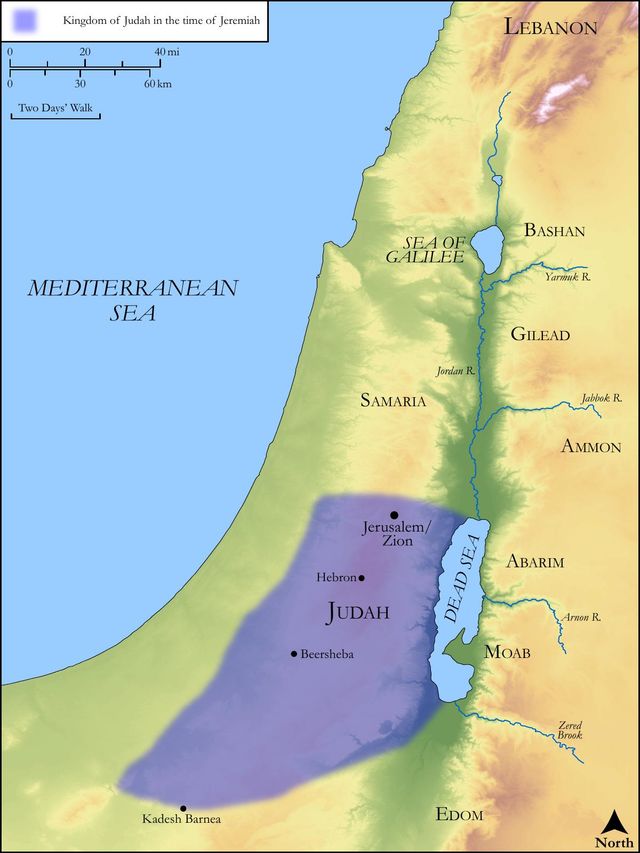
Study this verse
Public-domain commentary
Matthew Henry
From his Commentary on the Whole Bible. Henry comments on passages, not single verses — this entry covers Jeremiah 22:20–30. His three-level outline is real structure in the source text, so it is rendered as structure.
This prophecy seems to have been calculated for the ungracious inglorious reign of Jeconiah, or Jehoiachin, the son of Jehoiakim, who succeeded him in the government, reigned but three months, and was then carried captive to Babylon, where he lived many years, Jer 52:31. We have, in these verses, a prophecy,
I.Of the desolations of the kingdom, which were now hastening on apace, Jer 22:20-23.
Jerusalem and Judah are here spoken to, or the Jewish state as a single person, and we have it here under a threefold character: - 1. Very haughty in a day of peace and safety (Jer 22:21): "I spoke unto thee in thy prosperity, spoke by my servants the prophets, reproofs, admonitions, counsels, but thou saidst, I will not hear, I will not heed, thou obeyedst not my voice, and wast resolved that thou wouldst not, and hadst the front to tell me so." It is common for those that live at ease to live in contempt of the word of God. Jeshurun waxed fat, and kicked. This is so much the worse that they had it by kind: This has been thy manner from thy youth. They were called transgressors from the womb, Isa 48:8. 2. Very timorous upon the alarms of trouble (Jer 22:20): "When thou seest all thy lovers destroyed, when thou findest thy idols unable to help thee and thy foreign alliances failing thee, thou wilt then go up to Lebanon, and cry, as one undone and giving up all for lost, cry with a bitter cry; thou wilt cry, Help, help, or we are lost; thou wilt lift up thy voice in fearful shrieks upon Lebanon and Bashan, two high hills, in hope to be heard thence by the advantage of the rising ground. Thou wilt cry from the passages, from the roads, where thou wilt ever and anon be in distress." Thou wilt cry from Abarim (so some read it, as a proper name), a famous mountain in the border of Moab. "Thou wilt cry, as those that are in great consternation use to do, to all about thee; but in vain, for (Jer 22:22) the wind shall eat up all thy pastors, or rulers, that should protect and lead thee, and provide for thy safety; they shall be blasted, and withered, and brought to nothing, as buds and blossoms are by a bleak or freezing wind; they shall be devoured suddenly, insensibly, and irresistibly, as fruits by the wind. Thy lovers, that thou dependest upon and hast an affection for, shall go into captivity, and shall be so far from saving thee that they shall not be able to save themselves." 3. Very tame under the heavy and lasting pressures of trouble: "When there appears no relief from any of thy confederates, and thy own priests are at a loss, then shalt thou be ashamed and confounded for all thy wickedness," Jer 22:22. Note, Many will never be ashamed of their sins till they are brought by them to the last extremity; and it is well if we get this good by our straits to be brought by them to confusion for our sins. The Jewish state is here called an inhabitant of Lebanon, because that famous forest was within their border (Jer 22:23), and all their country was wealthy, and well-guarded as with Lebanon's natural fastnesses; but so proud and haughty were they that they are said to make their nest in the cedars, where they thought themselves out of the reach of all danger, and whence they looked with contempt upon all about them. "But, how gracious wilt thou be when pangs come upon thee! Then thou wilt humble thyself before God and promise amendment. When thou art overthrown in stony places thou wilt be glad to hear those words which in thy prosperity thou wouldst not hear, Psa 141:6. Then thou wilt endeavour to make thyself acceptable with that God whom, before, thou madest light of." Note, Many have their pangs of piety who, when the pangs are over, show that they have no true piety. Some give another sense of it: "What will all thy pomp, and state, and wealth avail thee? What will become of it all, or what comfort shalt thou have of it, when thou shalt be in these distresses? No more than a woman in travail, full of pains and fears, can take comfort in her ornaments while she is in that condition." So Mr. Gataker. Note, Those that are proud of their worldly advantages would do well to consider how they will look when pangs come upon them, and how they will then have lost all their beauty.
II.Here is a prophecy of the disgrace of the king; his name was Jeconiah, but he is here once and again called Coniah, in contempt.
The prophet shortens or nicks his name, and gives him, as we say, a nickname, perhaps to denote that he should be despoiled of his dignity, that his reign should be shortened, and the number of his months cut off in the midst. Two instances of dishonour are here put upon him: -
1.He shall be carried away into captivity and shall spend and end his days in bondage. He was born to a crown, but it should quickly fall from his head, and he should exchange it for fetters. Observe the steps of this judgment.
(1.)God will abandon him, Jer 22:24. The God of truth says it, and confirms it with an oath: "Though he were the signet upon my right hand (his predecessors have been so, and he might have been so if he had conducted himself well, but he being degenerated) I will pluck him thence." The godly kings of Judah had been as signets on God's right hand, near and dear to him; he had gloried in them, and made use of them as instruments of his government, as the prince does of his signet-ring, or sign manual; but Coniah has made himself utterly unworthy of the honour, and therefore the privilege of his birth shall be no security to him; notwithstanding that, he shall be thrown off. Answerable to this threatening against Jeconiah is God's promise to Zerubbabel, when he made him his people's guide in their return out of captivity (Hag 2:23): I will take thee, O Zerubbabel! my servant, and make thee as a signet. Those that think themselves as signets on God's right hand must not be secure, but fear lest they be plucked thence.
(2.)The king of Babylon shall seize him. Those know not what enemies and mischiefs they lie exposed to who have thrown themselves out of God's protection, Jer 22:25. The Chaldeans are here said to be such as had a spite to Coniah; they sought his life; no less than that, they thought, would satisfy their rage; they were such as he had a dread of (they are those whose face thou fearest) which would make it the more terrible to him to fall into their hands, especially when it was God himself that gave him into their hands. And, if God deliver him to them, who can deliver him from them?
(3.)He and his family shall be carried to Babylon, where they shall wear out many tedious years of their lives in a miserable captivity - he and his mother (Jer 22:26), he and his seed (Jer 22:28), that is, he and all the royal family (for he had no children of his own when he went into captivity), or he and the children in his loins; they shall all be cast out to another country, to a strange country, a country where they were not born, nor such a country as that where they were born, a land which they know not, in which they have no acquaintance with whom to converse or from whom to expect any kindness. Thither they shall be carried, from a land where they were entitled to dominion, into a land where they shall be compelled to servitude. But have they no hopes of seeing their own country again? No: To the land whereunto they desire to return, thither shall they not return, Jer 22:27. They conducted themselves ill in it when they were in it, and therefore they shall never see it more. Jehoahaz was carried to Egypt, the land of the south, Jeconiah to Babylon, the land of the north, both far remote, the quite contrary way, and must never expect to meet again, nor either of them to breathe their native air again. Those that had abused the dominion they had over others were justly brought thus under the dominion of others. Those that had indulged and gratified their sinful desires, by their oppression, luxury, and cruelty, were justly denied the gratification of their innocent desire to see their own native country again. We may observe something very emphatic in that part of this threatening (Jer 22:26), In the country where you were not born, there shall you die. As there is a time to be born and a time to die, so there is a place to be born in and a place to die in. We know where we were born, but where we shall die we know not; it is enough that our God knows. Let it be our care that we die in Christ, and then it will be well with us, wherever we die, though it should be in a far country.
(4.)This shall render him very mean and despicable in the eyes of all his neighbours. They shall be ready to say (Jer 22:28), "This is Coniah a despised broken idol? Yes, certainly he is, and much debased from what he was." [1.] Time was when he was dignified, nay, when he was almost deified. The people who had seen his father lately deposed were ready to adore him when they saw him upon the throne, but now he is a despised broken idol, which, when it was whole, was worshipped, but, when it is rotten and broken, is thrown by and despised, and nobody regards it, or remembers what it has been. Note, What is idolized will, first or last, be despised and broken; what is unjustly honoured will be justly contemned, and rivals with God will be the scorn of man. Whatever we idolize we shall be disappointed in and then shall despise. [2.] Time was when he was delighted in; but now he is a vessel in which is not pleasure, or to which there is no desire, either because grown out of fashion or because cracked or dirtied, and so rendered unserviceable. Those whom God has no pleasure in will, some time or other, be so mortified that men will have no pleasure in them.
2.He shall leave no posterity to inherit his honour. The prediction of this is ushered in with a solemn preface (Jer 22:29): O earth, earth, earth! hear the word of the Lord. Let all the inhabitants of the world take notice of these judgments of God upon a nation and a family that had been near and dear to him, and thence infer that God is impartial in the administration of justice. Or it is an appeal to the earth itself on which we tread, since those that dwell on earth are so deaf and careless, like that (Isa 1:2), Hear, O heavens! and give ear, O earth! God's word, however slighted, will be heard; the earth itself will be made to hear it, and yield to it, when it, and all the works that are therein, shall be burnt up. Or it is a call to men that mind earthly things, that are swallowed up in those things and are inordinate in the pursuit of them; such have need to be called upon again and again, and a third time, to hear the word of the Lord. Or it is a call to men considered as mortal, of the earth, and hastening to the earth again. We all are so; earth we are, dust we are, and, in consideration of that, are concerned to hear and regard the word of the Lord, that, though we are earth, we may be found among those whose names are written in heaven. Now that which is here to be taken notice of is that Jeconiah is written childless (Jer 22:30), that is, as it follows, No man of his seed shall prosper, sitting upon the throne of David. In him the line of David was extinct as a royal line. Some think that he had children born in Babylon because mention is made of his seed being cast out there (Jer 22:28) and that they died before him. We read in the genealogy (Ch1 3:17) of seven sons of Jeconiah Assir (that is, Jeconiah the captive) of whom Salathiel is the first. Some think that they were only his adopted sons, and that when it is said (Mat 1:12), Jeconiah begat Salathiel, no more is meant than that he bequeathed to him what claims and pretensions he had to the government, the rather because Salathiel is called the son of Neri of the house of Nathan, Luk 3:27, Luk 3:31. Whether he had children begotten, or only adopted, thus far he was childless that none of his seed ruled as kings in Judah. He was the Augustulus of that empire, in whom it determined. Whoever are childless, it is God that writes them so; and those who take no care to do good in their days cannot expect to prosper in their days.
Historical interpretation
Historical reception
2 surviving comments on this verse. Each one is dated, so this reads as a timeline rather than a list.
Select a marker to jump to its quote. Markers stagger vertically where authors wrote within a few decades of each other.
(Verse 24 and following) I live, says the Lord: Even if Coniah the son of Joachim king of Judah were a signet on my right hand, I would still pluck him (or you) out. And I will give you into the hand of those seeking your life, and into the hand of those you fear their faces, and into the hand of Nebuchadnezzar king of Babylon (which is not found in the Septuagint), and into the hand of the Chaldeans. And I will send you (or cast you) and your mother who bore you into a foreign land where you were not born: and there you will die. And to the land (Al. to the land moreover), to which they lift up their soul in order to return, they shall not return there. Above, he had said, to the house of the king of Judah you speak these things: and then, go down to the house of the king of Judah: again: thus says the Lord concerning the house of the king of Judah, and in reverse order, after he spoke of Zedekiah, who was the last of the kings in Jerusalem, he returns to his brother Joachim, who reigned before him. With the fulfillment of this prophecy, now he speaks to the son of Joachim, the grandson of Josiah, king of Jerusalem, Jechoniah, who is also called by another name Joachin, who was captured by Nebuchadnezzar with his mother, princes and craftsmen, and many nobles, and was led into Chaldea, and there he died. Therefore, it is said that if a ring does not depart from the hand of the bearer, and it slips off the finger with difficulty: so it will be in my hand, Jechonias; however, I will uproot him and deliver him to the king of Babylon, and there he will die with his mother and all his allies, and he will not see the land of Judah, which he desires, anymore. Miserable Grunnius, who opened his mouth to slander holy men and taught his tongue to speak falsehood, he interpreted one book of Sextus Pythagoras, a very noble man, into Latin; and he divided it into two volumes and dared to publish it under the name of the holy Martyr Xystus, bishop of the city of Rome: in which book there is no mention of Christ, no mention of the Holy Spirit, no mention of God the Father, no mention of the Patriarchs, Prophets, and Apostles; and with his usual recklessness and madness, he named this book 'The Ring', which is read in many provinces, especially by those who preach atheism and immorality. Therefore, in the same way that the Lord threatens to throw Jeconiah like a ring from his hand and finger, I beg the reader to cast aside this nefarious book; and if he wishes, to read it not as a ecclesiastical volume, but like the other books of philosophers. In my commentaries and explanations, it is customary to present the various opinions of interpreters and mix such discourse: some say this, others think that, some feel this way. Both the wretched Grunnius himself, and after many years the disciples of Jovinian, have slandered me and continue to slander me, attributing their own opinions to other names, which I do out of goodwill so as not to appear to harm anyone specifically. Therefore, since benevolence has turned into slander, I now declare, both to those who are dead and to those who are alive and attempting to revive his heresy, that their teacher Origen refers this passage to Christ, whom, like a ring taken from the hand of God the Father, was sent into the land of captivity, into the valley of tears, and handed over to the cross. And he does not hesitate to mention this, as is evident from what follows: Earth, earth, earth, hear the word of the Lord. Thus says the Lord: Write about this detestable, or barren, man, and the rest, to understand about the Lord of majesty. He writes this so that his disciples may not dare to deny it, in the fifth book of Stromata.
Since they did not imitate the piety of their ancestors though taking pride in their kinship with them—making much of Abraham, Isaac, Israel, David, Hezekiah and Josiah, men conspicuous for their virtue—for this reason the God of all rejects the arrogance of Jeconiah in these words: Even if he were a ring and were placed on my right hand, I would pull it off and hand it over to the enemy. Thus, let him not trust in his forebears’ virtue without emulating their virtue.
Continue studying Jeremiah 22:25 across the web’s major study libraries — every link below opens this exact verse, chapter, or book on the destination site.
Read & Compare
 BibleGatewayThis verse in more than 200 translations and 70 languages.
 Bible.comThe YouVersion reader — hundreds of translations, reading plans, and highlights.
 ESV.orgCrossway's official English Standard Version reader.
 NET BibleThe NET translation with 60,000+ translators' notes on every rendering decision.
 STEP BibleTyndale House's free study tool — original text, vocabulary, and scholarly resources.
 BibliaLogos Bible Software's free web reader.
 USCCBThe New American Bible (Revised Edition) with the U.S. bishops' study notes.
Commentaries
 BibleHub CommentariesDozens of classic commentaries on this verse, gathered on one page.
 StudyLightMore than 100 commentary sets — the largest collection on the web.
 BibleRefPlain-English commentary on what this verse means, verse by verse.
 Enduring WordDavid Guzik's free commentary on this chapter, widely used by Bible teachers.
 Bible Study ToolsVerse commentary alongside Greek and Hebrew study aids.
Original Language & Research
- BibleHub InterlinearThe verse word by word — original language, transliteration, and English.
- BibleHub LexiconEvery word's original-language definition and Strong's entry.
 Blue Letter BibleDeep-study tools — Strong's numbers, concordance, and word studies.
 SefariaThe Hebrew text with Rashi and centuries of Jewish commentary.
Sermons, Hymns & Audio


TrulyRandomVerse is not affiliated with these sites and doesn’t control their content. They’re linked because they’re genuinely useful.
Summary
Jeremiah 22:25 delivers a powerful and unyielding prophecy of divine judgment against King Coniah (Jehoiachin) of Judah. It unequivocally declares that God Himself will orchestrate the king's downfall, delivering him into the control of his most feared adversaries—specifically naming Nebuchadrezzar, king of Babylon, and the Chaldeans. This verse underscores God's absolute sovereignty over earthly rulers and nations, revealing that even a king's perceived power is subject to the divine will, especially in response to covenant unfaithfulness and persistent sin.
Context
ShowHideLiterary Context
Jeremiah 22:25 is situated within a series of prophetic oracles (Jeremiah 21-23) that pronounce judgment against the corrupt kings of Judah and their unrighteous rule, contrasting their failures with the ideal of a righteous monarch. Chapters 21 and 22 specifically address Zedekiah and the royal house, culminating in a direct and severe indictment of Coniah (also known as Jeconiah or Jehoiachin) from Jeremiah 22:24. The preceding verses in chapter 22 had already warned of the dire consequences of failing to uphold justice and righteousness, particularly for the royal house. This specific prophecy against Coniah is particularly harsh, emphasizing his complete rejection and impending exile, reinforcing the message that no one, regardless of lineage or position, is exempt from divine judgment for disobedience. The subsequent verses in Jeremiah 22:28-30 further detail Coniah's fate and the end of his direct royal line, solidifying the finality of this judgment.
Historical & Cultural Context
The prophecy against Coniah occurred during a tumultuous period in Judah's history, as the Neo-Babylonian Empire, under the formidable leadership of Nebuchadrezzar, was rapidly asserting its dominance over the nations round about. Coniah reigned for a mere three months and ten days in 597 BC, following the death of his father, Jehoiakim. Judah was a tributary kingdom, constantly caught between the geopolitical ambitions of Egypt and Babylon. The "Chaldeans" were the ruling dynasty of Babylonia at this time, often used synonymously with Babylonians in prophetic literature. Among the nations, kingship often involved the belief that a king's success or failure was tied to his relationship with his gods. Jeremiah's message directly challenges this, asserting that Judah's God, Yahweh, is the supreme sovereign who actively uses foreign powers, even powerful empires like Babylon, as instruments of His judgment against His disobedient people and their unfaithful leaders. The phrase "seek thy life" (Hebrew: bâqash nephesh) was a common idiom for plotting to kill or utterly destroy someone, indicating the extreme danger Coniah faced.
Key Themes
ShowHideJeremiah 22:25 powerfully contributes to several overarching themes within the book of Jeremiah and broader biblical theology. Firstly, it highlights Divine Sovereignty and Judgment, demonstrating that God is the ultimate authority, capable of delivering even kings into the hands of their enemies as a consequence of their sin. This is a recurring motif, as seen in God's use of Assyria in Isaiah 10:5 or the explicit declaration that Nebuchadnezzar is God's servant. Secondly, the verse underscores the Consequences of Disobedience and Covenant Unfaithfulness. Coniah's short, ill-fated reign and subsequent exile serve as a stark example of the severe repercussions for Judah's persistent rebellion against God's covenant commands. Thirdly, it reinforces the theme of Prophetic Fulfillment, as Jeremiah's specific and detailed predictions regarding Coniah's fate and the role of Babylon were precisely actualized in historical events, lending immense credibility to Jeremiah's divine commission and the truthfulness of God's word.
Exposition and Analysis
ShowHideKey Word Analysis
ShowHideThis primitive root signifies "to give," but with immense latitude in application, including "put," "make," "deliver (up)," or "commit." In Jeremiah 22:25, God's declaration "I will give thee" emphasizes His active agency and sovereign control over Coniah's fate. It is not merely a passive allowance but an intentional act of divine delivery, underscoring that Nebuchadrezzar is an instrument in God's hand, not an independent force.
This word, literally referring to the open hand, is used extensively in a vast array of literal and figurative applications. Here, the repeated phrase "into the hand of" is a powerful idiom signifying being delivered into the power, control, or dominion of another. It denotes complete subjugation and vulnerability, emphasizing Coniah's utter helplessness once God's judgment is enacted. The repetition amplifies the inescapable nature of this transfer of power.
This root means "to search out," "strive after," "desire," or "enquire." When paired with "life" (nephesh), as in "seek thy life," it denotes a determined and active pursuit to harm, destroy, or even kill. It highlights the hostile and relentless intent of Coniah's enemies, who are not merely opportunists but actively pursuing his demise.
Verse Breakdown
ShowHide"And I will give thee into the hand of them that seek thy life"
This opening clause immediately establishes God as the primary agent of judgment. The pronoun "I" refers to Yahweh, the God of Israel, asserting His sovereign authority over the king. "Give thee" signifies a deliberate act of handing over, a divine surrender of Coniah to his enemies. "Them that seek thy life" identifies the adversaries as those with hostile and destructive intent, actively plotting against Coniah's very existence, implying a threat to his person, reign, and freedom.
"and into the hand [of them] whose face thou fearest"
This phrase serves as a parallel and intensifying description of the same hostile party. "Whose face thou fearest" reveals Coniah's internal state and the identity of his oppressors from his perspective. It indicates that these enemies are not unknown or insignificant; they are a formidable and terrifying force that inspires dread in the king himself, highlighting the profound psychological and political impact of their power.
"even into the hand of Nebuchadrezzar king of Babylon"
This clause provides the specific and unambiguous identification of the primary instrument of God's judgment. Nebuchadrezzar, the powerful monarch of the Neo-Babylonian Empire, is named directly, leaving no doubt about the precise nature and source of the impending subjugation. This specificity underscores the prophetic accuracy and the historical reality of the coming events.
"and into the hand of the Chaldeans."
This final clause further clarifies and reinforces the identity of the oppressive force. The "Chaldeans" were the dominant ethnic group and ruling dynasty of Babylonia. This phrase functions as a synonymous parallel to "Nebuchadrezzar king of Babylon," emphasizing the collective might and unified threat of the Babylonian empire, ensuring the message of inescapable captivity is fully understood.
Literary Devices
ShowHideJeremiah 22:25 employs several powerful literary devices to convey its message of divine judgment and inescapable fate. Repetition is prominently used with the phrase "into the hand of," appearing four times. This anaphora emphasizes the absolute and inescapable transfer of power, highlighting Coniah's utter helplessness and the complete control of his adversaries. It underscores the divine agency in this delivery, as God is the one who "gives" him over. The use of Specific Naming ("Nebuchadrezzar king of Babylon," "the Chaldeans") grounds the prophecy in concrete historical reality, removing any ambiguity about the identity of the instruments of judgment and bolstering the prophecy's credibility. Furthermore, Parallelism is evident in the descriptions of Coniah's enemies: "them that seek thy life" and "them whose face thou fearest" are synonymous phrases that describe the same hostile force from different perspectives—their destructive intent and the king's terror. Similarly, "Nebuchadrezzar king of Babylon" and "the Chaldeans" function as synonymous parallels, reinforcing the identity of the foreign power. This layered description intensifies the sense of impending doom and the overwhelming nature of the threat. Finally, the declaration "I will give thee" exemplifies Divine Agency, portraying God not as a passive observer but as the active orchestrator of these events, wielding nations as instruments of His righteous judgment.
Theological and Thematic Connections
ShowHideJeremiah 22:25 stands as a stark testament to God's unwavering sovereignty over all earthly powers and His commitment to justice, particularly concerning the covenant people and their leaders. It powerfully illustrates that divine judgment is not arbitrary but a direct consequence of persistent disobedience and a failure to uphold righteousness, even for those in positions of power. The verse demonstrates God's capacity to use unlikely instruments, even pagan empires like Babylon, to accomplish His divine purposes and enforce His righteous decrees. This highlights a profound theological truth: no human authority, however mighty, can ultimately thwart the will of the Almighty. The prophecy's specificity regarding Nebuchadrezzar and the Chaldeans also underscores the reliability and precision of God's prophetic word, which finds its ultimate fulfillment in history.
Reflection and Application
ShowHideJeremiah 22:25 serves as a profound and sobering reminder of God's ultimate authority over all human affairs, particularly over those in positions of leadership. For contemporary leaders, whether in government, business, or the church, this verse underscores the immense responsibility that comes with power. It calls them to govern with righteousness, justice, and integrity, recognizing that their actions are not only subject to human scrutiny but ultimately to divine judgment. For all believers, this passage reinforces the principle that disobedience to God's revealed will carries severe consequences, while faithfulness leads to blessing. It encourages a deep trust in God's sovereign control, even when circumstances appear chaotic or overwhelming, knowing that He orchestrates all events, even through seemingly hostile forces, to accomplish His perfect and just purposes. This should inspire both reverence for God's power and a commitment to living in alignment with His commands, regardless of our station in life.
Questions for Reflection
ShowHideFAQ
ShowHideWas King Coniah truly as wicked as his father, Jehoiakim, to warrant such a severe prophecy?
ShowHideWhile Coniah's reign was exceptionally brief (three months and ten days), the biblical record suggests he "did evil in the sight of the Lord, according to all that his father had done" (2 Kings 24:9). Jeremiah's prophecies often condemned the cumulative sin of the royal house and the nation, not just individual acts. Coniah inherited a kingdom steeped in idolatry and injustice, and his failure to reverse course or demonstrate repentance, even in such a short time, marked him as continuing the pattern of unfaithfulness that invited divine judgment. The severity of the prophecy reflects God's unwavering commitment to His covenant and His intolerance for persistent rebellion, particularly from those entrusted with leading His people.
How does God "give" a king into the hand of an enemy? Does He directly intervene or simply allow events to unfold?
ShowHideThe phrase "I will give thee" (Hebrew: nâthan) signifies God's active and deliberate agency. It's not merely passive permission but an intentional act of divine orchestration. While God uses human instruments and historical circumstances (like the rise of the Babylonian Empire), the biblical perspective is that He is ultimately directing these events to fulfill His purposes. In this case, God actively "gave" Coniah over by withdrawing His protective hand from Judah, allowing Babylon to succeed in its conquest, and ensuring that the king's capture and exile were part of His sovereign plan for judgment and eventual restoration. This concept is seen elsewhere, such as when God "hardened Pharaoh's heart" (Exodus 9:12) or when He raised up Assyria as "the rod of My anger" (Isaiah 10:5).
Christ-Centered Fulfillment
ShowHideJeremiah 22:25, with its stark portrayal of a disobedient king delivered into the hands of his enemies by divine decree, finds profound Christ-centered fulfillment not in a literal parallel, but in a dramatic reversal and ultimate triumph. Coniah, a failed earthly king, was "given" by God into the hands of Babylon for judgment due to his and his people's sin. In striking contrast, Jesus, the true King of Israel and the Son of God, was also "given" into the hands of His enemies—the religious authorities and the Roman state—but not for His own sin, for He knew no sin (2 Corinthians 5:21). Rather, He was "delivered up according to the definite plan and foreknowledge of God" (Acts 2:23) as the ultimate sacrifice for the sins of humanity. While Coniah's delivery led to exile and the end of his earthly reign, Christ's delivery led to the cross, then to resurrection, and ultimately to His enthronement as King of kings and Lord of lords (Revelation 19:16). The fear Coniah felt before Nebuchadrezzar is replaced by the victory of Christ, who conquered death and the grave, disarming the powers and authorities (Colossians 2:15). Thus, Jeremiah 22:25, in its depiction of divine sovereignty over judgment, foreshadows the even greater divine sovereignty over redemption, where God "gave His only Son" (John 3:16) not to destroy, but to save, establishing an eternal kingdom that will never be delivered into the hand of any foe.