


Isaiah 17:13
Bible text: King James Version (1769 Blayney text) · Public domain
Bible text: King James Version with Strong's numbers · Public domain
Bible text: Berean Standard Bible · Public domain
Bible text: American Standard Version (1901) · Public domain
Bible text: World English Bible, Messianic edition · Public domain
Bible text: Geneva Bible (1599) · Public domain
Bible text: Young's Literal Translation · Public domain
- לְאֻמִּיםle·'u·MimnationsH3816N-mpNoun Plural Masculine Absolute
- כִּשְׁאוֹןkish·'onlike [the] uproar ofH7588Prep-k ¦ N-mscNoun Singular Masculine Constructכִּlikeשְׁאוֹן[the] uproar of
- מַיִםMa·yimwatersH4325N-mpNoun Plural Masculine Absolute
- רַבִּיםra·BimmanyH7227Adj-mpAdjective Plural Masculine Absolute
- יִשָּׁאוּןyi·sha·'Unthey are in an uproar !H7582V-Niphal-Imperf-3mp ¦ SfxVerb Niphal Imperfect 3rd Plural Masculineיִשָּׁאוּthey are in an uproarן!
- וְגָעַרve·Ga·'arand he will rebukeH1605Conj-w ¦ V-Qal-ConsecPerf-3msVerb Qal Consecutive Perfect 3rd Singular Masculineוְandגָעַרhe will rebuke
- בּוֹbo<in> itPrep-b ¦ 3msSuffix Personal 3rd Singular Masculineבּ<in>וֹit
- וְנָסve·Nasand it will fleeH5127Conj-w ¦ V-Qal-ConsecPerf-3msVerb Qal Consecutive Perfect 3rd Singular Masculineוְandנָסit will flee
- מִמֶּרְחָקmi·mer·Chakfrom a distanceH4801Prep-m ¦ N-msNoun Singular Masculine Absoluteמִfromמֶּרְחָקa distance
- וְרֻדַּףve·ru·Dafand it will be chasedH7291Conj-w ¦ V-Pual-ConsecPerf-3msVerb Pual Consecutive Perfect 3rd Singular Masculineוְandרֻדַּףit will be chased
- כְּמֹץke·Motzlike chaff ofH4671Prep-k ¦ N-mscNoun Singular Masculine Constructכְּlikeמֹץchaff of
- הָרִיםha·RimmountainsH2022N-mpNoun Plural Masculine Absolute
- לִפְנֵיlif·nei<to> beforeH6440Prep-l ¦ N-mpcNoun Plural Masculine Constructלִ<to>פְנֵיbefore
- רוּחַRu·acha windH7307N-fsNoun Singular Feminine Absolute
- וּכְגַלְגַּלu·khe·gal·Galand like whirling dustH1534Conj-w ¦ Prep-k ¦ N-msNoun Singular Masculine Absoluteוּandכְlikeגַלְגַּלwhirling dust
- לִפְנֵיlif·Nei<to> beforeH6440Prep-l ¦ N-mpcNoun Plural Masculine Constructלִ<to>פְנֵיbefore
- סוּפָהsu·Faha storm-windH5492N-fsNoun Singular Feminine Absolute
English is a literal word-by-word gloss of the Hebrew, not the KJV's wording. Why?
This is the original text the KJV's translators worked from — each Hebrew word with its own literal English meaning in this verse, prepared by scholars at Tyndale House, Cambridge. The KJV translates whole sentences, not word by word, so its wording differs: one Hebrew word can become several English words, and the KJV may choose “the LORD” where the gloss reads “Yahweh”. Both are faithful — they answer different questions. For the KJV's own rendering, switch to the KJV text.
Details
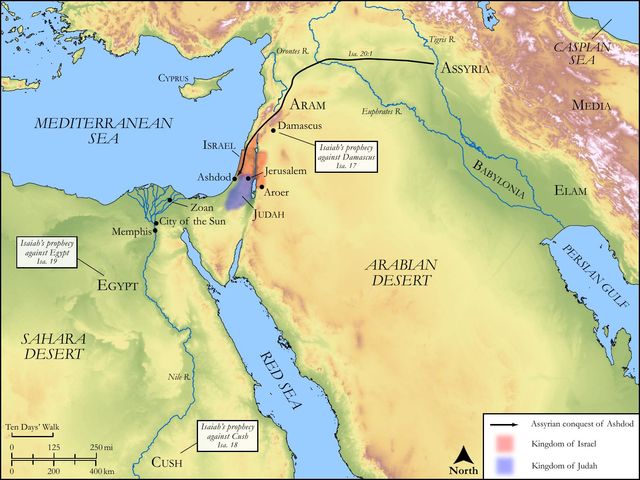
See on the biblical-era map
Study this verse
Public-domain commentary
Matthew Henry
From his Commentary on the Whole Bible. Henry comments on passages, not single verses — this entry covers Isaiah 17:12–14.
These verses read the doom of those that spoil and rob the people of God. If the Assyrians and Israelites invade and plunder Judah, if the Assyrian army take God's people captive and lay their country waste, let them know that ruin will be their lot and portion. They are here brought in, 1. Triumphing over the people of God. They relied upon their numbers. The Assyrian army was made up out of divers nations: it was the multitude of many people (Isa 17:12), by which weight they hoped to carry the cause. They were very noisy, like the roaring of the seas; they talked big, hectored, and threatened, to frighten God's people from resisting them, and all their allies from sending in to their aid. Sennacherib and Rabshakeh, in their speeches and letters, made a mighty noise to strike a terror upon Hezekiah and his people; the nations that followed them made a rushing like the rushing of many waters, and those mighty ones, that threaten to bear down all before them and carry away every thing that stands in their way. The floods have lifted up their voice, have lifted up their waves; such is the tumult of the people, and the heathen, when they rage, Psa 2:1; Psa 93:3. 2. Triumphed over by the judgments of God. They thought to carry their point by dint of noise; but woe to them (Isa 17:12), for he shall rebuke them, that is, God shall, one whom they little think of, have no regard to, stand in no awe of; he shall give them a check with an invisible hand, and then they shall flee afar off. Sennacherib, and Rabshakeh, and the remains of their forces, shall run away in a fright, and shall be chased by their own terrors, as the chaff of the mountains which stand bleak before the wind, and like a rolling thing before the whirlwind, like thistle-down (so the margin); they make themselves as chaff before the wind (Psa 35:5) and then the angel of the Lord (as it follows there), the same angel that slew many of them, shall chase the rest. God will make them like a wheel, or rolling thing, and then persecute them with his tempest and make them afraid with his storm, Psa 83:13, Psa 83:15. Note, God can dispirit the enemies of his church when they are most courageous and confident, and dissipate them when they seem most closely consolidated. This shall be done suddenly (Isa 17:14): At evening-tide they are very troublesome, and threaten trouble to the people of God; but before the morning they are not. At sleeping time they are cast into a deep sleep, Psa 26:5, Psa 26:6. It was in the night that the angel routed the Assyrian army. God can in a moment break the power of his church's enemies, even when it appears most formidable; and this is written for the encouragement of the people of God in all ages, when they find themselves an unequal match for their enemies; for this is the portion of those that spoil us, they shall themselves be spoiled. God will plead his church's cause, and those that meddle do it to their own hurt.
Historical interpretation
Historical reception
3 surviving comments on this verse. Each one is dated, so this reads as a timeline rather than a list.
Those who believe that the captivity of Damascus discussed above was inflicted by the Romans also refer what is written here to the time of Christ and the apostles: “People will bow to their Creator, and their eyes will look to the holy one of Israel.” They further think that what follows, namely, “You will plant faithful plants, and you will sow strange seeds; in the day of your planting, the wild grape” applies to the infidelity of the Jews. And this little passage that we just set forth they interpret as concerning the peoples who persecute the church. The next line, “he will rebuke him, and he will flee far away,” they receive as concerning the devil, demonstrating the destruction of persecutors and demons through a tropological interpretation. We, however, follow the original order and complete the historical foundation with a historical culmination. Woe, it says, to all the nations who wage war against my people, whose attack was strong enough to be compared to the waves of the sea. But when raging warriors come and inundate my land, then their prince Sennacherib will flee from them, rebuked, and they will be scattered like dust in a plundering storm. As the top of a whirl-wind revolves, so will he be struck by an angel when he approaches Jerusalem to besiege her. He will come in the morning and witness his powerful army destroyed. And “this is the portion of those who despoil us.” This prophet speaks either in the person of the people or as though uniting himself to his nation.
(Verse 12 and following) Woe to the multitude of many peoples, like the roaring of the sea, and the tumult of the nations, they shall make a sound like the noise of many waters. The peoples shall sound like the noise of abundant waters: and he shall rebuke him, and he shall flee far off: and he shall be carried away as dust of the mountains before the wind, and as a whirlwind before a tempest. In the evening, and behold trouble: in the morning, and he shall not be. This is the portion of them that have wasted us, and the lot of them that spoiled us. Above, we read about the calling of the Gentiles and the rejection of the Jews, and also about the election of a few Jews among the Apostles. And since in comparison to the whole world and all the nations, only a small part of the people believed in Christ, as it was said above: 'And the remnant of Syria shall be as the glory of the children of Israel' (for 'many are called, but few are chosen' - Matthew 22:14) and 'not all have faith' (2 Thessalonians 3:2), now it follows that there is not mourning, but woe to those nations who refused to believe and persecuted the Christian people. And they are compared to the mass of waves and the roaring sea, and as much as is within them, they desire to overwhelm and occupy everything. For the people will sound forth in the spectacles of theatrical luxury, and in the cruelty of the amphitheater, and in the madness of the circus, just as the sound of overflowing waters, when with a united voice of impiety they blaspheme, and they say to the Christians, 'Throw them to the lions and beasts,' and other things of this kind. But to them, like raging seas, the Lord will rebuke the instigator of their sedition, and He will drive him away from His people. And as dust moved on the mountains, the higher it is, the stronger it is carried away; and as a whirlwind, which rises from the earth, is carried away into the sky by a sudden storm: so also he, being carried away, will be separated from the people of God and will flee, lest he be relegated to the abyss. And when the day of consummation comes, which is interpreted as evening, then there will be turmoil, acknowledging his sins. And in the morning, on the day of resurrection, it will not continue, as the LXX translated, it will not be. But if it will not be, what will those who give penance to the devil respond, and they promise as much as they can, an archangelic rank? This is the role of those who have devastated us, and the fate of those who will plunder us. This is either the speech of the Christian people or the prophet speaking from the perspective of the believing people, that the persecutors will have eternal destruction, who have oppressed the holy ones of God with exile, imprisonment, and the seizure of goods, and will possess eternal punishments.
(Verses 12-14.) Woe to the multitude of many peoples, as the sound of the roaring sea: and the tumult of nations, like the sound of many waters. The peoples will make noise, like the sound of overflowing waters: and they will rebuke him, and he will flee far away: and he will be carried away like the dust of mountains before the wind, and like a whirlwind before a storm. At evening time: and behold, there will be trouble in the morning, and it will not continue. This is their portion, who have plundered us, and their lot, who have taken us away. Those who consider the captivity of Damascus inflicted by the Romans, and this which is written: Man shall bow down to his Maker, and his eyes shall look to the Holy One of Israel, refer to the times of Christ and the Apostles. They also understand the following: You will plant a faithful plantation, and you will sow a foreign branch: on the day of your plantation the wild vine, etc., they perceive the unfaithfulness of the Jews. And this chapter that we have now presented is interpreted by the Gentiles who persecute the Church. Moreover, what follows is understood to be about the devil, with a tropological interpretation illustrating the devastation caused by persecutors and demons. But we follow the sequential order and protect the historical foundations with historical insight. Woe, he says, to all the nations that have fought against my people, whose force was so great that it could be compared to the waves of the sea. But when they come raging and flood my land, then their leader Sennacherib will flee, reproached by him, and be scattered like dust carried by the wind, and whirled up into the sky like a storm. Indeed, he will approach Jerusalem, besieging it, but he will be struck down by an angel; he will come in the morning, and he will see his army destroyed, the power of his might gone. And this will be the portion of those who devastated us. The Prophet speaks either on behalf of the people or joins himself to his own nation (IV Kings XIX, 35, 36). Afterwards we read: The Angel of the Lord went out and struck down in the camp of the Assyrians one hundred and eighty-five thousand; and they arose early in the morning, and behold, all the dead bodies. So Sennacherib king of the Assyrians departed and returned and lived in Nineveh.
Continue studying Isaiah 17:13 across the web’s major study libraries — every link below opens this exact verse, chapter, or book on the destination site.
Read & Compare
 BibleGatewayThis verse in more than 200 translations and 70 languages.
 Bible.comThe YouVersion reader — hundreds of translations, reading plans, and highlights.
 ESV.orgCrossway's official English Standard Version reader.
 NET BibleThe NET translation with 60,000+ translators' notes on every rendering decision.
 STEP BibleTyndale House's free study tool — original text, vocabulary, and scholarly resources.
 BibliaLogos Bible Software's free web reader.
 USCCBThe New American Bible (Revised Edition) with the U.S. bishops' study notes.
Commentaries
 BibleHub CommentariesDozens of classic commentaries on this verse, gathered on one page.
 StudyLightMore than 100 commentary sets — the largest collection on the web.
 BibleRefPlain-English commentary on what this verse means, verse by verse.
 Enduring WordDavid Guzik's free commentary on this chapter, widely used by Bible teachers.
 Bible Study ToolsVerse commentary alongside Greek and Hebrew study aids.
Original Language & Research
- BibleHub InterlinearThe verse word by word — original language, transliteration, and English.
- BibleHub LexiconEvery word's original-language definition and Strong's entry.
 Blue Letter BibleDeep-study tools — Strong's numbers, concordance, and word studies.
 SefariaThe Hebrew text with Rashi and centuries of Jewish commentary.
Sermons, Hymns & Audio


TrulyRandomVerse is not affiliated with these sites and doesn’t control their content. They’re linked because they’re genuinely useful.
Summary
Isaiah 17:13 presents a powerful prophetic vision of God's absolute sovereignty over the nations. It vividly portrays the initial terrifying surge of hostile earthly powers, likened to an overwhelming flood, only to immediately pivot to the Lord's effortless rebuke. This divine intervention scatters these formidable adversaries, reducing their might to the insignificance of chaff before the wind or a rolling tumbleweed caught in a whirlwind, thereby demonstrating the futility of human strength when confronted by the Almighty.
Context
ShowHideLiterary Context
Isaiah chapter 17 is a prophetic oracle primarily directed against Damascus, the capital of Syria, and Ephraim, the Northern Kingdom of Israel. These two entities had formed an alliance against Judah (as detailed in Isaiah 7) and were also prone to idolatry and reliance on human alliances rather than trusting in the Lord. The chapter opens with pronouncements of judgment against Damascus, foretelling its destruction and transformation into a ruinous heap (Isaiah 17:1). It then extends this judgment to Ephraim, lamenting its spiritual decline and the weakening of its fortified cities (Isaiah 17:4-6). Within this broader context of impending judgment, verse 13 serves as a stark illustration of the overwhelming nature of the hostile forces (likely Assyria, the instrument of God's judgment) and, more importantly, the decisive and ultimate power of God to disperse them. It acts as a powerful climax to the description of the nations' initial advance.
Historical & Cultural Context
The prophecies in Isaiah 17 are set against the turbulent backdrop of the 8th century BC, a period dominated by the relentless expansion of the Neo-Assyrian Empire. Assyria, a formidable military power, was systematically conquering smaller kingdoms, including Syria and Israel. Damascus and Ephraim, seeking to resist Assyrian aggression, formed alliances and often looked to other human powers for security, rather than relying on their covenant God. The imagery of "rushing waters" would have resonated deeply with an ancient audience familiar with destructive floods and overwhelming military invasions. The agricultural imagery of "chaff" and "wind" was also common, representing worthlessness and swift dispersal, a stark contrast to the perceived solidity and power of nations. This historical reality underscores the prophetic message: even the most powerful empires are transient and ultimately subject to divine decree, highlighting the futility of trusting in human strength or alliances.
Key Themes
ShowHideThis verse powerfully encapsulates several overarching themes prevalent in Isaiah and the broader prophetic literature. Foremost is the theme of Divine Sovereignty, asserting God's absolute control over all earthly powers and their destinies, regardless of their apparent might or ambition. This is a recurring motif, as seen in Psalm 2:4 where the Lord laughs at the nations' schemes. Closely related is the theme of God's Judgment, demonstrating the swift and decisive nature of His intervention against those who oppose His will or His people. His "rebuke" alone is sufficient to scatter even the most formidable adversaries, underscoring that His word carries ultimate authority, as highlighted in Psalm 33:9. Finally, the imagery of "chaff" and "rolling thing" emphasizes the Futility of Human Power when confronted by divine might. Nations, despite their initial terrifying advance, are ultimately ephemeral and easily dispersed, illustrating the transient nature of worldly kingdoms compared to God's eternal dominion, a concept echoed in Daniel 2:35.
Exposition and Analysis
ShowHideKey Word Analysis
ShowHideDerived from a root meaning "to rush," this noun conveys a tumultuous, noisy, overwhelming sound and movement, often associated with a great flood or a chaotic multitude. In this context, it vividly portrays the initial terrifying and seemingly unstoppable advance of the hostile nations, emphasizing their destructive force and disorienting clamor.
A primitive root meaning "to chide" or "reprove," this word signifies a powerful, authoritative command that causes immediate submission, cessation, or dispersal. It implies a stern, divine reprimand that does not involve physical struggle but rather a word of power that instantly brings about the desired effect, demonstrating God's effortless control over even the mightiest adversaries.
This term refers to the husks of grain, separated during winnowing. It is consistently used in biblical literature as a metaphor for worthlessness, lightness, and something easily scattered and destroyed by the wind. Its application here powerfully illustrates the utter insignificance and powerlessness of the nations when confronted by God's might, contrasting their initial formidable appearance with their ultimate vulnerability.
Verse Breakdown
ShowHide"The nations shall rush like the rushing of many waters"
This clause sets the scene, depicting the overwhelming and terrifying advance of hostile nations. The simile to "many waters" evokes the imagery of a destructive flood—vast, noisy, and seemingly unstoppable—emphasizing the sheer number and force of the invading armies. It captures the initial human perception of their formidable power.
"but [God] shall rebuke them, and they shall flee far off"
This marks a dramatic turning point. The conjunction "but" introduces a sharp contrast to the preceding imagery. God's intervention is not a physical battle but a mere "rebuke"—a powerful, authoritative command. This single act is sufficient to cause the nations, previously depicted as an unstoppable flood, to immediately "flee far off," highlighting the effortless ease and absolute efficacy of divine power.
"and shall be chased as the chaff of the mountains before the wind, and like a rolling thing before the whirlwind"
This final clause provides two vivid similes that illustrate the complete and utter defeat and dispersal of the nations. From an overwhelming flood, they are reduced to "chaff," worthless and easily scattered by the wind, and a "rolling thing" (like a tumbleweed), without control or direction, tossed about by a "whirlwind." This imagery underscores their powerlessness, insignificance, and the swiftness of their dispersal, emphasizing the finality of God's judgment and their utter lack of substance when faced with His might.
Literary Devices
ShowHideIsaiah 17:13 is rich in Imagery and Simile, employing vivid comparisons to convey its powerful message. The initial depiction of "nations shall rush like the rushing of many waters" uses a Simile to evoke a sense of overwhelming, chaotic, and destructive power, akin to an unstoppable flood. This is immediately contrasted by God's effortless intervention, creating a stark Antithesis or Contrast between human might and divine sovereignty. The subsequent descriptions, "chased as the chaff of the mountains before the wind" and "like a rolling thing before the whirlwind," are further Similes that powerfully illustrate the utter insignificance and swift dispersal of the nations once God acts. The use of "chaff" and "rolling thing" also serves as Symbolism for worthlessness, transience, and powerlessness. The very idea of God merely "rebuking" such a formidable force exemplifies Divine Omnipotence, where a word is sufficient to achieve ultimate victory, contrasting sharply with the initial Hyperbole used to describe the nations' terrifying advance.
Theological and Thematic Connections
ShowHideIsaiah 17:13 profoundly articulates the biblical truth of God's supreme sovereignty over all earthly powers and the ultimate futility of human strength apart from Him. It serves as a powerful reminder that while nations may rise and fall, and their armies may seem invincible, they are ultimately subject to the divine will. God's "rebuke" is not merely a verbal reprimand but an act of supreme authority that effortlessly dismantles human pride and ambition. This demonstrates that true security and lasting peace are found not in military might or strategic alliances, but in humble reliance upon the Lord, who alone can orchestrate the course of history and bring about His purposes. The verse underscores the transient nature of all worldly kingdoms in contrast to the eternal and unshakeable reign of God.
Reflection and Application
ShowHideIsaiah 17:13 offers profound spiritual nourishment and practical guidance for believers navigating a world often characterized by geopolitical turmoil and overwhelming challenges. In moments when the "rushing of many waters"—whether global crises, personal struggles, or societal pressures—threatens to engulf us, this verse anchors our hope in the unwavering sovereignty of God. It reminds us that no force, no matter how formidable or chaotic it appears, can stand against the Lord's authoritative word. Our confidence should not be placed in human institutions, political leaders, or even our own strength, but solely in the Almighty God who can scatter the mightiest adversaries with a mere "rebuke." This truth liberates us from anxiety and fear, calling us to a deeper trust and reliance on Him. It also serves as a warning against pride and self-sufficiency, both individually and nationally, urging humility and recognition of divine authority as the true source of stability and peace.
Questions for Reflection
ShowHideFAQ
ShowHideWhat is the primary message of Isaiah 17:13?
ShowHideThe primary message of Isaiah 17:13 is a powerful declaration of God's absolute sovereignty and control over all nations and their seemingly overwhelming power. It illustrates that while human forces may appear formidable and destructive, they are ultimately powerless before the divine "rebuke" and are easily scattered and rendered insignificant by God's will. This verse serves as a reminder that the Lord alone holds ultimate authority over the course of history and the destinies of kingdoms, a theme echoed throughout the prophetic books, such as in Daniel 4:17.
How does this verse relate to the broader context of Isaiah's prophecies?
ShowHideIsaiah 17:13 fits seamlessly into the broader context of Isaiah's prophecies, particularly those concerning judgment against the nations and the ultimate vindication of God's people. Chapters 13-23 of Isaiah contain a series of oracles against various foreign nations, demonstrating God's universal dominion. This specific verse, within the oracle against Damascus and Ephraim, reinforces the idea that even the most powerful regional players, like Assyria (who would be God's instrument of judgment), are merely tools in His hand. It highlights the futility of trusting in human alliances or military strength, urging reliance on the Lord alone, a central message throughout Isaiah, as seen in Isaiah 31:1.
Christ-Centered Fulfillment
ShowHideIsaiah 17:13, though an Old Testament prophecy concerning the nations, finds its ultimate Christ-centered fulfillment in the person and work of Jesus Christ, who embodies the very "rebuke" of God against the forces of chaos and evil. Just as God effortlessly scattered the formidable nations with a word, so too does Christ demonstrate supreme authority over all earthly and spiritual powers. His ministry was marked by a divine "rebuke" against sickness, demons, and even the raging sea, as seen when He calmed the storm with a mere command in Mark 4:39. The "rushing of many waters" can be seen as a type of the overwhelming forces of sin, death, and the kingdom of darkness that once held humanity captive. However, Christ, through His atoning sacrifice and victorious resurrection, has decisively "rebuked" these powers, disarming them and leading them captive in triumph, as described in Colossians 2:15. Ultimately, the scattering of the nations like "chaff" before the wind foreshadows the final judgment where all who oppose God's kingdom will be utterly vanquished by the word of Christ's power, and His eternal reign will be established, as prophesied in Revelation 19:15-16. He is the sovereign Lord who brings all things under His feet, ensuring that every opposing force is ultimately rendered as nothing more than scattered dust before His glorious, irresistible whirlwind of justice and truth.