


Hosea 6:10
Bible text: King James Version (1769 Blayney text) · Public domain
Bible text: Berean Standard Bible · Public domain
Bible text: American Standard Version (1901) · Public domain
Bible text: World English Bible, Messianic edition · Public domain
Bible text: Geneva Bible (1599) · Public domain
Bible text: Young's Literal Translation · Public domain
- בְּבֵיתbe·Veitin [the] house ofH1004Prep-b ¦ N-mscNoun Singular Masculine Constructבְּinבֵית[the] house of
- יִשְׂרָאֵלYis·ra·'ElIsraelH3478N-properNoun Proper Location
- רָאִיתִיra·'I·tiI have seenH7200V-Qal-Perf-1csVerb Qal Perfect 1st Singular common gender
- שַׁעֲרוּרִיָּהsha·'a·ri·ri·yaha horrible [thing]H8186Adj-fsAdjective Singular Feminine Absolute
- שָׁםSham[is] thereH8033AdvAdverb
- זְנוּתze·NutprostitutionH2184N-fsNoun Singular Feminine Absolute
- לְאֶפְרַיִםle·'ef·Ra·yim[belongs] to EphraimH669Prep-l ¦ N-proper-mNoun Proper Masculineלְ[belongs] toאֶפְרַיִםEphraim
- נִטְמָאnit·Ma'it has made itself uncleanH2930V-Niphal-Perf-3msVerb Niphal Perfect 3rd Singular Masculine
- יִשְׂרָאֵלYis·ra·'ElIsraelH3478N-properNoun Proper Location
English is a literal word-by-word gloss of the Hebrew, not the KJV's wording. Why?
This is the original text the KJV's translators worked from — each Hebrew word with its own literal English meaning in this verse, prepared by scholars at Tyndale House, Cambridge. The KJV translates whole sentences, not word by word, so its wording differs: one Hebrew word can become several English words, and the KJV may choose “the LORD” where the gloss reads “Yahweh”. Both are faithful — they answer different questions. For the KJV's own rendering, switch to the KJV text.
Details
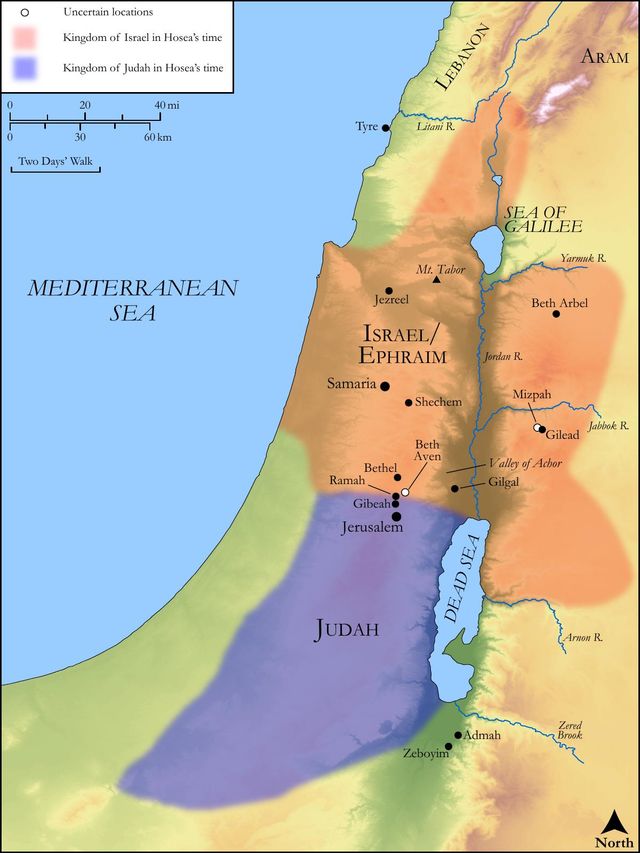
See on the biblical-era map
Study this verse
Public-domain commentary
Matthew Henry
From his Commentary on the Whole Bible. Henry comments on passages, not single verses — this entry covers Hosea 6:4–11. His three-level outline is real structure in the source text, so it is rendered as structure.
Two things, two evil things, both Judah and Ephraim are here charged with, and justly accused of: -
I.That they were not firm to their own convictions, but were unsteady, unstable as water, Hos 6:4, Hos 6:5.
O Ephraim! what shall I do unto thee? O Judah! what shall I do unto thee? This is a strange expression. Can Infinite Wisdom be at a loss what to do? Can it be nonplussed, or put upon taking new measures? By no means; but God speaks after the manner of men, to show how absurd and unreasonable they were, and how just his proceedings against them were. Let them not complain of him as harsh and severe in tearing them, and smiting them, as he has done; for what else should he do? What other course could he take with them? God had tried various methods with them (What could have been done more to his vineyard than he had done? Isa 5:4), and very loth he was to let things go to extremity; he reasons with himself (as Hos 11:9), How shall I give thee up, Ephraim? God would have done them good, but they were not qualified for it: "What shall I do unto thee? What else can I do but cast thee off, when I cannot in honour save thee?" Note, God never destroys sinners till he sees there is no other way with them. See here,
1.What their conduct was towards God: Their goodness, or kindness, was as the morning cloud. Some understand it of their kindness to themselves and their own souls, in their repentance; it is indeed mercy to ourselves to repent of our sins, but they soon retracted that kindness to themselves, undid it again, and wronged their own souls as much as ever. But it is rather to be taken for their piety and religion; what good appeared in them sometimes, it soon vanished and disappeared again, as the morning cloud and the early dew. Such was the goodness of Israel in Jehu's time, and of Judah in Hezekiah's and Josiah's time; it was soon gone. In time of drought the morning-cloud promises rain, and the early dew is some present refreshment to the earth; but the cloud is dispersed (and hypocrites are compared to clouds without water, Jde 1:12) and the dew does not soak into the ground, but is drawn back again into the air, and the earth is parched still. What shall he do with them? Shall he accept their goodness? No, for it passes away; and factum non dicitur quod non perseverat - that which does not continue can scarcely be said to be done. Note, That goodness will never be either pleasing to God or profitable to ourselves which is as the morning cloud and the early dew. When men promise fair and do not perform, when they begin well in religion and do not hold on, when they leave their first love and their first works, or, though they do not quite cast off religion, are yet unsteady, uneven, and inconstant in it, then is their goodness as the morning cloud and the early dew.
2.What course God had taken with them (Hos 6:5): "Therefore, because they were so rough and ill-shapen, I have hewn them by the prophets, as timber or stone is hewn for use; I have slain them by the words of my mouth." What the prophets did was done by the word of God in their mouths, which never returned void. By it they thought themselves slain, were ready to say that the prophets killed them, or cut them to the heart when they dealt faithfully with them.
(1.)The prophets hewed them by convictions of sin, endeavouring to cut off their transgressions from them. They were uneven in religion (Hos 6:4), therefore God hewed them. The hearts of sinners are not only as stone, but as rough stone, which requires a great deal of pains to bring it into shape, or as knotty timber, that is not squared without a great deal of difficulty; ministers' work is to hew them, and God by the minister hews them, for with the froward will he show himself froward. And there are those whom ministers must rebuke sharply; every word should cut, and though the chips fly in the face of the workman, though the reproved fly in the face of the reprover and reckon him an enemy because he tells the truth, yet he goes on with his work.
(2.)They slew them by the denunciations of wrath, foretelling that they should be slain, as Ezekiel is said to destroy the city when he prophesied of the destruction of it, Eze 43:3. And God accomplished that which was foretold: "I have slain them by my judgments, according to the words of my mouth." Note, The word of God will be the death either of the sin or of the sinner, a savour either of life unto life or of death unto death. Some read it, "I have hewn the prophets, and slain them by the words of my mouth, that is, I have employed them in laborious service for the people's good, which has wasted their strength; they have spent themselves, and hews away all their spirits, in their work, and in hazardous service, which has cost many of them their lives." Note, Ministers are the tools which God makes use of in working upon people; and, though with many they labour in vain, yet God will reckon for the wearing out of his tools.
(3.)God was hereby justified in the severest proceedings against them afterwards. His prophets had taken a great deal of pains with them, had admonished them of their sin and warned them of their danger, but the means used had not the desired effect; some good impressions perhaps were made for the present, but they wore off, and passed away as the morning cloud, and now they cannot charge God with severity if he bring upon them the miseries threatened. The prophet turns to him and acknowledges, Thy judgments are as the light that goes forth, evidently just and righteous. Note, Though sinners be not reclaimed by the pains that ministers take with them, yet thereby God will be justified when he speaks and clear when he judges. See Mat 11:17-19.
II.That they were not faithful to God's covenant with them, Hos 6:6, Hos 6:7. Here observe,
1.What the covenant was that God made with them, and upon what terms they should obtain his favour and be accepted of him (Hos 6:6): I desired mercy and not sacrifice (that is, rather than sacrifice), and insisted upon the knowledge of God more than upon burnt-offerings. Mercy here is the same word which in Hos 6:4 is rendered goodness - chesed - piety, sanctity; it is put for all practical religion; it is the same with charity in the New Testament, the reigning love of God and our neighbour, and this accompanied with and flowing from the knowledge of God, as he has revealed himself in his word, a firm belief that he is, and is the rewarder of those that diligently seek him, a good affection to divine things guided by a good judgment, which cannot but produce a very good conversation; this is that which God by his covenant requires, and not sacrifice and offering. This is fully explained, Jer 7:22, Jer 7:23. I spoke not to your fathers concerning burnt-offerings (that was the smallest of the matters I spoke to them of, and on which the least stress was laid), but this I said, Obey my voice, Mic 6:6-8. To love God and our neighbour is better than all burnt offering and sacrifice, Mar 12:33; Psa 51:16, Psa 51:17. Not but that sacrifice and offering were required, and to be paid, and had their use, and, when they were accompanied with mercy and the knowledge of God, were acceptable to him, but, without them, God regarded them not, he despised them, Isa 1:10, Isa 1:11. Perhaps this is mentioned here to show a difference between the God whom they deserted and the gods whom they went over to. The true God aimed at nothing but that they should be good men, and live good lives for their own good, and the ceremony of honouring him with sacrifices was one of the smallest matters of his law; whereas the false gods required that only; let their priests and altars be regaled with sacrifices and offerings, and the people might live as they listed. What fools were those then that left a God who aimed at giving his worshippers a new nature, for gods who aimed at nothing but making themselves a new name! It is mentioned likewise to show that God's controversy with them was not for the omission of sacrifices (I will not reprove thee for them, Psa 50:8), but because there was no justice, nor mercy, nor knowledge of God, among them (Hos 4:1), and to teach us all that the power of godliness is the main thing God looks at and requires, and without it the form of godliness is of no avail. Serious piety in the heart and life is the one thing needful, and, separate from that, the performances of devotion, though ever so plausible, ever so costly, are of no account. Our Saviour quotes this to show that moral duties are to be preferred before rituals whenever they come in competition, and to justify himself in eating with publicans and sinners, because it was in mercy to the souls of men, and in healing on the sabbath day, because it was in mercy to the bodies of men, to which the ceremony of singularity in eating and the sabbath-rest must give way, Mat 9:13; Mat 12:7.
2.How little they had regarded this covenant, though it was so well ordered in all things, though they, and not God, would be the gainers by it. See here what came of it.
(1.)In general, they broke with God, and proved unfaithful; there were good things committed to them to keep, the jewels of mercy and piety, and the knowledge of God, in the cabinet of sacrifice and burnt-offering, but they betrayed their trust, kept the cabinet, but pawned the jewels for the gratification of a base lust, and this is that for which God has justly a quarrel with them (Hos 6:7): They, like men, have transgressed the covenant, that covenant which God made with them; they have broken the conditions of it, and so forfeited the benefit of it. By casting off mercy and the knowledge of God, and other instances of disobedience, [1.] They had contracted the guilt of perjury and covenant-breaking; they were like men that transgress a covenant by which they had solemnly bound themselves, which is a thing that all the world cries out shame on; men that have done so deserve not again to be valued, or trusted, or dealt with. "There, in that thing, they have dealt treacherously against me; they have been perfidious, base, and false children, in whom is no faith, though I depended upon their being children that would not lie." [2.] In this they had but acted like themselves, like men, who are generally false and fickle, and in whose nature (their corrupt nature) it is to deal treacherously; all men are liars, and they are like the rest of that degenerate race, all gone aside, Psa 14:2, Psa 14:3. They have transgressed the covenant like men (like the Gentiles that transgressed the covenant of nature), like mean men (the word here used is sometimes put for men of low degree); they have dealt deceitfully, like base men that have no sense of honour. [3.] Herein they trod in the steps of our first parents: They, like Adam, have transgressed the covenant (so it might very well be read); as he transgressed the covenant of innocency, so they transgressed the covenant of grace, so treacherously, so foolishly; there in paradise he violated his engagements to God, and there in Canaan, another paradise, they violated their engagements. And by their treacherous dealing they, like Adam, have ruined themselves and theirs. Note, Sin is so much the worse the more there is in it of the similitude of Adam's transgression, Rom 5:14. [4.] Low thoughts of God and of his authority and favour were at the bottom of all this; for so some read it: They have transgressed the covenant, as of a man, as if it had been but the covenant of a man, that stood upon even ground with them, as if the commands of the covenant were but like those of a man like themselves, and the kindness conveyed by it no more valuable than that of a man. There is something sacred and binding in a man's covenant (as the apostle shows, Gal 3:15), but much more in the covenant of God, which yet they made small account of; and there in that covenant they dealt treacherously, promised fair, but performed nothing. Dealing treacherously with God is here called dealing treacherously against him, for it is both an affront and an opposition. Deserters are traitors, and will be so treated; the revolting heart is a rebellious heart.
(2.)Some particular instances of their treachery are here given: There they dealt treacherously, that is, in the places hereafter named [1.] Look on the other side Jordan, to the country which lay most exposed to the insults of the neighbouring nations, and where therefore the people were concerned to keep themselves under the divine protection, and yet there you will find the most daring provocations of the divine Majesty, Hos 6:8. Gilead, which lay in the lot of Gad and the half tribe of Manasseh, was a city of the workers of iniquity. Wickedness was the trade that was driven there; the country was called Gilead, but it was all called a city, because they were all as it were incorporated in one society of rebels against God. Or (as most think) Ramoth Gilead is the city here meant, one of the three cities of refuge on the other side Jordan, and a Levites' city; the inhabitants of it, though of the sacred tribe, were workers of iniquity, contrived it, and practised it. Note, It is bad indeed when a Levites' city is a city of those that work iniquity, when those that are to preach good doctrine live bad lives. Particularly it is polluted with blood, as if that were a sin which the wicked Levites were in a special manner guilty of. In popish countries the clergy are observed to be the most bloody persecutors. Or, as it was a city of refuge, by abusing the power it had to judge of murders it became polluted with blood. They would, for a bribe, protect those that were guilty of wilful murder, whom they ought to have put to death, and would deliver those to the avenger of blood who were guilty but of chance-medley, if they were poor and had nothing to give them; and both these ways they were polluted with blood. Note, Blood defiles the land where it is shed, and where no inquisition is made or no vengeance taken for it. See how the best institutions, that are ever so well designed to keep the balance even between justice and mercy, are capable of being abused and perverted to the manifest prejudice and violation of both. [2.] Look among those whose business it was to minister in holy things, and they were as bad as the worst and as vile as the vilest (Hos 6:9): The company of priests are so, not here and there one that is the scandal of his order, but the whole order and body of them, the priests go all one way by consent, with one shoulder (as the word is), one and all; and they make one another worse, more daring, and fierce, and impudent, in sin, more crafty and more cruel. A company of priests will say and do that in conspiracy which none of them would dare to say or do singly. The companies of priests were as troops of robbers, as banditti, or gangs of highwaymen, that cut men's throats to get their money. First, They were cruel and blood-thirsty. They murder those that they have a pique against, or that stand in their way; nothing less will satisfy them. Secondly, They were cunning. They laid wait for men, that they might have a fair opportunity to compass their mischievous malicious designs; thus the company of priests laid wait for Christ to take him, saying, Not on the feast-day. Thirdly, They were concurring as one man: They murder in the way; in the highway, where travellers should be safe, there they murder by consent, aiding and abetting one another in it. See how unanimous wicked people are in doing mischief; and should not good people be so then in doing good? They murder in the way to Shechem (so the margin reads it, as a proper name) such as were going to Jerusalem (for that way Shechem lay) to worship. Or in the way to Shechem (some think) means in the same manner that their father Levi, with Simeon his brother, murdered the Shechemites (Gen. 34), by fraud and deceit; and some understand it of their destroying the souls of men by drawing them to sin. Fourthly, They did it with contrivance: They commit lewdness; the word signifies such wickedness as is committed with deliberation, and of malice prepense, as we say. The more there is of device and design in sin the worse it is. [3.] Look into the body of the people, take a view of the whole house of Israel, and they are all alike (Hos 6:10): I have seen a horrible thing in the house of Israel, and, though it be ever so artfully managed, God discovers it, and will discover it to them; and who can deny that which God himself says that he has seen? There is the whoredom of Ephraim, both corporal and spiritual whoredom; there it is too plain to be denied. Note, The sin of sinners, especially sinners of the house of Israel, has enough in it to make them tremble, for it is a horrible thing, it is amazing, and it is threatening, enough to make them blush, for Israel is thereby defiled and rendered odious in the sight of God. [4.] Look into Judah, and you find them sharing with Israel (Hos 6:11): Also, O Judah! he has set a harvest for thee; thou must be reckoned with as well as Ephraim; thou art ripe for destruction too, and the time, even the set time, of thy destruction is hastening on, when thou that hast ploughed iniquity, and sown wickedness, shalt reap the same. The general judgment is compared to a harvest (Mat 13:39), so are particular judgments, Joe 3:13; Rev 14:15. I have appointed a time to call thee to account, even when I returned the captivity of my people, that is, when those captives of Judah which were taken by the men of Israel were restored, in obedience to the command of God sent them by Oded the prophet, Ch2 28:8-15. When God spared them that time he set them a harvest, that is, he designed to reckon with them another time for all together. Note, Preservations from present judgments, if a good use be not made of them, are but reservations for greater judgments.
Historical interpretation
Historical reception
1 surviving comment on this verse from the historical church.
In the house of Israel, I saw dreadful things; there were the fornications of Ephraim, Israel is defiled; and, Judah, I will put a harvest for you, when I will return the captivity of my people. From this crime and terrible horror, Jeremiah also spoke: "The heavens were astounded at this and the earth became deeply afraid" (Jeremiah 2). For what is more terrible than ten tribes suddenly turning to the worship of idols? Where it is said to their metropolis, "Take away your calf, Samaria, in which Ephraim first fornicated," that is, Jeroboam of the tribe of Ephraim, and by his fornication, Israel was defiled, namely the people of Samaria, who obtained for the most part the common name of Israel. Hence the speech is also turned to Judah: "You too, Judah, set up your harvest," and the sense is, "Do not think yourself secure because Israel is led away captive; prepare your crops, so that they can be harvested; for not long after, you yourself will be led captive to Babylon, and the time of your harvest will come." And when the Chaldeans cut you down, I will bring back the captivity of my people and under Cyrus the king of Persia and Artaxerxes will I lead back my people. And observe how significantly the captivity and the return of Judah is prophesied; but of Israel, that is, of the ten tribes, it is now silent, although when something prosperous is said, the advent of Christ is deferred. And in the house of the heretics, we see horrible things every day: first the masters fornicate, and the people who are led by them are defiled. It is also commanded to the Jews, that is, to the Church, that he himself should prepare, because of sins, his own harvest or vintage, when the time of judgment comes. But to him forgiveness is granted, and the Lord promises pardon, because he whom he loves he rebukes, and chastises every son whom he receives, to establish the proven and cleansed in his treasures. Some refer to what is said, "Juda, begin your harvest," or "put your harvest for yourself," in a good way, so that after Israel is punished, he may receive the fruit of his deeds according to what is written: "Those who sow in tears shall reap in joy" (Psalm 126: 5). We prefer a higher level of perception.
Continue studying Hosea 6:10 across the web’s major study libraries — every link below opens this exact verse, chapter, or book on the destination site.
Read & Compare
 BibleGatewayThis verse in more than 200 translations and 70 languages.
 Bible.comThe YouVersion reader — hundreds of translations, reading plans, and highlights.
 ESV.orgCrossway's official English Standard Version reader.
 NET BibleThe NET translation with 60,000+ translators' notes on every rendering decision.
 STEP BibleTyndale House's free study tool — original text, vocabulary, and scholarly resources.
 BibliaLogos Bible Software's free web reader.
 USCCBThe New American Bible (Revised Edition) with the U.S. bishops' study notes.
Commentaries
 BibleHub CommentariesDozens of classic commentaries on this verse, gathered on one page.
 StudyLightMore than 100 commentary sets — the largest collection on the web.
 BibleRefPlain-English commentary on what this verse means, verse by verse.
 Enduring WordDavid Guzik's free commentary on this chapter, widely used by Bible teachers.
 Bible Study ToolsVerse commentary alongside Greek and Hebrew study aids.
Original Language & Research
- BibleHub InterlinearThe verse word by word — original language, transliteration, and English.
- BibleHub LexiconEvery word's original-language definition and Strong's entry.
 Blue Letter BibleDeep-study tools — Strong's numbers, concordance, and word studies.
 SefariaThe Hebrew text with Rashi and centuries of Jewish commentary.
Sermons, Hymns & Audio


TrulyRandomVerse is not affiliated with these sites and doesn’t control their content. They’re linked because they’re genuinely useful.
Summary
Hosea 6:10 delivers a stark divine indictment against the Northern Kingdom of Israel, specifically targeting Ephraim, its most prominent tribe. The verse reveals God's profound grief and abhorrence at the nation's pervasive spiritual infidelity, depicted as "whoredom," which has led to a widespread moral and ceremonial defilement of the entire land and its people. It underscores God's omniscient awareness of their deep-seated rebellion and His righteous judgment against their covenant unfaithfulness.
Context
ShowHideLiterary Context
Hosea 6:10 is embedded within a section of the book (chapters 4-11) that elaborates on Israel's spiritual decline and the impending judgment from God. Immediately preceding this verse, Hosea 6:1-3 presents a superficial and short-lived "return" to the Lord, characterized by a lack of true repentance and a misunderstanding of God's desire for steadfast love rather than mere sacrifice (Hosea 6:4-6). The prophet highlights Israel's fleeting devotion, comparing it to a morning cloud or early dew. Following this, Hosea 6:7-9 details specific acts of transgression, including covenant breaking, bloodshed, and robbery, particularly focusing on the corruption within the priestly class and among the leaders. Verse 6:10 then serves as a culminating declaration of God's direct observation and condemnation of the deep-seated spiritual depravity that permeates the entire nation, linking the specific actions to a broader, pervasive "whoredom."
Historical & Cultural Context
The prophetic ministry of Hosea occurred in the 8th century BC, primarily during the reigns of Uzziah, Jotham, Ahaz, and Hezekiah in Judah, and Jeroboam II through Hoshea in Israel. This period for the Northern Kingdom (Israel, often referred to as Ephraim due to its dominant tribe) was marked by political instability, economic prosperity under Jeroboam II, and rampant religious syncretism. While outwardly maintaining some forms of Yahweh worship, the people had deeply integrated Canaanite Baal worship and other idolatrous practices into their lives, often at high places and sacred groves. This spiritual apostasy was compounded by a reliance on foreign political alliances (e.g., with Assyria or Egypt) rather than trusting in God for national security, a direct violation of their covenant with Yahweh. The "house of Israel" refers to the entire Northern Kingdom, while "Ephraim" specifically denotes its leading tribe, often used as a metonymy for the whole nation, emphasizing its central role in the national apostasy.
Key Themes
ShowHideHosea 6:10 powerfully contributes to several overarching themes within the book of Hosea. The most prominent is Spiritual Adultery and Covenant Unfaithfulness, where Israel's idolatry and pursuit of foreign alliances are consistently depicted as "whoredom" or "harlotry," mirroring Hosea's own marriage to Gomer (Hosea 1:2-3). This verse explicitly names "the whoredom of Ephraim," underscoring the depth of their betrayal of the exclusive covenant relationship with Yahweh, a direct violation of the first commandment given at Sinai (Exodus 20:3). Another key theme is Divine Grief and Judgment, as God declares, "I have seen an horrible thing," conveying His profound sorrow, abhorrence, and righteous anger over their actions. This highlights God's omniscience and His active engagement with His people's moral state (Psalm 139:7-12). Finally, the verse speaks to National Defilement and Corruption, as the "whoredom" leads to "Israel is defiled." This indicates that the spiritual unfaithfulness has permeated every aspect of national life, polluting their land, their worship, and their society, demonstrating how sin, especially idolatry, has broad societal consequences (Numbers 35:33).
Exposition and Analysis
ShowHideKey Word Analysis
ShowHideThis term denotes something fearful, appalling, shocking, or shudder-inducing. It signifies that Israel's actions were not merely displeasing but utterly repulsive, scandalous, and an abomination in the eyes of a holy God. It expresses God's visceral reaction to their spiritual state.
This word literally means "adultery" or "infidelity." In prophetic literature, as used here, it is a powerful metaphor for spiritual unfaithfulness, particularly the act of abandoning the covenant God to worship idols or rely on foreign powers. It conveys the profound betrayal inherent in Israel's actions, likening their relationship with God to a marriage covenant that they have violated.
A primitive root meaning "to be foul," especially in a ceremonial or moral sense, to be contaminated, polluted, or unclean. This word signifies that Israel's spiritual whoredom has not only offended God but has also rendered the entire nation ceremonially and morally impure, unfit for sacred relationship or worship. It implies a deep-seated corruption that has spread throughout the land and its people.
Verse Breakdown
ShowHide"I have seen an horrible thing in the house of Israel:"
This opening clause emphasizes God's direct observation and profound judgment. The phrase "horrible thing" (shaʻărûwrâh) conveys God's utter revulsion and shock at the spiritual state of His people. The "house of Israel" refers to the entire Northern Kingdom, indicating that this spiritual corruption is not isolated but pervasive throughout the nation, from its leadership to its common people. God's declaration highlights His omnipresence and His intimate knowledge of their hidden sins and open rebellion.
"there [is] the whoredom of Ephraim,"
This clause specifies the nature of the "horrible thing" – "whoredom" (zᵉnûwth). As a metaphor, it points to Israel's spiritual infidelity, their abandonment of the exclusive covenant with Yahweh for the worship of false gods (Baal, Asherah, etc.) and reliance on foreign alliances instead of divine protection. "Ephraim," as the dominant tribe, often represents the entire Northern Kingdom, signifying that this spiritual adultery is particularly pronounced and deeply rooted within its most influential segment.
"Israel is defiled."
This final clause states the consequence and pervasive impact of their "whoredom." The nation of "Israel" is declared "defiled" (ṭâmêʼ), meaning they are ceremonially and morally impure. This defilement is not merely external but has permeated their very being, their land, their worship, and their society, rendering them unclean in the sight of a holy God. It signifies a state of deep corruption that requires divine intervention and cleansing.
Literary Devices
ShowHideHosea 6:10 employs several potent literary devices to convey its message. Metaphor is central, particularly with the use of "whoredom" (zᵉnûwth) to describe Israel's spiritual infidelity. This powerful imagery, consistent throughout Hosea, likens God's covenant relationship with Israel to a marriage, making their idolatry and unfaithfulness a profound act of adultery and betrayal. The term "horrible thing" (shaʻărûwrâh) functions as a form of hyperbole or intensification, conveying God's extreme disgust and the shocking nature of Israel's sin, far beyond mere disapproval. It evokes a sense of shuddering horror. Furthermore, the declaration that "Israel is defiled" uses personification, attributing a state of impurity to the entire nation as if it were a single entity, emphasizing the widespread and pervasive nature of the corruption. This collective defilement underscores the profound impact of individual and corporate sin on the entire community and its standing before God.
Theological and Thematic Connections
ShowHideHosea 6:10 vividly portrays the gravity of spiritual unfaithfulness and its defiling consequences. The "whoredom of Ephraim" is a theological statement on the exclusive nature of God's covenant with His people; He demands singular devotion and abhors any form of idolatry or syncretism. This verse highlights God's holiness and His righteous indignation against sin, emphasizing that He sees and deeply reacts to the moral and spiritual state of His people. The defilement of Israel signifies that persistent sin, particularly covenant breaking, corrupts not only individuals but also the entire community, rendering them unfit for true worship and relationship with a holy God. It underscores the Old Testament principle that sin pollutes the land and the people, necessitating divine judgment or cleansing.
Reflection and Application
ShowHideHosea 6:10 serves as a timeless mirror for contemporary believers, urging us to examine the true objects of our devotion. While physical idolatry may be less common today, the "whoredom of Ephraim" finds its modern parallel in anything that usurps God's rightful place in our hearts and lives. This could be an insatiable pursuit of wealth, power, status, comfort, or even good causes that subtly become ultimate concerns, displacing our primary allegiance to Christ. God's declaration, "I have seen an horrible thing," reminds us that nothing is hidden from His all-seeing eye, and He is deeply grieved by any form of spiritual unfaithfulness. Our persistent pursuit of worldly affections or self-reliance, rather than exclusive trust in God, can lead to a defilement of our spiritual lives, hindering our intimacy with Him and diminishing our capacity for true worship and obedience. This verse calls us to a radical self-assessment, prompting us to repent of any functional idols, to purify our hearts, and to renew our covenant commitment to God, ensuring that our love and loyalty are undivided and pure.
Questions for Reflection
ShowHideFAQ
ShowHideWhat does "whoredom of Ephraim" mean in Hosea 6:10?
ShowHideIn Hosea 6:10, the "whoredom of Ephraim" is a powerful metaphor for the spiritual unfaithfulness and idolatry of the Northern Kingdom of Israel, often referred to as Ephraim due to its dominant tribe. It does not refer to literal prostitution, but rather to Israel's abandonment of their covenant relationship with Yahweh, their God, in favor of worshipping false gods (like Baal) and forming political alliances with pagan nations instead of trusting in divine protection. This spiritual adultery was a direct violation of the first commandment given at Sinai, which commanded exclusive worship of God (Exodus 20:3). The imagery emphasizes the betrayal and broken covenant between God and His chosen people.
How did Israel become "defiled" according to this verse?
ShowHideIsrael became "defiled" (Hebrew: ṭâmêʼ) because their spiritual "whoredom"—their widespread idolatry, syncretistic religious practices, and reliance on foreign powers—polluted the entire nation. In the Old Testament, sin, particularly idolatry and covenant breaking, was understood to have a defiling effect, rendering people and even the land ceremonially and morally unclean in the sight of a holy God. This defilement meant they were unfit for sacred relationship or worship with Yahweh. The prophet Hosea continually highlights how Israel's unfaithfulness had permeated every aspect of their society, leading to a comprehensive state of impurity that necessitated divine judgment or cleansing (Hosea 4:1-3).
Christ-Centered Fulfillment
ShowHideHosea 6:10, with its lament over Israel's spiritual whoredom and defilement, finds its ultimate resolution and fulfillment in Jesus Christ. The Old Covenant, like a marriage, was broken by Israel's infidelity, leading to their defilement and judgment. However, Christ comes as the faithful Bridegroom, establishing a new covenant not based on human obedience, but on His perfect sacrifice and grace. He is the one who perfectly embodies the steadfast love God desired from Israel (Matthew 9:15). Through His atoning work, Jesus provides the ultimate cleansing for the "horrible thing" of sin and spiritual unfaithfulness that defiles humanity. His blood purifies us from all unrighteousness, making us clean before God (Hebrews 9:14). The church, as the bride of Christ, is called to an exclusive and pure devotion to Him, reflecting the faithfulness Israel failed to maintain (Ephesians 5:25-27). In Christ, the promise of a new heart and a new spirit, where God's law is written on the heart, ensures a genuine and lasting faithfulness that overcomes the "whoredom" of the past, allowing God's people to walk in His statutes without defilement (Jeremiah 31:31-34).