


Genesis 43:6
Bible text: King James Version (1769 Blayney text) · Public domain
Bible text: Berean Standard Bible · Public domain
Bible text: American Standard Version (1901) · Public domain
Bible text: World English Bible, Messianic edition · Public domain
Bible text: Geneva Bible (1599) · Public domain
Bible text: Young's Literal Translation · Public domain
- וַיֹּאמֶרvai·Yo·merand he saidH559Conj-w ¦ V-Qal-ConsecImperf-3msVerb Qal Consecutive Imperfect 3rd Singular Masculineוַandיֹּאמֶרhe said
- יִשְׂרָאֵלYis·ra·'ElIsraelH3478N-proper-mNoun Proper Masculine
- לָמָהla·Mah<to> why?H4100Prep-l ¦ InterrogPronoun Interrogativeלָ<to>מָהwhy?
- הֲרֵעֹתֶםha·re·'o·Temdid you do harmH7489V-Hiphil-Perf-2mpVerb Hiphil Perfect 2nd Plural Masculine
- לִיLito mePrep-l ¦ 1csSuffix Personal 1st Singular common genderלִtoיme
- לְהַגִּידle·ha·Gidby tellingH5046Prep-l ¦ V-Hiphil-InfVerb Hiphil Infinitive Constructלְbyהַגִּידtelling
- לָאִישׁla·'Ishto the manH376Prep-l ¦ N-msNoun Singular Masculine Absoluteלָto theאִישׁman
- הַעוֹדha·'od¿ stillH5750Interrog ¦ Adj-msAdjective Numerical Singular Masculine Absoluteהַ¿עוֹדstill
- לָכֶםla·Khem[belong] to youPrep-l ¦ 2mpSuffix Personal 2nd Plural Masculineלָ[belong] toכֶםyou
- אָח'Ach[does] a brotherH251N-msNoun Singular Masculine Absolute
English is a literal word-by-word gloss of the Hebrew, not the KJV's wording. Why?
This is the original text the KJV's translators worked from — each Hebrew word with its own literal English meaning in this verse, prepared by scholars at Tyndale House, Cambridge. The KJV translates whole sentences, not word by word, so its wording differs: one Hebrew word can become several English words, and the KJV may choose “the LORD” where the gloss reads “Yahweh”. Both are faithful — they answer different questions. For the KJV's own rendering, switch to the KJV text.
Details
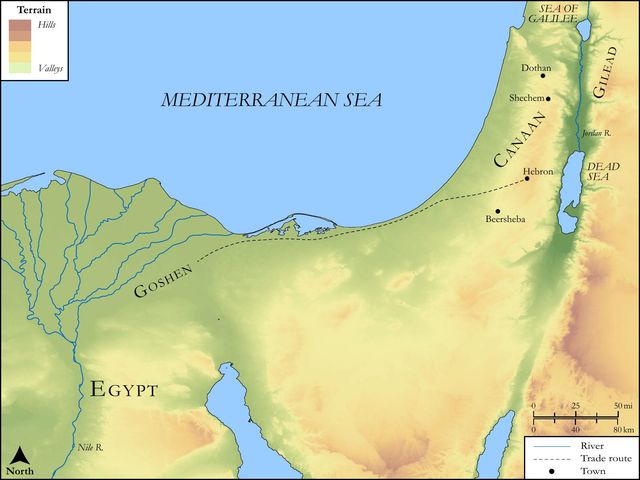
See on the biblical-era maps


Study this verse
Public-domain commentary
Matthew Henry
From his Commentary on the Whole Bible. Henry comments on passages, not single verses — this entry covers Genesis 43:1–10.
Here, 1. Jacob urges his sons to go and buy more corn in Egypt, Gen 43:1, Gen 43:2. The famine continued; and the corn they had bought was all spent, for it is meat that perisheth. Jacob, as a good master of a family, is in care to provide for those of his own house food convenient; and shall not God provide for his children, for the household of faith? Jacob bids them go again and buy a little food; now, in time of scarcity, a little must suffice, for nature is content with a little. 2. Judah urges him to consent that Benjamin should go down with them, how much soever it went against his feelings and previous determination. Note, It is not at all inconsistent with the honour and duty which children owe their parents humbly and modestly to advise them, and, as occasion is, to reason with them. Plead with your mother, plead, Hos 2:2. (1.) He insists upon the absolute necessity they were under of bringing Benjamin with them, of which he, who was a witness to all that had passed in Egypt, was a more competent judge than Jacob could be. Joseph's protestation (Gen 43:3) may be alluded to to show upon what terms we must draw nigh to God; unless we bring Christ along with us in the arms of our faith, we cannot see the face of God with comfort. (2.) He engages to take all possible care of him, and to do his utmost for his safety, Gen 43:8, Gen 43:9. Judah's conscience had lately smitten him for what he had done a great while ago against Joseph (Gen 42:21); and, as an evidence of the truth of his repentance, he is ready to undertake, as far as a man could do it, for Benjamin's security. He will not only not wrong him, but will do all he can to protect him. This is restitution, as far as the case will admit; when he knew not how he could restore Joseph, he would make some amends for the irreparable injury he had done him by doubling his care concerning Benjamin.
Continue studying Genesis 43:6 across the web’s major study libraries — every link below opens this exact verse, chapter, or book on the destination site.
Read & Compare
 BibleGatewayThis verse in more than 200 translations and 70 languages.
 Bible.comThe YouVersion reader — hundreds of translations, reading plans, and highlights.
 ESV.orgCrossway's official English Standard Version reader.
 NET BibleThe NET translation with 60,000+ translators' notes on every rendering decision.
 STEP BibleTyndale House's free study tool — original text, vocabulary, and scholarly resources.
 BibliaLogos Bible Software's free web reader.
 USCCBThe New American Bible (Revised Edition) with the U.S. bishops' study notes.
Commentaries
 BibleHub CommentariesDozens of classic commentaries on this verse, gathered on one page.
 StudyLightMore than 100 commentary sets — the largest collection on the web.
 BibleRefPlain-English commentary on what this verse means, verse by verse.
 Enduring WordDavid Guzik's free commentary on this chapter, widely used by Bible teachers.
 Bible Study ToolsVerse commentary alongside Greek and Hebrew study aids.
Original Language & Research
- BibleHub InterlinearThe verse word by word — original language, transliteration, and English.
- BibleHub LexiconEvery word's original-language definition and Strong's entry.
 Blue Letter BibleDeep-study tools — Strong's numbers, concordance, and word studies.
 SefariaThe Hebrew text with Rashi and centuries of Jewish commentary.
Sermons, Hymns & Audio


TrulyRandomVerse is not affiliated with these sites and doesn’t control their content. They’re linked because they’re genuinely useful.
Summary
Genesis 43:6 captures the raw anguish of Jacob, now known as Israel, as he confronts his sons for revealing the existence of his youngest son, Benjamin, to the powerful Egyptian governor. Amidst a severe and prolonged famine, Jacob's words convey his profound fear and frustration, believing their disclosure has created an impossible and dangerous demand, risking the loss of his last beloved son and threatening the very continuity of his family.
Context
ShowHideLiterary Context
This verse is situated at a critical juncture in the Joseph narrative, specifically after the first journey of Jacob's ten eldest sons to Egypt to buy grain. Following their encounter with Joseph, who recognized them but remained unrecognized himself, they returned to Canaan with grain but also with Joseph's demand to bring Benjamin back to Egypt as proof of their honesty, holding Simeon as a hostage. Jacob's outburst in Genesis 43:6 immediately precedes Judah's impassioned plea to Jacob to allow Benjamin to go, emphasizing the immense pressure and emotional turmoil within the family as famine intensifies and their survival hinges on a second journey to Egypt. This dialogue sets the stage for the pivotal reunion and reconciliation that will follow in subsequent chapters.
Historical & Cultural Context
The broader historical context is a severe, multi-year famine affecting both Canaan and Egypt, a common natural disaster in the lands of the patriarchs that often led to widespread suffering, migration, and political instability. Egypt, with its advanced irrigation system dependent on the Nile, was often a refuge during such times, as seen in Abraham's journey to Egypt during a famine (Genesis 12:10). The cultural norms of the time placed immense value on family continuity and the preservation of the patriarchal line. For Jacob, the loss of Benjamin, the only full brother of his presumed-dead son Joseph and the youngest child of his beloved wife Rachel, represented an existential threat to his lineage and a profound personal tragedy. The "man" referred to is Joseph, the vizier of Egypt, whose power and authority would have been absolute, making his demands non-negotiable in the eyes of Jacob's sons.
Key Themes
ShowHideGenesis 43:6 contributes to several overarching themes within the book of Genesis and the broader Pentateuch. It highlights the theme of Divine Providence working through human circumstances, as God orchestrates events—even Jacob's distress—to preserve His covenant people and fulfill His promises to Abraham, Isaac, and Jacob. The verse also powerfully illustrates Parental Grief and Anxiety, particularly Jacob's deep attachment to his sons, especially Benjamin, reflecting the profound human experience of love, loss, and fear for one's offspring. Furthermore, it subtly touches upon the Consequences of Past Actions, as the entire predicament stems from the brothers' earlier sin of selling Joseph into slavery (Genesis 37:28), setting in motion a chain of events that now brings their father to despair. The tension between Human Agency and Divine Sovereignty is also evident, as Jacob's sons' truthful disclosure and Jacob's emotional reaction are human choices, yet all are intricately woven into God's larger plan to bring His chosen family to Egypt for their preservation and eventual growth into a nation, foreshadowing the exodus from Egypt.
Exposition and Analysis
ShowHideKey Word Analysis
ShowHideThis is Jacob's covenant name, meaning "he will rule as God" or "struggles with God." Its use here, rather than "Jacob," is significant. It reminds the reader of his unique relationship with God and his role as the patriarch of the nascent nation, even as he experiences profound human weakness, fear, and frustration. It underscores that this personal anguish has national, covenantal implications.
This word signifies "to spoil," "to make (or be) good for nothing," or "to be bad (physically, socially or morally)." Jacob's accusation, "Wherefore dealt ye so ill with me," conveys a deep sense of harm inflicted upon him. He perceives his sons' actions not merely as an unfortunate consequence but as a direct, damaging blow to his well-being and the safety of his family, highlighting the intensity of his emotional suffering.
This primitive root means "to front," "to stand boldly out opposite," and by implication, "to manifest" or "to announce (always by word of mouth to one present)." Jacob's complaint centers on the act of "telling" or revealing. He views their disclosure of Benjamin's existence as the specific, culpable action that has led to his current torment, demonstrating his focus on the immediate cause of his distress rather than the broader circumstances.
Verse Breakdown
ShowHide"And Israel said,"
This opening immediately establishes the speaker as the patriarch, Jacob, under his covenant name, "Israel." This designation, often used in moments of spiritual significance or national import, highlights the gravity of the situation and the weight of his words, even as they express deep personal distress. It sets the tone for a pronouncement of anguish and accusation.
"Wherefore dealt ye [so] ill with me,"
Jacob's rhetorical question is a bitter accusation, expressing his profound sense of betrayal and suffering. He perceives his sons' actions—specifically, their revelation about Benjamin—as a direct harm inflicted upon him. The phrase "dealt ye so ill" conveys a feeling of being wronged or unjustly treated, underscoring his emotional pain and the perceived negative consequences of their actions. It reveals a father overwhelmed by fear and grief, lashing out at those closest to him.
"[as] to tell the man whether ye had yet a brother?"
This clause pinpoints the exact disclosure that Jacob finds so grievous. Under intense interrogation by Joseph, the brothers likely felt compelled to tell the truth about their family, including having another brother, to prove they were not spies. Jacob's blame here underscores his protective instincts and his despair over the seemingly impossible demand that has arisen from this revelation, threatening the loss of his last remaining son from Rachel.
Literary Devices
ShowHideThe verse employs several literary devices to convey Jacob's intense emotional state. Pathos is powerfully evident, as Jacob's words are saturated with the immense fear of losing Benjamin, his youngest son and the only remaining child of his beloved Rachel. This deep emotional attachment drives his reluctance and despair, making him lash out in his grief. There is also a strong element of Irony present, as Jacob's accusation, though deeply felt, is misdirected; unbeknownst to him, the "man" (Joseph) to whom his sons "told" about Benjamin is his own long-lost son, and the entire situation is part of God's providential plan for their salvation. Jacob's words also contain a degree of Hyperbole, as his "ill" treatment is a consequence of Joseph's testing, not malicious intent from his sons, reflecting his overwhelming emotional state rather than a balanced assessment of their actions.
Theological and Thematic Connections
ShowHideJacob's anguished cry in Genesis 43:6, born of fear and perceived injustice, is a poignant reminder that God's sovereign plan often unfolds through human weakness, misunderstanding, and distress. Unbeknownst to Jacob, the very circumstances causing him such profound anguish were part of God's overarching design to save his family from famine and bring about the long-awaited reconciliation between Joseph and his brothers. This narrative highlights how God frequently works through difficult, humanly inexplicable situations, using human choices and even suffering for a greater, redemptive purpose, ultimately preserving the covenant line through which His promises would be fulfilled.
Reflection and Application
ShowHideGenesis 43:6 offers profound insights into the human experience of fear, frustration, and the struggle to trust when circumstances seem to spiral out of control. Like Jacob, we often find ourselves in situations where we feel wronged, or where events unfold in ways that threaten what we hold most dear. This passage reminds us that even when our immediate circumstances are painful and confusing, and we are tempted to assign blame, God may be working behind the scenes for a greater good, just as He was for Jacob's family. It encourages us to exercise patience and faith, recognizing that life's pressures can force us to confront our deepest fears and move forward, even when it means surrendering something we desperately want to protect. Furthermore, the narrative encourages empathy, prompting us to understand the complexities of human predicaments and the difficult choices others face, rather than quickly assigning blame or judging their actions from our limited perspective. It challenges us to look beyond the immediate pain to discern God's larger, often hidden, purposes.
Questions for Reflection
ShowHideFAQ
ShowHideWhy did Jacob blame his sons so harshly?
ShowHideJacob's words reflect his deep emotional distress and overwhelming fear of losing Benjamin, his last surviving son from his beloved wife Rachel. Having already grieved the presumed death of Joseph (Genesis 37:33-35), the thought of losing Benjamin was an unbearable prospect. While his sons were caught in an extremely difficult situation, pressured by the powerful Egyptian governor (Genesis 42:15-20), Jacob's anguish led him to lash out. He viewed their revelation of Benjamin's existence as the direct catalyst for his current torment, highlighting the intensity of his grief and attachment rather than a fair or rational assessment of his sons' actions under duress.
Christ-Centered Fulfillment
ShowHideThe narrative of Genesis 43:6, situated within the broader Joseph story, profoundly foreshadows the redemptive work of Christ. Joseph, though innocent, was rejected by his own brothers, sold into slavery (Genesis 37:28), and suffered unjustly, yet he was ultimately exalted to a position of immense power in Egypt (Genesis 41:40). From this position, he became the unexpected means of salvation for his very family, providing sustenance and orchestrating their reconciliation, saving them from famine and preserving the covenant line. This mirrors Christ, who was rejected by His own people (John 1:11), suffered, died on the cross, and rose again to a position of ultimate authority and glory (Philippians 2:9-11). He became the sole means of salvation and reconciliation for all who believe, not just for a physical family but for God's spiritual family, the Church (Ephesians 2:16). Just as God's providential hand worked through Joseph's suffering and Jacob's distress to achieve His redemptive purposes, so too does the cross, the ultimate act of suffering and perceived "ill treatment," culminate in the preservation and eternal life of God's people, demonstrating His power to bring good out of apparent evil (Romans 5:8).