


Genesis 30:36
Bible text: King James Version (1769 Blayney text) · Public domain
Bible text: Berean Standard Bible · Public domain
Bible text: American Standard Version (1901) · Public domain
Bible text: World English Bible, Messianic edition · Public domain
Bible text: Geneva Bible (1599) · Public domain
Bible text: Young's Literal Translation · Public domain
- וַיָּשֶׂםvai·Ya·semand he putH7760Conj-w ¦ V-Qal-ConsecImperf-3msVerb Qal Consecutive Imperfect 3rd Singular Masculineוַandיָּשֶׂםhe put
- דֶּרֶךְDe·rekha journey ofH1870N-cscNoun Singular common gender Construct
- שְׁלֹשֶׁתshe·Lo·shetthreeH7969Adj-cscAdjective Numerical Singular common gender Construct
- יָמִיםya·MimdaysH3117N-mpNoun Plural Masculine Absolute
- בֵּינוֹbei·Nobetween himselfH996Adj-msc ¦ 3msAdjective Numerical Singular Masculine Constructבֵּינbetweenוֹhimself
- וּבֵיןu·Veinand betweenH996Conj-w ¦ Adj-mscAdjective Numerical Singular Masculine Constructוּandבֵיןbetween
- יַעֲקֹבya·'a·KoJacobH3290N-proper-mNoun Proper Masculine
- וְיַעֲקֹבve·ya·'a·Koand JacobH3290Conj-w ¦ N-proper-mNoun Proper MasculineוְandיַעֲקֹבJacob
- רֹעֶהro·'Eh[was] pasturingH7462V-Qal-Prtcpl-msVerb Qal Participle Singular Masculine Absolute
- אֶת'et<obj.>H853DirObjMParticle Object Indicator
- צֹאןtzon[the] flock ofH6629N-cscNoun Singular common gender Construct
- לָבָןla·VanLabanH3837N-proper-mNoun Proper Masculine
- הַנּוֹתָרֹתha·no·ta·Rotwhich remainedH3498Art ¦ V-Niphal-Prtcpl-fpVerb Niphal Participle Plural Feminine Absoluteהַwhichנּוֹתָרֹתremained
English is a literal word-by-word gloss of the Hebrew, not the KJV's wording. Why?
This is the original text the KJV's translators worked from — each Hebrew word with its own literal English meaning in this verse, prepared by scholars at Tyndale House, Cambridge. The KJV translates whole sentences, not word by word, so its wording differs: one Hebrew word can become several English words, and the KJV may choose “the LORD” where the gloss reads “Yahweh”. Both are faithful — they answer different questions. For the KJV's own rendering, switch to the KJV text.
Details
See on the biblical-era maps


Study this verse
Public-domain commentary
Matthew Henry
From his Commentary on the Whole Bible. Henry comments on passages, not single verses — this entry covers Genesis 30:25–36. His three-level outline is real structure in the source text, so it is rendered as structure.
We have here,
I.Jacob's thoughts of home.
He faithfully served his time out with Laban, even his second apprenticeship, though he was an old man, had a large family to provide for, and it was high time for him to set up for himself. Though Laban's service was hard, and he had cheated him in the first bargain he had made, yet Jacob honestly performs his engagements. Note, A good man, though he swear to his own hurt, will not change. And though others have deceived us this will not justify us in deceiving them. Our rule is to do as we would be done by, not as we are done by. Jacob's term having expired, he begs leave to be gone, Gen 30:25. Observe,
1.He retained his affection for the land of Canaan, not only because it was the land of his nativity, and his father and mother were there, whom he longed to see, but because it was the land of promise; and, in token of his dependence upon the promise of it, though he sojourn in Haran he can by no means think of settling there. Thus should we be affected towards our heavenly country, looking upon ourselves as strangers here, viewing the heavenly country as our home, and longing to be there, as soon as the days of our service upon earth are numbered and finished. We must not think of taking root here, for this is not our place and country, Heb 13:14.
2.He was desirous to go to Canaan, though he had a great family to take with him, and no provision yet made for them. He had got wives and children with Laban, but nothing else; yet he does not solicit Laban to give him either a portion with his wives or the maintenance of some of his children. No, all his request is, Give me my wives and my children, and send me away, Gen 30:25, Gen 30:26. Note, Those that trust in God, in his providence and promise, though they have great families and small incomes, can cheerfully hope that he who sends mouths will send meat. He who feeds the brood of the ravens will not starve the seed of the righteous.
II.Laban's desire of his stay, Gen 30:27.
In love to himself, not to Jacob or to his wives or children, Laban endeavours to persuade him to continue his chief shepherd, entreating him, by the regard he bore him, not to leave him: If I have found favour in thy eyes, tarry. Note, Churlish selfish men know how to give good words when it is to serve their own ends. Laban found that his stock had wonderfully increased with Jacob's good management, and he owns it, with very good expressions of respect both to God and Jacob: I have learned by experience that the Lord has blessed me for thy sake. Observe,
1.Laban's learning: I have learned by experience. Note, There is many a profitable good lesson to be learned by experience. We are very unapt scholars if we have not learned by experience the evil of sin, the treachery of our own hearts, the vanity of the world, the goodness of God, the gains of godliness, and the like.
2.Laban's lesson. He owns, (1.) That his prosperity was owing to God's blessing: The Lord has blessed me. Note, worldly men, who choose their portion in this life, are often blessed with an abundance of this world's goods. Common blessings are given plentifully to many that have no title to covenant-blessings. (3.) That Jacob's piety had brought that blessing upon him: The Lord has blessed me, not for my own sake (let not such a man as Laban, that lives without God in the world, think that he shall receive any thing of the Lord, Jam 1:7), but for thy sake. Note, [1.] Good men are blessings to the places where they live, even where they live meanly and obscurely, as Jacob in the field, and Joseph in the prison, Gen 39:23. [2.] God often blesses bad men with outward mercies for the sake of their godly relations, though it is seldom that they have either the wit to see it or the grace to own it, as Laban did here.
III.The new bargain they came upon.
Laban's craft and covetousness took advantage of Jacob's plainness, honesty, and good-nature; and, perceiving that Jacob began to be won upon by his fair speeches, instead of making him a generous offer and bidding high, as he ought to have done, all things considered, he puts it upon him to make his demands (Gen 30:28): Appoint me thy wages, knowing he would be very modest in them, and would ask less than he could for shame offer. Jacob accordingly makes a proposal to him, in which,
1.He shows what reason he had to insist upon so much, considering,
(1.)That Laban was bound in gratitude to do well for him, because he had served him not only faithfully, but very successfully, Gen 30:30. Yet here observe how he speaks, like himself, very modestly. Laban had said, The Lord has blessed me for thy sake; Jacob will not say so, but, The Lord has blessed thee since my coming. Note, Humble saints take more pleasure in doing good than in hearing of it again.
(2.)That he himself was bound in duty to take care of his own family: Now, when shall I provide for my own house also? Note, Faith and charity, though they are excellent things, must not take us off from making necessary provisions for our own support, and the support of our families. We must, like Jacob, trust in the Lord and do good, and yet we must, like him, provide for our own houses also; he that does not the latter is worse than an infidel, Ti1 5:8.
2.He is willing to refer himself to the providence of God, which, he knew, extends itself to the smallest things, even the colour of the cattle; and he will be content to have for his wages the sheep and goats of such and such a colour, speckled, spotted, and brown, which should hereafter be brought forth, Gen 30:32, Gen 30:33. This, he thinks, will be a most effectual way both to prevent Laban's cheating him and to secure himself from being suspected of cheating Laban. Some think he chose this colour because in Canaan it was generally most desired and delighted in; their shepherds in Canaan are called Nekohim (Amo 1:1), the word here used for speckled; and Laban was willing to consent to this bargain because he thought if the few he has that were now speckled and spotted were separated from the rest, which by agreement was to be done immediately, the body of the flock which Jacob was to tend, being of one colour, either all black or all white, would produce few or none of mixed colours, and so he should have Jacob's service for nothing, or next to nothing. According to this bargain, those few that were party-coloured were separated, and put into the hands of Laban's sons, and sent three days' journey off; so great was Laban's jealously lest any of them should mix with the rest of the flock, to the advantage of Jacob. And now a fine bargain Jacob has made for himself! Is this his providing for his own house, to put it upon such an uncertainty? If these cattle bring forth, as usually cattle do, young ones of the same colour with themselves, he must still serve for nothing, and be a drudge and a beggar all the days of his life; but he knows whom he has trusted, and the event showed,
(1.)That he took the best way that could be taken with Laban, who otherwise would certainly have been too hard for him. And,
(2.)That it was not in vain to rely upon the divine providence, which owns and blesses honest humble diligence. Those that find men whom they deal with unjust and unkind shall not find God so, but, some way or other, he will recompense the injured, and be a good pay-master to those that commit their cause to him.
Continue studying Genesis 30:36 across the web’s major study libraries — every link below opens this exact verse, chapter, or book on the destination site.
Read & Compare
 BibleGatewayThis verse in more than 200 translations and 70 languages.
 Bible.comThe YouVersion reader — hundreds of translations, reading plans, and highlights.
 ESV.orgCrossway's official English Standard Version reader.
 NET BibleThe NET translation with 60,000+ translators' notes on every rendering decision.
 STEP BibleTyndale House's free study tool — original text, vocabulary, and scholarly resources.
 BibliaLogos Bible Software's free web reader.
 USCCBThe New American Bible (Revised Edition) with the U.S. bishops' study notes.
Commentaries
 BibleHub CommentariesDozens of classic commentaries on this verse, gathered on one page.
 StudyLightMore than 100 commentary sets — the largest collection on the web.
 BibleRefPlain-English commentary on what this verse means, verse by verse.
 Enduring WordDavid Guzik's free commentary on this chapter, widely used by Bible teachers.
 Bible Study ToolsVerse commentary alongside Greek and Hebrew study aids.
Original Language & Research
- BibleHub InterlinearThe verse word by word — original language, transliteration, and English.
- BibleHub LexiconEvery word's original-language definition and Strong's entry.
 Blue Letter BibleDeep-study tools — Strong's numbers, concordance, and word studies.
 SefariaThe Hebrew text with Rashi and centuries of Jewish commentary.
Sermons, Hymns & Audio


TrulyRandomVerse is not affiliated with these sites and doesn’t control their content. They’re linked because they’re genuinely useful.
Summary
Genesis 30:36 succinctly captures Laban's immediate and strategic act of deceit following his agreement with Jacob regarding new wages. In a calculated move, Laban removed all the speckled, spotted, and brown animals—which were to be Jacob's agreed-upon portion—and established a significant "three days' journey" separation between his remaining flock and Jacob's charge. This action was a deliberate attempt to prevent Jacob from accumulating wealth, effectively rigging the agreement in his own favor and leaving Jacob to tend only the plain, unmarked animals, thereby setting the stage for divine intervention.
Context
ShowHideLiterary Context
This verse is a critical turning point in the ongoing, often contentious, relationship between Jacob and Laban, specifically concerning Jacob's long-awaited wages. After serving Laban faithfully for fourteen years to earn his wives, Leah and Rachel, as detailed in Genesis 29:20 and Genesis 29:27, Jacob expressed his desire to depart and establish his own household. Laban, recognizing that God's blessing on Jacob had greatly benefited his own prosperity, persuaded him to stay, proposing a new wage agreement in Genesis 30:27-31. Under this seemingly fair arrangement, Jacob would receive all the speckled, spotted, and brown animals among the sheep and goats as his compensation. However, immediately after this agreement, Laban revealed his true, manipulative character by removing all the animals that would constitute Jacob's potential wages—the speckled and spotted goats and the brown sheep—and entrusting them to his sons, creating a substantial physical separation to prevent interbreeding and ensure Jacob would start with nothing. This act directly precedes Jacob's divinely inspired breeding practices, which ultimately led to his immense prosperity, as recorded in Genesis 30:37-43.
Historical & Cultural Context
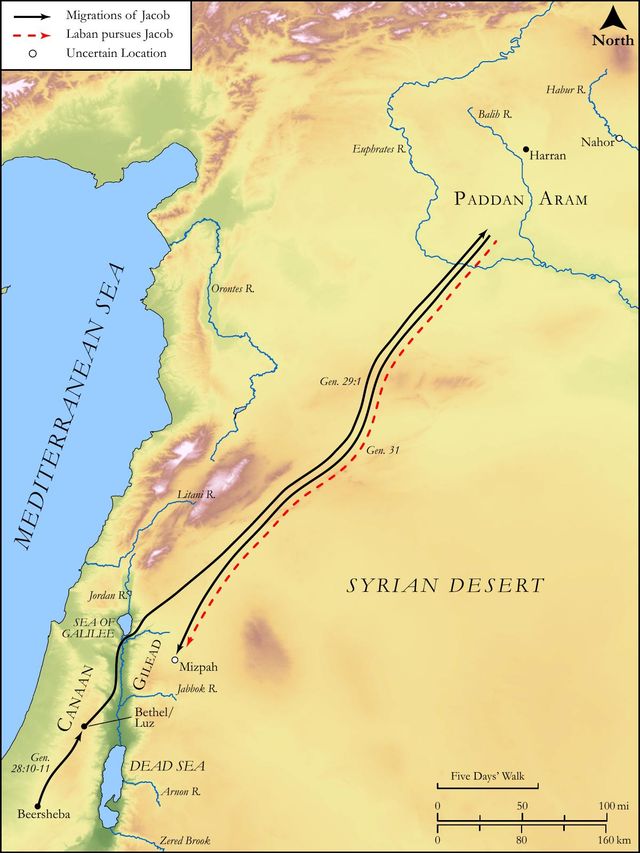
In the days of Jacob, pastoralism was a primary source of wealth and livelihood. Flocks of sheep and goats represented a family's economic security and status. Agreements, even oral ones, were generally considered binding, though often subject to manipulation by the unscrupulous, as Laban consistently demonstrates. The concept of "wages" (Hebrew: sakar) was well-established, and the terms of employment were crucial. Laban's act of separating the flocks by a "three days' journey" was a significant logistical undertaking, highlighting his determination to control the outcome. This distance, roughly 45-60 miles, would effectively prevent any accidental interbreeding between the separated "marked" animals and the "unmarked" animals left with Jacob, thus attempting to nullify the very mechanism by which Jacob was to gain wealth. This action showcases Laban's deep-seated distrust and avarice, characteristic of his dealings throughout the narrative.
Key Themes
ShowHideGenesis 30:36 contributes to several overarching themes within the book of Genesis and the broader biblical narrative. Firstly, it powerfully illustrates the theme of divine sovereignty over human treachery. Despite Laban's manipulative schemes to thwart Jacob's prosperity, God's plan for Jacob's blessing and the continuation of the covenant line ultimately prevails. Secondly, it highlights God's faithfulness to His covenant promises, particularly those made to Jacob (e.g., Genesis 28:15). Even when human circumstances are stacked against His chosen one, God demonstrates His ability to provide and protect. Thirdly, the ongoing struggle between Jacob and Laban serves as a microcosm of the conflict between human deceit and divine justice, with Laban consistently representing self-serving manipulation and Jacob, despite his own past deceptions, increasingly relying on God's intervention. This verse sets the stage for God to turn Laban's intended harm into Jacob's great gain, a pattern seen throughout biblical history.
Exposition and Analysis
ShowHideGenesis 30:36 states, "And he set three days' journey betwixt himself and Jacob: and Jacob fed the rest of Laban's flocks." This verse succinctly captures Laban's cunning and immediate betrayal of the recently established wage agreement. Having agreed that Jacob's wages would consist of all the speckled, spotted, and brown animals born from the flock, Laban wasted no time in attempting to circumvent the deal. He personally removed all such animals from the main flock and placed them under the care of his sons, creating a significant physical distance between them and Jacob's remaining charge.
Key Word Analysis
ShowHideFrom a primitive root meaning "to put," this verb is used in a great variety of applications, literal, figurative, inferentially, and elliptically. In this context, it emphasizes Laban's deliberate and intentional action. He didn't casually separate the flocks; he set a specific, significant distance, highlighting his calculated effort to control the outcome and prevent Jacob from gaining wealth.
Derived from a root meaning "to tread," this word refers to a "road" or "way," and by extension, a "journey." The phrase "three days' journey" (combining H7969 "three" and H3117 "days") signifies a substantial distance, approximately 45-60 miles. This was not a minor separation but a strategic and intentional move by Laban to create a clear division between the two flocks, underscoring the deliberate nature of his attempt to isolate the "marked" animals destined for Jacob's wages.
A primitive root meaning "to tend a flock," "to pasture it," or "to graze." It also carries the broader sense of "to rule" or "to associate with." Here, it describes Jacob's continued role as a shepherd, but specifically highlights that he was left to tend "the rest" of Laban's flocks—those animals that were plain and unmarked, seemingly offering no prospect of producing the speckled, spotted, or brown offspring that constituted his agreed-upon wages. This emphasizes the disadvantage Laban intended for Jacob.
Verse Breakdown
ShowHide"And he set three days' journey betwixt himself and Jacob"
This clause details Laban's immediate and decisive action following the agreement. The "he" refers to Laban, who took personal initiative to remove all the animals that would potentially become Jacob's wages (the speckled, spotted, and brown ones) from the main flock. The "three days' journey" signifies a considerable physical distance, deliberately established to prevent any interbreeding between the separated "marked" animals and the "unmarked" ones left with Jacob. This act underscores Laban's cunning and his attempt to circumvent the terms of their agreement, ensuring Jacob would start with a disadvantage.
"and Jacob fed the rest of Laban's flocks."
This second clause describes Jacob's assigned task after Laban's manipulative separation. Jacob was left to tend only the remaining animals, which, by definition of the agreement, were the plain, solid-colored sheep and goats. This highlights the seemingly impossible situation Jacob was placed in, as his wages were to come from the birth of "marked" offspring, yet all the "marked" breeding stock had been removed. This sets the stage for the subsequent narrative, where divine intervention and Jacob's resourcefulness lead to his extraordinary prosperity despite Laban's scheme.
Literary Devices
ShowHideThe verse employs several literary devices to convey its meaning and thematic significance. Irony is prominent, as Laban's meticulous efforts to defraud Jacob ultimately become the very catalyst for Jacob's greater prosperity, demonstrating the futility of human schemes against divine will. This act of separation also serves as foreshadowing, hinting at Laban's continued deceit and the inevitable culmination of their strained relationship, which will lead to Jacob's secret departure. There is a clear contrast established between Laban's immediate, self-serving treachery and the apparent fairness of the wage agreement he had just made. Furthermore, the "three days' journey" itself functions as symbolism, representing not just a physical distance but the deep rift of distrust, manipulation, and adversarial intent that characterized Laban's relationship with Jacob. It symbolizes Laban's desire for absolute control and his attempt to isolate Jacob from any means of legitimate gain.
Theological and Thematic Connections
ShowHideGenesis 30:36 serves as a powerful illustration of God's unwavering sovereignty and faithfulness, even in the face of human deceit and injustice. Laban's manipulative actions highlight the futility of human attempts to thwart divine purposes. Despite Laban's calculated efforts to prevent Jacob's prosperity and control his destiny, God's promise to bless Jacob and multiply his offspring prevailed. This narrative underscores that God can work through, and even overrule, the schemes of the wicked to accomplish His redemptive plan and provide for His chosen people. It reinforces the theological truth that God's covenant promises are not dependent on human integrity but on His own unchangeable character and power.
Reflection and Application
ShowHideGenesis 30:36 offers timeless insights into navigating difficult relationships and unfair circumstances. It serves as a stark reminder that human deception is a reality; we may encounter individuals who, despite agreements, seek to manipulate or cheat us. This narrative highlights the importance of discernment and understanding human nature, urging us to be wise without becoming cynical. Crucially, it provides profound encouragement that God's plan and blessing can prevail even when people attempt to hinder or defraud us. Jacob's eventual prosperity, despite Laban's trickery, serves as a powerful testament to God's ability to provide and prosper His people in unexpected ways. The story implicitly underscores the enduring value of integrity and fair dealing, contrasting it with Laban's consistent lack of integrity which ultimately led to the breakdown of his relationship with Jacob. When faced with injustice, our trust should ultimately rest in God, who is able to turn even the most disadvantageous situations into opportunities for His glory and our good.
Questions for Reflection
ShowHideFAQ
ShowHideWhat was the practical purpose of Laban setting "three days' journey" between the flocks?
ShowHideThe "three days' journey" was a significant distance, approximately 45-60 miles, and served a very practical and manipulative purpose for Laban. By physically separating the speckled, spotted, and brown animals (which were to be Jacob's wages) from the rest of the flock, Laban aimed to prevent these specific animals from interbreeding with Jacob's remaining plain flocks. This was a calculated attempt to ensure that Jacob would have no "marked" offspring born from his assigned flock, thereby effectively nullifying the wage agreement and preventing Jacob from accumulating wealth according to their terms. Laban's intention was to rig the system completely against Jacob, ensuring that Jacob would receive no wages from the agreed-upon method, thus maintaining Laban's own prosperity at Jacob's expense.
Christ-Centered Fulfillment
ShowHideWhile Genesis 30:36 directly concerns the earthly struggle between Jacob and Laban, it powerfully foreshadows the overarching theme of God's faithfulness to His covenant people despite human treachery and opposition, a theme ultimately fulfilled in Christ. Just as God ensured Jacob's prosperity and the continuation of the covenant line despite Laban's schemes, so too does God's redemptive plan in Christ triumph over all human sin, rebellion, and attempts to thwart His will. Jesus, the true Seed of Abraham, overcame the ultimate deception and opposition of Satan and a fallen world, securing an eternal inheritance for His people. The divine provision for Jacob in the face of injustice points to Christ as the ultimate provider and the one through whom God's kingdom will inevitably prevail, demonstrating that no human plot can derail God's sovereign purposes for His chosen ones. Through Christ, God's people are not merely delivered from oppression but are granted abundant life and spiritual prosperity, far exceeding any earthly gain, as promised in John 10:10. The ultimate victory of God's plan over all adversarial forces is perfectly realized in the work of Christ, who disarmed the powers and authorities, triumphing over them by the cross (Colossians 2:15).