


Genesis 11:25
- וַיְחִיvay·Chiand he livedH2421Conj-w ¦ V-Qal-ConsecImperf-3msVerb Qal Consecutive Imperfect 3rd Singular Masculineוַandיְחִיhe lived
- נָחוֹרna·ChorNahorH5152N-proper-mNoun Proper Masculine
- אַחֲרֵי'a·cha·ReiafterH310Adj-mpcAdjective Numerical Plural Masculine Construct
- הוֹלִידוֹho·li·Dohe fatheredH3205V-Hiphil-Inf ¦ 3msVerb Hiphil Infinitive Constructהוֹלִידfatheredוֹhe
- אֶת'et<obj.>H853DirObjMParticle Object Indicator
- תֶּרַחTe·rachTerahH8646N-proper-mNoun Proper Masculine
- תְּשַׁעte·sha'nine-H8672Adj-cscAdjective Numerical Singular common gender Construct
- עֶשְׂרֵה'es·RehteenH6240Adj-cscAdjective Numerical Singular common gender Construct
- שָׁנָהsha·Nahyear[s]H8141N-fsNoun Singular Feminine Absolute
- וּמְאַתu·me·'Atand one hundredH3967Conj-w ¦ Adj-fscAdjective Numerical Singular Feminine Constructוּandמְאַתone hundred
- שָׁנָהsha·Nahyear[s]H8141N-fsNoun Singular Feminine Absolute
- וַיּוֹלֶדvai·Yo·ledand he fatheredH3205Conj-w ¦ V-Hiphil-ConsecImperf-3msVerb Hiphil Consecutive Imperfect 3rd Singular Masculineוַandיּוֹלֶדhe fathered
- בָּנִיםba·NimsonsH1121N-mpNoun Plural Masculine Absolute
- וּבָנוֹתu·va·Notand daughtersH1323Conj-w ¦ N-fpNoun Plural Feminine Absoluteוּandבָנוֹתdaughters
English is a literal word-by-word gloss of the Hebrew, not the KJV's wording. Why?
This is the original text the KJV's translators worked from — each Hebrew word with its own literal English meaning in this verse, prepared by scholars at Tyndale House, Cambridge. The KJV translates whole sentences, not word by word, so its wording differs: one Hebrew word can become several English words, and the KJV may choose “the LORD” where the gloss reads “Yahweh”. Both are faithful — they answer different questions. For the KJV's own rendering, switch to the KJV text.
Details
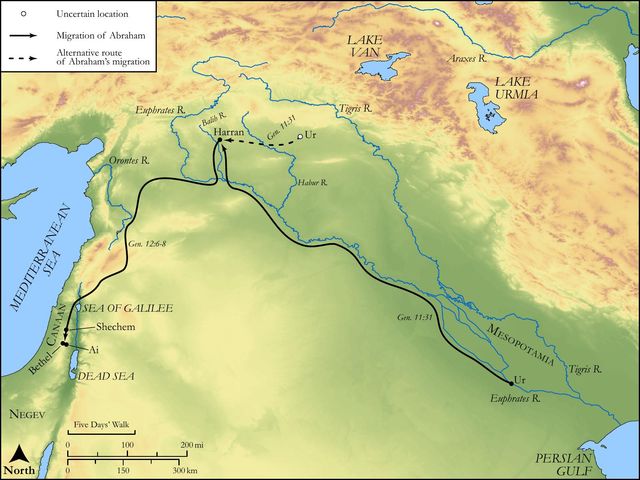
See on the biblical-era maps


Study this verse
Public-domain commentary
Matthew Henry
From his Commentary on the Whole Bible. Henry comments on passages, not single verses — this entry covers Genesis 11:10–26.
We have here a genealogy, not an endless genealogy, for here it ends in Abram, the friend of God, and leads further to Christ, the promised seed, who was the son of Abram, and from Abram the genealogy of Christ is reckoned (Mat 1:1, etc.); so that put ch. 5, ch. 11, and Mt. 1, together, and you have such an entire genealogy of Jesus Christ as cannot be produced, for aught I know, concerning any person in the world, out of his line, and at such a distance from the fountain-head. And, laying these three genealogies together, we shall find that twice ten, and thrice fourteen, generations or descents, passed between the first and second Adam, making it clear concerning Christ that he was not only the Son of Abraham, but the Son of man, and the seed of woman. Observe here, 1. Nothing is left upon record concerning those of this line but their names and ages, the Holy Ghost seeming to hasten through them to the story of Abram. How little do we know of those that have gone before us in this world, even those that lived in the same places where we live, as we likewise know little of those that are our contemporaries in distant places! we have enough to do to mind the work of our own day, and let God alone to require that which is past, Ecc 3:15. 2. There was an observable gradual decrease in the years of their lives. Shem reached to 600 years, which yet fell short of the age of the patriarchs before the flood; the next three came short of 500; the next three did not reach to 300; after them we read not of any that attained to 200, except Terah; and, not many ages after this, Moses reckoned seventy, or eighty, to be the utmost men ordinarily arrive at. When the earth began to be replenished, men's lives began to shorten; so that the decrease is to be imputed to the wise disposal of Providence, rather than to any decay of nature. For the elect's sake, men's days are shortened; and, being evil, it is well they are few, and attain not to the years of the lives of our fathers, Gen 47:9. 3. Eber, from whom the Hebrews were denominated, was the longest-lived of any that was born after the flood, which perhaps was the reward of his singular piety and strict adherence to the ways of God.
Historical interpretation
Historical reception
1 surviving comment on this verse from the historical church.
“And Aran [Haran] died before his father in the land in which he was born in the territory of the Chaldeans.” In place of what we read [in the LXX] as “in the territory of the Chaldeans,” in the Hebrew it has “in ur Chesdim,” that is, “in the fire of the Chaldeans.” Moreover the Hebrews, taking the opportunity afforded by this verse, hand on a story of this sort to the effect that Abraham was put into the fire because he refused to worship the fire, which the Chaldeans honor, and that he escaped through God’s help and fled from the fire of idolatry. What is written [in the LXX] in the following verses, that Thara [Terah] with his offspring “went out from the territory of the Chaldeans,” stands in place of what is contained in the Hebrew, “from the fire of the Chaldeans.” And they maintain that this refers to what is said in this verse: “Aran died before the face of Thara in the land of his birth in the fire of the Chaldeans”; that is, because he refused to worship fire, he was consumed by fire.
Continue studying Genesis 11:25 across the web’s major study libraries — every link below opens this exact verse, chapter, or book on the destination site.
Read & Compare
 BibleGatewayThis verse in more than 200 translations and 70 languages.
 Bible.comThe YouVersion reader — hundreds of translations, reading plans, and highlights.
 ESV.orgCrossway's official English Standard Version reader.
 NET BibleThe NET translation with 60,000+ translators' notes on every rendering decision.
 STEP BibleTyndale House's free study tool — original text, vocabulary, and scholarly resources.
 BibliaLogos Bible Software's free web reader.
 USCCBThe New American Bible (Revised Edition) with the U.S. bishops' study notes.
Commentaries
 BibleHub CommentariesDozens of classic commentaries on this verse, gathered on one page.
 StudyLightMore than 100 commentary sets — the largest collection on the web.
 BibleRefPlain-English commentary on what this verse means, verse by verse.
 Enduring WordDavid Guzik's free commentary on this chapter, widely used by Bible teachers.
 Bible Study ToolsVerse commentary alongside Greek and Hebrew study aids.
Original Language & Research
- BibleHub InterlinearThe verse word by word — original language, transliteration, and English.
- BibleHub LexiconEvery word's original-language definition and Strong's entry.
 Blue Letter BibleDeep-study tools — Strong's numbers, concordance, and word studies.
 SefariaThe Hebrew text with Rashi and centuries of Jewish commentary.
Sermons, Hymns & Audio


TrulyRandomVerse is not affiliated with these sites and doesn’t control their content. They’re linked because they’re genuinely useful.
Summary
Genesis 11:25 provides a concise yet crucial genealogical record, detailing Nahor's continued life for 119 years after the birth of his son Terah, and his ongoing procreation of other sons and daughters. This verse functions as a vital link in the post-Flood patriarchal lineage, meticulously tracing the ancestral line from Shem to Abram, thereby underscoring God's precise preservation of the chosen family through whom His redemptive plan and covenant promises would ultimately unfold.
Context
ShowHideLiterary Context
This verse is situated within the meticulously detailed genealogies of Genesis 11, specifically tracing the descendants of Shem, one of Noah's sons. It immediately follows the account of the Tower of Babel, which explains the diversification of languages and the scattering of humanity across the earth. The genealogies that follow, beginning with Shem's line, serve to narrow the biblical narrative's focus from a universal scope to a particular family line—the one through which God's redemptive purposes will be realized. Nahor's entry, positioned between Reu and Terah, solidifies a critical link in this divinely preserved chain, leading directly to Abram, the pivotal figure of the Abrahamic Covenant.
Historical & Cultural Context
The genealogies in Genesis 5 and 11 reflect the practice of recording ancestral lines, which in Israel established legitimacy, inheritance rights, and a claim to land, as when the tribes were numbered by the houses of their fathers. However, the biblical genealogies serve a unique theological purpose: to demonstrate God's faithfulness in preserving a "seed" (descendant) through whom His promises would be fulfilled. The mention of lifespans, though progressively decreasing from the pre-Flood era, still indicates significant longevity compared to modern standards, reflecting the post-Flood era's biological realities and the gradual effects of sin on human vitality. The emphasis on "begat sons and daughters" highlights the foundational importance of procreation and family continuity in the households of the patriarchs, which were essential for survival, societal structure, and the perpetuation of a lineage.
Key Themes
ShowHideGenesis 11:25 contributes significantly to several overarching themes within the book of Genesis and the broader biblical narrative. It reinforces the theme of Divine Sovereignty and Election, showing God's meticulous hand in guiding history through specific individuals and families, even in seemingly mundane details like a genealogical entry. The verse also highlights the Continuity of Promise, as the unbroken lineage ensures the eventual arrival of the promised "seed" who would bless all nations, a theme that becomes central with Abram's call in Genesis 12. Furthermore, it underscores the Reliability and Historicity of Scripture, asserting that the unfolding divine plan is rooted in verifiable human history, not myth, as evidenced by the precise recording of names and lifespans, even for figures like Nahor who are not central to the main narrative but are crucial links in the chain.
Exposition and Analysis
ShowHideKey Word Analysis
ShowHideThis primitive root signifies "to live," encompassing both literal existence and figurative vitality. In this context, it denotes Nahor's continued physical existence and the duration of his life after fathering Terah. It emphasizes the ongoing, though diminishing, longevity of the post-Flood patriarchs, a testament to God's sustaining power even in a fallen world.
A primitive root meaning "to bear young" or "to beget." This term is consistently used throughout biblical genealogies to denote the act of procreation and, more broadly, the establishment and continuation of a family line. Here, it highlights Nahor's role in the direct ancestral line of Abram (through Terah) and his continued fertility in producing other offspring, reinforcing the theme of generational continuity.
Derived from a root meaning "to build," this word signifies a "son" and, by extension, a builder of the family name. Its inclusion, alongside "daughters," emphasizes the full scope of Nahor's progeny beyond the single line of Terah, illustrating the natural growth of families while the biblical narrative strategically narrows its focus to the specific lineage of promise.
The feminine form of bên, meaning "daughter." Its presence alongside "sons" confirms Nahor's continued procreative activity, ensuring the perpetuation of his broader family line, even as the divine narrative specifically tracks the male lineage for the purposes of the covenant.
Verse Breakdown
ShowHide"And Nahor lived after he begat Terah an hundred and nineteen years"
This clause provides specific chronological information about Nahor's life. It states that after the birth of his son Terah, Nahor continued to live for an additional 119 years. This detail is crucial for establishing the timeline of the patriarchal age and for linking generations within the biblical narrative. It also implicitly reveals Nahor's total lifespan (148 years, as he was 29 when Terah was born, per Genesis 11:24), which, while long by modern standards, shows a continued decline in human longevity compared to earlier patriarchs.
"and begat sons and daughters"
This second clause indicates Nahor's ongoing fertility and the expansion of his family beyond Terah. While the biblical narrative primarily focuses on the direct lineage leading to Abram, this phrase acknowledges the broader reality of family life and procreation in ancient times. It underscores the natural progression of generations and the fulfillment of the divine command to "be fruitful and multiply," even as God's specific redemptive plan narrows its focus to a particular line.
Literary Devices
ShowHideThe primary literary device at play in Genesis 11:25, and indeed throughout Genesis 11, is Genealogy. This is not merely a list of names and numbers but a purposeful literary structure designed to establish historical continuity and theological progression. Each entry, including Nahor's, serves as a Link in a divinely ordained chain, connecting the universal history of humanity to the specific history of God's chosen people. The Repetition of the phrase "begat sons and daughters" across these genealogical entries emphasizes the ongoing cycle of life and the fulfillment of the creation mandate, even as the narrative selectively highlights the Messianic line. Furthermore, the precise numerical details (lifespans) lend an air of Historicity and Verisimilitude to the text, grounding the theological narrative in a seemingly factual, chronological framework.
Theological and Thematic Connections
ShowHideGenesis 11:25, while seemingly a straightforward genealogical entry, profoundly illustrates God's meticulous and sovereign hand in preserving the specific lineage through which His redemptive plan would unfold. It is a testament to divine faithfulness, demonstrating that even amidst the scattering of nations at Babel and the general decline of humanity, God was actively working to maintain an unbroken line leading to the promised "seed." This precision highlights the intentionality of God's work in history, ensuring that the covenant promises made to Abram would be rooted in a verifiable, divinely protected ancestry.
Reflection and Application
ShowHideGenesis 11:25, though brief, offers profound lessons for contemporary believers. It reminds us that God's grand redemptive plan unfolds through seemingly ordinary lives and generations, often in ways that are not immediately apparent. Nahor, a seemingly minor figure, was nonetheless a crucial link in the chain leading to Abram and ultimately to Christ. This should encourage us to recognize the significance of our own lives, however humble, within God's larger narrative. Every individual, every family, and every generation plays a part in the ongoing story of God's faithfulness. It calls us to trust that God is meticulously working behind the scenes, orchestrating events and preserving His purposes across vast stretches of time. Furthermore, it highlights the enduring value of family and heritage, not merely for biological continuity but as a divinely ordained means through which God's blessings and promises are passed down, laying the groundwork for future generations to receive and transmit the covenant.
Questions for Reflection
ShowHideFAQ
ShowHideWhy are these genealogies, like Genesis 11:25, so detailed?
ShowHideThese genealogies are meticulously detailed to establish the historical accuracy and divine preservation of the lineage from Adam to Abraham, and ultimately to Christ. They demonstrate God's faithfulness in maintaining a specific "seed" through whom His redemptive plan would unfold, ensuring the promised Messiah would come from a verifiable historical line, as affirmed by later biblical writers like Matthew and Luke.
What is the significance of Nahor having "sons and daughters" beyond Terah?
ShowHideThe mention of Nahor having other "sons and daughters" emphasizes the natural continuation of life and family lines, even as the biblical narrative strategically narrows its focus to the specific lineage chosen for God's covenant purposes. It highlights the broader human context and the fulfillment of the creation mandate to "be fruitful and multiply" (Genesis 1:28), while underscoring the divine election of a particular branch for the unfolding of salvation history.
Do the declining lifespans in Genesis 11, including Nahor's, have theological significance?
ShowHideYes, the declining lifespans from the pre-Flood patriarchs to those in Genesis 11 are often seen as a consequence of humanity's increasing sinfulness and the progressive withdrawal of God's sustaining grace in a fallen world. While Nahor still lived a long life by modern standards (148 years total), his 119 years after Terah's birth are significantly shorter than those of his earlier ancestors, illustrating a pattern of diminishing longevity that continues throughout biblical history and points to the pervasive effects of the curse of sin.
Christ-Centered Fulfillment
ShowHideGenesis 11:25, as a crucial link in the patriarchal genealogy, points directly to Christ by demonstrating God's meticulous preservation of the Messianic lineage. Nahor's life and progeny ensure the unbroken chain from Shem to Terah, who is the father of Abram, the patriarch of faith. This precise historical record establishes the human ancestry through which the promised "seed"—the Messiah—would ultimately come. Every name in this genealogy, including Nahor's, serves as a testament to God's unwavering faithfulness in upholding His covenant promises, guaranteeing that Jesus Christ would be born into the very lineage foretold since the protoevangelium in Eden. This divine commitment to a specific lineage culminates in the New Testament, where the genealogies of Matthew 1 and Luke 3 confirm Jesus' rightful place as the Son of David and the Son of Abraham, the fulfillment of all these ancient promises and the ultimate redeemer of humanity (Galatians 3:16).