


Genesis 11:24
Bible text: King James Version (1769 Blayney text) · Public domain
Bible text: Berean Standard Bible · Public domain
Bible text: American Standard Version (1901) · Public domain
Bible text: World English Bible, Messianic edition · Public domain
Bible text: Geneva Bible (1599) · Public domain
Bible text: Young's Literal Translation · Public domain
- וַיְחִיvay·Chiand he livedH2421Conj-w ¦ V-Qal-ConsecImperf-3msVerb Qal Consecutive Imperfect 3rd Singular Masculineוַandיְחִיhe lived
- נָחוֹרna·ChorNahorH5152N-proper-mNoun Proper Masculine
- תֵּשַׁעTe·sha'nineH8672Adj-csAdjective Numerical Singular common gender Absolute
- וְעֶשְׂרִיםve·'es·Rimand twentyH6242Conj-w ¦ Adj-mpAdjective Numerical Plural Masculine Absoluteוְandעֶשְׂרִיםtwenty
- שָׁנָהsha·Nahyear[s]H8141N-fsNoun Singular Feminine Absolute
- וַיּוֹלֶדvai·Yo·ledand he fatheredH3205Conj-w ¦ V-Hiphil-ConsecImperf-3msVerb Hiphil Consecutive Imperfect 3rd Singular Masculineוַandיּוֹלֶדhe fathered
- אֶת'et<obj.>H853DirObjMParticle Object Indicator
- תָּרַחTa·rachTerahH8646N-proper-mNoun Proper Masculine
English is a literal word-by-word gloss of the Hebrew, not the KJV's wording. Why?
This is the original text the KJV's translators worked from — each Hebrew word with its own literal English meaning in this verse, prepared by scholars at Tyndale House, Cambridge. The KJV translates whole sentences, not word by word, so its wording differs: one Hebrew word can become several English words, and the KJV may choose “the LORD” where the gloss reads “Yahweh”. Both are faithful — they answer different questions. For the KJV's own rendering, switch to the KJV text.
Details
See on the biblical-era maps


Study this verse
Public-domain commentary
Matthew Henry
From his Commentary on the Whole Bible. Henry comments on passages, not single verses — this entry covers Genesis 11:10–26.
We have here a genealogy, not an endless genealogy, for here it ends in Abram, the friend of God, and leads further to Christ, the promised seed, who was the son of Abram, and from Abram the genealogy of Christ is reckoned (Mat 1:1, etc.); so that put ch. 5, ch. 11, and Mt. 1, together, and you have such an entire genealogy of Jesus Christ as cannot be produced, for aught I know, concerning any person in the world, out of his line, and at such a distance from the fountain-head. And, laying these three genealogies together, we shall find that twice ten, and thrice fourteen, generations or descents, passed between the first and second Adam, making it clear concerning Christ that he was not only the Son of Abraham, but the Son of man, and the seed of woman. Observe here, 1. Nothing is left upon record concerning those of this line but their names and ages, the Holy Ghost seeming to hasten through them to the story of Abram. How little do we know of those that have gone before us in this world, even those that lived in the same places where we live, as we likewise know little of those that are our contemporaries in distant places! we have enough to do to mind the work of our own day, and let God alone to require that which is past, Ecc 3:15. 2. There was an observable gradual decrease in the years of their lives. Shem reached to 600 years, which yet fell short of the age of the patriarchs before the flood; the next three came short of 500; the next three did not reach to 300; after them we read not of any that attained to 200, except Terah; and, not many ages after this, Moses reckoned seventy, or eighty, to be the utmost men ordinarily arrive at. When the earth began to be replenished, men's lives began to shorten; so that the decrease is to be imputed to the wise disposal of Providence, rather than to any decay of nature. For the elect's sake, men's days are shortened; and, being evil, it is well they are few, and attain not to the years of the lives of our fathers, Gen 47:9. 3. Eber, from whom the Hebrews were denominated, was the longest-lived of any that was born after the flood, which perhaps was the reward of his singular piety and strict adherence to the ways of God.
Historical interpretation
Three Centuries of Reception
2 surviving comments on this verse. Each one is dated, so this reads as a timeline rather than a list.
Select a marker to jump to its quote. Markers stagger vertically where authors wrote within a few decades of each other.
“And Aran [Haran] died before his father in the land in which he was born in the territory of the Chaldeans.” In place of what we read [in the LXX] as “in the territory of the Chaldeans,” in the Hebrew it has “in ur Chesdim,” that is, “in the fire of the Chaldeans.” Moreover the Hebrews, taking the opportunity afforded by this verse, hand on a story of this sort to the effect that Abraham was put into the fire because he refused to worship the fire, which the Chaldeans honor, and that he escaped through God’s help and fled from the fire of idolatry. What is written [in the LXX] in the following verses, that Thara [Terah] with his offspring “went out from the territory of the Chaldeans,” stands in place of what is contained in the Hebrew, “from the fire of the Chaldeans.” And they maintain that this refers to what is said in this verse: “Aran died before the face of Thara in the land of his birth in the fire of the Chaldeans”; that is, because he refused to worship fire, he was consumed by fire.
Now Nachor lived twenty-nine years and begot Thare. The seventy interpreters have it seventy-nine.
Continue studying Genesis 11:24 across the web’s major study libraries — every link below opens this exact verse, chapter, or book on the destination site.
Read & Compare
 BibleGatewayThis verse in more than 200 translations and 70 languages.
 Bible.comThe YouVersion reader — hundreds of translations, reading plans, and highlights.
 ESV.orgCrossway's official English Standard Version reader.
 NET BibleThe NET translation with 60,000+ translators' notes on every rendering decision.
 STEP BibleTyndale House's free study tool — original text, vocabulary, and scholarly resources.
 BibliaLogos Bible Software's free web reader.
 USCCBThe New American Bible (Revised Edition) with the U.S. bishops' study notes.
Commentaries
 BibleHub CommentariesDozens of classic commentaries on this verse, gathered on one page.
 StudyLightMore than 100 commentary sets — the largest collection on the web.
 BibleRefPlain-English commentary on what this verse means, verse by verse.
 Enduring WordDavid Guzik's free commentary on this chapter, widely used by Bible teachers.
 Bible Study ToolsVerse commentary alongside Greek and Hebrew study aids.
Original Language & Research
- BibleHub InterlinearThe verse word by word — original language, transliteration, and English.
- BibleHub LexiconEvery word's original-language definition and Strong's entry.
 Blue Letter BibleDeep-study tools — Strong's numbers, concordance, and word studies.
 SefariaThe Hebrew text with Rashi and centuries of Jewish commentary.
Sermons, Hymns & Audio


TrulyRandomVerse is not affiliated with these sites and doesn’t control their content. They’re linked because they’re genuinely useful.
Summary
Genesis 11:24 precisely records that Nahor lived for twenty-nine years before begetting Terah, his son. This concise genealogical entry is a critical link in the biblical narrative, meticulously bridging the post-Flood dispersion of nations to the specific lineage that would lead directly to Abraham. It underscores the divine preservation of a chosen family line, demonstrating God's sovereign and sustained involvement in human history as He faithfully orchestrates the unfolding of His redemptive plan.
Context
ShowHideLiterary Context
Genesis 11:24 is situated within the post-Flood genealogies of Shem, specifically the line leading to Abraham. This chapter begins with the account of the Tower of Babel, a pivotal event that explains the dispersion of humanity and the diversity of languages. Immediately following this narrative of human rebellion and divine judgment, the text shifts to a meticulous tracing of a single family line from Shem, through Arphaxad, Shelah, Eber, Peleg, Reu, Serug, Nahor, and Terah, culminating in the introduction of Abram (Abraham) in Genesis 11:26. This precise genealogical record serves as a vital bridge, connecting the global events of early Genesis to the specific, covenantal history that begins with Abraham in Genesis 12.
Historical & Cultural Context
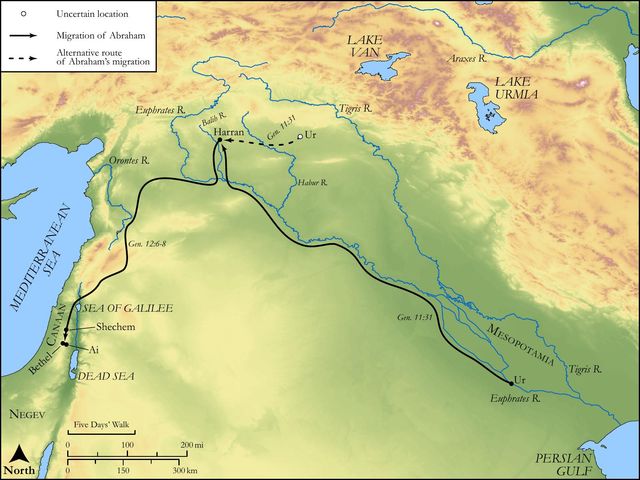
The genealogies in Genesis, including this verse, reflect the Hebrew practice of meticulously recording lineage, often for purposes of land rights, inheritance, or establishing identity. Unlike some ancient genealogies that might skip generations, the Genesis accounts often provide precise ages at the birth of the next generation, establishing a chronological framework for early human history. The ages recorded in Genesis 11, while still long by modern standards, show a significant decrease in lifespan compared to the pre-Flood patriarchs, reflecting a post-Flood reality. The setting is primarily Mesopotamia, the region from which Terah and his family would eventually migrate, first to Haran and then, with Abraham, to Canaan, as described in Genesis 11:31. This period is characterized by the rise of city-states and the development of distinct cultural and linguistic groups following the Babel dispersion.
Key Themes
ShowHideThis verse contributes to several overarching themes within Genesis and the broader biblical narrative. It highlights Divine Sovereignty and Providence, demonstrating God's active hand in preserving a specific lineage despite humanity's widespread sin and dispersion. The meticulous record underscores the theme of Continuity of Promise, showing how God's redemptive plan, initiated after the Fall (Genesis 3:15), is faithfully carried forward through chosen individuals across generations. It also reinforces the theme of Preparation for Covenant, as this genealogy systematically narrows the focus from all humanity to a single family, setting the stage for the pivotal covenant with Abraham in Genesis 12:1-3. The seemingly mundane details of age and lineage are, in fact, crucial components of God's overarching historical and theological design.
Exposition and Analysis
ShowHideGenesis 11:24, though brief, is a vital component of the biblical record, serving as a precise chronological and familial link in the lineage leading to Abraham. It states: "And Nahor lived nine and twenty years, and begat Terah." This succinct declaration, characteristic of the patriarchal genealogies in Genesis, provides essential data for understanding the unfolding of God's redemptive plan.
Key Word Analysis
ShowHideDerived from a root meaning "snorer." This is the name of the son of Serug and the father of Terah. He is the great-grandfather of Abraham. The inclusion of his name here is not merely for historical record but to establish the precise link in the messianic lineage, emphasizing the specific individuals through whom God's promises would be carried forward.
A primitive root meaning "to live," "to revive," or "to keep alive." In this context, it denotes the duration of Nahor's life before a significant event – the birth of his son. The verb underscores the continuity of life and generations, essential for the progression of the divine plan. It signifies the ongoing existence and procreation necessary for the lineage to continue.
A primitive root meaning "to bear young," "to give birth," or "to beget." This verb is consistently used in the genealogies of Genesis to denote direct paternal lineage. Its repeated use highlights the straightforward, biological transmission of the family line, emphasizing the unbroken chain of generations through which God's redemptive plan is progressively advanced and preserved.
Verse Breakdown
ShowHide"And Nahor lived nine and twenty years"
This clause provides the precise age of Nahor at the time of Terah's birth. The specificity of "nine and twenty years" (29 years) is characteristic of the Genesis genealogies, offering a meticulous chronological framework for the early patriarchal period. This detail contributes to the overall biblical timeline, allowing for a calculation of the duration between significant events and figures, such as the Flood and the call of Abraham. It underscores the Bible's commitment to historical and chronological accuracy in tracing the lineage of promise.
"and begat Terah"
This clause identifies Terah as Nahor's son, establishing the next crucial link in the genealogical chain. The act of "begetting" signifies direct paternal descent, ensuring the continuity of the family line. Terah is a pivotal figure as he is the father of Abram (Abraham), Nahor (the younger, Abraham's brother), and Haran (Genesis 11:27). This simple statement thus sets the immediate stage for the introduction of Abraham, the patriarch through whom God would establish His covenant people and initiate His grand redemptive plan.
Literary Devices
ShowHideThe primary literary device employed in Genesis 11:24, and indeed throughout the genealogies of Genesis 5 and 11, is Repetition in the formulaic presentation ("X lived Y years and begat Z"). This consistent structure provides a sense of order, continuity, and divine intentionality. It emphasizes the unbroken chain of generations, reinforcing the idea that God is faithfully working through specific individuals to bring about His purposes. The use of Precision in detailing ages (e.g., "nine and twenty years") lends an air of historical accuracy and reliability to the narrative, suggesting that these are not mere mythical tales but records of actual historical progression. Furthermore, the entire genealogical section functions as a Literary Bridge, connecting the broader narratives of humanity's early history (creation, fall, flood, Babel) to the specific, covenantal history of Israel that begins with Abraham.
Theological and Thematic Connections
ShowHideGenesis 11:24, like the other genealogical entries, serves as more than a mere historical record; it is imbued with profound theological significance. It powerfully illustrates God's unwavering commitment to His redemptive plan, even amidst human failure and dispersion. The meticulous tracing of this lineage underscores the theme of divine faithfulness, demonstrating that God is actively working through specific individuals and generations to bring about His purposes. This verse is a testament to God's patient providence, showing that His plans unfold over vast spans of time and through seemingly ordinary acts like birth, all meticulously orchestrated for His ultimate glory.
Reflection and Application
ShowHideFor a contemporary audience, Genesis 11:24, though a simple genealogical note, offers profound insights into God's character and His method of working in the world. It reminds us that God's grand plans often unfold over vast spans of time and through countless individuals, many of whom are unnamed or briefly mentioned in the grand narrative. This should encourage us to trust in God's patient providence, knowing that He is faithfully working out His purposes across generations, even when we cannot perceive the immediate impact or significance of our own lives. Our seemingly small contributions or the "mundane" details of our existence are woven into God's larger tapestry, contributing to His ultimate redemptive design and the eventual establishment of His eternal Kingdom. This verse calls us to embrace a long-term perspective, recognizing that God's faithfulness transcends individual lifespans and culminates in His perfect timing.
Questions for Reflection
ShowHideFAQ
ShowHideWhy are biblical genealogies so detailed and important?
ShowHideBiblical genealogies, such as the one in Genesis 11:24, are crucial because they establish historical continuity, demonstrate God's faithfulness in preserving a chosen lineage, and provide a chronological framework for biblical history. They are not mere lists but serve to validate the promises of God, especially concerning the coming of the Messiah through a specific, divinely ordained family line. They reveal God's meticulous attention to detail in orchestrating His redemptive plan, showing that His purposes are not random but carefully executed across generations.
What is the significance of Nahor and Terah in the broader biblical narrative?
ShowHideNahor and Terah are significant because they are direct ancestors of Abraham, the patriarch through whom God established His covenant people, Israel. While they are not major figures themselves with extensive narratives, their inclusion in this genealogy highlights the unbroken chain of God's providential care in preserving the lineage leading to the fulfillment of His promises. They represent essential links in the pre-history of God's chosen nation, serving as vital connections in the genealogical line that ultimately culminates in the birth of Jesus Christ, as affirmed in the New Testament genealogies (e.g., Luke 3:34).
Christ-Centered Fulfillment
ShowHideGenesis 11:24, by meticulously tracing the lineage through Nahor to Terah and ultimately to Abraham, serves as a foundational testament to God's unwavering commitment to His redemptive plan, which finds its ultimate fulfillment in Jesus Christ. The preservation of this specific family line demonstrates God's sovereign hand guiding history towards the birth of the Messiah, who is the "seed" promised to Abraham, through whom all nations would be blessed (Galatians 3:16). Every name in this genealogy, including Nahor and Terah, is a divinely appointed link in the chain that culminates in Christ, the one through whom all the families of the earth are indeed blessed (Genesis 12:3). Thus, this seemingly simple verse points to the profound divine faithfulness that ensured the advent of the Savior, fulfilling the ancient promises and establishing God's eternal Kingdom, forever linking the Old Testament genealogies to the New Testament's grand narrative of salvation in Christ (Matthew 1:1-17).