


Ezra 2:39
Bible text: King James Version (1769 Blayney text) · Public domain
Bible text: Berean Standard Bible · Public domain
Bible text: American Standard Version (1901) · Public domain
Bible text: World English Bible, Messianic edition · Public domain
Bible text: Geneva Bible (1599) · Public domain
Bible text: Young's Literal Translation · Public domain
- בְּנֵיbe·Nei[the] descendants ofH1121N-mpcNoun Plural Masculine Construct
- חָרִםcha·RimHarimH2766N-proper-mNoun Proper Masculine
- אֶלֶף'E·lefone thousandH505Adj-csAdjective Numerical Singular common gender Absolute
- וְשִׁבְעָהve·shiv·'Ahand sevenH7651Conj-w ¦ Adj-csAdjective Numerical Singular common gender Absoluteוְandשִׁבְעָהseven
- עָשָׂר'a·SarteenH6240Adj-csAdjective Numerical Singular common gender Absolute
English is a literal word-by-word gloss of the Hebrew, not the KJV's wording. Why?
This is the original text the KJV's translators worked from — each Hebrew word with its own literal English meaning in this verse, prepared by scholars at Tyndale House, Cambridge. The KJV translates whole sentences, not word by word, so its wording differs: one Hebrew word can become several English words, and the KJV may choose “the LORD” where the gloss reads “Yahweh”. Both are faithful — they answer different questions. For the KJV's own rendering, switch to the KJV text.
Details
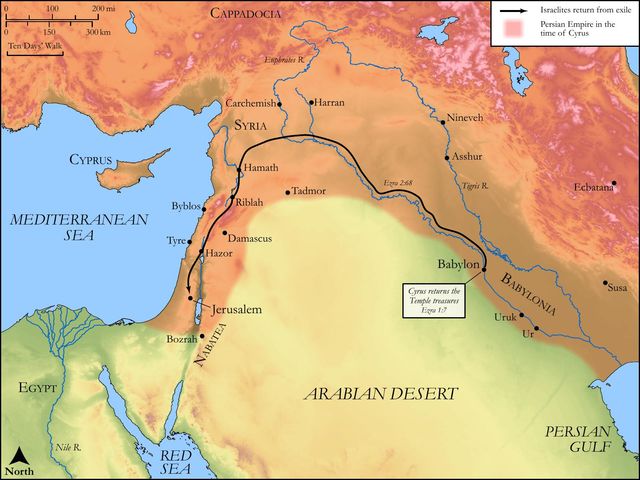
See on the biblical-era map
Study this verse
Public-domain commentary
Matthew Henry
From his Commentary on the Whole Bible. Henry comments on passages, not single verses — this entry covers Ezra 2:36–63. His three-level outline is real structure in the source text, so it is rendered as structure.
Here is an account, I. Of the priests that returned, and they were a considerable number, about a tenth part of the whole company: for the whole were above 42,000 (Ezr 2:64), and four families of priests made up above 4200 (Ezr 2:36-39); thus was the tenth God's part - a blessed decimation. Three of the fathers of the priests here named were heads of courses, Ch1 24:7, Ch1 24:8, Ch1 24:14. The fourth was Pashur, v. 38. If these were of the posterity of that Pashur that abused Jeremiah (Jer 20:1), it is strange that so bad a man should have so good a seed, and so numerous.
II.Of the Levites.
I cannot but wonder at the small number of them, for, taking in both the singers and the porters (Ezr 2:40-42), they did not make 350. Time was when the Levites were more forward to their duty than the priests (Ch2 29:34), but they were not so now. If one place, one family, has the reputation for pious zeal now, another may have it another time. The wind blows where it listeth, and shifts its points.
III.Of the Nethinim, who, it is supposed, were the Gibeonites, given (so their name signifies) by Joshua first (Jos 9:27), and again by David (Ezr 8:20), when Saul had expelled them, to be employed by the Levites in the work of God's house as hewers of wood and drawers of water; and, with them, of the children of Solomon's servants, whom he gave for the like use (whether they were Jews or Gentiles does not appear) and who were here taken notice of among the retainers of the temple and numbered with the Nethinim, Ezr 2:55, Ezr 2:58. Note, It is an honour to belong to God's house, though in the meanest office there.
IV.Of some that were looked upon as Israelites by birth, and others as priests, and yet could not make out a clear title to the honour.
1.There were some that could not prove themselves Israelites (Ezr 2:59, Ezr 2:60), a considerable number, who presumed they were of the seed of Jacob, but could not produce their pedigrees, and yet would go up to Jerusalem, having an affection to the house and people of God. These shamed those who were true-born Israelites, and yet were not called Israelites indeed, who came out of the waters of Judah (Isa 48:1), but had lost the relish of those waters.
2.There were others that could not prove themselves priests, and yet were supposed to be of the seed of Aaron. What is not preserved in black and white will, in all likelihood, be forgotten in a little time. Now we are here told,
(1.)How they lost their evidence. One of their ancestors married a daughter of Barzillai, that great man whom we read of in David's time; he gloried in an alliance to that honourable family, and, preferring that before the dignity of his priesthood, would have his children called after Barzillai's family, and their pedigree preserved in the registers of that house, not of the house of Aaron, and so they lost it. In Babylon there was nothing to be got by the priesthood, and therefore they cared not for being akin to it. Those who think their ministry, or their relation to ministers, a diminution or disparagement to them, forget who it was that said, I magnify my office.
(2.)What they lost with it. It could not be taken for granted that they were priests when they could not produce their proofs, but they were, as polluted, put from the priesthood. Now that the priests had recovered their rights, and had the altar to live upon again, they would gladly be looked upon as priests. But they had sold their birthright for the honour of being gentlemen, and therefore were justly degraded, and forbidden to eat of the most holy things. Note, Christ will be ashamed of those that are ashamed of him and his service. It was the tirshatha, or governor, that put them under this sequestration, which some understand of Zerubbabel the present governor, others of Nehemiah (who is so called, Neh 8:9, Neh 10:1, and who gave this order when he came some years after); but the prohibition was not absolute, it was only a suspension, till there should be a high priest with Urim and Thummin, by whom they might know God's mind in this matter. This, it seems, was expected and desired, but it does not appear that ever they were blessed with it under the second temple. They had the canon of the Old Testament complete, which was better than Urim; and, by the want of that oracle, they were taught to expect the Messiah the great Oracle, which the Urim and Thummim was but a type of. Nor does it appear that the second temple had the ark in it, either the old one or a new one. Those shadows by degrees vanished, as the substance approached; and God, by the prophet, intimates to his people that they should sustain no damage by the want of the ark, Jer 3:16, Jer 3:17. In those days, when they shall call Jerusalem the throne of the Lord, and all the nations shall be gathered to it, they shall say no more, The ark of the covenant of the Lord, neither shall it come to mind, for they shall do very well without it.
Continue studying Ezra 2:39 across the web’s major study libraries — every link below opens this exact verse, chapter, or book on the destination site.
Read & Compare
 BibleGatewayThis verse in more than 200 translations and 70 languages.
 Bible.comThe YouVersion reader — hundreds of translations, reading plans, and highlights.
 ESV.orgCrossway's official English Standard Version reader.
 NET BibleThe NET translation with 60,000+ translators' notes on every rendering decision.
 STEP BibleTyndale House's free study tool — original text, vocabulary, and scholarly resources.
 BibliaLogos Bible Software's free web reader.
 USCCBThe New American Bible (Revised Edition) with the U.S. bishops' study notes.
Commentaries
 BibleHub CommentariesDozens of classic commentaries on this verse, gathered on one page.
 StudyLightMore than 100 commentary sets — the largest collection on the web.
 BibleRefPlain-English commentary on what this verse means, verse by verse.
 Enduring WordDavid Guzik's free commentary on this chapter, widely used by Bible teachers.
 Bible Study ToolsVerse commentary alongside Greek and Hebrew study aids.
Original Language & Research
- BibleHub InterlinearThe verse word by word — original language, transliteration, and English.
- BibleHub LexiconEvery word's original-language definition and Strong's entry.
 Blue Letter BibleDeep-study tools — Strong's numbers, concordance, and word studies.
 SefariaThe Hebrew text with Rashi and centuries of Jewish commentary.
Sermons, Hymns & Audio


TrulyRandomVerse is not affiliated with these sites and doesn’t control their content. They’re linked because they’re genuinely useful.
Summary
Ezra 2:39, stating "The children of Harim, a thousand and seventeen," is a precise entry within the meticulous census of Jewish exiles returning from Babylonian captivity to Judah. This verse, like others in Ezra 2, serves as a vital record of the families and individuals who formed the initial wave of returnees, underscoring the re-establishment of the covenant community, the re-population of the land, and the foundational steps towards rebuilding the Temple and Jerusalem. It highlights the importance of every family's contribution to the national and spiritual restoration.
Context
ShowHideLiterary Context
Ezra 2 is a detailed register of the first wave of Jewish exiles who returned from Babylon to Judah under the leadership of Zerubbabel and Jeshua. This chapter immediately follows the decree of King Cyrus, as recorded in Ezra 1:1-4, which permitted the Jews to return and rebuild the Temple in Jerusalem. The exhaustive list, stretching from Ezra 2:1 to Ezra 2:67, meticulously enumerates families, individuals, priests, Levites, temple servants, and even animals, culminating in a total count. Ezra 2:39 is one such entry, providing the specific number of male adults from the family of Harim, emphasizing the comprehensive nature of this foundational record for the re-established community.
Historical & Cultural Context
The historical backdrop for Ezra 2:39 is the post-exilic period, specifically the initial return from the seventy-year Babylonian captivity, as prophesied by Jeremiah (Jeremiah 29:10). After the fall of Babylon to Persia, King Cyrus issued a decree (c. 538 BC) allowing the exiled Jews to return. This census was not merely a historical record but a crucial administrative document for the nascent community. Genealogies and family lists were paramount in ancient Israel for establishing identity, confirming tribal affiliations, validating claims to land inheritance, and determining eligibility for priestly or Levitical service. The "children of Harim" in this verse refers to a lay family or clan, distinct from the priestly family of Harim mentioned elsewhere (e.g., Ezra 2:32 or Nehemiah 7:42), underscoring the meticulous categorization of the returnees for various societal and religious roles.
Key Themes
ShowHideThe inclusion of Ezra 2:39 within this detailed census highlights several key themes. Firstly, it powerfully illustrates the theme of Restoration and Divine Faithfulness. The very act of counting and returning a remnant testifies to God's unwavering faithfulness to His covenant promises, bringing His people back to the land after judgment. Secondly, the emphasis on Identity and Lineage is central; these lists confirmed who belonged to the covenant community, ensuring their rightful place and participation in the rebuilding efforts. For the "children of Harim," their inclusion signifies their legitimate standing within the returned remnant. Lastly, the meticulous numbering underscores the theme of Community Building. Each individual and family, like the "thousand and seventeen" from Harim, represented a vital component of the collective effort to rebuild Jerusalem, the Temple, and the social fabric of Judah, demonstrating the importance of every member in God's overarching plan for His people.
Exposition and Analysis
ShowHideKey Word Analysis
ShowHideThis word literally means "son," but in this context, "children of Harim" refers to the male descendants, members, or a collective clan unit belonging to the patriarch or family head named Harim. This usage is common in biblical genealogies and censuses, indicating the entire family group or lineage that traces its origin back to a common ancestor, rather than just immediate offspring. It signifies their corporate identity and shared heritage within the returned community.
This proper noun denotes a specific Israelite family or clan. The name itself, derived from a root meaning "devoted" or "consecrated," appears multiple times in Ezra and Nehemiah, referring to distinct groups. In Ezra 2:39, it specifically identifies a lay family, separate from the priestly family of the same name. This distinction highlights the careful and precise record-keeping of the ancient census, ensuring that each group's identity and role within the community were clearly defined, particularly concerning temple service and land allocation.
This precise numerical count combines the Hebrew words for "thousand" (H505, ʼeleph), "seven" (H7651, shebaʻ), and "ten" (H6240, ʻâsâr). This signifies the exact number of male adults from the Harim family who participated in the initial return. The meticulous detail of these numbers throughout Ezra 2 underscores the administrative thoroughness of the census, which was crucial for allocating resources, organizing the community, and establishing the demographic foundation for the re-settlement of Judah. It also subtly emphasizes the tangible reality of God's fulfillment of His promise to bring a remnant back.
Verse Breakdown
ShowHide"The children of Harim"
This clause identifies a specific family or clan unit among the returning exiles. It signifies their lineage and corporate identity, essential for their place within the re-established community of Judah.
"a thousand and seventeen"
This phrase provides the exact numerical count of male adults from the Harim family who were part of this first wave of returnees. It highlights the meticulous record-keeping of the census, which was vital for the administrative and social organization of the post-exilic community.
Literary Devices
ShowHideEzra 2:39, as part of a larger Census/List, functions as a critical administrative and theological document. The pervasive use of Numeration throughout the chapter, including the specific count for the "children of Harim," emphasizes the meticulous detail and precision with which the returning community was recorded. This is not merely a dry historical record but a testament to the tangible reality of God's faithfulness in bringing a specific, countable remnant back to the land. The Repetition of the formula "The children of [Name], [Number]" across the chapter reinforces the comprehensive nature of the census, highlighting that every family and individual was accounted for in God's plan for restoration. This literary structure underscores the foundational importance of these returnees for the future of Israel.
Theological and Thematic Connections
ShowHideEzra 2:39, though a simple numerical entry, profoundly illustrates God's meticulous care for His people and His unwavering faithfulness to His covenant promises. The very act of counting and listing each family, including the "children of Harim," demonstrates that God's plan for restoration was not an abstract concept but a concrete reality involving specific individuals and families. This census laid the administrative and demographic groundwork for the re-establishment of the nation, the rebuilding of the Temple, and the resumption of covenant life. It serves as a powerful reminder that God values every person and family within His divine economy, meticulously orchestrating their return to fulfill His redemptive purposes.
Reflection and Application
ShowHideThe seemingly mundane listing in Ezra 2:39 offers profound spiritual lessons for contemporary believers. It reminds us that God's grand redemptive plan is meticulously detailed, valuing every single individual and family. Just as the "children of Harim" were counted and given their place in the physical restoration of Israel, so too are we, as believers, counted and cherished within God's spiritual kingdom. This verse calls us to appreciate the importance of our own unique place and contribution within the body of Christ, recognizing that even seemingly small or unglamorous acts of faithfulness contribute to the larger work of God. It encourages us to embrace our identity within the covenant community, understanding that belonging to God's people carries both privilege and responsibility in building up His church and extending His kingdom.
Questions for Reflection
ShowHideFAQ
ShowHideWhy is this verse, seemingly just a number, included in the Bible?
ShowHideEzra 2:39, along with the entire census in Ezra 2, is included for several crucial reasons. Firstly, it serves as a vital historical and administrative record, documenting the specific families and their numbers who participated in the initial return from exile. This was essential for establishing land claims, verifying lineage for priestly service, and organizing the re-settlement of Judah. Secondly, it provides theological affirmation of God's faithfulness; the return of a specific, countable remnant fulfills prophetic promises (e.g., Jeremiah 29:10). Thirdly, it underscores the importance of every individual and family in God's plan. Even seemingly ordinary groups like the "children of Harim" were significant enough to be counted, demonstrating God's meticulous care for His people and their collective role in the restoration of His covenant community.
Is this "Harim" the same as the priestly Harim mentioned elsewhere in Ezra and Nehemiah?
ShowHideNo, the "children of Harim" mentioned in Ezra 2:39 refers to a lay family or clan, distinct from the priestly family of Harim. The priestly family of Harim is listed separately in the census (e.g., Ezra 2:32 and Nehemiah 7:42). This distinction highlights the meticulous nature of the biblical census, which carefully categorized individuals and families based on their lineage and their roles within the community, particularly concerning eligibility for temple service. The presence of two distinct groups with the same name underscores the administrative precision required for the re-establishment of the post-exilic community.
Christ-Centered Fulfillment
ShowHideThe meticulous counting of the "children of Harim" and other families in Ezra 2, marking their return to the promised land, prefigures the ultimate and greater gathering of God's people in Christ. Just as a physical remnant was called out of exile to rebuild Jerusalem and the Temple, so too are believers, through faith in Jesus, called out of spiritual exile and brought into the new covenant community, the Church. This physical restoration foreshadows the spiritual redemption and the establishment of God's eternal kingdom through the Lamb of God. In Christ, the meticulous genealogies and family lists find their ultimate fulfillment, as all who believe, regardless of their earthly lineage, become children of God and heirs according to the promise. The re-population of Judah by a specific number of families points forward to the countless multitude from every nation, tribe, people, and language who will stand before the throne, redeemed by Christ (Revelation 7:9), demonstrating God's sovereign and inclusive plan to gather His people into His eternal presence.