


Ezekiel 41:24
Bible text: King James Version (1769 Blayney text) · Public domain
Bible text: Berean Standard Bible · Public domain
Bible text: American Standard Version (1901) · Public domain
Bible text: World English Bible, Messianic edition · Public domain
Bible text: Geneva Bible (1599) · Public domain
Bible text: Young's Literal Translation · Public domain
- וּשְׁתַּיִםu·she·Ta·yimand twoH8147Conj-w ¦ Adj-fdAdjective Numerical Dual Feminine Absoluteוּandשְׁתַּיִםtwo
- דְּלָתוֹתde·la·TotleavesH1817N-fpNoun Plural Feminine Absolute
- לַדְּלָתוֹתla·de·la·Tot[belonged] to the doorsH1817Prep-l ¦ N-fpNoun Plural Feminine Absoluteלַ[belonged] to theדְּלָתוֹתdoors
- שְׁתַּיִםShe·ta·yimtwoH8147Adj-fdAdjective Numerical Dual Feminine Absolute
- מוּסַבּוֹתmu·sa·BotturningH5437V-Hophal-PassPrtcpl-fpVerb Hophal Participle Passive Plural Feminine Absolute
- דְּלָתוֹתde·la·TotleavesH1817N-fpNoun Plural Feminine Absolute
- שְׁתַּיִםShe·ta·yimtwo [leaves]H8147Adj-fdAdjective Numerical Dual Feminine Absolute
- לְדֶלֶתle·De·let[belonged] to a doorH1817Prep-l ¦ N-fsNoun Singular Feminine Absoluteלְ[belonged] toדֶלֶתa door
- אֶחָת'e·ChatoneH259Adj-fsAdjective Numerical Singular Feminine Absolute
- וּשְׁתֵּיu·she·Teiand twoH8147Conj-w ¦ Adj-fdcAdjective Numerical Dual Feminine Constructוּandשְׁתֵּיtwo
- דְלָתוֹתde·la·TotleavesH1817N-fpNoun Plural Feminine Absolute
- לָאַחֶרֶתla·'a·Che·ret[belonged] to the other [door]H312Prep-l ¦ Adj-fsAdjective Singular Feminine Absoluteלָ[belonged] to theאַחֶרֶתother [door]
English is a literal word-by-word gloss of the Hebrew, not the KJV's wording. Why?
This is the original text the KJV's translators worked from — each Hebrew word with its own literal English meaning in this verse, prepared by scholars at Tyndale House, Cambridge. The KJV translates whole sentences, not word by word, so its wording differs: one Hebrew word can become several English words, and the KJV may choose “the LORD” where the gloss reads “Yahweh”. Both are faithful — they answer different questions. For the KJV's own rendering, switch to the KJV text.
Details
See on the biblical-era map
Study this verse
Public-domain commentary
Matthew Henry
From his Commentary on the Whole Bible. Henry comments on passages, not single verses — this entry covers Ezekiel 41:12–26.
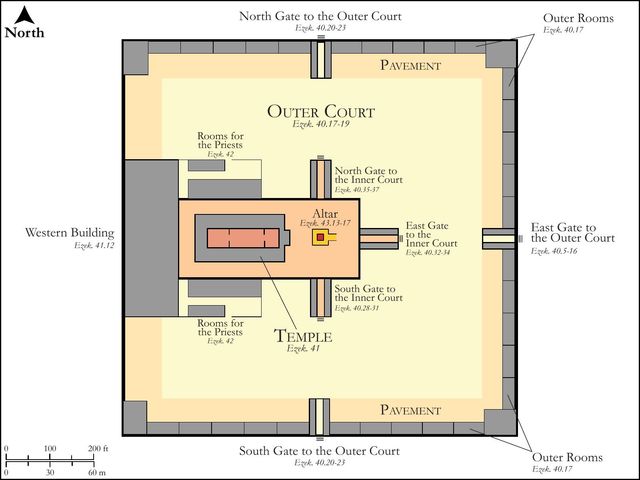
Here is, 1. An account of a building that was before the separate place (that is, before the temple), at the end towards the west (Eze 41:12), which is here measured, and compared (Eze 41:13) with the measure of the house, and appears to be of equal dimensions with it. This stood in a court by itself, which is measured (Eze 41:15) and its galleries, or chambers belonging to it, its posts and windows, and the ornaments of them, Eze 41:15-17. But what use was to be made of this other building we are not told; perhaps, in this vision, it signified the setting up of a church among the Gentiles not inferior to the Jewish temple, but of quite another nature, and which should soon supersede it. 2. A description of the ornaments of the temple, and the other building. The walls on the inside from top to bottom were adorned with cherubim and palm-trees, placed alternately, as in Solomon's temple, Kg1 6:29. Each cherub is here said to have two faces, the face of a man towards the palm tree on one side and the face of a young lion towards the palm-tree on the other side, Eze 41:19. These seem to represent the angels, who have more than the wisdom of a man and the courage of a lion; and in both they have an eye to the palms of victory and triumph which are set before them, and which they are sure of in all their conflicts with the powers of darkness. And in the assemblies of the saints angels are in a special manner present, Co1 11:10. 3. A description of the posts of the doors both of the temple and of the sanctuary; they were squared (Eze 41:21), not round like pillars; and the appearance of the one was as the appearance of the other. In the tabernacle, and in Solomon's temple, the door of the sanctuary, or most holy, was narrower than that of the temple, but here it was fully as broad; for in gospel-times the way into the holiest of all is made more manifest than it was under the Old Testament (Heb 9:8) and therefore the door is wider. These doors are described, Eze 41:23, Eze 41:24. The temple and the sanctuary had each of them its door, and they were two-leaved, folding doors. 4. We have here the description of the altar of incense, here said to be an altar of wood, Eze 41:22. No mention is made of its being over-laid with gold; but surely it was intended to be so, else it would not bear the fire with which the incense was to be burned, unless we will suppose that it served only to put the censers upon. Or else it intimates that the incense to be offered in the gospel-temple shall be purely spiritual, and the fire spiritual, which will not consume an altar of wood. Therefore this altar is called a table. This is the table that is before the Lord. Here, as before, we find the altar turned into a table; for, the great sacrifice being now offered, that which we have to do is to feast upon the sacrifice at the Lord's table. 5. Here is the adorning of the doors and windows with palm-trees, that they might be of a piece with the walls of the house, Eze 41:25, Eze 41:26. Thus the living temples are adorned, not with gold, or silver, or costly array, but with the hidden man of the heart, in that which is not corruptible.
Historical interpretation
Historical reception
1 surviving comment on this verse from the historical church.
(Vers. 23 seqq.) And he spoke to me: This is the table before the Lord, and there were two doors in the temple and in the sanctuary, and in the two doors on each side there were two little doors that folded into each other. For there were two doors on each side of the doors, and on the doors of the temple there were carved cherubim and palm tree sculptures, just as they were also engraved on the walls. Therefore, the wood in the front of the vestibule was thicker: on top of which there were slanting windows, and the appearance of palm trees on both sides of the shoulders of the vestibule, according to the width of the house and the thickness of the walls. In this place, the Septuagint edition differs greatly from the Hebrew truth. Therefore, I will only mention that they have translated 'σπουδαῖα' as 'crassioribus lignis', which means necessary or worthy of attention, and 'absconditas' as 'oblique fenestras' or hidden windows. And at the end of the testimony, they have measured the 'laquearia superliminaris' or vestibule, as well as the 'conjuncta' or joined sides of the house, which they have called 'ἐζυγωμένα', and for which we can translate as equal weight. Therefore, that man who had brought the prophet into the hidden part of the temple and had shown him, among other things, the wooden altar which had both corners and horns according to the Septuagint, and wooden walls, said to him: This altar that you see, it is the table in front of the Lord, which burns in the likeness of a ruby and is not consumed; of which the holy one speaks to God: You have prepared a table before me, against those who trouble me (Ps. 22:5). There were also two doors in the temple and in the sanctuary itself, through which the sacraments of both instruments are revealed, and in the two doors on each side there were two little doors, which folded into each other: so that in history you may have spiritual understanding, and in the tropology the truth of history, both of which need each other, and if one is lacking, knowledge is incomplete. But what follows, 'There were two doors on each side of the doors,' is clear according to the letter. For in the larger dining rooms, it is customary for two to adhere and join together: so that the larger entrance is not closed or opened by two large doors, but by four smaller ones. In these doorways of the temple, or the holy of holies, there were carved Cherubs, of which we have mentioned above, and sculptures of palm trees, so that after a multitude of knowledge, victory would be provided to those entering. These sculptures of palm trees were also on all the walls of the temple. And the reasons why the Cherubim were carved on the doors themselves and the images of palm trees were depicted. Also, why the wood on the outer gate vestibule was thicker: so that they would have strength and could receive the carved work. Furthermore, according to spiritual understanding, the doors are more firm and carved, so that they possess both strength and beauty, so that no one like Uzziah can break into the Holy of Holies and claim priesthood for himself (2 Chronicles 26). Moreover, the gates which were windows were oblique, or concealed, so that the very light which was provided from within did not have perfect knowledge, nor clear light and open to all: but for the most part it was concealed. For now we see in an enigma (I Cor. XIII, 12); and we do not yet know as we ought to know: but when that which is perfect has come, then that which was in part, will be destroyed. And there was a likeness of palms here and there. In the interior of the Temple and in the Holy of Holies, he did not place the right hand and the left, so that he would not seem to say anything negative about things that are great and mysterious; but rather on this side and on that side, according to what is written in the Gospel: 'If someone strikes you on the right cheek, turn to him the other also' (Matthew 5:39). Could he not have said, 'and the left'? But when the right is struck, the other right is offered, because in a holy man, both the right and the left are perfect. And in the corners of the vestibule on the sides of the house, and the width of the walls: for which seventy were carried to the vaults of Aelus, that is, the porch, and the sides of the house, of equal weight or measure: through which it is covertly shown that the doorposts of the vestibule (for these seem to signify the corners) and the sides of the house, and the width of the walls, are all full of reason and measure, and that nothing is found in the temple of the Lord that is without order and wisdom.
Continue studying Ezekiel 41:24 across the web’s major study libraries — every link below opens this exact verse, chapter, or book on the destination site.
Read & Compare
 BibleGatewayThis verse in more than 200 translations and 70 languages.
 Bible.comThe YouVersion reader — hundreds of translations, reading plans, and highlights.
 ESV.orgCrossway's official English Standard Version reader.
 NET BibleThe NET translation with 60,000+ translators' notes on every rendering decision.
 STEP BibleTyndale House's free study tool — original text, vocabulary, and scholarly resources.
 BibliaLogos Bible Software's free web reader.
 USCCBThe New American Bible (Revised Edition) with the U.S. bishops' study notes.
Commentaries
 BibleHub CommentariesDozens of classic commentaries on this verse, gathered on one page.
 StudyLightMore than 100 commentary sets — the largest collection on the web.
 BibleRefPlain-English commentary on what this verse means, verse by verse.
 Enduring WordDavid Guzik's free commentary on this chapter, widely used by Bible teachers.
 Bible Study ToolsVerse commentary alongside Greek and Hebrew study aids.
Original Language & Research
- BibleHub InterlinearThe verse word by word — original language, transliteration, and English.
- BibleHub LexiconEvery word's original-language definition and Strong's entry.
 Blue Letter BibleDeep-study tools — Strong's numbers, concordance, and word studies.
 SefariaThe Hebrew text with Rashi and centuries of Jewish commentary.
Sermons, Hymns & Audio


TrulyRandomVerse is not affiliated with these sites and doesn’t control their content. They’re linked because they’re genuinely useful.
Summary
Ezekiel 41:24 provides a precise architectural specification for the doors within the prophet's visionary temple. It details that these doors are constructed with "two leaves apiece," further clarifying them as "two turning leaves," with two such leaves allocated for each of the two doors. This seemingly minor yet meticulously described detail underscores the divine blueprint's absolute precision and order for God's sacred dwelling, hinting at both the grandeur and the regulated access to His holy presence.
Context
ShowHideLiterary Context
Ezekiel 41:24 is situated within the extensive and highly detailed prophetic vision of a new temple, which spans chapters 40-48 of the book of Ezekiel. This vision, delivered after the destruction of the first temple and the desolation of Jerusalem, served as a profound message of hope and future restoration for the exiled Israelites. Chapter 41 specifically focuses on the dimensions and intricate features of the temple's inner sanctuary, including the nave (hekal), the Holy of Holies (devir), and the surrounding chambers. The meticulous description of the doors, their construction, and their "turning leaves" seamlessly integrates into the overall architectural blueprint, emphasizing the divine origin and paramount importance of every component within this sacred structure. This level of detail echoes the divine instructions for the Tabernacle in Exodus 25:9 and the first temple in 1 Kings 6, underscoring God's precise standards for His dwelling place.
Historical & Cultural Context
The vision was granted to Ezekiel during the Babylonian exile, approximately 573 BC, a period of profound national despair for the Jewish people. Their cherished temple lay in ruins, their land was occupied, and their covenant relationship with God seemed fractured. In this dire context, a vision of a perfectly ordered, glorious new temple offered immense spiritual and psychological solace. It served as a powerful assurance of God's enduring faithfulness, His unceasing presence, and a future restoration far grander than their past. Solomon's temple featured elaborate, multi-leaved doors crafted from precious materials, signifying the sanctity and importance of the spaces they guarded. The "two turning leaves" described here would have been a common yet impressive architectural feature for significant entrances, suggesting both grandeur and controlled access, typical of sacred precincts.
Key Themes
ShowHideThe meticulous description of the temple doors in Ezekiel 41:24 contributes significantly to several overarching themes within the book. Firstly, it highlights Divine Precision and Order, emphasizing God's meticulous nature and His desire for exactness in worship and in His dwelling place. Every detail, no matter how seemingly minor, is divinely ordained, reflecting God's perfect design and sovereignty. Secondly, the very presence and nature of the doors underscore the theme of Access and Separation. Doors inherently regulate passage, signifying the profound sacredness of God's presence and the structured, often restricted, approach required to enter certain areas of the temple. This concept resonates deeply with the holiness of God described in Isaiah 6:3, where even heavenly beings cover themselves in His presence. Lastly, the entire temple vision, including these architectural details, serves as a powerful symbol of Future Hope and Restoration. For a people in exile, a vision of a perfect temple promised a future where God's glorious presence would once again dwell among them, contrasting sharply with their current desolation and foreshadowing the ultimate dwelling of God with humanity in the new creation, as depicted in Revelation 21:3.
Exposition and Analysis
ShowHideKey Word Analysis
ShowHideFrom the root דָּלָה, meaning "something swinging," this term refers to the valve of a door, a gate, or a leaf. In Ezekiel 41:24, its repetition (translated as "doors" and "leaves") emphasizes the components of the entrance, highlighting that these were not single panels but multi-part entries. The word itself carries the connotation of a barrier that can be opened, controlling access to a space, often one of importance or sanctity.
This feminine noun, derived from a root meaning "to turn around" or "to surround," describes the dynamic nature of the door leaves. It specifically refers to a "reversal" or "fold," indicating that these were hinged or pivoted leaves designed to swing open. This detail implies functionality and an impressive, perhaps grand, mechanism for entry, rather than a simple, static barrier, suggesting movement and controlled passage.
This numeral, a dual form, signifies "two" or "twain." Its repeated use in the verse ("two leaves apiece," "two turning leaves," "two leaves for the one door, and two leaves for the other door") precisely quantifies the components of the doors. This emphasis on "two" highlights the symmetrical, balanced, and complete nature of each entrance within the divine architectural plan, reinforcing the theme of order.
Verse Breakdown
ShowHide"And the doors had two leaves [apiece],"
This initial clause introduces the primary architectural feature: the doors of the visionary temple. The phrase "two leaves apiece" immediately establishes that these were not single-panel doors but were composed of multiple sections, specifically two, for each opening. This design suggests a more substantial, grand, and perhaps more secure entrance than a simple single door.
"two turning leaves;"
This phrase further specifies the functional nature of the "two leaves." The term "turning" (Hebrew: mûwçabbâh') indicates that these leaves were designed to pivot or swing open, likely on hinges or posts. This detail emphasizes the dynamic and operational aspect of the doors, implying they were fully functional and designed for regular use, allowing for controlled and deliberate passage into the sacred spaces.
"two [leaves] for the one door, and two leaves for the other [door]."
This final clause reiterates and clarifies the precise distribution of these leaves. It confirms that each distinct door opening was comprised of two such "turning leaves." The repetition underscores the consistent and symmetrical design throughout the temple's entrances, reinforcing the overarching theme of divine order and meticulous planning evident in every aspect of the vision.
Literary Devices
ShowHideEzekiel 41:24 primarily employs Architectural Detail and Repetition. The verse is a prime example of the pervasive Architectural Detail found throughout Ezekiel's temple vision, where every dimension, material, and feature is precisely described. This meticulousness serves to underscore the divine origin and perfect nature of the blueprint, leaving no room for human improvisation or error. The repeated use of the number "two" and the word "leaves" (or "doors," which are comprised of leaves) exemplifies Repetition. This literary device serves to emphasize the specific construction of the doors, ensuring the reader fully grasps the symmetrical and dual-component nature of each entrance. The repetition also contributes to the sense of divine order and exactness, as if God is painstakingly dictating every precise measurement and feature of His future dwelling. While not a direct literary device, the verse also contributes to the overall Symbolism of the temple as a place of divine presence, where access is both grand and highly regulated.
Theological and Thematic Connections
ShowHideEzekiel 41:24, with its precise description of the temple doors, speaks to the profound theological truth of God's ordered and intentional presence among His people. The meticulous detail highlights that every aspect of God's dwelling, even seemingly minor architectural features, is imbued with divine purpose and holiness. These doors, with their "two turning leaves," symbolize both the grandeur of God's sanctuary and the regulated access to His presence, underscoring the sacred boundary between the holy and the common. This vision, given during a time of exile and desolation, offered a powerful promise of future restoration and the re-establishment of God's dwelling among His people, a dwelling characterized by perfect order and divine design, ultimately pointing to the ultimate dwelling of God with humanity.
Reflection and Application
ShowHideThe detailed description of the temple doors in Ezekiel 41:24, though seemingly mundane, offers a profound lesson for believers today. It reminds us that God is a God of infinite detail and intentionality, not only in grand plans but also in the seemingly small components of His design. This divine precision should inspire a deep reverence for God's holiness and His desire for order in all things, including our lives and worship. While the physical temple no longer stands as the primary dwelling place of God, the principles of intentionality, reverence, and the concept of "access" remain vitally important. Our approach to God, made possible through Christ, should be with a spirit of intentionality, respect for His divine nature, and gratitude for the immense privilege we now have to enter His presence. Just as these doors provided a pathway into a sacred space, so too are we called to enter into a deeper relationship with God, understanding that His presence transforms and sanctifies every aspect of our being, calling us to live lives that reflect His divine order and holiness.
Questions for Reflection
ShowHideFAQ
ShowHideWhat is the significance of the "two turning leaves" for the doors?
ShowHideThe "two turning leaves" (Hebrew: mûwçabbâh') indicate that these were not single, solid panels but double doors designed to pivot or swing open. This architectural detail is significant for several reasons: it suggests a grand and impressive entrance, befitting a divine sanctuary; it implies functionality, allowing for controlled access and passage into the holy spaces; and it underscores the meticulousness of God's architectural blueprint, where even the mechanics of the doors are divinely specified, emphasizing perfect order and design, reflecting the divine nature of the entire structure.
Does this visionary temple in Ezekiel refer to a literal future temple?
ShowHideThe interpretation of Ezekiel's temple vision varies among scholars. Some believe it describes a literal temple that will be built in Jerusalem during a future millennial reign of Christ, based on the highly detailed and specific measurements provided in the text. Others view it as a symbolic representation of God's restored presence among His people, the perfection of worship, or a spiritual reality that finds its ultimate fulfillment in the church or the new heavens and new earth. Regardless of the literal or symbolic interpretation, the vision powerfully conveys themes of God's faithfulness, His desire to dwell with His people, and the ultimate restoration of His kingdom. The detailed nature of the vision suggests a profound reality, whether physical or spiritual, of God's perfect order and His ultimate plan for dwelling with humanity, as seen in Revelation 21.
Christ-Centered Fulfillment
ShowHideEzekiel 41:24, with its precise description of the temple doors and their "two turning leaves," finds its ultimate Christ-centered fulfillment in the person and work of Jesus. While the Old Testament temple represented God's dwelling among His people and provided a means of access through ritual and sacrifice, it was always a shadow pointing to a greater reality. Jesus Himself declares, "I am the door; if anyone enters through Me, he will be saved, and will go in and out and find pasture" John 10:9. He is the true and living "door" through whom humanity gains access to God's presence, not through physical structures or animal sacrifices, but through His atoning work on the cross. The "turning leaves" of Ezekiel's vision foreshadow the opening of a new and living way into the Most Holy Place, a way inaugurated by Christ's torn body on the cross Hebrews 10:19-20. Moreover, Jesus is not only the door but also the true Temple, the ultimate dwelling place of God among humanity John 2:19-21. Through Him, believers become living stones in a spiritual house, a new temple where the Holy Spirit dwells 1 Peter 2:5. Thus, the meticulous design of Ezekiel's visionary doors ultimately points to the perfect, divinely ordained access to God made possible solely through Christ, the Lamb of God who takes away the sin of the world John 1:29.