


Ezekiel 40:48
Bible text: King James Version (1769 Blayney text) · Public domain
Bible text: King James Version with Strong's numbers · Public domain
Bible text: Berean Standard Bible · Public domain
Bible text: American Standard Version (1901) · Public domain
Bible text: World English Bible, Messianic edition · Public domain
Bible text: Geneva Bible (1599) · Public domain
Bible text: Young's Literal Translation · Public domain
- וַיְבִאֵנִיvay·vi·'e·Niand he brought meH935Conj-w ¦ V-Hiphil-ConsecImperf-3ms ¦ 1csVerb Hiphil Consecutive Imperfect 3rd Singular Masculineוַandיְבִאֵhe broughtנִיme
- אֶל'eltoH413PrepPreposition
- אֻלָם'u·Lam[the] porch ofH197N-mscNoun Singular Masculine Construct
- הַבַּיִתha·ba·Yitthe houseH1004Art ¦ N-msNoun Singular Masculine Absoluteהַtheבַּיִתhouse
- וַיָּמָדvai·Ya·modand he measuredH4058Conj-w ¦ V-Qal-ConsecImperf-3msVerb Qal Consecutive Imperfect 3rd Singular Masculineוַandיָּמָדhe measured
- אֵל'ela pillar ofH352N-mscNoun Singular Masculine Construct
- אֻלָם'u·Lama porchH197N-msNoun Singular Masculine Absolute
- חָמֵשׁcha·MeshfiveH2568Adj-csAdjective Numerical Singular common gender Absolute
- אַמּוֹת'a·mOtcubitsH520N-fpNoun Plural Feminine Absolute
- מִפֹּהmi·Pohfrom hereH6311Prep-m ¦ AdvAdverbמִfromפֹּהhere
- וְחָמֵשׁve·cha·Meshand fiveH2568Conj-w ¦ Adj-csAdjective Numerical Singular common gender Absoluteוְandחָמֵשׁfive
- אַמּוֹת'a·MotcubitsH520N-fpNoun Plural Feminine Absolute
- מִפֹּהmi·Pohfrom hereH6311Prep-m ¦ AdvAdverbמִfromפֹּהhere
- וְרֹחַבve·Ro·chavand [the] breadth ofH7341Conj-w ¦ N-mscNoun Singular Masculine Constructוְandרֹחַב[the] breadth of
- הַשַּׁעַרha·Sha·'arthe gateH8179Art ¦ N-msNoun Singular Masculine Absoluteהַtheשַּׁעַרgate
- שָׁלֹשׁsha·Losh[was] threeH7969Adj-csAdjective Numerical Singular common gender Absolute
- אַמּוֹת'a·mOtcubitsH520N-fpNoun Plural Feminine Absolute
- מִפּוֹmi·Pofrom hereH6311Prep-m ¦ AdvAdverbמִfromפּוֹhere
- וְשָׁלֹשׁve·sha·Loshand threeH7969Conj-w ¦ Adj-csAdjective Numerical Singular common gender Absoluteוְandשָׁלֹשׁthree
- אַמּוֹת'a·MotcubitsH520N-fpNoun Plural Feminine Absolute
- מִפּוֹmi·Pofrom hereH6311Prep-m ¦ AdvAdverbמִfromפּוֹhere
English is a literal word-by-word gloss of the Hebrew, not the KJV's wording. Why?
This is the original text the KJV's translators worked from — each Hebrew word with its own literal English meaning in this verse, prepared by scholars at Tyndale House, Cambridge. The KJV translates whole sentences, not word by word, so its wording differs: one Hebrew word can become several English words, and the KJV may choose “the LORD” where the gloss reads “Yahweh”. Both are faithful — they answer different questions. For the KJV's own rendering, switch to the KJV text.
Details
See on the biblical-era map
Study this verse
Public-domain commentary
Matthew Henry
From his Commentary on the Whole Bible. Henry comments on passages, not single verses — this entry covers Ezekiel 40:39–49. His two-level outline is real structure in the source text, so it is rendered as structure.
In these verses we have an account,
I.Of the tables that were in the porch of the gates of the inner court.
We find no description of the altars of burnt-offerings in the midst of that court till Eze 43:13. But, because the one altar under the law was to be exchanged for a multitude of tables under the gospel, here is early notice taken of the tables, at our entrance into the inner court; for till we come to partake of the table of the Lord we are but professors at large; our admission to that is our entrance into the inner court. But in this gospel-temple we meet with no altar till after the glory of the Lord has taken possession of it, for Christ is our altar, that sanctifies every gift. Here were eight tables provided, whereon to slay the sacrifices, Eze 40:41. We read not of any tables for this purpose either in the tabernacle or in Solomon's temple. But here they are provided, to intimate the multitude of spiritual sacrifices that should be brought to God's house in gospel-times, and the multitude of hands that should be employed in offering up those sacrifices. Here were the shambles for the altar; here were the dressers on which they laid the flesh of the sacrifice, the knives with which they cut it up, and the hooks on which they hung it up, that it might be ready to be offered on the altar (Eze 40:43), and there also they washed the burnt-offerings (Eze 40:38), to intimate that before we draw near to God's altar we must have every thing in readiness, must wash our hands, our hearts, those spiritual sacrifices, and so compass God's altar.
II.The use that some of the chambers mentioned before were put to.
1.Some were for the singers, Eze 40:44. It should seem they were first provided for before any other that attended this temple-service, to intimate, not only that the singing of psalms should still continue a gospel-ordinance, but that the gospel should furnish all that embrace it with abundant matter for joy and praise, and give them occasion to break forth into singing, which is often foretold concerning gospel times, Psa 96:1; Psa 98:1. Christians should be singers. Blessed are those that dwell in God's house, they will be still praising him.
2.Others of them were for the priests, both those that kept the charge of the house, to cleanse it, and to see that none came into it to pollute it, and to keep it in good repair (Eze 40:45), and those that kept the charge of the altar (Eze 40:46), that came near to the Lord to minister to him. God will find convenient lodging for all his servants. Those that do the work of his house shall enjoy the comforts of it.
III.Of the inner court, the court of the priests, which was fifty yards square, Eze 40:47.
The altar that was before the house was placed in the midst of this court, over-against the three gates, and, standing in a direct line with the three gates of the outer court, when the gates were set open all the people in the outer court might through them be spectators of the service done at the altar. Christ is both our altar and our sacrifice, to whom we must look with an eye of faith in all our approaches to God, and he is salvation in the midst of the earth (Psa 74:12), to be looked unto from all quarters.
IV.Of the porch of the house.
The temple is called the house, emphatically, as if no other house were worthy to be called so. Before this house there was a porch, to teach us not to rush hastily and inconsiderately into the presence of God, but gradually, that is, gravely, and with solemnity, passing first through the outer court, then the inner, then the porch, ere we enter into the house. Between this porch and the altar was a place where the priests used to pray, Joe 2:17. In the porch, besides the posts on which the doors were hung, there were pillars, probably for state and ornament, like Jachin and Boaz - He will establish; in him is strength, Eze 40:49. In the gospel church every thing is strong and firm, and every thing ought to be kept in its place and to be done decently and in order.
Historical interpretation
Historical reception
1 surviving comment on this verse from the historical church.
(Vers. 44 seqq.) «And outside the front gate of the cantor's treasury in the inner courtyard, which was on the side of the gate facing the north, their faces were towards the south: one on the side of the eastern gate, which faced the way of the north. And he said to me: This is the treasury that faces the southern way of the priests, who keep watch in the temple's guardrooms. Furthermore, the treasury that faces the way of the north will be for the priests who serve at the altar: these are the sons of Zadok who come near from the sons of Levi to the Lord, to minister to Him. And he measured the porch of the temple by the length of one hundred cubits, and the width of one hundred cubits, square: and the altar that was before the temple: and he brought me into the porch of the temple, and he measured the porch five cubits on this side, and five cubits on that side: and the breadth of the gate three cubits on this side, and three cubits on that side. And the length of the porch was twenty cubits, and the breadth eleven cubits, and there were steps to it: and pillars before the gates one on this side, and another on that side. Regarding the treasuries, the Seventy translated them as exedrae. And what we called exedrae, or the treasuries of the singers, was omitted by them. And again, after the measurement of the vestibule of five cubits on this side and five cubits on that side, they added from their own, and the width of the gate was fourteen cubits, whereas in the Hebrew it is only mentioned as a width of twelve cubits, and the width of the gate on this side was three cubits, and on that side was three cubits. I have reminded the reader not to be confused by the diversity of translations, but to be satisfied with the Hebrew truth in this particular place, especially when it comes to the measurements of the temple. Therefore, after the wall, which the Seventy translated as the περίβολον, which surrounded the whole temple in a square circuit, we read that the prophet was introduced into the inner courtyard, and then to the north, and to the south, and to the Eastern Gate, and again to the north: concerning which, as we were able, we have spoken, and in the diversity of which, either of names or of measurements, the past discourse showed what seemed to us: the meaning of which the testimony of the Savior briefly shows, saying: In my Father's house there are many mansions (John 14:2). After completing these things, he enters the temple, that is, the Holy of Holies, of which it is now said, and within the inner gate, the treasuries, or the singing halls. To them is given this command: Sing to the Lord a new song (Psalm 95:1). They cry out with the angels: Glory to God in the highest, and on earth peace to people of good will (Luke 2:14). This inner courtyard was situated on the side of the gate that faced the North, the South, and the East, so that the singers of the Lord, and those who are engaged in the ministry of angels, may always remember by which steps they have reached the highest, and diligently understand the mysteries of each place. Finally, that man whose pen and cord were in his hand, having led the prophet into the inner courtyard which overlooked the southern road, spoke these words: 'This is the treasury or council chamber; and as Theodotius set it up, the chamber, which is separated for the dwelling of the priests, is for the observation of the temple guards. Furthermore, the treasury which overlooks the northern road will belong to the priests who stand guard at the service of the altar.' In which it should be noted that the priests to whom the custody of the temple has been entrusted dwell in the treasury, which faces the south, where the fullest light is. But those who stand guard at the ministry of the altar, where victims are offered for sin, should be in the treasury facing the north, for those who come from the north and offer victims for sins, desiring to receive and save them. Both of these, serving the Lord in their respective duties, are called the sons of Zadok, which means righteous or justifying. For God, the Almighty, whose name is written: The Lord is righteous and loves justice; His face has seen equity (Psalm 11: 8). But these are the sons of Sadoc of the sons of Levi, which is interpreted as 'assumed'. And they themselves are assumed by the Lord, so that they may approach Him, and never is it said of Moses alone: Moses approached the Lord; but also all who serve and minister to Him are said to draw near to the Lord. But this man who introduced Ezekiel into the inner courtyard, and so to speak, into the Holy of Holies, measured the courtyard itself, in which there were two chambers or treasuries assigned to the guards of the temple or the dwelling places of the altar, and he found it to be two hundred cubits in length and breadth: so that the priests of God who serve in the ministry, who had entered through a narrow and tight path, may have wide walkways and dwell in a perfect and complete number of virtues. And in the very courtyard there was an altar in front of the face of the temple, so that the prayers of the saints never ceased before God. Moreover, the aforementioned man led Ezekiel into the vestibule, or πρόπυλον of the temple, which measured five cubits on each side, for the one who was brought in had been trained in divine understanding and knew neither right nor left, but entered by the royal way. The width of the gate itself, which was the entrance to the vestibule of the temple, was three cubits on each side. In the elegant observance of the Holy Scriptures, it is not said from the right or the left, lest anything be named left in the Holy of Holies, but from this side and that side, that is, from both sides. And immediately the discerning reader understands that the number three relates to the mystery of the Trinity, which is the gate for those who approach God, for the Father is in the Son, and the Son is in the Father, and the Holy Spirit is in both. This number three is the gate for those who, after baptism in the Trinity, come to salvation. But what follows, the length of the vestibule is twenty cubits, and the width is eleven cubits, seems to raise the question of how the dual number, which refers to two decades, and the eleventh, which seems to have one less, can be said to complete the sacred number twelve in the temple vestibule. Most people solve this problem in the following way: Although the priests are holy and placed in the service of the temple, and offer daily sacrifices to Christ, because they dwell in this mortal and fragile body, subject to sickness and vice, they have the number twenty and eleven. Where was it that the Apostle said, 'Wretched man that I am, who will deliver me from this body of death' (Rom. VII, 24)? Not that we believe, according to the most savage heresy, that bodies are to be destroyed; but that it is our desire to be clothed upon, not stripped, and to receive immortality with this mortal, and to put on incorruption with this corruptible. However, what follows, 'And it was ascended by eight steps' (I Cor. XV), that is, to the inner gate, presents a great difficulty for those who know the Hebrew language. Finally, Symmachus, whom we have followed in this place, set out eight degrees: Seventy, ten; Theodotion and the second edition of Aquila, eleven; but the first edition set no number, but simply said, and the degrees by which it was ascended to it: so that either according to the custom of the previous gates, we understand eight degrees, as Symmachus understood, or certainly those which the inner gate had, whose number Scripture did not say (for which in Hebrew it is placed, Urob (), that is, breadth, Aste (), Esre (). But if it is read in this way, eleven signifies; but if we read 'Esre,' which means ten, without the final 's,' it does not signify ten but a pronoun (which). To experts in the Hebrew language, these may seem like delusions; but now we are not writing about controversies or speeches in which the composition of words is commonly used, but about explanations and commentaries on Hebrew books. But let us return to our task. The number eight or ten, which is a perfect number, or eleven, about which we have already spoken, is ascended to the gate of the holy ones, on the front of which there were columns, one on this side and another on that side. He did not say 'two' so as not to incur the number dual, but 'one and one', which is a perfect number, and imitates the unity of God. These, however, were two columns, of which it is also said in the Apocalypse: 'He who conquers, I will make him a pillar in the temple of my God, and he shall go out no more' (Rev. 3:12). And Peter and John are called the pillars of the Church (Gal. 2), through whom we enter into the Holy of Holies, and by whose teaching our entrance to Christ is made.
Continue studying Ezekiel 40:48 across the web’s major study libraries — every link below opens this exact verse, chapter, or book on the destination site.
Read & Compare
 BibleGatewayThis verse in more than 200 translations and 70 languages.
 Bible.comThe YouVersion reader — hundreds of translations, reading plans, and highlights.
 ESV.orgCrossway's official English Standard Version reader.
 NET BibleThe NET translation with 60,000+ translators' notes on every rendering decision.
 STEP BibleTyndale House's free study tool — original text, vocabulary, and scholarly resources.
 BibliaLogos Bible Software's free web reader.
 USCCBThe New American Bible (Revised Edition) with the U.S. bishops' study notes.
Commentaries
 BibleHub CommentariesDozens of classic commentaries on this verse, gathered on one page.
 StudyLightMore than 100 commentary sets — the largest collection on the web.
 BibleRefPlain-English commentary on what this verse means, verse by verse.
 Enduring WordDavid Guzik's free commentary on this chapter, widely used by Bible teachers.
 Bible Study ToolsVerse commentary alongside Greek and Hebrew study aids.
Original Language & Research
- BibleHub InterlinearThe verse word by word — original language, transliteration, and English.
- BibleHub LexiconEvery word's original-language definition and Strong's entry.
 Blue Letter BibleDeep-study tools — Strong's numbers, concordance, and word studies.
 SefariaThe Hebrew text with Rashi and centuries of Jewish commentary.
Sermons, Hymns & Audio


TrulyRandomVerse is not affiliated with these sites and doesn’t control their content. They’re linked because they’re genuinely useful.
Summary
Ezekiel 40:48 offers a meticulously detailed measurement of the porch and gate leading into the visionary temple, emphasizing the divine precision and inherent order foundational to God's future dwelling place among His people. This verse, an integral part of an extensive architectural blueprint, underscores the sacredness and intentionality of access to God's holy presence, serving as a critical element within Ezekiel's profound prophetic vision of restoration and renewed communion.
Context
ShowHideLiterary Context
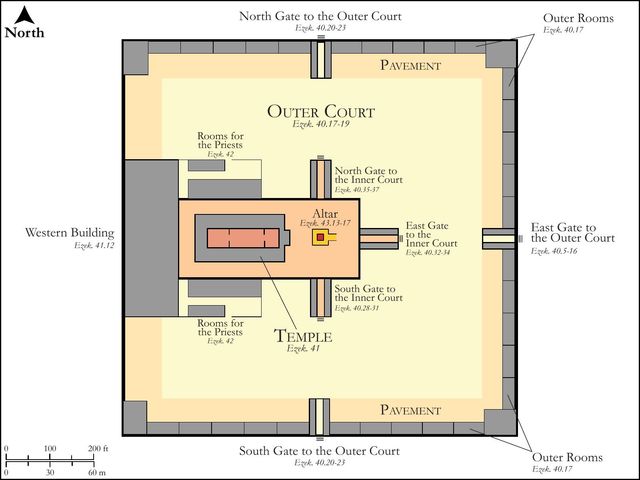
Ezekiel 40:48 is situated within a monumental and highly detailed vision of a new temple, which commences in Ezekiel 40. This vision was granted to the prophet following the traumatic destruction of the First Temple in Jerusalem and the subsequent exile of the Israelites to Babylon. Chapters 40-42 provide an exhaustive architectural blueprint, meticulously describing the temple's outer court, inner court, various chambers, and the main sanctuary building itself. An angelic guide meticulously leads Ezekiel through each section, providing precise measurements for every structural element. This particular verse focuses on the vestibule or entrance hall—the "porch"—of the main temple building, detailing the dimensions of its structural posts and the breadth of its gate. This section, therefore, serves as a crucial threshold, meticulously defining the initial point of access to the holy inner sanctum and emphasizing the divine order that governs entry into God's presence.
Historical & Cultural Context
The vision of the temple was received by Ezekiel during the Babylonian exile (circa 593-571 BC), a period marked by profound national despair and spiritual disorientation for the Jewish people. The destruction of Jerusalem and the Temple in 586 BC, vividly recounted in 2 Kings 25, represented not only the loss of their land and sovereignty but, more significantly, the apparent departure of God's presence from among them. Among the nations, temples were considered the literal dwelling places of their gods, and their destruction often signified the defeat or abandonment by the god. Ezekiel's vision, therefore, served as a powerful counter-narrative, offering a message of profound hope, restoration, and the certainty of God's future dwelling among His people. The use of cubits as a standard unit of measurement was common in ancient architecture, and the meticulousness of these measurements would have conveyed authenticity and divine authority to the original audience, assuring them that this was not a mere dream but a divinely ordained blueprint for a glorious future.
Key Themes
ShowHideThe meticulous measurements and architectural descriptions throughout Ezekiel 40, including the specific details in verse 48, contribute significantly to several overarching themes within the book of Ezekiel. First, the theme of Divine Precision and Order is paramount; the overwhelming detail signifies God's meticulousness, His perfect design, and the certainty of His plans, reflecting His inherent holiness and sovereignty. Second, the vision points to The Future Temple and God's Dwelling, serving as a powerful symbol of God's unwavering commitment to restore His presence among His people after its departure, as lamentably depicted in Ezekiel 10:18. The porch, as an entrance, symbolizes the renewed and structured access to God's presence. Third, the vision embodies a profound message of Hope and Restoration for a people in exile, promising a future where God's glory will return to His dwelling place, as triumphantly envisioned in Ezekiel 43:4. This future reality, whether interpreted literally or symbolically, powerfully underscores God's faithfulness to His covenant promises.
Exposition and Analysis
ShowHideKey Word Analysis
ShowHideThis term specifically denotes a vestibule or portico, often serving as an impressive entrance hall to a significant building like a temple or palace. In the context of Ezekiel's vision, the "porch of the house" is not merely an architectural feature but a crucial transitional space, signaling the approach to the sacred inner sanctuary. Its precise measurement underscores its importance as the initial, divinely ordained point of access to God's dwelling.
This primitive root means "to stretch" and, by implication, "to measure (as if by stretching a line)." The act of measuring throughout Ezekiel's temple vision is central, signifying divine authority, precision, and the exactitude of God's design. It implies a fixed, unchangeable plan, not subject to human whim or error, reinforcing the certainty and divine origin of the vision's fulfillment.
This word refers to a strong support, a pilaster, or a doorpost. In this verse, it specifically denotes the structural supports of the porch. The mention of these posts, along with their symmetrical measurements, emphasizes the stability, strength, and foundational integrity of the envisioned temple. They are not merely decorative but essential load-bearing elements, reinforcing the permanence and divine construction of God's future dwelling.
Verse Breakdown
ShowHide"And he brought me to the porch of the house,"
This clause establishes the immediate setting for the subsequent architectural measurements. The "he" refers to the angelic guide who has been meticulously leading Ezekiel through the visionary temple complex since Ezekiel 40:3. The "porch of the house" is the vestibule or entrance hall of the main temple building, signifying the grand threshold to the most sacred part of the structure.
"and measured [each] post of the porch,"
The guide's action of measuring highlights the meticulous detail and precision inherent in the divine blueprint. The "posts" are the structural supports of the porch, indicating that every foundational element of this new temple is divinely ordained and perfectly proportioned, ensuring its stability and sacredness.
"five cubits on this side, and five cubits on that side:"
These specific measurements for the posts (or the space around them) emphasize perfect symmetry and exactitude. A cubit was an ancient unit of length, typically ranging from 18 to 21 inches. The repetition of "five cubits on this side, and five cubits on that side" powerfully reinforces the balanced and perfect design, leaving no room for ambiguity or human imperfection in God's plan.
"and the breadth of the gate [was] three cubits on this side, and three cubits on that side."
This clause provides the dimensions for the gate itself, which leads through the porch into the temple proper. The "breadth" refers to its width. Once again, the symmetrical "three cubits on this side, and three cubits on that side" underscores the divine order and the precise, controlled dimensions of entry into God's holy dwelling, indicating an intentional and reverent access.
Literary Devices
ShowHideEzekiel 40:48, like the surrounding chapters, is primarily characterized by Detailed Description and Architectural Precision. The prophet meticulously records every measurement, post, and gate, presenting a vivid, almost technical blueprint rather than a flowing narrative. This exhaustive detail serves to underscore the divine origin and absolute certainty of the vision, emphasizing that God's plans are not vague but perfectly formed. The Repetition of phrases like "on this side, and on that side" (used twice in this verse) powerfully emphasizes the perfect symmetry and balance of the temple's design, reinforcing the idea of divine order and completeness. Furthermore, the temple itself, including its Symbolism of the porch and gate, represents God's renewed presence among His people and the structured, holy access to Him. The very act of measuring can be seen as a Metaphor for God's sovereign control, His meticulous planning, and His precise fulfillment of promises.
Theological and Thematic Connections
ShowHideEzekiel 40:48, with its emphasis on precise measurements and the structured entrance of the temple, profoundly reveals God's nature as a God of order, holiness, and intentionality. The meticulous detail of the vision underscores that God's plans are not haphazard but perfectly designed, reflecting His inherent character and sovereignty. This future temple, whether understood literally or symbolically, represents the restoration of God's presence among His people, a presence that is holy and accessible only on His terms. The "porch" and "gate" serve as a sacred threshold, signifying the importance of proper approach and reverence when entering God's dwelling. This vision, given during a time of exile and despair, offered a powerful message of hope, assuring Israel that God would indeed dwell with them again, demonstrating His unwavering faithfulness to His covenant promises and His ultimate, redemptive plan.
Reflection and Application
ShowHideEzekiel 40:48, with its precise and seemingly technical measurements, holds profound spiritual lessons for believers today. It serves as a powerful reminder that God is a God of meticulous detail and perfect order. His plans, both for the grand narrative of all history and for the intricate tapestry of our individual lives, are not random or chaotic but intricately designed and purposefully executed. This truth should instill in us a deep and abiding trust in His sovereignty, even when circumstances around us seem overwhelming or uncertain. The emphasis on the "porch" and "gate" as divinely ordained points of entry into God's dwelling also speaks to the importance of intentionality, reverence, and humility in our approach to God. Just as the physical temple had specific pathways and dimensions for access, so too does our spiritual approach to God require a heart prepared by humility, purity, and a desire to align with His revealed will. Furthermore, this vision, given in a time of profound despair for the exiles, serves as a powerful beacon of hope. It assures us that God's promises of dwelling with His people are utterly certain, culminating in the glorious reality of His presence with us, both now through the indwelling Holy Spirit and eternally in the New Heavens and New Earth.
Questions for Reflection
ShowHideFAQ
ShowHideWhat is the significance of the "porch" in this vision?
ShowHideThe "porch" (Hebrew, ʼûwlâm') in Ezekiel 40:48 refers to the vestibule or entrance hall of the visionary temple. Its significance is multifaceted. Architecturally, it serves as an impressive and transitional space, leading from the outer courts into the main sanctuary building. Theologically, it symbolizes the threshold or point of access to God's holy presence. The precise measurements given for it underscore that access to God is not arbitrary but divinely ordained, structured, and requires a reverent approach. It is the initial, grand entry point, setting the tone for the sacredness of what lies beyond, much like the detailed instructions for the tabernacle in Exodus 25.
Why are the measurements so precise throughout Ezekiel's temple vision?
ShowHideThe overwhelming precision of the measurements in Ezekiel's temple vision, exemplified in Ezekiel 40:48, serves several crucial purposes. First, it highlights God's divine order and meticulousness. God is not a God of chaos but of perfect design and intention, as seen in the intricate details of the creation account. Second, it lends authenticity and authority to the vision, assuring Ezekiel and his audience that this is a genuine, divinely revealed blueprint, not a mere dream or human construct. Third, it emphasizes the certainty of God's promises. The exactitude implies that God's future plans for restoration and His dwelling among His people are fixed and will be fulfilled precisely as revealed. Finally, it underscores the holiness and sacredness of God's dwelling, where every detail is important and contributes to its perfect function and beauty.
Is Ezekiel's temple a literal temple to be built, or is it symbolic?
ShowHideThe interpretation of Ezekiel's temple vision, including Ezekiel 40:48, is a subject of ongoing theological debate. Some scholars interpret it as a literal temple that will be built in Jerusalem during a future period, often associated with the Millennial Kingdom, where Christ reigns on Earth. They point to the extreme detail and specific measurements as evidence for a literal structure. Others view it as primarily symbolic, representing God's perfect dwelling among His people in a spiritual sense, fulfilled in the Church (as seen in believers being built into a holy temple in Ephesians 2:19-22) or ultimately in the New Jerusalem (described in Revelation 21), where God Himself is the temple (Revelation 21:22). A third view suggests it is a hybrid, with literal elements pointing to profound spiritual realities, emphasizing God's desire for perfect fellowship and the restoration of His glory. Regardless of the precise interpretation, the vision powerfully conveys God's unwavering commitment to dwell among His people in holiness and order.
Christ-Centered Fulfillment
ShowHideEzekiel 40:48, describing the precise dimensions of the temple's porch and gate, finds its ultimate and profound Christ-centered fulfillment in the person and work of Jesus Christ. While the Old Testament temple provided a physical space for God's presence and a structured means of access, Jesus declares Himself to be the true and ultimate temple, stating, "Destroy this temple, and in three days I will raise it up" (John 2:19). He was speaking of the temple of His body, through which God's presence fully dwelt among humanity (John 1:14). Furthermore, Jesus is the "door" or "gate" through whom all who believe must enter to find salvation and abundant life, as He proclaims, "I am the door: by me if any man enter in, he shall be saved" (John 10:9). The meticulously measured porch and gate in Ezekiel's vision thus foreshadow the perfect and singular way of access to God, which is now exclusively through Christ. His sacrificial death on the cross miraculously tore the temple veil from top to bottom (Matthew 27:51), signifying that the way into God's most holy presence is no longer restricted by physical barriers or ritualistic measurements, but is opened wide through the new and living way provided by His blood (Hebrews 10:19-22). Through Him, we have boldness and access with confidence by faith (Ephesians 3:12). Thus, the precise architectural details of Ezekiel's vision ultimately point to the perfect, divinely ordained access to God made possible only through the person and atoning work of Jesus Christ.