


Ezekiel 23:20
Bible text: King James Version (1769 Blayney text) · Public domain
Bible text: Berean Standard Bible · Public domain
Bible text: American Standard Version (1901) · Public domain
Bible text: World English Bible, Messianic edition · Public domain
Bible text: Geneva Bible (1599) · Public domain
Bible text: Young's Literal Translation · Public domain
- וַתַּעְגְּבָהva·ta'·ge·Vahand she lusted !H5689Conj-w ¦ V-Qal-ConsecImperf-3fs ¦ SfxVerb Qal Consecutive Imperfect 3rd Singular Feminineוַandתַּעְגְּבָshe lustedה!
- עַל'alonH5921PrepPreposition
- פִּלַגְשֵׁיהֶםpi·lag·shei·Hemtheir paramoursH6370N-mpc ¦ 3mpNoun Plural Masculine Constructפִּלַגְשֵׁיparamoursהֶםtheir
- אֲשֶׁר'a·SherwhomH834RelParticle Relative
- בְּשַׂרbe·sar[was the] flesh ofH1320N-mscNoun Singular Masculine Construct
- חֲמוֹרִיםcha·mo·RimdonkeysH2543N-cpNoun Plural common gender Absolute
- בְּשָׂרָםbe·sa·Ramtheir fleshH1320N-msc ¦ 3mpNoun Singular Masculine Constructבְּשָׂרָfleshםtheir
- וְזִרְמַתve·zir·Matand [was the] ejaculation ofH2231Conj-w ¦ N-fscNoun Singular Feminine Constructוְandזִרְמַת[was the] ejaculation of
- סוּסִיםsu·SimhorsesH5483N-mpNoun Plural Masculine Absolute
- זִרְמָתָםzir·ma·Tamtheir ejaculationH2231N-fsc ¦ 3mpNoun Singular Feminine Constructזִרְמָתָejaculationםtheir
English is a literal word-by-word gloss of the Hebrew, not the KJV's wording. Why?
This is the original text the KJV's translators worked from — each Hebrew word with its own literal English meaning in this verse, prepared by scholars at Tyndale House, Cambridge. The KJV translates whole sentences, not word by word, so its wording differs: one Hebrew word can become several English words, and the KJV may choose “the LORD” where the gloss reads “Yahweh”. Both are faithful — they answer different questions. For the KJV's own rendering, switch to the KJV text.
Details
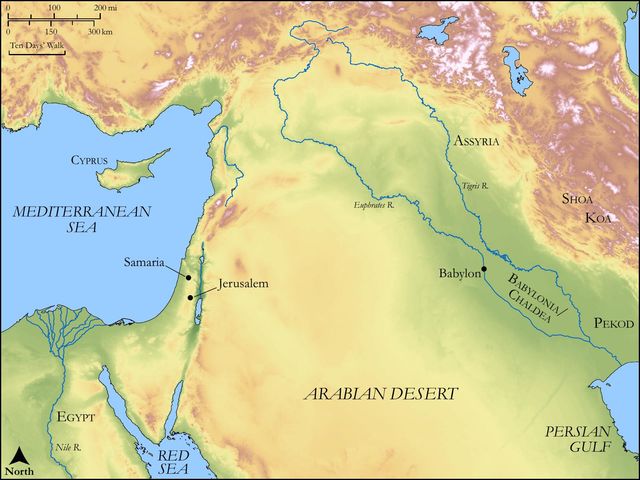
See on the biblical-era map
Study this verse
Public-domain commentary
Matthew Henry
From his Commentary on the Whole Bible. Henry comments on passages, not single verses — this entry covers Ezekiel 23:11–21. His three-level outline is real structure in the source text, so it is rendered as structure.
The prophet Hosea, in his time, observed that the two tribes retained their integrity, in a great measure, when the ten tribes had apostatized (Hos 11:12, Ephraim indeed compasses me about with lies, but Judah yet rules with God and is faithful with the saints; and this was justly expected from them: Hos 4:15, Though thou Israel play the harlot, yet let not Judah offend); but this lasted not long. By some unhappy matches made between the house of David and the house of Ahab the worship of Baal had been brought into the kingdom of Judah, but had been by the reforming kings worked out again; and at the time of the captivity of the ten tribes, which was in the reign of Hezekiah, things were in a good posture: but it lasted not long. In the reign of Manasseh, soon after the kingdom of Judah had seen the destruction of the kingdom of Israel, they became more corrupt than Israel had been in their inordinate love of idols, Eze 23:11. Instead of being made better by the warning which that destruction gave them, they were made worse by it, as if they were displeased because the Lord had made that breach upon Israel, and for that reason became disaffected to him and to his service. Instead of being made to stand in awe of him as a jealous God, they therefore grew strange to him, and liked those gods better that would admit of partners with them. Note, Those may justly expect God's judgments upon themselves who do not take warning by his judgments upon others, who see in others what is the end of sin and yet continue to make a light matter of it. But it is bad indeed with those who are made worse by that which should make them better, and have their lusts irritated and exasperated by that which was designed to suppress and subdue them. Jerusalem grew worse in her whoredoms than her sister Samaria had been in her whoredoms. This was observed before (Eze 16:51), Neither has Samaria committed half of thy sins.
I.Jerusalem, that had been a faithful city, became a harlot, Isa 1:21.
She also doted upon the Assyrians (Eze 23:12), joined in league with them, joined in worship with them, grew to be in love with their captains and rulers, and cried them up as finer and more accomplished gentlemen than any that ever the land of Israel produced. "See how richly, how neatly, they are dressed, clothed most gorgeously; how well they sit a horse; they are horsemen riding on horses; how charmingly they look, all of them desirable young men." And thus they grew to affect every thing that was foreign and to despise their own nation; and even the religion of it was mean and homely, and not to be compared with the curiosity and gaiety of the heathen temples. Thus she increased her whoredoms; she fell in love, fell in league, with the Chaldeans. Hezekiah himself was faulty this way when he was proud of the court which the king of Babylon made to him and complimented his ambassadors with the sight of all his treasures, Isa 39:2. And the humour increased (Eze 23:14); she doted upon the pictures of the Babylonian captains (Eze 23:15, Eze 23:16), joined in alliance with that kingdom, invited them to come and settle in Jerusalem, that they might refine the genius of the Jewish nation and make it more polite; nay, they sent for patterns of their images, altars, and temples, and made use of them in their worship. Thus was she polluted with her whoredoms (Eze 23:17), and thereby she discovered her own whoredom (Eze 23:18), her own strong inclination to idolatry. And when she had had enough of the Chaldeans, and grew tired of them and disposed to break her league with them, as Jehoiakim and Zedekiah did, her mind being alienated from them, she courted the Egyptians, doted upon their paramours (Eze 23:20), would come into an alliance with them, and, to strengthen the alliance, would join with them in their idolatries and then depend upon them to be their protectors from all other nations; for so wise, so rich, so strong, was the Egyptian nation, and came to such perfection in idolatry, that there was no nation now which they could take such satisfaction in as in Egypt. Thus they called to remembrance the days of their youth (Eze 23:19), the lewdness of their youth, Eze 23:21.
1.They pleased themselves with the remembrance of it. When they began to set their affections upon Egypt, they encouraged themselves to put a confidence in that kingdom, because of the old acquaintance they had with it, as if they still retained the gust and relish of the leeks and onions they ate there, or rather of the idolatrous worship they learned there, and brought up with them thence. When they began an acquaintance with Egypt they remembered how merrily their fathers worshipped the golden calf, what music and dancing they had at that sport, which they learned in Egypt; and they hoped they should now have a fair pretence to come to that again. Thus she multiplied her whoredoms, repeated her former whoredoms, and encouraged herself to close with present temptations, by calling to remembrance the days of her youth. Note, Those who, instead of reflecting upon their former sins with sorrow and shame, reflect upon them with pleasure and pride, contract new guilt thereby, strengthen their own corruptions, and in effect bid defiance to repentance. This is returning with the dog to his vomit.
2.They called it God's remembrance, and provoked him to remember it against them. God had said indeed that he would reckon with them for the golden calf, that idol of Egypt (Exo 32:34); but such was his patience that he seemed to have forgotten it till they, by their league now with the Egyptians against the Chaldeans, did, as it were, put him in mind of it; and in the day when he visits he will now, as he has said, visit for that. It is very observable how this adulteress changes her lovers: she dotes first on the Assyrians; then she thought the Chaldeans finer and courted them; after a while her mind was alienated from them, and she thought the Egyptians more powerful (Eze 23:20) and she must contract an intimacy with them. This shows the folly,
(1.)Of fleshly lusts; when they are indulged they grow humoursome and fickle, are soon surfeited but never satisfied; they must have variety, and what is loved one day is loathed the next. Unius adulterium matrimonium vocant - One adultery is called marriage, as Seneca observes.
(2.)Of idolatry. Those who think one God too little will not think a hundred sufficient, but will still be for trying more, as finding all insufficient.
(3.)Of seeking to creatures for help; we go from one to another, but are disappointed in them all, and can never rest till we have made the God of Israel our help.
II.The faithful God justly gives a bill of divorce to this now faithless city, that has become a harlot.
His jealousy soon discovered her lewdness (Eze 23:13): I saw that she was defiled, that she was debauched, and saw which way her inclination was, that the two sisters both took one way, and that Jerusalem grew worse than Samaria. For, if we stretch out our hand to a strange god, will not God search this out? No doubt he will; and when he has found it can he be pleased with it? No (Eze 23:18): Then my mind was alienated from her, as it was from her sister. How could the pure and holy God any longer take delight in such a lewd generation? Note, Sin alienates God's mind from the sinner, and justly, for it is the alienation of the sinner's mind from God; but woe, and a thousand woes, to those from whom God's mind is alienated; for whom he turns from he will turn against.
Historical interpretation
Historical reception
4 surviving comments on this verse. Each one is dated, so this reads as a timeline rather than a list.
(Verse 35, 36, and following) And I will bring you into a desert of peoples, and there I will judge you face to face. Just as I contended with your fathers in the desert of the land of Egypt, so I will judge you, says the Lord. And I will subject you to my scepter, and I will bring you into the bonds of the covenant, and I will choose from among you the transgressors and the wicked: from their place of residence I will bring them out, and they will not enter the land of Israel, and you will know that I am the Lord. Thus says the Lord: I will do for you who are in Babylon, and now serve idols, what I did for your ancestors in Egypt. I will lead you into the desert of the peoples, and there I will judge you face to face, just as I contended with them in judgment when they came out of Egypt. And after I have judged you, I will subject you to my scepter and rule, and I will make a covenant with you and bring you into your land with the bonds of love, so that bound by my love, you will never be able to depart from me. But I will choose from among you the transgressors and the wicked, who persist in the hardness of their hearts in evil deeds, not for possession, but for rejection. And I will indeed bring them out of the land of their dwelling, so that when they are brought out, they will not enter the land of Israel; but they will perish in various regions. And by the distinction between good and evil, you shall know that I am the Lord, who judges all things. The rest of the discourse hastens, and we briefly go through each point, in order to provide only the meaning to the readers.
(Ver. 23, 24 onwards) Again, I raised my hand against them in the wilderness, to scatter them among the nations and disperse them in the lands, because they had not performed my judgments, and had rejected my commandments, and had violated my Sabbaths, and their eyes had been after the idols (or thoughts) of their fathers. Therefore, I also gave them statutes that were not good, and judgments in which they would not live, and I defiled them in their offerings (or transgressions), as they offered (or led astray) everything that opens the womb because of their sins (for which the Septuagint translated, to destroy them and what they had overlooked): and they will know that I am the Lord. Where in the Old Testament, against their children, who fell in the wilderness, the Lord lifted up His hand to scatter them among the nations, Scripture does not say; but it is to be believed that this was done in accordance with what is reported here. Or he signifies by this, that after they entered the promised land, they were given over at various times, for many sins, to different nations and kings, and at that time the commandments of the Lord, which were good according to their nature, and the judgments by which believers could live, were made not good for them, since they were in no way able to keep the precepts of the law in captivity, and to do what the divine word commanded. He did not say, 'I gave them evil commandments,' but, 'not good commandments.' For it does not immediately follow that what is not good is evil, as the Apostle teaches, it is good for a man not to touch a woman; but because of incontinence, let each possess his own vessel in sanctification and honor (I Cor. VII). And if he does not do this, it is neither good nor evil. Therefore, God gave them, dispersed among the nations, not good commandments, that is, he allowed them to follow their own thoughts and desires, to do what is not appropriate. And he defiled them in his gifts: just as a Priest separates lepers from the people, and shows that they are defiled; while they offer to idols what they should offer to God. And they pass everything that opens the womb through the fire of Baal, that is, the firstborn; so that after they have deserted God and been handed over to the worship of idols, then they may understand that He is the Lord whom they have provoked to anger by their own fault. Symmachus interpreted this passage more explicitly, treating the future as past. Therefore, I will also give them bad precepts and judgments for which they will not live, and I will defile them because of their gifts, as they consecrate and offer everything that opens the womb, so that I may destroy them, and they will know that I am the Lord. And the meaning is this: because I have seen the sons of the fathers equaling the wickedness of their ancestors and doing the same things for which they offended God, I wanted to divide them into nations and disperse them throughout the whole world, and give them bad precepts and judgments in which they would not live, so that I may defile them with their gifts, for they consecrated everything that opens the womb to idols, and I may destroy them forever, and they will know that I am the Lord. Through which he showed that he had not given them good commandments who dwelt in the wilderness, but to those whom he wanted to scatter among the nations, and to make foreigners in the whole world, he gave them a desire for things that he did not give: so that there they would do good commandments of God, not good because of their own fault, while they exhibited to idols what God had commanded to be exhibited. This can also be said, that before the offense, they received only the Ten Commandments; but after idolatry and blasphemy, they received multiple ceremonies of the law, so that they would offer victims to God rather than to demons, and by comparison with sacrilege, what was not good in itself became lighter, and by no means evil, because it was offered to God, and yet not good, because they offended the author of good.
(Vers. 11 seqq.) When her sister Oholibah saw this, she became more wicked than her, and her desire for sexual immorality surpassed that of her sister. Shamelessly, she displayed her prostitution to the sons of Assyria, to their captains and leaders who came to her. She was dressed in various (or costly) garments, riding on horses with riders, all of them handsome young men. And I saw that both of them had defiled the same path, and they multiplied their sexual immorality. And when she saw the painted figures on the wall, the images of the Chaldeans portrayed with colors, having their loins girded with belts, and their heads covered with painted turbans, in the likeness of the rulers (or of the most miserable) of the Babylonians and the land of the Chaldeans, where they were born, she was inflamed with lustful desire for them. And she sent messengers to them in Chaldea. And when the sons of Babylon came to her, to the bed of her prostitution, they defiled her with their harlotry, and she was defiled by them, and her soul turned away from them. And she uncovered her fornication and revealed her disgrace, and my soul withdrew from her as my soul withdrew from her sister. For she multiplied her fornication, remembering the days of her youth when she played the harlot in the land of Egypt. And she went crazy with desire for their lovers, whose flesh is like the flesh of donkeys and whose genitals are like the genitals of horses. And you visited the wickedness of your youth: when your breasts were conquered in Egypt, and the breasts of your puberty were broken. According to the letter, the interpretation is easy, that when Oholibah, that is, Jerusalem, in which was the tabernacle of God, saw the stripes of her sister, she was not warned by example to turn away her foot from error; but she increased her sister's prostitution. For she once made idols outside in Dan and Bethel: but she frequently worshiped the statue of Baal in the high places and in the temple of God, and fornicated with the Assyrians. But the idol of Baal, or Bel, and (to speak plainly) Belis, is the religion of the Assyrians, consecrated by Nino the son of Belis in honor of his father. And he shamelessly offered his prostitution to the Assyrians, to leaders and magistrates, who were clothed in various and multicolored garments, and to horsemen and young men who were distinguished in appearance by all. So that the prostitution of both sisters became one. And in this way Jerusalem increased its own prostitution, for seeing the images of the Chaldeans on the walls, she became crazed with desire and, deceived by their appearance and clothing, sent messengers to them, seeking help: who came and defiled her. And because pleasure is not perpetual, but quickly brings satiety: she, defiled and saturated with them, departed from their company. Therefore, even I, seeing her turpitudes and fornications made public to all, withdrew from her, so that I, who had surpassed the crimes of my sister, would also surpass her in the magnitude of punishments. Her audacity was of such great extent that she committed all the errors of her youth in a more serious age: and she indulged in Egyptian vices, even following the lusts of the Chaldeans. For he once went mad in the company of Egyptians, whose flesh resembles that of donkeys, and with such a copious flow of semen, and genitals so large, that they surpass even the deformity of horses. Nor did his wickedness cease in his youth: on the contrary, after she became mine, she returned to surpass her former lust in the desert and in the land of promise, where she was deflowered, and her breasts were broken, and all the adornment of her virginity was destroyed. Furthermore, according to tropology, it is difficult to understand how the Church conquers heretical desire unless perhaps we can say this: the servant who knows his master's will and does not do it will be beaten with many stripes (Luke 12:47); and that heretics commit unspeakable acts outside the ark, and perish in shipwreck: but those who follow true faith, if they imitate the vices of Assyria and Chaldea and follow the discolored images of sins, are worthy of greater torments. Shall we not send messengers to the Chaldeans, who interpret as if they were demons, when we open to them and offer them our breasts to be broken in the inner chamber of the mind, and having been satiated with pleasures, we pass from one to another; and not so much do we desire fornication as we desire the number of prostitutes, and we have come to such madness that after much time in the service of the Lord's day, we return to Egypt and do the things that we did in the world before we received the name of faith?
(Verse 27, 29 onwards) Therefore speak to the house of Israel, son of man, and tell them: Thus says the Lord God: Moreover, your fathers have blasphemed against me and have treated me with contempt, even as they spurned me. And I brought them into the land that I had lifted my hand to give them ((Vulgate adds: that land)): they saw every high hill and every leafy tree, and there they offered their sacrifices and presented there the irritation of their offerings, and they placed there the fragrance of their sweetness, and they poured out their ((Vulgate is silent on this)) libations there. And I said to them, 'What is the high place to which you are going?' And its name was called the High Place until this day. Therefore speak to the house of Israel, son of man, and say to them, 'Thus says the Lord God: As for your fathers, they have provoked Me to anger by their iniquities, by the fact that they have fallen away from Me. So I brought them into the land that I had lifted My hand in an oath to give them.' They saw every high hill and every leafy tree, and there they offered their sacrifices. They also presented there the provocation of their gifts, and they set there their pleasing aroma, and they poured out there their drink offerings. And I said to them: What is abbana, because you enter there? And they called its name abbana until this day. I wanted, he said, to scatter them in the wilderness, and to give them not good precepts, so that they would sacrifice to idols what they should have offered to me, and consecrate all their first-fruits to them by fire, so that I might kill them and destroy them. But when he says, I wanted, he shows that he did not do what he wanted. And that which follows: 'And they shall know that I am the Lord,' is not found in the Septuagint. For it did not seem fitting to them to know after their destruction that he himself is the Lord. But you, son of man, speak again to them, that is, to the elders of the house of Israel, who have come to inquire of you: Your fathers, from whom you have descended, have also blasphemed against me and held me in contempt; after I brought them into the land which I had given them to possess, they turned against me to provoke me. For when they saw every high hill and leafy tree, they would sacrifice on the mountains and in the groves and thickets, and offer victims to the idols, and pour out libations. And when I saw this, I said to them: What is this, Bama? for it is called high: or why do you enter into such a place which you have chosen for yourselves in all the hills, so that even today these places are called Bamoth, and the ancient error retains its original name? Regarding Bama, which we translate as excelsum, there is an error in the Septuagint edition, where it is written as ἀββανὰ, which does not resonate in the Hebrew language. Bama can mean 'in which' if the two syllables are divided into two words, but in the present context, that sense does not fit. However, wherever it is written in the Books of Kings and Chronicles: 'The people still sacrificed and offered incense on the high places,' Bama in the singular and Bamoth in the plural mean 'high places.'
Continue studying Ezekiel 23:20 across the web’s major study libraries — every link below opens this exact verse, chapter, or book on the destination site.
Read & Compare
 BibleGatewayThis verse in more than 200 translations and 70 languages.
 Bible.comThe YouVersion reader — hundreds of translations, reading plans, and highlights.
 ESV.orgCrossway's official English Standard Version reader.
 NET BibleThe NET translation with 60,000+ translators' notes on every rendering decision.
 STEP BibleTyndale House's free study tool — original text, vocabulary, and scholarly resources.
 BibliaLogos Bible Software's free web reader.
 USCCBThe New American Bible (Revised Edition) with the U.S. bishops' study notes.
Commentaries
 BibleHub CommentariesDozens of classic commentaries on this verse, gathered on one page.
 StudyLightMore than 100 commentary sets — the largest collection on the web.
 BibleRefPlain-English commentary on what this verse means, verse by verse.
 Enduring WordDavid Guzik's free commentary on this chapter, widely used by Bible teachers.
 Bible Study ToolsVerse commentary alongside Greek and Hebrew study aids.
Original Language & Research
- BibleHub InterlinearThe verse word by word — original language, transliteration, and English.
- BibleHub LexiconEvery word's original-language definition and Strong's entry.
 Blue Letter BibleDeep-study tools — Strong's numbers, concordance, and word studies.
 SefariaThe Hebrew text with Rashi and centuries of Jewish commentary.
Sermons, Hymns & Audio


TrulyRandomVerse is not affiliated with these sites and doesn’t control their content. They’re linked because they’re genuinely useful.
Summary
Ezekiel 23:20 presents a profoundly graphic and unsettling portrayal of Jerusalem's (Aholibah's) extreme spiritual idolatry and unfaithfulness to Yahweh. Through vivid, animalistic imagery, the verse depicts her insatiable and depraved lust for illicit alliances with foreign nations and their pagan practices, underscoring the profound depth of her moral degradation. This shocking description serves to highlight the intensity of God's revulsion and to justify the severe divine judgment awaiting His rebellious people.
Context
ShowHideLiterary Context
Ezekiel 23 continues the prophet's extended and disturbing allegory of two sisters, Aholah (representing Samaria/Israel) and Aholibah (representing Jerusalem/Judah), as prostitutes who have abandoned their covenant with God for illicit relationships with foreign nations. This chapter intensifies the theme of spiritual harlotry introduced earlier in Ezekiel 16, depicting Judah as even more depraved than her sister Israel. Verse 20 specifically focuses on Aholibah's particularly egregious and depraved pursuit of foreign alliances and their associated idolatries, building on the narrative of her earlier infatuations with Assyrians and Babylonians. The graphic language employed here is deliberately shocking, designed to amplify the disgust and moral outrage, thereby setting the stage for the severe divine judgment detailed in the latter half of the chapter, where God declares His intention to bring these very "lovers" against her.
Historical & Cultural Context
During Ezekiel's prophetic ministry (late 7th to early 6th century BCE), Judah was caught in a precarious geopolitical position, sandwiched between powerful empires like Assyria, Egypt, and later Babylon. Instead of trusting in Yahweh, successive kings of Judah repeatedly sought political and military alliances with these nations, often adopting their gods, religious customs, and idolatrous practices. This was a direct and egregious violation of the Mosaic covenant, which demanded exclusive worship of God and complete reliance on Him alone. The imagery of prostitution was a common prophetic metaphor for idolatry and covenant unfaithfulness in Israel, while cultic prostitution was also practiced in some pagan religions. The explicit sexual imagery in this verse, while shocking to modern sensibilities, was intended to convey the profound betrayal and moral degradation in terms powerfully understood by an ancient audience familiar with both the animalistic depictions in fertility cults and the crude realities of prostitution.
Key Themes
ShowHideThis verse powerfully contributes to several overarching themes prominent in the book of Ezekiel. Firstly, Spiritual Adultery and Idolatry is paramount, illustrating Judah's profound breach of her covenant with God by pursuing illicit relationships with foreign powers and their pagan deities, a direct violation of the first commandment and the covenant's core demand for exclusive loyalty. Secondly, the theme of Divine Disgust and Impending Judgment is vividly portrayed, as the graphic language reflects God's utter revulsion at His people's actions, thereby justifying the severe punishment that is to come. Lastly, the verse underscores the Consequences of Unfaithfulness, demonstrating how spiritual and political compromises inevitably lead to moral degradation and, ultimately, destruction, a pattern seen throughout Israel's history, as highlighted in passages like Jeremiah 2:13.
Exposition and Analysis
ShowHideKey Word Analysis
ShowHideFrom the primitive root H5689, this word signifies "to breathe after," or "to love (sensually)." In this context, it denotes an intense, obsessive, and illicit desire, indicating Jerusalem's profound and perverse infatuation with foreign entities. It moves beyond mere political alliance into a passionate, spiritual betrayal, highlighting the depth of her unholy longing.
Derived from H6370, this term refers to a concubine or, in its masculine form as used here, a paramour. Metaphorically, it represents the foreign nations (such as Assyria and Babylon) with whom Judah formed unholy alliances. By calling them "paramours," the text underscores that Judah treated these nations as illicit lovers, abandoning her covenant fidelity to Yahweh, her divine Husband.
This feminine noun describes "a gushing of fluid," specifically semen. Its use here, in conjunction with "horses," is deliberately crude and shocking. It emphasizes the unrestrained, animalistic, and utterly depraved nature of Jerusalem's spiritual and political lust, stripping away any pretense of dignity or moral restraint and highlighting the extreme extent of her moral degradation.
Verse Breakdown
ShowHide"For she doted upon their paramours,"
This initial clause establishes the central accusation against Jerusalem (Aholibah): she has developed an intense, illicit, and obsessive desire for her "paramours," which metaphorically represent the foreign nations and their idolatrous practices. The verb "doted" (from ʻăgab) conveys a passionate, sensual longing, highlighting the profound depth of her spiritual infidelity and the emotional intensity of her betrayal of God. This was not a reluctant engagement but an eager, passionate pursuit.
"whose flesh [is as] the flesh of asses,"
This graphic simile describes the perceived physical attributes of these "paramours" in a crude and demeaning way. The "flesh of asses" (H1320 bâsâr and H2543 chămôwr) refers to the large, prominent sexual organs of donkeys, animals known for their strong sexual drive and often associated with crudeness. This imagery is intended to shock and underscore the base, animalistic, and utterly perverse nature of Jerusalem's lustful pursuit of these foreign alliances and their associated paganism. It strips away any perceived glory or strength from these nations, reducing them to objects of crude, carnal desire and highlighting the debased nature of her spiritual affections.
"and whose issue [is like] the issue of horses."
Continuing the vulgar imagery, this clause further emphasizes the unrestrained and potent sexual vitality of the "paramours," comparing their "issue" (H2231 zirmâh, semen) to that of horses (H5483 çûwç), animals renowned for their vigorous sexual activity and unbridled passion. This metaphor amplifies the idea of Jerusalem's insatiable and depraved spiritual appetite, suggesting a boundless and uncontrolled lust that mirrors the uninhibited sexual drive of these animals. It highlights the extent of her degradation and the intensity of her spiritual harlotry, which has become as uninhibited and offensive as animalistic coupling, demonstrating a complete abandonment of moral and covenantal boundaries.
Literary Devices
ShowHideThe verse is replete with powerful literary devices designed to convey the profound spiritual degradation of Jerusalem. Allegory is central to Ezekiel 23, with Aholibah personifying Jerusalem as a harlot, making her spiritual unfaithfulness tangible and relatable. The graphic descriptions employ vivid Imagery and Metaphor, directly comparing the "flesh of asses" and "issue of horses" to the foreign nations and their perceived virility. This is not a literal description but a highly charged Symbolism of Jerusalem's perverse attraction to their power and pagan practices, which she pursued with an animalistic fervor. The language is deliberately Hyperbolic and shocking, using crude and animalistic terms to emphasize the extreme depth of Jerusalem's spiritual depravity and God's utter revulsion. This use of Shock Value aims to strip away any pretense of dignity from their actions, exposing their sin in its most offensive form and justifying the severity of the impending divine judgment.
Theological and Thematic Connections
ShowHideEzekiel 23:20 profoundly underscores the gravity of covenant unfaithfulness and idolatry. The graphic imagery serves to highlight the intensity of God's jealousy and righteous anger when His people abandon Him for other gods or worldly alliances. The theological message is clear: God demands exclusive devotion, and any deviation, especially one driven by such base desires as depicted, constitutes spiritual adultery. This verse reveals the corrupting nature of sin, showing how a relationship meant to be holy and exclusive can devolve into utter depravity, leading inevitably to divine judgment. It is a stark reminder that trusting in human power or worldly systems over God's sovereignty is not merely a political misstep but a profound spiritual betrayal that deeply offends the divine Bridegroom.
Reflection and Application
ShowHideWhile the explicit language of Ezekiel 23:20 is specific to its historical context, its underlying spiritual principles resonate deeply with contemporary believers. This verse compels us to honestly examine the objects of our deepest affections and allegiances. Are we, like ancient Jerusalem, "doting" on anything that subtly or overtly competes with our exclusive devotion to God? This could manifest as an excessive pursuit of wealth, status, comfort, or even intellectual ideologies that subtly displace God from His rightful place of supreme authority in our lives. The "paramours" in our modern context might be anything that promises security, satisfaction, or identity apart from Christ, leading us into spiritual compromise. The shocking imagery serves as a potent warning against the insidious nature of idolatry, reminding us that even seemingly benign attachments can, if unchecked, lead to a profound spiritual degradation and separation from God's intended path for us. It challenges us to cultivate a pure, undivided heart, ensuring that our primary loyalty and trust remain firmly rooted in the Lord, who alone is worthy of our complete devotion.
Questions for Reflection
ShowHideFAQ
ShowHideWhy is the language in Ezekiel 23:20 so graphic and offensive?
ShowHideThe language in Ezekiel 23:20 is deliberately graphic and offensive to convey the extreme depth of Jerusalem's spiritual depravity and God's profound revulsion at her actions. By comparing Jerusalem's idolatry and foreign alliances to the "flesh of asses" and "issue of horses," the prophet uses hyperbole and shock value to strip away any pretense of dignity or justification for her unfaithfulness. This crude imagery emphasizes the animalistic, unrestrained, and utterly base nature of her spiritual harlotry, making it clear that her actions were not merely political missteps but a profound and disgusting betrayal of her covenant with Yahweh. It serves to justify the severe judgment that is to come, as seen throughout the book of Ezekiel, which often employs visceral imagery to convey God's holiness and the severity of sin.
What does "doting upon their paramours" mean in this context?
ShowHide"Doting upon their paramours" (from the Hebrew ʻăgab and pîylegesh) signifies an intense, obsessive, and illicit desire or infatuation. In the allegorical context of Ezekiel 23, Jerusalem (Aholibah) is depicted as a woman passionately pursuing illicit sexual relationships. Metaphorically, this refers to Judah's profound spiritual unfaithfulness to God, her divine Husband. Instead of relying solely on Yahweh and obeying His covenant, she developed an insatiable lust for alliances with powerful foreign nations (like Assyria and Babylon) and adopted their pagan gods and practices. This "doting" represents a passionate, spiritual betrayal, where her ultimate allegiance and trust were placed in these worldly powers rather than in the Lord, a theme also explored in Isaiah 30:1-3 where reliance on Egypt is condemned.
Christ-Centered Fulfillment
ShowHideEzekiel 23:20, with its stark depiction of spiritual harlotry, powerfully highlights humanity's pervasive propensity for unfaithfulness and idolatry, a condition that finds its ultimate remedy and reversal in Christ. While Israel, as God's chosen bride, repeatedly "doted upon paramours" and pursued illicit alliances, Jesus Christ stands as the perfectly faithful Bridegroom, who never wavered in His devotion to God and His redemptive mission. He came not to condemn the harlot but to redeem her, offering cleansing for the very "issue" of sin that defiles humanity. The animalistic lust described in the verse points to the deep-seated corruption of the human heart, a corruption that only the atoning sacrifice of the Lamb of God, who takes away the sin of the world! can truly purify. Through His death and resurrection, Christ establishes a new covenant, inviting a people once spiritually adulterous to become His pure and spotless Bride, redeemed from the power of sin and death. He calls us away from the empty promises of worldly "paramours" and towards a life of exclusive devotion, offering true satisfaction and eternal security found only in Him. This fulfillment is beautifully expressed in the New Testament's vision of the Church as Christ's beloved, betrothed to one Husband, living in faithful union with Him and awaiting His glorious return.