


Exodus 36:10
Bible text: King James Version (1769 Blayney text) · Public domain
Bible text: Berean Standard Bible · Public domain
Bible text: American Standard Version (1901) · Public domain
Bible text: World English Bible, Messianic edition · Public domain
Bible text: Geneva Bible (1599) · Public domain
Bible text: Young's Literal Translation · Public domain
- וַיְחַבֵּרvay·cha·Berand he joinedH2266Conj-w ¦ V-Piel-ConsecImperf-3msVerb Piel Consecutive Imperfect 3rd Singular Masculineוַandיְחַבֵּרhe joined
- אֶת'et<obj.>H853DirObjMParticle Object Indicator
- חֲמֵשׁcha·Meshfive ofH2568Adj-cscAdjective Numerical Singular common gender Construct
- הַיְרִיעֹתhay·ri·'Otthe curtainsH3407Art ¦ N-fpNoun Plural Feminine Absoluteהַtheיְרִיעֹתcurtains
- אַחַת'a·ChatoneH259Adj-fsAdjective Numerical Singular Feminine Absolute
- אֶל'eltoH413PrepPreposition
- אֶחָת'e·ChatoneH259Adj-fsAdjective Numerical Singular Feminine Absolute
- וְחָמֵשׁve·cha·Meshand fiveH2568Conj-w ¦ Adj-csAdjective Numerical Singular common gender Absoluteוְandחָמֵשׁfive
- יְרִיעֹתye·ri·'OtcurtainsH3407N-fpNoun Plural Feminine Absolute
- חִבַּרchi·Barhe joinedH2266V-Piel-Perf-3msVerb Piel Perfect 3rd Singular Masculine
- אַחַת'a·ChatoneH259Adj-fsAdjective Numerical Singular Feminine Absolute
- אֶל'eltoH413PrepPreposition
- אֶחָת'e·ChatoneH259Adj-fsAdjective Numerical Singular Feminine Absolute
English is a literal word-by-word gloss of the Hebrew, not the KJV's wording. Why?
This is the original text the KJV's translators worked from — each Hebrew word with its own literal English meaning in this verse, prepared by scholars at Tyndale House, Cambridge. The KJV translates whole sentences, not word by word, so its wording differs: one Hebrew word can become several English words, and the KJV may choose “the LORD” where the gloss reads “Yahweh”. Both are faithful — they answer different questions. For the KJV's own rendering, switch to the KJV text.
Details
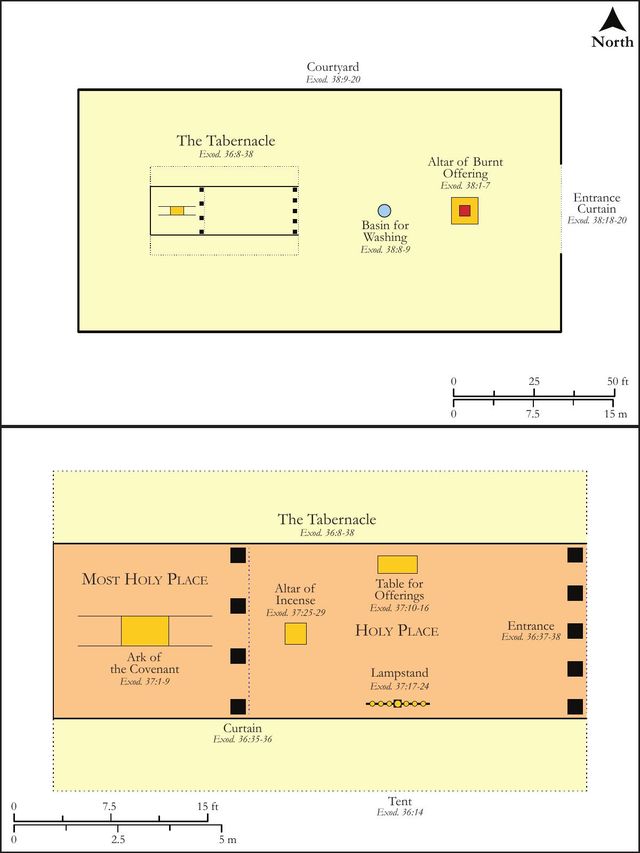
See on the biblical-era maps

Study this verse
Public-domain commentary
Matthew Henry
From his Commentary on the Whole Bible. Henry comments on passages, not single verses — this entry covers Exodus 36:8–13.
The first work they set about was the framing of the house, which must be done before the furniture of it was prepared. This house was not made of timber or stone, but of curtains curiously embroidered and coupled together. This served to typify the state of the church in this world, the palace of God's kingdom among men. 1. Though it is upon the earth, yet its foundation is not in the earth, as that of a house is; no, Christ's kingdom is not of this world, nor founded in it. 2. It is mean and mutable, and in a militant state; shepherds dwelt in tents, and God is the Shepherd of Israel; soldiers dwelt in tents, and the Lord is a man of war, and his church marches through an enemy's country, and must fight its way. The kings of the earth enclose themselves in cedar (Jer 22:15), but the ark of God was lodged in curtains only. 3. Yet there is a beauty in holiness; the curtains were embroidered, so is the church adorned with the gifts and graces of the Spirit, that raiment of needle-work, Psa 45:14. 4. The several societies of believers are united in one, and, as here, all become one tabernacle; for there is one Lord, one faith, and one baptism.
Continue studying Exodus 36:10 across the web’s major study libraries — every link below opens this exact verse, chapter, or book on the destination site.
Read & Compare
 BibleGatewayThis verse in more than 200 translations and 70 languages.
 Bible.comThe YouVersion reader — hundreds of translations, reading plans, and highlights.
 ESV.orgCrossway's official English Standard Version reader.
 NET BibleThe NET translation with 60,000+ translators' notes on every rendering decision.
 STEP BibleTyndale House's free study tool — original text, vocabulary, and scholarly resources.
 BibliaLogos Bible Software's free web reader.
 USCCBThe New American Bible (Revised Edition) with the U.S. bishops' study notes.
Commentaries
 BibleHub CommentariesDozens of classic commentaries on this verse, gathered on one page.
 StudyLightMore than 100 commentary sets — the largest collection on the web.
 BibleRefPlain-English commentary on what this verse means, verse by verse.
 Enduring WordDavid Guzik's free commentary on this chapter, widely used by Bible teachers.
 Bible Study ToolsVerse commentary alongside Greek and Hebrew study aids.
Original Language & Research
- BibleHub InterlinearThe verse word by word — original language, transliteration, and English.
- BibleHub LexiconEvery word's original-language definition and Strong's entry.
 Blue Letter BibleDeep-study tools — Strong's numbers, concordance, and word studies.
 SefariaThe Hebrew text with Rashi and centuries of Jewish commentary.
Sermons, Hymns & Audio


TrulyRandomVerse is not affiliated with these sites and doesn’t control their content. They’re linked because they’re genuinely useful.
Summary
Exodus 36:10 meticulously records the precise execution of God's instructions for constructing the Tabernacle, specifically detailing the joining of the inner linen curtains. This verse highlights the careful craftsmanship involved in coupling two distinct sets of five curtains each, forming the foundational and aesthetically rich covering for the holy sanctuary. It underscores the themes of divine blueprint, the necessity of unity in sacred design, and the excellence required in preparing a dwelling place for God among His people, emphasizing faithful obedience to every divine command.
Context
ShowHideLiterary Context
This verse is situated within the detailed account of the Tabernacle's construction, following the extensive divine instructions given to Moses on Mount Sinai, as thoroughly outlined in Exodus 25-31. Chapters 35 and 36 serve as the narrative of the execution of these commands, beginning with the willing contributions of the Israelites and the commencement of work by the divinely gifted artisans, Bezalel and Aholiab. Specifically, Exodus 36:10 directly fulfills the command found in Exodus 26:3, where God states, "The five curtains shall be coupled one to another; and [the other] five curtains [shall be] coupled one to another." The preceding verses, Exodus 36:8-9, describe the materials (fine twined linen with cherubim) and precise dimensions of these curtains, setting the stage for their assembly. The subsequent verses in chapter 36 detail the creation of the loops and clasps, which would further unite these two large panels, emphasizing the intricate and interconnected nature of the Tabernacle's components.
Historical & Cultural Context
The construction of the Tabernacle took place in the wilderness during Israel's nomadic journey, serving as the portable, sacred epicenter of their worship and a tangible manifestation of God's covenant presence among them. Crucially, the instructions for its construction were not left to human innovation but were a direct "pattern" (Hebrew: tabnît) revealed by God to Moses on Mount Sinai, as explicitly stated in Exodus 25:9. This divine origin underscores the Tabernacle's unique holiness and the absolute necessity of precise adherence to God's design. The meticulous detail, extending even to how the curtains were to be "coupled," reflects the profound reverence due to God and the seriousness with which His dwelling place was to be prepared. The skilled craftsmen, empowered by the Spirit of God for this specific task (as noted in Exodus 31:3), were not merely laborers but instruments fulfilling a divine purpose, demonstrating that all human skill, when consecrated, can serve God's grand and holy design. This level of precision was paramount for a structure intended to house the very presence of the Almighty.
Key Themes
ShowHideExodus 36:10 contributes significantly to several overarching themes within the book of Exodus and the Pentateuch. The most prominent theme is Divine Instruction and Obedience, as the verse directly executes God's specific commands, highlighting the importance of following God's revealed will in every detail. This meticulous obedience is directly linked to the theme of Holiness and Sacred Space, as the Tabernacle was to be a pure and perfect dwelling for a holy God. The act of "coupling" also emphasizes Unity and Cohesion, both in the physical structure of God's dwelling and, by extension, in the spiritual unity expected of God's people. Furthermore, the detailed craftsmanship points to Divine Presence and Immanence, as the ultimate purpose of the Tabernacle was to enable God to "dwell among them" (Exodus 25:8). The entire Tabernacle project, including the precise joining of these curtains, foreshadows God's desire for intimate fellowship with His people, a relationship characterized by order, holiness, and unity.
Exposition and Analysis
ShowHideKey Word Analysis
ShowHideThis primitive root means "to join (literally or figuratively)." In this context, it signifies a deliberate and precise act of uniting distinct elements into a cohesive whole. While châbar can also refer to "charming" or "fascinating" (by means of spells), its application here to the Tabernacle curtains emphasizes a strong, purposeful bond that creates functional integrity and unity. It denotes more than a casual connection; it suggests an integral association, highlighting the divine intention for coherence and completeness in God's dwelling place.
Meaning "a hanging (as tremulous); curtain." This term specifically refers to the large, finely woven linen panels that formed the innermost covering of the Tabernacle. The use of this word emphasizes their function as a protective and decorative "hanging" that defined the sacred space. The meticulous joining of these yᵉrîyʻâh underscores their essential role in creating the enclosure for God's presence, highlighting their beauty and structural importance.
Meaning "united, i.e. one; or (as an ordinal) first." This numeral is used repeatedly in the verse ("one unto another"), reinforcing the concept of individual curtains being brought into a state of unity. It emphasizes the sequential and systematic process of joining each curtain to the next, ultimately forming a single, unified panel. The repeated use of ʼechâd highlights the meticulous, piece-by-piece construction that culminated in a harmonious and integrated whole, reflecting God's design for unity.
Verse Breakdown
ShowHide"And he coupled the five curtains one unto another"
This phrase details the initial phase of the work. The "he" refers collectively to the skilled craftsmen, led by Bezalel, who were entrusted with the execution of the divine blueprint. Five individual linen curtains, each of precise dimensions and material (as described in Exodus 36:8-9), were meticulously joined together. This act created a single, large panel, demonstrating the principle of bringing disparate parts into a cohesive and functional unit, a foundational step in forming the Tabernacle's inner covering.
"and [the other] five curtains he coupled one unto another"
This second clause mirrors the first, indicating the creation of an identical second panel. Another set of five curtains was similarly and precisely joined. The repetition underscores the symmetry, exactness, and adherence to the divine pattern required for the Tabernacle's construction. It highlights the formation of two distinct, yet perfectly matched, large sections that would eventually be united by golden clasps to form the complete curtain system, signifying the ordered and deliberate nature of God's design and the importance of balanced perfection in His sanctuary.
Literary Devices
ShowHideThe primary literary device evident in Exodus 36:10 is Repetition. The phrase "he coupled the five curtains one unto another" is repeated verbatim, emphasizing the symmetrical and precise nature of the work. This repetition serves not only to confirm that two identical panels were created but also to underscore the meticulous adherence to God's instructions, reinforcing the theme of faithful obedience. Beyond simple repetition, the verse also employs Precision and Detail, focusing on the exact number of curtains ("five") and the specific action of "coupling." This highlights the divine demand for accuracy and excellence in the Tabernacle's construction, where every component, no matter how small, was vital to the overall integrity and sanctity of the structure. Furthermore, the act of "coupling" itself functions as Symbolism, representing the unity and coherence intended for God's dwelling place. Just as individual curtains are joined to form a single, encompassing covering, the various components of the Tabernacle, and by extension, God's people, are meant to function as a unified and harmonious whole, reflecting the order and unity of God Himself.
Theological and Thematic Connections
ShowHideExodus 36:10, with its focus on the precise coupling of the Tabernacle curtains, profoundly illustrates several theological and thematic truths. It underscores the divine demand for meticulous obedience to God's revealed will, where every detail, no matter how seemingly minor, contributes to the sacred purpose and overall integrity of His design. The act of joining disparate parts into a unified whole speaks powerfully to the theme of unity—both in the physical structure of God's dwelling and, by extension, in the spiritual body of His people. This unity is not accidental or haphazard but divinely designed and meticulously executed, reflecting God's own nature as a God of order, perfection, and harmony. The Tabernacle, as a whole, foreshadows God's desire to dwell among His people, a dwelling characterized by holiness, divine order, and a unified purpose, setting the stage for the ultimate indwelling of God in Christ and His church.
Reflection and Application
ShowHideThe detailed account of coupling the Tabernacle curtains in Exodus 36:10 offers profound insights for our lives today. It serves as a powerful reminder that God is a God of order and precision, valuing excellence, diligence, and faithfulness in all that we undertake, especially in our service to Him. Just as the craftsmen painstakingly followed every divine instruction, we are called to live lives of intentional obedience, recognizing that even the seemingly small details of our walk with God contribute significantly to His larger, perfect design. The unity achieved by joining the curtains serves as a compelling metaphor for the church, the body of Christ. We, as individual believers, are called to be "coupled" together in love, purpose, and mission, working in harmony to manifest God's presence and glory in the world. Our spiritual effectiveness, both individually and corporately, is often intrinsically tied to our willingness to submit to God's blueprint for our lives and ministries, ensuring that our efforts are not haphazard but aligned with His perfect and unifying will. This verse challenges us to consider: Are we truly giving our best to God in every area of our lives, and are we actively pursuing and preserving unity within the body of Christ, reflecting His own desire for cohesion and harmony?
Questions for Reflection
ShowHideFAQ
ShowHideWhat is the significance of "coupling" five curtains at a time instead of all ten at once?
ShowHideThe instruction to couple the ten curtains into two sets of five (as seen in Exodus 26:3 and meticulously executed in Exodus 36:10) was primarily for practical reasons related to the Tabernacle's portability and ease of assembly. By creating two large panels, each approximately 45 feet by 60 feet, it made the curtains significantly easier to handle, transport, and erect in the wilderness. This design allowed for a central seam where the two large panels could be joined or separated using golden clasps, facilitating the dismantling and reassembly of the Tabernacle as the Israelites moved. While the primary emphasis is on functional design for a movable dwelling, some scholars suggest symbolic significance, perhaps representing the two tables of the Law or the division between the Holy Place and the Most Holy Place, underscoring the ordered and deliberate nature of God's design.
Were these curtains the outermost covering of the Tabernacle?
ShowHideNo, the curtains mentioned in Exodus 36:10 were the innermost covering of the Tabernacle. These were made of fine twined linen with intricate cherubim skillfully worked into them (as described in Exodus 26:1), forming the beautiful and sacred internal walls and ceiling of the sanctuary. Above these linen curtains were several other layers, each with a distinct material and purpose, providing protection and additional symbolism. These layers included: a covering of goats' hair (the tent itself), followed by a covering of rams' skins dyed red, and finally, an outermost covering of badgers' (or porpoise) skins, which served as the durable, weather-resistant protective layer (see Exodus 26:7-14). Each layer contributed to the overall structure, sanctity, and symbolic richness of God's dwelling place.
Christ-Centered Fulfillment
ShowHideExodus 36:10, with its precise description of coupling the Tabernacle curtains, finds its ultimate and profound fulfillment in the person and work of Jesus Christ. The Tabernacle itself was a temporary dwelling place for God among His people, a tangible shadow pointing to a greater, eternal reality. Just as the curtains were meticulously joined to form a unified, holy sanctuary, Christ is the ultimate "coupling" of perfect divinity and full humanity, the very Word made flesh who "tabernacled among us" (John 1:14). He is the true temple, the perfect and complete dwelling place of God's fullness (as seen in Colossians 2:9), embodying the very presence and glory that the Tabernacle merely symbolized. Furthermore, the unity symbolized by the joined curtains powerfully foreshadows the spiritual unity of the church, the body of Christ, which is built upon Him as the chief cornerstone (Ephesians 2:19-22). Through His ultimate sacrifice on the cross, Christ has broken down the dividing wall of hostility, effectively "coupling" Jew and Gentile into one new humanity, creating peace and access to God for all who believe (Ephesians 2:14-16). We, as believers, are now living stones, being built into a spiritual house, a holy priesthood, to offer spiritual sacrifices acceptable to God through Jesus Christ (1 Peter 2:5). Thus, the meticulous joining of the Tabernacle curtains anticipates the perfect, unified dwelling of God, fully realized in Christ and continually manifested in His unified church.