


Esther 2:23
Bible text: King James Version (1769 Blayney text) · Public domain
Bible text: King James Version with Strong's numbers · Public domain
Bible text: Berean Standard Bible · Public domain
Bible text: American Standard Version (1901) · Public domain
Bible text: World English Bible, Messianic edition · Public domain
Bible text: Young's Literal Translation · Public domain
- וַיְבֻקַּשׁvay·vu·Kashand it was soughtH1245Conj-w ¦ V-Pual-ConsecImperf-3msVerb Pual Consecutive Imperfect 3rd Singular Masculineוַandיְבֻקַּשׁit was sought
- הַדָּבָרha·da·Varthe matterH1697Art ¦ N-msNoun Singular Masculine Absoluteהַtheדָּבָרmatter
- וַיִּמָּצֵאvai·yi·ma·Tze'and it was foundH4672Conj-w ¦ V-Niphal-ConsecImperf-3msVerb Niphal Consecutive Imperfect 3rd Singular Masculineוַandיִּמָּצֵאit was found
- וַיִּתָּלוּvai·yi·ta·Luand they were hangedH8518Conj-w ¦ V-Niphal-ConsecImperf-3mpVerb Niphal Consecutive Imperfect 3rd Plural Masculineוַandיִּתָּלוּthey were hanged
- שְׁנֵיהֶםshe·nei·Hem[the] two of themH8147Adj-cdc ¦ 3mpAdjective Numerical Dual common gender Constructשְׁנֵי[the] two ofהֶםthem
- עַל'alonH5921PrepPreposition
- עֵץ'Etza gallowsH6086N-msNoun Singular Masculine Absolute
- וַיִּכָּתֵבvai·yi·ka·Tevand it was writtenH3789Conj-w ¦ V-Niphal-ConsecImperf-3msVerb Niphal Consecutive Imperfect 3rd Singular Masculineוַandיִּכָּתֵבit was written
- בְּסֵפֶרbe·Se·ferin [the] book ofH5612Prep-b ¦ N-mscNoun Singular Masculine Constructבְּinסֵפֶר[the] book of
- דִּבְרֵיdiv·Rei[the] matters ofH1697N-mpcNoun Plural Masculine Construct
- הַיָּמִיםhai·ya·Mimthe daysH3117Art ¦ N-mpNoun Plural Masculine Absoluteהַtheיָּמִיםdays
- לִפְנֵיlif·Nei<to> beforeH6440Prep-l ¦ N-mpcNoun Plural Masculine Constructלִ<to>פְנֵיbefore
- הַמֶּלֶךְha·Me·lekhthe kingH4428Art ¦ N-msNoun Singular Masculine Absoluteהַtheמֶּלֶךְking
English is a literal word-by-word gloss of the Hebrew, not the KJV's wording. Why?
This is the original text the KJV's translators worked from — each Hebrew word with its own literal English meaning in this verse, prepared by scholars at Tyndale House, Cambridge. The KJV translates whole sentences, not word by word, so its wording differs: one Hebrew word can become several English words, and the KJV may choose “the LORD” where the gloss reads “Yahweh”. Both are faithful — they answer different questions. For the KJV's own rendering, switch to the KJV text.
Details
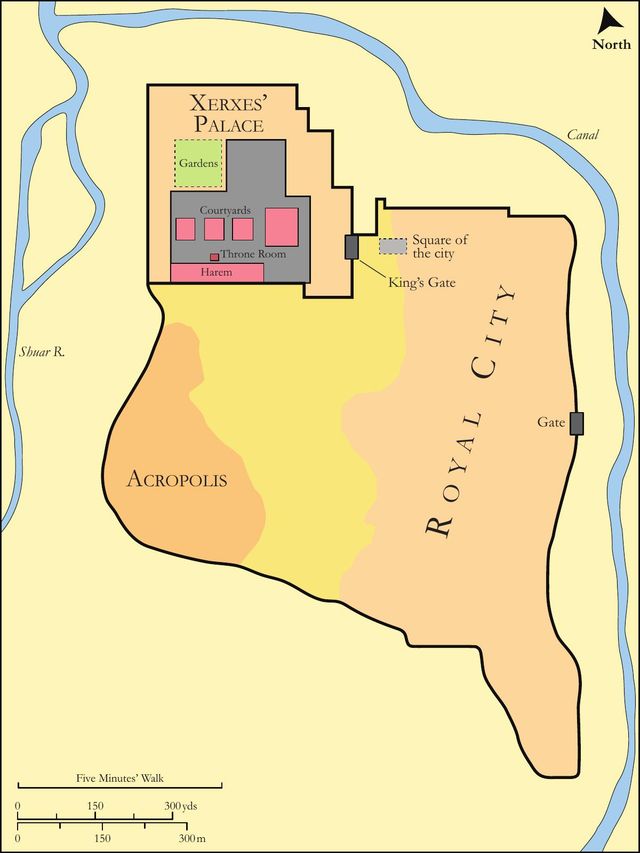
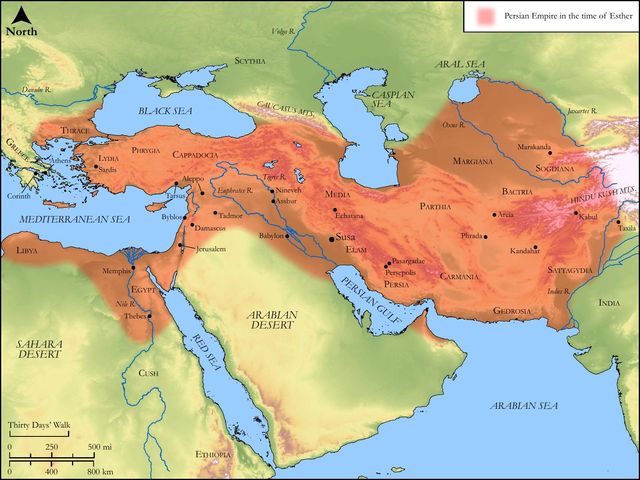
See on the biblical-era maps
Study this verse
Public-domain commentary
Matthew Henry
From his Commentary on the Whole Bible. Henry comments on passages, not single verses — this entry covers Esther 2:21–23.
This good service which Mordecai did to the government, in discovering a plot against the life of the king, is here recorded, because the mention of it will again occur to his advantage. No step is yet taken towards Haman's design of the Jews' destruction, but several steps are taken towards God's design of their deliverance, and this for one. God now gives Mordecai an opportunity of doing the king a good turn, that he might have the fairer opportunity afterwards of doing the Jews a good turn. 1. A design was laid against the king by two of his own servants, who sought to lay hands on him, not only to make him a prisoner, but to take away his life, Est 2:21. Probably they resented some affront which they thought he had given them, or some injury which he had done them. Who would be great, to be so much the object of envy? Who would be arbitrary, to be so much the object of ill-will? Princes, above any mortals, have their souls continually in their hands, and often go down slain to the pit, especially those who caused terror in the land of the living. 2. Mordecai got notice of their treason, and, by Esther's means, discovered it to the king, hereby confirming her in and recommending himself to the king's favour. How he came to the knowledge of it does not appear. Whether he overheard their discourse, or whether they offered to draw him in with them, so it was that the thing was known to him. This ought to be a warning against all traitorous and seditious practices: though men presume upon secresy, a bird of the air shall carry the voice. Mordecai, as soon as he knew it, caused it to be made known to the king, which ought to be an instruction and example to all that would be found good subjects not to conceal any bad design they know of against the prince or the public peace, for it is making a confederacy with public enemies. 3. The traitors were hanged, as they deserved, but not till their treason was, upon search, fully proved against them (Est 2:23), and the whole matter was recorded in the king's journals, with a particular remark that Mordecai was the man who discovered the treason. He was not rewarded presently, but a book of remembrance was written. Thus with respect to those who serve Christ, though their recompence is adjourned till the resurrection of the just, yet an account is kept of their work of faith and labour of love, which God is not unrighteous to forget, Heb 6:10.
Historical interpretation
Historical reception
2 surviving comments on this verse. Each one is dated, so this reads as a timeline rather than a list.
Then it adds: “And it was investigated, and discovered, and both men were hung on a gibbet; and the king commanded that it be written in the record book that he should be repaid somehow for saving his life; and it was set down in the accounts, and recorded in the chronicles before the king.” The “record books” are, then, the volumes of the two Testaments which set down the rewards that await the righteous in return for their good deeds, and the punishments that await the wicked for their sins. Hence it is written in the Gospel: “The son of man is going to come in the glory of his Father, and will then repay each one according to his works” (Matthew 16). And likewise, “The wicked will come to eternal punishment, while the just come to eternal reward” (Matthew 25). Hence Paul as well writes to the Romans as follows: “For the wrath of God is unleashed upon all the wickedness and injustice of men, who repress in their injustice the truth of God who repays each according to his works; and those who seek glory, honor, and purity by patiently doing good deeds will receive eternal life, while those who trust in wickedness, because they are contentious and will not acquiesce to the truth, will receive wrath and indignation. There will be trouble and distress for every soul of an evildoer” (Romans 1 and 2). Ezekiel as well speaks about this: “The justice of the just man will be upon him, and the wickedness of the wicked man will be upon him. When a soul has sinned, it will die” (Ezekiel 18). The Psalmist also refers to this in the same terms: “The eyes of the Lord are upon the just, and his ears attend to their prayers; the face of the Lord is upon those who do evil, that he may wipe their memory from the earth” (Psalms 33).
There is no doubt that the Scribes and Pharisees of the Jews are signified by the two eunuchs who were the caretakers of the royal house and guarded the threshold of the palace. Indeed it was said that even though they had the key to knowledge, they did not enter and did not let others enter. They wanted to rebel against the king and kill him because they were jealous of the teaching and virtue of the Savior. They constantly put him in danger and conspired with the ministers of Roman power to find a way to kill him. Therefore it is written in the gospel, “Then the Pharisees went and plotted to entrap him in what he said. So they sent their disciples to him, along with the Herodians, saying, ‘Teacher, we know that you are sincere, and teach the way of God in accordance with truth, and show deference to no one; for you do not regard people with partiality. Tell us, then, what you think. Is it lawful to pay taxes to Caesar, or not?’ ” And in another passage it is read, “So the chief priests and the Pharisees called a meeting of the council, and said, ‘What are we to do? This man is performing many signs. If we let him go on like this, everyone will believe in him, and the Romans will come and take our place and people.’ ” And a bit further it is added, “So from that day on they planned to put him to death.”
Continue studying Esther 2:23 across the web’s major study libraries — every link below opens this exact verse, chapter, or book on the destination site.
Read & Compare
 BibleGatewayThis verse in more than 200 translations and 70 languages.
 Bible.comThe YouVersion reader — hundreds of translations, reading plans, and highlights.
 ESV.orgCrossway's official English Standard Version reader.
 NET BibleThe NET translation with 60,000+ translators' notes on every rendering decision.
 STEP BibleTyndale House's free study tool — original text, vocabulary, and scholarly resources.
 BibliaLogos Bible Software's free web reader.
 USCCBThe New American Bible (Revised Edition) with the U.S. bishops' study notes.
Commentaries
 BibleHub CommentariesDozens of classic commentaries on this verse, gathered on one page.
 StudyLightMore than 100 commentary sets — the largest collection on the web.
 BibleRefPlain-English commentary on what this verse means, verse by verse.
 Enduring WordDavid Guzik's free commentary on this chapter, widely used by Bible teachers.
 Bible Study ToolsVerse commentary alongside Greek and Hebrew study aids.
Original Language & Research
- BibleHub InterlinearThe verse word by word — original language, transliteration, and English.
- BibleHub LexiconEvery word's original-language definition and Strong's entry.
 Blue Letter BibleDeep-study tools — Strong's numbers, concordance, and word studies.
 SefariaThe Hebrew text with Rashi and centuries of Jewish commentary.
Sermons, Hymns & Audio


TrulyRandomVerse is not affiliated with these sites and doesn’t control their content. They’re linked because they’re genuinely useful.
Summary
Esther 2:23 details the swift and conclusive resolution of a conspiracy against King Ahasuerus. It records the discovery, investigation, and execution of two royal chamberlains, Bigthan and Teresh, who plotted to assassinate the king. Crucially, the verse highlights that this entire event, including Mordecai's role in exposing the plot, was meticulously documented in the official royal chronicles, setting the stage for future divine interventions and the eventual deliverance of the Jewish people.
CONTEXT
ShowHideExposition and Analysis
ShowHideKey Word Analysis
ShowHideThis term (H1245) is a primitive root meaning "to search out (by any method, specifically in worship or prayer); by implication, to strive after; ask, beg, beseech, desire, enquire, get, make inquisition, procure, (make) request, require, seek (for)." In this context, it signifies a thorough, careful, and diligent investigation or search, indicating that the plot against the king was not merely suspected but confirmed through a rigorous and official process, lending credibility to Mordecai's report and the subsequent judgment. It implies a formal judicial inquiry rather than a hasty reaction.
This word (H8518) is a primitive root meaning "to suspend (especially to gibbet); hang (up)." While "hanged" might suggest a gallows, in the Persian context, this often refers to impalement or crucifixion, where the condemned was fixed to a stake or pole. This was a public and humiliating form of death, intended to serve as a stark warning to others.
This noun (H5612) means "writing (the art or a document); by implication, a book; bill, book, evidence, [idiom] learn(-ed) (-ing), letter, register, scroll." Here, it refers to the official royal annals or "book of the daily events/times" (often rendered "chronicles" from the Hebrew divrei hayyamim). These were not personal notes but meticulously kept state records, detailing important occurrences, decrees, and acts of service or treason within the Persian Empire. The inclusion of Mordecai's deed in this official record highlights its historical importance and sets the stage for its later, providential retrieval.
Verse Breakdown
ShowHide"And when inquisition was made of the matter, it was found out;"
This clause emphasizes the thoroughness and success of the investigation. Mordecai's report was not dismissed but rigorously examined, and the truth of the conspiracy by Bigthan and Teresh was unequivocally confirmed. This validation underscores the reliability of the information provided by Mordecai through Esther, ensuring the king's actions were based on verified facts.
"therefore they were both hanged on a tree:"
This is the immediate and severe consequence of their treason. The execution of Bigthan and Teresh serves as a clear demonstration of Persian justice and the king's absolute authority. The method of execution, "hanged on a tree," highlights the public and deterrent nature of the punishment, designed to instill fear and prevent future plots against the monarch.
"and it was written in the book of the chronicles before the king."
This final clause is profoundly significant, acting as a narrative linchpin. It confirms that Mordecai's act of loyalty and the entire incident were officially documented in the royal annals, accessible to the king. This seemingly mundane administrative detail becomes the critical element that will later lead to Mordecai's recognition and the eventual turning point in the fortunes of the Jewish people, demonstrating God's meticulous, though unseen, orchestration of events.
Literary Devices
ShowHideThe verse employs several key literary devices. Foreshadowing is prominent, as the meticulous recording of Mordecai's loyalty in the royal chronicles directly sets up the dramatic events of Esther 6, where this very record becomes the catalyst for his exaltation and the downfall of Haman. There is also a subtle Irony at play: an act of loyalty intended to protect a pagan king ultimately serves as a crucial step in the deliverance of God's chosen people, demonstrating how divine purposes can be achieved through secular means. The phrase "hanged on a tree" also carries a Symbolic weight, representing swift and absolute justice, a theme that will recur later in the book with Haman's own fate.
Theological and Thematic Connections
ShowHideEsther 2:23 powerfully illustrates the concept of divine providence, even in a book where God is not explicitly named. The seemingly ordinary administrative act of recording Mordecai's loyalty becomes a crucial piece in God's intricate tapestry of salvation for His people. It highlights that God works through human agency, secular systems, and seemingly coincidental events to bring about His perfect will. This verse reminds us that no act of faithfulness, no matter how small or unacknowledged at the time, goes unnoticed by the sovereign God, who orchestrates all circumstances for His ultimate glory and the good of His people. It underscores the truth that God's plan is meticulously unfolding, often behind the scenes, ensuring that justice will ultimately prevail and His purposes will be accomplished.
Reflection and Application
ShowHideEsther 2:23 offers profound lessons for believers today. It reminds us that our acts of integrity, faithfulness, and loyalty, even in seemingly mundane or unappreciated contexts, are not insignificant. Mordecai's vigilance and report, though initially only recorded in a royal archive, became the very instrument through which God would later save an entire nation. This encourages us to live with diligence and righteousness in our daily lives, trusting that God sees and remembers our deeds, even when human recognition is absent. It reinforces our faith in God's sovereign control over all circumstances, assuring us that He is actively working behind the scenes, orchestrating events for His ultimate purposes, even in a world that often seems chaotic or godless. Our faithfulness, however small, contributes to His grand design.
Questions for Reflection
ShowHideFAQ
ShowHideWhat was the "book of the chronicles" and why was its mention so important?
ShowHideThe "book of the chronicles" (Hebrew: sepher divrei hayyamim) refers to the official royal annals or historical records of the Persian Empire. These were meticulously kept documents detailing significant events, decrees, and acts of service or treason. Its mention in Esther 2:23 is profoundly important because it lays the groundwork for the pivotal events in Esther 6. When King Ahasuerus suffers from insomnia, he requests these very chronicles to be read to him. It is through this reading that he discovers Mordecai's unrewarded loyalty in exposing the plot, which directly leads to Mordecai's exaltation and sets in motion the reversal of Haman's evil decree against the Jews. It highlights God's providential use of seemingly mundane administrative details to achieve His redemptive purposes.
What kind of execution was "hanged on a tree" in the Persian context?
ShowHideWhile the English translation "hanged on a tree" might suggest a gallows, in the Persian context, the phrase "hanged on a tree" (Hebrew: talu al-etz) often refers to impalement or crucifixion. This was a severe and public form of capital punishment where the condemned was fixed to a stake or pole, either through impalement or by being nailed or tied to a cross-shaped structure. It was designed not only to execute but also to humiliate the condemned and serve as a stark deterrent to others. This method of execution is also seen in other biblical texts, such as when the five kings were hanged on trees by Joshua.
Christ-Centered Fulfillment
ShowHideEsther 2:23, while detailing a secular act of justice and record-keeping, resonates with profound Christ-centered themes. The meticulous recording of Mordecai's loyalty in the royal chronicles foreshadows the divine "books" in heaven, where God records the deeds of humanity and, more importantly, the names of those who belong to Him in the Book of Life. Just as Mordecai's forgotten loyalty was eventually brought to light for his vindication and the salvation of his people, so too does God remember every act of faithfulness by His children, and His ultimate justice will prevail. The execution "on a tree" for treason, a common form of capital punishment, eerily echoes the ultimate "tree" or cross upon which Jesus, the innocent Lamb of God, was hanged. He bore the curse of our treason against God, suffering the ultimate penalty for our sins, so that our names might be written in the Lamb's Book of Life. Thus, the seemingly administrative detail of Esther 2:23 points forward to the divine record-keeping that secures our eternal salvation through Christ's perfect sacrifice and the ultimate justice executed at the cross.