


Deuteronomy 2:2
Bible text: King James Version (1769 Blayney text) · Public domain
Bible text: Berean Standard Bible · Public domain
Bible text: American Standard Version (1901) · Public domain
Bible text: World English Bible, Messianic edition · Public domain
Bible text: Geneva Bible (1599) · Public domain
Bible text: Young's Literal Translation · Public domain
- וַיֹּאמֶרvai·Yo·merand he saidH559Conj-w ¦ V-Qal-ConsecImperf-3msVerb Qal Consecutive Imperfect 3rd Singular Masculineוַandיֹּאמֶרhe said
- יְהוָהYah·wehYahwehH3068N-properNoun Proper Title
- אֵלַי'e·Laito meH413Prep ¦ 1csPrepositionאֵלַtoיme
- לֵאמֹרle·Mor<to> sayingH559Prep-l ¦ V-Qal-InfVerb Qal Infinitive Constructלֵ<to>אמֹרsaying
English is a literal word-by-word gloss of the Hebrew, not the KJV's wording. Why?
This is the original text the KJV's translators worked from — each Hebrew word with its own literal English meaning in this verse, prepared by scholars at Tyndale House, Cambridge. The KJV translates whole sentences, not word by word, so its wording differs: one Hebrew word can become several English words, and the KJV may choose “the LORD” where the gloss reads “Yahweh”. Both are faithful — they answer different questions. For the KJV's own rendering, switch to the KJV text.
Details
See on the biblical-era maps
Study this verse
Public-domain commentary
Matthew Henry
From his Commentary on the Whole Bible. Henry comments on passages, not single verses — this entry covers Deuteronomy 2:1–7. His three-level outline is real structure in the source text, so it is rendered as structure.
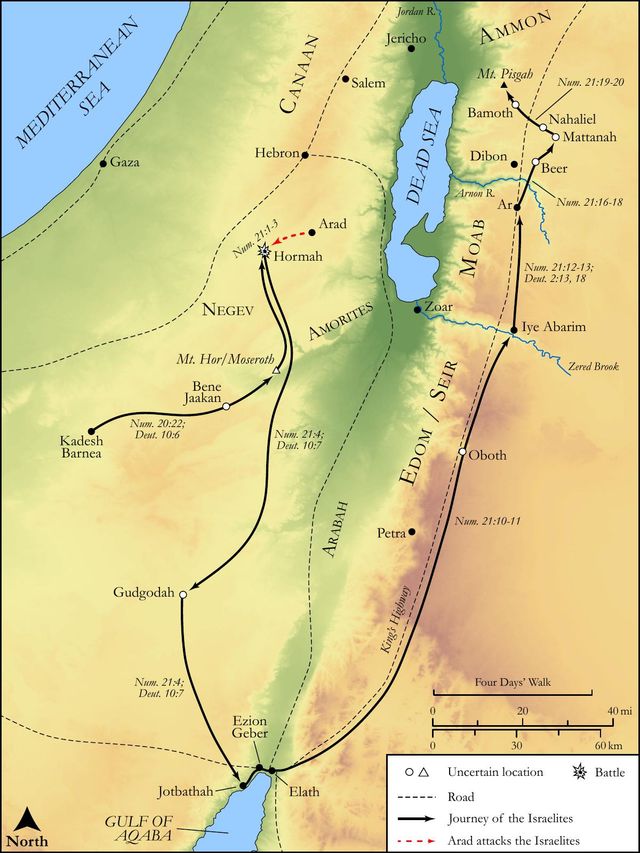
Here is, I. A short account of the long stay of Israel in the wilderness: We compassed Mount Seir many days, Deu 2:1. Nearly thirty-eight years they wandered in the deserts of Seir; probably in some of their rests they staid several years, and never stirred; God by this not only chastised them for their murmuring and unbelief, but, 1. Prepared them for Canaan, by humbling them for sin, teaching them to mortify their lusts, to follow God, and to comfort themselves in him. It is a work of time to make souls meet for heaven, and it must be done by a long train of exercises. 2. He prepared the Canaanites for destruction. All this time the measure of their iniquity was filling up; and, though it might have been improved by them as a space to repent in, it was abused by them to the hardening of their hearts. Now that the host of Israel was once repulsed, and after that was so long entangled and seemingly lost in the wilderness, they were secure, and thought the danger was over from that quarter, which would make the next attempt of Israel upon them the more dreadful.
II.Orders given them to turn towards Canaan.
Though God contend long, he will not contend for ever. Though Israel may be long kept waiting for deliverance or enlargement, it will come at last: The vision is for an appointed time, and at the end it shall speak, and not lie.
III.A charge given them not to annoy the Edomites.
1.They must not offer any hostility to them as enemies: Meddle not with them, Deu 2:4, Deu 2:5.
(1.)They must not improve the advantage they had against them, by the fright they would be put into upon Israel's approach: "They shall be afraid of you, knowing your strength and numbers, and the power of God engaged for you; but think not that, because their fears make them an easy prey, you may therefore prey upon them; no, take heed to yourselves." There is need of great caution and a strict government of our own spirits, to keep ourselves from injuring those against whom we have an advantage. Or this caution is given to the princes; they must not only not meddle with the Edomites themselves, but not permit any of the soldiers to meddle with them.
(2.)They must not avenge upon the Edomites the affront they gave them in refusing them passage through their country, Num 20:21. Thus, before God brought Israel to destroy their enemies in Canaan, he taught them to forgive their enemies in Edom.
(3.)They must not expect to have any part of their land given them for a possession: Mount Seir was already settled upon the Edomites, and they must not, under pretence of God's covenant and conduct, think to seize for themselves all they could lay hands on. Dominion is not founded in grace. God's Israel shall be well placed, but must not expect to be placed alone in the midst of the earth, Isa 5:8.
2.They must trade with them as neighbours, buy meat and water of them, and pay for what they bought, Deu 2:6. Religion must never be made a cloak for injustice. The reason given (Deu 2:7), is, "God hath blessed thee, and hitherto thou hast lacked nothing; and therefore," (1.) "Thou needest not beg; scorn to be beholden to Edomites, when thou hast a God all-sufficient to depend upon. Thou hast wherewithal to pay for what thou callest for (thanks to the divine blessing!); use therefore what thou hast, use it cheerfully, and do not sponge upon the Edomites." (2.) "Therefore thou must not steal. Thou hast experienced the care of the divine providence concerning thee, in confidence of which for the future, and in a firm belief of its sufficiency, never use any indirect methods for thy supply. Live by the faith and not by thy sword."
Continue studying Deuteronomy 2:2 across the web’s major study libraries — every link below opens this exact verse, chapter, or book on the destination site.
Read & Compare
 BibleGatewayThis verse in more than 200 translations and 70 languages.
 Bible.comThe YouVersion reader — hundreds of translations, reading plans, and highlights.
 ESV.orgCrossway's official English Standard Version reader.
 NET BibleThe NET translation with 60,000+ translators' notes on every rendering decision.
 STEP BibleTyndale House's free study tool — original text, vocabulary, and scholarly resources.
 BibliaLogos Bible Software's free web reader.
 USCCBThe New American Bible (Revised Edition) with the U.S. bishops' study notes.
Commentaries
 BibleHub CommentariesDozens of classic commentaries on this verse, gathered on one page.
 StudyLightMore than 100 commentary sets — the largest collection on the web.
 BibleRefPlain-English commentary on what this verse means, verse by verse.
 Enduring WordDavid Guzik's free commentary on this chapter, widely used by Bible teachers.
 Bible Study ToolsVerse commentary alongside Greek and Hebrew study aids.
Original Language & Research
- BibleHub InterlinearThe verse word by word — original language, transliteration, and English.
- BibleHub LexiconEvery word's original-language definition and Strong's entry.
 Blue Letter BibleDeep-study tools — Strong's numbers, concordance, and word studies.
 SefariaThe Hebrew text with Rashi and centuries of Jewish commentary.
Sermons, Hymns & Audio


TrulyRandomVerse is not affiliated with these sites and doesn’t control their content. They’re linked because they’re genuinely useful.
Summary
Deuteronomy 2:2, though remarkably concise, serves as a pivotal divine utterance within the book of Deuteronomy, marking a crucial transition in Israel's prolonged wilderness journey. It records the direct, authoritative communication from Yahweh to Moses, signaling an end to a period of aimless wandering and initiating a new phase of purposeful divine guidance and specific instructions for the Israelites as they prepare to advance towards the Promised Land. This divine address underscores God's active involvement in the destiny of His people and sets the authoritative tone for the detailed historical recounting and commands that Moses is about to deliver.
Context
ShowHideLiterary Context
Deuteronomy 2:2 immediately follows a recounting of Israel's prolonged wandering in the wilderness, specifically around Mount Seir, the territory of Edom, for nearly 38 years since their departure from Kadesh Barnea. This period of aimless movement was a direct consequence of the previous generation's disobedience and lack of faith, as detailed in Deuteronomy 1, particularly their refusal to enter the Promised Land after the disheartening report of the spies (Deuteronomy 1:34-35). Thus, this verse marks a significant narrative turning point: the cessation of the punitive wandering and the commencement of God's renewed, direct, and specific instructions for the new generation regarding their advance towards their inheritance. It sets the stage for the detailed historical review and the subsequent laws that form the core of Moses' farewell addresses to the nation.
Historical & Cultural Context
The Israelites, having spent four decades as nomads in the wilderness, were a people on the cusp of transitioning into a settled nation. They were positioned on the eastern side of the Jordan River, preparing to enter Canaan, a land already inhabited by various established nations. The historical context is one of a vast, arid wilderness, where survival and direction were entirely dependent on divine provision and guidance. Culturally, the direct communication from God to Moses reaffirmed Moses' unique prophetic authority and Israel's covenant relationship with Yahweh, emphasizing that their identity and destiny were divinely ordained. This divine word, delivered in a specific geographical and historical moment, was crucial for shaping their national identity, military strategy, and ethical conduct as they prepared to confront and interact with the surrounding peoples.
Key Themes
ShowHideThis concise verse is rich with foundational themes central to Deuteronomy and the broader biblical narrative. Firstly, it powerfully establishes Divine Revelation and Authority, asserting that the words Moses is about to deliver are not his own, but direct, authoritative communication from Yahweh. This underscores the divine inspiration of the Law and all subsequent instructions, affirming that "all Scripture is God-breathed and is useful for teaching, rebuking, correcting and training in righteousness" (2 Timothy 3:16). Secondly, it highlights God's Active and Personal Guidance, demonstrating His continuous involvement in the journey of His people. Even after years of wandering and judgment, God remains intimately engaged, providing precise instructions for their path forward, moving them from a state of aimlessness to one of purposeful advancement. Thirdly, it reaffirms Moses' Unique Mediating Role as God's chosen prophet, through whom the divine will was revealed to the people, a role central to Israel's covenant relationship with God, as seen from the initial encounter at Sinai (Exodus 19:3). Finally, the verse signals A New Chapter in Israel's journey, marking a decisive shift from a period of wandering and divine discipline to a renewed phase of divine direction and the imminent fulfillment of God's promises, echoing God's earlier command to leave Horeb and advance (Deuteronomy 1:6).
Exposition and Analysis
ShowHideKey Word Analysis
ShowHideThis is God's personal covenant name, often rendered as Yahweh. Derived from a root meaning "to be," it signifies the self-existent, eternal God who is faithful to His promises. Its use here emphasizes not merely a generic deity, but the specific, relational God who entered into a covenant with Israel, demonstrating His faithfulness, sovereignty, and unwavering commitment to His people despite their past failures. It underscores the personal and intimate nature of this divine communication.
This primitive root signifies a clear, authoritative, and intentional declaration, rather than a casual utterance or suggestion. It implies a direct verbal communication from God, carrying the weight of command and instruction. The use of ʼâmar here highlights the foundational nature of God's word as the source of truth, law, and guidance for His people, establishing the divine origin and binding authority of all that follows in Deuteronomy.
Verse Breakdown
ShowHide"And the LORD spake unto me"
This initial clause immediately establishes the divine source and supreme authority of the message that is about to be delivered. The conjunction "And" connects this pivotal moment to the preceding narrative, indicating a continuation of God's active involvement with His people, but now with a renewed and direct instruction. "The LORD" (Yᵉhôvâh) signifies the covenant God, who is faithful to His promises and intimately involved in the life and destiny of Israel. The phrase "spake unto me" highlights Moses' unique and unparalleled role as the direct recipient of divine revelation, emphasizing his mediation between God and the people.
"saying"
This simple participle functions as an introductory marker, indicating that what follows is the precise and direct content of God's speech. It underscores the verbal nature of God's communication and sets the expectation for the specific divine commands and directives that will unfold in the subsequent verses and chapters. It signifies that the narrative is shifting from a general recounting to the verbatim transmission of God's explicit instructions.
Literary Devices
ShowHideThe primary literary device at play in Deuteronomy 2:2 is Direct Discourse, where the narrative voice explicitly states that God is speaking directly to Moses, followed by the verbatim content of that speech in subsequent verses. This immediate transition into God's own words lends immense authority and immediacy to the message. Furthermore, the phrase "And the LORD spake unto me, saying" functions as a Formulaic Introduction or Prophetic Formula, a recurring literary convention throughout the Pentateuch and prophetic literature that consistently signals divine revelation and underscores the divine origin and binding nature of the message. This formula serves as a Framing Device, introducing the specific divine commands and historical recounting that follow, thereby structuring the narrative and emphasizing the authoritative source of the instructions for Israel's next phase of their journey.
Theological and Thematic Connections
ShowHideDeuteronomy 2:2 profoundly establishes the foundational principle that all subsequent revelation in Deuteronomy originates directly from God Himself. It highlights God's ongoing commitment to His covenant people, providing precise guidance even after periods of wandering and discipline. The divine initiative in communication underscores His sovereignty, faithfulness, and active involvement in human history. It also reinforces the principle that true authority for life and faith flows from God's revealed word, mediated through His chosen servants. This pattern of divine speech and human reception is central to biblical theology, affirming God's desire for relationship and His provision of clear direction for His people's journey, demonstrating that His word is always purposeful and leads to the fulfillment of His promises.
Reflection and Application
ShowHideDeuteronomy 2:2 serves as a timeless reminder of God's unwavering commitment to communicate with His people and His desire to provide clear direction for their lives. Just as He spoke definitively to Moses, guiding Israel out of aimless wandering into purposeful advancement, so too does God continue to speak to us today through His inspired Word, the Bible, and by His Holy Spirit. This verse calls us to cultivate a posture of attentive listening and humble obedience, trusting that God's guidance, even when it leads through unfamiliar or challenging terrains, is always for our ultimate good and designed to lead us into His promised blessings. It challenges us to actively seek His specific direction in our daily decisions, believing that His voice is the ultimate authority for navigating the complexities of life and fulfilling our divine purpose, moving us from spiritual aimlessness to a life of focused, Spirit-led advancement.
Questions for Reflection
ShowHideFAQ
ShowHideWhy is this short verse so important in the context of Deuteronomy?
ShowHideDeuteronomy 2:2 is profoundly important because it marks a critical turning point in Israel's wilderness journey and in Moses' narrative. After nearly 38 years of wandering due to the previous generation's disobedience (as recounted in Deuteronomy 1), this verse signals the end of that aimless period and the beginning of precise, divinely ordained instructions for their advance towards the Promised Land. It re-establishes God's direct, authoritative voice, setting the stage for the detailed commands and historical recollections that constitute the core of Deuteronomy, emphasizing that the subsequent actions are not human initiatives but divine mandates.
How does God speak to believers today, similar to how He spoke to Moses?
ShowHideWhile God no longer speaks audibly to individuals in the same direct, prophetic manner as He did to Moses (who had a unique role as mediator of the Old Covenant), He continues to communicate powerfully and authoritatively with believers today. Primarily, God speaks through His inspired and infallible Word, the Bible, which is "God-breathed and useful for teaching, rebuking, correcting and training in righteousness" (2 Timothy 3:16). Additionally, the Holy Spirit indwells believers, guiding them into all truth (John 16:13), illuminating Scripture, and providing discernment. God also speaks through circumstances, the counsel of godly community, and ultimately through the person of Jesus Christ, who is the ultimate revelation of God (Hebrews 1:1-2).
Christ-Centered Fulfillment
ShowHideDeuteronomy 2:2, with its declaration that "the LORD spake unto me, saying," profoundly foreshadows the ultimate and most complete divine revelation found in Jesus Christ. While Moses served as God's chosen mediator, through whom the Law and specific instructions for Israel were delivered, he himself pointed forward to a greater Prophet whom God would raise up (Deuteronomy 18:15). This ultimate Prophet is Jesus, who is not merely a messenger but the very Word of God made flesh, the definitive and final revelation of God to humanity (Hebrews 1:1-2). Just as God's voice initiated a new, purposeful phase for Israel, moving them from aimless wandering to directed advancement, so too does Christ's coming inaugurate the new covenant, offering a new way of life and true spiritual inheritance for all who believe (Jeremiah 31:31-34). Through Christ, God continues to speak, not merely through commands on tablets of stone, but through the indwelling Holy Spirit who guides believers into all truth (John 16:13) and empowers them to walk in obedience to the divine will, leading them to their eternal promised land and the fulfillment of all God's promises.