


Deuteronomy 2:3
Bible text: King James Version (1769 Blayney text) · Public domain
Bible text: Berean Standard Bible · Public domain
Bible text: American Standard Version (1901) · Public domain
Bible text: World English Bible, Messianic edition · Public domain
Bible text: Geneva Bible (1599) · Public domain
Bible text: Young's Literal Translation · Public domain
- רַבrav[is] enoughH7227Adj-msAdjective Singular Masculine Absolute
- לָכֶםla·Khemfor youPrep-l ¦ 2mpSuffix Personal 2nd Plural Masculineלָforכֶםyou
- סֹבsogoing roundH5437V-Qal-InfVerb Qal Infinitive Construct
- אֶת'et<obj.>H853DirObjMParticle Object Indicator
- הָהָרha·Harthe hill countryH2022Art ¦ N-msNoun Singular Masculine Absoluteהָtheהָרhill country
- הַזֶּהha·Zeh<the> thisH2088Art ¦ PrtParticle Demonstrativeהַ<the>זֶּהthis
- פְּנוּpe·NuturnH6437V-Qal-Imp-2mpVerb Qal Imperative 2nd Plural Masculine
- לָכֶםla·Khem<for> yourselvesPrep-l ¦ 2mpSuffix Personal 2nd Plural Masculineלָ<for>כֶםyourselves
- צָפֹנָהtza·Fo·nahnorth -wardH6828N-fs ¦ SfxNoun Singular Feminine Absoluteצָפֹנָnorthה-ward
English is a literal word-by-word gloss of the Hebrew, not the KJV's wording. Why?
This is the original text the KJV's translators worked from — each Hebrew word with its own literal English meaning in this verse, prepared by scholars at Tyndale House, Cambridge. The KJV translates whole sentences, not word by word, so its wording differs: one Hebrew word can become several English words, and the KJV may choose “the LORD” where the gloss reads “Yahweh”. Both are faithful — they answer different questions. For the KJV's own rendering, switch to the KJV text.
Details
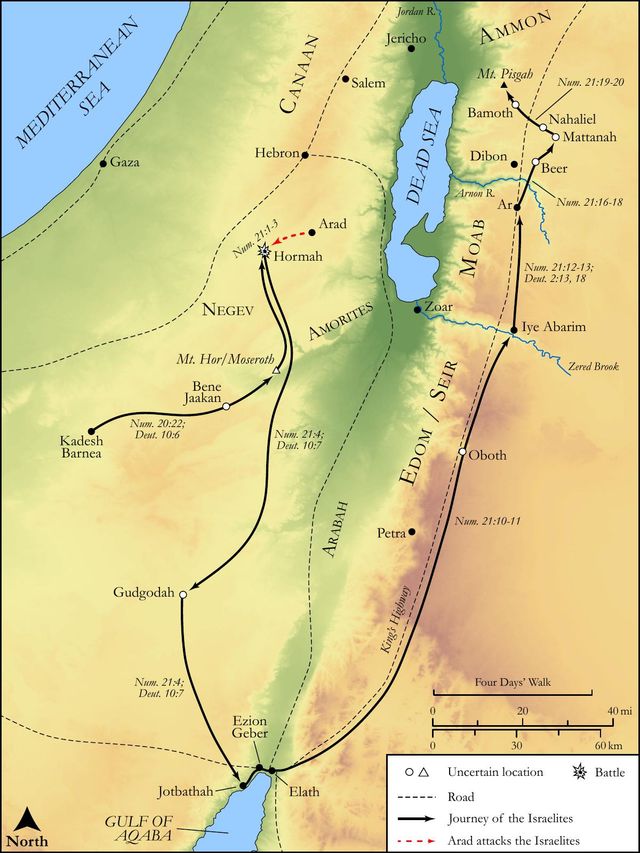
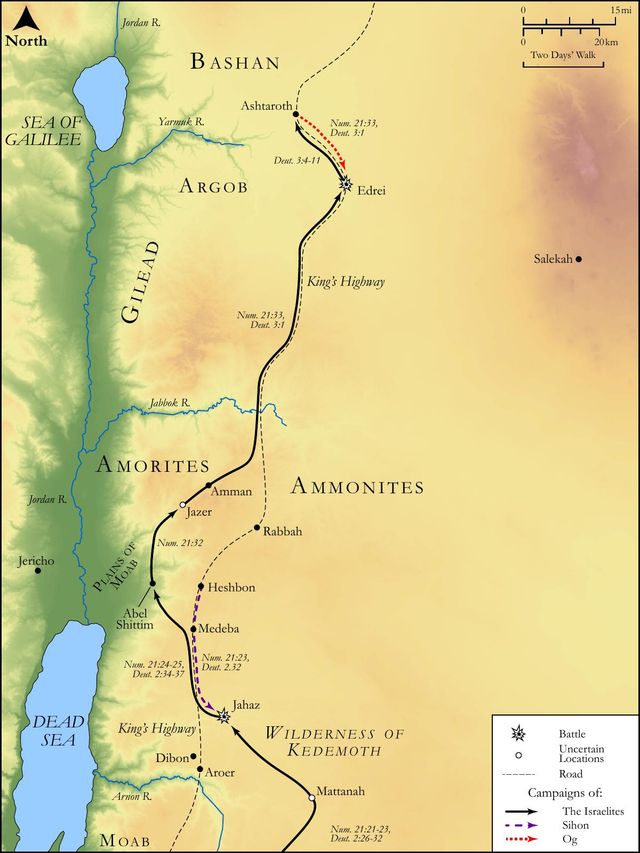
See on the biblical-era maps
Study this verse
Public-domain commentary
Matthew Henry
From his Commentary on the Whole Bible. Henry comments on passages, not single verses — this entry covers Deuteronomy 2:1–7. His three-level outline is real structure in the source text, so it is rendered as structure.
Here is, I. A short account of the long stay of Israel in the wilderness: We compassed Mount Seir many days, Deu 2:1. Nearly thirty-eight years they wandered in the deserts of Seir; probably in some of their rests they staid several years, and never stirred; God by this not only chastised them for their murmuring and unbelief, but, 1. Prepared them for Canaan, by humbling them for sin, teaching them to mortify their lusts, to follow God, and to comfort themselves in him. It is a work of time to make souls meet for heaven, and it must be done by a long train of exercises. 2. He prepared the Canaanites for destruction. All this time the measure of their iniquity was filling up; and, though it might have been improved by them as a space to repent in, it was abused by them to the hardening of their hearts. Now that the host of Israel was once repulsed, and after that was so long entangled and seemingly lost in the wilderness, they were secure, and thought the danger was over from that quarter, which would make the next attempt of Israel upon them the more dreadful.
II.Orders given them to turn towards Canaan.
Though God contend long, he will not contend for ever. Though Israel may be long kept waiting for deliverance or enlargement, it will come at last: The vision is for an appointed time, and at the end it shall speak, and not lie.
III.A charge given them not to annoy the Edomites.
1.They must not offer any hostility to them as enemies: Meddle not with them, Deu 2:4, Deu 2:5.
(1.)They must not improve the advantage they had against them, by the fright they would be put into upon Israel's approach: "They shall be afraid of you, knowing your strength and numbers, and the power of God engaged for you; but think not that, because their fears make them an easy prey, you may therefore prey upon them; no, take heed to yourselves." There is need of great caution and a strict government of our own spirits, to keep ourselves from injuring those against whom we have an advantage. Or this caution is given to the princes; they must not only not meddle with the Edomites themselves, but not permit any of the soldiers to meddle with them.
(2.)They must not avenge upon the Edomites the affront they gave them in refusing them passage through their country, Num 20:21. Thus, before God brought Israel to destroy their enemies in Canaan, he taught them to forgive their enemies in Edom.
(3.)They must not expect to have any part of their land given them for a possession: Mount Seir was already settled upon the Edomites, and they must not, under pretence of God's covenant and conduct, think to seize for themselves all they could lay hands on. Dominion is not founded in grace. God's Israel shall be well placed, but must not expect to be placed alone in the midst of the earth, Isa 5:8.
2.They must trade with them as neighbours, buy meat and water of them, and pay for what they bought, Deu 2:6. Religion must never be made a cloak for injustice. The reason given (Deu 2:7), is, "God hath blessed thee, and hitherto thou hast lacked nothing; and therefore," (1.) "Thou needest not beg; scorn to be beholden to Edomites, when thou hast a God all-sufficient to depend upon. Thou hast wherewithal to pay for what thou callest for (thanks to the divine blessing!); use therefore what thou hast, use it cheerfully, and do not sponge upon the Edomites." (2.) "Therefore thou must not steal. Thou hast experienced the care of the divine providence concerning thee, in confidence of which for the future, and in a firm belief of its sufficiency, never use any indirect methods for thy supply. Live by the faith and not by thy sword."
Continue studying Deuteronomy 2:3 across the web’s major study libraries — every link below opens this exact verse, chapter, or book on the destination site.
Read & Compare
 BibleGatewayThis verse in more than 200 translations and 70 languages.
 Bible.comThe YouVersion reader — hundreds of translations, reading plans, and highlights.
 ESV.orgCrossway's official English Standard Version reader.
 NET BibleThe NET translation with 60,000+ translators' notes on every rendering decision.
 STEP BibleTyndale House's free study tool — original text, vocabulary, and scholarly resources.
 BibliaLogos Bible Software's free web reader.
 USCCBThe New American Bible (Revised Edition) with the U.S. bishops' study notes.
Commentaries
 BibleHub CommentariesDozens of classic commentaries on this verse, gathered on one page.
 StudyLightMore than 100 commentary sets — the largest collection on the web.
 BibleRefPlain-English commentary on what this verse means, verse by verse.
 Enduring WordDavid Guzik's free commentary on this chapter, widely used by Bible teachers.
 Bible Study ToolsVerse commentary alongside Greek and Hebrew study aids.
Original Language & Research
- BibleHub InterlinearThe verse word by word — original language, transliteration, and English.
- BibleHub LexiconEvery word's original-language definition and Strong's entry.
 Blue Letter BibleDeep-study tools — Strong's numbers, concordance, and word studies.
 SefariaThe Hebrew text with Rashi and centuries of Jewish commentary.
Sermons, Hymns & Audio


TrulyRandomVerse is not affiliated with these sites and doesn’t control their content. They’re linked because they’re genuinely useful.
Summary
Deuteronomy 2:3 marks a pivotal divine declaration to the Israelites, signaling the definitive end of their nearly 38-year period of aimless wandering around Mount Seir. This prolonged sojourn was a direct consequence of the previous generation's unbelief and disobedience. The verse commands a precise and immediate change in direction, instructing the new generation to turn northward, thereby initiating their purposeful movement towards the long-promised land of Canaan and a new, obedient phase of God's redemptive plan for His people.
Context
ShowHideLiterary Context
This verse is situated within Moses' second major discourse in the book of Deuteronomy, a series of farewell sermons delivered to the new generation of Israelites on the plains of Moab, just before they are to enter the Promised Land. Moses is recounting the nation's history from the covenant at Horeb to their present location, emphasizing God's faithfulness despite Israel's past disobedience. Deuteronomy 2 specifically details the journey from Kadesh-Barnea, highlighting the long period of wandering in the wilderness, particularly around Mount Seir, the territory of Edom. The command in Deuteronomy 2:3 serves as a divine turning point, marking the conclusion of the judgment period for the rebellious generation and the beginning of the advance for the obedient one. It directly follows God's instruction to Israel not to provoke the Edomites, as their land was divinely given to Esau's descendants, a theme reiterated in Deuteronomy 2:4-5.
Historical & Cultural Context
For almost four decades, the Israelites had been living as nomads in the vast wilderness, a direct result of their rebellion and refusal to enter Canaan after the spies' negative report at Kadesh-Barnea (Numbers 14:33-35). The "mountain" referred to is Mount Seir, the mountainous region inhabited by the Edomites, descendants of Esau. God had specifically commanded Israel to avoid conflict with Edom, Moab, and Ammon, as these nations, though related, had been divinely allotted their own territories (Deuteronomy 2:4-9). The prolonged circling of Mount Seir signifies a period of divine discipline and patient waiting for the rebellious generation to die out. Culturally, this period would have instilled a deep sense of dependence on God for provision and direction, shaping the new generation's identity as a people utterly reliant on Yahweh, preparing them for the challenges of conquering and settling the Promised Land.
Key Themes
ShowHideDeuteronomy 2:3 encapsulates several profound themes foundational to the Deuteronomic narrative. Firstly, Divine Sovereignty and Timing: God, not Israel, dictates the duration of their wandering and the precise moment for advancement. His declaration "long enough" underscores His absolute control over seasons of discipline and progress, demonstrating that His plans unfold according to His perfect timetable. Secondly, Consequences of Disobedience and Divine Patience: The 38 years of circling were a direct consequence of the previous generation's unbelief at Kadesh-Barnea (Numbers 14:26-35), yet God patiently guided them through this period until His judgment was fulfilled. Thirdly, Transition and New Beginnings: The command to "turn you northward" marks a definitive shift from aimless wandering and judgment to purposeful movement and the imminent fulfillment of God's covenant promises. It signifies a fresh start for the new generation, called to embrace faith and obedience as they prepare to inherit the land (Deuteronomy 1:35-36).
Exposition and Analysis
ShowHideKey Word Analysis
ShowHideThis verb (H5437) means "to revolve, surround, or border." In this context, it powerfully conveys the repetitive, unproductive, and seemingly aimless nature of Israel's journey around Mount Seir. It implies a lack of forward progress, a state of being stuck in a cycle, which was a direct result of their previous disobedience. The word highlights the futility of their movement until God's timing for change arrived, emphasizing the disciplinary aspect of their wilderness experience.
This word (H7227) signifies "abundant" or "sufficient." When combined with the personal pronoun, "long enough" (literally "much for you" or "enough for you") is a divine declaration of sufficiency, indicating that the appointed time for their prolonged wandering has concluded. It marks the end of a specific season – a season of discipline, waiting, and the passing of the disobedient generation. This phrase underscores God's active involvement in their history, marking the precise moment for a new phase to begin according to His sovereign will.
This word (H6828) means "hidden" or "dark," used specifically of the north as a quarter (gloomy and unknown). In this context, it specifies a precise geographical direction. Geographically, turning northward from Mount Seir would lead them towards the Transjordan plateau, the King's Highway, and eventually to the plains of Moab, which was their staging ground for entering Canaan. Symbolically, this specific command represents a decisive and purposeful shift from aimless wandering towards a clear, God-ordained destination, signifying progress, divine guidance, and the imminent fulfillment of promises.
Verse Breakdown
ShowHide"Ye have compassed this mountain long enough:"
This clause addresses the new generation of Israelites, reminding them of the prolonged period of wandering that their fathers endured and that they, too, experienced. "Compassed this mountain" refers to their nearly 38 years of circling the territory around Mount Seir (Edom). The phrase "long enough" is God's authoritative declaration that this season of unproductive movement, a consequence of past rebellion, has reached its divinely appointed end. It signifies that the judgment on the previous generation has been fully executed, and the time for a new phase, marked by God's renewed favor and direction, has arrived.
"turn you northward."
This is a direct, imperative command from God, delivered through Moses. It signifies a decisive and immediate change in direction. From a state of aimless circling, Israel is now commanded to embark on a purposeful journey towards their inheritance. "Northward" is not just a geographical instruction but a symbolic call to leave behind the wilderness and its associated discipline, and to move forward in faith towards the land of promise, under God's renewed guidance and blessing. This command initiates the final leg of their journey towards the fulfillment of the Abrahamic covenant.
Literary Devices
ShowHideDeuteronomy 2:3 employs several powerful literary devices to convey its profound message. The phrase "Ye have compassed this mountain long enough" functions as a Metaphor for spiritual stagnation, the consequences of disobedience, and a period of divine discipline. The physical circling around Mount Seir symbolizes the unproductive and disciplined period of wandering. The entire verse is a direct Divine Command, highlighting God's absolute authority and His active, sovereign role in guiding His people's journey. It serves as a narrative Turning Point, marking a significant transition from a period of judgment and aimless wandering to one of purposeful advancement towards the Promised Land. The specificity of "northward" provides a concrete, directional Symbolism, representing not just a geographical shift but a definitive move towards destiny, the fulfillment of divine promises, and a new era of obedience and blessing.
Theological and Thematic Connections
ShowHideDeuteronomy 2:3 powerfully illustrates God's sovereignty over time and His unwavering faithfulness to His covenant, even amidst human failure. It reveals that while God justly disciplines His people for disobedience, His patience endures, and He ultimately brings about His purposes according to His perfect timing. The "long enough" declaration underscores that divine judgment has a prescribed duration, and once its purpose is fulfilled, God initiates a new season of grace and advancement. This principle applies not only to national Israel but also to individual believers, demonstrating that God does not intend for His people to remain indefinitely in cycles of stagnation or consequence, but calls them to repent, learn, and move forward in His will. It speaks to the importance of recognizing God's timing and being prepared to obey His call to new directions, trusting in His redemptive plan.
Reflection and Application
ShowHideDeuteronomy 2:3 offers a profound spiritual lesson for believers today. Just as Israel experienced a season of unproductive circling due to past disobedience, we too can find ourselves stuck in spiritual ruts, repeating old mistakes, or lingering in periods of stagnation caused by unaddressed sin, fear, or unbelief. This verse serves as a divine wake-up call, reminding us that God has a dynamic purpose for our lives that goes beyond aimless wandering or dwelling on past failures. When God declares "long enough," it's an invitation to repentance, a call to leave behind old patterns of sin, fear, or unbelief, and to embrace a new, purposeful direction He is setting before us. It challenges us to be attuned to His voice, to discern His timing for transition, and to move forward in faith, trusting that His "northward" command always leads to greater fulfillment of His will and purpose for our lives. It encourages us to shed the burdens of past failures and step into the fresh opportunities and divine appointments He has prepared, embracing the journey of sanctification and growth.
Questions for Reflection
ShowHideFAQ
ShowHideWhy did Israel have to wander for so long around Mount Seir?
ShowHideThe prolonged wandering around Mount Seir, lasting nearly 38 years, was a direct consequence of the Israelites' rebellion and unbelief at Kadesh-Barnea. After the spies' negative report, the generation that came out of Egypt (except for Caleb and Joshua) refused to enter the Promised Land, provoking God's wrath. As a judgment, God declared that this entire generation would perish in the wilderness, and their children would wander for forty years, one year for each day the spies explored the land (Numbers 14:33-35). The circling of Mount Seir was part of this disciplinary period, a time of waiting for the rebellious generation to die out before the new generation could advance. It highlights God's justice in punishing sin, but also His patience and faithfulness in preserving a remnant and ultimately fulfilling His covenant promises through the next generation.
What is the significance of "northward"?
ShowHideGeographically, "northward" (צָפֹון, tsâphôwn) from Mount Seir would lead the Israelites towards the Transjordan plateau, where they could eventually access the King's Highway. This route would take them around the territories of Moab and Ammon, and ultimately to the plains of Moab, which served as their staging ground before crossing the Jordan River into Canaan. Symbolically, "northward" represents a decisive and purposeful change in direction. It signifies a move away from the aimless wandering and disciplinary period of the wilderness and towards the specific, God-ordained path leading to their inheritance. It's a divine command for focused, forward progress, indicating that the time for waiting and judgment is over, and the time for action and fulfillment of God's promises has begun.
Christ-Centered Fulfillment
ShowHideDeuteronomy 2:3, with its declaration of "long enough" and command to "turn you northward," finds profound Christ-centered fulfillment. The Israelites' wilderness wandering, a consequence of sin and unbelief, serves as a powerful foreshadowing of humanity's spiritual wandering and estrangement from God due to the Fall. Just as God declared an end to Israel's aimless circling, so in Christ, God declares an end to humanity's futile striving and condemnation under the law. Jesus is the ultimate "turning" point for humanity, the one who brings an end to the cycle of sin and death. Through His atoning sacrifice, He takes away the sin of the world (John 1:29), making a way for us to cease our spiritual "wandering" and enter into true rest and purpose. He is the "northward" direction, the true path to the Father (John 14:6), leading His people not to a physical land, but to an eternal inheritance and spiritual blessings in the heavenly places (Ephesians 1:3). In Christ, the period of judgment for those who believe is "long enough" and definitively over, as there is now no condemnation for those who are in Him (Romans 8:1). He guides us from a life of aimless wandering in sin to a purposeful journey of discipleship, leading us ultimately to the promised new heavens and new earth (Revelation 21:1) and eternal communion with God.