


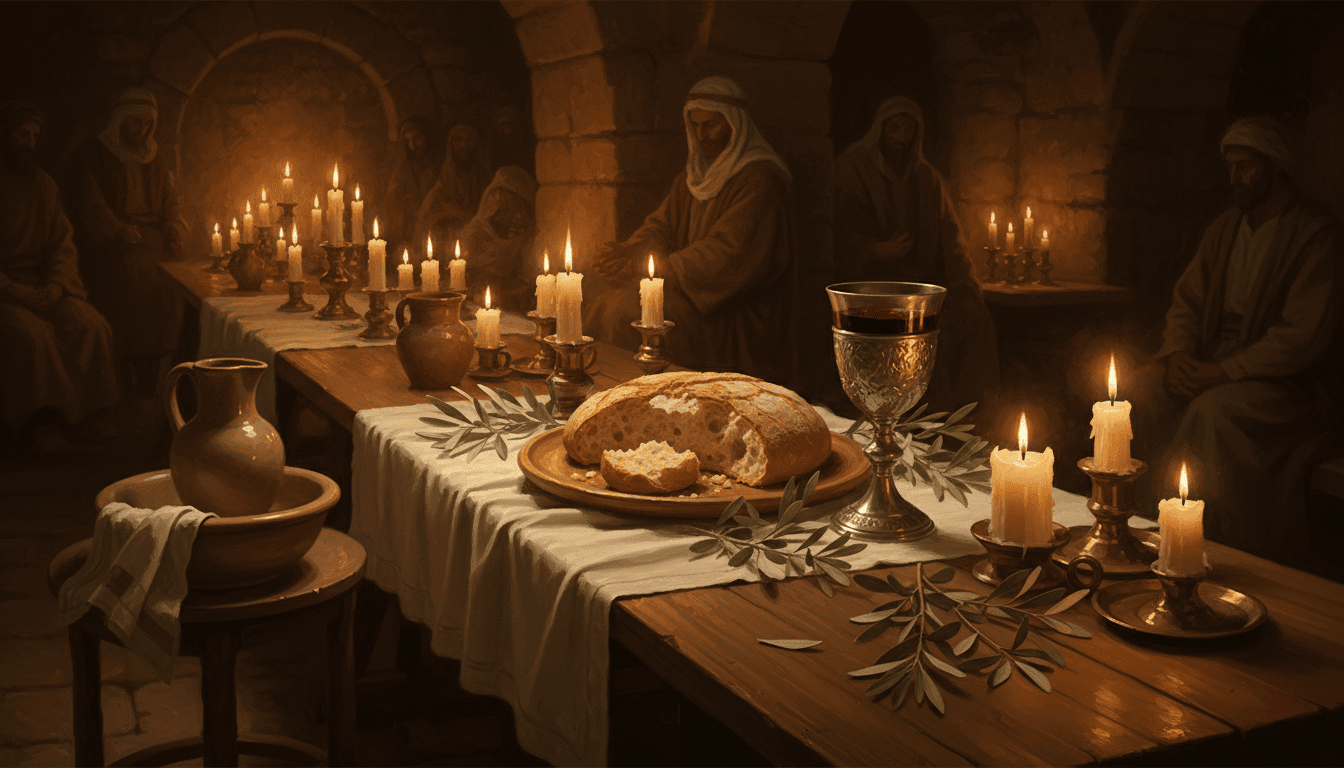
Maundy ThursdayThe Last Supper
Introduction
Maundy Thursday commemorates the Last Supper, when Jesus gathered with his disciples on the night before his crucifixion to celebrate the Passover meal. During this intimate gathering, Jesus instituted the Lord's Supper, washed his disciples' feet, and gave them a new commandment to love one another. The word "Maundy" comes from the Latin mandatum, meaning "commandment," referring to Jesus's command to love. This sacred evening reveals Christ's servant heart, establishes the memorial meal that would unite his church through the ages, and teaches humility, betrayal, and sacrificial love—one of the most poignant moments in the Gospel narrative.
The Passover Context
The Last Supper took place during the Passover celebration, Israel's most important feast. Passover commemorated God's deliverance of Israel from Egyptian slavery, when the blood of a lamb protected each household from the angel of death. Jesus deliberately chose this feast to institute the new covenant meal, revealing that he himself was the ultimate Passover Lamb.
And the blood shall be to you for a token upon the houses where ye are: and when I see the blood, I will pass over you, and the plague shall not be upon you to destroy you, when I smite the land of Egypt.
Exodus 12:13
KJV
On the first day of Unleavened Bread, when the Passover lamb was sacrificed, the disciples asked Jesus where he wanted them to prepare the Passover meal. Jesus sent two disciples into the city, instructing them to follow a man carrying a jar of water. They were to tell the master of the house, "The Teacher says, Where is my guest room, where I may eat the Passover with my disciples?"
And the first day of unleavened bread, when they killed the passover, his disciples said unto him, Where wilt thou that we go and prepare that thou mayest eat the passover? And he sendeth forth two of his disciples, and saith unto them, Go ye into the city, and there shall meet you a man bearing a pitcher of water: follow him. And wheresoever he shall go in, say ye to the goodman of the house, The Master saith, Where is the guestchamber, where I shall eat the passover with my disciples?
Mark 14:12-14
KJV
Everything happened exactly as Jesus predicted. The disciples found the room, prepared the Passover, and when evening came, Jesus reclined at table with the twelve. This final meal together would become the most significant supper in history, establishing a memorial that Christians would observe until Christ's return.
Jesus Washes the Disciples' Feet
Before the meal, Jesus rose from the table, laid aside his outer garments, wrapped a towel around his waist, poured water into a basin, and began to wash the disciples' feet. This was the work of a servant, not a master. Yet Jesus, knowing that the Father had given all things into his hands and that he had come from God and was going back to God, humbled himself to perform this menial task.
Jesus knowing that the Father had given all things into his hands, and that he was come from God, and went to God; He riseth from supper, and laid aside his garments; and took a towel, and girded himself. After that he poureth water into a bason, and began to wash the disciples' feet, and to wipe them with the towel wherewith he was girded.
John 13:3-5
KJV
Peter initially objected, declaring, "Thou shalt never wash my feet." But Jesus replied, "If I wash thee not, thou hast no part with me." Peter then asked for his hands and head to be washed as well. Jesus explained, "He that is washed needeth not save to wash his feet, but is clean every whit: and ye are clean, but not all"—a reference to Judas, the betrayer.
Peter saith unto him, Thou shalt never wash my feet. Jesus answered him, If I wash thee not, thou hast no part with me. Simon Peter saith unto him, Lord, not my feet only, but also my hands and my head. Jesus saith to him, He that is washed needeth not save to wash his feet, but is clean every whit: and ye are clean, but not all.
John 13:8-10
KJV
After washing their feet, Jesus explained the significance of his action. "Ye call me Master and Lord: and ye say well; for so I am. If I then, your Lord and Master, have washed your feet; ye also ought to wash one another's feet. For I have given you an example, that ye should do as I have done to you." True greatness in God's kingdom is expressed through humble service.
Ye call me Master and Lord: and ye say well; for so I am. If I then, your Lord and Master, have washed your feet; ye also ought to wash one another's feet. For I have given you an example, that ye should do as I have done to you.
John 13:13-15
KJV
This enacted lesson directly contradicted the disciples' recent dispute about which of them was the greatest. Jesus taught that the greatest among them should become as the youngest, and the leader as one who serves. "I am among you as the one who serves," Jesus declared, modeling the servant leadership he demanded of his followers.
And there was also a strife among them, which of them should be accounted the greatest. And he said unto them, The kings of the Gentiles exercise lordship over them; and they that exercise authority upon them are called benefactors. But ye shall not be so: but he that is greatest among you, let him be as the younger; and he that is chief, as he that doth serve. For whether is greater, he that sitteth at meat, or he that serveth? is not he that sitteth at meat? but I am among you as he that serveth.
Luke 22:24-27
KJV
The Betrayal Foretold
During the meal, Jesus became troubled in spirit and testified, "Verily, verily, I say unto you, that one of you shall betray me." The disciples looked at one another, uncertain of whom he spoke. Peter motioned to John, who was reclining next to Jesus, to ask who it was. When John asked, Jesus answered, "He it is, to whom I shall give a sop, when I have dipped it." Then he gave the bread to Judas Iscariot.
When Jesus had thus said, he was troubled in spirit, and testified, and said, Verily, verily, I say unto you, that one of you shall betray me. Then the disciples looked one on another, doubting of whom he spake. Now there was leaning on Jesus' bosom one of his disciples, whom Jesus loved. Simon Peter therefore beckoned to him, that he should ask who it should be of whom he spake. He then lying on Jesus' breast saith unto him, Lord, who is it? Jesus answered, He it is, to whom I shall give a sop, when I have dipped it. And when he had dipped the sop, he gave it to Judas Iscariot, the son of Simon.
John 13:21-26
KJV
After receiving the bread, Satan entered into Judas. Jesus told him, "That thou doest, do quickly." None of the other disciples understood what was happening. Some thought Jesus was instructing Judas to buy provisions for the feast or to give something to the poor. Judas immediately went out into the night, departing to betray his Master.
And after the sop Satan entered into him. Then said Jesus unto him, That thou doest, do quickly. Now no man at the table knew for what intent he spake this unto him. For some of them thought, because Judas had the bag, that Jesus had said unto him, Buy those things that we have need of against the feast; or, that he should give something to the poor. He then having received the sop went immediately out: and it was night.
John 13:27-30
KJV
Jesus had known from the beginning who would betray him. He chose Judas as one of the twelve, fully aware of his eventual treachery, so that Scripture might be fulfilled: "He who ate my bread has lifted his heel against me." Yet Judas bore full responsibility for his betrayal. Jesus pronounced a terrible woe upon him: "It had been good for that man if he had not been born."
Yea, mine own familiar friend, in whom I trusted, which did eat of my bread, hath lifted up his heel against me.
Psalms 41:9
KJV
The Son of man goeth as it is written of him: but woe unto that man by whom the Son of man is betrayed! it had been good for that man if he had not been born.
Matthew 26:24
KJV
The Institution of the Lord's Supper
As they were eating, Jesus took bread, and after blessing it, broke it and gave it to the disciples, saying, "Take, eat; this is my body." Then he took a cup, and when he had given thanks, he gave it to them, saying, "Drink of it, all of you, for this is my blood of the covenant, which is poured out for many for the forgiveness of sins."
And as they were eating, Jesus took bread, and blessed it, and brake it, and gave it to the disciples, and said, Take, eat; this is my body. And he took the cup, and gave thanks, and gave it to them, saying, Drink ye all of it; For this is my blood of the new testament, which is shed for many for the remission of sins.
Matthew 26:26-28
KJV
Paul records Jesus's additional words: "This is my body, which is broken for you: this do in remembrance of me. After the same manner also he took the cup, when he had supped, saying, This cup is the new testament in my blood: this do ye, as oft as ye drink it, in remembrance of me." Every time believers partake of the Lord's Supper, they proclaim the Lord's death until he comes.
And when he had given thanks, he brake it, and said, Take, eat: this is my body, which is broken for you: this do in remembrance of me. After the same manner also he took the cup, when he had supped, saying, This cup is the new testament in my blood: this do ye, as oft as ye drink it, in remembrance of me. For as often as ye eat this bread, and drink this cup, ye do shew the Lord's death till he come.
The bread and cup represent Christ's broken body and shed blood, the basis of the new covenant. Just as the Passover meal commemorated Israel's deliverance from Egypt, the Lord's Supper commemorates our deliverance from sin through Christ's sacrifice. Jesus is the Lamb of God who takes away the sin of the world, the fulfillment of every Passover lamb slain throughout Israel's history.
The next day John seeth Jesus coming unto him, and saith, Behold the Lamb of God, which taketh away the sin of the world.
John 1:29
KJV
Jesus declared that he would not drink of the fruit of the vine again until he drank it new in the kingdom of God. The Lord's Supper looks both backward to the cross and forward to the marriage supper of the Lamb. It is a memorial of Christ's death and an anticipation of his return.
Verily I say unto you, I will drink no more of the fruit of the vine, until that day that I drink it new in the kingdom of God.
Mark 14:25
KJV
The New Commandment
After Judas departed, Jesus gave his disciples a new commandment: "Love one another; as I have loved you, that ye also love one another. By this shall all men know that ye are my disciples, if ye have love one to another." This command was "new" not because love was previously unknown, but because it was grounded in a new standard: Christ's own sacrificial love.
A new commandment I give unto you, That ye love one another; as I have loved you, that ye also love one another. By this shall all men know that ye are my disciples, if ye have love one to another.
John 13:34-35
KJV
Jesus demonstrated the full extent of this love just hours later on the cross. "Greater love hath no man than this, that a man lay down his life for his friends," Jesus would soon say. His love for his disciples was not mere sentiment but costly self-sacrifice. He loved them to the end, to the uttermost, to the point of death.
Greater love hath no man than this, that a man lay down his life for his friends.
John 15:13
KJV
John later wrote that we know love by this: Jesus laid down his life for us, and we ought to lay down our lives for one another. Christian love is not defined by cultural norms or personal feelings but by Christ's self-giving sacrifice. If God so loved us, we also ought to love one another.
Hereby perceive we the love of God, because he laid down his life for us: and we ought to lay down our lives for the brethren.
1 John 3:16
KJV
Beloved, if God so loved us, we ought also to love one another.
1 John 4:11
KJV
Peter's Denial Predicted
Peter declared, "Lord, why cannot I follow thee now? I will lay down my life for thy sake." Jesus answered, "Will you lay down your life for me? Truly, truly, I say to you, the rooster will not crow till you have denied me three times." Peter's self-confidence would soon crumble under the pressure of fear and self-preservation.
Peter said unto him, Lord, why cannot I follow thee now? I will lay down my life for thy sake. Jesus answered him, Wilt thou lay down thy life for my sake? Verily, verily, I say unto thee, The cock shall not crow, till thou hast denied me thrice.
John 13:37-38
KJV
Jesus warned Peter specifically: "Simon, Simon, behold, Satan demanded to have you, that he might sift you like wheat, but I have prayed for you that your faith may not fail. And when you have turned again, strengthen your brothers." Jesus foresaw both Peter's denial and his restoration. Peter would fall, but he would not ultimately fall away, because Jesus interceded for him.
And the Lord said, Simon, Simon, behold, Satan hath desired to have you, that he may sift you as wheat: But I have prayed for thee, that thy faith fail not: and when thou art converted, strengthen thy brethren.
Luke 22:31-32
KJV
Jesus's Farewell Discourse
The Last Supper led into Jesus's extended farewell discourse recorded in John 14-17. He comforted his troubled disciples with promises: "Let not your heart be troubled: ye believe in God, believe also in me. In my Father's house are many mansions: if it were not so, I would have told you. I go to prepare a place for you." Though he was leaving, he would return to bring them to be with him forever.
Let not your heart be troubled: ye believe in God, believe also in me. In my Father's house are many mansions: if it were not so, I would have told you. I go to prepare a place for you. And if I go and prepare a place for you, I will come again, and receive you unto myself; that where I am, there ye may be also.
John 14:1-3
KJV
Jesus promised to send the Holy Spirit, the Helper who would dwell with them forever, teach them all things, and remind them of everything Jesus had said. He gave them peace—not as the world gives, but his own peace that transcends understanding. He was the true vine, and they were the branches; apart from him they could do nothing.
But the Comforter, which is the Holy Ghost, whom the Father will send in my name, he shall teach you all things, and bring all things to your remembrance, whatsoever I have said unto you.
John 14:26
KJV
I am the vine, ye are the branches: He that abideth in me, and I in him, the same bringeth forth much fruit: for without me ye can do nothing.
John 15:5
KJV
Jesus's high priestly prayer in John 17 followed, interceding for his disciples and for all who would believe through their message. He prayed for their protection, sanctification, and unity, that they might be one as he and the Father are one. This prayer reveals Christ's heart for his church.
Neither pray I for these alone, but for them also which shall believe on me through their word; That they all may be one; as thou, Father, art in me, and I in thee, that they also may be one in us: that the world may believe that thou hast sent me.
John 17:20-21
KJV
Conclusion: Remembering Until He Comes
Maundy Thursday calls us to remember. We remember Christ's humility in washing feet, his institution of the memorial supper, his new commandment to love, and his impending sacrifice. Every time we gather at the Lord's table, we proclaim his death until he comes, feeding on him by faith and experiencing communion with him and with one another. Maundy Thursday reminds us that following Jesus means embracing the way of the cross, serving one another in love, and trusting in his finished work. As we partake of the bread and cup, we renew our covenant commitment to the One who gave his body and shed his blood to purchase our redemption.